Pick of the Brown Bag
February 26, 2020
by
Ray Tate
Welcome to the Pick of the Brown Bag. In this blog, I, Ray Tate give you my thoughts and feelings about the past week's comic books. This includes Amethyst, Ant-Man, Batgirl, Detective Comics, Grimm Noir, Heathen, Hidden Society, Red Hood and the Outlaws, Red Sonja and Vampirella Meet Betty and Veronica and Wonder Woman. You can also find these reviews as quick and dirty sentences on Twitter: #PickoftheBrownBag.

Vampirella and Red Sonja attempted to save Betty and Veronica from Vampirella's blood thirsty sister Draculina. The blonde alien vampire attempted to flee with the Riverdale teens through a portal to the dying planet of Drakulon. Unfortunately, those pesky laws of time sent V and Sonja back to the 1970s where Dan Parent is king or Archie Comics cartoony style.

Because Parent isn't trying to be realistic as illustrator Maria Sanapo from previous issues, the ladies look even sexier. Writer Amy Chu also intensifies the burlesque with nods to horror and exploitation. For example, at the drive-in, the real movie Blacula unspools.

The vampire attacks are remarkably gory. The seventies fashions designed to show more skin. Parent's cartooning makes this all palatable. His art basically transforms the mood like hokey special effects. If Alice were murdered in a more realistic fashion but with the same amount of gore and terror, it might have been too much. As Parent presents it, she's still very dead, but we can move beyond her to a strange moment when Sonja enters the Heart of Darkness and she appears to be singling out Riverdale's boy genius Dilton for potential future snuggling. Lucky Dilton.

Tormented by a misogynist culture, the Viking girl Aydis either had to marry or die because she kissed a girl. Instead, her father took her out to the woods and murdered her with his bare hands. Nah. Aydis' Dad was a forward thinking, loving father. He just wanted to get his daughter away from those lunatics. Aydis freed the legendary Brynhilde from the Ring of Fire not to bind her to her bed but to simply show the people that the gods can be defied. Alas, there's consequences.

The fellows are Trolls and something Aydis cannot fight, but as Natasha Alterici's and Ashley Wood's story progresses, we see that the Trolls are victims of Odin's wrath as well. This was a very tricky story. Aydis reasons with the Trolls, but she's still their prisoner. She despises what Odin's done to the Trolls, and she has a plan of rescue in mind. I don't really want to give the story away, but genuine sweetness abounds in the tale and makes for a fitting return to the comic book racks.

The new title Hidden Society reminds me of the opening of Dungeons and Dragons where the Dugeonmaster renames Hank, Eric, Diana, Presto, Sheila and Bobby. Each member of the Hidden Society on the cover gets an intro and a scene to introduce themselves to the audience/reader. Instead of a Dungeonmaster, we get Ulloo the Wizard.

Who looks, acts and sounds like a Hanna-Barbera Arabian Knight. This should not be construed as a minus. Laura, the blind girl, who commands a cigar-smoking goat-genie is the most original of the creations.
The boy magician reminds me of Johnny Quest's Hadji. Even if he doesn't have the turban and Prince Turhan also from The Arabian Knights, but the crowd pleaser is without a doubt Lucy Lawless as Mercy.

Hidden Society is mostly harmless. An undemanding, entertaining episodic gathering of eagles that's given import by clean and beautiful art from American Vampire's Rafael Albuquerque.

Amethyst returns as she’s wont to do. This time, with Amy Reeder at the helm of story and art. For those who don’t know Amethyst, Reeder gives you a crash course.
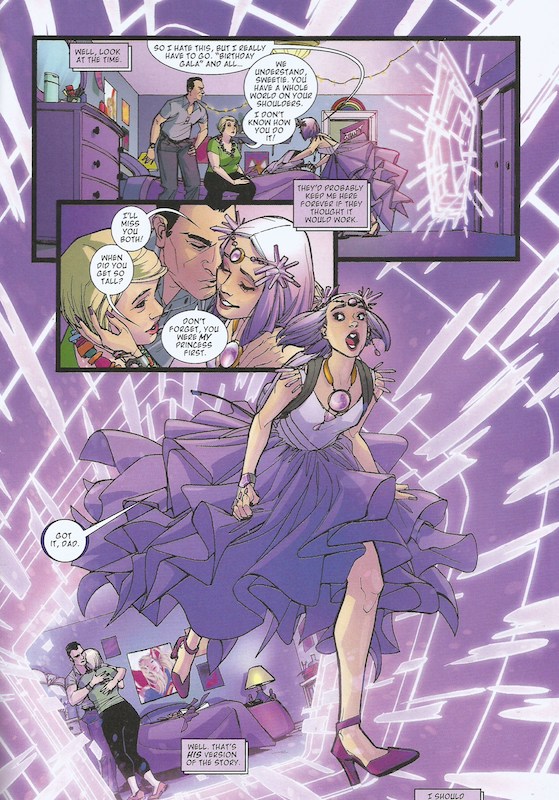
For those who want a more historical lesson. Amethyst began in the Bronze Age, created by Dan Mishkin, Gary Cohn and Ernie Colon. Though Amethyst seems ripe to be an outlier, her creators and the Powers That Be actually aligned her with the DCU. The Crisis on Infinite Earths affected she and Gem World. She met Superman, fought alongside Dr. Fate and battled Legion of Super-Heroes’ foe Mordru. Amethyst made the cut to the New 52, and this is the version of Amethyst that we see.

Amethyst returns to Gem World and finds it in ruin, her people gone. There’s a lot that going around these days.

She soon reunites with her winged horse, which was once a feathered unicorn but probably deemed too phallic and seeks to discover what happened. She goes to the former swashbuckling Lady Turquoise who now rules the Gem Realm of the same name.

Not exactly the help that she’s looking for, and for some reason, Reeder crossed Turquoise with a Thark. Amethyst takes her cause to the people, and thank goodness, the interesting looking one takes up the sword.

Amethyst serves as an excellent introduction to a surprisingly old character. Writer/artist Amy Reeder creates a new threat for Amethyst to fight and a new mystery to solve. The art is utterly gorgeous fusing science fiction pulp to fairy tale elegance.

Right from the start. You want to just light Batgirl afire. A whimpering Jason Bard spews our dialogue that echoes through time and space to its very coinage by the Venerable Bede. And even then it seemed old.

You may ask why is Batgirl fighting a dragon? Is it a cool homage to Tom King’s Batman doing the same? A bit early for that, but no. Batgirl is stuck in a poorly reiterated version of Dan Abnett’s Unearth from Titans.

As I said in the previous review Ernest Hinton, the bald fellow isn’t like this. He’s a harmless fantasy writer. So why is he trying to kill Batgirl, especially since by the rules of the new game he has his lady love, former publisher, Margaret? He has no motivation. But then he never did.


Then we find out not just love but also fear feeds the dragon. So fear and love feed the dragon. Logic would dictate a lack of emotion should starve it. Of course, Castellucci’s allegedly dramatic story doesn’t have the sensibility of Ghostbusters.
This whole thing appears to be Castellucci’s idiot attempt to redeem Jason Bard with an alleged love for Barbara Gordon.

Uh-Huh. That doesn’t make him less of an asshole. Need I remind you, Jason Bard sent Babs’ father to prison and attempted to kill Batman by blowing up the Batmobile. Jason Bard’s attraction to the hot redhead in the story just means he’s got eyes and a penis. Incidentally, he was attracted to his hot redheaded partner and Vicki Vale another hot redhead in Batman Eternal. The thing is Jason Bard gravitates toward hot redheads. They are his sexual preference.
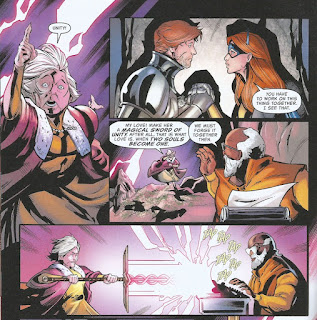
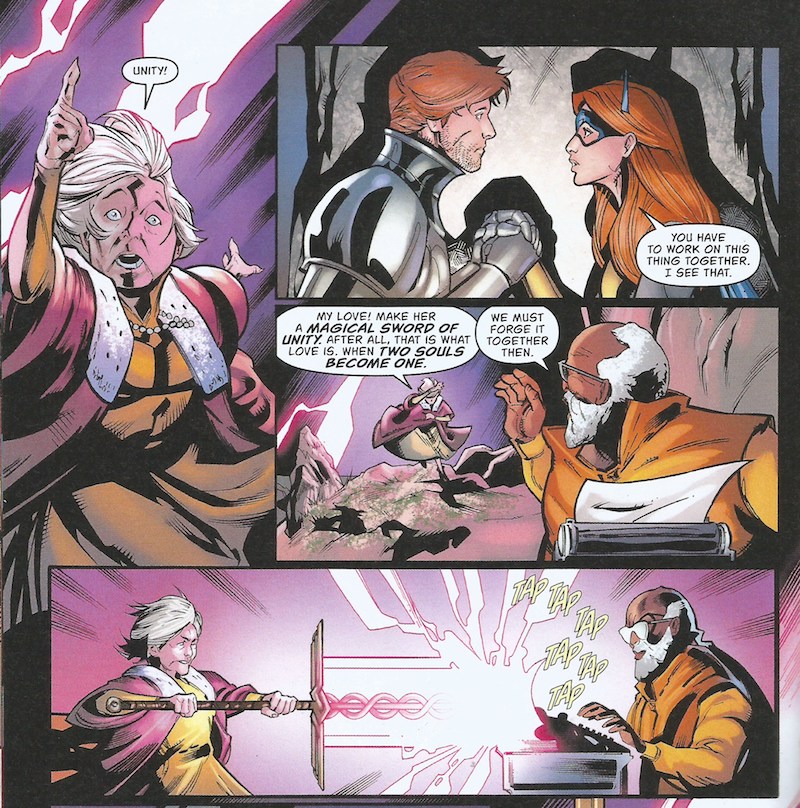
Unity? What the hell does that mean? That doesn’t even make sense because Bard doesn’t know who Batgirl is. Fine. Unity forges a giant sword that a Batgirl uses to fight the dragon with Jason.
Unity was the answer is all along. Then why...
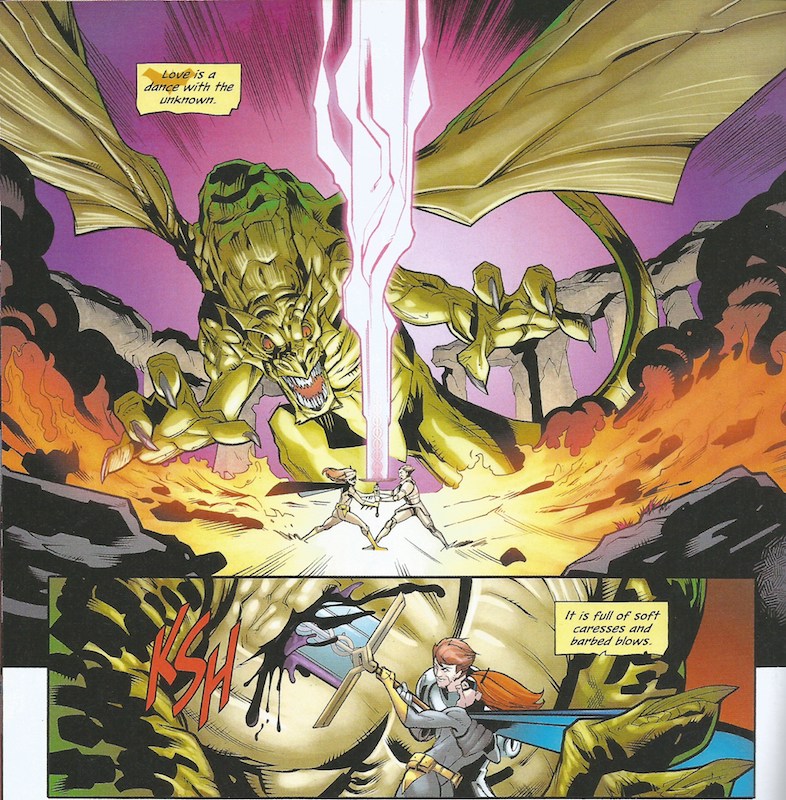
So it is love then? Is it unity or love? They’re not the same things. You can be unified in hatred. You can be unified with enemies for a common cause.


That’s not love. And you’re not Kirk.
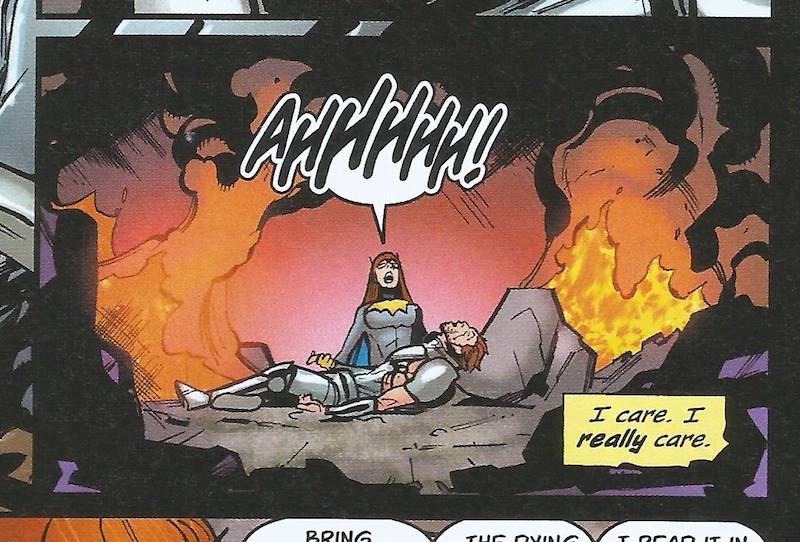
Can this get any fucking worse? Yes. Yes, it can. Castelllucci once again reinforces her idea that Ernest Hinton is malicious, and a Batgirl is blind.

You see. I am unified. That is. I have no doubt. It is my firm belief that Dan Abnett never meant for Ernest Hinton to be a sadistic son-of-a-bitch. It is my firm stance that Jason Bard, the New 52 version, is a right old bastard who will throw himself at any redhead. I never thought I'd miss the old Jason Bard. The square, but there you have it.

Red Hood and the Outlaws is mainly about Jason leading Artemis and Bizarro on a train heist.

You had me at train heist. You didn't have to include a weird death scene with former crime boss Suzi Su. You didn't have to spotlight a Brian Yuzna moment. You needn't have added a wtf character from the Giffin and DeMateis era of Justice League. You didn't need to leave me on a Doom Patrol cliffhanger, nor rope in that diminutive cameo. You didn't have to throw in some fun confusing stuff about the All-Caste or Isabella and Jason's dog. You had me at train heist.

You had me at train heist. You didn't have to include a weird death scene with former crime boss Suzi Su. You didn't have to spotlight a Brian Yuzna moment. You needn't have added a wtf character from the Giffin and DeMateis era of Justice League. You didn't need to leave me on a Doom Patrol cliffhanger, nor rope in that diminutive cameo. You didn't have to throw in some fun confusing stuff about the All-Caste or Isabella and Jason's dog. You had me at train heist.

So, if you guessed that Detective Comics is about Two-Face.

You're correct, sir and/or madam.

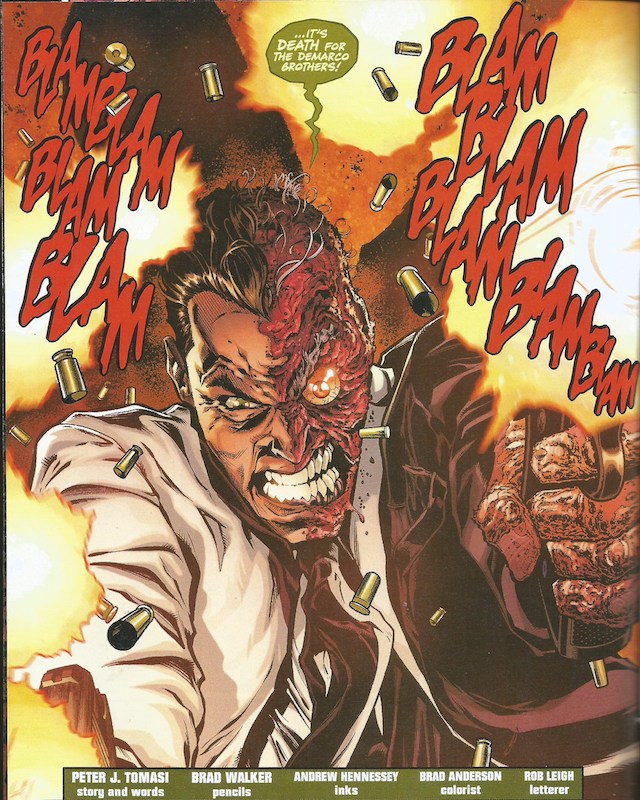
Detective Comics is indeed about Two-Face.
Batman's investigation into Two-Face's latest crime leads him to a new murder and some unsettling developments.

The answers to these questions adds an original facet to an already crowded visage.

You're correct, sir and/or madam.
Detective Comics is indeed about Two-Face.
Batman's investigation into Two-Face's latest crime leads him to a new murder and some unsettling developments.

The answers to these questions adds an original facet to an already crowded visage.

Valda is the Viking lover of Native American adventurer Arak. This affair occurred in the Bronze Age.

Valda debuts in the New 52 here in the pages of Wonder Woman. The story doesn't really go beyond a gorgeously illustrated fight between Wonder Woman and Valda before Steve Orlando once again captures the whole point of Wonder Woman and what Amazon loving submission means.

Once Valda and Wonder Woman talk things out, Diana realizes that Valda has good reason to wreck of the present day. This leads to the return of the Invisible Jet redesigned fantastically by artist Max Raynor.

If the rest of Wonder Woman was this good I would be happy, but Orland cannot help but trot out his Mary Sue of a character the brand new Paula Von Gunther.

I just hate this whole thing. Orlando tries to discretely detach Paula Von Gunther's name from the Nazis and fails miserably. If the Von Gunthers were using the Nazis to get at the Amazons, a woeful achievement, then why was her mom an inbred white supremacist hick?
If Orlando is trying to say something about how racists blind themselves with false flags and facade rationales, then why does Paula shuck the life Wonder Woman facilitated so readily once that idiot Leviathan shows up? Paula you see wasn't raised racist. Diana dropped her off to foster parents of good character. Paula in the current issue denies that her cretinous family were Nazis. It doesn't make any sense.

Ant-Man hired himself out to find the missing bees that absconded from a farm. His investigation leads him to fellow John Byrne creation Swarm. Swarm however isn't the bad guy. Still, his past Scott Lang will not and should not forget.

Zeb Wells' story is a blast from start to finish. Byrne created Swarm at the height of Bee-Mania. Africanized Honey Bees were going to sting us to death in several movies of the week, as well as in theaters. Killer Bees became a staple of Saturday Night Live. Byrne in one of his cheeriest moods combined this zeitgeist with Nazis and gave us Swarm.
Wells sends up Swarm with his own contributions to the insect man sub-genre.

I mean. If you thought he may be sincere with Vespa or even Tusk, Thread is a dead giveaway to a punchline. So, yeah. Ant-Man teams up with Swarm, unifies one may say to combat a bigger menace. Meanwhile, Cassie Lang's Mom disses Kate Bishop's West Coast Avengers in a completely Mom kind of way. You get laughs. You get dark humor. You get a Nazi Bee-Man who loves Scott Lang now.

Zeb Wells' story is a blast from start to finish. Byrne created Swarm at the height of Bee-Mania. Africanized Honey Bees were going to sting us to death in several movies of the week, as well as in theaters. Killer Bees became a staple of Saturday Night Live. Byrne in one of his cheeriest moods combined this zeitgeist with Nazis and gave us Swarm.
Wells sends up Swarm with his own contributions to the insect man sub-genre.

I mean. If you thought he may be sincere with Vespa or even Tusk, Thread is a dead giveaway to a punchline. So, yeah. Ant-Man teams up with Swarm, unifies one may say to combat a bigger menace. Meanwhile, Cassie Lang's Mom disses Kate Bishop's West Coast Avengers in a completely Mom kind of way. You get laughs. You get dark humor. You get a Nazi Bee-Man who loves Scott Lang now.

Grimm Noir. Look at that cover. How can you resist? The one-shot by Gerry Duggan casts the Thing as a hardboiled detective. You know he was inspired by Ben's usual stealth outfit of fedora and long coat, which artist Ron Garney takes great pleasure in fitting.

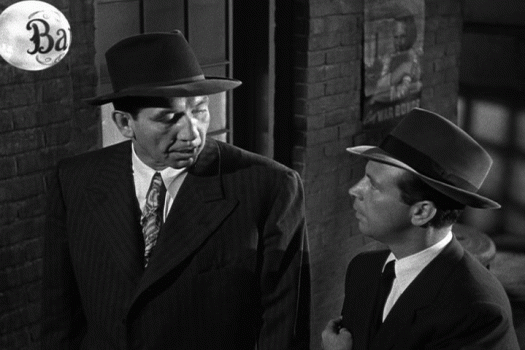
Grimm isn't just about rain-soaked streets and tough men meeting other tough men in two piece suits. Ben's nightmare which foreshadows the missing neighbor is very noir-driven and frequently overlaps imagery with such memorable cinema as Murder My Sweet.

Because this is not just a noir, where the protagonist acts as Alice and falls metaphorically into hell, Duggan cleverly makes Alicia Masters a forensic anthropologist who reconstructs the face from Ben Grimm's phantasm.
Thus, instead of a photograph, Ben actually carts around the statue to show potential witnesses. The fact that Duggan could slip in a 1940s styled opera singer into the mix is inspired.
The Phantom in this case is a loser villain from Marvel's past. I'll give you a tiny hint. He seemingly lost his life in the swamp. When Ben actually confronts the leader of this Dance Macabre, it's clobbering time. The noir falls to the wayside of a happy ending filled with FF action and optimism. That's really only how this story could have ended.

Grimm isn't just about rain-soaked streets and tough men meeting other tough men in two piece suits. Ben's nightmare which foreshadows the missing neighbor is very noir-driven and frequently overlaps imagery with such memorable cinema as Murder My Sweet.
Because this is not just a noir, where the protagonist acts as Alice and falls metaphorically into hell, Duggan cleverly makes Alicia Masters a forensic anthropologist who reconstructs the face from Ben Grimm's phantasm.
Thus, instead of a photograph, Ben actually carts around the statue to show potential witnesses. The fact that Duggan could slip in a 1940s styled opera singer into the mix is inspired.
The Phantom in this case is a loser villain from Marvel's past. I'll give you a tiny hint. He seemingly lost his life in the swamp. When Ben actually confronts the leader of this Dance Macabre, it's clobbering time. The noir falls to the wayside of a happy ending filled with FF action and optimism. That's really only how this story could have ended.


