Showing posts with label West Coast Avengers. Show all posts

Wednesday, April 24, 2019

POBB April 17, 2019

Pick of the Brown Bag
April 17, 2019
by
Ray Tate

I actually considered putting up a “gone fishing” sign in place of a full blog.  

The books this week were honestly pretty damn boring.  The exceptions being Miles Morales Spider-Man and James Bond.  

I’m going to give props to Fair Lady and Infinity 8 for at least being somewhat interesting if not arresting.  

This issue of West Coast Avengers was also the best chapter of the vampire story, but on the whole I didn’t like the vampire reveal.

In the meantime, if you haven’t the time for these fuller reviews.  Check me out on Twitter: #PickoftheBrownBag.


Aquaman is freaking gorgeous.  You make this an oversized art book and take out all the words, and I’ll buy it again.  Seriously.  

You’ve got Robson Rocha illustrating divine dragons, that I’m betting have nothing to do with Game of Thrones.

Oh how I wish the waters really were unspoken.  The dragon even gets better.  It trisects in an homage to Ghidorah.  


You’ve got a blue exotic lady with horns.  Oooo!  She’s sprouted wings too.


A whole pantheon of new watery deities swim to Aquaman’s side.

The least interesting thing about the book is the story itself.  Aquaman’s memory loss is unimportant.  His Aquaman powers allow him to score victory.  So, his amnesia is irrelevant.

Kelly Sue DeConnick’s external world-creation mythology and the Cailleach would actually work without Aquaman so long as Robson Rocha, Danielle Henriques and Sunny Cho illustrated.

One Knightmare too many in Batman.  This issue visually is a dance between Batman and Catwoman, and it’s a great showcase for Yanick Paquette.  


As Batman twirls Catwoman around, her costume changes to reflect the years they’ve been dancing together.  Trouble is it all seems too familiar.  

We’ve seen this before in past issues of Tom King’s Batman.  Those scenes were cool because the change in uniform was sudden and meaningful.  King reiterated Golden Age and Silver Age continuity and incorporated it back into the mythos.

Alongside the dance, King reveals the Big Bad behind Batman’s Knightmares.  It's a wtf type of revelation.  Let’s say you hypothetically want to prevent Bruce Wayne from being Batman, for his own good.  Okay.  So, precluding his happiness helps you how?  Trapping him in dreamland pushes your plans forward in what way?

Ultimately what you’re going to end up with is a seriously pissed off Batman whose rage is going to cut through your operations like a hot knife through butter.


Fairlady is a new book from Image that boasts to: contain a complete Fairlady mystery.”  Yes, and no.  It’s definitely self-contained.  It’s definitely a detective story involving a missing person.  


It’s not a fair-play mystery.  You cannot solve it.  The unfamiliar fantasy/science fiction setting precludes sleuthing.   Nevertheless.  This is an interesting book.  

It’s not a knock your socks off type.  It’s quiet and methodical because writer/co-creator Brian Schirmer is shooting for Raymond Chandler transposition.  


As is common with some private eye media, Schirmer begins the story somewhere near the end.  The tale drifts back to the beginning, introducing Jenner Faulds, presumably the Fairlady, and her partner Oanu, of the Jessu species.  

We won’t call him a feline since that’s apparently a touchy subject.  Faulds and Oanu interview contacts to trace leads.  This includes staples from the detective novel just in new forms.

When Faulds and Oanu eventually track down the missing embezzler, they find a transformation that also presents a weird mirror image to the genre. 

From beginning to end, Schirmer’s story is a clever reinterpretation of the tried and true.  Art by Claudia Balboni and Marissa Louise presents an art noveau tinged science fantasy pulp that’s always pleasing to the eye.


This can also be said of Infinity 8.  Artist Martyn Trystram spreads a plethora of aliens and odd humans across the Infinity 8.  

The story is somewhat the same as all of Infinity 8.  The alien captain can rewind time eight times.  The ship encountered and is encountering an alien debris field.  It just can’t escape from it.
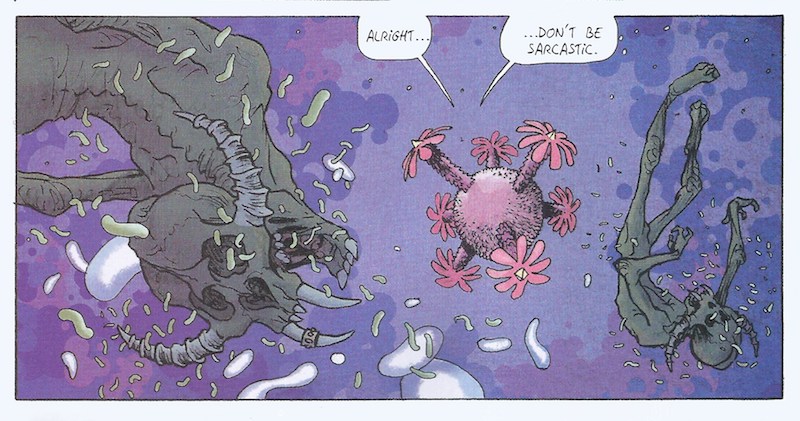
The first volume was straight up pulp with a sharp-witted, sharp-tongued protagonist.  The second added social and historical commentary, this time with a self-absorbed but effective agent.  I plainly did not enjoy the last volume of Infinity 8, “The Gospel According to Emma.”  The main character was a thoroughly unlikeable zealot/imbecile.  

Major Patty Zimmerman is far more agreeable, dedicated and honest.  

The Captain pulled her from undercover work in the Symbolic Guerrillas; what seems to be a benign musical group, entourage and fans, but may actually be a terrorist organization.


Writer Lewis Trondheim portrays Patty with a relishing single-mindedness, but that's only one side of Major Zimmerman.  When Patty discovers the secrets of the alien object, she reveals another facet to her personality.  

Patty can experience a sense of wonder.  Her awe is justified because although we see a myriad of species and outré alien formations, the elegance and idea behind the conclusion of the chapter defies expectation and presents beauty that’s instinctive. 


I’m trying to think of a reason why this Robert Downey Jr. moment is the only moment worth sharing.  My feeling is that Dan Slott just did too much in Iron Man.  His ambition got the better of him.  It started as a return match against a goofy villain who turned out to be just a little cleverer than first thought.  It became another Tony Stark fuck-up leading to sensory overload and way, way too many characters to keep track of. 

James Bond once again divides the story evenly between its star and new character John Lee, a Korean agent and the new Oddjob.  John seeks to free a fellow agent from the mind-controlling grip of the evil organization ORU.  This is good stuff all around.  Lee teams with Bond, but the Australian Secret Service capture James and and leave him in the clink.

Always fun when the hero’s captured by rival friendlies.  Love the smirk by artist Steven Mooney.  It’s so suitable.  As the story continues, M tasks Bond to kill Lee for his duplicity, but Bond’s not a good boy.


Considered and called a blunt instrument, Bond is anything but.  Bond frequently disobeys orders for the sake of justice.  He refuses to kill though so sanctioned.  He saves the girl at the cost of the mission numerous times.  He seeks revenge.  He threw away his suicide capsules long ago.  In this issue, Pak demonstrates why James Bond is a legend.


Nightwing should really be called Nightwings.  Red Hood crossed out and the Outlaws.  Though I do keep referring to the book that way.  In any case, the events in Batman bled over to Nightwing.  Dick Grayson no longer remembers his life, and he tried to stress the point by burning his gear and hideout.  

He didn’t succeed, and a trio of Bludhaven detectives and a firefighter friend took his costumes and his equipment to become…well, it’s obvious.  The Scarecrow showed up with a jones to kill Nightwing who he knows to be the original Robin.  However, Crane never glommed onto the fact that his amnesiac patient whom he genuinely helped was in fact his target.  Ric Grayson as he likes to call himself, joined the Nightwings and started to backslide into the hero business; albeit with a stupid look.


Yeah, baby!  Street clothes and grease on my face.  I mean come on.  This "disguise" is just dandy for an impromptu rescue of the Nightwings when they found themselves outmatched by Scarecrow, but this is your look?  At least wear a helmet or special shades for pity’s sake.  Ric’s basically Nightwing with a poorer dress sense and the cheapest mask possible.  

That said, this isn’t the worst book I’ve read from Dan Jurgens.  Ric gets some training from firefighter Nightwing Hutch, and much is made about this muscle memory which gives him preternatural acrobatic and fighting ability. 

On the other hand, why is he here? He’s supposed to be starting a new life with a pretty bartender he fell for, not reliving the old one.  Anyway, we get some background on Hutch and a new villain.  If that floats your boat, go for it.  Otherwise, skip.

Mary Shelley Monsterhunter was a real disappointment because Adam Glass in this first issue treads old history.  Mary and Percy Shelley with Lord Byron challenge each other to a horror-story writing contest.  Mary beats them hands down with her strange story Frankenstein.  This just needed to be more original.  Perhaps the forthcoming issues will break new ground.


This is my first normal issue of Miles Morales Spider-Man.  Last issue was a comedy homage to Ferris Bueller’s Day Off.  Here, we see Miles doing Spidey things, such as battle groups of warring gangs.


React to his Spider-Sense, crack-wise, web the crap out of bad guys and fight off eighties Spider-Man villain Tombstone, all energetically written by Saladin Ahmed and illustrated by Javier Garron.

Miles Morales is truly Spider-Man reinvented.  It’s the book for people who know the basics about Spider-Man and none of the astounding amount of continuity that Peter Parker amassed over the years.

That’s not to say that Miles is synonymous with young Peter.  Rather as in real life, we all share certain similarities and differences that unite us and distinguish us.  Reading Miles Morales is like reading updated original Spider-Man stories.  It's also different because Miles is different.  His friends are different.  His girlfriend is different.  He lacks an Aunt May, a J.Jonah Jameson.  He’s a student and a kid, not a photographer science genius.  He’s upbeat.  Most important.  He lacks the guilt that weighs down upon the original Spider-Man.  He’s the carefree Spidey just trying to be friendly and keeping his neighborhood safe.


Marvel Boy sought Kate Bishop to investigate a Skrull nest hidden behind a cult.  The trouble is they’re not Skrulls.  They’re vampires, and they think Miss America is the Chosen One.  As soon as West Coast Avengers revealed the vampire twist, I lost interest.  I don’t even know why vampires exist in the Marvel Universe.  Why they exist in any superhero universe.

DC uncharacteristically explained the lack of vampires in its Post-Crisis universe by publishing a John Byrne/Chris Claremont Justice League story called “The Tenth Circle.”  Basically, the answer is the Justice League destroyed them.  Anyway.  Marvel’s got vampires, and West Coast Avengers is lousy with them leading me to a question involving the outing of a half-vampire character.  

What exactly is a half-vampire?  That doesn’t even make sense.  You either are a vampire or you’re not.  You’ve been inflicted or not.  Vampires are make believe, and you can write your own rules, but I just don’t see how half-vampires can work.  

Vampires are undead monsters that drain you or turn you into them.  No, I don’t get Blade either.  So don’t even.  Angel and Spike from Buffy the Vampire Slayer are human souls piloting vampire husks.  They’re not half-vampire in any sense.  When Angel drank Buffy’s blood to supercharge himself for a coming battle, Buffy didn’t become half-vampire.  She stayed Buffy, stayed Slayer because Angel didn’t turn her. 

Vampires used to be impotent; their fangs stood in for their privates, but over the years, that paradigm changed.  So let’s assume that a vampire impregnated a lady. Her offspring could be half-vampire, I guess, yet it still doesn’t make sense unless the vampire was alive to begin with.  Morbius for example, the living vampire could in theory sire a half-vampire.  You can’t just become one is what I’m saying.


Tuesday, February 5, 2019

POBB January 30, 2019

Pick of the Brown Bag
January 30, 2019
by
Ray Tate

The Pick of the Brown Bag returns with all new reviews of Batgirl, Detective Comics, James Bond, the Lone Ranger, Scooby-Doo, The Shape of Elvira, Unstoppable Wasp and West Coast Avengers.  It’s actually a pretty short POBB this week, but if you haven’t the time, you still have the option of even teensier reviews on Twitter: #PickoftheBrownBag.


Greg Pak’s and Marc Laming’s crack at James Bond introduced John Lee.  Perhaps the descendent of the classic Bond villain from novel and movie.  


SIS or if you prefer MI-6 tasks Bond with the surveillance and termination of a courier.  John Lee interferes.  Some remarkable fights break out between Lee and Bond.  They also engage in an exciting speedboat chase.  


The Courier gets away and a villainous player steps onto the stage.  In addition, we learn that Lee knows something James Bond does not.  Killing the courier will set off a bomb in the McGuffin, a briefcase.

This issue of James Bond opens with M and his South Korean counterpart conducting diplomacy.  


South Korea is a western ally.  So, it’s certainly plausible that headway can be made.  Especially since Mr. Park confirms John Lee’s intelligence associated with the case.  While the parlay occurs James Bond follows his own agenda.


Bond hopes his stunt ferrets out Mr. Lee while he hunts down the courier and the case to what appears to be a legitimate military base situated in Australia.


If it were simply a mercenary installation, the guard would have greeted James with a hail of bullets or at the very least, gun raised.  Infiltrating the base, Bond discovers two surprises.

Naturally, Lee’s presence and Bond’s stubbornness institute another duel and another draw.  With Lee in the wind, Bond resumes his primary mission.  


Incidentally, while Bond engages Lee and the unfriendly agency behind the courier and the case, Moneypenny serves as Bond’s handler.  Her voice reverberates continuously through his ears.  She adds reason and contrast.  Most of all Moneypenny builds on the already impressive entertainment value of James Bond.

Once Bond infiltrates the site.  Things grow dicier.  The female villain introduced last issue demonstrates uncanny skill.  Park furthermore grants Luka the until now nameless courier a little dignity. 


The villain's organization ORU is a fabrication, but Pak grants his fictional terror cell weight by connecting them to the 2004 train bombings in Madrid.  It’s an excellent idea especially given the uncertainty.  Hopefully, Pak will detail ORU's precise goals.   World domination? Power through world destabilization? Simple greed?

When the smoke clears, Bond and Lee ready themselves to resume their fight.  The geopolitical reality of their two firms precludes their grudge-match, and the chapter finishes with strong imagery and a potent cliffhanger.


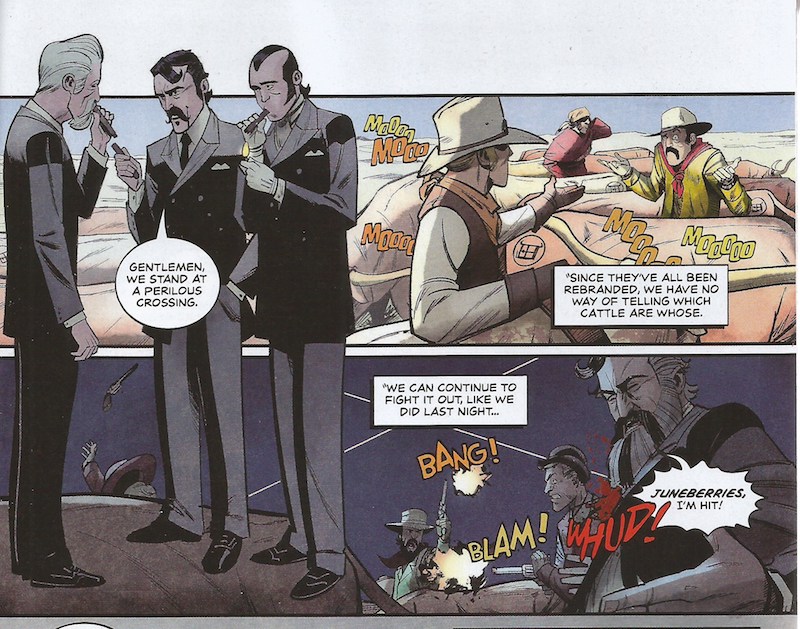
Greedy ranchers began to barbwire territory claimed after stepping over the bodies of the rightful property holders.  At first the Lone Ranger sought a lawful means to end this bloodshed.  Alas, the savage ways of the Texan robber barons thwarted his efforts.  So, he begged Tonto to rejoin his pursuit of justice.  Together, they became wilier, and last issue the duo arranged for their enemies to diminish their own ranks.

Clearly the Lone Ranger and Tonto far outmatch the cadre of ranchers taking part in this naked land grab.  So, the leader of the pack contacts an outlier to end the Ranger’s and Tonto’s threat.

Connor isn’t like any of your ordinary hired-hands.  He’s a predator of extraordinary caliber.  A man changed by his experiences at the true life prison Camp Douglas.  

There’s no real reason to include the history of Camp Douglas in The Lone Ranger, but writer Mark Russell’s depiction is one-sided.  Readers should check out the before and after picture of history.

The battle between Tonto and Connor is a pivotal moment in this chapter of The Lone Ranger.  For once, Tonto seems to find a worthy opponent.  The Ranger appears outgunned. Have the horrors of the west caught up with our heroes? More than most, writer Mark Russell an Bob Q replicate the feeling of a serial that leaves you hanging until the next issue.

With its depiction of gang intimidation, this issue of Scooby-Doo Team-Up is one of the most mature.  


Oh, it’s still good for kids.  It just dips a little more into reality than most.  The plot also has nothing to do with cracked real-estate schemes.  

I liken the tone to Scooby and the Gang’s team-up with Black Lightning to their time-travel encounter with the Justice Society. 


The gang give a talk to Jefferson Pierce’s students about their exploits and stumble onto a ghostly challenge between old time gangsters and Tobias Whale’s The 100.


When Tobias does show up, the superb artist Dario Brizuella departs from the Bronze Age model and pulls more from Black Lightning actor Marvin Jones III.


In addition to a Tobias Whale/Black Lightning battle and a superb rationale behind the hauntings, Sholly Fisch also includes Black Lightning’s mentor Peter Gambi in the adventure.


Gambi's presence gives Brizuella the opportunity to have some fun with the fashions of the nineteen seventies.  This is less frivolous than you might think.  Fisch's plot twist actually anticipates a naturally evolving development that would have hampered the done-in-one nature of Scooby-Doo Team-Up.  That story element furthermore is one of the things that make this issue thematically different.


Detective Comics presents a terrific trap from which Batman and his escapologist teacher Thaddeus Brown, the original Mister Miracle must extricate themselves.  


Peter Tomasi demonstrates that Tom King isn’t the only Batman writer with an extensive memory of Batman history.  He employs one of Batman’s utile costume accessories from the Bronze Age to facilitate his and Brown’s freedom.


The culprit behind this and prior attacks on Batman’s past remains anybody’s guess.  The thing from last issue returns, and I still have no idea why its significant.  It’s certainly not intelligent enough to prepare these devices, and I think it mainly exists to give something Batman to punch.


In her first story, Mairghread Scott acknowledged the damage done to Babs’ physicality and mentality after the Joker crippled her.  This tale reads as if Batgirl never experienced a particularly nasty interruption in her adventures.  She sounds like herself.  She behaves like herself.  She fights crime like herself.  


With Paul Pelletier on hand, Batgirl becomes a powerhouse of martial prowess and an exemplar of female anatomy in violent motion.  


Pelletier enjoyed embellishing Batgirl in the past. He demonstrated artistic insight into her character.  The latest costume change as a result is practically unnoticeable.  You would simply know her by sight even if you never read a Batgirl story before.

Scott’s and Pelletier's latest Batgirl shares some similarities to “Batgirl’s Last Case” from the Bronze Age.  In that story, Babs became a Congresswoman.  Here she volunteers for another woman running for Congress.  


By the time “Batgirl’s Last Case” unfolded, Jason Bard had already become a semi-regular cast member in the Batgirl Bronze Age era.  Bard is a fixture in Scott’s story.  

Scott makes Jason Bard more interesting by using his ne’er do-well history from Batman Eternal to give him a scuzzy edge.  He believes that Gotham City PD is corrupt.  That's why he's working for a candidate promising to clean up the department.  Instead of being Philip Marlowe, Bard is the head of a security firm.  He’s also willing to skirt the law to serve the needs of his client.  In an improvement of his character, Scott eliminates Bard's pathological hatred for Batman and the Batman Family.  

Scott also adds depth to her politically-themed mystery through the addition of a rival volunteer who hates Babs Gordon out of principle.


Izzy however is mere flourish when compared to the surprising complexity behind the detective story.  These types of puzzles usually go one of two ways.  Either the rival hires a spoilsport to cause his opponent trouble, or the target is behind the crime in a bid to paint herself the victim in order to gain publicity, sympathy and votes.  Batgirl falls to none of these tropes.


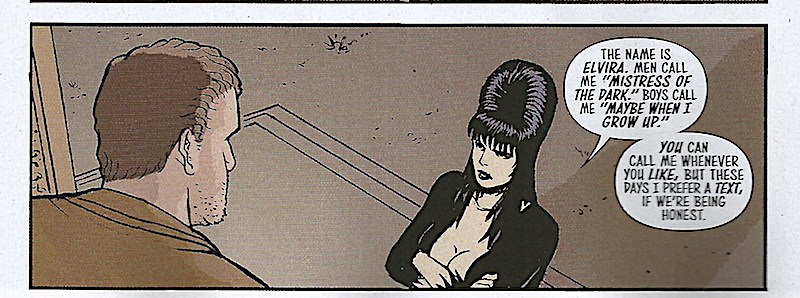
When wearing a low-cut black dress that appears to be more like a shroud and a beehive black wig, Cassandra Peterson needs no introduction.  She’s the voluptuous Elvira, horror hostess.

Elvira cracked wise on television stations and even streaming platforms.  She enlivened usually bad movies just before the commercial breaks.  


Sometimes Elvira’s risqué.  Other times, she reminds people that her looks aren’t just for show and she’s one of the monsters.  Most of the time, she’s a mistress of camp comedy.

As you can see, artist Fran Strukan brings the nuances of Cassandra Peterson’s performance to the comic book reflection of Elvira.  He draws upon these visual facets for a story that places Elvira in demand.


Elvira goes to meet her director, but instead finds a cast of strange characters in an edifice that houses mazes and perhaps monsters.

No.  No monsters.  Perhaps Just the amusing talent the director collects.  Elvira’s interaction with the cast sends up the cult movie industry with insider jokes and smart humor.  Perhaps writer David Avallone has experience in such matters.


Unstoppable Wasp turns into a serious depiction of bipolar disorder which Nadia van Dyne nee Pym inherited from her father.


Defeat served as the trigger.  Nadia escaped from the Red Room to gain a better life in her father’s country.  Nadia also wanted to prove that women were underserved, and that intelligence arises in all genders.

To work on the latter, Nadia collected girl geniuses.  Along the way, she picked up a step-mother, Janet van Dyne, who adopted her, freed her friend Ying from her former masters and reinvigorated Bobbi Morse’s love for science.


Were you aware of Mockingbird's connection to the super-soldier program? No? It's actually not a retro-plant.  Attempting to replicate the super-soldier formula is part of Bobbi's origin story, from the magazine Marvel Super-Action.   It's mention shouldn't be taken lightly either.  Jeremy Whitley  restores things forgotten or fudged.

The attack on G.I.R.L. ostensibly instigated by AIM was in fact the brain-child of a group of female villains.  So, it wasn't the male of the species that undermined Nadia and her team, but a group of equally prepared femme fatales, one of whom was a former hero from The Avengers Academy.  AIM are still "adorable ineffectual bee-keepers."


Because Nadia never failed quite so badly before, she attempts to fix everything.  That ain't healthy, and she becomes progressively worse as the book draws to a conclusion.  
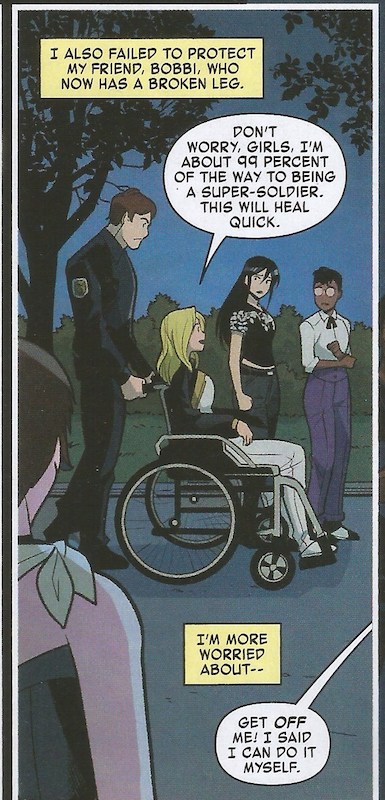
Whitley is careful however to differentiate the way the condition manifests in Nadia and her father.  Indeed, Hank Pym's often violent mood swings were more of a plot development than a faithful depiction of a real-life mental disorder.  Whitley demonstrates that you can treat people afflicted with a mental issue with respect while still incorporating the problem in a strong superhero story with a feminist tilt.


After an attack by MODOK, the West Coast Avengers found themselves fighting Madame Masque and the New Masters of Evil.  These battles led to their capture in a bread and circuses affair.  

Most of them.  Kate Bishop remains at large, and two new spins kept her that way.  First, she discovered that her supposedly dead mother is working undercover with the Master of Evil.  On the other hand, mom could be genuinely an employee who simply doesn’t want her daughter to die or face injury.  The other surprise is on the cover.


I know nothing about Marvel Boy other than what I gleaned from this issue of West Coast Avengers.  He seems quite competent with a poor understanding of human social interactions.

With Kate free and Marvel Boy providing enormous distraction, the West Coast Avengers soon extricate themselves from the Masters of Evil's torture chamber.

Most of the issue is art above writing, which isn't a bad thing, especially in the fourth act which should be and is action-packed.  Satana takes the spotlight with her hellfire creations combatting the Avengers.


Kelly Thompson's writing comes to the fore in the relationship between America and Ramone.  She also delights giving Kate what appears to be the worst day of her life and Gwenpool's best.