Showing posts with label Black Label. Show all posts

Monday, May 17, 2021

POBB May 17, 2021

Pick of the Brown Bag
May 17, 2021
by
Ray Tate

Welcome to the latest edition of the Pick of the Brown Bag.  It's another title focused posting this week, as I try to catch up on all the comics I've read but not yet reviewed.


I mentioned Tom King's Batman and Catwoman in passing, but I decided to give it an in depth look now that DC published four issues.  

Let me once again state.  I am not a fan of the Black Label DC Brand.  The insulting Batman: Damned scorched any enthusiasm I can muster for a new Black Label title.  In fact, when I see another of those things on the racks, I kind of cringe.  

If not for Jimmy Palmiotti's and Amanda Conner's Harley Quinn and the Birds of Prey, I may have just ignored Batman and Catwoman.  And I'm a Tom King fan.  So, King owes them a debt.

On a scale of one to ten where Harley Quinn is a ten and Batman: Damned is negative thirty.  Batman and Catwoman so far rates a positive seven.  

At first I believed King extended the continuity he wrote for Batman into the Black Label title, but Batman and Catwoman is too screwy to be associated with continuity.  It takes a bit of this and a bit of that and meshes this-that into something that's entertaining in places, head-scratching in others.

After the backlash over Batman's penumbra of a penis, the Powers That Be appear to have rethought the whole for mature audience Black Label directive.  Batman and Catwoman for example presents no nudity, nor even proper swearing.


So it looks like DC is reinventing the Black Label title.  Perhaps they now define the subjects thusly: 

DC titles that are sometimes risqué but always off-tangent from the DC Universe proper.  These books do not necessarily relate the time Victorian Batman fought Jack the Ripper or when Superman stopped the Confederacy cold.  So don't you dare go looking for that.  We don't do those anymore.  These books also will not, repeat not under any circumstances feature Batman's offending member.  Don't panic.

The root of Batman and Catwoman can be found in Tom King's Batman run.  In Batman forty-nine, the Joker takes a wedding hostage.  Batman and Catwoman investigate.  Joker blows up Batman into unconsciousness.  Catwoman and the Joker mortally wound each other, and they're the only ones left talking, if not standing.  


Catwoman will not kill.  At least that's her reputation.  She is a thief not a killer, nor even a purveyor of brutal violence.  This serves the character from the Golden Age to the Bronze Age.  
The New 52 and Rebirth reinforced the consistency.

However, King's Catwoman though not a heartless murderer, isn't above killing.  She's a harder, more realistic figure that incorporates nearly all of the character's history from comics.  Including Batman Year One.  

Frank Miller implied that Catwoman and her cohort Holly were man-hating prostitutes.  DC ran with that--Catwoman Year One--until then new Catwoman writer Jo Duffy elegantly dismissed the suggestion.  She explained this misogynist concept to be a ruse setup to roll Johns, which is far more in keeping with Catwoman's status as arch-thief.

Anyway.  In Batman forty-nine, Catwoman is willing to kill the Joker.  She's willing to do what Batman will not do.  Not out of malice or even blood lust.  Rather as a public service.  

That's the Continuity Proper answer, but King took a second look at his creation.  I suspect he looked at the scene askew.  Batman and Catwoman is the consequence.

Batman and Catwoman takes place in three different time frames.  Two where Batman is alive, and another when Batman is dead.

King provides an answer to what kills Batman in Detective Comics #1027.  He also portrayed Batman's last day and set up his Batman and Catwoman future in a speculation presented during his Batman run.  That speculation will also be crucial to Batman and Catwoman.

When Batman is alive, he's with Catwoman.  He lives, she lives in stately Wayne Manor.  Alfred is alive except in the near present.  Alfred died in King's Batman run.


The story begins when one of Batman's former lovers comes looking for her child, who ran away to Gotham City.  Batman and Catwoman go on the hunt.

Apart from the identity of the mother, events begin rather normally, and Batman and Catwoman seems to be just that extension of Batman I identified.

The child unfortunately runs into the Joker, and things take a turn for the worse.  It's that misery that catalyzes everything that occurs in Batman and Catwoman.  

That's about all I can safely say about Batman and Catwoman without giving away the plot, the identities of the characters, everything.  

I can tell you, if you do not wish to go on, that Clay Mann's artwork is smooth as silk.  King's story is full of quirks and eye-brow raising surprises; none of which make sense except outside of the context of Continuity Proper.  As a result, Batman and Catwoman reads like a stream of writer's consciousness.  Though it's a controlled body.    

I can also recommend the book to Catwoman fans.  Batman does not really get a point of view in the story, for obvious reasons.  A lot of events go behind his back, when he's not dead.  

Batman isn't aware of what's happening.  He doesn't have a clue until Catwoman spells it out for him.  One can argue that love blinds.  One can argue this was the whole original point of the liaison.  In the end though, Batman unaware of what's going on is a little too difficult to grasp.  He's supposed to be ten steps ahead of everybody.  That closing gap is the flaw in the series.


For Catwoman fans, however, Tom King writes Selina Kyle like no other.  He really has a taste for her and knows how she prowls.  Despite the events having little basis in comic book history or Continuity Proper, Catwoman behaves as you expect her to given the situation.  If you accept the premise of King's story, you're in for a good ride.  If you can't accept it even as a glimmer of quantum possibility, then maybe you should stick to King's Batman run.

This review will be filled with spoilers as soon as the graphic warning manifests and continue that way.  I just didn't see any other means around it.


S
P
O
I
L
E
R


A
H
O
Y

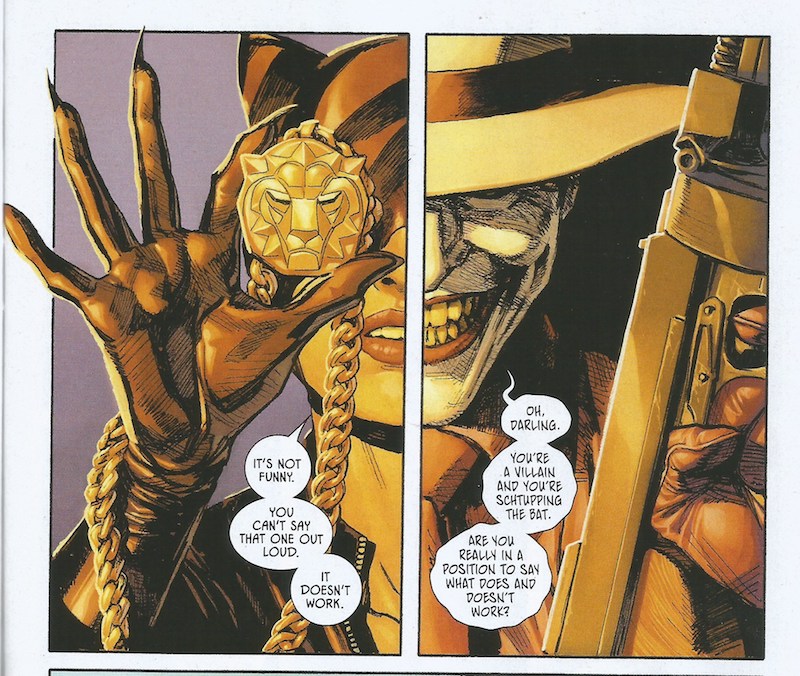
Three time periods all unfolding during Christmas comprise Batman and Catwoman.  In one, Batman is dead.  In a second, recent past, Batman and Catwoman hunt for Andrea Beaumont's son.  In the third, distant past, Catwoman and Joker subsist in symbiosis to undermine Batman's strengths.  

Though many scenes speak for themselves.  The time-hopping can be confusing if there's no frame of reference.  Clay Mann provides that frame through fashion.  Catwoman in Black is the distant past.  Catwoman gray is the recent past, and older Selina is obvious.

In issue one, Selina visits an old man in Florida.  This catalyzes the reflections of the more recent past where King incorporates Batman Animated Series continuity into the decidedly un-cartoony artwork of Clay Mann.


Andrea Beaumont for those unfamiliar with the character appeared as Batman's first love in The Mask of Phantasm.  The best of the Batman films after Batman Returns. 


The theater select original animated feature offered the audience not just a tweaked Batman origin but also drew in Mike Barr's and Al Davis' Reaper stories from Batman Year Two.

During the course of Batman's and Catwoman's investigation of Andy's disappearance, more Animated Series recreations arrive on scene.  You may begin to think that Batman and Catwoman is in fact an extrapolation of The Animated Series.


Yet.  Batman and Catwoman isn't quite the animated continuity either.  King's Joker in this story appears as different incarnations, none of which would fit in the The Animated Series, save for this one.  There's a sense that the Joker alters his appearance to placate Batman.  The purple-garbed murderous clown better suits Batman's world rather than the straight up gangster who appears before Catwoman.


Batman and Catwoman also reintroduces Helena Wayne.  Though she's not Helena from earth-two.  Neither from the Bronze Age nor the New 52.  This is Batman's and Catwoman's daughter, briefly seen in King's speculation about Batman's last day.

Different costume as well, and here's where the Black Label becomes a little more racy.


I mean, there's really no reason for that bit of fan service other than it's a Black Label book and they can get a way with it.  

I suppose you can make the argument that the social mores of the near future lean toward permissiveness, but come now.  This is gratuitous.  


One good look at Helena's rear and you're likely to forget everything else that happened in the series.  Fortunately, I take notes.

Batwoman, Helena's not Huntress, in King's future not only investigates the murder of an old man in Florida.  She's looking into the Batman's rogues.  The case in Helena's present appears to link to the the deaths of the Joker's former henchmen.  


For the audience it's no mystery.  The usually tight-lipped Tom King divulges the secret.


Andrea is once again Phantasm.  The death of her son destroys her peace of mind, and she even goes so far as kidnapping Selina.

Once the first issue of Batman and Catwoman ran through its course, I questioned whether or not I'd be interested in the entire series.  King isn't after all creating a fair play mystery.  We know practically everything.  I don't believe Catwoman would ever willingly partner with the Joker, but I can tenuously accept the premise for this series.  Still, it's not something I'd choose out of all the comic books in the world to read.

Then King and Mann introduced Batwoman.  She's the most exciting and visually striking character in Batman and Catwoman.  I want her series.

Certainly, my subjective love for Helena Wayne lends bias, but I can also prove the argument objectively.


Batwoman bases her outfit on Batgirl as much as Batman.  She must be a fan.  Dick Grayson, now Commissioner of Gotham City, trusts her.  So she is entrenched in the Batman Family.  The rogues recognize her as Batman's successor and heir.  Imbuing greater resonance.

Helena seems determined to bring her mother to justice for the original murder in issue one.  She behaves a lot like her father.  Looks like him too when striking a pose.


Unlike Batman, the dynamic between she and her mother is different, and her pursuit generates the friction.  


Furthermore, the LGBT community lose none of their representation.  Batwoman is gay.  Helena Wayne is gay.  With the addition of Helena Wayne, Batman and Catwoman becomes a must read, rather than a pleasant enough time waster for those with a surplus of funds.

Wednesday, February 19, 2020

POBB February 12, 2020

Pick of the Brown Bag
February 12, 2019
by
Ray Tate

Welcome to the Pick of the Brown Bag.  I'm Ray Tate, and I review the best and worst comic books of the week.  For this post, I look at Doctor Who, Harley Quinn and the Birds of Prey, Hawkeye Free Fall, Immortal Hulk, Thor, Vampirella and Red Sonja and Wonder Woman.  The tweets for those who haven't the time to delve deep into the critiques are already live.  Check them out on Twitter: #PickoftheBrownBag

After being horribly burned by Batman: Damned, I never intended to buy another Black Label title again.  


Amanda Conner and Jimmy Palmiotti return to the Harley Quinn Universe.  They continue their outstanding comedy series under a Black Label aegis.  'Nuff said.  You got me.


I knew Palmiotti's and Conner's newest Harley Quinn excursion would be good.  Mainly because Conner's drawing it.  So even if Palmiotti's story wasn't up to snuff, unlikely, the art would at the very least be stunning.

What I couldn't expect is how stunning   DC shells out big bucks production values for their Black Label titles.  Harley Quinn is no exception.  

The book is unusually sized, with greater width and height, though not as metric as Damned.  Because of the change in format, you can pick out more detail in Conner's art.


You get a greater breadth of her sense of space, visual narrative flow and an ability to convey the illusion of animation.  The paper stock of the Black Label series furthermore picks up Paul Mounts colors and facilitates even more lushness.

One of the purposes of Black Label is to provide adult entertainment in comic book form.  For some reason, Batman Damned translated that into a cacophony of crotch shots.  Palmiotti and Conner on the other hand don't go much farther than they did in their original Harley Quinn series.  Sure, there's swearing.  It's a shade more over the top violent, but all of the explicitness exhibits a tastefulness woefully absent in Damned.


Conner and Palmiotti's story is a classic crime drama.  Harley took out a loan from a firm of sharks to save her building.  When she's late on the payments, Defeo takes it out in the hide of one of Harley's closest friends.  


The trouble for Defeo is that Harley Quinn when stripped down is the epitome of the hardboiled protagonist with a past.  She uses the experience of that past to seek revenge.


A Princess Bride riff to boot.


When Palmiotti and Conner add layers to Harley Quinn, then you get such things as the dream-enhanced memories with Poison Ivy and guest appearances by former Wonder Woman villain Egg Fu.  Power Girl shows up for no reason at all other than Conner and Palmiotti really like Power Girl.  The way in which Harley exacts her pounds of flesh are less Elmore Leonard and more Bugs Bunny, which is exactly right.

Three of the Birds of Prey show up in the book, and they exemplify Conner's and Palmiotti's ability to make me care about characters.


As anybody who has gleaned anything from this blog knows, I love the original Huntress Helena Wayne.  Conner and Palmiotti give me a new Huntress to think about.  A woman of color like the New 52 model, freaking dangerous like Helena, and she knows Harley Quinn either because of some adventure I didn't read or just because the writers felt like it.  Hence the Harleyverse.


Cassandra Cain in the post-Crisis is a fake Batgirl.  This one appears based on the film version and mute like the original. Again this is a case of where the strength of the art and writing overcomes my immediate instinct to disdain.  


I praised Steve Orlando's inventory issues of Wonder Woman before, and if you haven't picked up that brief run, check out the trade paperback.  The artist Aco rendered most of the illustration.  So, it's a combination of a writer plugged into Wonder Woman and highly sophisticated psychedelic illustration.

Now, Steve Orlando and Bronze Age artist Jan Duursema take over Wonder Woman, bringing a new status quo that nevertheless respects traditional Wonder Woman history. 

Thanks to John Byrne, Wonder Woman made Boston her home.  In Orlando's new writing, Wonder Woman returns to Boston only to find a less than friendly welcome.


That's Nora Nunes, hopefully not a relative of Devin. the man who wants to birth Donald Trump's baby.  Nora is Boston PD and sent to determine whether or not Wonder Woman is a catalyst threat to Bean Town.

It's a weird role for a police officer hearkening back to the old west.  I'm not sure it's legal.  You never hear of police officers or even sheriffs running people out of town anymore, but it's certainly interesting. 


In any case, Nora watches Wonder Woman save the people of Boston from the weather inspired no doubt by climate change but erupting from supernatural sources.  


Not to worry.  The story isn't really about these weirdos.  It's about Wonder Woman instilling hope and courage in all.  Seriously.  Orlando just gets Wonder Woman.


Along the way, we glimpse Etta Candy's new lease on life.  Fitting for the long-time cast member.  In the end, Wonder Woman's innate goodness wins out--spoiler ahoy, I guess--and she turns antagonist into friend.  That's always been Wonder Woman's greatest strength.  Her belief that anybody can become a better person.


Orlando however cannot help but bring back his goofy take on classic Wonder Woman villain Paula Von Gunther.  


This is a sore spot with me, but the lion's share of Wonder Woman is utterly enticing, attractive and entertaining.  


This issue of Vampirella and Red Sonja is skippable.  Babs Tarr's cover is the best thing about the book.  

Jordie Bellaire seemed to establish the premise in the first story.  V left Drakulon late in the 1960s.  She established herself on earth for a year and become involved in a real-life mystery.  There she found Sonja.  Together they smashed a Russian military base.  It's scientific head attempted to reverse engineer one of V's people.  

Instead of however going on from there, he went backwards.  First a Hyborean Age Sonja issue.  Then a sixties Vampirella issue.  Okay.  Place holders I thought for the next big story.

Bellaire though now confounds expectations.  For some reason, Bellaire feels the need to summarize the last two focus issues on the individual stars.  


This goes on for eight pages.  We learn that Red Sonja likes to watch V have sex.


A lot.  Because the focus issue suggested that V wasn't engaging in a world record of fornication.  She changed partners at the very least daily.

After this, Vampirella and Red Sonja reunite corporeally in some vaguely medieval village where a dragon threatens villagers..

I still have no idea why this whole thing is happening. It's like a short story with admittedly some mildly entertaining repartee wedging a summary and a setup for another time travel based issue followed by a clump of house ads.  I mean.  I've read worse.  The aforementioned Batman Damned, but this issue of Vampirella and Red Sonja is for completists only.


If you want time travel done right, look no farther than Doctor Who.  The television series and the comic book.


The Doctor took the TARDIS back in time with the hopes of hitting Woodstock.  She found instead her past.  Specifically, "Blink" where the Weeping Angels trapped she and Martha Jones in 1969 without the TARDIS.  Um.  The Doctor was a man back then.


This issue reveals what's been snatching people.  Obviously, I'm not going to tell you what it is.  Not even a hint, but it's just as surprising as the big reveal in the latest episode of the television series.  You just won't see it coming.  The Doctor Who comic book consistently lives up to the standard set by the television series.


What I can tell you is how Jody Houser makes Yaz the VIP companion in the tale.  
  
I don't know how artist Roberta Ingranata landed this gig.  She seemed to impress everybody when she substituted for Rachel Stott, the primo Doctor Who artist.  Ingranata certainly impressed me, but she doesn't yet have a good handle on Mandip Gill who plays Yaz on the series.

I don't know why that is.  She illustrates everybody else with aplomb.  Alternately, maybe Gill never gave permission to use her likeness in a comic book.  It happens.

I can also say that the Doctor reunites with Martha Jones.  


Incidentally, if you have a Jones for Freema Agyeman, she's on the NBC series New Amsterdam.  The Doctor's free with information about the future because she knows when she leaves, Martha won't remember a thing.  That's how time travel works in Doctor Who, and it makes sense.

Though, you cannot help but feel sorry for Martha.  She's in love with the Doctor, you see.  Her Doctor.  At this point in time, they're trapped in 1969.  She's bottled those feelings so the situation doesn't become worse.  That must be infuriating.  The Doctor of our respective present shows up.  She also knows Martha was in love with her.  Martha will likely feel the same emotions over the present time Doctor.  Technically, they could act upon those feelings, but even if they did, that memory will be wiped out along with any memory of the future when history realigns.  Martha cannot catch a break.

Neither can Beta-Ray Bill.  Every time I see Beta-Ray in a comic book somebody's beating him senseless.  I just wish he could score a major victory at some point. Just have him smite a minor Eternal.  Give Beta-Ray Bill something.


At least the fight between Thor and Beta-Ray Bill has a purpose.  Thor's working with Galactus to stop the Black Winter.  Beta-Ray Bill just doesn't like Galactus.  End of story.

This issue of Thor is definitely an art issue over the writing.  Donny Cates provides some interesting insights on Thor's memory, which Doctor Who covered as well, but Thor is primarily Nic Klein energetically battering poor Beta-Ray Bill around through Thor.  The colors by Matt Wilson enhance the seriousness of the battle.


Immortal Hulk delves into the heart and history of former Shadowbase employee Dr. McGowan.  


This trip down memory lane isn't without purpose, and its significance becomes apparent when the Big Guy battles the hypnotizing alien Xemnu.  


The reality of the situation is that way back in the sixties, Stan Lee and Jack Kirby introduced Xemnu as the Hulk in Journey to Mystery.  

He predated the more familiar Hulk by two years.  It's likely though that Lee and Kirby just liked the name and stuck it on another "monster."

Anyhow, things go from bad to worse, and the full range of Xemnu's power reverberates at the end.  It's the only moment in Immortal Hulk where you feel the Hulk is vulnerable and can be beaten.  


In Hawkeye Freefall Matt Rosenberg reestablished Hawkeye.  He gave readers a glimpse of the man, his skill and his self-deprecating wit.  He also connected Hawkeye romantically with the Night Nurse, but more than that, Rosenberg introduced a puzzle.  Hawkeye is one of the few heroes that take on new identities.  One of them is the swordsman Ronin.  Ronin took names at the expense of the Hood.  Everybody and their aunt except Spider-Man thought Ronin was in fact Hawkeye until Hawkeye actually fought Ronin.

In this issue Rosenberg comes clean with the mystery of Ronin, but I'm not breathing a word.  What I can see is that I don't think I've seen this technique before, and it may be the most original use of a plot device.  Certainly, it's imaginative and makes sense.  

I also cannot go into the absolute hilarity of Hawkeye's ploys to divert suspicion.  He's tired of being accused.  This leads to an outrageous scenario with the Night Nurse, and one of the funniest uses of self-censorship.  

So what can I tell you about Hawkeye Freefall?  Something I'd normally keep under my hat.  The Black Widow guest-stars in a substantial cameo.


She figures it all out, and you don't want to miss artist Otto Schmidt's graceful rendition of Natasha Romanov.  Another hero also uses his powers to dope out the secret of Ronin.  This one sets off the cliffhanger.  So, his identity I'll keep secret.