Pick of the Brown Bag
November 11, 2015
by
Ray Tate


Je suis Paris
Welcome to the Pick of the Brown Bag, a weekly review of the current comic books. If you haven’t the time to read the full-force reviews, I also now tweet teensy summaries under #PickoftheBrownBag. This week I look at Batman and Superman, Bombshells, Justice League United, King Tiger, Mythic, Spider-Gwen and Starfire. New this week a slew of Marvel: All-New Wolverine, Ultimates and Web Warriors. I’ll also peruse the indy title Black Bag and in the Emily Blunt film section Live, Die, Repeat, also known as Edge of Tomorrow.

Mythic posits that the world actually runs on magic and a select few protect it. In this issue, new recruit Nate finds himself naked and bathed in an equal opportunity scene that practically reveals everything.

Actually more explicit than this even.
The reason for the impromptu wash is ostensibly to return the ghost children of a particular realm to work. They tend to a particular elephant. In reality, the immortal seer Cassandra had an ulterior motive, not really insidious but mischievous.

The light, risqué tone gives way to a more serious situation when the spotlight turns to Waterson, Anatol and Venus. They must interrogate the Midgard Serpent, one of the Norse entities that will usher in Ragnarok.

The back up story features a past episode in Waterson's life, whom we discover is a Native American deity.

I'm a skeptic and atheist, but the creative team convinces me of the validity of their world for the length of the book. The creative team succeed through grounded dialogue, superb artwork and a humorous tone when dealing with the problems of the supernatural surroundings. The comedy in Mythic makes the drama all the more powerful. The realism in the artwork offsets the absurdity in some of the lore the team face.

Black Bag operates within a common knowledge base. We've all seen spy stories like Black Bag before, and Chris Roberson's story brokers no novelty. However, the characters possesses richness and history all within the span of a single comic book. The art's realistic and pleasing to the eye. The dialogue matter-of-fact but prepared for the delivery of a good cast of actors.

Unbeknownst to Robert, his wife Renear is an operative/assassin whose current target unfortunately has a daughter.

Renear's handler wants her to finish the job no matter the collateral damage, the term upper spy echelons use for innocent bystanders diced in the crossfire. Renoir defies that order, and sees another option.
As Black Bag progresses, we learn how Renear found herself in the spy business, and this too is an interesting story within a story, demonstrating the character's poise under pressure.
The wife with a secret life is becoming as much of an archetype in comic books as the vigilante seeking revenge. I suspect this may be because young creators end up married and liking it. The appreciation of their wives' ability to multitask naturally evolved into a creative extrapolation. For that reason we have such characters as Jennifer Blood, Lady Killer and now Renear Dellaroy of Black Bag.

King Tiger faces an apocalypse most personal in his eponymous comic. This leads to a smash of archetypes in a Hong Kong flick inspired story that has infinite production values thanks to artists Doug Wheatley and Rain Beredo.

The nature of the beast and the design of King Tiger's trap involves blood. It also may require sacrifice, but King Tiger's lady love will have none of that.

Rikki actually may be key to solving all the problems King Tiger and the world faces, but it's more than just about her can-do attitude. The message she conveys in the ending is uplifting and makes sense given the rules of the game.
In between the major battles and events, the creative team builds on a superhero universe within Dark Horse publications. Barb Wire, King Tiger, Ghost, X and the Captain Midnight all appear to be loosely connected through the auspices of Black Sky, a black ops government agency. Dark Horse needs to do something after losing the license to Star Wars, and they may see the superhero field open for them once again.
In between the major battles and events, the creative team builds on a superhero universe within Dark Horse publications. Barb Wire, King Tiger, Ghost, X and the Captain Midnight all appear to be loosely connected through the auspices of Black Sky, a black ops government agency. Dark Horse needs to do something after losing the license to Star Wars, and they may see the superhero field open for them once again.

Somewhen before the whole Secret War Battleworld thing Wolverine died. So far, Marvel hasn’t brought him back. Old Man Logan is the Wolverine from another universe, but present day Wolverine still hasn’t arisen from the grave.
So, the Powers That Be bestow the title on Laura, the artist formerly known as X-23. If you know nothing about Laura, not to worry, writer Tom Taylor includes a painless fill-in of information laced through the dialogue. 
Wolverine in the above example is a ghost of memory. Rather than haunt Laura, he guides her and reinforces her moral code. The damage he refers to happened in the riveting opening.

Ouch. All New Wolverine works well as an introduction to a newish character, breaking the ground to her inheritance...

...and relating a strong action-fueled story that lets the clean lines of artists David Lopez and David Navarrot prevail. Vivid hues by Nathan Fairbairn offer unexpected clarity. Given the violence, Marvel’s powers could have chosen to go moody, but the art team doesn’t strive for the samurai drama of Frank Miller or the mature themed Terry and the Pirates Wolverine in Majipoor. All New Wolverine is a super-hero comic book with all the color and daring that implies.

The Ultimates have nothing to do with Marvel’s Ultimate Universe. Funny story about that. Did you know Marvel’s Ultimate universe’s germination occurred because Marvel bought Malibu Comics which instituted the Ultraverse? True.
Anyway, writer Al Ewing puts together a new team of Avengers in all-but-name who operate from the Triskelion, which has the name value of being demolished in Captain America Winter Soldier.

The true Black Panther is always welcome in the POBB. I first encountered the Black Panther in Stan Lee’s and Jack Kirby’s Fantastic Four. I’d normally include a graphic, but as you may have gathered, the book I read was not an original but a reprint. No idea which.
In any case, the only time I didn’t like the Panther, his look anyway, occurred when some artists mucked up one of the coolest black costumes in comics.

Kenneth Rocafort handles the artwork in The Ultimates. So, no complaints about the regal King T’Challa, or any of the other Ultimates for that matter.
You may not recognize all the team, but Ewing quickly breaks down the basics.

America Chavez is actually a new character for me. I only briefly experienced her brand of justice in A-Force, and that wasn’t the America Chavez presented here.

America Chavez is a strongly reimagined character that honors the spirit of the original 1943 Timely figure. Miss America Madeline Joyce appeared in a diverse clutch of comics before graduating to her own series that underwent a strange metamorphosis. After issue one, Miss America became a girls magazine with a comic story feature. It then reverted back to comic book format only without the superhero. Instead, the comedy hi-jinks of Patsy Walker took over the book. In the context of the Marvel Universe, Madeline Joyce married Robert Frank the Whizzer and died during childbirth. Kind of sucks really. So, Marvel killed her off historically and fictionally. There hasn’t been a reiteration until now.

The other stranger to most is the Blue Marvel. No need to look him up. I already did. As memory served, he doesn’t exist until now. That’s fine. Once again, Ewing gives you all you need to know about this smart, retro-fitted hero, and he has good chemistry with Captain Marvel, amusingly the only white hero on the team. So we have a reversal of what’s expected, and nobody makes a big deal out of it. That’s because despite the overt black hero theme, what makes The Ultimates stand out is the mission statement. This goal involves Galactus. I actually said “Ooooo,” at the cliffhanger. Something different.

Web-Warriors is a goofy book. The premise acts as a flimsy excuse to squish together all the popular spider-characters in one. Surprisingly only a single of these alternates is actually Peter Parker, and he’s likely a Peter Parker you’ve never seen before.

The Sandman/Blue Beetle combo is the Spider-Man of the 1930s from the Noir Marvel mini-series.

The majority of the team consists of Spider women, and this is perhaps the only real appeal of Web-Warriors.

That's Spider-Gwen fighting alongside May Day Parker from the MC2 Universe or a reasonable facsimile. I’m not saying that Web-Warriors is a bad book. It’s technically well-written. Mike DeCosta embodies the personality of Spider-Gwen and May Day in their dialogue. As for the other spiders? Meh.
The book opens with the cosmos hopping Spider Force infiltrating an animated universe, which amuses through cartoon law.

The spiders then split up. May and Gwen travel to an Egyptian based alternate earth for lunch. Besides tacos—with Qamar Al-Din—they encounter a multitude of Electro. The shocking encounter leads to the conclusion that maybe the spiders aren’t the only avatars assembled.
As plots go, I’ve seen far worse, but I don’t believe the Web- Warriors series can subsist on such a cardboard concept. I’m willing however to hope that the Spider Force face something worthier of their mettle in future issues rather than a mere antithesis of multiple villainy.
There’s no denying that this book collects three of my favorite spiders. The men folk and the pig I couldn’t care less about. Web-Warriors also benefits from excellent artwork from David Baldeon, Scott Hanna and Jason Keith fostering a broad scope that’s fitting for the out there ideas. The maintainers of the Web for example are suitably alien. The environments the spiders find themselves in neatly hint at whole different worlds. David Baldeon’s design for the Spider-Gwen and the Spider Girls suits their visual history and lends to the hyper kinetics of the friendly neighborhood kind.

A second feature introduces Lady Spider, a steampunk version of Spider-Man who seeks to bring the Black Cat to justice, ala Batman. It's a short and fun chaser that may tie in to the main plot.

In Radioactive Spider-Gwen Spider-Woman must deal with a very different version of Captain America.

The battle is just as a frenetic as you expect thanks to the artist's sense of motion and comedy. As well it points out one of the major differences between Captain America and any hero you would care to name. Cap doesn't tire. Many creators ignore or forget Cap's immunity to fatigue.
Gwen is trying to find the person responsible for turning young Peter Parker into a lizard and murdering him in the process. Curt Connors seems a likely bet, but a multitude of Lizard Men apparently under the employ of SHIELD spreads doubt.
The mystery allows writer Jason Latour to characterize Gwen as a detective, even more so than the original Web-Slinger. Her father is after all Captain Gwen Stacy of the NYPD. Later Latour also instills more empathy to Gwen as she settles into the superhero lot that chances dealt her, and her humanity comes through vie a short epilogue involving the hapless Bodega Bandit.
In addition, we get a stellar version of Captain America, plausibly and originally separated between the present day and the 1930s. Cap's sidekick builds on the sudden mythology and spikes the dialogue with a hilarious bellicose personality. Last but not least, just in case you didn't catch all the "subtlety" in the art and flashback, the creative team include a fake Who's Who in the Marvel Universe entry for their Captain. It's no-less informative, but it's also cheeky and Spider-Gwen specific.

Starfire is basically a vehicle demonstrating just how tough our Tamaran princess is. I'm totally okay with that. First, Kori returns home to save her friend Stella's brother from being killed by the villain she encountered previously.

Mmmn-hmmn. Kori killed before, and that gives her an indication on just how much strength she can use to get the job done. This means, that Starfire is actually stronger than what you see in the panels. She's holding back.

Impressive given that the bounty hunter appeared to be no pushover. He's little match for Koriand'r. I'm not exaggerating when saying that this is one of the more visceral issues of Starfire, but Conner and Palmiotti still make the comic book about something. Kori doesn't fight for the sake of fighting. She fights because she cares about what happens to these humans she's adopted, and that makes all the difference.

You can be forgiven for thinking that Batman and Superman is actually a wayward episode of The A-Team. It has a great trouble-shooting feel in which the team's skills all commingle for a solution to a major life threatening problem. In this case, Vandal Savage.

Soon, our Magnificent Seven--er four--are teaching the villagers to fend for themselves and seeing what can be used to set up a trap, but Vandal Savage has a shadowy ace up his sleeve.

The story teams up Superman and the Batman Family. The playful dialogue creates enviable interaction between the teammates. It also conveys a sense of place and time. Previously Batgirl mentioned her meeting with Superman during the Batman and Superman Annual. Superman knows Grayson the best, and he seems to have warmed to the Red Hood like everybody else. Otherwise, he knows Jason from the old days when the man was the boy Robin. In any case, Batman and Superman is a welcome old school addition.
Batgirl returns in Justice League United.

Batgirl is one member of the latest away team Adam Strange sent out to determine why a city in France turned into a perpetual war zone. The reason not really that important. This is all an excuse to partner the Justice League with DC's soldiers from war comics.

And to see Steel and Robotman punch the new OMAC in the mouth.

The conceit of the tale allows for great moments such as this one where Enemy Ace and the Star-Spangled Kid face certain doom if not for the brain of John Henry Irons and the Kid's willpower.

Ah, yes. Vandal Savage brings flintiness to the arena. He and Sgt. Rock already have a history. Cleverly, the fact that both characters recognize their mutual past indicates that they are who they say they are. Not everybody is, and this was kind of a let down. Alas, Unknown Soldier is not the Unknown Soldier. I was hoping DC would finally usurp his unnecessary doppelgänger Hush.

You see? Nobody likes to refer to the Star-Spangled Kid as Stargirl.

When the preliminary fights are out of the way, and the strategy determined, we get the above moment when the entire DC battalion recruits the League to put an end to the perpetual war. The book carries a fitting anti-war message that blends in with the coolness of Paul Pelletier's, Rob Hunter's and Jeromy Cox's artwork and the melange dynamic of the heroes. Make no mistake. I'm recommending the whole chapter play.
Bombshells also delivers an anti-war message.

In this world, Supergirl and Star-Spangled Kid are sisters in Russia, and previously they proved their worth to the Russian Military. This issue Kara and Courtney learn the horrible truth about some of their actions, and I've got to say this was a stirring indictment of the Soviet propaganda machine. You can almost hear the boot-march chorus and the baritone of the Russian opera in the background.

We don't stay in Russia for long, writer Marguerite Bennett bounces us to Gotham City where Harley Quinn plies her trade and encounters a real whopper of a reminder of bad continuity. I won't spoil the cameo. Suffice to say, that she's a head turner.
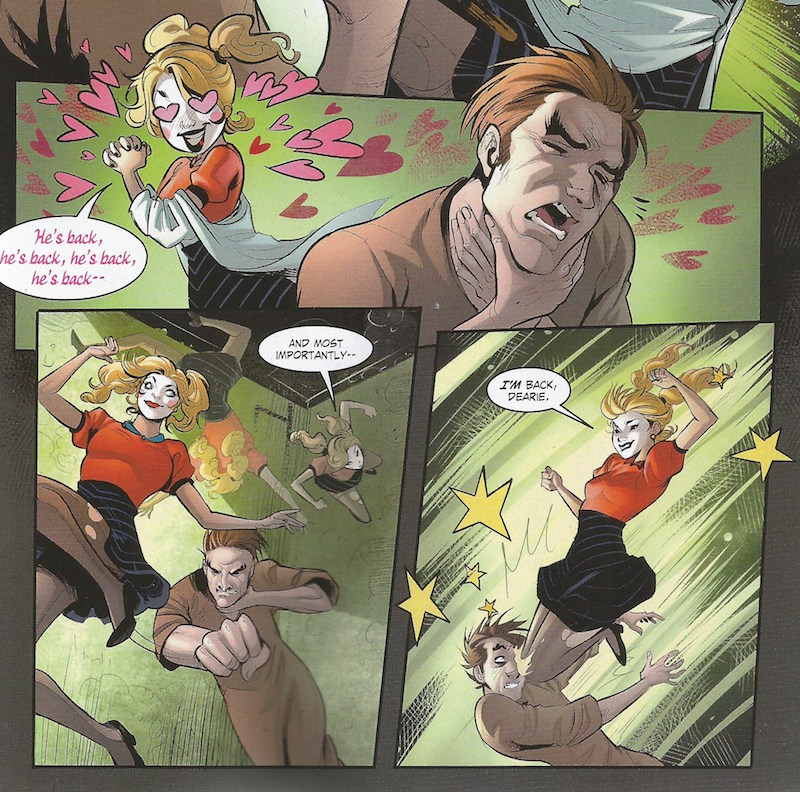
Unfortunately, the whole point of Harley's mad spree is lost on me. It doesn't play a part in the two other episodes, and only seems to get her from point A to point B. Bennett characterizes what may be her bisexuality at a dance, but the whole farce just seemed a waste of time and space. Wonder Woman was much better. Diana gains her Bombshells costume, refuses to give in to barbarism and continues her flirtation with Steve Trevor. Not as good as the previous issues, but Wonder Woman fans probably won't want to miss it.

The Emily Blunt Film Review
The Emily Blunt Film Review is brought to you by Fox and Friends, spreaders of manure since 1998.
Live, Die, Repeat also known as The Edge of Tomorrow sets the stage for interplanetary war with an imaginative enemy brought to life through potent special effects.
The bizarre tale—adapting the novel All You Need is Kill by Hiroshi Sakurazaka—possesses a time travel element that quickly usurps military action.
Emily Blunt portrays Rita Vratsky, the best of the best armored soldiers that fights for the earth’s existence. She has a secret that she shares with newcomer-to-battle Major William Gage played by Tom Cruise. The enemy knows their every move. Normally, that would signify a mole, but Edge of Tomorrow shoots higher.

Blunt demonstrates a feel for action and swordplay. When swathing herself in the characterization of Vratsky, she becomes tight-lipped, letting subtle changes in her body language and expression relate her feelings. Later, She exhibits a canny, natural delivery of science jargon. Those expecting a romance will be disappointed. Rather, Blunt keeps her character professional and distances herself from Cruise’s novice turned expert. I am no Tom Cruise fan, but he is adequate in this film.
In addition to Blunt’s uniformly excellent performance, the movie offers the audience strong science fiction. It benefits from a frequently funny cast that also double as action stars. Furthermore, they stretch their dramatic chops in the last act. The production values impress, and the flick delivers a subtle anti-war message while at the same time reinforcing the need for conflict and sacrifice. Given these elements, I have but one caveat. The film’s themes earned it an unhappy ending, but instead, a sunnier finish prevails. Live, Die, Repeat would have been a stronger movie had the filmmakers followed the trajectory of the mood.


