Pick of the Brown Bag
April 11, 2024
by
Ray Tate
Welcome to the Pick of the Brown Bag. I'm your host/creator/head guru Ray Tate. Today, I review the entirety of Hawkgirl, which is the newest mini-series from Jadzia Axelrod and Amancay Nahuelpan.

Very Cool Making the Mace Her Logo.
I already critiqued the first two issues of Hawkgirl in a previous post. This current missive will cover some of that old ground but in a fresh revealing way.
Don't worry. I won't be divulging the entirety. You'll have plenty warning ahead of any massive shocks.
For those who want the short and dirty version: Hawkgirl is worth your money and time. So if you haven't purchased the singles or your local comic book store can't provide back issues pick up the trade when it comes out in June.
Created by Gardner Fox and Sheldon Moldoff, Shiera Sanders debuted in the first issue of Flash Comics in 1940. A year later in All-Star Comics she becomes an equal partner in the crimefighting duo Hawkman and Hawkgirl.

The original Hawkgirl swung her mace for about ten years before folding her wings.
Afterward, DC Comics Master Julius Schwartz directed original creator Gardner Fox and Joe Kubert to reboot the Hawks for the Space Age.

These Hawks arrived on earth from the planet Thanagar. They soon left the nesting title of The Brave and the Bold; earned their own name comic book; joined the Justice League of America and, with that team, flew about twenty years strong.

The Crisis on Infinite Earths changed everything.
Many of DC's Silver Age writers also sold science fiction to pulp magazines. They were aware of the parallel earth concept. They established a unique multiverse for DC Comics. In that system two sets of Hawkman and Hawkgirl glided.

Crisis essentially eliminated the alien Hawkman and Hawkgirl. The aftermath of the series compressed the history of both pairs into the original Hawks from the World War II era.
The Powers That Be explained the Hawks' pesky longevity via comic book tomfoolery; continued exposure to the metal that allowed the Hawks to fly also kept them young.

Highly convenient, that.
Ten years after the Crisis on Infinite Earths, DC landed another pair of Thanagarians. Coincidentally these two also named Shayera and Katar. What are the odds?

After the Hawkworld titles called it quits, the Powers That Be at DC continued to revisit the Hawks, with middling results. In fact, the best thing that ever happened to Hawkgirl occurred outside of comic books.

Bruce Timm and his team decided that to gender balance the roster in the animated series Justice League, they needed a Hawkgirl, not a Hawkman. They did more to restore the legacy of Hawkgirl than anybody else.
Number one, she's an alien from Thanagar. Number two, the wings are real. No Nth Metal needed to fly. We can thank animator Dan Riba for that. Number three, Maria Canals-Barrera, a Hispanic actress, voiced Hawkgirl. Doing so brilliantly.
It is this version of Hawkgirl, the animated version, that Jadzia Axelrod merges with the current model of Hawkgirl in DC Comics.

Love the comedy in this scene.
The modern Hawkgirl is Kendra Saunders, debuting twenty-five years or so ago in James Robinson's and David Goyer's newly minted Justice Society. Kendra is the latest reincarnate in a long line of reincarnates; some of whom such as the Western hero Cinnamon should never have been sucked into this crazy vortex in the first place.

I appreciate that Amancay Nahuelpan bestows a great deal of muscle to Kendra. She's no lightweight. In this scene, Adriano Lucas' color effects do much to humanize Kendra's ethereal other selves.
Reincarnation is the least interesting aspect of Hawkgirl and Hawkman. It was originally a simple device to explain how and why the then modern 1940s Hawks skillfully used ancient weapons. Reincarnation however became the end-all and be-all of the heroes. Though not when they actually needed it.
Axelrod instead demonstrates that Hawkgirl has many winning qualities outside of her reincarnated past. She argues these elements should be celebrated. These aspects should be promoted for the character's success.
For example, Hawkgirl's association with multiple heroes from different generations is a major boon. And this association had nothing to do with reincarnation.

A smiling Superman! Who would have thunk it?
Axelrod reintroduces Hawkgirl fighting alongside members of a now disbanded Justice League.
There's also mention of the JSA. Since there's plenty of overlap amongst the rosters of both teams, nothing more needs to be said. Axelrod knows when to shut up.
The creatures the heroes fight are brand new. So, you needn't bother googling living British fireballs in round braziers. That could net you some NSF pics anyhow.
These creatures don't reappear. Though I do hope they return at some point in another Hawkgirl miniseries or better yet an ongoing.

I like how Hawkgirl hits them with her mace.
Though our heroes seem to have a way upper hand, you shouldn't underestimate these things just because they're short and when alone, pretty useless.

Is this the end of Hawkgirl?
Nope. Jadzia Axelrod is the co-creator of the purple alien princess Galaxy. Hawkgirl was my introduction, but Galaxy appeared in her own graphic novel, illustrated by co-creator Jess Taylor. One of those small, manga-sized items, I tend to ignore: ISBN # 978-1-7795-0875-1.

Galaxy is a trans-female hero, but my guess is that unlike Supergirl's Dreamer, she had access to advanced alien technology and probably transitioned a hell of a lot easier.
Mind you DC's multiverse should have excellent transitional means and what not on little ol' earth. I'm sure they still also have Republicans on their earth, but the law is very likely a wishful thinking kind of thing than a deterrent. Justice reigns on DC's earth, not the law.
I've never understood the MAGAs specific hatred of the trans community. I understand that the majority of MAGA are bigots, but boy, do they hate the trans community.
What these people are actually hating is a failure of our pitiful technology. I suppose they're just too stupid to dice that out for themselves.
The fact is that should we as a species somehow survive, our descendants will be popping pills and changing their sexes for weekend parties.
In any case, Galaxy plays a major role in Hawkgirl. Her intervention not only saves Kendra. Axelrod through Galaxy also draws this version of Hawkgirl closer to cartoon perfection.

An interesting scene bringing in a sensual quality to healing.
The wings are a part of Hawkgirl now; the Nth Metal even more magical than before, which foreshadows things to come.
Galaxy isn't the only representative in Hawkgirl. Axelrod diversifies the cast significantly. For example, she reacquaints readers with Alysia from Batgirl. Alysia's presence may in fact qualify Hawkgirl for the record books. Two supporting cast trans characters introduced previously in a single issue, a single story. Two supporting trans characters signifying the DCU.

Anyway. If you are keeping count. Alysia's wife shows up at the end of the series. Galaxy has a girlfriend. Axelrod also introduces an old friend of Kendra's that's come out of the closet.

So, here's a spoiler for you because you may be thinking Abilene is part of some kind of cabal with the villain of the piece. Or indeed the villain. Especially when she turns up more than once, and you've never actually heard of Abilene before. I mean that's how it usually turns out, yeah?
Apologies if I'm revealing an author's red herring, but Abilene is just what she says she is.

Oh, come on. It wasn't that much of a spoiler and it won't affect your enjoyment of the series. Grow up. Abilene just adds much needed spice. She's a non-love interest in a story that doesn't need one.

Axelrod furthermore demonstrates her skill as a writer with the tried and true of the DCU.

I would say give Nahuelpan and Lucas a Batman book to illustrate, but I'm guessing they'd be saddled with a bad writer. Better he remain in Hawkgirl's supporting cast as written by Axelrod.
Batman guest stars in Hawkgirl, and Axelrod characterizes him well. I understood him. I understood Gotham. I can't always say that nowadays.
This guest appearance isn't gratuitous. Timm and company implied that Batman and Hawkgirl knew each other before the Justice League. They may have even been detective colleagues before the League.

For that established reason, Batman and Hawkgirl are given repartee and dialogue that imparts the feeling that these two have a history. The late great Kevin Conroy and Maria Canals-Barrera furthermore delivered the subtle pitch of innuendo perfectly.
Axelrod being no dummy plays on that aspect.

What I didn't expect is that adherence to what works turning into a full-fledged plot twist. A good one as well. One that takes into account the loopy kind of universe Batman and Hawkgirl inhabit.

Well done. Axelrod and Nahuelpan respect the hell out of Batman. He cameos in issue one. He returns in force for issue three where Axelrod blends the old with the new.

There's something rather fitting about a fox-like figure from folklore using undead urban myths against Batman. A foe with a more Hawkgirl flavor also soars to make trouble for Kendra.

The blame for these beasts and revisits can be dropped at the paws of the aforementioned fox-trickster named Vulpecula.
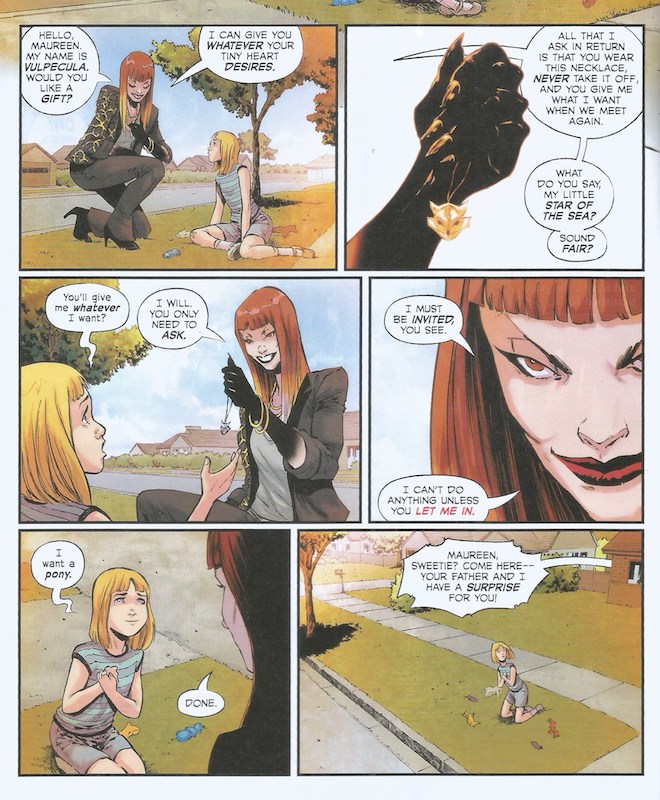
A smashing name. Vulpecula is a being from another dimension who wants to go home. The trouble lies in how she intends to get there.

Though she's technically a visitor, or tourist if you prefer, she's clearly boned up on earth history during her time-travel trips. For that reason she knows not to underestimate the Dark Knight.

Primarily though, Vulpecula uses her amazing abilities to slide through the timeline of anybody she touches or intimately contacts. She performs these deeds to seed items that require time to mature.
Vulpecula needs a critical mass of Nth Metal to open a portal to her dimension. Hawkgirl is her prime target. She is suffused with Nth Metal.
Axelrod's manipulation of the Nth Metal as a plot-link provides a strong explanation that among other things answers the question why now does Vulpecula unleash her schemes.
Hawkgirl has been exposed to Nth Metal for most of her adult life. Galaxy just fixed the conflict between human and Thanagarian intake of Nth Metal. So, all of these attacks make sense.

The fourth issue of Hawkgirl gives readers the payoff to the promise of Metropolis. Hawkgirl teams up with Supergirl and Steel, alias Natasha Irons, for a battle against a dragon unleashed by Vulpecula.
Intriguingly, Axelrod offers this as a new beginning to the Hawkgirl series for people who missed the first three issues. It's a winning technique.

Synchronously with respect to the innocuous gathering, Vulpecula ensorcels Galaxy in her time-traveling schemata.

Axelrod takes this opportunity to demonstrate that Vulpecula is not completely without empathy. For example, she understands the vulgarity of war.

This conscience explains why she's a trickster-villain and not a villain with delusions of grandeur. She makes a deal with people. She gives them something they want at a young age. She takes them when they're ripe; after they've reaped the benefit of her part of the bargain.
At heart, Vulpecula simply wants to go home. Her desperation and her belief that the ends justify the means makes her a villain.
The fact is that Vulpecula had nearly infinite opportunities to simply ask for help to get home. However, she doesn't really see mere mortals as anything but lower lifeforms. Even Kryptonians.

Here again. Axelrod characterizes Supergirl, one of my favorite DC superheroes, particularly well.
Supergirl is more playful and humorous than her esteemed cousin. Superman is much more reserved, unless standing next to Batman.
Superman would never puckishly tease Natasha Irons like that. Supergirl? Oh, yes. She would. She grew up with Kryptonian culture. She is more Kryptonian in mind than Superman. Supergirl gets the job done and has fun doing that job.
Supergirl saving the day doesn't factor into Vulpecula's plans. Thus, she bequeaths Kryptonite fire to the dragon.
Vulpecula orchestrates a superb sleight of hand. She dupes Galaxy from the very beginning to fortify Hawkgirl so that she can contend against the dragon, that she transported to Metropolis. This is all a bid to get close enough to Kendra in order to slide into her past.

Axelrod devotes an entire issue to Kendra Saunders. Not Hawkgirl but the girl who will become Hawkgirl. Unsurprisingly, every superhero has a happy childhood.

Before tragedy strikes, Bruce Wayne is loved by his parents. Before Krypton explodes, Superman is loved by his parents. Hawkgirl is no different.
It's really nice to see somebody building up Kendra beyond her reincarnates. Bonus that Axelrod entwines this trip down memory lane with the main plot.
Vulpecula however runs into some turbulence as she tries to make a deal with Kendra.

This of course isn't the end of it. Vulpecula has gone far to see her seeds of devilry fruit. She's not giving up now, just because of unforeseen circumstances. Of course, now she's combatting more than just a strong child.

Despite the stress being caused by a fanciful reason, I think every woman can probably sympathize with Kendra. Guess what. Hawkgirl made it through all of this. She's a survivor. Kendra is a survivor. That's one of the reasons why she's engaging.

This crescendo of the series pits Hawkgirl against Vulpecula in her own dimension. The key is that by hook or by crook Vulpecula intends to win. The crook part of that is the problem. Careful reading predicts her comeuppance and the uniqueness of Kendra ultimately saves the day.


