Showing posts with label Chu. Show all posts

Tuesday, August 31, 2021

POBB August 25, 2021

Pick of the Brown Bag
August 25, 2021
by
Ray Tate

Welcome to the newest Pick of the Brown Bag.   I'm your comics guru, Ray Tate.  For this posting, I take a tour of the new DC Wonder Woman title Sensational Wonder Woman.  A play of words on Wonder Woman's original home.


Sensational Wonder Woman is ideal for somebody that doesn't want to subscribe to Wonder Woman and/or doesn't want to get involved in a story arc.  This reader likes Wonder Woman, not necessarily her continuity, and the occasional good Wonder Woman adventure. 

Sensational Wonder Woman consists of stand-alone Wonder Woman tales with differing writers and artists.  Continuity is flexible, and so far DC published six issues.  The first I reviewed in depth earlier.  

The second issue of Sensational Wonder Woman by Andrea Shea pits Wonder Woman against frequent foil Artemis.  It didn't  start out that way.  Wonder Woman answered an sos from Artemis.  They nevertheless end up fighting in the gladiator pit on War World.  How they reach this point offers a twist or two.


Even if you don't know what a War World is, you'll catch on quick.  Older fans will be surprised at some of the new wrinkles in the shtick.  Of course there's always the tried and trusted.


Master of War World, Mongul becomes involved in the duel, and there's much rejoicing when Wonder Woman and Artemis soon hand this perpetual loser his ass.  

Mongul only had one moment of Bronze Age glory, which is one better than Kobra.  In Alan Grant's and Dave Gibbons' "For the Man Who Has Everything," the feature of a Superman Annual, Mongul overcomes Superman with the Black Mercy and stands toe-to-toe against Wonder Woman.   


If you gave Ally Babble an immersive hallucinogenic weed, he would have partially succeeded as well.  Come to think of it.  So would Kobra.  I'm also pretty sure Wonder Woman had the sniffles that day.

The art of Sensational Wonder Woman by Bruno Redondo is absolutely mouth-watering.  Dynamic anatomy in multiple clashes, and Redondo is equally adept at depicting the quieter moments.

In the third issue, Colleen Doran brings her skill for writing and art in a tale that depicts a kind of day in the life of Diana.  First Wonder Woman explodes onto the scene.  


The sharks are in fact Megs, which have somehow become the royal escorts of Themyscira.  They also show up in the adventures of Young Diana in the backup feature of Wonder Woman.  I don't recall them appearing anywhere in the Bronze Age, the television series or the films however.  Oh, well.  Not important.

After a meet and greet on the beach, a local blaze, not Johnny, quickly catches Diana's attention.  During the focus on Wonder Woman, Doran reboots one of Wonder Woman's nineties cast members, depicted on the cover.


She looks quite different.  So, this isn't a spoiler.  I never had any affinity with the cast member.  Still, Doran demonstrates the woman's worth and her sense of ethics in business.  That puts on a different spin.  

Doran's Wonder Woman gibes with the Lynda Carter version of the character.  She's friendly, an idol to millions of people and casually powerful.

In the third issue's side B Alyssa Wong throws a "Museum Gala" with invitees Diana Prince and Bruce Wayne.  


Mr. Freeze shows up, and Wonder Woman, who seldom needs to protect her secret identity, even when she had one, goes into action.

This story works through a combination of wit, the friendship between Diana and Bruce as well as the cartoony, energetic art of Eleonora Carlini.  Colors by Enrica Eren Angiolini add pizzazz.

In the fourth issue Corrine Bechko opens her story with Diana attending a climate change conference.  There she meets a woman who claims to be able to control the weather by moving the clouds to where they need to be.


Of course, this is a potty theory.  Nevertheless, she makes it rain without placing a single bet on Draft Kings.  Unfortunately the experiment gets out of hand, and Wonder Woman under the auspices of artist Dani finds herself battling her old enemy the Blue Snowman.

Nope.  I never heard of this character before either.  Can the wikipedia save us?  Apparently so.

A secret villain pulls the Snowman's strings.  This villain is well known to Wonder Woman fans.  Bechko though in dialogue shorthand explains what you need to know.  Even had you never read a single issue of Wonder Woman, you would still know what floats the boats of both foes.


With the fifth issue, Amy Chu teams up with Maria Laura Sanapo for a time-spanner that delves into Wonder Woman's World War II history as well as her current history.
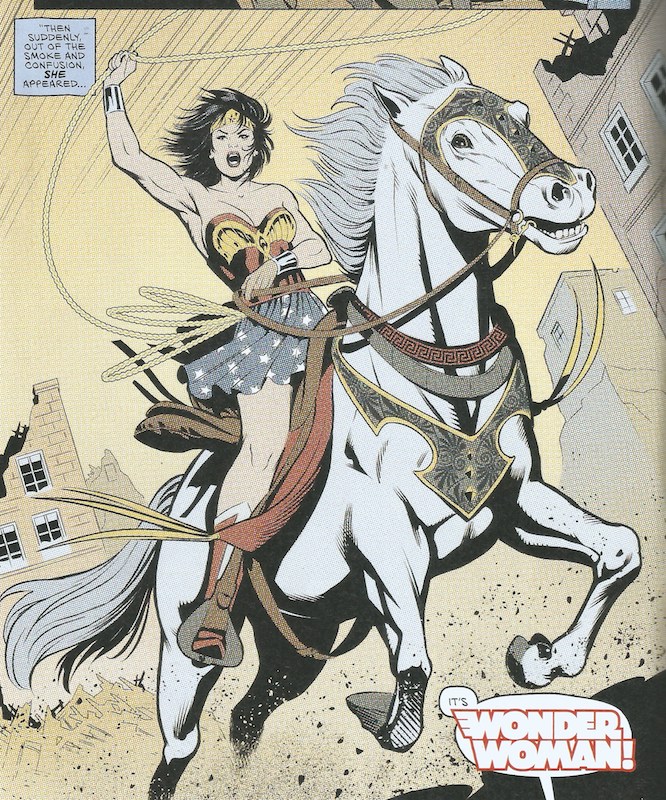

This issue is a good example of how Sensational Wonder Woman doesn't follow the rules of continuity but looks at the historical canon.  

Since the nineties DC Comics eschewed Wonder Woman's World War II history.  George Perez reintroduced her as a contemporary character.  Subsequent reboots followed suit.  

Chu and Sanapo instead embrace Wonder Woman's immortality and present her as a Nazi fighter and an everlasting symbol of justice and feminism.


An elderly woman relates the story of her long friendship with Wonder Woman, but this history threatens her existence.  Since nobody believes her.  For the same reason, mad science in a comic book is just science, it will come to nobody's surprise that Katie speaks the truth.  

Yes, Chu's story is predictable, but nobody wanted to see this sweet, old woman put out on the street because of a potentially hyperactive imagination.  It would have been a disappointment had Wonder Woman not shown up, validated Katie's recollections and saved the day.  This isn't a Black Label book.


Sina Grace in the most recent issue presents a collage of Wonder Woman continuity.  Paul Pelletier is just the artist to illustrate this fun little villains team-up.  First, Artemis leads the Amazons on an attack on Parliament.


The opening scene reflects the universally reviled mini-series Amazon Attacks.  However, Diana knows something's up on page three.  

It doesn't take six miserable issues to find out the gist of it all.  Let me just say at this point.  I love Paul Pelletier's, Norm Rapmund's and Adriano Lucas' art even when Pelletier is not having characters bash each other's heads in.


That moment of realistic body language is just beautiful. Enhanced by the subdued colors.   

Diana's investigation leads her to Themyscira where she meets the first attacker from her Rogue's Gallery.  I don't really count Artemis as a rogue.  She's more of a hot-headed rival.


The design on Silver Swan is modern, and it's clear to me that Sina Grace didn't want to muddy the very streamlined plot with the question of the Swan's secret identity.

If this version of the Silver Swan were in fact Vanessa Kapetelis, Diana would have referred to her as Vanessa and try to reason with her friend.  As such, this is just the villain Silver Swan, an impediment to be squashed.

In a bit of a battle twist, Wonder Woman meets the host of this fight dance toot sweet.


If she looks familiar, you're not mistaken.  This is Queen Bee the head of HIVE.  Though this may not be the Queen Bee you're familiar with.  

Over the years, Queen be transformed.  Originally a Silver Age foe against the Justice League, the alien Bee became decidedly human or at least more humanoid in the nineties as a femme fatale in the Giffin/DeMatteis/Maguire League.  Grant Morrison returned her to his JLA as an alien menace.

In the New 52, she became the blonde fusion you see in Wonder Woman and the head of old Superman turned Teen Titans baddie group HIVE.  HIVE stands for...er...a little help?


Queen Bee not in a sharing mood continues the boss fight section of Wonder Woman.


Giganta inspired by the 1943 film Captive Wild Woman and the 1958 shlock Attack of the Fifty-Foot Woman.  Introduced as an ape turned woman in Wonder Woman #9 and given the size changing powers sans simian history in the classic Saturday morning treat Challenge of the Super-Friends.  


We also see Dr. Poison looking extremely uncomfortable in full leathers on the tropical Paradise Island.  This is a deucedly fun exercise that's dependent on the smooth mix of easy-going dialogue full of quips and barbs, some hilarious use of Wonder Woman canon and of course Paul Pelletier's ability to illustrate every character in the DC Universe to perfection.

Wednesday, March 14, 2018

POBB March 7, 2018

Pick of the Brown Bag
March 7, 2018
by
Ray Tate

Welcome to the Pick of the Brown Bag, my name is Ray Tate, and every week I review comic books.  For this installment, I look at Batman, The Green Hornet, Green Lanterns, Infinity Countdown, Oblivion Song and X-Men Red.  Tweeted teensy-weensy capsular reviews can be found on Twitter: #PickoftheBrownBag.


Tom King's Batman can be read story by story, issue by issue.  It can also be read as a whole run.   You don’t need to do this. You’ll simply get a richer experience if you choose to do so.  

King's debut "I am Gotham" introduced the heroes Gotham and Gotham Girl.  Two youths saved by Batman who wanted to pay it forward.  To that end, they gained superpowers with the hope of joining Batman’s crusade.  The duo saves Batman’s life upon their first meeting.  


You may ask how does this story affect Poison Ivy’s latest ploy.  It doesn’t.  Not really.  However, one may also ask why is Catwoman working side by side with Batman? Or more to the point.  Why this time? 


The answer to that question can be found in past issues of Tom King’s epic.  Batman recruited Catwoman to infiltrate Bane’s island nation.  He needed to abduct the Pycho-Pirate to undo the psychological damage inflicted upon Gotham Girl.  Gotham Girl once cured gained insight into Batman's psyche.  Through what appeared to be a simple conversation, but was in fact a gentle probing, she did what she and her brother Gotham set out to do.  Help Batman.


The conversation between Batman and Gotham Girl explains Catwoman's presence.  That dialogue explains why Batman inoculated Catwoman against Ivy’s latest concoction.  Batman and Catwoman are together fighting Ivy.  


In a previous review, I suggested that Catwoman and Ivy don't actually know each other or like each other.  That may have been presumptuous.  King clarifies their relationship in another scene.  It's not the friendship depicted in askew DC book Harley Quinn, seen above.  

You should look at King's run as a chapter-play novel, distinct from the abundant continuity of DC Comics.  King draws from that well, but it's not exact.  At some point Catwoman and Ivy met and fostered an amenable relationship.  That doesn't mean the bond is derived from anything actually published in the past.


The rationale behind Ivy’s scheme lies in the past created by King.  King directly references the events in “The War of Jokes and Riddles.”  You do not need to know this information, but you’ll have a more rewarding experience if you read that chapter.  "The War of Jokes and Riddles" characterized Tom King's version of Poison Ivy.  A killer of men.  A defender of the Green, and the planet in general.  These actions motivate her plan in the current issue of Batman.


You can tell by the cover that Ivy used her botanical genius to possess the Justice League.  Batman and Catwoman are not just battling Ivy but also the League turned into pawns.  Batman recently teamed up with Superman and Wonder Woman in two of King's bookends.  Little did we know that King used those tales to foreshadow the confrontation here.  He furthermore had a hand in the Batman/Flash crossover.  The Ivy-controlled Flash appeared last issue and returns this issue.

I've said in the past that mind control is one of my least favorite plot devices, but perhaps that's because of the sloppy execution.  King's method is anything but, and Batman detects the source of Ivy's power.  He deduces a flaw in Ivy's supposed perfection and uses that knowledge as a weapon.  Mind you, Batman's one crazy son of a bitch for doing this shocking thing.  Goading Ivy, Batman triggers a scenario that makes you gasp.  More than just for the sake of horror, King utilizes the event to once again add depth to Ivy.  Demonstrate her limits and define her villainy.  He advances Batman's plan to thwart his foe in ways that even surprise the most invested Batman fan.


Created by George Trendle and Fran Striker in 1936, The Green Hornet and Kato fought the criminal underworld first on radio then in comic books.  They next buzzed through two serials, and in the sixties, Van Williams and Bruce Lee embodied the duo. 


The Green Hornet returned about thirty years later.  Now Comics produced the longest run of Green Hornet comic books.  In these issues, Kato’s daughter became the partner of the new Green Hornet.  The owners of the license while appreciating the change felt that Bruce Lee could only be Kato.  So an older Kato resumed the role.  

The Green Hornet premiered on the silver screen in a less than successful movie, but this newest stab catalyzed Dynamite to publish new Green Hornet adventures.  I was keen on them as much as I was enamored by their version of the Shadow and berry-juice Phantom.  Happily, the newest Green Hornet series makes the recent past moot.

The Green Hornet shares the same conceit as the Phantom.  Both are defined by legacy.  However, the adventures don’t really reflect that legacy.  Now Comics radically changed the Green Hornet.  Concert pianist and composer Paul Reid nephew of Britt Reid became the Green Hornet.  Every other Hornet however is Britt Reid, crusading newspaper publisher of The Daily Sentinel.


Britt’s disappearance is the source of renewal.  When it comes to heroes, periods of absence, rumors of death are occupational hazards.  Kato stays optimistic.  It’s only when somebody tries to besmirch the legacy that he and his daughter take action.


Green Hornet’s seedy ruse sets him apart from other heroes.  The Hornet pretends to be a criminal boss that already owns the city.  He allows other criminals to operate only if he gets a taste of the honey.


Britt’s disappearance behaves as a power vacuum.  Would-be hero Hornets aren’t trying to follow in his footfalls.  Felons are.  Only the Katos and the Hornet’s allies know the truth about the Green Hornet.  So they must provide a suitable descendent.  

Amy Chu impressed me with Red Sonja, and she makes a good first impression with the Green Hornet premiere.  In many ways she does the same thing.  She sets the timer back to what the fans already know.   Then she begins relating her new take which includes an apropos joke involving Pink Panther lore.   

Artists German Erramouspe and Brittany Pezzillo demonstrate a mastery of Green Hornet atmosphere.  They spotlight the criminal world that the Hornet inhabits and violent spurts of action reminiscent of the Van Williams/Lee series.  The new Green Hornet era begins.


Using the fictional app Caper, Green Lantern Simon Baz hooked up with the new hero Night Pilot and didn’t really think anything would happen beyond that one night.   Little did Simon realize that Caper was in fact a means to select candidates for an interstellar superhuman trafficking ring.  Night Pilot, the latest victim. 


In a past review, I credited Green Lanterns writer Tim Seeley with the original idea.  A POBB reader pointed out that Amunet the Brit villain played with wicked glee by Katee Sackhoff from The Flash utilized the twist first.  


I’m not sure that’s accurate.  Amunet Black debuted as a crime boss.  Killer Frost owed her a debt.  Neither indentured servitude or human trafficking came into play until much later.  I’d argue that Seeley and the writers of The Flash conceived the idea about the same time and neither influenced the other.  Still, The Flash did much more with the concept.  Unfortunately, Seeley’s story is faltering.

Baz and his partner Jessica Cruz take their investigation into superhuman trafficking to their superiors, and what they find is green tape.

I’m not crazy about this whole idea of a legalese subset of the Green Lantern Corps.  It’s a silly idea.  The Lanterns have plenty of evidence to warrant a Green Lantern Corps jamboree upside the Church of Steed’s metaphorical head.  The Justice League would have happily invaded the Nebula to Free the slaves and break some slaver bones.


Instead, the Lanterns must perform another infiltration.  Their tactic repeats the previous issue with less imaginative disguises and a montage of action that substitutes for actual subterfuge.

Their contact in this whole shebang is Scraps, one of the new Omega Men, incidentally identified by the ring as terrorists only two issues ago.


Scraps behavior also puzzles me.  She expressed no regret over her actions and only co-operated with the Lanterns under duress.  Now, she’s a gung-ho vigilante who claims ignorance to the superhuman trafficking.  Where is this coming from?


What started out as a good idea is now wearing out its welcome.  The impediments to the finish line strike me as contrived, and the added implementation of a tiresome plot device combined with wishy-washy characterization force me to suggest that you skip this issue of the Green Lanterns.


X-Men Red began when Jean Grey attempted to broker a peace between humans and mutants.  Unbeknownst to her an enemy from the X-Men's past lethally sabotaged the efforts.  Because of this event televised live, Jean and the X-Men she asked to help her forge a dream are on the run. Wakanda and Atlantis of course granted Jean and the X-Men asylum.  That doesn't make her feel any less guilty about her efforts. 


Tom Taylor and Mahmud Asrar in many ways do the same thing that Tom King does in Batman.  They work within their own continuity.  For example, Nightcrawler may look even more grittier on the cover of X-Men Red, but as you can see in the graphic, he just looks like the same old Kurt Wagner.  Taylor in turn does not explain Jean's return.  She just has.  Although, he's currently guiding the adventures of Wolverine and her clone sister Honey Badger, he lets their dialogue and personality speak.  Taylor furthermore fools me.


Trinary is an original mutant creation from Taylor and Asrar.  It's the last thing I'd expect from an X-Men book.  X-Men writers are content to throw mutants at the reader without any explanation.  They expect anybody that picked up an X-Men book attended X-Men State University and knows what color toothbrush Sunfire uses.  Trick question.  Sunfire doesn't have to brush his teeth.  He can just burn them clean.  In any case, Taylor introduces a new mutant, makes her pertinent to the story and uses her in a statement decrying misogyny.  


Trinary faces betrayal not because she's a mutant but because she's a woman. That evokes an even sadder realism.  Fortunately, for Trinary, the X-Men are coming to get her and less you think that the book is too philosophical...


...A montage of X-Team action speeds the pace of Trinary's rescue and induction into X-Men Red.  The reference to the Green Lanterns isn't accidental, but Taylor's and Asrar's tactics for the X-Men are better paced and executed.  Furthermore, nobody's acting out of character.


This issue of Infinity Countdown is actually Guardians of the Galaxy.  Now, I don't know why there would be fans of the Infinity Stones that would object to the Guardians of the Galaxy, but I'm laying it out for you.  If you're not a Guardians of the Galaxy fan, and I can't imagine anybody that fits this profile, then you can comfortably skip this chapter.  For everybody else, strap yourself in because this is an issue of Guardians of the Galaxy that actually feels as whacky as the films.  The story begins with Fargo via Nova.


That's Eve Bakian, the pregnant Nova that the Guardians met during their investigation into the Nova Corps.  Shi'ar assassins known as the Talonar placed moles in the organization.  The Guardians ferreted them out.  Perhaps Raccoon-ed would be a better word.  Since Rocket was all over this assignment, and he deduced the identities of the spies.  Eve and her Novas are some of the good Novas, they remained planet-side to guard the Infinity Stone of Power, which swelled to the size of a skyscraper.  Telling you this doesn't really spoil anything because the Infinity Stone is actually a MacGuffin.  The whole point of this part of the story is to send the Talonar into the welcoming hands of Drax.

He's not a fan.  Drax's dialogue and his actions is pure cinematic goodness.  He's absolutely hilarious in the destruction of the Talonar.  The example scene is just a sample of Drax's ingenuity when fighting the Talonar.  Drax for example attempts to use Talonar accoutrements to ease his mission of smacking them silly, and succeeds in Drax fashion.  This is where a classic rock song might play in the film.  The timing of the moment and the other comedic beats belongs to artist Aaron Kuder.  


Drax is the Guardian that involves himself the most with the Infinity Countdown.  The other Guardians are busy cleaning up the trash of a sub-plot from Gerry Duggan's premiere issue of Guardians of the Galaxy.


Guardians of the Galaxy readers know that something stunted Groot's natural ripening.  They also know that somebody was planting crazy versions of Groot big and small.  That somebody turned out to be an Elder of the Universe.  Also featuring big in Guardians of the Galaxy.


While beating the snot out of an Elder of the Universe certainly generates a lot of fun.  Duggan surprises with even stranger developments.


Robert Kirkman's Oblivion Song at first seemed like a typical post-Apocalyptic genre bender, beginning with hunting humans in a nuclear wasteland.


I actually sighed at this scene.  I keep telling you.  If one nation launches a nuclear strike at the United States.  Every life form on this planet is going to die.  The lucky ones will experience the quick flash frying at ground zero.  The rest of the populace will suffer from breakdowns of the immune system and cancer followed by a slower death.  There's no way out of this.  It doesn't matter who fires first.  Automated spoilsport systems will finish the job.  Anyhow, Kirkman wants me to think his new world is cool.  I can taste the manipulation.  I'm supposed to root for the hunter.  The killer.


He's got a gun and a cape.  Of course I must root for him.  Yeah.  Right.  So, my sighs grow deeper.  Even when a giant monster shows up with an appetite.  


Then, something happens.  I turn the page, and I realize that Kirkman counted on me feeling this way.  Oblivion Song isn't actually a post-Apocalyptic story at all.  It's a science fiction story that shares far more in common with the 1950s films than 1980s nuclear survivor movies.  


The hunter turns out to be a scientist.  He's not actually hunting humans.  He's saving them, and I don't mean that he's shooting them to put them out of their miseries.  He's doing something quite different, and that's why Oblivion Song is worth your time and coin.  


Kirkman employs 1950s archetypes with depth to relate a story that he addresses on multiple levels. The difference also lies in the way he unfolds the tale.  In 1950s, the government of creature features saw eye to eye with heroic scientists,  Certainly the Powers That Be first scoffed at the very idea of giant grasshoppers or deadly mantises, but eventually they came around and combined forces with the brains of the outfits for the common good.  Religion didn't even enter into it unless in a rare instance one of the stars recited a parable from The Bible at the end.  In Oblivion Song, Kirkman's hero butts heads with budgetary concerns, a callous government and religious yahoos.  His reasons aren't entirely altruistic, but they're certainly more noble than shucking his duty to humanity.  No, Oblivion Song isn't the book you think it is.  It's way better.