Showing posts with label Spider-Woman. Show all posts

Wednesday, March 25, 2020

POBB March 18, 2020

Pick of the Brown Bag
March 18, 2020
by
Ray Tate


Good Night, Major.
You always brought a smile to my face.

Welcome to the Pick of the Brown Bag.  In these trying times the Phantom of the Attic still came through with a bounty of comic books, and we have some reviews that just couldn't be included with the previous editions of this posting.  Up to date decisions however can still be found on Twitter: #PickoftheBrownBag.

As you may have learned Diamond, after this week, will no longer distribute comic books.  The floppies anyhow.  This is due to the fact of unfortunately necessary stay-at-home orders and government shut-downs to business.  

What this means to the POBB is this.  After the current posting, there will be one final issue of the blog as you know it.  The POBB is not going away, but it's going to change.  

I have a number of comic books and graphic novels in my collection, and I think I'll review them.  As always, I'll try to avoid major spoilers, unless it's a classic.  In which case, I may decide to showcase the issue and spoil the hell out of it.  You'll be warned of course.  

If you're wondering about online comics and such.  Yeah, I might.  Maybe.  I'll probably still be reading, but you know what? Not as quickly.  

The portability of the floppies as well as that of magazines was a major attraction.  I have never gotten used to reading things on-line.  I didn't grow up in that era.  Enough doom and gloom.  Let's get on with the current issue of the Pick of the Brown Bag.


In a previous review, I praised Adler for not taking Sherlock Holmes out of the picture.  Unfortunately, the book does indeed substitute Irene Adler for Sherlock Holmes.  


"The Adventure of the Sussex Vampire" is a canonical Sherlock Holmes short that elegantly applies reason to a supposed supernatural event.  With few clues, Holmes at his best solves a confounding mystery.  Doing most of the thinking on the train ride to the scene of the crime.  Damn!

The detective Professor Moriarty mentioned in the debut of Adler appears to be another Victorian literary figure who shows up this issue.


It's certainly novel.  I'll give you that.  Phileas Fogg is of course the protagonist from Jules Verne's Around the World in Eighty Days.  


So where does that leave me? Difficult to say, since this issue of Adler focuses on the villains of the piece.  


In that respect Adler succeeds admirably.  Carmilla is Sheridan Le Fanu's lesbian vampire.  She is one of the most transformative figures in literature, and it's a surprise that she appears quite early in history.  

The world of film would be a different place without Carmilla.  Carmilla became a major influence not just to horror but to lesbian film in general.


Dracula's Daughter (1936)

In Adler, Carmilla serves Ayesha.  Created by H. Rider Haggard for the novel She, Ayesha is also known as She Who Must Be Obeyed.  I know you've heard the phrase, but what you may not know is that it originates from Haggard's novel.

Ayesha is an immortal queen who learns the ways of magic and preserves her two-thousand year old body with supernatural flame.  Any man who sees her will instantly fall in love with her.  Prostrating themselves before her.  The enchantment seems to work on lesbian vampires as well.  

I love this imagery by Paul McCaffrey.  It demonstrates the sensuality of the relationship and indicates that the feeling may be one-sided.  There is nothing but ambition in Ayesha's eyes.  The dispossessed queen may not be satisfying any of Carmilla's needs.  She instead may see Carmilla as a killing tool, but a dangerous one.  So, she allows her a modicum of familiarity.  Though perhaps not the freedom to enter her bedchamber.

Haggard granted Ayesha empathy through a love story subplot.  However, she was power mad and killed to get her way, no matter how petty the desire.  In Adler, writer Lavie Tindhar bestows Ayesha dignity through her resistance to British Imperialism.  Irene as well expresses a distaste for the practice.  Ayesha saves Jane Eyre's life.  Her motivation in this case appears to simply be sisterhood.  Jane is Irene's Watson.  I have no idea why.  I can only assume that Jane's common name with Miss Marple, not a public domain figure, triggered the inclusion.


Jordie Bellaire reestablished Vampirella in the nineteen sixties where she meets a time lost Red Sonja.  Together they solve a real life mystery and put an end to a Soviet experiment.  

After that Bellaire produced two-stand alone tales for each female hero.  He then introduced a time-tripping element that confused and irritated me.  I thought this would be a series where Red Sonja and Vampirella would adventure in the sixties, not backwards through the ages.  However, I'm willing to overlook a premise if the story's good.  This issue is pretty good.

After leaving some medieval fantasy nonsense, Red Sonja and Vampirella find themselves in the roaring twenties.  Here they're under the gun.


Not to worry, neither is any slouch in a fight.  After disposing of their would be attackers, by non-lethal means, V and Sonja pull a classic switcheroo.


They find a clue in the pocket of one of the goons and decide to rendezvous with the unknown parties.  Feeling peckish, Sonja decides to sate her hunger.  


The rat objects.  The rodent is actually the witch that gifted Sonja with the Generation Stone, which allows her to travel through time.  Instead of eating the rat, Sonja incorporates the witch/rat into her ruse.  Further investigating uncovers crooked cops common to the period.


The whole shebang is in service to horrors that manifest only after Sonja and V scratch the surface.  None of these developments are common to the period.  

The pace moves at a fast clip.  Vampirella and Red Sonja's interaction is a hoot, and they're on the same page regarding what's hidden in the dark.  


In Tom Sniegoski's Vengeance of Vampirella, Vampirella relates how she became a monster.  In this stand-alone tale, Vampirella claims to be a split personality.  One side human. The other a creature.  

In reality, by the tale's conclusion, you'll see that Vampirella is in fact all too human even if in actuality an alien.  

The story takes place in a relative calm period in Vampirella's life.  She's working with the Danse Macabre.  An organization that confronts the supernatural.  


The untamed jungle seems to affect Vampirella, and this is an original idea.  Vampirella's release of the beast so to speak isn't due to any stress involved in a typical battle with an unstoppable foe such as a Golem or what have you.  She's basically using her abilities to combat nature and becomes more savage as the world reverts to a primeval state.

It gets remarkably worse as Vampirella struggles through the unchecked flora.  She encounters carnivorous plants of all ilk  and a callback to Charlton's Phantom.


This allows artist Robert Castro to show that he's not just dynamite with the depiction of a painfully sexy woman that walks around with spaghetti straps covering her erogenous zones.  He's also a skillful illustrator of dynamic action.   

The spider encounter is just one of many allusions.  Her whisper of "Satyr and Circe..." is reminiscent of Wonder Woman's Greek exclamations such as "Suffering Sappho!"  In a humorous sequence she basically encounters some Terry Gilliam inspired Trolls followed by dryads.  She is also welcome when saving the day.


As I have suggested in many a review, Vampirella isn't so much a monster or creature as a horror-themed superhero for an adult audience.  This idea Sniegoski conveys in the consistent tension.  The tale's antagonists are pulpy, but Vampirella's narration is not.  Her bemusement of the cockney speaking Trolls is her only respite from an otherwise harrowing encounter that ends logically but tragically in a deliverance not from evil put unbridled power.


In Vampirella's mothership title, Christopher Priest details how her enemies brought down the plane that she and witch boy Benny were on.  This reads like a Mission Impossible styled espionage piece that's conducted by the anti universe Jim Phelps and the IMF.  The spotlight lies on the villains, but Priest also includes an operatic ending for one of the cast as well as a incremental descent into madness for another.


Captain Marvel is a showstopper conclusion to the latest story in which a fruitcake cosmic wannabe forced Carol to kill the Avengers for him.  Early in the tale, I had serious misgivings and doubted writer Kelly Thompson.  

I'm still not happy with that brutal fight against Iron Man.  I'm not a fan who wants to see superheroes duel.  These things usually bore me to tears, and the fisticuffs end up being the equivalent of padding in an ordinary drama.


So naturally, Carol hasn't been killing Avenges.  She's been pocketing them in another dimension while turning in handy dandy clones in substitute for their bodies.  
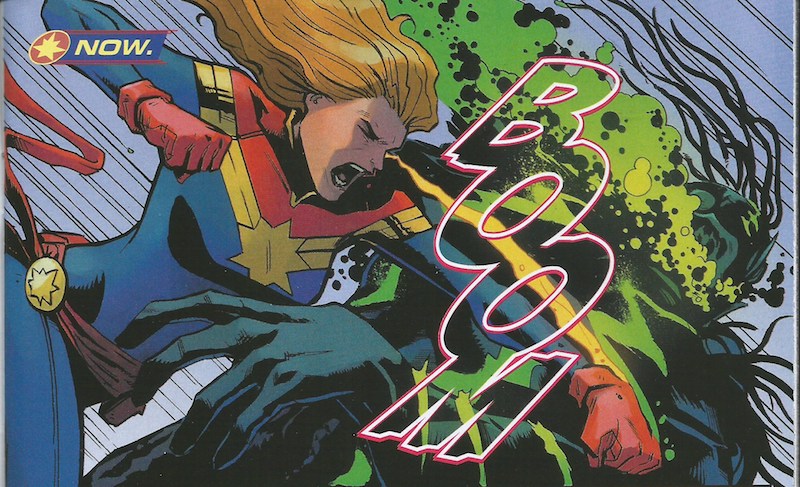

This afforded Captain Marvel time to learn Vox Supreme's plans, most of them and give Tony Stark the opportunity to brainstorm a way out of the mess.  

It all comes to a head this issue.  Carol beats the snot out of Vox Supreme while the Avengers rescue the innocent, but my telling you this doesn't cover the wonderful twists in that fight.  The graphics I've included only give you a taste of the startling visuals to come.


Spider-Woman is Jessica Drew.  A long time ago, in a hidden city on Mount Wundagore, uranium deposits irradiate young Jessica to the point of death.  To save her life, her scientist parents and the High Evolutionary place her in cryogenic stasis while they work on a cure.  They derive this cure from the venom of multiple spider species.  That cure grants Jessica spider-like powers as well as an immunity to poisons and a venom blast.  She also once issued a unique pheromone.  Exposure either turned you on or turned you off to her.  When Jessica emerges in this altered state, she emerges as a young woman.

Why bring up old history, asks you? For one thing, Karla Pacheco's story recalls a lot of it, not in specifics but in characterization and action.  After being shunned by the High Evolutionary's Moreau Project, Jessica fell under the thrall of HYDRA and ended up fighting the Thing in Marvel Two-In-One.  She leaves HYDRA, not on good terms, of course, and becomes a criminal to survive.  In London, she meets SHIELD agent Jerry Hunt who eventually turns her to the good.  Pacheco's tale starts off thusly...


A billionaire named Marchand hires Jessica to be security at his daughter's birthday party.  This ends up being more than a milk run.  Though milk men do appear.


A lot of Jess' battles capture the flavor of the original stories.  For one thing, they were more mature in nature. That expression on Jess' face is indicative of a series of hard knocks delivered by life.  She gets back up again.

The violence choreographed by Pere Perez is more realistic in nature and edged sharper than most depictions.  When Jess' best friend beats the tar out of Vox Supreme, she's a Kree smacking around an inky alien.  It's a level removed from reality.  Jessica is fighting mortal men and holding back just enough to avoid a kill.  Jessica's fighting while ill.  This sickness is a callback to the feelings of loneliness due to the consequences of the pheromone.


Even the fantasy super heroics bear a certain amount of creepiness that became a Spider-Woman signature.  Unlike Spider-Man, Spider-Woman told no jokes.  She silently stalked from a variety of vantages before waylaying the villain with a venom blast.  It's for these reasons Spider-Woman will appeal to faithful fans of the character.  

The back up story is geared more for the modern Spider-Woman reader.  Here we see Jess with baby boy in tow.  Indeed, while Jess' struggle to make ends meet echoes the past, it's very much a present day problem as well.  Avengers get stipends, but Jess is no longer part of that team.

During this immediate past event, Jess gains a new costume and a host of problems.  Artist Paulo Siqueira gives Jess a lot more pulchritude in this short, but he also grants a powerful musculature.  This is in fact a return to the character, since Siqueira is the original artist for the 2000s Captain Marvel, where she guest-starred.

Tuesday, August 20, 2019

POBB August 14, 2019

Pick of the Brown Bag 
August 14, 2019
by
Ray Tate

Welcome to the Pick of the Brown Bag, in this review blog, I examine the previous week's comic books, so you'll be ready to pick them up or save your coin on your next visit to your local shop.  This week's subjects include Captain Marvel, Catwoman, Detective Comics, Fantastic Four, Friendly Neighborhood Spider-Man, JLA and Black Hammer, Outer Darkness, Red Sonja, the Unbeatable Squirrel Girl,  Unearth and White Trees.  In the Spoiler Section I’ll look at Doctor Who.  As always, should you not have the time to read the entire blog, or even skim through it, you can check me out on Twitter: #PickoftheBrownBag.  This week, I'll mention some of the books that were all right but didn't merit a full review.


Before specialty comic shops, I used to subscribe to Peter Parker the Spectacular Spider-Man.  As in, it would arrive by snail mail.  When the newest version of the Spider-Man title hit the stands, nostalgic feelings convinced me to give this old favorite of mine a chance.  I liked Chip Zdarsky’s Spider-Man writing.  You can find several reviews on this blog dedicated to each issue.  I wish I could speak so highly of Zdarsky’s White Trees.  

Zdarsky made me balk during the first clutch of dialogue.  He throws out alien names at me.  Bad enough “Sir Krylos the Bold is the son of Sir Tanghar the Proud and Lady Sherock, the wild general,” but I apparently also need to know Sir Krylos grows “tantaflower and grains” and “The Trilonians have been advancing south again.” All within three bloody panels.  It just gets worse from there: Seatonia, Cannahn, General Targrand, Trahlax Gate.

When creating a language rules apply.  Klingons, Romulans, Vulcans.  Roots and cadence explain why Star Trek alien names are so resonant.  Optimus Prime, Megatron, Starscream.  Daleks, Cybermen, Zygons.  Rutans, Sontarans, Silurians.  Leonardo, Michelangelo, Raphael, Donatello.  Venus De Milo, the female Teenage Mutant Ninja Turtle.  They didn’t just call her Bertha.

All of the White Trees names amount to gobbledygook without any real backing.  They contribute to an overall lost feeling.  You named them, but I have no idea who these guys are.  Cat dude? Gracefully aging Human? Native American Village People Elf?


Sure, I get some explanation as the story unfolds, but on the whole they’re a trio of Dungeons and Dragons amalgams with some sexual fluidity thrown in for spice.  


No! Not Jaxward! Not Shelan!  Wait.  Who?

Actually, these Dungeons and Dragons characters have more personality and uniqueness about them.


I get that the sausage party is looking for their kids; abducted allegedly by their former enemies.  I still don’t know what they did to deserve this revenge.  Were they honorable? Dishonorable? Did they just live too long? What stirred up the pot?  Why wait so long to snatch the kids?  They’ve had them for awhile now.

Zdarsky spends a wee bit more time on Krylos (Gracefully Aging Human) Krylos experiences memories of his missing son Chaka.

Sorry, Chal-Kra.  These memories are stereotypes for the most part.  Get out in the field and work, boy.  Oh, well you're a painter.  I hate your painting subjects! That sort of thing.


In what should be the most rousing scene, Krylos faces a dragon.  The trouble is I never once thought any of these fellows were in danger.  It would have been bad manners to burn cardboard.

When we finally reach a female character in the story, she turns out to have a bond to the Cat Dude.


All right that explains the daughter of Now Bisexual Cat Dude.  I’ll give you that, but why is Krylos staring at his son's painting for so long? I understand that it's his son’s work, but why three panels of it?  There’s simply a lot in this book I don’t comprehend, and the writing doesn’t persuade me to try.

White Trees is suggested for mature readers, and when the trio of questers make camp among the title objects you find out the why of the warning label.   


In fact the only solid thing, pun not intended, White Trees has got going for it is sexual content.  Gay sex doesn’t float my boat, so to speak, but if you’re into that, you’ll probably appreciate the well-illustrated scenes.  I furthermore applaud the book for sticking to its guns and unabashedly showing penis all over the place.  Batman: Damned got all the hype in the world for spotlighting a heavily shadowed member of the Justice League.  Oh, yeah.  That pun, baby, that was intended.


Your Friendly Neighborhood Spider-Man finds a parasite named Helminth at the center of the web of an Internet scam.  So, Spidey calls in a favor from Tony Stark, but it’s not the team-up you think.


What Spidey wants is a clever solution that reflects his intellect and his experience.  He’s doped out the best means to extricate this pest.  It shouldn’t involve violence, but there are some people that just deserve it.


The older woman is named Marnie.  She was a superhero back in the day and can still throw a mean punch.  A little searching identifies her as the Rumor, a retro-planted Nazi fighter who teamed up with Captain America.  She’s not the only hero in the building.


The Prowler is technically a gray subject, but mostly known as a hero.  He reformed a long time ago, and when he puts on the suit its usually for the side of angels.  

His heart’s in the right place, but being a sometimes superhero means that you frequently find yourself way over your head.

Fortunately for Hobie, the underlying theme of this issue of Friendly Neighborhood Spider-Man is experience.  The Rumor is packed with it.  So is Spider-Man.


Prowler as we learn in the upbeat conclusion has a different kind of experience that’s nevertheless necessary.  

I really enjoyed this issue of Friendly Neighborhood Spider-Man.  Despite coming in on the tail end of the story, I understood all that transpired and appreciate that it was about something.  The visual mention of Captain Jean DeWolff was a nice touch.  She’s too often forgotten, and I still miss her.  I also love Spidey being the inspirational figure that he used to be as well as a humiliation for villains of all ilk.


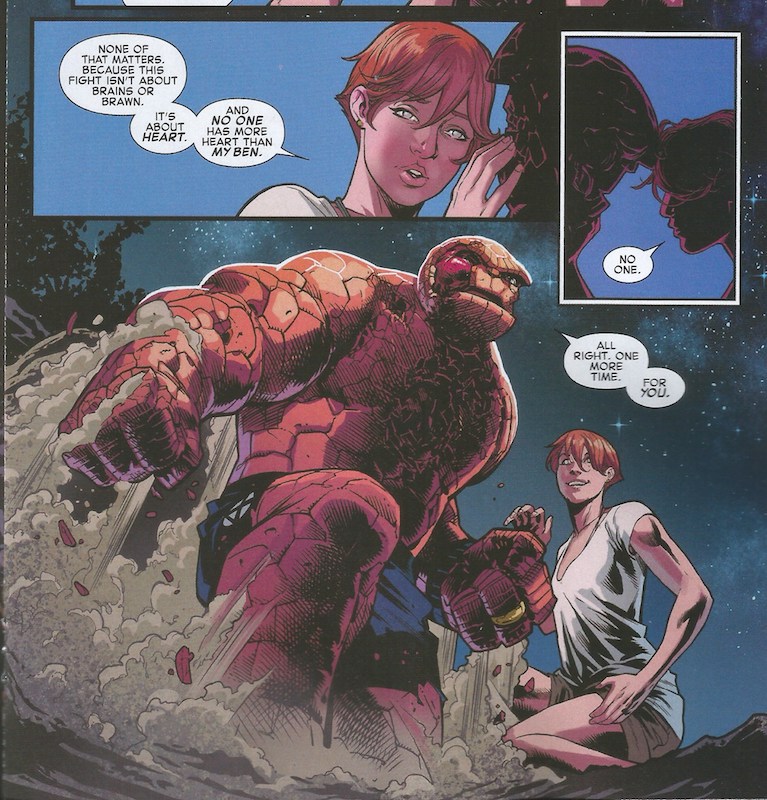
The Puppet Master controls the Immortal Hulk to disturb Ben Grimm’s and Alicia Masters’ honeymoon.  


Apparently Phil Masters didn’t know Alicia happened to be on the island paradise.  This demonstrates how short-sighted Puppet Master is.  It's the honeymoon.  You kind of need two to tango.


The fight continues pretty much as expected, and artist Sean Izaakse takes this privilege of a Marvel tradition to heart, giving it his all in the kinetic choreography as well as the human moments.


The aftermath of the fight feels like the conclusion of a Fantastic Four cartoon where everybody’s laughing, cracking wise and having a good time.  I liked that epilogue but you may find it cheesy.  On the flip side, the second piece depicting the Hulk’s revenge may throw you off if you don’t read the Immortal Hulk.  Even so, I'm not sure the Hulk would enact such brutality.  It's more likely that the Hulk would beat up all the guards to get to Phil and threaten the life out of him.


Captain Marvel got booted out of the Air Force and tolerates a peppy young competitor that seems to coincide with bouts of health issues.  These appearances happen when creatures called the Kraken manifest to cause havoc.  Carol’s pretty sure her old Kree enemy Dr. Minerva is up to no good.  Although, last issue, she offered her help.

A lot of the basis for this material originates from Margaret Stohl’s Life of Captain Marvel, which I didn’t read and only know second hand.  Apparently, in the comic books, Carol is half-Kree.  Carol’s mother Marie Danvers whom you may have met in the seventies original volumes of Ms. Marvel turns out to be Kree all along.  Presumably, her tough-as-nails construction worker dad is still human.  The Supreme Intelligence who is mostly responsible for triggering Carol’s power kept up the ruse for some reason.  I can buy that the Brood scientists hadn’t a clue.  Since they were so incredibly shrewd that they snuffed themselves out when re-triggering Carol’s abilities as Binary.

A lot of this life-kicking-teeth stuff could have really taken Carol into a Garth Ennis type of nose-dive concluding in a likely suicide.  Kelly Thompson though, emphasizes the positives in Carol’s life to balance out the negatives.  Alpha Flight still wants her.


So does Jim Rhodes.  

There’s much talk about pairing Carol up with Valkyrie to cement Marvel’s promise of a lesbian relationship in the cinematic universe.  I have no problem with that, but it’s not very practical with Carol being helluva gone most of the time.  I also like Carol’s relationship with Jim Rhodes in the comics.  Either or both is fine by me.

Carol has super-friends.


Marvel attempted to bolster their female readership in the nineteen seventies with the release of The Cat, Spider-Woman and Ms. Marvel.  Marvel unfortunately canceled The Cat due to poor numbers.  Buyers probably thought it was rip-off of Catwoman, and due to the lack of specialty stores, it was always hit or miss that you could get a comic book you had seen in advertising.  The Cat incidentally became Tigra.  So, blessing in disguise.  

I was glad that years later Spider-Woman and Ms. Marvel found each other and became the best of friends.  She provides one of the best lines I've ever heard describing Captain Marvel.  I was less pleased that Kurt Busiek turned Carol into an alcoholic, but this led to a bond with Iron Man that Kelly Thompson handles beautifully.

The visual narrative by Carmen Carnero throughout Captain Marvel is utterly gorgeous and paced with precision.  With colorist Tamra Bonvillain the scene below shared between Carol and Tony is perfect.


At the lab, Tony figures out what’s wrong with Carol.  I was very surprised that Thompson cut to the chase.  The answer once again goes back to The Life of Captain Marvel.  Don’t worry.  You don’t have to buy the book in order to understand what’s going on here.  Thompson and company explain the whole thing, and how it seems to tie in the evil schemes of Dr. Minerva.  Or does it?


Somebody’s kidnaped Brain Drain, and a message that seems to be a weird sort of spam turns out to be something else.

The explanation leads to more edutainment from Squirrel Girl writer Ryan North.  I had no idea any of this computer tomfoolery could be done.  

Though I could talk more about The Unbeatable Squirrel Girl in the Spoiler Section, it’s not really necessary.  Ninety percent of Squirrel Girl’s worth comes from the gags.  Spoil a joke, ruin a joke.  There’s a plethora of comedy types, and I can guarantee that you’ll find at least one funny that will make you laugh aloud.

The ten percent of the plot blows up Squirrel Girl’s life literally and figuratively as a tin-plated face returns to these pages.  Is it really Dr. Doom behind all the troubles Squirrel Girl faces in the story? And would I outright spoil that information if it was important to the story? These are the questions you’ll have to ask yourself if you listen to my recommendation and purchase The Unbeatable Squirrel Girl.


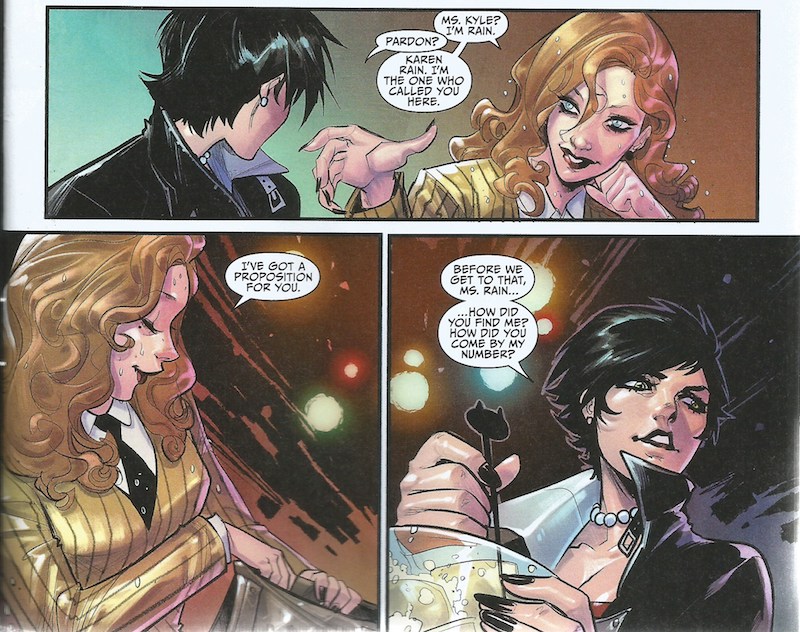
Ram V returns to Catwoman with a delightful done-in-one that could have happened anywhere and at any time in Catwoman’s life.  In short, it’s a tale that you having never read a single issue of Catwoman can pick up and enjoy.  The story draws on a lot of pulp themes which suit Catwoman perfectly.

Catwoman is bisexual.  Maybe that wasn’t the intent or always the case, but Ed Brubaker first implied it, and another Catwoman writer made the suggestion explicit.  That’s why Selina emulates Rick Blaine in the scene.


If you want to dismiss the attraction, you can always take it as Catwoman having read a lot of pulp novels, recognizing the moment as straight from purple prose and maybe seeing Casablanca.  Doesn’t matter.  The point is last time Ram V engaged Catwoman in a superb heist.  This one is a setup.


Catwoman listens to the story.  In the best of pulp tradition, the damsel plays on Kitty’s weaknesses, which are also her strengths.

The story flies like a feline in pursuit pausing only for Catwoman’s reverie over the wedding.  Ram V imitates Tom King expertly as she has a dialogue with a stray.  The wedding subtly plays into why she took this job in the first place.

Back to the plot.  It’s of course a trap, and Catwoman soon finds herself battling a new villain, or an old one with a new take on life and threads.  This fellow however isn’t the only Batman Rogue who makes an appearance.  I was delighted to see an old friend from the Bronze Age.


Mr. Freeze returns to cause Batman loads of trouble in Detective Comics.  Not however in this issue.  Mr. Freeze fans will only get two pages with he and Nora as part of the Year of the Villain tie-in.  So, any of those just Mr. Freeze fans.  Statistically there must be a few.  They can comfortably skip this issue.

Detective Comics starts off amusingly with a one page depiction of Batman on patrol, wiping out at least eleven miscreants all in a single night, all to the tune of Alfred in his ear reminding him of Bruce Wayne’s obligations.  Batman of course doesn’t listen, and goes home to find only Ace waiting for him.

After literally two minutes of sleep, Batman as Bruce Wayne awakens.  At first he promises death to Alfred but accepts that this whole thing is on him.

Writer Peter J. Tomasi and artists Christian Duce and Luis Guerrero juxtapose a meeting of Wayne Enterprises with the introduction of the Big Bad.  Our villain of the issue is a Batman Rogue that was second tier but through association became a hit.  That’s the only clue you’ll be getting. 

Tom King doesn’t really deal with the Bruce Wayne persona.  He deals with Batman, the real man.  We had a taste of Tomasi’s Wayne image from the Detective Comics Annual, but since he was with a genuine friend, the smart and lovely Sophia Zervas, Batman projected a more realistic Wayne.  This version is a farce but plausible.


Tomasi’s Bruce Wayne is different.  He’s mercurial, but also brilliant.  The role creates a believable character that could build an empire yet still be a million light years from Batman.


Another cost-saving, environmentally friendly measure puts Bruce Wayne on a plane amongst CEOs to Singapore.  One of those CEOs is the Big Bad’s target, but when lightning strikes the plan goes to blazes.  Bruce Wayne lets his Cape show, though not too much.  Again, there's a an apropos idea that Bruce Wayne could end up the hero and not be Batman.


The Justice League, including Batman find themselves imprisoned in the place of Black Hammer.  This creates a lot of problems for Batman, Superman, Wonder Woman and Cyborg.

Batman’s breakdown isn’t just in his fruitless patrols.  It also lies in flawed observational skills regarding Superman.  Wonder Woman though immortal finds this imprison tortuous.  Cyborg has it even worse since he cannot blend in with the crowd.

Meanwhile, the Black Hammer heroes confront Starro but mostly squabble among themselves.  It’s not until the remaining Justice League members show up that Starro lies defeated.  Starro wasn’t the gist of the tale anyway.


The League want to know where their friends are, but the answers to that lie in space where John Stewart and a team of Green Lanterns confront another Black Hammer figure.

This is a pretty interesting “team-up,” and it’s always great to see Hawkgirl again.  


The story is out of continuity, and writer Jeff Lemire takes advantage of the freedom to not only toon up Hawkgirl but also to revisit a planet in the DCU that no longer exists.  Hasn't existed since pre-Crisis days.  The final page is a keeper.  I really didn’t expect that shocker and look forward to how Lemire will extricate himself from this bit of writing.


A stand-alone Outer Darkness has Riggs and the crew of The Charon in Star Trek mode. 


But brothers and sisters, this ain’t Star Trek.  Gory murders that better suit a splatter movie open the book.  The only reason why Riggs wants to investigate personally is because of a name on the manifest.


The investigation goes as one may expect in Outer Darkness, with violence, murder and betrayal through demonic possession.  Good stuff albeit a little short.


A body transforming malaise drew scientists and marines to Mexico.  A pair of boys identified the mouth of a cavern from whence the disease is thought to originate.  

At first, the scientists experience an exotic alien world ripe for exploration.  To the marines its a clear and present danger, and a giant from H.G. Welles soon punctuates the hazards.  Still, it's all a just an extrapolation of the science fiction visions of the past.

There's a sense of wonder about Unearth that quickly becomes a sense of dread.


You don't feel it right away, even though early scenes from Amelia's memories foreshadow what's to come.


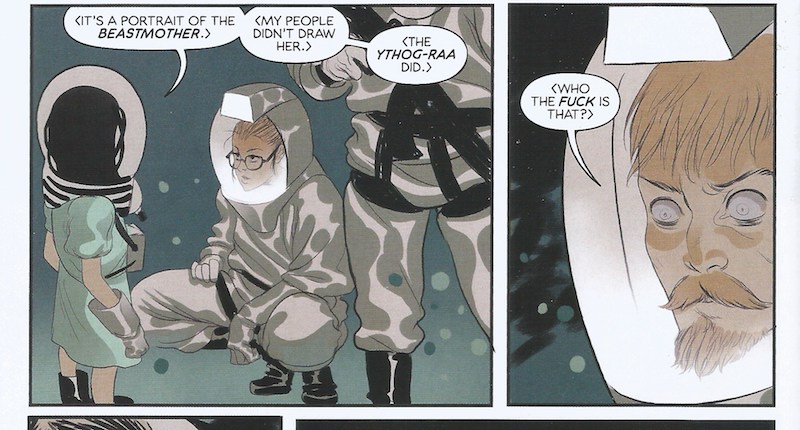
It's a simple table top game, or is it?  As the team moves, on Dr. Amelia Reyes exhibits greater knowledge of the cavern system than their foundling.  Foundlings are always bad news in these types of stories.  They're like Changelings left behind by dark faerie.

Before long, we get an idea of the horrors to expect.  The magnificent giant is actually a malignant wyrm.  The bizarre creatures are symptoms of a cosmic plague.


Ythog-Raa.  That sounds a lot like Yog-Sototh.  Who needs no further explanation if you're student of H.P. Lovecraft.  The girl furthermore refers to it as the Beastmother, which is a damn shame.  Because nobody I think will be getting out of this alive.

Unearth started as a simple updating on Jules Verne's Journey to the Center of the Earth via Aliens.  I totally dismissed the body horror element.  Incorporating it into science fiction.  This issue diverts into some very unexpected territory.


Appointed Queen of Hyrkania, Red Sonja defends her people from the ravenous Zamoran Empire, led by Dragan who comes off as a cross between Groucho Marx's Rufus T. Firefly and Idi Amin.  No, he's too smart to be Trump.  

Sonja uses the tactics taught to her by a grand warrior named Domo, and she flashes back to these teachings when she employs them.  Last issue, Dragan kidnaped Sonja's cousin Kyron and planned to use him as a hostage to force her into marriage.  It doesn't matter that Dragan is already married and sire to a son.  This is after all the Hyborean Age.  Something unfortunate happens to Kyron.  Now, Sonja doesn't just want to protect the people of Hyrkania.  She wants revenge.

Red Sonja is the instrument of plenty of gory murders this issue, many of them quite spectacular, as she nears ever closer to the delivering demise of the would be emperor of the world.  


Her strategems evolve from memories of her cousin and parallel her lessons with Domo.  In the middle of this exercise, in a simply strong Red Sonja story, writer Mark Russell expounds on political ambition to make Red Sonja his.  I'm reminded of the sometimes philosophical diversions in spaghetti westerns.

It also doesn't matter if the figures exude resonance.  Sonja overcomes everything and everybody in her way.  The methods she uses are remarkable in their variation.  Some of them lack a single moment of fair play but for some reason you're unbothered and still see Red Sonja as the hero of this picture.  Perhaps because she only attacks warriors where as Dragan tortures innocent, helpless captives.  Dragan's callousness identifies who is truly savage.


The Spoiler Section


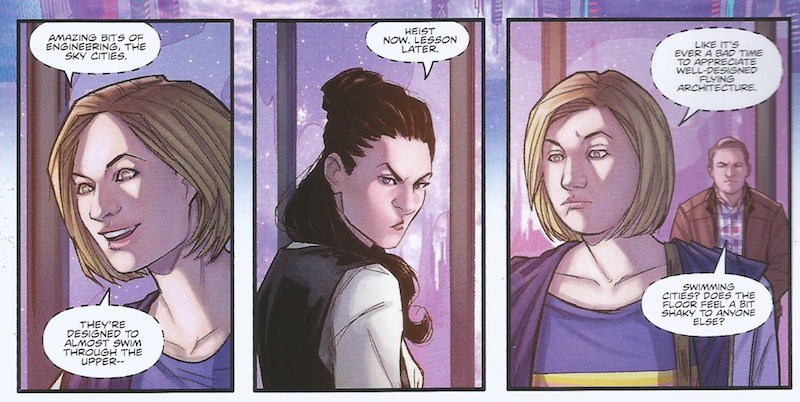
Neil Gaiman in dialogue introduced the Corsair.  The Time Lord that gave proof positive that Time Lords could in fact switch gender.  This wasn't the first indication which still belongs to Steven Moffat when he wrote Matt Smith's Doctor's first lines in "The End of Time," but it was another first.  Jody Houser, Roberta Ingranata and Enrica Eren Angiolini is the first to introduce the Corsair in a proper Doctor Who project.  Even beating the audios to the punch. 


Last issue, the Doctor after being tried for a crime she didn't commit traced the clues to her old friend the Corsair.  Because she knows that the Corsair will die, and horribly at that, she wanted to spend as much time with her as possible.  The Corsair says that the Doctor's rubbed off on her.  She's actually stealing for the benefit of universe.  It may not have mattered.


The Doctor's probably not lying either.  Though the Doctor is a hero, she's also a thief.  Stealing the TARDIS, willfully breaking the laws of her people, bucking the system.  Fighting the Man.  Her friendship could have overridden her altruistic instincts.  Missy in the television series has a great line about her friendship with the Doctor.  It does make one think.


So, our friends go to Radoplina to face the vault of vaults and steal the treasure for the good of the cosmos.  Or is Corsair just playing the Doctor?  Either choice would be good, and Houser makes it actually immaterial whether or not Corsair is on the up and up.  It's just a lark to see the Doctor and the Corsair interact.


When the Doctor figures out how to open the vault, all is revealed, and the answer determined.  That said, the Corsair hasn't run out of trickery and does things that the Doctor wouldn't do.  On a good day.  All of the chicanery leads to a surprise at the conclusion.  You didn't expect a Doctor Who Big Bad behind the whole thing, but thar she blows.  Darned if that identity doesn't make sense.

No, it's not Missy.