Showing posts with label Conan. Show all posts

Friday, May 20, 2022

POBB May 15, 2022

Pick of the Brown Bag
May 15, 2022
by
Ray Tate

Welcome to a focused issue of The Pick of the Brown Bag.  This week I look at the new Conan related title Belit and Valeria from Ablaze Comics.  Courtesy of Max Bemis, Rodney Buchemi and Dinei Ribeiro.

So, I'll level with you.  I'm not really a huge fan of Conan the Barbarian.  I've liked the selective doses I've experienced, and I've liked what I perused from creator Robert E. Howard.  I just never harbored the desire to be a completist. 


That said.  I've read "Queen of the Black Coast," Belit's first and only appearance and its counter Red Nails; the novella introducing Valeria. 


These stories by the way are available at Project Gutenberg, a superb source for free electronic public domain works.


The new story's relatively simple.  Belit comes back from the dead, satisfies her urges, somehow overwhelms Valeria and intends to trade her for a sorcerer who may be able to explain the necromancy that brought her back to life.  Double-crosses result in Belit battling a giant serpent and those she intended to barter with.


The tale begins with Belit arising from her watery grave and encountering mermaids.  By far this is my favorite scene.  It's a good dovetail of continuity from "Queen of the Black Coast."  The mermaids behave very naturally.  They're not luring men to their deaths, nor falling in love with surface dwellers.  They're just hanging out and eating fish by the shore.

Belit in this scene is as naked as a PG book will allow--a head scratcher given this book should, by MPAA standards, be rated R.  I'll address that factor later.

Robert E. Howard describes Belit as being somewhat of a nudist.  She only typically wears a girdle...


...and the jewels she plundered.  While he describes her breasts as bare, he doesn't say anything about the nipples.  

As Miley Cyrus sagely pointed out: 


The link will take you to one of my older postings but more importantly it also features a playable Youtube video of Miley singing a very clean version of "Jolene."  Not her usual fare and quite melodic.  Women should never be dismissed as mere sex objects, nor should their sexual nature as human beings be repressed.


Those hoping to eventually see Belit's nipples will be disappointed.  Though, she shows as much skin as possible, again, as much as a PG book will allow, Valeria is the one who flashes her tits.  


Ah, spoiler alert, I suppose.  Surely, this scene if not Valeria's second bare-breasted moment should earn the book a big fat R.  That begs the question.  Why so, dainty when depicting Belit?


Valeria in fact is clad head to toe in Red Nails until she's selected to be concubine and then sacrifice.  None of her nudity is by choice, and she doesn't seem to be the type to flash her knockers, even as a tactical distraction.  

According to Red Nails, Valeria is a seasoned pirate.  Her background is only hinted at but her characterization crystalized:

"You walk more like a hillman than a sailor," he said. "You must be an Aquilonian. The suns of Darfar never burnt your white skin brown. Many a princess would envy you."

"I am from Aquilonia," she replied. His compliments no longer irritated her. His evident admiration pleased her. For another man to have kept her watch while she slept would have angered her; she had always fiercely resented any man's attempting to shield or protect her because of her sex. But she found a secret pleasure in the fact that this man had done so. And he had not taken advantage of her fright and the weakness resulting from it. After all, she reflected, her companion was no common man.

Valeria's philosophy is suffrage based, and that's where I feel the tit-flashing conflicts with her persona.  She doesn't mind if somebody sees her naked after a fight that tears off her clothing.  She's not going to try to cover up her naughty bits to emulate a comical figure in some sort of bad, broad burlesque.  It would be more like.  Yeah, I'm naked.  I'm beautiful.  So what?  Stop staring, and hand me that shirt.

Valeria's willingness to display her goods is only one problem with her characterization.  In Red Nails, Robert E. Howard depicts Valeria, in contrast to Belit, as thoughtful and pragmatic.  Like Conan she doesn't waste words.  

Bemis on the other hand gives Valeria quite a chattery disposition, which disagrees with Howard's buccaneer. 


Valeria is a mistress of the sword and has a mean right cross.  In Red Nails only the sheerest brute force overcomes her.  That and sorcery.  In other scenes, Howard demonstrates her prowess.  She fights side by side with Conan, slaying three warriors in one clash.

Bemis offers no explanation as to how Belit captured Valeria, in the first place.  Valeria is just introduced in a cage.  I don't understand.  I can buy the idea that the newly resurrected Belit crosses paths with Valeria.  I just cannot comprehend how she bested her without so much as a scratch on either.

Artist Rodney Buchemi's Valeria also differs too much from Howard's imagery.  She looks and behaves more like a bad imitation of Gabrielle from Xena Warrior Princess.  She doesn't once exhibit the corsair's bearing that Robert E. Howard paints so vividly.

She was tall, full-bosomed and large-limbed, with compact shoulders. Her whole figure reflected an unusual strength, without detracting from the femininity of her appearance. She was all woman, in spite of her bearing and her garments. The latter were incongruous, in view of her present environs. Instead of a skirt she wore short, wide-legged silk breeches, which ceased a hand's breadth short of her knees, and were upheld by a wide silken sash worn as a girdle. Flaring-topped boots of soft leather came almost to her knees, and a low-necked, wide-collared, wide-sleeved silk shirt completed her costume. On one shapely hip she wore a straight double-edged sword, and on the other a long dirk. Her unruly golden hair, cut square at her shoulders, was confined by a band of crimson satin.

Against the background of somber, primitive forest she posed with an unconscious picturesqueness, bizarre and out of place. She should have been posed against a background of sea-clouds, painted masts and wheeling gulls. There was the color of the sea in her wide eyes. And that was as it should have been, because this was Valeria of the Red Brotherhood, whose deeds are celebrated in song and ballad wherever seafarers gather.

Pertaining to Belit, Rodney Buchemi's artwork is utterly magnificent.  He definitely channels the late great George Perez when rendering the female form.


Belit moves like a panther, and that's congruent with Howard's descriptive.  He doesn't indicate she's the giantess that Buchemi makes her to be, but I'm perfectly willing to accept that as artistic license.   

According to Bemis' story, Belit returns to the world sexually frustrated.  

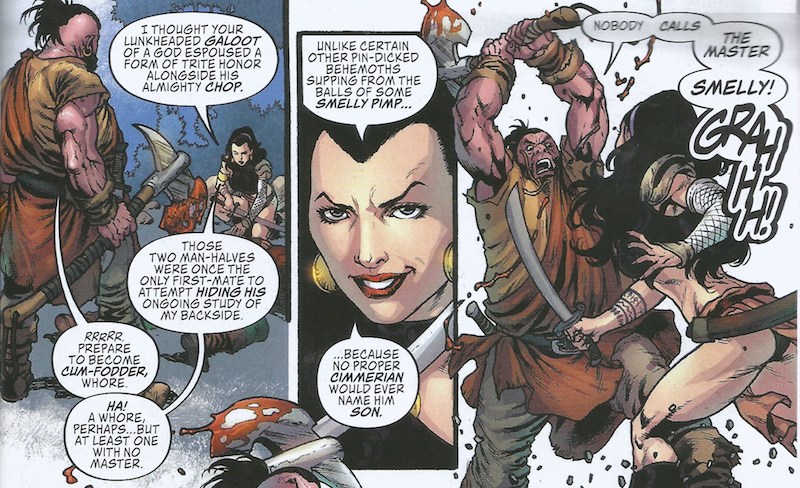
I'm okay with that, makes perfect sense, really, but I object to the coarseness when she phrases her desire.   Bemis continues this crude dialogue throughout the book, and it becomes quite tiring especially when compared with the bad poetry Robert E. Howard wrote:

"Look at me, Conan!' She threw wide her arms. 'I am Bêlit, queen of the black coast. Oh, tiger of the North, you are cold as the snowy mountains which bred you. Take me and crush me with your fierce love! Go with me to the ends of the earth and the ends of the sea! I am a queen by fire and steel and slaughter—be thou my king!"


Now, look, compared to actual poets, that's not good by any measure, but it's better than this:


And certainly better than this:

So, should you buy Belit and Valeria? I'd have to say not at full price.  I can only recommend Bucehmi's marvelous artwork.  Bemis' story glosses over a matter of plot importance, laces the dialogue with crudity not pleasing for the Robert E. Howard fan and fails in a number key elements of characterization. I also question the restraint when depicting the nudity of one character but not the other.  If Bemis had stretched a little and provided some his own bad poetry instead of gutter tongue and Ablaze Publishing decided exactly who the audience was going to be, this might have been an at least mediocre pairing.


Tuesday, September 1, 2020

POBB September 1, 2020

Pick of the Brown Bag
September 1, 2020
by
Ray Tate


Created in 1932 by Robert E. Howard for the quintessential pulp anthology Weird Tales, Conan the Barbarian became one of the most influential characters of the modern era.  Without Conan, the genre of sword and sorcery would not exist.  He is the inspiration for every bare chested dude wielding a blade, fighting in magical realms.  Usually, with a nubile woman clutching his leg.


Conan eventually became the subject of movies, animation and a television series.  In 1970, Roy Thomas brought Conan to Marvel Comics where he stayed until the millennium.  Marvel recently reacquired the rights to publish Conan, and the Powers That Be perhaps inspired by a classic issue of What If? transported Conan to the now.  


Conan first arrived scowling in Vegas and cursing the wizard Kulan Gath for the unexpected teleportation.  I don't know if his old enemy Gath is the culprit.  It certainly fits his m.o.  However, there's more at work here than mere hocus-pocus.


Conan in the Savage Avengers annual, fought alongside  Damien Hellstrom, who usurped Mephisto's rule of Hell.  I doubt it's a coincidence that Mephisto inveigles himself in Conan's life.

Back in Vegas, Conan meets Nyla, a thief.  Together they set up the heist of the Inferno Hotel.  Unexpectedly, they cross paths with the Black Cat.  Hijinks ensue, and the duo end up with a magical ring that transports them to Wakanda.  All part of the plan.


The fellow wearing Tron is Imus Champion, an obscure Avengers villain.  Don't worry about him.  He's not important.  Mephisto promised Champion that he would be "the most powerful man in the world," which means he's soon to be dog meat.  The ring is the thing that demands attention.


Gosh, that was neat, and it's the kind of event you frequently come to be surprised by in Weird Tales.  The twist allows artists Luke Ross and Nolan Woodward the chance to strut their stuff.


To be fair, you may be asking where's the Serpent Crown.  You're getting a ring.  The story winds you to the discovery of a scepter.  You were promised a Serpent Crown.  I'm sure the 1970s object of power is around here somewhere, but for right now, you just need to sit back and relax for a backdoor Marvel Team-Up book.  In this issue, Conan meets the Black Panther.


This encounter is so entertaining.  On a gut level, it pits possibly the finest natural warrior in the history of literature against a unique royal super-hero who combines fighting prowess with technological savvy.  On another level, the pithy dialogue suits the combatants.  On a third level, Black Panther and Conan exist within the same context.  They are not of modern civilization.  They understand each other instinctually.


I can almost believe that writer Saladin Ahmed imagined this scene first and then built a story around it.  One helluva a story.


Tuesday, March 10, 2020

POBB March 4, 2020

Pick of the Brown Bag
March 4, 2020
by
Ray Tate

The Pick of the Brown Bag marches on with reviews of Black Cat, Conan and the Battle for the Serpent Crown, Dark Agnes, Doctor Doom, Doctor Who, Outer Darkness and Chew, Strange Academy and Red Sonja.  As always should you not have time in your busy schedules for all of the script, check me out on Twitter: #PickoftheBrownBag.


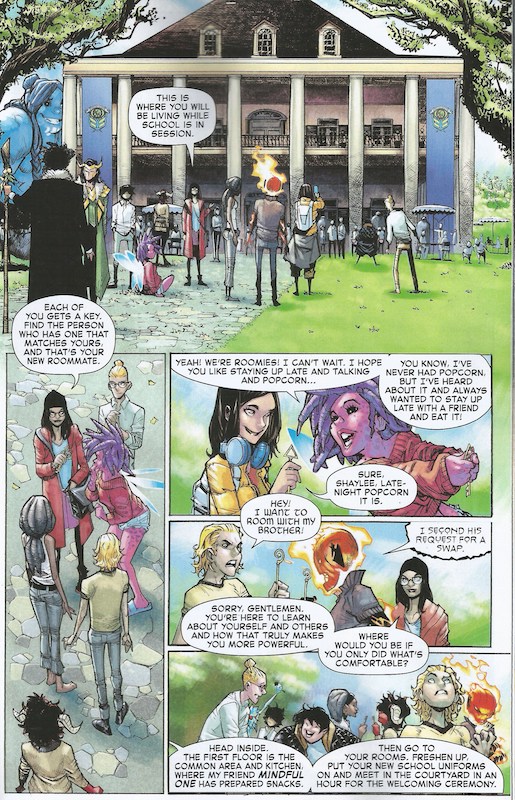
Strange Academy isn't the kind of book I normally buy.  It's a magic based story number one.  It's Marvel's answer to Harry Potter number two, but this charmer is a keeper.

Some of the scenes are so adorable that they can kill you.


Oh.  A floaty puppy on page one.  That's so...so...excuse me a moment.

The previews for Strange Academy have been everywhere, but they don't do the book any justice.  Humberto Ramos and Edgar Delgado offer a lush, organic tapestry of aesthetically winning illustration.  


The cohesive visual narrative establishes plot, setting and cast.  Writer Skottie Young follows our young puppy pilot through the ages.  Her good-natured practice of magic unwittingly leads to a dark threat.  Tolkein in nature.  Fortunately, the adult wizards and witches of the Marvel Universe are paying attention.


That's Zelma Stanton from Doctor Strange, but you don't need to know her history.  Young, Ramos and Delgado inform through the dialogue and the design.  

Zelma makes a straightforward pitch to Emily's parents.  I admired the honesty.


It's a refreshing change from the cryptic nonsense that I'm used to seeing from magic-based stories.  Emily's parents agree.  Zelma transports Emily to Strange Academy.

The grounds get a deserved double-page spread with a range that a scan will just undermine.  So, I'm not even going to try.

At the school, Young delves into Marvel's magical realms to find students with familiar backgrounds.  The cast is new.  Their origins not.  


The class consists of the human Emily, Asgardian Venture Brothers, an expressive fairy, son of Dormammu and more.  All except the Frost Giant sparkle with personality.  The faculty are recognizable alumni as the previews suggested.


Of course you also get Dr. Voodoo, a bemused Scarlet Witch and Dr. Strange his own bad self.  Benedict Cumberbatch is the best thing that ever happened to Dr. Strange.  He's made Strange approachable, and that's the Strange you get here.  You can't imagine the Dr. Strange from years past heading a kids school.  Strange Academy ironically feels natural.

On the starship Charon, a diplomatic situation goes horribly wrong.  

This forces Captain Riggs into doing something drastic.


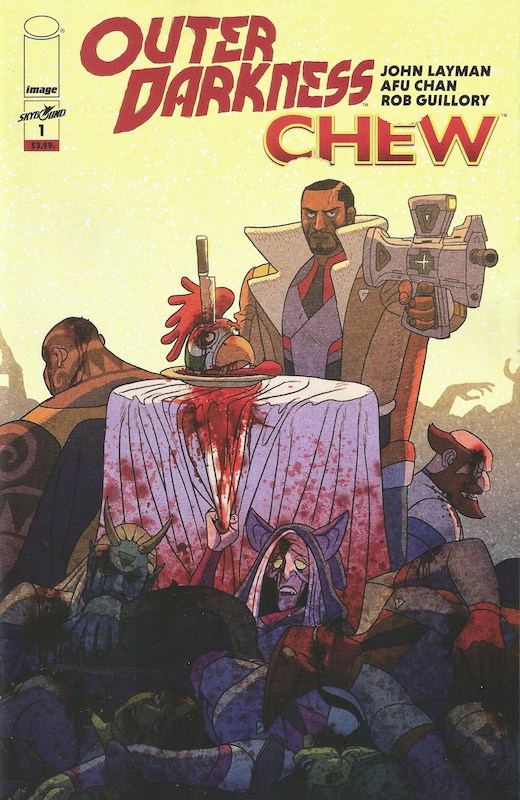
Riggs and the crew of the crew of the Charon mistake Tony Chu to be a culinary master.  When in fact, he is a Cibopath.  


As you can see, if you don't know beans about Chew, you're in good hands as the creators of the story John Layman and Rob Guillory quickly and painlessly give you the basics as well as the color.


If you're a Chew fan but don't know beans about The Outer Darkness, you get a crash course from creators John Layman and Afu Chan.


This explains why you wouldn't want to stay in the Outer Darkness universe for very long.  Heck, even a second.  


It's the antithesis of Star Trek. The occult and science merge in the Outer Darkness, and there aren't any Orion Slave Girls.  Just death, death and more death.


When the great minds of the Marvel Universe band together to create the Antilion, somebody sabotages the project and frames Doctor Doom for the crime.  Now, Doom is on the run, but he's got company.


Kang is somehow related to Doom.  We don't know how, but the thread's been carried through decades of the Marvel Universe.  Writer Christopher Cantwell relishes the opportunity to make gags about the convolutions during Doom's and Kang's cross-country escapade.


Doctor Doom thus emerges as a bizarre send up of old time Bing Crosby and Bob Hope films.  They were always on the road to somewhere.


The same goes for Kang and Doom.  Of course, this isn't exactly all laughs.


Some, but not all.  Kang and Doom dope out how to put the kibosh on a black hole created by the Antilion sabotage.  The solution actually has some scientific teeth to it.


You may ask why Doom and Kang would bother.  Cause you can't conquer a planet if it isn't there.  

The amusing story features some satisfying murder, an abbreviated fight with a Marvel mercenary and oddly enough a Ghost Rider villain and a bizarre guest appearance by Thomas Magnum as played by...Timothy Olyphant.


It should come as no surprise that Doctor Who gives you everything you want in a team-up of incarnations: the current Whittaker Doctor and the Tennant Doctor.  Written with a spritely touch by Jody Houser and injected with oomph through the art of Roberta Ingranata, Doctor Who is that crisp, refreshing breeze on a sunny day.

The story takes place when the Weeping Angels ambushed the Tennant Doctor and Martha Jones.  The "kindest of psychopaths" sent the duo back in time to 1969, to die of old age, whilst they inched closer to capture the TARDIS.  Of course, the Angels failed, and maybe that's why there's another Weeping Angel in 1969 out to seek revenge.


You'll note that Yaz takes the lead while the Doctor's away.  The current Doctor and Martha Jones investigate disappearances in the locality.  They first return to the shop in which Martha secured a job.  Soon, they get to the bottom of things.


And no, I won't be talking about the second Doctor Who baddie.  The Angels have the cover.  So, identifying them is no spoiler.  

In addition to the double trouble, gags galore abound, the Tennant Doctor gets used to the new look TARDIS and the Whittaker Doctor plays defense against her thicker younger self to spare Martha any further discomfort.


Martha fell in love with the Doctor.  A gender switch isn't enough to quell feelings the Doctor is now aware of.


Martha as I said in the previous review is really going to be the one that hurts the most during the caper.  She's not going to remember anything when the timelines realign.  That may be for the best.  It's never the less sweet that the Doctor cares about Martha's feelings as much as she cares about what's attacking in 1969.


Black Cat needs to steal a painting for her former mentor the Black Fox.  This drops her into Madripoor and the home of Mr. Patch whom she discovers is her old friend Wolverine.  Alas, a snotty boy billionaire jerk named Kilgore Kade stole Wolverine's possessions.  Black Cat promises to steal them all back and to make a fine point, she snatches his shades.


Touché.  This however puts Wolverine and the Cat on the run in Madripoor.  There's naturally a bounty on their heads.


There's more comedy where that came from.  Backed by the spectacularly bouncy art of Kris Anka, Jed MacKay delights in the mismatched pair's interaction.  He takes unusual pleasure in the comedic regenerative powers of Wolverine and surprise guest star Deadpool.


Yeah.  I spoiled that one because anything that directs you to Black Cat is a good thing.  This laugh aloud funny issue also demonstrates Cat's skills as an arch thief and planner. MacKay parallels the present day with the past.


Introducing elements intimated in previous issues and granting some depth to Black Cat's current nemesis.  As well as the Black Fox who was just a one-off Spider-Man annoyance.

The Black Cat is but one of the guest stars in Conan and the Battle for the Serpent Crown.  Khulan Gath transported Conan to the present, or so he thinks, and the Cimmerian has been getting into all sorts of trouble.  Some of it heroic, like stopping human trafficking in Savage Avengers Annual.  Some of it not so much.


Black Cat stole the jewels Conan and companion thief Nyla intended to steal.  He's determined to get them back.


So begins the chase.  Whether you're a fan of any of the Barbarian series or not, you must acknowledge an ornate attention toward dynamic anatomy.  Luke Ross and Nolan Woodard provide strong artwork fitting for the history of Conan's comic book exploits.  


The story by Saladin Ahmed is comedic, largely due to the Black Cat as well as Barbarian out of Hyborea humor.  However, once you get used to the novelty of Conan in the twenty-first century, you can appreciate that this is actually an operatic drama with a tenor fiend behind the whole ordeal.

Hired as bodyguards, Dark Agnes and Etienne accompany Sister Marie and Helen on a coach ride that's interrupted by brigands.  They're hot for the money Agnes' carcass will fetch.  This allows for some superb swashbuckling art from Luca Pizzari.

Upon arriving at court, Agnes renews and old friendship and learns of an old enemy.  


Becky Cloonan's story is rich in character and plot.  She takes two solid set pieces and uses them to reintroduce characters and weave a good murder mystery.  


She also makes small talk interesting during the lull periods where you just enjoy the scenery and the costuming.


Red Sonja must petition for food to feed her war-torn people of Hyrkania.  She does so at the throne of the man who murdered her mentor Domo.  Her companion who is far better with diplomacy strikes a bargain that saves their lives.


Mark Russell's anachronistic dialogue provides a lot of lightness and humor.  He also presents some slapstick comedy from an untrained army.  Meanwhile, a reflective Sonja reflects upon the nature of the world, and finds it unforgiving.  The weight of victory lies heavy on her shoulders.

At the same time, Russell looks upon Isolde, regent of Hyrkania, ruling in a time of scarcity.   This parallel thread is a horror story dropping the mic with a nasty twist. 


Bob Q eschews cheesecake when depicting Sonja.  His emphasis on muscle over curves may upset some faithful fans, but his take on Sonja is just as valid as the wild Frank Thorne She-Devil with a Sword or Carlos Gomez's tribute to pin-ups and pulchritude.