Pick of the Brown Bag
May 22, 2019
by
Ray Tate
The Pick of the Brown Bag begins anew with reviews of Batgirl, Detective Comics, Iron Man, Miles Morales Spider-Man, Scooby-Doo Team-Up and the Unstoppable Wasp. As usual, should you lack the time or patience with the thick and meaty reviews, you can always get the low-down on Twitter: #PickoftheBrownBag.

In Sholly Fisch's and Dario Brizuela's latest Scooby-Doo Team-Up, Freddie, Daphne, Velma, Shaggy and Scooby receive a summons from Flash. The Gang joined forces with the Flash on several occasions, sometimes alone and sometimes with the Justice League.
Scooby-Doo Team-Up exists in its own continuity. Tom King is unlikely to mention Batman partnering with Mystery Inc. Although, you never know. Certainly, it's in Peter Tomasi's wheelhouse.
Because of Scooby-Doo Team-Up's stand-alone nature, Fisch can always start from scratch. He never chooses to do so, and the internal consistency helps strengthen the storytelling. The Flash by the way is with the League in another galaxy. The call a ruse.

The Flash Rogues generally speaking are only interested in the money. If they threaten anybody, they do so with the knowledge that the Flash will speed to the hapless' rescue. Thus cementing civilian use as effective distractions. Make no mistake.

They are still bad guys and gals. However, because the Flash Rogues are just greedy bank robbers and not truly evil, they are willing to on occasion throw their lot in with the Flash or seek out help from his compatriots when necessary. In this case, Scooby and the Gang.

The Top is a classic Silver Age Flash foe and a former Rogue. The Top died during the Bronze Age, a rare occurrence. Fisch accurately describes the death of the Top, minus Golden Glider psychopathically blaming the Flash for the demise.

Brizuela designs the Rogues with some edge to them, using sharp angles for their faces and sneers for expressions. Including as you see Golden Glider.

Golden Glider is Captain Cold's sister Lisa Snart. If you’re wondering about Golden Glider's Glitter Gun from The Flash, that's all television series invention.
In the comics, Glider is a figure skater, trained by the Top. This as well Fisch acknowledges. She turned criminal when the Top died, but with a different set of gimmicks.
In the comics, Glider is a figure skater, trained by the Top. This as well Fisch acknowledges. She turned criminal when the Top died, but with a different set of gimmicks.
In the end, the Golden Glider’s relationship with the Top and her unusual skill-set proves key to the real villain’s defeat. Ah, yes. Spoiler Ahoy. The Top isn't really haunting the Rouges.
Before the unmasking happens, our sleuths offer and strike out suspects. They unfortunately inspire the Rogues to pull off a super-heist as bait for the Top's manifestation.
Before the unmasking happens, our sleuths offer and strike out suspects. They unfortunately inspire the Rogues to pull off a super-heist as bait for the Top's manifestation.

I am totally tickled that the Rogues refer to Mystery Inc. by name or as "you kids." It's actually quite plausible that the Rogues would behave in such a civil manner.
Once at the scene of the crime, things get even more interesting. Shaggy proves to be an asset. We get some more characteristic Rogue behavior, with Captain Boomerang adding some comedy, and a timely rescue from some surprise guest-stars.
Once at the scene of the crime, things get even more interesting. Shaggy proves to be an asset. We get some more characteristic Rogue behavior, with Captain Boomerang adding some comedy, and a timely rescue from some surprise guest-stars.

Batgirl in one sense is lovingly nostalgic. The Terrible Trio haunt Gotham City with the same masks but different faces beneath. Indeed, originally these villains arrived in the fifties as scientists specific to their chosen element: air, water, earth. Nowadays, they're greedy psychopaths. Though don't confuse them with the Flash Rogues.

Despite Vulture’s warning to keep out of Batgirl’s way, in fact out of the way of all of the Batman Family, last issue Fox lures Batgirl into a mystery and a trap.

The smart thing of course would be to kill her on the spot. Fox however wants to prove a point. So, he sets up Batgirl in an escape proof chamber, filling with water, as a stage show for the opening of The Den.
This kind of death trap used to be the pride of comic book writing. Nowadays, seldom do writers actually construct a death trap for the character. It's after all more realistic to describe a no-win situation for the protagonist or frame a consequence of the fight to prove a hero's potential downfall.
Rarely do we see a villain stop himself from delivering the final blow and deciding, "No. I'm going to stick her in a straight-jacket upside down in an impenetrable tube filling with water." This is an honest to goodness death trap, and it's a beauty based on Houdini.
Of course this whole thing could have failed without the proper art team enhancing the drama. Fortunately we have Paul Pelletier, Norm Rapmund and Jose Marazan Jr. and colorist Jordie Bellaire combining with Mairghread Scott's honest Batgirl narration. Together they convince the reader that this is the moment that Babs can die.
This kind of death trap used to be the pride of comic book writing. Nowadays, seldom do writers actually construct a death trap for the character. It's after all more realistic to describe a no-win situation for the protagonist or frame a consequence of the fight to prove a hero's potential downfall.
Rarely do we see a villain stop himself from delivering the final blow and deciding, "No. I'm going to stick her in a straight-jacket upside down in an impenetrable tube filling with water." This is an honest to goodness death trap, and it's a beauty based on Houdini.
Of course this whole thing could have failed without the proper art team enhancing the drama. Fortunately we have Paul Pelletier, Norm Rapmund and Jose Marazan Jr. and colorist Jordie Bellaire combining with Mairghread Scott's honest Batgirl narration. Together they convince the reader that this is the moment that Babs can die.

Scott like Alan Burnett and Michael Reaves imbue the Terrible Trio with a nuance of perversion and sickness. In Batman: the Animated Series, the Terrible Trio are rich dilettantes, committing crimes for kicks. They corner an acquaintance, Rebecca, when she discovers the truth and they decide to kill her. The Shark's off hand comment about dying with out clothing is particularly nasty and in that vein of seemingly normal individuals putting on masks and turning out worse than Gotham City's usual suspects.

Of course Batgirl escapes, but not before she uses every trick in her utility belt, every muscle in her body to no avail. In the end, she takes a page from Batman and cheats.

Of course Batgirl escapes, but not before she uses every trick in her utility belt, every muscle in her body to no avail. In the end, she takes a page from Batman and cheats.

Batman #295
Thus endeth the lesson until Shark pulls a fast one outside of the Golden Age and forces Batgirl to conduct another knock-down, drag-out fight. This is all on the artists, who remind the reader of Batgirl’s martial arts mastery.

Scott juxtaposes the battle to the death with a hostile take-over of Barbara Gordon’s clean energy company. The British buyers force Babs’ partner Alyssa into an ethical corner and reveal a connection between Barbara and a Batman villain. This may come as a shock for Alyssa, but not to any Batgirl fan. I’ll give you a hint. It’s not Catwoman. Batgirl and Catwoman loathe each other.

This issue of Detective Comics dishes the origin of Peter Tomasi’s and Brad Walker’s Arkham Knight. The origin is elegant and answers every question posed in previous chapters.
Who is the Arkham Knight? What is the meaning of the Knight’s name? Why does the Knight hate Batman?

Why does the Arkham Knight work with Arkham Inmates? Why does the Knight save police officers caught in the crossfire?

Why does the Arkham Knight work with Arkham Inmates? Why does the Knight save police officers caught in the crossfire?
New character Ingrid Karlsson is not the Arkham Knight. Karlsson though is connected to the Arkham Knight.
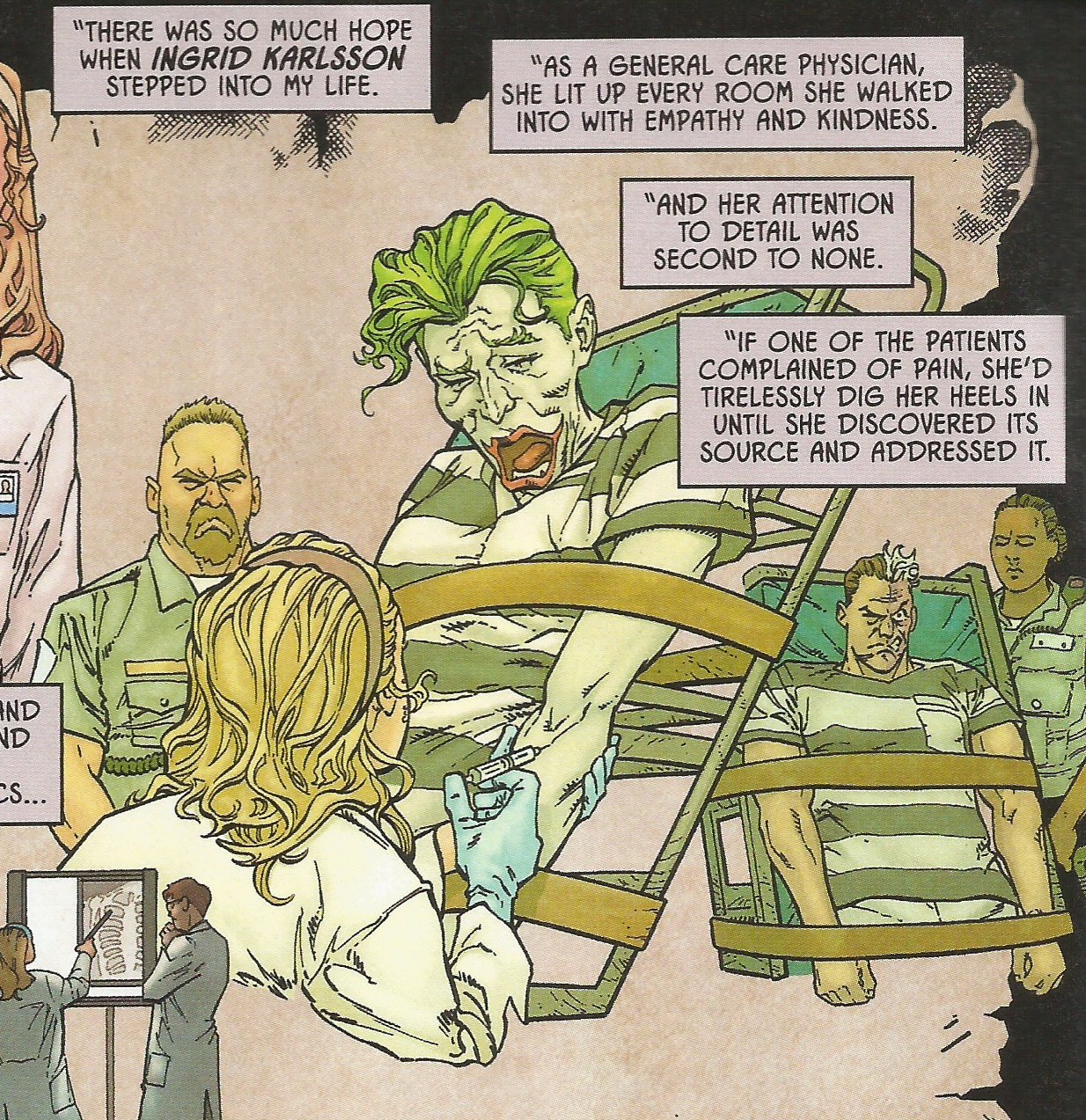
Ingrid is a medical doctor responsible for the care of the Arkham inmates. The inmates—yes, even the Joker—trust her because of her dedication and honesty.
Arkham Knight’s trigger occurs when a riot breaks out in the Asylum. The usual suspects however are not the cause.

What happens next is a remarkable story of madness and one man’s foolishness, perhaps animosity, toward Batman that helps shape the Knight’s skewered viewpoint.
 In the present day, the Knight employs the Arkham inmates to fruit the plan. This includes a surprise villain from another title, but associated with Gotham City.
The Arkham Knight story is fascinating and entertaining. It’s a straight up mystery with a satisfying reveal and explanation. The Arkham Knight is truly insane, but not in a crazy, comic book character kind of way.
In the real world, the Arkham Knight is certifiable. The grand delusions the Knight harbors for Gotham City lack the egotism of Bond-type villainy. The Knight bears no criminal nor evil intent. Instead, the Knight fosters a distinctive worldview that’s far off tangent from any recognizable sphere.

Oh, for pity’s sake. What the hell’s up with Iron Man’s covers! The imagery makes little sense—I can’t even tell what that is—and lacks any bearing to the tone of the book. Sorry, I had to get that off my chest.
Writer Dan Slott recapitulates everything he introduced and reintroduced in his ten issue run. This is why the conclusion feels particularly deep.
Writer Dan Slott recapitulates everything he introduced and reintroduced in his ten issue run. This is why the conclusion feels particularly deep.
Slott’s Iron Man began with old Iron Man foe the Controller living up to his name through stalwart head of security Bethany Cabe becoming an unwitting mole at Stark Enterprises.

Around the same time, Tony Stark unveils a virtual reality platform that sweeps the world. The Controller however digs in and via manipulating internet trolls succeeds in vampirizing the mental energy of users. The result is this fellow.

Stark enters the eScape and discovers his parents alive, not well and twisted. Stark frees himself from their ideal of him, restores the eScape, rescues his birth mother Amanda and finds himself out of power and dying within his armor.
While the Controller undertook a personal stake in the eScape, Slott debuted a business rival in Sunset Bain who recruited Tony’s brother Arno Stark as her idea man.
While the Controller undertook a personal stake in the eScape, Slott debuted a business rival in Sunset Bain who recruited Tony’s brother Arno Stark as her idea man.

Safe, Tony immediately begins to work on the problem. That naturally manifests in a new suit of armor.

The ridding of the Controller should feel anti-climactic. Like the popping of a big balloon, yet thanks to Valerio Schiti it’s anything but. Slott furthermore adds commentary and creates a sneaky bit of comedy with Stark depriving Sunset of even a Pyrrhic victory.

Iron Man and the Wasp are an item, and the Wasp leads the attack on the Controller. Fortunately, the Champions show up for backup.


This makes sense since the Unstoppable Wasp Nadia Van Dyne is the original Wasp’s stepdaughter. I mention this for Wasp Nadia completists.
Jeremy Whitley's Unstoppable Wasp seems straight forward but surprises on a number of levels. One of those levels I will spoil, but it’s a small spoiler that you’ve probably already concluded anyway. Last splendidly Tigra-filled issue ended with Nadia’s previously though dead mother contacting her. Now, you must have thought like I did. It’s a trap.

What surprised me is that writer Jeremy Whitley didn’t go the old, Nadia betrayed by her emotions walks into a trap routine. Instead, between issues, she asked for help from Bobbi Morse alias Mockingbird, and Bobbi’s plus one at Nadia's birthday party, Winter Soldier.

What’s weird is the Red Room is expecting them, which begs the question how did they know? It’s certainly possible there’s a mole among Nadia’s group. On the other hand perhaps electronic surveillance is the answer. Alternatively, Nadia’s party may have attracted media attention. The Mother of Red Room could have spotted Winter Soldier or learned of his appearance and made some clever deductions.
While Bobbi and Bucky do a Bond in Siberia, Nadia prepares for hosting the first GIRL Expo. GIRL for those not in the know is Nadia’s think tank of girl scientists.

Despite being issue eight of a two volume series, this chapter is actually a pretty good jump-on point for those who haven’t yet experienced the femme positive adventures. Whitley introduces the ladies of GIRL with narrative asides and exemplars of their brilliance.

The subplot involving the Red Room plunges you into Nadia’s background. Let me just say. I am not a fan of the Red Room themes in Black Widow comics. Call it familiarity breeding contempt. I will give the Unstoppable Wasp team this. Whitley expands on the Red Room motif while also returning to the theme of AIM attempting to steal GIRL’s inventions and perhaps combining the two.

Miles Morales Spider-Man is interested in stopping Tombstone from taking over a chunk of his neighborhood. In the process of stopping the power grab, he encounters the new hero Starling.

Not to be confused with one of the original Birds of Prey conceived by Duane Swierczynski. Miles is down with Starling for a number of reasons, many of them obvious. There's a big no-go as far as he’s concerned. She’s just too rough.

As the story progresses, Starling reveals much of her history, and it’s interesting stuff that surpasses her motive for hunting Tombstone; this storytellers Saladin Ahmed and Javier Garron wisely downplay.
In addition to Starling's history, the kinetic art of Javier Garron, the popping colors of David Curiel, the crafters entice with a fascinating problem for Miles Morales that spans his entire life and not just his costumed self.

In addition to Starling's history, the kinetic art of Javier Garron, the popping colors of David Curiel, the crafters entice with a fascinating problem for Miles Morales that spans his entire life and not just his costumed self.

It's funny. The Flash's spectacular season finale just dealt with the secret identity issue in a mature way. I don't know how long Miles and Barbara were dating, but maybe she deserved to know if the relationship were serious. Starling on the other hand just met Spidey, and it's difficult for me to think he would tell her. The fact that he's tempted indicates just how dangerously smitten he is with the new protagonist.


