Pick of the Brown Bag
March 1, 2017
by
Ray Tate
Welcome to the Pick of the Brown Bag, a weekly comic book review blog. This posting I critique Marvel's newest America, Aquaman, Batman, Big Trouble in Little China/Escape from New York, Doctor Who, Flash Gordon: King’s Cross, James Bond, Motor Girl and the Unstoppable Wasp.

Motor Girl starts out edgy. Sam suffers from an episode involving her PTSD, but her make believe gorilla Mike pops in to motivate her.

The mood shifts to the absurd as Sam talks with her would be tormentor Victor in the middle of the Arizona desert. Victor works for Mr. Walden who seeks to buy the junkyard from Libby, a feisty old lady, that took a shine to Sam. Sam recuperates there by fixing cars and the odd flying saucer that whooshes by. Thus far, only Sam has encountered the cute little green fellows. Now, perhaps Larry as well.
Sam and Victor soon discuss what’s going on. The aliens and their abduction of his partner. At first civilized, the conversation soon takes a violent turn. Victor is at heart a goon.

At this point, the merely amusing story skyrockets to the hilarious. Writer/Artist/Creator Terry Moore demonstrates that Sam is far from a damsel in distress. That’s no surprise, but it’s just brilliantly funny how Moore conveys Victor’s complete misunderstanding of Sam’s remarkable tenacity and battle prowess. Poor research on his and Mr. Walden’s part.

Nadia Pym encounters an old friend in The Unstoppable Wasp. She concludes her encounter with Moon Girl and now Devil Dinosaur. She gets a new phone, more momentous than you would think and meets a new friend. Nadia also pisses off the original Wasp, though not in the way you expect. She recruits a nutty professor for her new group GIRL—Genius In action Research Lab—and works her unstoppable charisma on another candidate, but not before a classic Marvel villain shows up at the cliffhanger.

Ying is Nadia’s former partner from the Red Room, the place that Russia uses to create Black Widows. I’m not all that keen on the Red Room, nor the changes to Black Widow’s history over the years. I just preferred Natasha Romanova as a really, well-trained Russian agent that defected. Not a super-soldier nigh immortal.

Anyway, the Russian connection works better in The Unstoppable Wasp because it’s only lightly touched upon and Nadia and Ying were science prodigies rather than spies. This is the first time that a lethal edge is implied in the training, but Nadia will have none of that. She naturally offers Ying to join in her freedom, but Ying has other ideas which lead to Devil Dinosaur saving the day.

As Ying disappears Nadia tries to persuade Lunella to join her, but Lunella’s precociousness prevents her. This is a nice moment where writer Jeremy Whitley distances Nadia from Moon Girl through age and relative wisdom.

Nadia of course displays this trait through wit. Note the sly look that artists Elsa Charretier and Megan Wilson grant to Nadia's face. From there Whitley and artistic company contrast these attributes by reminding readers that Nadia is also almost like a cave woman thawed from the ice.

The phone allows Whitley to create a plausible coincidence. The moment furthermore generates the possibly of another genius girl addition to the cast. This one the most of an iconoclast.

The literal plot device also carries Nadia to her conversation with the Wasp.

It’s important for the original Wasp to be part of the story, to approve of Nadia. If she despised Nadia, this whole book could have fallen apart. The scene also communicates that Whitley could have easily written Janet Van Dyne if he wanted. She’s perfectly characterized and the history between she and Jarvis is well played.

From the conversation, Nadia bounces to her next candidate for GIRL: Pricilla Lashayla Smith.

And then her father, whose presence is another example of Whitley’s clever writing. The Unstoppable Wasp is pro-femme but not anti-male. Whitley demonstrates that natural intelligence amongst women will likely only flourish best with feminist fathers, mothers and mentors. Pricilla’s father, a smart guy in his own right, is tickled pink and portrayed as a still embarrassing Dad with lough out loud funny results. Whitley contrasts this with Nadia’s last candidate for the day. Here, achievement has been corrupted and may be about to be pounded. Unstoppable Wasp proves once again not to be a typical superhero book.

So, let’s tread some facts first. America isn’t just shorthand for a country. America is actually a proper name with an interesting history. America is the feminine version of Americus, which means leader. It's a linguistic relative to Amerigo, as in Vespucci, the royal financier of Columbus and an explorer in his own right. Amerigo didn't name the Americas after himself. That honor goes to a mapmaker named Martin Waldseemuller.

America Chavez is Marvel's newest version of their 1940s superhero Miss America. America Chavez’s powers line up with Miss America’s abilities. She’s preternaturally strong, super-tough and can fly. She also possesses the ability to open star-shaped wormholes in space/time. Whereas Miss America’s powers derive from being struck by lightning, decades before Barry Allen, America Chavez’s powers arise from the genetic inheritance of two mothers. I’m guessing she’s the product of a fusion between two eggs. In theory and experiment a possibility. Though nothing’s definite about her birth in the flashback.
America’s costume now pays homage to Miss America. Miss America is famous for sporting the stars and stripe shield as an emblem, and as you can see America Chavez is rocking that symbol. This isn’t her only costume of course, but I think it’s actually braver of the creative team to display America’s links to Miss America than to explore LGBT themes. Not that I’m against it. Comic book readers tend to be liberal progressives. They’ve already accepted LGBT characters and people. It’s something however when you say America Chavez is spiritually Miss America. Miss America is now a Latino girl who likes girls.

The parallel isn’t with Xena, a whole cloth creation. It’s with Jimmy Olsen being portrayed by Mehcad Brooks on Supergirl. The very idea of such a popular character that represented Americana being something outside a Conservative stereotype is far more revolutionary. Madeline Joyce, the original, would approve because she was a Nazi fighter.

America by writer Gabby River and artists Joe Quinones, Joe and Paolo Rivera and Jose Villarubia is very good. The story starts out strong with a scene exemplifying America’s super-powered skill-sets and emphasizes her place amongst outlaw supergroup The Ultimates.
That being said. I wouldn’t say that America isn't a perfect book. The middle causes puzzlement, and the plot becomes weighed down with a sudden shift. Details follow, and for those who eschew spoilers, the review ends here.
S
P
O
I
L
E
R

A
H
O
Y
I cannot for the life of me understand why the fact that America’s girlfriend Lisa Halloran doesn’t want to go with her to the West Coast is a breakup worthy problem.

Sexy for All Kinds of Reasons
For real people, a long distance relationship is a challenge. America opens up portals. She can see Lisa any time she wants. They can stay a couple. We just saw America fight on behalf of different planet and in an eye-blink relocate to New York. What on earth is the difference? Pricilla in The Unstoppable Wasp found the solution to her problems to be the very thing America has.
The West Coast school itself is a drag. I like that it’s Supreme Court Justice Sonia Sotomayor’s school, but it’s quite a plot dump. We’ve got weird dancers…

Crap. They’ll be snapping their fingers to rumble any second.
…and exposition clogged lectures on subjects that are completely unfamiliar to even hardcore Marvel audiences.

Wait. What?
Things pick up when America runs into a classmate—nope, don’t know him either—that’s built a time machine. So, America travels back to…Well, that would be even too big of a spoiler for a passage forewarned.

Last issue, the Doctor, Rose, Jack and comic book companion Tara Mishra, formerly of UNIT, found themselves beset with mermaids and Portuguese slavers. Just when the Doctor appeared to be making friends with the mermaid, a jealous Creature from the Black Lagoon emerged from the water. Both attempted to outdo Mera.

Their skirmish taxes the concentration. The Doctor drops into the drink. At this point, sparks fly between Tara and the Doctor, but not the kind between he and Rose. Tara’s well meaning efforts crush the Doctor’s plan.

Fortunately, the mermaid Yiara, really an alien (duh), resuscitates the Doctor’s plan. but not before the nature of Yiara and Lpupiara, our Black Lagoon resident, stands revealed.
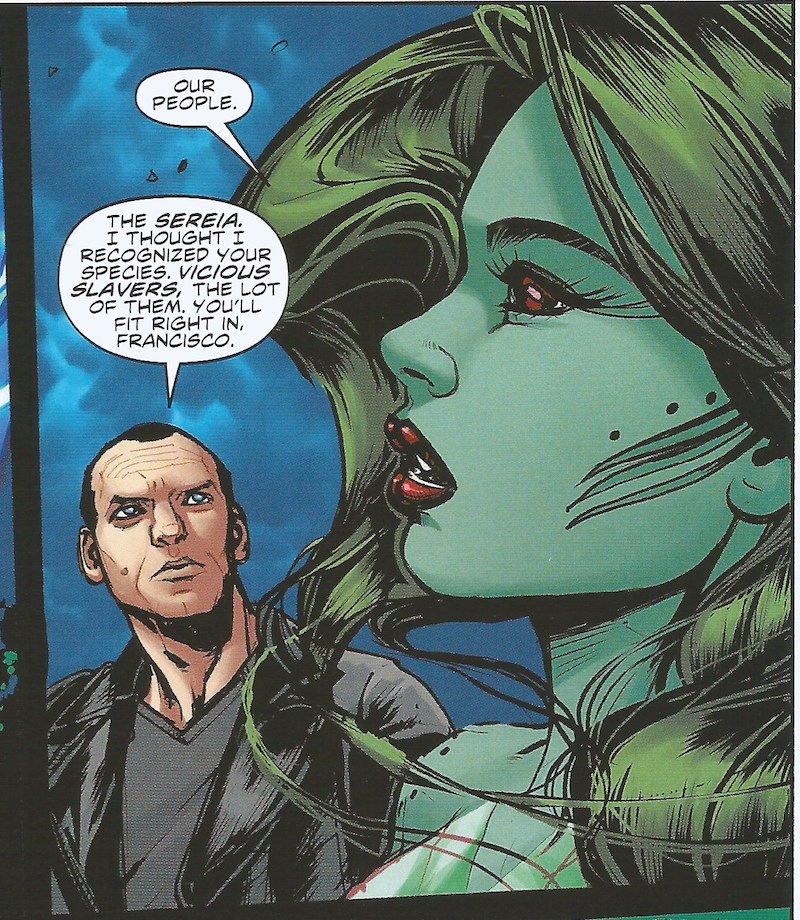
Thus, Cavan Scott and Adriana Melo unleash a chain of events that recreate the feel of Eccleston’s era of Doctor Who.

There are no clean victories here, and the Doctor wins by the skin of his teeth. In addition, the scope of the whole thing with a spacecraft filled with slavers gets curtailed by the end of the episode. It's not a lead in to bigger story. The Doctor's presence changes everything cutting short an invasion of the earth, quickening the pace.

Aquaman battles Warhead at the Beckman College Research Department. This isn’t just a physical battle but also a telepathic and philosophical struggle. At the same time, the Secret Service tries not to lose their vital Atlantean charge, and a dicey surprise awaits Aquaman at his lighthouse home in Amnesty Bay.

Aquaman’s art by Scott Eaton, Wayne Faucher and Gale Eltaeb turn this very thoughtful tale into a remarkable action-packed singular superhero story. I like how the red expresses the emotion and the digitization implies the effect of bodies being blown apart. It's more subtle while simultaneously revealing the point of view of a robot or cyborg disturbed by what he's programmed to do. It's like the conflict of a positronic brain splayed across the pages for the reader to see.

The physical battle between Warhead and Aquaman becomes almost background to what's really going on. Warhead's programming does not easily allow succession. He attempts to take control first. Aquaman's telepathy turns into a succor for a tormented being with similar abilities. “Superpower” is unusual not just because of its anti-war themes. It’s unique in the resolution, one that only a hero like Aquaman can provide.

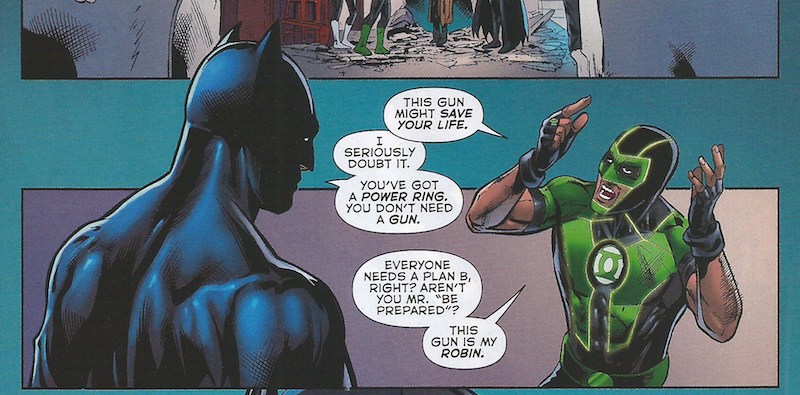
Last issue Bane attempted to snatch the Psycho Pirate over Batman’s corpse. This naturally failed, but the move forced Batman to take outrageously drastic solutions to protect his family from becoming leverage. Bane still managed to abduct the people who wouldn’t leave Gotham, and now Bane has an offer for Batman.

Batman’s answer leads to a brutal fight juxtaposed against the parallel of Batman’s and Bane’s development. From frightened children to the movers and shakers of the crime tree.

Chuck Dixon likely never had this idea in mind for Bane. Current Batman writer Tom King promotes the mirror image and seems to suggest that Bane is more authentic a figure only to set him up for total failure. Batman became Batman out of love and respect for his parents. He never allowed his rage over their death to twist him. Instead, he rebuilt a family out deduction and heroism.

Batman's grudging willingness to let people into his life serves as the solution to this particular problem. Bane became Bane because he forgot how to love. He instead sought power for the sake of power. He acquired lieutenants. For all his boasting, Bane is nothing special. Just another notch in Batman’s utility belt.

Benjamin Percy takes over James Bond, and although no Warren Ellis, he kicks off an adventure that feels Bondish. Bond is sent to a snowy chalet to eradicate an assassin.

He aborts the mission for reasons only Bond would follow but an unsub completes his task. Upon chasing and fighting his unknown helper, he finds something unexpected in context, but quite predictable by Bond's audience.

A classic Bond switcharoo. The difference lies in how unsurprising a gender "upset" is now compared to then.

In modern times, we don't blink when the woman is the expert revenge seeker or heartless killer, but Ian Fleming with his unwitting feminism actually made this plot twist through his popularity far more acceptable. Competent female crimefighters such as Pat Savage (Doc Savage), Myra Reldon (The Shadow) and Nellie Gray (The Avenger), were already established before Ian Fleming created such formidable Bond Girls as Honey Ryder and Judy Havelock. It was nevertheless Ian Fleming that broke the glass ceiling.
Bond returns home for another assignment, and he's not at all impressed until M draws out the implications.

The most obvious difference in the new Bond story is the increased amount of dialogue, first person narration and the broader scope of the world of Bond.

Percy's Bond is lighter closer to Roger Moore than Ellis' more Brosnan like Bond. This is perfectly valid choice, but the meanness of Ellis' Bond is gone. As is the reaction from other cast members to Bond.

It all began when trucker Jack Burton interfered with David Lo Pan's plans to rule the world. Since then, the sorcerer's ghost haunted Jack. Both he and Jack found themselves sucked into an alternate reality where Snake Plissken escaped the prison of New York. A parallel version of Jack's friend named Bobby Liu used a magic scroll to call forth Snake Plissken but got Jack instead. That's because it turns out Jack and Snake are two sides of the same vibrational coin. Bobby wanted Snake, who does show up, to save beloved blues singer Blind Apple Mary. This leads to alls sorts of chicanery, including a magic guitar now in the very wrong hands of Escape from New York antagonist Bob Huack.

Bob convinced a weak government to wipe out the last survivors in order to start over. Complicating matters is David Lo Pan who though a ghost isn't about to let the world go up in smoke and he with it. So, Jack and David do the unthinkable.

With this deal in place enemies become allies...

...or not. In a previous issue, David unleashed a whole can of Snake whup-ass on our heroes. Snakes from the multiverse set out to kill each other and everybody else. The Lady Snake the best of the lot survived with the added insurance of an atomic bomb set to her beating heart. Fortunately, David has one Snake left, and it's a doozy.

The action and comedy merge for a satisfying blend of both franchises and original, really original story by the reliable Greg Pak.

Bob convinced a weak government to wipe out the last survivors in order to start over. Complicating matters is David Lo Pan who though a ghost isn't about to let the world go up in smoke and he with it. So, Jack and David do the unthinkable.

With this deal in place enemies become allies...

...or not. In a previous issue, David unleashed a whole can of Snake whup-ass on our heroes. Snakes from the multiverse set out to kill each other and everybody else. The Lady Snake the best of the lot survived with the added insurance of an atomic bomb set to her beating heart. Fortunately, David has one Snake left, and it's a doozy.

The action and comedy merge for a satisfying blend of both franchises and original, really original story by the reliable Greg Pak.

The Defenders of the Universe sit in Ming’s dungeon awaiting their fate. It’s not what you expect.

This witty twist is just one of many in Jeff Parker’s affectionate homage and continuation of the decades long duel between Flash Gordon and Ming the Merciless.

The way out lies through Mandrake’s magic. This allows for even more comedy and action, but they need a distracting, and that's where Flash comes in.

Princess Aura practically molded every bad girl with a Jones for the hero, but Aura's made from a way, different culture and a maniacal upbringing.
Not to worry, Flash's safety is assured. It's not even a spoiler because the happy-go-lucky mood of Flash Gordon is the tell. Nothing bad is going to happen in this mini-series, and the hi-jinks end once again on the goofiest of notes.


Princess Aura practically molded every bad girl with a Jones for the hero, but Aura's made from a way, different culture and a maniacal upbringing.
Not to worry, Flash's safety is assured. It's not even a spoiler because the happy-go-lucky mood of Flash Gordon is the tell. Nothing bad is going to happen in this mini-series, and the hi-jinks end once again on the goofiest of notes.