Pick of the Brown Bag
October 3, 2018
by
Ray Tate
Welcome to the Pick of the Brown Bag. My name is Ray Tate, and here at the POBB I review the best and the worst comics of the week. For this post I peruse Batman, Iron Man, James Bond, The Lone Ranger, Nightwing and first subject Sparrowhawk. Fresh condensed reviews can also be found on Twitter: #PickoftheBrownBag.

I'm always willing to give a first issue a try even when the genre's not really in my bailiwick. What I'll usually do is flip through the book in the comic book shop and assess the artwork. If the art's decent and the story doesn't appear wordy--often bad news--I'll take the debut home with me.

Sparrowhawk's illustration by Matias Basla knocked me out. So, that was half the battle. The story though not at all wordy, looked to be pure fantasy. Sparrowhawk surprised me.

The tale opens in 19th century Northumberland, England, and delves deep into death, illegitimacy, racism, peerage and marriage as a means to an end. That's a wee bit more complex than most of the fairy tales I'm aware of. Artemisia is at the center of this web of intrigue. However, the death of her half-sister Elizabeth, not depicted, triggers the entirety.
At this point, we learn of a war waged between the Lady of the Manor and Artemisia. It's a war besieging all fronts. Lady Grey's real beef is that Artemisia is her husband's bastard child. Her skin color and station helped Lady Grey hate Artemisia even more.

At the same time, she must know that Artemisia is a young woman of rare character. She knows that Artemisia will not let her other half-sister Caroline suffer a horrible fate. She therefore hates Artemisia for another reason. She knows Artemisia is a better person than she can ever hope to be.
This skirmish appears to favor Lady Grey. Resigned to stewing in Lady Grey's trap, Artemisia prepares for the inevitable. The faerie however take a hand in her destiny and throw her through the looking glass.

Usually children find their way to the lands of make believe. Alice follows a hare. Peter, Lucy, Susan and Edmond discover Narnia through the Wardrobe by accident. The aggression of the faerie traveler is unique, and writer Delilah Dawson draws on the folklore of changelings for a decidedly fresh spin.

Once in Faerie, Artemisia must strike a bargain to learn of the rules. This bargain seems like nothing, but it's in fact insidious and far darker than the actions Artemisia must later preform. This includes fighting a giant and undergoing a strange, painful metamorphosis. Recommended.

I aways liked Dick Grayson as Robin. I never warmed to his ungrateful, wretched Nightwing. The idea was that Robin grew up and grew out of his short pants. So, he created a surlier identity based on the alter-ego Superman used when occasionally fighting crime in the bottled city of Kandor.
The New 52 rebooted Nightwing along with every other DC character. Kyle Higgins and Scott Snyder wrote Dick Grayson as the man I thought he always should have become. Almost every hero and villain benefitted from the New 52. Even Booster bloody Gold acquired his potential.
In Forever Evil, scribe Geoff Johns exposed Dick Grayson's identity to the world. So, Dick Grayson reinvented himself as spy in a series of adventures written by Tim Seeley. The soft adjuster Rebirth excised the revelation scene. So, Dick resumed his Nightwing sobriquet. Since Rebirth, I've dipped in and out of Nightwing's title. Mostly ending up with a shoulder shrug. Perfectly okay but not notable.
The newest Nighting writer Benjamin Percy impressed me the most. However, it's becoming increasingly apparent to the writers of the Batman Family titles that adherence to Tom King's continuity in Batman is vital for continued relevance.
In Forever Evil, scribe Geoff Johns exposed Dick Grayson's identity to the world. So, Dick Grayson reinvented himself as spy in a series of adventures written by Tim Seeley. The soft adjuster Rebirth excised the revelation scene. So, Dick resumed his Nightwing sobriquet. Since Rebirth, I've dipped in and out of Nightwing's title. Mostly ending up with a shoulder shrug. Perfectly okay but not notable.
The newest Nighting writer Benjamin Percy impressed me the most. However, it's becoming increasingly apparent to the writers of the Batman Family titles that adherence to Tom King's continuity in Batman is vital for continued relevance.

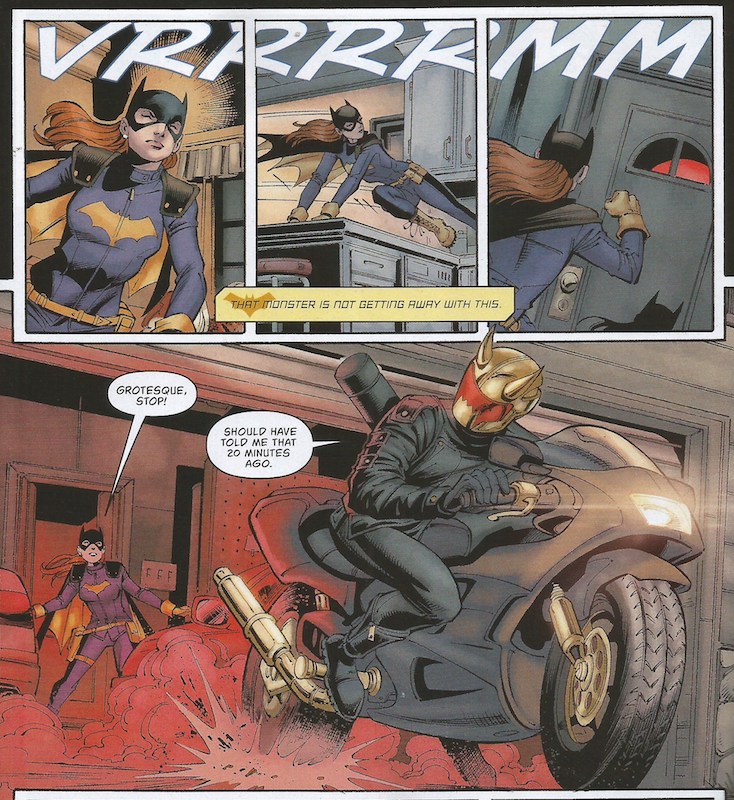
As a result, Percy drops a lot of things that I liked in Nightwing. Dark Web, the new enemy organization with a penchant for body horror, memory theft and hacking. The mobile Batcave complete with motorcycle and crime lab gifted to him by Batgirl.
His recent triumph on a mythical raceway and the acknowledgment he earned after about a million of years of being a sidekick. These are the casualties of a radical, essentially new character created from the ashes of Tom King's latest Batman issue.

You cannot even compare Nightwing’s transformation to regeneration. A core Doctor, if you will, remains essentially the same, even should he become she.

And she's fan-tas-tic!
The Doctor's memories also seem to be preserved. For example, the third Doctor’s love and memories of his companion Sarah Jane remain intact throughout the regenerative cycle. Nightwing may possess a few old memories, but those memories lack emotional connections. Nightwing for example does not remember Barbara Gordon.

Batgirl's Blue Eyes courtesy of Nick Filardi
That scream of anguish echoing in the distance emits from the scores of Dick Grayson/Barbara Gordon shippers that were never going to get their fondest desires anyhow. I've spoken in previous reviews of how DC fomented the concept. I never liked the idea of anything beyond friendship between Nightwing and Batgirl. Dick Grayson's mental fog doesn't really make me happy. I'm not celebrating a final stake in that particular heart. Rather, it's another shoulder shrug.

This is a new character almost coincidentally named Dick Grayson. So, I’m going to examine his characterization as if he weren’t named Dick Grayson. Indeed, he seems to prefer any variation of the monicker.
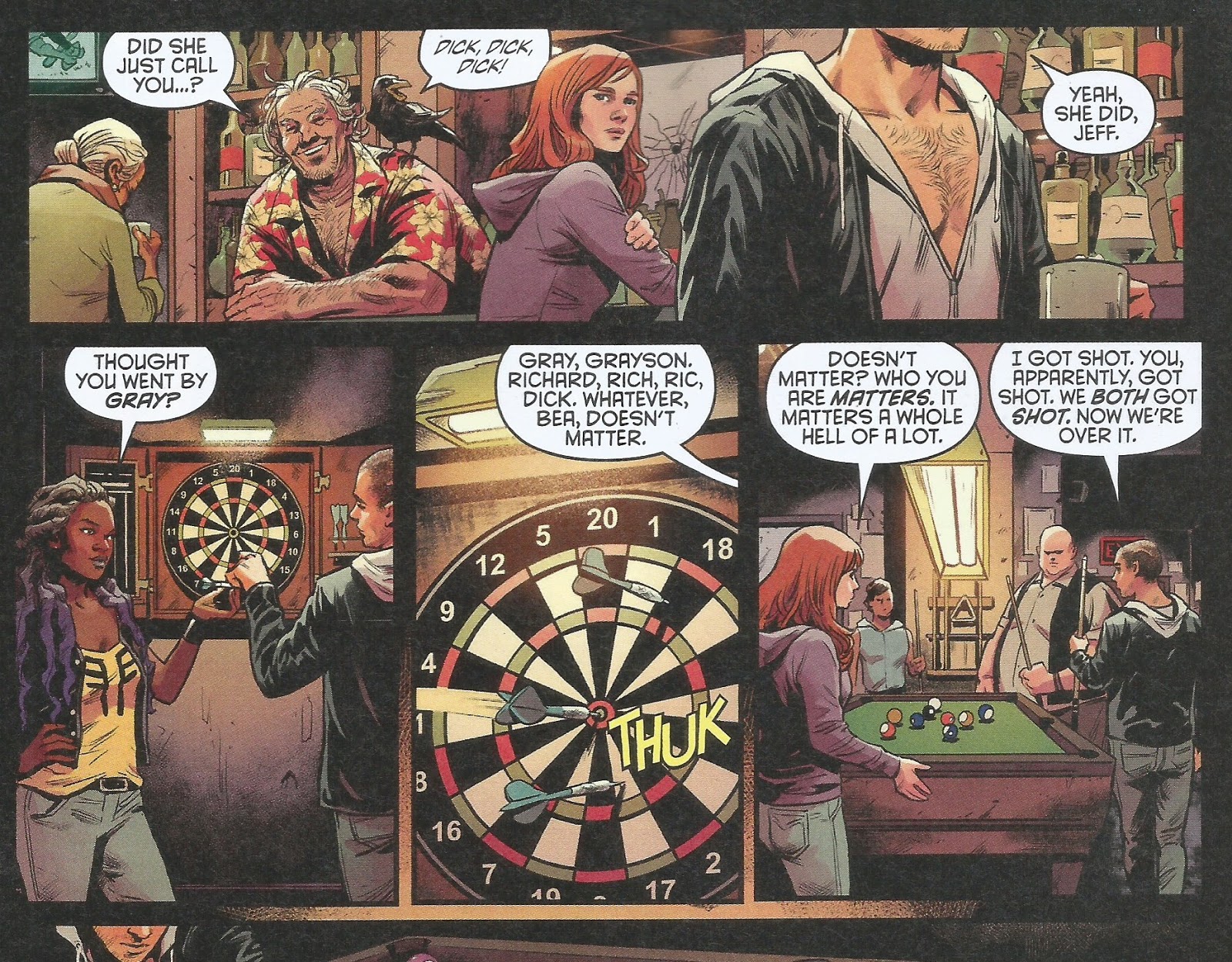
Nevertheless, to preclude confusion, I'll still refer to him as Dick Grayson. Dick is basically a street level operator with an alarming lack of identity. He doesn’t have a home. Instead, he borrows other peoples’ abodes for a night or two. He does though pay them for any inconvenience.

DIck takes on work as a cab driver. He engages in fight club type brawls for money. He hustles pool, and he basically attempts to survive any way he can in a somewhat nomadic existence. Though he still sticks to the Bludhaven and Gotham City districts. At least for now.

Dick Grayson does nothing to arouse any emotion in the reader other than to stop a holdup at a diner.

That's pretty low-res for a second tier super-hero. Nightwing is all setup, but there’s still some interest for the discerning reader. Dick's downturn draws the Batman Family together.

They do not abandon Dick Grayson. In fact, Batman follows him presumably throughout this new journey.

Essentially, Batman is Dick's Dad making sure his boy is okay on his first day of school. I've always surmised that Batgirl often visited the Batcave for intel or just to discuss the latest crimefighting technology with Batman, over tea and scones. That said. This is probably the most Batgirl's been seen in the Batcave since Batman Eternal.
On the flip side, it amused me greatly that Dick Grayson’s new environment is filled with things that are in the Black Label debacle The Damned. Here I thought you could only proudly present a XXX theater in a Black Label book. Apparently not.
On the flip side, it amused me greatly that Dick Grayson’s new environment is filled with things that are in the Black Label debacle The Damned. Here I thought you could only proudly present a XXX theater in a Black Label book. Apparently not.

In fact, Nightwing has more of an adult feel to it. Not because Thomas Wayne is diddling somebody on the side maybe or because of Batman's circumcised co-star. Nightwing addresses brain trauma after severe injury. That's a tough conversation to have with an adult let alone a child.
Facilitating the better representation of maturity, the artwork by Chris Moonyham and Filardi takes a realistic upswing to lend verisimilitude to the situation. Overall Nightwing is a superior book when compared to The Damned, but I don't really think it surpasses Benjamin Percy's opening gambit. It's just different.
Facilitating the better representation of maturity, the artwork by Chris Moonyham and Filardi takes a realistic upswing to lend verisimilitude to the situation. Overall Nightwing is a superior book when compared to The Damned, but I don't really think it surpasses Benjamin Percy's opening gambit. It's just different.

A lot of people think that Batman is about revenge, but even when he snapped necks with a song in his heart, Batman wasn't seeking vengeance for his murdered parents. He never thought Dr. Death or Professor Hugo Strange killed his parents. He pursued the criminal element because he vowed nobody else would suffer like he did.
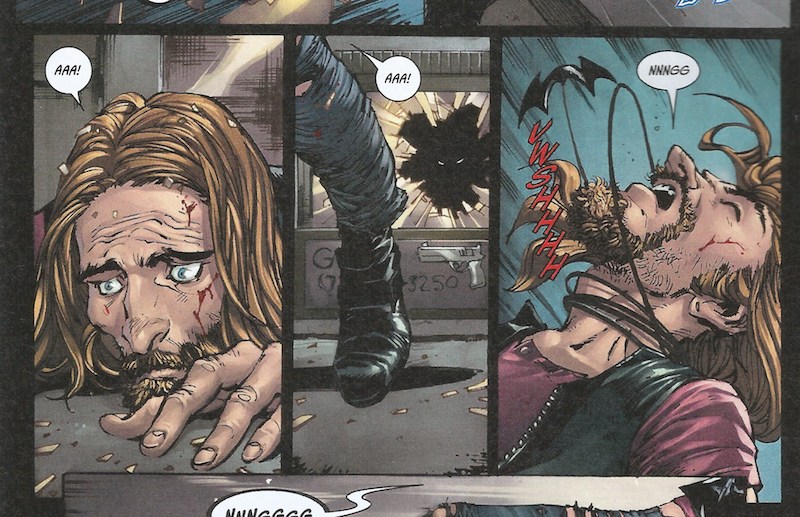
It is for that reason he adopted Dick Grayson. This latest issue of Batman on the other hand is about revenge. Plain and simple.

Even Alfred wants a taste. Last time the KGBeast of all creatures took something precious from Batman. Batman simply wants to capture the Beast, beat him senseless and maybe even kill the son-of-a-bitch. Nobody can fault Batman if he slipped this once. I don't think it will happen, but you never know.
Because Batman doesn't play out in a vacuum, this is a revenge story like no other. It's a revenge story set in the DCU. In addition to terrorizing a gun dealer, Batman seeks out leads from old comrades and old enemies. In one hilarious moment, Batman threatens an old-school alien.
Frankly, despite my respect for Jims Aparo and Starlin, I never thought the KGBeast was a big deal. Batman defeats him in a mini-series and imprisons him beneath Gotham City. Naturally he escapes, but I don't believe that was his creators' intent. That he made it to a Tom King Batman is surprising.
It is for that reason he adopted Dick Grayson. This latest issue of Batman on the other hand is about revenge. Plain and simple.

Even Alfred wants a taste. Last time the KGBeast of all creatures took something precious from Batman. Batman simply wants to capture the Beast, beat him senseless and maybe even kill the son-of-a-bitch. Nobody can fault Batman if he slipped this once. I don't think it will happen, but you never know.
Because Batman doesn't play out in a vacuum, this is a revenge story like no other. It's a revenge story set in the DCU. In addition to terrorizing a gun dealer, Batman seeks out leads from old comrades and old enemies. In one hilarious moment, Batman threatens an old-school alien.
Frankly, despite my respect for Jims Aparo and Starlin, I never thought the KGBeast was a big deal. Batman defeats him in a mini-series and imprisons him beneath Gotham City. Naturally he escapes, but I don't believe that was his creators' intent. That he made it to a Tom King Batman is surprising.

The Lone Ranger returns to comics with writer Mark Russell and James Bond artist Bob Q. The creative team reintroduce the Ranger and later Tonto through the theme of historical civil unrest in the 19th century.

The Fence Cutting Wars began as a conflict between sheep herders and cattlemen. A direct affront to the concept of the open range, the conflict emerged as a result of greed, bigotry and the abuse of the Homestead Act of 1862. The Act was meant to benefit any person who didn’t “take up arms against the United States.” Progressively that included women and former slaves.
All such populations could apply for a federal land grant, but cattle barons soon took advantage. They began to mark territory with barbed wire. The land frequently stolen from independent farmers and/or sheep herders.
In the debut of The Lone Ranger, the ranchers wage the war against each other. No doubt because the victim believed and abided by the law.

Russell’s sturdy plot gets a boost by his characterization of the fiendish cattle barons. Racist and rotten to the core, they’re the picture of period Southern Democrats. Basically, the Democratic Party used to be The Republican Party and visa versa. Modern democrats would not be recognizable until the FDR era.
All well and good but what about the Lone Ranger. What’s his part in all of this, and does Russell do a good job presenting him?
Dynamite introduced a well received Lone Ranger series that “modernized” the Ranger and Tonto without taking the weird western route that Joe R. Lansdale did for DC Comics. Neither was a bad series but each lacked something.
Russell happily does not dwell too much time on the Ranger’s origin, which everybody hopefully knows. He makes some interesting tweaks. He demonstrates that the Ranger is what he is because he is a dead man reborn.

Russell further displays the Ranger's acumen and his stealth. The Ranger is quiet. Sneaking up on henchmen. Spying on the villains while he gets the facts. When exposed showing off his marksmanship and his partnership with Silver, brought to life by Q.

Russell further displays the Ranger's acumen and his stealth. The Ranger is quiet. Sneaking up on henchmen. Spying on the villains while he gets the facts. When exposed showing off his marksmanship and his partnership with Silver, brought to life by Q.

The second issue of James Bond Origin is more comedic and lighter in tone than the premiere. That's due to the well executed trope of the British SAS drill sergeant that insults his charges and makes their lives miserable in the process of training.

Jeff Parker's wit fashions these insults and situations in such a way that it's impossible to hold back. I found myself laughing aloud frequently.
Sergeant Sayles is a hilarious over the top creation that's probably a believe-it-or-not accurate assessment of the World War II drillers. He's a true sadist, and proud of the fact.

Sayles' goal is to break each and every recruit. Several wash out. Nascent Bond is still Bond, and Parker parallels young Bond with Captain Kirk. He pulls a Kobayashi Maru that's brilliant and funny.
In addition to breaking-in-training hell, Bond learns electronics and chemistry. Parker also proves that he's a cunning linguist, and it's here that Bond exudes his remarkable charisma.

He does not lose his virginity here. Bond loses his virginity at age sixteen in Paris as reported in Ian Fleming's "A View to a Kill." Gospel. These amusing achievements hang on the framework of a mole hunt, and that too is interesting.

Jeff Parker's wit fashions these insults and situations in such a way that it's impossible to hold back. I found myself laughing aloud frequently.
Sergeant Sayles is a hilarious over the top creation that's probably a believe-it-or-not accurate assessment of the World War II drillers. He's a true sadist, and proud of the fact.

Sayles' goal is to break each and every recruit. Several wash out. Nascent Bond is still Bond, and Parker parallels young Bond with Captain Kirk. He pulls a Kobayashi Maru that's brilliant and funny.
In addition to breaking-in-training hell, Bond learns electronics and chemistry. Parker also proves that he's a cunning linguist, and it's here that Bond exudes his remarkable charisma.

He does not lose his virginity here. Bond loses his virginity at age sixteen in Paris as reported in Ian Fleming's "A View to a Kill." Gospel. These amusing achievements hang on the framework of a mole hunt, and that too is interesting.

Ah, yes the famous Wasp/Tony Stark thing. That I've never heard of.

I have it on good authority that if I see something in Iron Man that I don't recognize as being canon, I should simply chalk it up to Brian Bendis, the previous show runner, curse him and move on.
Dan Slott reshapes badness into something good. For example, Tony Stark's birth-mother is apparently a female version of the late, great David Bowie.

I probably would have hated this retcon had I read it in a Bendis book, but Slott and Valerio Schiti make Amanda Armstrong so darn likable.
Tony and Janet dated and want to rekindle the romance. Okay. I accept that and move on. Besides, in no way shape or form should Hank Pym and Janet Van Dyne get back together.
The Marvel cinematic universe is a much brighter, happier place. That version of Hank and Janet Pym, everybody roots for. Rightfully so.
On the flip-side, everybody knows about Hank Pym's and the Wasp's tragic history together and his even more bizarre co-dependency with his creation Ultron.

Still, a Wasp and Iron Man union should feel a little uncomfortable, even if they're unrelated. Even if they've only known each other six years Marvel-sliding-scale time and not the historical seventy.
Slott presents their commonalities as Valerio Schiti makes them a charming couple and action-ready dynamic duo. This bounce negates any potential discomfort.
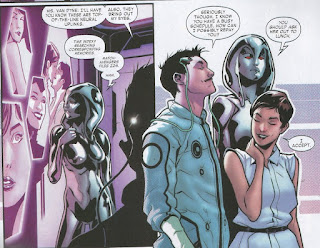
Jocasta's confirmation is our confirmation about the validity of Tony's romance with the Wasp. What's also fascinating about the scene is that Slott and Schiti characterize Janet as a remarkably warm, kind person.
In one of Hank Pym's worst moments, he brainwashed Iron Man to kidnap the Wasp and turn her over to Ultron. Hank and Ultron worked in concert to build Ultron a mate, Jocasta. Hank then nearly killed his then wife by transferring Jan's brain patterns to Jocasta.
So, in summary, Janet is dating her former kidnaper, because guess what? It wasn't his fault, but how many people would be so forgiving?
She's being absolutely chirpy while in the presence of Jocasta, the being she was forced to animate. Not Jocasta's fault, and yet...In fact, Wasp early on embraced Jocasta.
In the Unstoppable Wasp, Janet actually adopts Hank's child from his previous marriage. The second wasp Nadia Van Dyne.
Janet is without a doubt the most ethical person in the Marvel Universe, and because of that you want she and Tony to be happy.
Oh, you seek a plot as well? Okay. So, high stakes industrial espionage from the loopy Tony Stark foil Slott and Schiti introduced a few issues ago. Complete with attack killer robots and an application of Jocasta's roboethics forcing a non-violent solution. The book is so upbeat that the answer comes in the form of a pun extrapolated to the eleven.

I have it on good authority that if I see something in Iron Man that I don't recognize as being canon, I should simply chalk it up to Brian Bendis, the previous show runner, curse him and move on.
Dan Slott reshapes badness into something good. For example, Tony Stark's birth-mother is apparently a female version of the late, great David Bowie.

I probably would have hated this retcon had I read it in a Bendis book, but Slott and Valerio Schiti make Amanda Armstrong so darn likable.
Tony and Janet dated and want to rekindle the romance. Okay. I accept that and move on. Besides, in no way shape or form should Hank Pym and Janet Van Dyne get back together.
The Marvel cinematic universe is a much brighter, happier place. That version of Hank and Janet Pym, everybody roots for. Rightfully so.
On the flip-side, everybody knows about Hank Pym's and the Wasp's tragic history together and his even more bizarre co-dependency with his creation Ultron.

Still, a Wasp and Iron Man union should feel a little uncomfortable, even if they're unrelated. Even if they've only known each other six years Marvel-sliding-scale time and not the historical seventy.
Slott presents their commonalities as Valerio Schiti makes them a charming couple and action-ready dynamic duo. This bounce negates any potential discomfort.

Jocasta's confirmation is our confirmation about the validity of Tony's romance with the Wasp. What's also fascinating about the scene is that Slott and Schiti characterize Janet as a remarkably warm, kind person.
In one of Hank Pym's worst moments, he brainwashed Iron Man to kidnap the Wasp and turn her over to Ultron. Hank and Ultron worked in concert to build Ultron a mate, Jocasta. Hank then nearly killed his then wife by transferring Jan's brain patterns to Jocasta.
So, in summary, Janet is dating her former kidnaper, because guess what? It wasn't his fault, but how many people would be so forgiving?
She's being absolutely chirpy while in the presence of Jocasta, the being she was forced to animate. Not Jocasta's fault, and yet...In fact, Wasp early on embraced Jocasta.
In the Unstoppable Wasp, Janet actually adopts Hank's child from his previous marriage. The second wasp Nadia Van Dyne.
Janet is without a doubt the most ethical person in the Marvel Universe, and because of that you want she and Tony to be happy.
Oh, you seek a plot as well? Okay. So, high stakes industrial espionage from the loopy Tony Stark foil Slott and Schiti introduced a few issues ago. Complete with attack killer robots and an application of Jocasta's roboethics forcing a non-violent solution. The book is so upbeat that the answer comes in the form of a pun extrapolated to the eleven.