Showing posts with label Romulus. Show all posts

Tuesday, June 6, 2017

POBB May 31, 2017

Pick of the Brown Bag
May 31, 2017
by
Ray Tate

The Pick of the Brown Bag is a weekly comic book review blog created and run by yours truly Ray Tate.  The party begins now, but if you can’t attend, you can check out the teensy reviews on Twitter: #PickoftheBrownBag.  For this posting, I examine two annuals from DC Comics: Wonder Woman and Trinity.  I look at the latest issues of Doctor Who, Southern Cross, Romulus and Motor Girl.  Finally, I’ll add my voice, to a growing chorus, with a spoiler free review of the remarkable Wonder Woman movie.  


It’s the Captain Jack Harkness issue of Doctor Who.  In the appropriately dubbed “Secret Agent Man,” writer Cavan Scott takes the reader on a whirlwind tour of Jack’s life as a Time Agent.


"Secret Agent Man" presents Jack as a happy-go-lucky omnisexual presented first in Doctor Who and his darker self seen in Doctor Who spin-off Torchwood.  Scott gives a valid reason for the seeming split personality and shows that both Jacks are an equal pair of the same suit.


Scott in addition integrates this idea within the skeleton of recent events occurring in the comic book.  At the same time, he creates a new mystery that’s at the core of the good captain's troubles, and involves the Doctor in a typically spectacular fashion.


Southern Cross in many ways is what Prometheus wanted to be.  It’s strong industrial science fiction with an intergalactic corporation at its center.  It’s the story about a strong female protagonist searching a mystery that involves Cthulhu-strange aliens, and it even features a talking disembodied head.  Whereas Prometheus is evil, Southern Cross is good, and that’s largely due to the trio of creators: Becky Cloonan, Any Belanger and Lee Louridge.

The artists create a gritty tapestry of metal and alien planets trying to be tamed by humans that lack the facilities to do so.  The corporation Zemi catalyzes the reduction of humanity to savages, and the heroes of the story are grifters and con artists.  On the surface, Southern Cross is good, hard science fiction drama, but it’s far more complex than that.


One of the more interesting things about Southern Cross is that each volume is based on a backstory that catches up with the fore story.  For example, Amber, Alex’s sister is killed or worse, and Alex Braithwaite begins Southern Cross searching for the truth.  When she finds it, Southern Cross survivor Kyril starts the second volume on Titan, and this story catches up to what happened to Alex.  In other words, Southern Cross is elliptical in terms of narrative.  Alex catches up to Amber.  Kyril catches up to Alex.


The second volume of Southern Cross focuses on Kyril and Hazel, an investigator for Zemi but not on the corporation’s side.  However, Cloonan introduces another pair of important characters trying to catch up to Alex.  Her father Maxwell Braithwaite and Thrn, Alex’s former lover.  Both want to find out what happened to Alex.  So, now the pattern becomes, Maxwell catching up to his daughters and Thrn catching up to Alex.  Thus, the past of Southern Cross stretches back even further to snap back to the present.  It’s really quite clever and at the same time enriches the plot.


Essentially this is the origin of Motor Girl.  The story begins in the present where Mr. Walden brings down a flying saucer and tries without success to cool his mercenaries’ fear of strange visitors.


One of those little green men visited Sam at the junkyard, and she became kind of fond of the fellow.


However, there’s more to Bik than meets the eye, and his benign 1950s styled appearance might just be an illusion.  Although perhaps his form is determined by the viewer.  Usually, unconsciousness eliminates pretense.  Of course, since this is another person’s original fiction, there’s no reason to maintain the rules of set by another author.  In any case, the imagery of the scene stirs a memory in Sam, and it’s not a good one.


Sam was a soldier in Iraq, and this frequently comedic story bears teeth when exposing PSTD from torture or mentioning the scars Sam received for her service.  It’s in these moments where we learn from whence Sam’s greatest defense mechanism comes.  Mike, a talking gorilla that only Sam can see.  

At the same time, the story posits another possibility.  This reality that Sam’s appears to see could all be just in her head?  Signposts from her past seem to resurface in the present.  The imagery could be a coincidence, beautifully realized in fiction, or the visuals may just be Sam's terrifying present being reordered into a structured fable.  

Terry Moore has done this before with Strangers in Paradise, but if he were to pull a reality switch in Motor Girl, it would at least be justified.  That’s why I think this latter contingency is unlikely.  It would be too easy.  It’s messier to suggest that Mike, Bik, Walden and every trial and tribulation Sam faces both mental and physical actually happens within the context of a flexible reality.


Romulus returns with a perfect chapter that at once advances the story and reminds readers what’s going on in the first place.  In other words.  A perfect point to jump on and experience this literate beautifully illustrated action tale pitting Ashlar against the cult of Romulus.

We joined in on her fight as she thwarted an attempt to kidnap a young engineer Nicholas.  Eventually Romulus found their quarry, and Ashlar intends to free him.  Romulus anticipated Ashlar's determination.


Achilles is a man conditioned to kill Ashlar.  He refers to himself as her shadow.  Dirty pool would be a better term.  By tuning in on the spirt of her mother, Ashlar finds a means to work through the terrible pain the drug causes and with its impetus, gain her objective.

While it may seem that I’m spilling a helluva lot of information.  Telling you all of these tidbits doesn’t actually affect the pleasure of reading.  Romulus’ strength lies in the art, the dialogue, the exploration of an embedded “alien” culture in modern times and the feistiness of she-wolf Ashlar.  As an added bonus, Romulus made an enemy out of a much better known cult from myth and popular culture.


Ashlar met the Illuminati in a previous issue.  As you can see, she’s using them not the other way around.  The Illuminati’s role in this affair remains to be judged.  Romulus however is a potent force for evil.  The cult’s success is written in blood throughout history, and Ashlar removing an asset from their care doesn’t ensure victory.  You must even admire the persistence Romulus as well as their agent's ability to compartmentalize yet still be true to the cause, however crazy it is.


The Trinity annual is a sequel of sorts to another story involving Ra’s Al Ghul and Circe.  I never read that tale, but I still understood this one.  So, nobody should have a problem with comprehension.  

The ne’er do wells lord about the heretofore unknown Pandora Pits, not to be confused with the Lazarus Pits.  At the same time, Bruce Wayne is holding a repast for his friends.  Simultaneously, the Pandora Pits draw a traveler known for his dabbling in the occult, and chaos ensues with this harrowing omen.


That’s all I can say without giving away major plot points.  The tale written by Rob Williams flows effortlessly through the excellent characterization of Batman, Superman and Wonder Woman, as well as the mysterious traveler.  Ra’s al Ghul’s persona lost its cohesiveness the moment the Bronze Age ended.  I never know what he’s about nowadays.  Way over his head for this misadventure, that's for sure.  Circe is sort of like her humorous Justice League counterpart.  So, that works.  The art by Guillem March is both masterful and scope and skill.  With that checklist viewed….

S
P
O
I
L
E
R
S


A
H
O
Y

The mysterious traveler is none other Jason Blood and you know that Etrigan cannot be far behind, but what happens when Demon blood crosses the fluid of the Pandora Pit?


The Demon unleashes hell on earth, and only Batman, Superman and Wonder Woman can stop it, or can they given the painting that appears to foretell a grim future?  


The story allows for beautiful moments of the Trinity fighting against Etrigan and a Demon horde, but more than calisthenics, Williams' tale is about the ties that bind the heroes.  


The new Wonder Woman annual looks at several facets comprising Wonder Woman’s history and characterization.  It’s an anthology, which usually means duck for cover.  Don’t worry.  Every story is worth reading, and the art though varying in style is homogenous in attractiveness.

“And Then There Were Three,” relates the first meeting of Batman, Superman and Wonder Woman in respect to Superman’s restoration.  It is easily the most light-hearted tale Greg Rucka ever wrote.  There’s not a single hint of darkness in this sly comedy. 


Continuity followers will now need to adjust Geoff Johns’ and Jim Lee’s Justice League accordingly.  It’s not as bad as you think.  There’s simply no friction between the Big Three.  Just Green Lantern and Batman.  Green Lantern and Superman.  Green Lantern and Wonder Woman.  Green Lantern and Aquaman.  Green Lantern is a jerk.

Superman, as Clark Kent is the first to note Wonder Woman’s appearance, but Lois Lane, so spritely she sounds like Dana Delaney, races for the scoop.  Alfred drolly informs Batman of the new development, and Batman and Superman have the same idea.

Rucka shockingly opts for a happy Superman that shares the double-act camaraderie with the drily witty Dark Knight.  The next thing you know Wonder Woman appears and she negates any chance of a  stereotypic slug fest.  


The genuinely funny punchline at once offers a sincere pronouncement of Wonder Woman’s core, Batman's self-reflection and a critique on the frequently defined boy scout.

The next tale examines Wonder Woman’s status as an international law bringer.  Wonder Woman never had a city of operations, apart from Washington D.C. during the war time originals.  She traveled throughout the world, and you never knew when or where she would show up.  She was frequently portrayed as a peacekeeper associated with the United Nations.  That purpose never went away.


When Markovia orders the execution of King Shark, Wonder Woman intervenes under the aegis of a treaty violation.  She then proceeds to demonstrate her abilities as the ultimate Olympian athlete while rooting out the truth, with her golden lasso.  She's at once an officer of international law and the conveyer of mercy.  


In “The Curse and the Honor,” Wonder Woman spars with an old samurai who wishes to test his skill against the warrior eternal.


There is more to this tale than innocent whim.  The samurai bears an onus that he wishes Wonder Woman to lift.  The events present Wonder Woman as an Amazon, granting succor and adhering to a champion’s code of conduct.


The last tale presents Wonder Woman as a fount of knowledge and the protector of innocent life forms.  The story is obviously an enticement for Godzilla and Gamera fans, but monster and maiden require each other for the tale to work.  So, it’s a Wonder Woman story and a creature feature.

Saturday Afternoon at the Movies


Wonder Woman is simply put the best movie DC has released.  It tops the Man of Steel through an accuracy in the portrayal of history and a more satisfying love story.  It equals Man of Steel via a sophistication to the craft of story.  The acting in each venture is superb and therefore even keel.  However, whereas Henry Cavill is a very good Superman, Gal Gadot is Wonder Woman.  Both films present fascinating foreign cultures that beg for their own explorations, stunning cinematography and authenticity in special effects and action.  The villains in Man of Steel are richer in character, but Wonder Woman’s villains were meant to be human, for the most part.  That’s the point.  


Wonder Woman takes place in World War I, not World War II, the period in which William Moulton Marston created the Amazon.  This switch caused some perturbation among fans when first learned, but the calmer of us realized that the writers and the director were just trying to do their own thing while being faithful to the spirit of the source.  The truth is that if Wonder Woman had taken place in World War II, it would have been an entirely different film, and not necessarily a better one.  

Keep in mind, and I cannot stress this enough.  Overall, the Germans of today, and maybe two or three generations back are lovely people.  The Nazis were scum.  I referred to the Nazis as the nesting dolls of evil and legislated serial killers.  There was no good in them.  In comparison, the Allies though flawed appeared to be lawful good, and so Wonder Woman would have been an unavoidably patriotic movie—as often was the television series, and that’s not what the filmmakers wanted nor aimed for.  


The theatre of World War I is a much more compelling backdrop for the birth of Wonder Woman because nobody is on her side except Steve Trevor, in spirit the Amazons and a wonderful clutch of outsiders.  Male chauvinism is universal at this time, especially in the upper ranks that arose not from merit but typically from peerage.  Furthermore, there’s an equivalency in the presentation of German soldiers fighting English soldiers within the confines of the infamous No Man’s Land.  That congruence is vital, and Wonder Woman matures during a hero’s journey through chaos that lacks recognizable evil.  Right and wrong however still matters.  Morality is an application in Wonder Woman.  It’s a force Diana carries into battle. 


The fully seasoned Wonder Woman that battles for the fate of the world at the end of the film experienced hard lessons, felt her childish fantasies shattered by horrible realizations.  However, she emerges as a stronger character because of the exposure, and in a pivotal moment, Wonder Woman draws power from the well of a universal principal.  An extraordinary movie better than we could have ever wished for.


Tuesday, January 3, 2017

POBB December 28, 2016

Pick of the Brown Bag
December 28, 2016
by
Ray Tate

Your friendly, neighborhood weekly comic book review blog says aloha to 2016 with reviews of Batgirl, Future Quest, Harley’s Little Black Book, James Bond, The Mighty Thor, Rom, Romulus, Scooby-Doo Team-Up and The Titans.

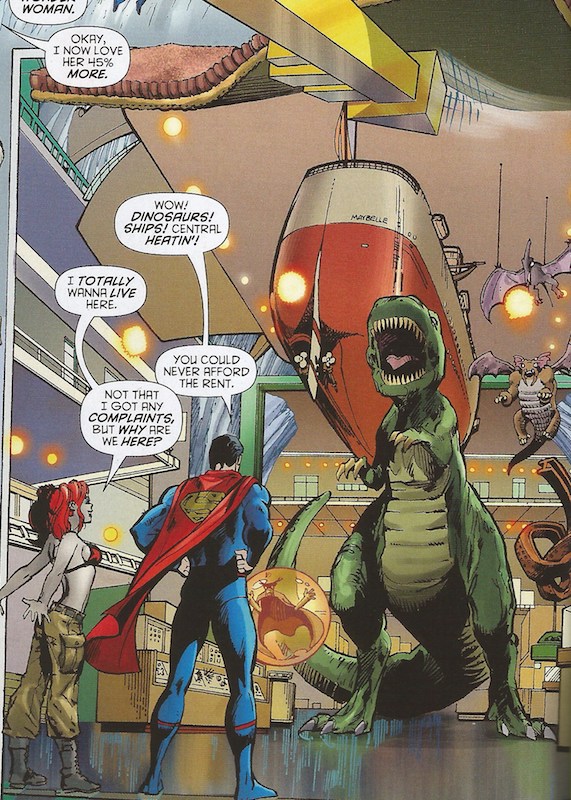
Harley Quinn appears in two contenders this week.  In her eponymous Little Black Book, Harley must battle Superman.


Sound familiar? If no, then you’re not much of a comic book historian.  Amanda Conner and Jimmy Palmiotti with Neal Adams spoof All-New Collector’s Edition #56 better known as Superman vs. Muhammad Ali.


Believe it or not, I never read this special.  These $2.00 tabloid-sized monsters were rare finds because they existed at a time when comic books were sold in Woolworth’s not specialty comic book shops.  I distinctly remember reaching for Superman vs. Wonder Woman only to see it snatched away by a taller boy.  I was lucky enough to read Superman vs. Spider-Man, a collection of Batman reprints, and that’s about it.  So, I’m not exactly sure how close to the source material the writers and artists are hitting.  Most of my knowledge is hand-me-down.  For example, I know that Neal Adams was one of the original talents behind Superman vs. Muhammad Ali, and it's a real coup to nab him for Harley Quinn's Little Black Book.  

What I can say is that even without the first hand experience of Superman vs. Muhammad Ali, Harley Quinn’s Little Black Book is laugh out loud funny.  It’s also independent of continuity.  So we don't need to worry about other universes and Lo-Bots.  Superman is the real deal Superman.  We even see him disguised momentarily as mild-mannered Clark Kent.


This gag is a callback to Christopher Reeves and Gene Hackman in Superman.

The story begins on Coney Island Beach where one of the Scrubb interrupts the basking Harley and Tony.  According to wikipedia and the Grand Comic Database, the Scrubb is the same alien species that demanded the Ali/Kal-El bout.  This one does not make a good first impression.


Harley lacks super-powers, but as she states in the story, she does know how to fight.  That makes her itching to take on Superman in order to eventually bring the beat down on the Scrubb’s champion and save the earth.  


Harley’s Little Black Book isn’t just a yuk fest.  It’s in addition a very clever fairplay troubleshoot against the aliens.  The story also acts as a nostalgic tip of the hat to Superman history.  Right from the start Palmiotti and Conner affectionately poke fun of Superman’s fondness for telephone booths.  They remember little nuggets of trivia that give the book texture as well as genuine valid points of argument.


At the same time, they “don’t tug on Superman’s cape.”  We get ample moments where Superman does what he does best.


Mind you.  Harley’s comment may refer to an old Superman themed joke.  As the story progresses, Conner and Palmiotti compare and contrast the force of nature Harley Quinn and the super straight arrow.  Although sometimes they’re both baffled by the goofball Scrubb.


Rather than eschew the Wonderful World of Krypton motifs of Superman comics, Palmiotti and Conner embrace it.  They furthermore hinge the story’s solution an old trick Superman picked up from a friend.  


Also on board for the main event, the classic versions of Lois Lane and Jimmy Olsen, minus the bow tie.


At this point, you probably expect me to ask why isn’t Jimmy Olsen black.  Nope.  Skin color doesn’t factor into this because Harley Quinn’s Little Black Book is meant to be the quintessential versions of the heroes and supporting cast members.  My complaint about Action Comics is equally valid because at that moment, DC had the opportunity to move their books closer to the successful television series.  No explanation needed because Rebirth is a tweak of the new 52.  Furthermore, because Neal Adams is drawing, Jimmy actually looks like Jimmy Olsen rather than Maggie Sawyer.  Lois Lane looks like Lois Lane with a mod haircut.  In other words, there’s something about them that resonates their visual history.  You know who they are.


Steve Lombard

It’s always wonderful to see Neal Adams’ Superman.  The aliens give Adams a lot of leeway for imagination, and the reader also witnesses Adams’ flair for comedy from an almost Jack Davis like double-page spread of beach-goers to the slapstick expressions of Rat’Zar, the Grand Poobah of Scrubb.  Adams in addition has a remarkable flair for illustrating Harley Quinn.  That would seem counterintuitive since Quinn is usually cartoony, often exaggerated, and Adams is a realistic artist.  Nevertheless, Quinn becomes one of Adams’ masterpieces.


Harley next pays a Christmas visit to Scooby-Doo and the Gang.  Harley and Ivy previously guest starred in Scooby-Doo Team-Up.  So, there’s always a danger of repetition especially in something as admittedly formulaic as Scooby-Doo.  Writer Sholly Fisch however creates an original new encounter between Harley and the sleuths.
As the story progresses so do the gags and a surprise mention of an untold tale or tales in which Harley Quinn met Dr. Thirteen and the Phantom Stranger.


Harley tags along with Fred, Daphne, Velma, Scooby and Shaggy as Mystery Inc. attempt to solve the haunting of a department store with the same sheet spectral shtick from the previous Team-Up.  You must admire Fisch’s moxie.  He’s practically inviting the reader to see a repeat, but no, the Ghost of Christmas Past and Present are entirely solvable not unadvertised super-villains or super-heroes in disguise.


Although the solution lies at the end of the story, the capture occurs in the middle of the comic book, and this is due to the complexity of the story.  It’s not just a mystery or Harley Quinn’s Ha-Has.  Fisch surprises the reader with apropos guest stars as well as allusions to Scooby-Doo Where Are You? continuity, which of course I’ll not spoil here.

Fisch’s able partner Dario Brizuela with colorist Silvana Brys draws a melange of different styles suitable for these mystery role players.  No matter what design he works in, everything looks great and blends together.

Ariel Olivetti brings depth and realism to the heretofore stylish cartoony Future Quest.  Even Jan’s uniform gains a little satiny texture.

There’s in addition a contrast to the way super-heroes look in comparison to real real people.


Mightor is supposed to be a godlike figure.  Essentially a prehistoric Thor.  Race Bannon is just a super fit secret agent.


It’s an interesting artistic experiment, and the heightened realism doesn’t distract you from the story until Olivetti renders Coil-Man from the Impossibles.


That’s the least disturbing image of Coil-Man from the book.  You can’t fault Olivetti’s sense of humor.  Yes.  That’s probably what a Coil-Man would look like in real life.

The story begins with Buzz Conroy’s Mom, Race and Devi leaving to join Mightor and Birdman in their fight against Omikron in Utah.  Omikron is keen to take Mightor’s club, which it empowered years ago.

Meanwhile enemies Dr. Benton Quest and Dr. Zin combine forces for the greater good, but FEAR isn’t interested in such a collusion.


The story by Jeff Parker reveals far more depth than one expects from Hanna-Barbera superhero cartoons, which mostly relied on elegant simplicity.  He emphasizes love, fatherhood, duplicity in villainy and tragedy in the origin of Space Ghost.  Despite introducing more mature elements to the tales of these beloved characters, their charming essence still remains.


In the Silver Age, lightning struck a chemically bathed Wally West, and he became Kid Flash.  Sidekick to Barry Allen.  Kid Flash, Robin, Wonder Girl, Aqualad and Speedy form the Teen Titans.  At the conclusion to the Crisis of Infinite Earths, Wally assumes the role of his mentor The Flash who sacrifices himself to stop the Anti-Monitor from destroying the Cosmos.  The new 52 is a whole cloth recreation of the earth.  In the new 52, the Teen Titans didn’t exist.  The heroes that comprised the team all had different origins, and manifested at different times.  Donna Troy for example is the youngest of the group, emerging as a homunculus from an unexplained crone’s magical stew on Paradise Island.

In Rebirth, Wally West returns.  It turns out that during the recreation of the new 52, some heroes from past continuities were captured and removed from time and space.  When Wally returns nobody recognizes him.  Eventually he convinces the Flash, Batman and the Teen Titans of his authenticity, but celebrations must be short lived because with Wally’s return comes the encore performance of Abra Kadabra, the magician from the future.


Dan Abnett writes some of the best science fiction in comics set inside action-filled narratives for each artist to actualize.  In Earth 2 he explores the pitfalls of creating planets out of nothing.  Aquaman is a full of sci-fi pulp and political intrigue.  For The Titans, instead of glossing over the paradoxes and character histories, he relies upon them for excellent storytelling.  He takes the mysticism out of the Speed Force.  The Titans form an alliance from true memories from times that didn’t happen.  


Batgirl is a standalone story reuniting Babs with Poison Ivy.  In the new 52, Poison Ivy isn’t exactly a villain.  More of an anti-hero.  She in fact debuted as one of the members of the Birds of Prey.  Batgirl though teaming up with Black Canary and Starling, in fact officially joined the team later.

Poison Ivy’s ambivalence toward human life and her unspecified history with Batman generates friction and distrust between she and Batgirl.  It must be noted however that Batman in fact approved of Ivy’s association with the Birds of Prey.  He believed that the Birds were a good influence on Ivy.  Furthermore, Gail Simone produced a very clever seasonal explanation for Ivy’s mercurial behavior that paralleled the life of plants.  So sometimes, Ivy’s genuinely benevolent.  Other times she’s downright evil.

Hope Larson’s done-in-one takes place aboard Ivy’s and Batgirl’s plane.  Ivy’s carting a prehistoric plant that she believed dormant.  Some unexpected turbulence creates enough stress to wake up the planet and from its perspective the alien environment causes it to grow with preternatural speed.  Neither Batgirl or Ivy expected exactly what they face. 


Artist Raphael Albuquerque emphasizes their almost comical surprise.  At this moment, you know that they’re in the same predicament, which won’t make their partnership any easier.

Larson’s story is filled with humorous exchanges and solid research.  Though ostensibly enemies, Poison Ivy and Batgirl save each other’s life multiple times.  Ivy in addition concocts the perfect means to keep the other passengers out of harm’s way, and there’s a lovely moment when Batgirl and Ivy boost each other’s morale.   Larson bases the plant on the real life Carrion Flower which as its name suggests attracts pollinating flies with the scent of rotted flesh.  Larson finds the perfect MacGyver for Batgirl to employ.  Throughout the book, she makes the point that neither Batgirl or Ivy can stop the plant alone.  Thus they must depend on each other, and the way that each character contributes is often uplifting.

Romulus is a secret order that balances the power of the world through persuasion and assassination.  They have done this throughout history.  Only, their apparent altruistic however extreme motives prove to be false.  The Romulus assassin Axis discovers the order's true goal, deems it justifiably insane and turns her sword against them.  She is not alone.   Her daughter knows the truth about Romulus, and when Axis falls, Ashlar picks up the gauntlet.
The story begins with Sozo a celebrity that’s actually one of the Illuminati, escorting Ashlar on a plane trip to meet her group.


The dialogue in the scene is about as funny as the book gets.  For the most part this is a serious duel between Romulus and Ashlar for the fate of the world.  The soberness of the situation is emphasized by artist Nelson Blake’s lupine design for Ashlar and writer Bryan Hill’s wolf themes.  

When the plane lands, Ashlar discovers an Illumanti camp setup for her and Caliban, her new mentor.


The remainder of the book details Caliban teaching Ashlar another way to fight that counters her intuitions.  At the same time, Ashlar's charge Nicholas rots in a Romulus cell, and they work at breaking his resolve.  Romulus is just so enthralling.  The art and the dialogue with an intriguing martial arts philosophy draws you into the pages.

The Dark Elf Malekith has taken over the Alfheim, the domain of the Light Elves.  Malekith also made a pact with Loki and Darrio Aggar the Minotaur head of Roxxon.  The League of Realms, a defacto supergroup comprised of representatives from the Nine Realms, opposes Malekith’s attempt to rule.  Their attempt to free the Queen of the Light Elves blew up in their faces.  In this second chapter, Thor now faces a former victim of Malekith’s in a suit of magical armor that forces her to fight.


The plight of the victim seen on page one cements Malekith’s malevolence.  The grin of spikes on the thing’s helmet becomes an irony rather than a testament to toughness.  While Thor battles the creature, the League of Realms take on Malekith’s forces.  The overmatched Dark Elves become cannon fodder, and Roz Solomon representing Midgard comes off as classic SHIELD thanks to Steve Epting’s stunning artwork.


We also get a few good Sif moments, a nasty Malekith showpiece and a Loki that you’re not quite sure about.  Again, Epting creates such emotion in his face that his conflict looks genuine not the cackling jackanapes from the old days.


Two more Space Knights arrive on earth in Rom.  This should be a cause for rejoicing, but the reunion is anything but happy.  The Knights attempt to eradicate Camilla Byers, infected with the Dire Wraith plague, but not yet turned.


These Space Knights are not Terminator and Starshine the Marvel Space Knights that used to accompany Rom.  Writers Christos Gage and Chris Ryall take advantage of the clean slate to create new Space Knights as well as a ranking system that creates even more disadvantages for Rom.

The conflict and the unreliability of the Analyzer that allows Rom and his fellows to detect Dire Wraiths comes to a head in the form of battle.  The Dire Wraiths of course attempt to take advantage of the discord but Camilla’s bravery turns the tide of battle.  Strong issue not to be missed. 


Last but not least, “Eidolon” ends with an attempted assassination, a damsel that stabs her way out of distress, bodies dropping on London streets and a vicious duel between the traitorous Eidolon and Bond, James Bond.