Pick of the Brown Bag
June 8, 2016
by
Ray Tate
It's time for the Pick of the Brown Bag, a weekly comic book review blog. My name is Ray Tate, and my current batch consists of Henchgirl, King's Quest and Vampirella. From the Rebirth section, I'll review Action Comics, Aquaman and Wonder Woman. I'll also say a few words about The Adventures of Supergirl and Black Canary. I also review Now You See Me: The Second Act. If you're out of time and in the comic book store, desperate not to waste your money, check my reviews out on Twitter: #PickoftheBrownBag.

I've been reading comic books for years, and you know what's never bothered me until recently? The whiteness of the cast. A lack of diversity in comic books is in general what I grew up with.

Mind you, there was less of this white homogeny in the Bronze Age. Of course, there was practically no good representation of diversity in the Golden and Silver Ages. Yet I never noticed the difference. I suppose I was simply too young to even consider skin color or sexual orientation, but perhaps the uniform entertainment if not actual depth in the tales of yore allowed me to overlook what is now obvious. In addition, art styles drastically differed from those of today. Artists of the Golden Age preferred exaggeration and cartoons.

Comic books and comic strips shared more in common. Comic book illustrators neither imitated photographs nor mimicked reality. So, I never really paid attention to DC’s color blindspot.

John Byrne when rebooting Superman with Man of Steel kept most of the traditional cast white, but he introduced a black villain early on and gave us Maggie Sawyer, the first openly lesbian character in mainstream comic books. As well as her girlfriend Toby Raynes.
Although Hollywood comes under fire frequently, television and movies exposed me to diverse casts. I can now see what represents reality on the big screen.

I'm not calling for a black Superman or Wonder Woman in the comics. The detonation of continuity isn't acceptable.

James Bond ranges from Sean Connery through Pierce Brosnan. Each Bond is the same white guy, and he's not a Time Lord. He can't suddenly be a black man or a woman. He's also one hundred percent wolf. That cycle of Bond however is finite.
The makers of Bond already spun off a new Bond in a new continuity. Daniel Craig is not playing the same James Bond. So there's no reason why Idris Elba or Gillian Anderson could not be new Bonds in a new cycle of movies.
It's not a delicate issue. It's a question of practice in serial fiction. If you create a new continuity—a new cosmos per se, gender, sexual orientation, complexion is up for grabs, but the pull of tradition is strong. Most continuities recapitulate past continuities.

For that reason it seems likely that Batman's always going to be a straight, white guy. He's a straight, white guy in the 1930s. He's a straight, white guy in the 1970s. He's a straight, white guy in the 1990s. He's a straight, white guy in 2012 to the present. Will that always be the case? Maybe not. A really amazing black actor could put on the cape and cowl and match Michael Keaton. Instead of Catwoman, he could kiss Catman. Anything wrong with that? Nope. You give me a strong enough actor to weigh against the action, and I will follow you anywhere.
Rebirth doesn't reboot the new 52. It's purpose is to mesh history as memory to the baggage-free heroes of the new 52. However, couldn't the Powers That Be not use Rebirth to redefine second and third tier cast members? To be fair the DC Powers are trying. Ryan Choi, a new black Wally West and Latino Jaime Reyes gain roles in the new 52 thanks to Rebirth. That's not the same thing as reshaping the traditional cast staples.

Nothing is whiter than Action Comics, and it's so remarkably jarring. Why does Jimmy Olsen need to be a white dude? Why can't he reflect Supergirl's Jimmy Olsen, Mehcad Brooks?

When Olsen stands next to Maggie Sawyer, they look like brother and sister. Maggie is still a lesbian at least. Maybe Jenny there is as well.

The Olsen Twins
Lois Lane is from Another Universe. Why is she white? Superman has to be white because he’s purporting to be the post-Crisis model. The one that died at the hands of Doomsday, but nobody’s buying it. So why couldn’t Lois Lane be black? It might at least give her visual uniqueness even if not livening her personality or dialogue.

And That's...One to Grow On
Lois Lane hasn’t said one original or interesting thing since bursting--no--since inching onto the scene of Rebirth. All she spouts here are stereotypic mom-spun homilies. Wouldn't Lois say something like: "Hey, kiddo. We have a strict no super-powers rule in the house. It goes with you break it, you bought it." Then she'd ruffle his hair. Kryptonian hair is super-strong yet super-soft. It's like spider-silk raised to the nth power.

Maybe if the story was just slam-bang I wouldn't be reminded of the black Perry White played with conviction by Laurence Fishburne introduced in Man of Steel...

...or notice that there's only one black guy in the entire comic book, and he's not on any tier of importance. Alas, the plot is not. Action Comics is boring and predictable.
Jimmy Olsen annoys Maggie Sawyer at a high tech hostage crisis where the hostage takers don't actually know what they want. They're just your basic hoods with sophisticated gear to better fit in with a city of tomorrow like Metropolis.
Meanwhile, the humorless Kent family from another earth moves in to their new home. Lois and Clark remind me of a 1950s white couple about to be invaded by giant ants or radioactive katydids. They've got this rube wholesomeness going for them that's supposed to mirror the assumption of the audience's homogeneity even when you're actually a goth.

This is Superman.
All the sex and excitement has just been bled out of this marriage. Writer Dan Jurgens portrays Clark as a stubborn head of the household that does what he wants without Lois Lane's blessing, after all she's just a woman. Once a vibrant reporter with sharp intelligence, now a lifeless husk sucked dry by becoming an adjunct to Clark. This is the fucking worst family I have ever seen in comic books.

Lucky thing extra-universe Clark happened to have a brand new 52 Superman costume lying around to better look the part when picking a fight with Lex Luthor.

You see whether or not Lex staged this hostage crisis to garnish good press is moot. Lex Luthor in the new 52 does not have any personal beef with Superman.

Superman didn't cause the loss of his hair, and the Lex of the new 52 isn't as xenophobic as some of his other avatars. His arrogance levels dropped immensely, and he did the remarkable thing of saving Superman's life by removing the Kryptonite shard that a former Crime Syndicate member shoved into his brain. He could have let Superman die. It would not have been his responsibility.

Lex Luthor furthermore ended Atomica's life and even if some Leaguers will always be suspicious, Luthor earned a spot in the Justice League. As to the House of El business, Luthor did not alter his armor. The Hunger Dogs of Apokolips fashioned the shield because they believed Luthor to be their destined savior. I guess he could have corrected them, but Superman is dead. Luthor isn’t buying this poser as Superman and neither am I.

The end result is that Superman is a total smug sphincter for starting this fight. Confronting Luthor isn't his responsibility anyway. If anybody deserves to chastise Luthor for attempting to fill the void it should be Supergirl, the inheritor of Superman's legacy.

In summary, Superman forces Lex Luthor into a dick measuring contest. All the members are white. Because of the drained colors, everybody looks even whiter. Lois Lane gets nothing. Not a single world that sparks. Oh, yeah, and Doomsday shows up on the last page because…whatever. I’ll keep the surprise white guest star to myself just in case you think it’s a shocker. He's also got some lousy dialogue.
The other books from Rebirth do what Action Comics does not.

Aquaman is at once a field guide to all things Aquaman as well as an update for those who haven't checked in on the book recently.

Writer Dan Abnet thankfully expunged the Aquaman is Arion the sorcerer motif. He mentions it not once.

Instead, we get a look at the hero from The Super-Friends onward. Super-strong, super tough skin, tougher in water, fastest swimmer, remarkable stamina, breathes underwater, compels sea life to obey his commands. Oh, yeah.

The plot hanging all of this together consists of Aquaman battling Atlantean terrorists, which have always been present in the series. Although perhaps not the 1940s when the Golden Age Aquaman frequently sank U-Boats with his bare fists.

Yes. Aquaman is not a new super-hero. He's almost as old as his contemporaries in the Justice League.
Unlike Superman from Another Universe, Aquaman doesn't represent white America. He could convey an Aryan appearance, yet he does not. Blonde and white-skinned, maybe, Aquaman however possesses eyes as blue as the sea, and his costume isn't red and blue, white is psychologically added, but scaled orange with fins on green tights. He's a monarch, the same thing the Colonists fought against. His domain is the entire world. Aquaman isn't a god. He's the worst thing for any racist. He's a hybrid. Aquaman's father was a human lighthouse keeper. His mother an Atlantean. His parents were different, and he wasn't raised human but given tastes of both worlds.
The upshot of this is that even if you think Aquaman is a joke or he shouldn't be ruling Atlantis or the Seven Seas for that matter, he doesn't give a shit. You're still worth something to Aquaman, and he's going to save your life.

Superman endangers the innocent just because he’s ticked off at Luthor, the wrong Luthor. Aquaman seeks to stop a terrorist cell from using fusion bombs. Screw you, Superman.

Superman endangers the innocent just because he’s ticked off at Luthor, the wrong Luthor. Aquaman seeks to stop a terrorist cell from using fusion bombs. Screw you, Superman.
The love of Aquaman's life, and at the very least his common law wife, Mera expresses far more personality than Lois Lane. Warm, sexy and funny, Mera adds something beautiful to the story and life of Aquaman. Her devotion to Aquaman is honest, and it doesn't feel like an obligation. That these two are in love is obvious.

Mera’s dialogue is twenty thousand leagues deeper than that of the Loisbot, and although we do not see her engage in the action, she nevertheless appears to be ready for anything.
Oh, and because of a surprise guest star, the unbearable whiteness of being does not apply to Aquaman. Even if our cameo did not appear, the Atlanteans are so diverse despite the sameness of their skin tone that the great white hope argument still wouldn't be justified.

The Flash is the least interesting of the remainder not because it's boring or lacks diversity but because the beginning of the story reflects the Flash’s origin. If you watch The Flash, you know this origin by heart. Grant Gustin narrates it, and more than a handful of episodes go in depth.
The Flash team next reiterate what Rebirth already revealed. The narrator of Rebirth is a lost hero known to the Flash attempting to warn the champions of DC that their history has been tampered with.
What bumps The Flash up one from Action Comics is the interaction between the Flash and Batman.

The Flash continues the tale from Rebirth, and although it doesn't provide answers, it reinforces a steady friendship between Batman and the Flash, that began with Flashpoint.
That the writer bases their friendship on a mutual love of science is at once ingenious and fitting. Furthermore, there are no rulers out, and everybody behaves like adults.

Greg Rucka returns to Wonder Woman, and the improvement has all the impact of a brick to the head. Rucka is so good that he doesn’t actually need to be original. That’s not a crack.
The story begins with Wonder Woman taking care of business at what appears to be a sex slavery operation being run under the auspices of a seedy strip club.

Really nothing special. I mean, Rucka could have just said to Matthew Clark. No, go nuts. Or, he could have meticulously said, okay, this is where Wonder Woman uses her lasso as a whip. Or a combination. They’re all good action scenes that feed into the Wonder Woman feminist mythology; no surprise Rachel Maddow is covering the story as Wonder Woman leaps away. Nevertheless, this sequence, which would have been a perfectly polished Wonder Woman short story, isn’t the best thing about Wonder Woman.
The best thing about Wonder Woman occurs when Rucka has her questioning herself and her origins. You can argue that this is a dream/fantasy/virtual reality issue, but it’s not. This isn’t like The Adventures of Supergirl or Black Canary. It’s something entirely different.
Rucka’s doesn’t create a dreamworld. He voices Wonder Woman’s doubt in her current and past history. That is interesting.

So the sculpted from clay original and the Zeus reboot are both put into perspective as equal lies. The reasons why Diana left Paradise Island become fluid. Rucka also doesn’t wear out this welcome. He lets artist Clark summarize the stakes in a shattered mirror. For an encore, Rucka discards the new 52 costume--which I like by the way--for a decidedly more ancient look that Liam Sharp illustrates beautifully. Diana travels to Olympus to find answers and instead must run a gauntlet of mythology.
Every word in Wonder Woman is compelling. The cast of one should bore the reader, but she doesn’t. Her narrative is fascinating, and her actions at once culturally strange as well as characteristic. Rucka doesn’t simply ask which is Wonder Woman’s true history. He asks what do these memories, false or not, mean to Diana. That’s why Wonder Woman reads like a novel rather than a cheap artifice like Action Comics.

Adventures of Supergirl and Black Canary both create dream sequences or traumatic fantasies for their title characters. Supergirl is a mostly harmless solidly written stand-alone that pales in comparison to the introduction of the Black Mercy on the television series. It does however debut the unusual character of Psi who acts like the Sandman.

A warden of dreams at Fort Rozz, Psi mistakes Supergirl for an enemy and puts her through Emanuela Luppachino's beautifully illustrated nightmare.

A warden of dreams at Fort Rozz, Psi mistakes Supergirl for an enemy and puts her through Emanuela Luppachino's beautifully illustrated nightmare.

Black Canary concludes with a death dream that sends Canary into a different lifetime. I’m not sure this was the way to go in ending the series. The conclusion where Dinah grants the Big Bad the Five Heavens Palm technique is strong enough alone. The epilogue where Amanda Waller finally makes peace with Dinah also carries a more potent impetus.

King's Quest begins with a fun memory of Flash Gordon, Dale Arden and Professor Zarkov playing with the queen of an aquatic race.

The story cuts to the world's present day status as a desert planet. This tragedy comes as a genuine shock; the aftermath of Ming at his most merciless. Writers Ben Acker and Heath Corson skillfully put a face and personality to the victimization of the planet. The idea of this power and terror sticks with you throughout the read, even when Acker and Corson alleviate the mood.

Mandrake and Professor Zarkov argue about the merits of science and magic throughout their portion of the story. The discussion offers the book's first true moments of hilarity and foreshadows the means in which Mandrake will bamboozle the enemy, which suits his mien to a tee, or perhaps top hat would be more apt.
As Mandrake, Zarkov and the young but wise Prince Valiant deal with Ming's forces on the haunted water planet, Flash Gordon and the Phantom travel through space, encountering Ming's forces. Fortunately, Flash has a plan...

...that he hasn't thought through. I don't know if there are die hard Flash Gordon fans. The ones that are fans of the newspaper strip, but I can see them perhaps getting somewhat upset over Dynamite's Flash Gordon model. However, Flash Gordon started as a polo star that became a football hero. He started as a resourceful, daring, chisel-jawed straight-laced hero that became the mold for such astronaut heroes in 1950s science fiction films. The problem is that Flash is too representative of Americana machismo. Most people can't take that seriously any more.
Jeff Parker who wrote King's Watch reintroducing the heroes of King Features to a new audience kept Flash's luck and resourcefulness intact, but he also gave him a recklessness that's indicative of what modern readers would perceive of an actual Flash Gordon doing his daring-do. If he were Batman, we would simply accept it. He's Flash Gordon. We can't accept it. He doesn't have the same resonance that he once did. So Flash as written in King's Quest is a good blend of the past and present. His plan of course steals Han Solo's bad luck attempt at bamboozling the Stormtroopers. The difference is that Flash believes fully that it will work. It kind of does. Except for the fact he hasn't thought things through. The recklessness.
Observing the fiasco is the Phantom. Currently the Phantom is two. Mandrake's best friend and long time strong arm Lothar took over from the Phantom's comrade, who assumed the role when the actual Phantom died. He gave his life for the sake of the earth. Lothar during his travels found the real Phantom under the Defenders of the Earth's noses. Jen Harris is the actual Phantom, or at least she will be when Lothar finishes her training.
As you can see, Dynamite is on the right track. Having a female Phantom isn't new. Though a black Phantom is. Double your diversity I always say. They're also not just here for their gender or skin color. Lothar remains Lothar and portrays the Phantom admirably. Jen Harris' neophyte fumbles provide humor and sparkling dialogue with her mentor Lothar. As the story progresses, so does Jen and Dale Arden, who immediately becomes less of a mcguffin to the story and so much more modern and interesting than Lois Lane, who I can't stress enough sucks.
Jeff Parker who wrote King's Watch reintroducing the heroes of King Features to a new audience kept Flash's luck and resourcefulness intact, but he also gave him a recklessness that's indicative of what modern readers would perceive of an actual Flash Gordon doing his daring-do. If he were Batman, we would simply accept it. He's Flash Gordon. We can't accept it. He doesn't have the same resonance that he once did. So Flash as written in King's Quest is a good blend of the past and present. His plan of course steals Han Solo's bad luck attempt at bamboozling the Stormtroopers. The difference is that Flash believes fully that it will work. It kind of does. Except for the fact he hasn't thought things through. The recklessness.
Observing the fiasco is the Phantom. Currently the Phantom is two. Mandrake's best friend and long time strong arm Lothar took over from the Phantom's comrade, who assumed the role when the actual Phantom died. He gave his life for the sake of the earth. Lothar during his travels found the real Phantom under the Defenders of the Earth's noses. Jen Harris is the actual Phantom, or at least she will be when Lothar finishes her training.
As you can see, Dynamite is on the right track. Having a female Phantom isn't new. Though a black Phantom is. Double your diversity I always say. They're also not just here for their gender or skin color. Lothar remains Lothar and portrays the Phantom admirably. Jen Harris' neophyte fumbles provide humor and sparkling dialogue with her mentor Lothar. As the story progresses, so does Jen and Dale Arden, who immediately becomes less of a mcguffin to the story and so much more modern and interesting than Lois Lane, who I can't stress enough sucks.

I've been a fan of Vampirella for a helluva long time. It must be at least three decades. When I was a little kid, the magazine was usually out of my hands quicker than a heartbeat. Thanks mom. I did however occasionally get a glimpse. Thanks dad. Vampirella's skintastic look was striking bait for the adventures of the only good vampire in fiction.

As I got older and Vampirella metamorphosed into a comic book, I finally could read an entire story. Vampirella was the flip side of Supergirl. Supergirl is blonde. Vampirella is brunette. Both are aliens and the last of their kind. Each of them have similar powers. Both are champions. Whereas Supergirl is science fiction, Vampirella is horror. More often than not Supergirl and Vampirella are outsiders. Even amongst their peers. Despite the sex appeal or maybe in addition to the sex appeal, Vampirella's stories are uniformly well constructed and filled with surprises. While you can argue favorites and follies, almost every writer of Vampirella followed the basics of good storytelling. They didn't treat the story any less because it was a Vampirella story.
Kat Leth's latest chapter in Vampirella exemplifies just how good this title can get without even trying. The tale opens with Vampirella being greeted by the conductor of the current Danse Macabre immortal actress Slade. The ambience is that of a classy ball, and as doors open, we see how true the description is.

The thing is I've seen this sort of setup before. Classy villain pretending to be civilized. The ball is an hors douevre to the main course of badass finale. What I didn't expect were the little twists of brutality that happen so quickly. What I didn't expect was the elimination of padding and cutting to the chase. I also didn't expect Vampirella finding so ready a means to curtail Slade. One that she brought to the table, making it doubly giddy. I really should have anticipated that trickery. So, once again Vampirella is better than a new reader might expect and as usually great for the faithful fan.

As I got older and Vampirella metamorphosed into a comic book, I finally could read an entire story. Vampirella was the flip side of Supergirl. Supergirl is blonde. Vampirella is brunette. Both are aliens and the last of their kind. Each of them have similar powers. Both are champions. Whereas Supergirl is science fiction, Vampirella is horror. More often than not Supergirl and Vampirella are outsiders. Even amongst their peers. Despite the sex appeal or maybe in addition to the sex appeal, Vampirella's stories are uniformly well constructed and filled with surprises. While you can argue favorites and follies, almost every writer of Vampirella followed the basics of good storytelling. They didn't treat the story any less because it was a Vampirella story.
Kat Leth's latest chapter in Vampirella exemplifies just how good this title can get without even trying. The tale opens with Vampirella being greeted by the conductor of the current Danse Macabre immortal actress Slade. The ambience is that of a classy ball, and as doors open, we see how true the description is.

The thing is I've seen this sort of setup before. Classy villain pretending to be civilized. The ball is an hors douevre to the main course of badass finale. What I didn't expect were the little twists of brutality that happen so quickly. What I didn't expect was the elimination of padding and cutting to the chase. I also didn't expect Vampirella finding so ready a means to curtail Slade. One that she brought to the table, making it doubly giddy. I really should have anticipated that trickery. So, once again Vampirella is better than a new reader might expect and as usually great for the faithful fan.

In Henchgirl the art gets a little smoother. The narrative quality of the visual goes from good to excellent, and the story becomes even more interesting. Creator/writer/artist Kristen Gudsnuk should have run out of ideas for the magic turning Henchgirl into an evildoer. Before she was merely a confused criminal, but now she's outright villainous. Instead, Gudsnuk naturally shows her estrangement from hero Mannequin.

She also begins to create a schism between Mary and her new bestie Coco, kingpin Monsieur Butterfly's top girl. The abrasiveness is getting to her.

Gudsnuk shows how Mary's bad behavior is affecting her roommates and friends, and the scene where she tries to push Tina, the carrot-life producing girl into a criminal escapade.

These moments however skirt the main story. Gudsnuk introduces a new anime styled super-hero who makes two mistakes. One, she gets in Mary's way and two, she partners with the Mannequin. The jealousy leads to vicious no-holds barred showdown.

Mary possesses "freakish" strength, and now that she's evil she thinks underhandedly. You may ask why she still cares about the Mannequin. Jealousy is one of the baser emotions, and the spell allows her to feel the jealousy, amplified ten fold I'd say.

When I went to see the first Now You See Me, I didn't know what to expect. I ended up delighted by the film. The ending however seemed definite. So I went to the sequel with a little trepidation. Could the filmmakers come up with something equally impressive that didn't ruin what I thought was a perfect ending?
Stage magician activists known as The Horsemen return, but not arbitrarily. They have a plan in mind, and their vanishing act in the first film links up nicely with the events in this film. As the movie progresses, the filmmakers appear to shed the finale of the first movie, but as the end nears they recoup the magic.

As I watched Now You See Me: The Second Act, I began to think of how the film would play. I knew a massive trick had to be involved. So I attempted to see through the smoke and mirrors. I ended up with a different plot, but the surprise the filmmakers had in store for me delighted me once again. The actual story was better than the one I made up in my head. That doesn't happen too often.
Lizzy Caplan from The Masters of Sex replaces Isla Fisher who portrayed female magician Henley. It's no surprise Fisher decided not to return given she almost drowned during the water-tank escape in the first movie. Caplan brings a streetwise aspect to the magic and fits in with the Horsemen quite smoothly. We also get a full blast of Dave Franco whose part in the first movie was through the plot short. Franco provides a charming persona with superb stagecraft. He acts like a young magician might. Stalwarts Mark Ruffalo and Jesse Eisenberg along with a hilarious and dramatic Woody Harrelson reprise their roles with skill and depth. Guest stars surprise, and their performance matches that of the Horsemen.

She also begins to create a schism between Mary and her new bestie Coco, kingpin Monsieur Butterfly's top girl. The abrasiveness is getting to her.
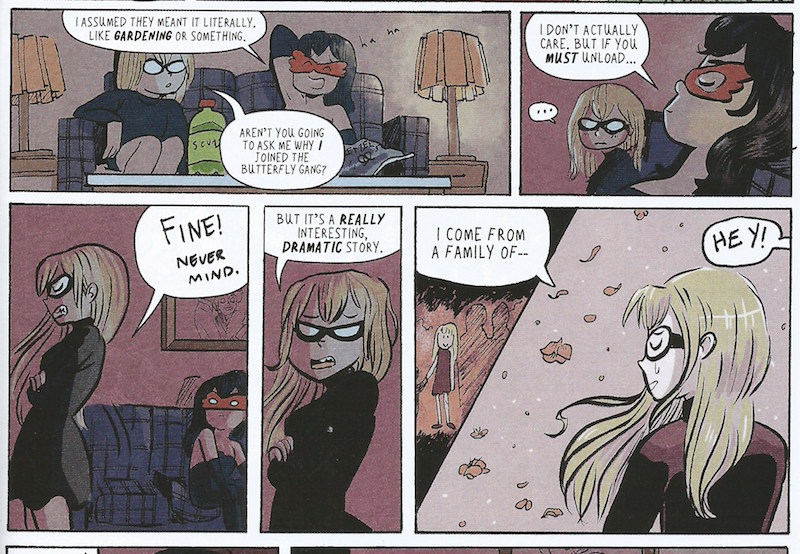
Gudsnuk shows how Mary's bad behavior is affecting her roommates and friends, and the scene where she tries to push Tina, the carrot-life producing girl into a criminal escapade.

These moments however skirt the main story. Gudsnuk introduces a new anime styled super-hero who makes two mistakes. One, she gets in Mary's way and two, she partners with the Mannequin. The jealousy leads to vicious no-holds barred showdown.

Mary possesses "freakish" strength, and now that she's evil she thinks underhandedly. You may ask why she still cares about the Mannequin. Jealousy is one of the baser emotions, and the spell allows her to feel the jealousy, amplified ten fold I'd say.
The Saturday Afternoon Movie

When I went to see the first Now You See Me, I didn't know what to expect. I ended up delighted by the film. The ending however seemed definite. So I went to the sequel with a little trepidation. Could the filmmakers come up with something equally impressive that didn't ruin what I thought was a perfect ending?
Stage magician activists known as The Horsemen return, but not arbitrarily. They have a plan in mind, and their vanishing act in the first film links up nicely with the events in this film. As the movie progresses, the filmmakers appear to shed the finale of the first movie, but as the end nears they recoup the magic.

As I watched Now You See Me: The Second Act, I began to think of how the film would play. I knew a massive trick had to be involved. So I attempted to see through the smoke and mirrors. I ended up with a different plot, but the surprise the filmmakers had in store for me delighted me once again. The actual story was better than the one I made up in my head. That doesn't happen too often.
Lizzy Caplan from The Masters of Sex replaces Isla Fisher who portrayed female magician Henley. It's no surprise Fisher decided not to return given she almost drowned during the water-tank escape in the first movie. Caplan brings a streetwise aspect to the magic and fits in with the Horsemen quite smoothly. We also get a full blast of Dave Franco whose part in the first movie was through the plot short. Franco provides a charming persona with superb stagecraft. He acts like a young magician might. Stalwarts Mark Ruffalo and Jesse Eisenberg along with a hilarious and dramatic Woody Harrelson reprise their roles with skill and depth. Guest stars surprise, and their performance matches that of the Horsemen.


_001.jpg)


