Showing posts with label Baltimore. Show all posts

Tuesday, May 12, 2015

POBB: May 6, 2015

Pick of the Brown Bag
May 6, 2015
by
Ray Tate

Welcome to the Pick of the Brown Bag.  In this blog, I review the best and the worst of the weekly haul of comic books.   Criticism, comment and compliments are welcome.  This week I look at Angel and Faith, Avengers vs., Baltimore: the Cult of the Red King, John Carter Warlord of Mars, Rocket Girl, Scooby-Doo Team-Up, Spider-Gwen, Spider-Woman and the Wonder Woman ’77 Special.


Avengers vs.  is an anthology pitting mostly movie-characterized Avengers against well known Avengers foes including The Red Skull, Attuma, Frost Giants, MODOK and of course Loki.  These identity reveals are no spoilers since each short story is an adventure tale.  You're given no fair play clues to solve a mystery.  Each of the stories has something going for it, and the artwork is uniformly appealing.  So if you’re an Avengers fan, you’ll want to add this to your collection.

In “The Art of War” writer Joe Caramagna animates the statues of New York and forces the Avengers to fight the power of art.  The living behemoths turn out to be a ploy conducted by the Red Skull wielding some high tech/ magic mojo.  I like how Caramagna ties in the Nazi obsession with art, especially “decadent” art, and takes it to a comic book extreme.

In terms of writing, Iron Man is the most in character.  You can easily imagine Robert Downey Jr. speaking Caramagna’s lines.  

Black Widow would have sounded like Scarlett Johansson if not for her being drawn classically Widow, courtesy of Andrea DeVito and Laura Villari; it’s a psychological thing.  Captain America mirrors the comic book Cap; not Chris Evans.  There’s nothing wrong with that, but I like the Chris Evans Cap, and I’d like to see a book based on his portrayal of the star-spangled Avenger.  Hulk is really talky and that just seems off to me, but I do love this gag.


In the second of Caramagna stories, Wellington Alves, Anderson Silva and Carlos Lopez detail an action-filled battle against the Frost Giants.    


Loki is the standout in this story.  He adheres to his own agenda and doesn’t exhibit an ounce of honor.  He’s not emulating Tom Hiddleston, but it’s a fun presentation nevertheless.  I also like the underlying motif of Iron Man not believing in Asgardian magic.  I agree with him.  In the films Asgardian magic is actually advanced alien technology that follow’s Clarke’s Law.  That’s also what Jack Kirby and Stan Lee implied originally.  Thor and his brethren are really ancient aliens.  They just don’t act like it.


The Falcon acts really bizarre in this story.  I’ve always liked the Falcon.  When introduced in the comics, I thought finally somebody stronger than Bucky or the Rick Jones/Bucky to partner with Cap.  The Falcon was a black dude, skilled in the martial arts, which fit with what was happening in seventies pop culture.  In Winter Soldier, the movie version of Sam Wilson is that of a pararescue operative.  Where the hell does this “polysomnographic” stuff come from?  I understand that you want to make the black character smart, but that gobbledygook must go.  It makes you look as if you’re trying.

In the third tale, Attuma goes environmental…


…which is hilariously bad.   Attuma is the blue jackass that wants to conquer the world and kill Namor while doing it.  Plain and simple.  Forgiving this unnecessary update, Caramagna uses a character I never heard of.


I had to look up to see if her connections to the Norse were true to myth.  Just like Mr. Caramagna says.  If I learn something from a comic book, it automatically gets a pass.  Ron Lim's art here also looks better when he's trying to fit in with continuity proper.


Scooby-Doo Team-Up’s Dario Brizuela takes up illustration duties in the third tale which pits Iron Man and Falcon against MODOK and everybody’s favorite beekeepers AIM.  Loki also guest-stars.  This is a much better spotlight for the Falcon’s intelligence without needless technobabble, and Brizuela’s streamlined style makes for a perfect animated excursion.


Rocket Girl returns for an inauspicious sixth issue.  The usually frenetic teen cop gave up her Rocket Girl status at the end of the previous series, and now all she has are memories of a future that may never arrive.  This leaves Writer Brandon Montclare and Amy Reeder with a dilemma.  How can they present Rocket Girl without a rocket pack?  As you can see by this issue, the answer is that they cannot.


The plot, such as it is, involves Annie getting into a slap fight with a perfect stranger after an argument at a food stand.  She apparently believed Dayoung Johansson, the artist formerly known as Rocket Girl, will kick her nemesis' ass for her, but Dayoung stays out of it and reminisces about her first time on the force.


In that memory, Dayoung and her partner tackle semi-legal vice.  The episode provides the only enjoyment in Rocket Girl since Dayoung energetically back-knees the pimp in the nose.  Readers looking to feed off the amazing blast of energy from Rocket Girl need to pick up the first volume, and the faithful will hopefully need not wait long for Rocket Girl to return to her aerial acrobatics. 


Introduced in The Edge of the Spider-Verse, Spider-Gwen began in the middle with Gwen Stacy alias Spider-Woman being hunted by the police over the death of Peter Parker. 


J.J. Jonah Jameson further turned public opinion against Gwendy.  Before these pivots in her life, Spider-Gwen had already had some capers under her belt.  


Her new series created the idea that Gwen was at a crossroads.  Keep in mind.  This is a turning point in a series that doesn’t actually exist.   Gwen revealed her identity to her father Captain Stacy, and she gave up drumming for the Mary Janes, the band comprised of what-if Peter Parker Prime associates, girlfriends and wives.  Remarkable in itself.  

This issue returns Spider-Gwen to her never established status-quo.  Not counting a humorous encounter with graffiti taggers, it's a mostly introspective issue where Gwen decides to come clean to her neighbors Ben and May Parker only to find succor and renewal in May's words.


It's a dangerous issue of Spider-Gwen because the wrong timing or dialogue could have doomed the story to pretentiousness or tedium.  Instead it's quite beautiful, and writer Jason Latour and artists Robbie Rodriguez and Rico Renzi can take their well-deserved bows.  If anything, this issue of Spider-Gwen proves that it doesn't need to be packed to the webs with action or cute to be damn good.  


Spider-Woman took the place of classic Marvel villain the Porcupine in order to track down the creeps that forced the Porcupine to commit crimes.  They pressed him into service by threatening his ex-wife and daughter.  This interests Spider-Woman who like Batgirl is a natural detective.

A lot happens in Spider-Woman, but every bit of that something is a spoiler.  Suffice to say there’s more than meets the eye to the missing molls and the threats to the tykes, and there’s probably a level of complexity that most of the cast hadn’t counted upon.  So instead of dropping a picture of Amy Pond as pirate, I’ll leave you with yet another reason why you should be buying Spider-Woman.  The artwork.


In this scene, Javier Rodriguez, Alvaro Lopez and Muntsa Vicente in a nutshell demonstrate Spider-Woman’s powers and as well exemplify the casual tone of this book.  That’s just a taste.  Every panel is a feast.


The Wonder Woman Special is written by Marc Andreyko.  I’ll wait for that to sink in…


…Okay.  So, what’s a serious writer like Marc Andreyko doing on what should be a fluff piece associated with what most people think is a camp television series?  The answer is making this book worth purchasing.


Andreyko already had a crack at Wonder Woman in Manhunter. It was one of the few times Wonder Woman acted like Wonder Woman and sounded great, despite being stuck in the Dark Age of Crippled Batgirl.  

That’s how talented Marc Andreyko is.  He can take a largely unappealing pantheon weighted down by nauseating events and turn them into gold.  


Wonder Woman 77’s continuity is unblemished and essentially a blank slate for Andreyko to play with.  Andreyko doesn’t lighten his style or dampen his strong plotting.  Instead, he stays true to the time and the characters.  

The fact is that Steve Trevor and Diana Prince were light-hearted.  The events taken out of the context of Wonder Woman were not necessarily so.  It’s all in how you approach the subject matter.  There were all sorts of terrorist plots and nuclear threats in the updated show.  If these stories seemed less serious than those with similar plots on say Mission Impossible, it was because Steve and Diana had a happy-go-lucky attitude and abundant optimism.  Plus, they lived in a world that just might be saved by a tiara slinging Amazon Princess.

In the first story, Steve and Diana go to a disco in order to safeguard a defected Russian scientist.  That’s a perfectly reasonable 70s plot.  Strip away the disco, and alter the nationality of the scientist, and you’ve got a plot that can go anywhere, to any series.  


Little do Steve and Diana know that Wonder Woman villain Silver Swan is about to make her debut.  This is a theme with Andreyko’s stories for Wonder Woman 77.  He does what few writers have done, rely on Wonder Woman’s limited Rogue’s Gallery and imagines how they could plausibly make entrances on the television series.  Silver Swan as a disco darling is simply brilliant.

In the second story Andreyko chooses a more serious mind-bending plot that very easily could have made the television series as a season opener.  This is a strong bit of writing that pays tribute to The Prisoner, but again does so in a uniquely Wonder Woman way.  Andreyko remembers a terrible pilot that predated Lynda Carter’s unchallenged reign as Wonder Woman.  I remember that pilot as well.  It exemplified the horrors that Hollywood could bring down upon our beloved superheroes.  

Look! She's in a robe! There's a reason for that.


Andreyko’s writing gives Wonder Woman and Steve Trevor dignity.  His remembrance of things past should be incorporated in the latest Wonder Woman myths.  I’d like to see Wonder Woman do the spin, use the tiara more often.  Illustrated by a cadre of terrific artists—Drew Johnson, Matt Haley, Richard Ortiz and Jason Badower—Wonder Woman 77 is a gold mine of terrific Wonder Woman imagery and spitting image versions of Lynda Carter and Lyle Waggoner.  A must by for Wonder Woman fans, and needed specifically by fans of the Wonder Woman television series.


John Carter offers the final battle between Carter and his opposite number in an impressively choreographed sword duel by Robert Castro.   


Skullduggery ensues with Dejah Thoris, and it leads to an unexpected conclusion that curtails cliffhanger histrionics.  Good, solid writing by Ron Marz.  Excellent artwork.


Introducing the Baltimore drinking game...


Take one drink when nondescript characters show up.  

Take another if they're wearing brown.  

Take two drinks if any seem vaguely familiar.


Take one drink for every time a character mentions Lord Baltimore.   

Take two if that character is a woman.  Take another if they smoke a cigarette.

Six Drinks

An exercise in non build-up, the latest issue of Baltimore this time Cult of the Red King dulls the senses with a boring cast who mill about spouting plot points and past events in between namedropping Lord Baltimore every three or four seconds.

I know what you're thinking, but you're wrong.  We had sex because of Lord Baltimore.  
Four Drinks By the Way.

None of these brown clad people appear to have lives or thoughts of their own.  They all gravitate toward the previous lone wolf Lord Baltimore and think only of him and his ever-so heavy burden.  This is ridiculous.

The ennui occurs on a ship bound for who knows where but ends up crashing on what looked to be easily avoidable ice.  Fire the captain.  This unexciting wreck will force our companions in enervation to walk, thus making the proceedings even slower.  


Clearly meant to be an opening for new readers, the Cult of the Red King acts instead as a depressant more likely to tranquilize new readers into stupors.


Oh, now this is the stuff.  Angel and Faith on the surface is Koh, Angel and Faith teaming up to stop Illyria, a goddess who wears the body of Fred.  Both introduced in the television series.


Things don’t go well from very beginning, but there’s more at play than fisticuffs.  Writer Victor Gischler directs a supernatural personality conflict between Fred and Illyria that was never broached on the television series, and because of the characters, he makes the conflict about more than dominance and submission.


This is a battle of philosophy and an expression of Illyria’s pain at being the last of her kind.  You can see it in Will Conrad’s and Michelle Madsen’s artwork.  


Illyria is angry and hurt by surviving.  Fred is determined to survive, and Angel who allied with both is trying to find a common medium as he reconnects with Faith.  It’s such a good issue.


Scooby and the Gang team up with Johnny Quest and his team.  Although Bandit and Scooby might have issue over who belongs to who.


This team-up is about as amazing as you thought it would be.  Writer Sholly Fish takes advantage of every opportunity such a meeting would grant.  Johnny dopes out the secret behind the mummy.  A mummy seems the perfect foil for both teams.  Daphne compares herself to Race Bannon.  There’s added Johnny Quest menace behind the mask of the monster, and of course Hadji performs the only Indian Rope Trick that actually works.  Perfect.


Tuesday, December 9, 2014

POBB: December 3, 2014

Pick of the Brown Bag
December 3, 2014
by
Ray Tate

This week the comic books come in droves.  Action Comics, Army of Darkness, Angel and Faith, Baltimore: the Wolf and the Apostle, Bionic Woman, Detective Comics, Hellboy and the BPRD 1952, Justice League Dark, Justice Inc., Shaft, Swamp Thing and Vampirella.

Lots of inhumanity and injustice in the news.  So, sometimes all you want to do is brew a cup of tea, lay back and read your comic books to get away from all the stress of an unfair reality.

Son-of-a—

J.M. DeMatteis forgot to take his anti-depressants again, and he decided to share his dismal mood with unsuspecting readers.  Congratulations.  This is my last issue of Justice League Dark.  

I don't care if Frankenstein and Black Orchid are on the roster.  I don’t read comic books to feel bad.  I read them to feel good.  I’m looking for moments such as this.


Not this.

DeMatteis’ story is like two episodes of Doctor Who that cross over and expel all the charm and optimism.  Specifically, the story combines Christopher Eccleston’s “End of the World” with David Tennant’s “Lazarus Experiment.”

You see, somehow, in an over-priced annual, the team got stranded in the upper regions of the future, and they ended up on the remains of the earth.  Coincidentally they happen to be on the piece of rock occupied by what's left of Felix Faust.

In Doctor Who, the Doctor takes Rose to a space station to witness the natural death of the earth.  They instead get caught up in unraveling a plot to kill the other guests in attendance.  The earth dies, essentially in the background.  Don’t worry.  Nobody’s on it.  None however witness this proud planet's demise.  The underlying point is that the guests were too busy trying to live rather than experience a philosophical point.   Realizing that this was a dark, affecting day for Rose, the Doctor freshens the air.  He takes Rose back to modern day earth, brimming with life and chips.  The earth, vibrant and magnificent, is still there.


In Justice League Dark we get the abyss.


Don’t worry.  DC hasn’t cancelled Swamp Thing.  In fact though the focus of Swamp Thing shifts to the birth of a new avatar from the villainous Lady Weeds and includes a gratuitous Constantine cameo like he has a television show or something, it was still damn good and far more entertaining than Justice League Downer.  


Come to think of it.  The transformation of Lady Weeds resembles the metamorphosis of Miss Hartigan in Doctor Who's "The Next Doctor."  It nevertheless feels different.


The distinction lies in the characterization.  Lady Weeds deserved the fate Capucine meted out.  Miss Hartigan, a Victorian, was partially a victim of mankind's arrogance.  Emphasis on the man part.

Anyway back to Justice League Dark, it turns out that  Faust who now looks like Mr. Lazarus from “The Lazarus Experiment”....

...managed to preserve a single rose, and like Superman in The Dark Knight Returns, Swampy restores himself with the green locked inside.  The difference rests in the execution.  Frank Miller's scene exhibits remarkable poetry and originality.  

It doesn't matter if such an action is scientifically dodgy.   It instead offers evidence for the truth behind the work.  If The Dark Knight Returns was as cynical as some believed it to be, Superman would have died from the nuclear blast to emphasize a theme of fallen gods.  Instead, Miller resuscitates the Man of Steel through science-laced fantasy.   The Dark Knight Returns is uniformly positive toward the super-hero concept.  The narrative voice is always on the side of those with capes and cowls.

DeMatteis on the other hand tries to perform the same feat and fails miserably.  First, DeMatteis' scene is unoriginal.  Second, we knew Swamp Thing's survival was certain.  No reason to care.  Third, the rose demonstrates neither cleverness or poetry.  It merely serves as a plot device.  In addition, Faust could have used his magic to preserve an oasis rather than squander his occult ken on turning himself into a worm blob or a bug swarm.


Cry Me a River

What the rose in Justice League Dark ends up being is a nugget of artifice, a piece of deus ex machina in a morass of dank angst.

Throughout the book you see the team suffering from lack of oxygen, warm atmosphere, digestion by a subpar Lovecraft homage and succumbing to various moments of entropy.  Not once do you actually believe any of the team will be killed.   You just wonder how they'll dread next.  So Justice League Dark ends up being a terrible experience.  There’s no hope here, no humor, no real feeling or conviction either.


Yay! It’s the Mad Hatter! We haven’t seen the Mad Hatter since.  Geez.  Has it been that long?  The Mad Hatter appeared in waning issues of Nightwing before he became Grayson...

...Gail Simone’s last issue of Batgirl and 2011’s Batman: Dark Knight in which the maniac murders Silver St. Cloud also-ran Natalya Trusevich, but hey, if you’re like me, you never tire of seeing this one-note lunatic over and over again.  Does anybody actually do anything at Arkham Asylum?  Guard prisoners?  Treat the insane?


So besides the old hat, Brian Buccellato and Francis Manapul reintroduce Anarky and exacerbate the rivalry between Batman and Harvey Bullock.  


I can't blame Batman for falling asleep.

This is dull stuff indeed that exhibits a choppy narrative flow by dotting all over the place with barely connected set-pieces and belaboring dialogue that makes for stilted characters.  


Do we actually need to know the murder rate in Gotham?  Do we honestly require a recap of events in one clunk of exposition?  Must we experience the non-rapport between Bullock and Detective Yip?


Also in the déjà vu category, we have Action Comics.  Remember the creepy Superman Animated Series episode Unity, which introduced a big mind-controlling tentacled horror to the hapless residents of Smallville?  


Well here's the story again only twice as long and without the pyrotechnics of heat vision from the Kryptonian cousins scoring victory against the alien parasite.

Our stalwart DC heroes didn't fare well at all this week.  Their literary predecessors however were outstanding.


The maestro behind the cacophony of attacks on The Shadow, Doc Savage and newly minted pulp hero the Avenger reveals himself amidst a bold assault orchestrated by The Voodoo Master.


I would wear the hell out of a tee-shirt depicting this amazing scene illustrated 
by Giovanni Timpano and colorist Marco Lesko.

Meanwhile, Richard Henry Benson plies his new trade with rubber bullets and a throwing knife.  These weapons he will name Mike and Ike.


Michael Uslan's Justice Inc. mimics the breakneck pace of a really good cliffhanger serial and makes excellent use of Doc, the Shadow, The Avenger and their foes.


The characterization of our very different heroes rings true as does their interaction which provides oodles of enjoyment.  In addition the dialogue between Doc and his arch-enemy generates a lot more friction and depth than the average hero-villain conflict.


Dynamite also wins the week with the dead serious reintroduction of John Shaft.  Real people do not have origin stories.  However they have turning points and histories, and that's what writer David F. Walker details in the premiere issue.  He looks at the events that helped to forge "the black private dick."

Those looking for the "sex machine with all the chicks," will need to look elsewhere.  Instead, Walker relates a tale from Shaft's 1968 youth without the kitsch that often plagues such period tales.  Walker's vignette posits Shaft taking up the gentle art of boxing and finding corruption from rich whites and blacks alike but honor among his peers.


Shaft is a literate take on the character created by Ernest Tidyman and illustrated with dignity and realism by Doc Savage artist Bilquis Evely.  

Shaft is not a spoof like Black Dynamite.  Instead, it's a legitimate self-contained short crime story that demonstrates a believable sense of justice and pride amidst a rotten system begging to be overturned.  There's a sense of degree and restraint within the characterization that lends authenticity to the plotting and sincere first person narration.  Recommended for everybody.


Seventies icon Jaime Sommers, the Bionic Woman, attempts to escape General Morales' weird vision of the future.  She finds that she's not the only prisoner unhappy with the suburban facade of a de facto Village.  The inmates however have a secret.  


The A.I. are genuinely self aware, and despite their being crafted whole cloth you feel more for the victims of General Morales' vicious lesson than the fate of Swamp Thing in Justice League Dark.  

On the OSI's end, Oscar Goldman calls in some extraordinary help to find Jaime, and writer Brandon Jerwa has a surprise in store for readers as to exactly where that location may be.

Bionic Woman continues to be a draw for its mimicry of Lindsay Wagner's performance, a cracking story and terrific artwork by David Cabrera that delivers the goods.


Aaaaaaaaassssh in spaaaaaaaaace!  A necromancer takes The Necronomicon into space and unleashes Deadite havoc courtesy of possessed astronauts.  Fortunately, in a hilarious tribute to Z-Grade movies of old, Ash Williams stows away on the shuttle. 

Despite an absence of gravity, he's ready to dismember with his trusty chainsaw and "boomstick."

Cullen Bunn demonstrates the comic chops and sense of crowd pleasing awesomeness that became his signature in such comics as Fear Itself: The Deep and Fearless Defenders.  His characterization of Ash brilliantly imitates Bruce Campbell's signature role, and his plotting and imagination lives up to the potential of the concept. 


Ash unleashes a torrent of violence and a staccato of wise-cracks.  Hilariously, the Deadites refer to him as "The Chosen One" which would indicate a wickedly humorous Supreme Being in the Sam Raimi Evil Dead films.  Ash is even less likely a natural pick of a Chosen One than a certain blonde valley girl of geek acquaintance.

One of the prime reasons I'm not reading Buffy the Vampire Slayer is due to its lack of focus on the television cast.   The clutch of new characters who I couldn't care less about became the stars.  The success of Buffy's continuity lies in the shared knowledge of its viewers.  We for example know who Warren is because we watched his intro and his curtain call.


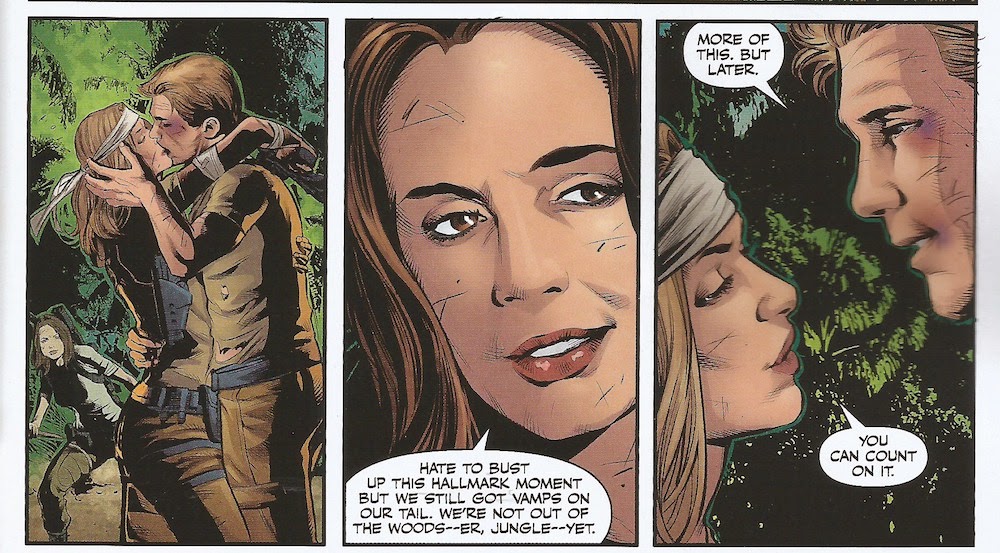
Angel and Faith is a different sort of animal.  While the title introduces new characters, their interactions instead of overwhelming the narrative, serve to enhance it.  Angel's detective contact Brandt for example isn't instrumental when Angel confronts Amy Madison a television series irregular.  He's outside for backup.


Ultimately Angel alone battles the arch-witch to keep Warren dead.  Angel's bag of tricks amusingly mirror the tactics a Big Bad might use.  While his explanation is perfectly innocuous and sensible in context, the reader might remember that Angel was once Angelus one of the worst vampires on the planet.

Writer Victor Gischler simply keeps the spotlight on stars of television series, and it's as if he's producing a new show starring Angel and Faith, however, in comic book form.  It seems simple doesn't it?  It's complex.  The easy thing to do, the lazy thing to do would be to fall back on your own characters using the ones readers want to see as support staff.  Gischler gives fans what they want.  He mimics the delivery of the actors in the dialogue while Will Conrad completes the illusion with remarkable likenesses, and both combine their talents seamlessly to present something readable, something nostalgic yet something new.

Angel's erstwhile partner Faith and Samantha Finn, also introduced on the television series, stage a classic rescue of Riley against a population of vampirized natives.  Ostensibly, Faith and the former Slayers that make up the private security firm Deepscan, infiltrated the jungle to save a client's father, but the truth is who gives a damn about some fourth tier character's dad?  The draw for the reader is Riley finally meeting Faith in her actual flesh and the reunion of husband and wife.


The monster of the week is a back drop.

Angel wasn't the first good vampire, and technically he's not.  He's a human soul forced to constantly battle a demon inside a vampire husk.  Angel currently pilots the vampire body.  So he's a good vampire.

The first vampire to defend humanity for purely altruistic reasons from the creatures of the night was Vampirella.


While adults always read comic books, the powers that be generally ensured the fare was "safe" enough for kids.  Created by Forrest J. Ackerman, Vampirella arose as a comic book for adults.  It dealt with horrific situations and supernatural creatures.  It's hero was an alien vampire who wasn't abashed to show a little skin.  Incidentally, the fact that Vampirella was a valorous blood-sucker would have caused massive seizures in those enforcing the infamous comics code authority.  Even villainous monsters were a no-no.

Over the years, as Vampirella became a comic book instead of a comic book magazine, the writers and artists made the tales a little tamer, more PG-13 than solid R.  One of the things that Nancy Collins did when she took over the title was return Vampirella to the top shelf of the rack.  Vampirella became sensual not just revealing.  She drank human blood, something we rarely saw her do in the subsequent comic books.  She furthermore literally fed on her monstrous ilk.

The increase in sexual content is obvious.  The current story pits Vampirella against Dr. Faust--yes, that one--and Collins makes this figure from literature even more repellent by amending his fable with acts of rape against legendary queens and demigods.  One such crime artist Patrick Berkenkotter depicts in flashback, and this era of Vampirella indeed shows more flesh than the previous periods.  

A little show of tits and asses never harmed anybody.  Nudity and sex aren't the only thing that returned Vampirella to its roots.  I'm an atheist.  So perhaps I'm biased in my assessment of the Church.  As it stands, the Church is a model of male chauvinism, and it has been the traditional home of child molesters.  Maybe the new Pope changed things a smidgeon, but I don't see much in evidence.  Rather people believe that things have changed.  The idea of the Vatican actually fighting evil, really, doing anything, always rubbed me the wrong way.  I mean, yes, Vampirella is a fairy story, but in reality, the Church at its best is an indolent parasite.  

Collins severed Vampirella's curious ties with the Vatican. She didn't expunge Vampirella's history, but she completed the corruption of the organization.  Collins portrayed the Church as hypocritical, quite willing to turn on Vampirella an unswerving agent of good that served their cause faithfully.  Rather than help Vampirella when cursed by Ethan Shroud to be possessed by Umbra, the Church decides the most efficient way to stop the apocalypse is to destroy Vampirella.  Collins imagines a new group.


Collins' plans are more textured.  The Kabal are a clutch of monsters that have decided to live in a society by rule of law.  Not necessarily human law but law nonetheless.  They police they're own ranks, and those that break their code are dealt with sometimes leniently, other times harshly.  Vampirella fits right in with this group, and their current problem is Dr. Faust.

Faustus' plan to appease his demonic masters would terrify children, especially those about to visit their primary care physicians, and it as well represents an almost gleeful return to mature themes.  Collins exploits the common fear of needles, the anti-vaccination movement to demonstrate a diabolical plan by Faust.  I look forward to the next issue.


Mike Mignola returns to Hellboy in 1952 to relate Hellboy's first mission for the BPRD.  The story is mostly a quiet reflection in Hellboy's point of view.  


Co-writer John Arcudi probably dealt with the cacophony of accompanying agents.  I assume this because loud is Arcudi's forte.  It's a good start to a new Hellboy adventure.


With Christopher Golden and artists Ben Stenbeck, Mignola concludes his Baltimore novella The Wolf and the Apostle.  There's not much more here than a superbly gory werewolf story, but Baltimore has some lovely pithy thought on humanity.

For Baltimore, monsters would be just beasts if not for the taint of humanity that allows them to be cruel.  Nice.  I never really thought of that twist before.