Pick of the Brown Bag
September 19, 2012
by
Ray Tate
Today in the Pick of the Brown Bag, I'll cover The Judas Coin an original graphic novel by Walt Simonson,. It's another big week for DC zero issues. Birds of Prey, Catwoman, Nightwing, Supergirl and Wonder Woman are all ripe subjects for the POBB, as well as the brand new Sword and Sorcery with the pre-Crisis character Amethyst and the even older hero Beowulf. I'll also look at Young Justice, the all-ages title spinning-off from the television series.
Let's Get This Party Started
I'm an atheist and because of my skepticism I have low tolerance for anything based on Christian mythology. Crosses and holy water against vampires? That's something I can accept at least for an hour or two. Young Samson and Goliath sure.
Angels or a benevolent god? Forget it. Thankfully, I don't have to believe for a second in order to accept the premise in Walt Simonson's time-spanning graphic novel The Judas Coin.

Simonson leaves plenty of wiggle room for people like me. In the tradition of the storytellers of old, Simonson establishes that the story may have happened, or it may not have happened. It's a story, related to generations and perhaps amended down the line. So maybe we're talking about the legend of Jesus and Judas, or maybe not. Maybe it's Brian.
The key is that a curse falls on the coin in question, or perhaps the coins in question. Well, the Hope Diamond is supposed to be cursed, and that's a real world object. So I can accept that lots of bad things happened to people in possession of the coin but these events weren't necessarily caused by the supernatural, merely greed and happenstance.
After the preamble, the story kicks off with one of the most obscure DC comics characters from The Brave and the Bold. The Golden Gladiator defines honor to his friend Caesar. No, not the monkey, or Julius. The Golden Gladiator's colleague is Titus Flavius Caesar Vespasian Augustus, a real world Emperor of Rome. Simonson did his research. He sets the story in Germania, where Vespasian made his first impression as legate. Marcus and Vespasian attempt to parlay with allies. They find traitors and outlaws that might be persuaded to join their cause, only if the accursed coin doesn't foul their intentions.
Next Jon the Viking Prince and his men discover an island tribe that use the coin as a talisman. The encounter leads to an episode that's almost Pythonesque in nature, albeit with a more dramatic sensibility. It's here that you notice Simonson starting to tweak his artwork to suit either the period or the fame. It's still very vividly his style, but the illustration in this short bears some nuances from his early work which included nods to Joe Kubert, the co-creator of the Viking Prince, also representing The Brave and the Bold.
I was a little surprised not to see the Silent Knight among the heroes contesting against the curse of the coin, but Simonson jumps ship to Adventure Comics with Captain Fear next. In the past, Alex Nino related the pirate's escapades. Nino's artwork and Walt Simonson's renderings look somewhat similar to begin with. Nino however was more of an evoker. He put in just enough nuts and bolts to recreate the atmosphere of the period. Simonson provides sharp, focused detail for mutiny possibly caused by a rather familiar looking coin.
Galloping into the west, Simonson brilliantly characterizes the trickster Bat Lash. Watch as DC's Maverick out-talks and out-thinks his way out of a comeuppance from a sore loser. Of course all of these dominos could have been initially toppled by a coin lying in the kitty.
Modern times finds a coin master matching wits against rival thieves, and when the bottom falls out of Two-Face's plans, he finds himself in the odd role of spectator watching and even admiring the Batman bringing his nemeses to painful justice. Unfortunately for the Dark Knight, chances favor the criminal, or was it chance? Might not a curse and a coin jinxed the Batman's wants? Simonson goes black and white for this case. Combined with the widescreen horizontal format, the story feels like a comic strip, a particularly dramatic one.
In the final short, Simonson takes the coin to the future of Manhunter, his presence no doubt a gag on Simonson's most famous character. This Manhunter is not Paul Kirk but the near one-shot Manhunter 2070. Simonson shifts his art to anime and breaks out looser sexual mores to make the finale even weirder.
The Judas Coin is a steal, and every page earns each penny. The paperstock beautifully reproduces Simonson's artwork and draws out the deep rich colors of Lovern Kindzierski. Here's hoping this isn't the last prestige hardback from Simonson.
Frank Miller's Dark Knight Returns characterized the elder Selina Kyle as a madame who ran a call girl service. That imaginary future for Batman and his mythology became canon to the post-Crisis DCU. Miller based his Year One on the past he hinted at in Dark Knight Returns. A poorly conceived Catwoman miniseries also corroborated Miller's hooker master-plan.
When Jo Duffy began the first ongoing Catwoman series, the first thing she did was fudge the newly minted history. She re-established Catwoman as a lifelong thief that only pretended to be a prostitute in her early days of larceny. Good for Duffy.

Rolling unsuspecting johns was simply an easy way to steal cash fast. Duffy also erased Selina's friend Holly, who was killed previously in Showcase after managing to rise from the gutter to the upper crust.
Ed Brubaker cherry picked from Miller and Duffy. He audaciously and inexplicably resurrected Holly, but he wisely glossed over Selina's past. Jeph Loeb chucked all of Catwoman's post-Crisis continuity out the window in favor of a parallel to the animated series version. This Catwoman also fit in with some of her appearances in Grant Morrison's JLA and Devin Grayson's Gotham Knights.
Despite all these different origins, Catwoman actually holds some immunity. The fact is that most people have a fixed idea about who and what Catwoman is. None of the muck tends to sticks. The perception is quite simple. Catwoman is a master thief who fell in love with Batman, the world's greatest detective.
The post-Crisis is no more, and the new 52 reigns supreme. With the zero issue, Ann Nocenti debuts as the new Catwoman writer, and she orchestrates a new beginning for Selina that's closer to the ideal.
The reason why Selina's so good at stealing is that she survived a childhood of thieving mistakes. As a youngster, Selina and her brother were artful dodgers working for a corrupt Fagin who headed the orphanage where the siblings plied their trades. It's funny but Gotham City had quite a few orphanages. The addition of Selina's brother incidentally is not a new invention. He debuted in a 1952 issue of Batman as The King of Cats.

An example of why most 1950s comics should be avoided.
As Selina grows older, she goes solo and starts attempting the art of disguise; a classic trick she employed in her 1940 debut as the Cat. Although, rather than opt for a Hollywood styled makeover with latex, Selina tries to assume other roles and finds this task daunting.

Selina becomes better and better at dishonesty. As a result she grows more cunning, and her research into different lives hones her intellect. This is where we find her. Only she's not searching for jewels. She's seeking her identity. Nocenti calls back to the distant past once more. She plays with the idea of Catwoman's true identity. At one point in the 1950s Batman lore, Selina Kyle suffered from amnesia. She adopted the Catwoman persona because she didn't actually know who she was.
The Cat seemed like a whole being. Catwoman and Selina Kyle could have been two individuals, something Tim Burton and Michelle Pfeiffer played up in Batman Returns. The clothes maketh the woman. Catwoman's costume arose mainly out of comic book convention. Costumed criminals were simply popular. She could have theoretically stayed free from the distinction, but that's not how history played out, and the idea of she becoming a costumed felon gave greater credence to the amnesia angle.
In the end the whole amnesia explanation satisfied nobody, and it was relegated to the designation of ruse. There's only one good origin for the cat motif Selina Kyle chose, and Nocenti sagely employs it.

Nocenti has somebody else throw Selina off the rooftop, but there's no doubt that the kitties that revive Selina padded from Tim Burton's cat flap. The scene also exemplifies how well Adriana Melo choreographs action, drama and lays out dynamic panels.
Birds of Prey writer Duane Swierczynski produces the most original of the zero issues.
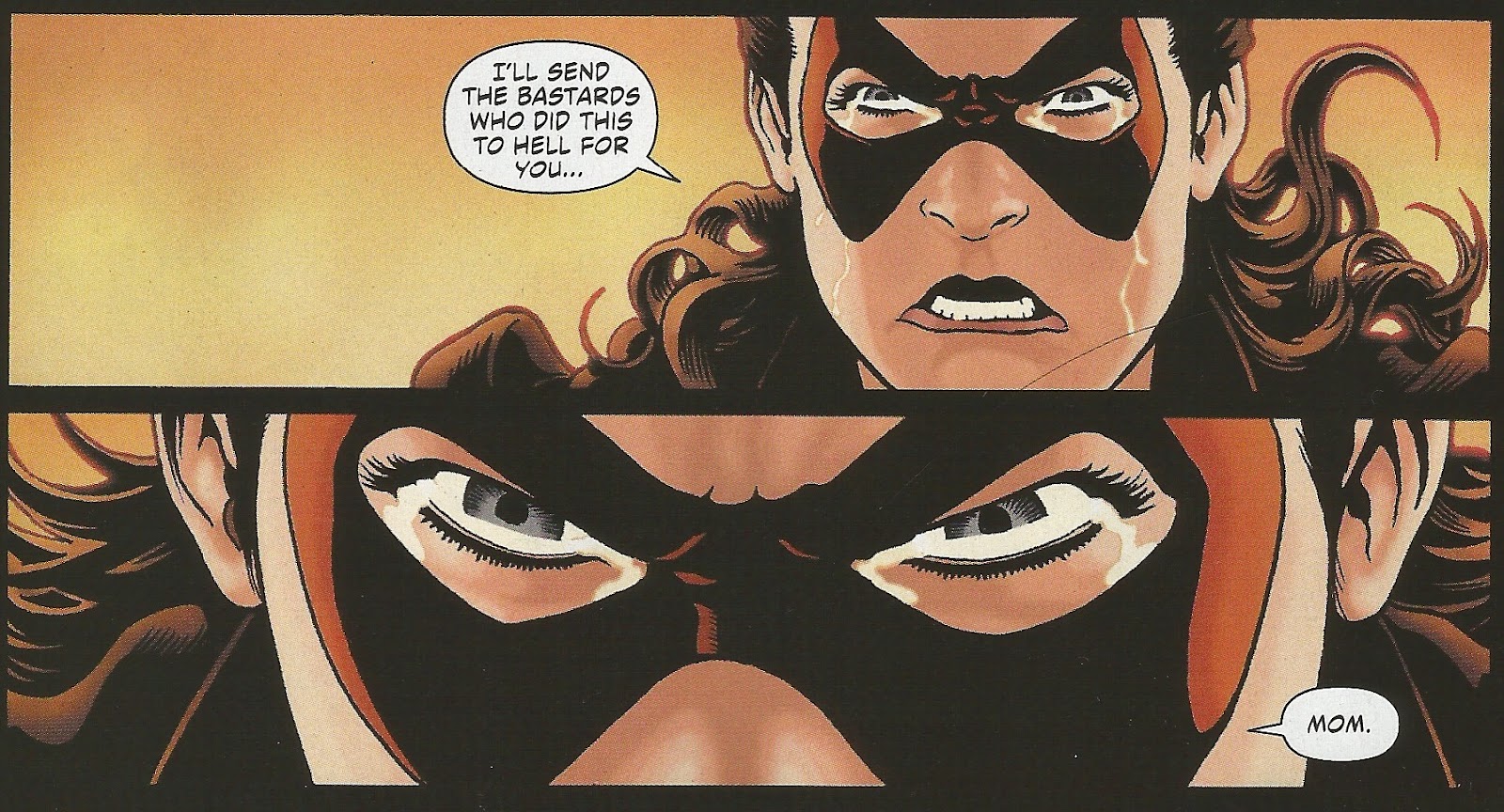
He integrates three of the Birds into the new 52's past, and this book pretty much kills the Oracle identity for Barbara Gordon. There's simply no evidence to suggest she was anybody but Batgirl. For me, that's pennies from heaven. For Oracle fans, well, they can suck it, like I had to do for twenty-three years.
Every cell in my body loathed the crippling of Barbara Gordon. That's about 100 trillion units of hate, but I also had issue with the Oracle persona. To whit, Barbara Gordon would never have joined the Suicide Squad unless she meant to destroy it from within, but there was no indication of duplicity.
The Bronze Tiger murdered the original Batwoman. The original Batwoman was Babs' friend and colleague. Depending on what day it was, the original Batwoman existed in the post-Crisis and her murder was canon, sometimes. Batman for example mentions the original Batwoman during Knightquest, when he employs the Bronze Tiger, something that also wouldn't happen but did. The Bronze Tiger claimed brainwashing as a defense, apparently accepted by all. It's a crap copout, and Batman would have recognized the Tiger's state when beating the snot out of him in the pre-Crisis.

Babs working alongside Batwoman's murderer? No way in hell. Babs ending him? That I could have accepted and admired.
When Babs creates the Birds of Prey, the conception made more sense than Babs joining the Suicide Squad. However let me emphasize. As soon as DC started reintroducing magic and alien technology back into the post-Crisis DCU Barbara being confined to a wheelchair stopped being even remotely possible. As soon as Batman was healed from his crippling by a mutant named Shondra Kinsolving, Barbara's paralysis became ever more insulting.

That's of course the old. We know that in the new timeline Barbara Gordon was crippled by the Joker. However, she was healed, in all probability through the direct involvement of Batman, approximately two years before her re-emergence as Batgirl, with regard to the formation of the Justice League. This adventure occurs likely a few months the Joker felled her.
Fresh from Team 7, Diana Lance learns of a deal going down at the Penguin's nightclub, the Iceberg. She infiltrates the club under the pretense of obtaining a job with security. Since this demands smacking around Penguin's security, artist Romano Molenaar enjoys a wide berth of artistic freedom, the freedom to have Black Canary kick ass.
Romano Molenaar's artwork is a definite boon to Birds of Prey. His ladies are proportionate, exhibit fluid motion and engage in deadly displays of martial arts. I wouldn't mind seeing him as the regular artist on Birds of Prey, assuming that the spectacular skills of Cliff Richards are unavailable.

Once ensconced in Penguin's nest, the Black Canary meets Evelyn alias Starling, the Penguin's henchwench. The ladies take an immediate liking to each other despite being ostensibly on the other side.
Starling is bisexual. In fact, she's the best bisexual/lesbian hero in the new 52 and one of the best ever. Thanks to writer Duane Swiercynski, Starling possesses a far more entertaining personality than depth deprived Batgirl substitute number five Batwoman. That personality pops from the dialogue when she interacts with the Canary and when she encounters Batgirl for the first time.
Starling is sexually drawn to the Black Canary, but that's only part of the story. Swierczynski isn't simply relating a dry origin. He's got three surprises revealed at the conclusion for regular Birds of Prey readers.

Batgirl cameos in an issue of Young Justice this week, and her brief appearance is really the only reason why I purchased the title. Nevertheless, it was a better read than I thought it would be.
Miss Martian is my favorite character in Young Justice. This ridiculous post-Crisis femme Martian Manhunter, with an origin blatantly contradictory to DC's entire history works extremely well without the backdrop of the mess that was.
In Young Justice Weisman gives her an adoptive family, a love interest, a sparkling personality and an intrinsic role on the team. Artists Christopher Jones and Zac Atkinson furthermore make Miss Martian as cute as a button.
Another alien makes guest appearance. Young Justice writer Greg Weisman bases this version of Superman on the animated series Superman voiced by Tim Daley and George Newbern. Never ever a bad thing.
Justice League colleague Zatanna appears for a warm, amusing running gag. Zatanna it turns out was a member of Young Justice, and in the present, she just joined the Justice League. I have to admit that it's a good and novel fit. Batman The Animated Series introduced Zatanna as the young daughter of Zatarra who crushes on a young Bruce Wayne.

Although for all-ages, Young Justice still exemplifies a book that doesn't talk down to its audience. The creative team for example depict a mature relationship between nineteen year-old Dick Grayson and the grown up Bette Kane, indicating that the creators feel that kids are sophisticated enough to know that adults have sex.
Ultimately, I can't really recommend Young Justice as fully as I would have liked. The art's elegant and welcoming like most of the all-ages tie-ins that were, Batman Adventures, for example, but the story jumps around time all too frequently, and this is not a time travel story. Rather, for no reason at all, the story starts at a point where Nightwing is Robin, then jumps to his future. The same kind of jump occurs when Superboy meets Clark Kent for the first time and then reacquaints with Kent when he covers the present day rally for an outspoken critic of the Qurac regime. Weisman and company in between these flashbacks/flashforwards also cut to Nightwing and Wonder Girl recruiting the Blue Beetle.
Young Justice ties in more with the post-Crisis DCU than any other animated series. It's still in its own continuity. Batgirl's walking after all, but people weeping for the post-Crisis chaos may find what they want in this series. It's not exactly the post-Crisis, but Ted Kord was murdered. No indication if comic relief shot Beetle in the head. Jamie Reyes is the second Blue Beetle. The presence of Qurac is a big DCU callback as is the Queen Bee, Lagoon Boy and Rocket from the Milestone Universe.
Nightwing zero deals with familiar territory, but writer Kyle Higgins adds dimension to the death of the Graysons through an adorable birthday gift that highlights what Dick lost.
This is a uniform trait in the new 52. The writers don't just make the parents of the heroes footnotes in their histories. They've been imbuing them with depth and power. The Waynes in Scott Snyder's absolutely brilliant Night of the Owls resonate, and you feel a sense of Bruce's loss. The Waynes were nice people who loved their son. The Graysons are no different.
Higgins shorthands the characterization of the Graysons by qualifying them in a typical parent-child scene, and though they punish Dick Grayson for doing something stupid, they clearly punish out of love. Dick must learn from the rules he broke.

When Tony Zucco murders the Graysons, Higgins looks to the animated series for inspiration. When Bruce speaks you can hear Kevin Conroy's empathy toward "the boy." This is no mere copy. Higgins once again brings nuances to a scene enhanced by artists Eddy Barrows, Eber Ferreira and Rod Reis. Co-plotter Tom DeFalco with Higgins furthermore gently tease the bare bones of Robin's origin story into the twenty-first century of the new 52. Dick does not become Bruce Wayne's ward. Rather, Bruce Wayne offers the police a safe haven where Dick Grayson can recuperate. Bruce takes Dick out of the Wayne Care Center when Batman encounters Dick searching for Zucco by himself on the streets, another echo to the animated series.
Fans of the character won't want to miss the special zero issue since it presents Nightwing in full uniform as Robin for the first time. An attractive affair without the traditional short pants. The story gives a strong reason why Robin dons the costume, and the illustrations of the Batman of the past in the new 52 visually allude to the original Dark Knight from Neal Adams. If that's not enough I don't know what will fulfill your desires gentle readers.
Although Nightwing is a sad book. It's not the saddest. Supergirl feels like a gut punch.

The combination of Supergirl's youthful innocence, her absolute trust in her father Zor-El, and his willingness to sacrifice anything for her is just about the most heart-wrenching fiction I've experienced this year. Thank not just Michaels Green and Johnson but also Mahmud Asrar's incredibly moving artwork. His endearing body language for Kara, and the horrible eaten alive by guilt expressions of Zor-El combine to strike with potent impact that once again makes the reader feel what this hero has lost.
Supergirl divulges heretofore unknown details about the history of Krypton and the House of El. The zero issue also reinforces what's already known.
Green and Johnson emphasize that cloning is forbidden. Kara is not a clone. We do see however that Zor-El was conducting experiments on his daughter to make her more receptive to the gifts of the yellow sun, and he is somehow responsible for the World-Killers that Supergirl faced in her regular issues. These experiments caused the rift between he and his brother Jor-El. He always intended for Kara to stay in stasis in order to saturate her with yellow sunlight, which nicely sidesteps the age issue. Kara was indeed young Kal-El's baby sitter, and while the emphasis is on Zor-El, Alura also appears to express love for her daughter.

I don't have much to say about Wonder Woman except that Brian Azarello and DC take the smartest step they've ever made in the Wonder Woman/Donna Troy/Cassie Sandsmark triangle. They eliminate one side and "proudly present" the newest version of Wonder Girl.
Wonder Woman was Wonder Girl. Thank the cosmos! No crazy John Byrne villain magic cloning! No firemen rescuing crying baby! No Wonder Girl predating Wonder Woman! No Terry Long! Wonder Woman was Wonder Girl, just like she was back in the Bronze Age. Presumably she was Wonder Baby as well. Fan-tas-tic! Cliff Chiang's artwork even echoes that sweet Ross Andru illustration that made Wonder Girl's adventures so enjoyable.

I know didley-squat about Amethyst. I saw ads for her series around the time of The Crisis on Infinite Earths, but the comic book was never available, and since I'm a tough sell on sword and sorcery books, I never looked into getting the back issues. No worries. The new 52 Amethyst is pretty self-explanatory. On earth, she's a cross between Veronica Mars and Lisbeth Salander. Off earth, blend in Buffy the Vampire Slayer and the modern interpretation of Red Sonja, the original chick in chain mail.
Writers Cristy Marx and Tony Bedard make Sword and Sorcery very user friendly but not all ages. The writers take a tip from C.S. Lewis. The children who entered the Wardrobe leading to the land of Narnia aged and gained the wisdom and experience of adults. When they returned to earth, they became children again. This should come as no shock to any Captain Marvel readers. A similar magic affects Amethyst.
On earth, she appears to be Goth with dark features and a preference for dark clothes. Once on Gemworld here referred to as Nilla, she gains the more familiar blonde hair and purple garb. In an ingenious twist, she's just as surprised as the reader.
Amethyst's mother, Grace, has been training her since she was able to pick up a sword. That gives Amethyst, or Amy, skills rare to other young women her age. Those skills come in handy when she stops an attempted gang rape.

Such a crime might seem out of place in a book that's ostensibly a fairy tale, but rape and murder was the catalyst of Veronica Mars, and the books of Narnia and the Oz books of L. Frank Baum while written for kids didn't scrub their stories. Gruesome things happened in these novels.
The crime is furthemore not in the book for titillation. The writers instead typify rape as a power trip and an act of humiliation, and it is attempted rape. Amethyst intervenes thereby establishing her creds as no mean feminist hero.
When Amethyst and her mother set foot on Gemworld, their problems arise from Amethyst's aunt. A witch of the highest order, or lowest depending on your viewpoint, Lady Mordiel absorbs the lifeforce of her bloodline, identified by the blonde hair. All and all, it's a promising start to a new series that's not quite all sorcery or sword.