Pick of the Brown Bag
May 10, 2017
by
Ray Tate

Hold on to your Hasselhoffs, it’s time for the Pick of the Brown Bag. My name is Ray Tate, and I am your POBB guru. This week I review All-New Wolverine, Batman and the Teenage Mutant Ninja Turtles, Bug!, Future Quest, Red Hood and the Outlaws, Rough Riders, Supergirl and The Titans. If you haven't time for the richer reviews here, check out the POBB on twitter #PickoftheBrownBag.

A lone gunman named Leon Czolgosz assassinated President McKinley. Glass expands on the assassin's rumored links to anarchist groups, but even the law had to admit; no conspiracy played a part in the assassination.
Authorities imprisoned Emma Goldman, a period leader of the anarchist movement. Innocent of any wrongdoing, Goldman eventually gained her freedom.
Authorities imprisoned Emma Goldman, a period leader of the anarchist movement. Innocent of any wrongdoing, Goldman eventually gained her freedom.

When you alter the facts of the concrete past you create an extra dollop of make-believe and force the reader to question the writer's motive. Is there any point to suggest a cult gorily murdered McKinley on his deathbed? I can't really see one. Glass could have introduced the anarchists some other way. He might have made a vague connection to Czolgosz and the McKinley assassination. This concoction seems like grandstanding. It's actually more plausible to suggest an alien influence in the Spanish-American War, which served as the heart of the last Rough Riders volume.
These facts flaw an otherwise exciting story positing a fight between a weird sect of anarchists and the Rough Riders: Annie Oakley, Thomas Edison, Harry Houdini, Jack Johnson, Monk Eastman and their leader Theodore Roosevelt, now President.
The story begins with the Jack the Ripper styled murder of McKinley. The crazies even leave a blood-streaked message for the law to find: imperio absenti chaos regit. In the absence of government, chaos rules. Naturally, Roosevelt tries to diminish the attempt at overthrow. Gibing with history.
These facts flaw an otherwise exciting story positing a fight between a weird sect of anarchists and the Rough Riders: Annie Oakley, Thomas Edison, Harry Houdini, Jack Johnson, Monk Eastman and their leader Theodore Roosevelt, now President.
The story begins with the Jack the Ripper styled murder of McKinley. The crazies even leave a blood-streaked message for the law to find: imperio absenti chaos regit. In the absence of government, chaos rules. Naturally, Roosevelt tries to diminish the attempt at overthrow. Gibing with history.

While I might object to Glass' added ghoulishness to McKinley's assassination, the inclusion of William Randolph Hearst in the stew is inspired. This mixture of fact and fiction works well. Hearst's incitement and coverage of the Spanish-American War really did make Teddy Roosevelt out to be a hero, ripe for a rise. Roosevelt would resent Hearst implying a debt. The result would be a natural animosity. This is represented by Roosevelt's silly detective work.

What are you going to do Teddy? Examine every cigar that lights across your path? The cigar found at the scene is at best circumstantial evidence. Roosevelt just doesn't like Hearst. He hoped he could pin the McKinley assassination on him. He's much better as an action man. Glass introduced Roosevelt as a sci-fi hero, and we get another taste of that when encountering his coach and coachman. Once again the outlandish anachronisms seem perfectly reasonable when compared to Roosevelt Holmes.

What are you going to do Teddy? Examine every cigar that lights across your path? The cigar found at the scene is at best circumstantial evidence. Roosevelt just doesn't like Hearst. He hoped he could pin the McKinley assassination on him. He's much better as an action man. Glass introduced Roosevelt as a sci-fi hero, and we get another taste of that when encountering his coach and coachman. Once again the outlandish anachronisms seem perfectly reasonable when compared to Roosevelt Holmes.

In general the Rough Riders stay within their realms of influence. For example, Annie Oakley's fame engages the reader with a triple twist in the plot involving the Catholic Church, or perhaps just a few of its members. Harry Houdini's and Jack Johnson's investigation allows for artist Pat Olliffe to stretch his fingers and evolve bursts of frenzied activity. Too frequently, authors and artists rely on the dignity of time and stiff photographs to recreate well-known personages to the pages. Glass and Olliffe treat the team and notable cameos in a livelier fashion. The literal and visual characterization of the Rough Riders is a consistent enticement.

At last! The conclusion to the Hanna-Barbera adventure hero crossover Future Quest. The suspense was excruciating. A being dubbed Omikron devoured everything in its path and decimated the Space Force, a group of intergalactic peacekeepers. Omikron made a mistake. He left one officer alive.

Space Ghost vowed to end Omikron. You know Space Ghost's story. His fights against Brak and Zorak, but Space Ghost established the Ghost Planet, his base and the Phantom Cruiser all to prepare for the inevitable round two against Omikron. Space Ghost attempted to stop Omikron from reaching earth. In the end, our hero failed. This resulted in the Phantom Cruiser crashing, Jan and Jace injured and intersecting with earth heroes like Birdman and the Quests.
As Future Quest demonstrates, Space Ghost was always doomed to fail. It takes the combined might of all the heroes to kill Omikron. That's because the devourer employs numerous survival tricks. The beast can regenerate so long as a piece of it survives. It can also create wormholes to travel through through time and space. In effect instantaneously.
Last issue, the heroes brainstormed a plan, that hinged on Multi-Man as bait, luring the creature in the Grand Canyon where it would meet its physical demise. At the same time, two individuals would keep it psionically distracted. The plan's failure can be traced to the depth that Parker infuses to traditional nemeses Dr. Zin and Dr. Quest. Parker takes advantage of their backstories and lack thereof to provide links and empathy to the characters. It's this emotional impetus that short circuits the efficacy of their genius minds. So another genius intends to take their place.
As Future Quest demonstrates, Space Ghost was always doomed to fail. It takes the combined might of all the heroes to kill Omikron. That's because the devourer employs numerous survival tricks. The beast can regenerate so long as a piece of it survives. It can also create wormholes to travel through through time and space. In effect instantaneously.
Last issue, the heroes brainstormed a plan, that hinged on Multi-Man as bait, luring the creature in the Grand Canyon where it would meet its physical demise. At the same time, two individuals would keep it psionically distracted. The plan's failure can be traced to the depth that Parker infuses to traditional nemeses Dr. Zin and Dr. Quest. Parker takes advantage of their backstories and lack thereof to provide links and empathy to the characters. It's this emotional impetus that short circuits the efficacy of their genius minds. So another genius intends to take their place.

Linda Conroy, Buzz Conroy's mom, will fry her brain if she attempts to single a double. Fortunately, her son and the awesome Frankenstein Jr. needs her.

Right. So, this image is worth the price of the book.
Conroy states what we've always known. Frankenstein Jr. is more than just a mere robot. He's an artificial intelligence, and Linda reveals a secret about his mind. Naturally there will be no spoilers here. Though I must inform that the Impossibles because of their origins are immune to Omikron's touch. That makes them valuable players in the fight against the malevolent monster. In many ways, the Impossibles are innocents inducted into the spy world. They're not really used to this sort of thing, especially Cobalt, our lady in blue. Tara of the Herculoids however reacts with determination, and that's what artist Doc Shaner conducts. If you never saw these characters before, you know their makeup now.

Igoo also bears that immunity. Given an infinite amount of time, and the countering of portal formation, Igoo could probably smash Omikron to bits, but he's no mindless beast. He's tearing into Omikron for a gleefully specific reason.

Cobalt is one of the newest Impossibles created by Parker and company to diversify the traditional imbalance of a white male cast. I'm not calling out Hanna-Barbera for racism. Not at all. Hanna-Barbera was actually quite subversive. The inclusion of Hadji for example, who with Johnny becomes fittingly pivotal in the defeat of Omikron.

You can furthermore argue that Hanna-Barbera, even in early days, were all about girl-power.


You can furthermore argue that Hanna-Barbera, even in early days, were all about girl-power.

So when you think about it. Hanna-Barbera wasn't actually interested in placating society's social mores. They created traditional family units like The Flintstones and The Jetsons, but they also gave us Gravity Girl of the Galaxy Trio and Penelope Pitstop. Jeff Parker takes it farther with a black Mightor, and the splendid revelation of Birdman's Falcon 7. At the same time, Parker and company relate a terrific team-up against a threat that deserves Space Ghost, Birdman, Mightor, the Herculoids, the Impossibles and Johnny Quest.

The New Teen Titans created by Marv Wolfman and George Perez debuted during the waning days of the Bronze Age. New villain Deathstroke became their arch-nemesis, but he wasn’t the first. That honor belongs to Deathstroke’s son Grant Wilson. Grant premiered in The New Teen Titans as a douchebag without costume or special abilities.

That changed quickly. Grant made a deal with HIVE to become the Ravager. Grant’s powers appear to be based on the Thunder Agent Lightning who ages rapidly when using his speed. You can guess what happens to Grant.

Yeah, so sorry to see that sphincter go. Nevertheless, everybody’s loved by somebody, and Grant’s somebody is his father Slade Wilson. Ravager's death provokes the obsessive and convoluted lengths Deathstroke undertakes to kill the New Teen Titans throughout their original run. All that energy wasted on a waste of skin.
Modern Deathstroke is somewhere in between his totally bug-shit evil and so moral that he knows Batman's secret identity incarnations. One interesting thing about the modern Deathstroke is that he never even met the Titans, but that doesn't mean he doesn't have memories of them.

Dan Abnett’s story opens in Slade’s memories, but these are not true memories. These are ghosts manifested by the return of Wally West. The Watchmen didn’t wipe out Crisis history. They still wiped out new 52 history. So even if like Superman’s timeline, the Titans' history is restored, the continuum will be restructured to fit new 52 logic.
The New Teen Titans never existed in the new 52. There were only the Teen Titans who outgrew the teen modifier. This makes sense given that Cyborg is a founding member of the Justice League. Beast Boy and Raven are kids. Starfire…um…I’ll get back to you on her. So the current Titans always were the past Teen Titans. Surprisingly that includes Lilith best known for being a telepathic boomerang. Lilith always left the Titans and returned to the Titans, sometimes decades later.
The New Teen Titans never existed in the new 52. There were only the Teen Titans who outgrew the teen modifier. This makes sense given that Cyborg is a founding member of the Justice League. Beast Boy and Raven are kids. Starfire…um…I’ll get back to you on her. So the current Titans always were the past Teen Titans. Surprisingly that includes Lilith best known for being a telepathic boomerang. Lilith always left the Titans and returned to the Titans, sometimes decades later.
Deathstroke awakens in the hospital with memories that shouldn’t exist. So, he kidnaps Wally West to find out what the hell is going on.

Deathstroke however wants more than information. He instead sees a way out for his son, but I've got bad new for Slade. His plan cannot work. Time is out of joint. This is the kickoff of a new Titans crossover spanning The Titans, the Teen Titans and Deathstroke. Abnett's part is another superbly written exploration in reality bending associated with universe reboots; dramatic artwork courtesy of Brett Booth.

Even though I love Batman and Teenage Mutant Ninja Turtles to pieces, despite wishing it was an ongoing series, the current issue didn’t actually need to exist. The first five chapters of the mini-series comprised a beginning, middle and end. This epilogue set in the future of both teams is more of a separate short story. On the other hand, it’s the Batman Family and the Turtles animated style, in a story that’s extremely rewarding.
The previous issues were all about how the Turtles and the Batman Family interact as they fight the villains of Gotham City. This issue is set at later date. The Batman Family work smoothly with the Turtles.

Batman smiling, referring to the Turtles as allies. If that doesn’t make you want to buy this book, nothing will. However, there are more enticements. Batman and Leonardo are on the same wavelength, and that provides a wonderful running gag. The gag among others exemplifies Michelangelo’s feel good attitude.

Donatello attempts to advance his romantic standing with Batgirl, while kicking goofy Kraang ass.

I so prefer him over Nightwing as a love interest. I think he’d treat Barbara right. Then, there’s Raphael’s bravery.

It’s difficult not to recommend even a superfluous issue of Batman and the Teenage Mutant Ninja Turtles when its filled with such overwhelming comic book joy.

Batgirl returns to the pages of Supergirl, and once again writer Steve Orlando surprises me. I’m beginning to see that when he’s not hung up on trying to make you like the schisms between the comic book and the television series--Cameron Chase, Supergirl’s handlers instead of adoptive parents and the D.E.O.--he can relate a good story with palatable characterization of the stars.

Orlando regressed Supergirl to a more youthful state and with a middling comprehension of earth customs, in conjunction with Superman's restoration. However, he doesn’t make her stupid. Supergirl knows Babs is Batgirl and is smart enough to joke about it, as well as her alter-ego Kara Danvers. Supergirl furthermore has depth. She can even be poetic.

Barbara and Supergirl are on hand for the newest application of Phantom Zone technology, as redesigned by Tychotech. Tycho is one of Supergirl’s more forgettable foes from the new 52. A Lex Luthor wannabe who got diced in his machinations. Tychotech's C.E.O. Katarina Bissell stands in for Lena Luthor. However, it’s such an obvious analogue that you can ignore Lena’s redub and the Tychotch swap from Luthorcorp. Sharp-eyed readers will also note a reference that only the die-hard Superman fan will get.
What should be a perfectly successful day of a technological upgrade for humanity turns into disaster when one of the Fatal Five shows up and tries to kill Supergirl.

That’s not a spoiler. He's not a Fatal Five member you’ll recognize. The villain in fact never had a connection until now. The attack o creates havoc, oh, that’s not a misspelling by the way, and you know when you have anything Phantom Zone related, the doorway cannot be far behind.

The disaster prompts Batgirl into spectacularly illustrated action, and it’s a good thing there’s a spare hero around for Supergirl because she’s got her hands full dealing with the mystery villain. It’s not so much his ability or power but the psychological factor. Like Emerald Empress, the enigma is seeking revenge for Supergirl's future.

Orlando displays Supergirl’s powers inventively. Once again the presentation proves to me that Supergirl works best without all of these quasi-television series distractions. I'd be happy if she were just a reporter at Catco and worked with the D.E.O. not as an agent but in a voluntary capacity, as she does on the series. I'm not asking for everything. Alex Danvers and Maggie Sawyer for example would be problematic. However, I don't think a simpler congruence would hurt at all.

Orlando displays Supergirl’s powers inventively. Once again the presentation proves to me that Supergirl works best without all of these quasi-television series distractions. I'd be happy if she were just a reporter at Catco and worked with the D.E.O. not as an agent but in a voluntary capacity, as she does on the series. I'm not asking for everything. Alex Danvers and Maggie Sawyer for example would be problematic. However, I don't think a simpler congruence would hurt at all.

Red Hood and the Outlaws gets pretty weird. Only Bizarro deals with a physical problem. That in itself presents irony since his labor in real life is nigh metaphorical.

Jason, while in captivity, where the Joker killed him, becomes trapped by his own mind. His revisit to the past uncovers truths that he already accepted. His acceptance imbues him with more emotional weight. Jason is a genuinely flawed hero. Not because he kills villains. If I were to accept that as a flaw, I’d be diminishing a wide range of champions from the Three Musketeers to the Doctor. No, Jason is flawed because he screwed up royally. He died, but he lived to tell about it. Lobdell could make a joke out of that. Instead, he embraces this comic book plot device to make Jason a better character.

Artemis meanwhile reunites with her friend Akila the keeper of the Bow of Ra. It doesn’t matter that Artemis and Wonder Woman killed Akila. Like Jason, Akila is back, and she wants to raise their homeland from the ashes. Inexplicably, the Amazons of Bana-Mighdall are alive and well. It appeared that Akila destroyed them as well as the city itself.

Why does this scene remind me so much of Doctor Who's “Warrior’s Gate? Is it the spectral nature of Akila? The hopelessness of regaining the past? Perhaps, the staged frivolity of the Bana-Mighdall Amazons, who may or may not be there?

There’s such creepiness in the Artemis/Akila scenes, and it only becomes enhanced by what Jason learns in a semi-comedic interrogation of the Qurac strongman. Lyricism is at the center of Red Hood and the Outlaws. Lobdell downplays the comedic flair he's shown in the past. Instead, he makes the chapter a reflective seduction. Jason overcomes the mementos of his personal failure. Artemis falls in the arms of her guilt.

Bug! is probably the strangest revival in the history of DC Comics. Every so often DC tries a new Doom Patrol or Shade the Changing Man, cosmos knows why for the latter. Even Prez should have been expected. Bug! though is a real head scratcher. Bug is in fact Forager, and if that name sounds familiar to you, then you probably read Cosmic Odyssey by Jim Starlin and Mike Mignola.

Forager really was a bona fide Jack Kirby creation and appeared in The New Gods, during the Bronze Age. Nevertheless, Forager's arc truly began and ended in Cosmic Odyssey. Those events artist and co-writer Mike Allred reprises.

If you want your character's death to mean something, have it piss off Batman enough that he decks a god. Bug! posits that Forager actually survived, and I know what you're thinking. He didn't just survive Cosmic Odyssey, but also every cosmic reshuffling since. Actually Cosmic Odyssey, highest recommendation here, is one of those rare books that works as a story in every era. Starlin was very careful not to put in anything that he thought would be retconned later. Even the reunification of Jason Blood and the Demon still works. Though I'm not sure the Green Lanterns can be stopped by yellow anymore. Ah, well. It almost works.
Forager awakens in a cocoon secreted to an old dark house. There's a mystery to be solved, and no meddling teens and cowardly Great Dane to help him work out the ins and outs of his resurrection. Here be monsters, though, ghost girls, dominoes and duplicitous talking toys.
 The beauty of the story is that in addition to the quirkiness, the outright comedy and the dynamic action, Bug! also turns out to be a ruse of the best kind.

So, at this point, I'm going to have to spoil big reveals in the script and in the cast. If you trust my reviews and you're looking for an endorsement of Bug! you've got that. Read no further if you want to be completely surprised. Skip to the review of All-New Wolverine. Otherwise...
S
P
O
I
L
E
R

A
H
O
Y
It turns out that the Big Bad of the piece moved Forager's cocooned "corpse" to the house in order to lure his enemy into a trap. Who is that enemy? Here's the Big Bad.

I figure you've got two reactions. WTF or Vaguely Familiar. Here are some other parties involved.

And finally, here is our guest of honor.

The SANDMAN! Gardner Fox and Bert Christman created the original gas-masked Sandman. Jack Kirby gave us the second Sandman.

Kirby based his costume on the second uniform used by the first Sandman. Kirby dubbed the second version of the Sandman the Master of Nightmares. Kirby's Sandman corralled two of those nightmares, Brute and Glob, to be his aids. The wild premise of the Sandman is that he enters your dreams to fight particularly nasty nightmares and stop them from becoming real. The Sandman breaches Forager's dream to help him wake up, if he can. There's still a chance Forager is really dead. Double spoiler alert. He's not.
This however is exactly what General Electric planned all along. He knew the Sandman would be bound to save Forager. So he uses the legend that built around the Forager to lure the Sandman into his clutches. He then seizes the whistle that allows the Sandman to crossover to the real world. General Electric didn't however count on Forager as anything other than a pawn. Underestimating Forager, just like in Cosmic Odyssey, proves to be his downfall

Forager really was a bona fide Jack Kirby creation and appeared in The New Gods, during the Bronze Age. Nevertheless, Forager's arc truly began and ended in Cosmic Odyssey. Those events artist and co-writer Mike Allred reprises.

If you want your character's death to mean something, have it piss off Batman enough that he decks a god. Bug! posits that Forager actually survived, and I know what you're thinking. He didn't just survive Cosmic Odyssey, but also every cosmic reshuffling since. Actually Cosmic Odyssey, highest recommendation here, is one of those rare books that works as a story in every era. Starlin was very careful not to put in anything that he thought would be retconned later. Even the reunification of Jason Blood and the Demon still works. Though I'm not sure the Green Lanterns can be stopped by yellow anymore. Ah, well. It almost works.
Forager awakens in a cocoon secreted to an old dark house. There's a mystery to be solved, and no meddling teens and cowardly Great Dane to help him work out the ins and outs of his resurrection. Here be monsters, though, ghost girls, dominoes and duplicitous talking toys.


So, at this point, I'm going to have to spoil big reveals in the script and in the cast. If you trust my reviews and you're looking for an endorsement of Bug! you've got that. Read no further if you want to be completely surprised. Skip to the review of All-New Wolverine. Otherwise...
S
P
O
I
L
E
R

A
H
O
Y
It turns out that the Big Bad of the piece moved Forager's cocooned "corpse" to the house in order to lure his enemy into a trap. Who is that enemy? Here's the Big Bad.

I figure you've got two reactions. WTF or Vaguely Familiar. Here are some other parties involved.

And finally, here is our guest of honor.

The SANDMAN! Gardner Fox and Bert Christman created the original gas-masked Sandman. Jack Kirby gave us the second Sandman.

Kirby based his costume on the second uniform used by the first Sandman. Kirby dubbed the second version of the Sandman the Master of Nightmares. Kirby's Sandman corralled two of those nightmares, Brute and Glob, to be his aids. The wild premise of the Sandman is that he enters your dreams to fight particularly nasty nightmares and stop them from becoming real. The Sandman breaches Forager's dream to help him wake up, if he can. There's still a chance Forager is really dead. Double spoiler alert. He's not.
This however is exactly what General Electric planned all along. He knew the Sandman would be bound to save Forager. So he uses the legend that built around the Forager to lure the Sandman into his clutches. He then seizes the whistle that allows the Sandman to crossover to the real world. General Electric didn't however count on Forager as anything other than a pawn. Underestimating Forager, just like in Cosmic Odyssey, proves to be his downfall

An alien child carrying a plague forces SHIELD to quarantine Roosevelt Island. The child speaks two words that change everything: Laura Kinney. Wolverine drops in to solve the mystery, but thanks to the greater connectivity of the modern world, she's not alone. A plethora of brains direct their intelligence to the problem.

Nice to see Mockingbird on the team after being outed as a genius in The Unstoppable Wasp. Writer Tom Taylor takes what should be a tragedy and an onus on Wolverine, and makes the threat of plague uplifting. In the previous issues, Wolverine questioned her want to kill. An enemy from the past triggered her instinct to kill, but she managed to overcome that fight in a most violently Wolverine way.
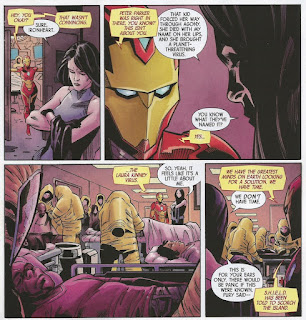
The story becomes a question of determining whether or not Laura is good for anything other than killing. The answer is yes, and it will take some villainous scientists combined with the heroic ones and Wolverine to find the cure.

Nice to see Mockingbird on the team after being outed as a genius in The Unstoppable Wasp. Writer Tom Taylor takes what should be a tragedy and an onus on Wolverine, and makes the threat of plague uplifting. In the previous issues, Wolverine questioned her want to kill. An enemy from the past triggered her instinct to kill, but she managed to overcome that fight in a most violently Wolverine way.

The story becomes a question of determining whether or not Laura is good for anything other than killing. The answer is yes, and it will take some villainous scientists combined with the heroic ones and Wolverine to find the cure.


