Pick of the Brown Bag
October 19, 2016
by
Ray Tate
Hello. My name is Ray Tate, and welcome to the Pick of the Brown Bag. In this blog, I pick the best and worst from the comic book yield of the week. The POBB is also available condensed on Twitter #PickoftheBrownBag.
My current batch of reviews includes Aquaman, Batman, Doctor Who, Hellboy and the BPRD, The Mighty Thor, Spider-Gwen and Unbeatable Squirrel Girl. I will also review brand new title and Die Kitty Die! First a spoiler free critique of…

After Emily Blunt made a joke about the Republican debate, Fox & Friends told Blunt to leave Hollywood and classified her as “Dixie Chicked.”

Fox & Friends meant the remark to be a metaphor for career suicide. Of course, their crackerjack research failed to uncover the millions and millions of dollars the Dixie Chicks earned long after they spoke out against the Iraq War; the number of awards won as well as the Dixie Chicks’ annoying habit of ignoring Fox & Friends by conducting successful tours all over the world.

Since Fox & Friends’ thought-free commentary, I’ve made it a point to watch every Emily Blunt movie that’s in my wheelhouse. Old ones. New ones. There’s several reviews here under her tag. I’m not going to watch Emily Blunt in say Return of the Native. It was a wretched book. It would be a wretched movie. I will however watch a murder mystery with Emily Blunt.

The Girl on a Train is based on a novel by author Paula Hawkins, who also wrote Gone Girl. I never read Hawkins’ works, and skipped that movie. Nothing personal. The subjects just didn’t seem like my type. I’ve always been more of hardboiled private eye and Sherlock Holmes kind of reader.
From what I saw of the teasers, The Girl on a Train neither seemed like my thing. Nevertheless, it might be a murder mystery starring Emily Blunt. Good enough. So let me once again dedicate this review to Fox & Friends. I never would have become such an avid Emily Blunt movie watcher without your shrewd wit.
Let’s get this out of the way first. The Girl on a Train is a murder mystery, it’s just not from the formulaic ilk where there’s a corpse, a brilliant sleuth and an elegant solution. The formula nests inside a much more complex piece of feminist filmmaking.

The female cast is numerous and each character bears far more dimension than one expects in a murder mystery. Regardless of gender, characters in the genre frequently exist to provide motives, alibis, information, false leads. They’re the chaff, that the detective separates to get to the wheat. Not so in The Girl on a Train.

The characters in the film mean something more, but neither are they symbols. Rather, they’re a blend of women’s issues embodied, and that’s what makes the figures unique. You can argue that the murder mystery is subterfuge for a drama about metamorphosis, but It’s more apt to say that the mystery catalyzes change.

Blunt is stunningly good as somebody completely unsure of herself and deducing an enigma that perhaps only she can see. She believably portrays without a doubt one of the most unreliable witnesses in cinema.
The rest of the cast is formidable, and that includes second and third tier character surprises. I hesitate to say that the mystery is easy to solve, because it’s just as important to answer why as well as how. The motive of the perpetrator harbors practicality, but the cast and crew create a believable pathological component triggering the chain of events. The rot of one mind gives The Girl on a Train an unsettling edge and justifies the slow burn buildup of the characterization and setting of the stage.

The Shaggy Man was created by Justice League foe Professor Ivo, the same maniac behind Amazo. The beast though covered in fur and savage like an evolutionary throwback is in fact an android with the counterintuitive ability to adapt to any attack thrown at it.

As the story in Aquaman suggests it is nigh unstoppable usually requiring the arch teamwork of multiple heroes to finally defeat it.

Pitting the Shaggy Man against one lone Aquaman seems completely unbalanced, in more ways than one, but writer Dan Abnett knows what he's doing.

This final issue of "Unstoppable," an apt-named story, plays fair with the reader. Aquaman for example doesn't fire the hitherto unknown Wave-Motion Gun. He beats the Shaggy Man through the facility the android lacks. Guile.
The Shaggy Man rages through Atlantis and to Amnesty Bay, Aquaman's hometown. This path of destruction allows Abnett to revisit old friends introduced in Aquaman and examine Arthur’s status as their hero. It's telling that even those not wild about Aquaman are still willing to tolerate him. This sample of the populace sees Aquaman more of an annoyance than a federal criminal. In the end the acceptance of Aquaman's heroism combined with his intelligence saves the day but not without cost.

Amanda Waller is ultimately responsible for threatening the lives of Gothamites and the death of Batman's protege Gotham.

She put Hugo Strange on the payroll. Strange in turn used the Psycho-Pirate.

Both unsurprisingly went rogue.
The duo created havoc like downing a passenger plane, which almost succeeded in slaying Batman and causing random explosions all around the city ending the lives of innocent scores. They turned the young hero Gotham into a killing machine and in the process murdered Waller's own soldiers. The Black Hole of Calcutta should be reopened for Amanda Waller. So why would Batman work for an arch criminal like Waller?

All the right reasons. The Psycho-Pirate cast a spell of fear on Gotham Girl. Batman needs the Medusa Mask if not the psychopath who wears it to quell Claire's fears. The problem is that Hugo Strange sold the Psycho-Pirate to Bane, and now Batman must build his own Suicide Squad to invade Santa Prisca and retrieve the Medusa Mask.
Tom King enlivens the typical Gathering of Eagles story through ingenious surprises, off kilter recruits and one whopper of a cliffhanger. Simultaneously, former Justice League Dark artist Michael Janin uses his appealing illustration that has one foot in realism and the other in comic book tradition to make this excursion into Gotham more like a trip to Metropolis but with more stonework. Arkham doesn't look like a nightmare. It looks like what it's supposed to be. An institution designed to incarcerate the mentally disturbed and also facilitate rehabilitation.
The first member of Batman’s team is a well known rogue from the Dark Knight gallery. No big deal, but his second is a complete redirection.

The Bronze Tiger didn't know Batman's secret identity. They weren't old friends. Allegedly brainwashed by the Sensei, the champion martial artist murdered the original Batwoman setting off a startling story that demonstrated just how much damage an angry Batman could wreak.

Rebirth and the New 52 permanently erases these events. In addition the creative team use the fresh start to imbue Batman with more warmth and humanity. Janin's attractive and fitting redesign of the Bronze Tiger also enhances his fresh start in the DC Universe.
Batman's next potential is a woman.

No, not the time-lost Saturn Girl. Although, it's nice to see King cleverly remind the reader. I'm now convinced that the Legion will play a large role in the upcoming battle against the Watchmen.

This is the lady in question, and her identity displays Batman's acumen, observational power and experience. The lady is not a Batman rogue, nor is Batman's next inductee. The pair’s obscurity indicates King's knowledge of the DC Universe and beyond.

The final teammate is either a whopper of a ruse or a complete rewrite of the staple character's history. Not even the figure's recent reintroduction. The entire history, barring a tiny blip in the seventies. Hint, it's not the Joker. Though I can see why you might conclude such an identity. King's and Janin's Batman looks to be another thrilling, engrossing run.

The conclusion of Doctor Who is quick, entertaining and in terms of art jaw dropping beautiful. The Doctor stumbled upon a dying TARDIS, which took over a family’s house while attracting energy scavengers. Neither of which will foil mother Holly in her attempt to reunite with her family.

Rachael Stott’s artwork for the people in this chapter edges out her draftsman-like illustration for the house and the TARDIS. This is because writer George Mann sets the pace of a Cloister Bell danger signal and clock. Stott ably matches the pace with an exciting chase through the house and the TARDIS.

Gaze into the crystal ball and discover the secrets of Mjonlir in the pages of the Mighty Thor! Or watch Jason Aaron waste a bunch of trees to tweak the familiar origin of the hammer and Thor. A tweak that could have been covered in a paragraph. I won't spoil the "surprise" but the only inventive thing in Thor is the wraparound by regular artist Russell Dauterman.

Can Squirrel Girl be as clever as the cover.

Yes. Previously in Squirrel Girl, Nancy convinced Doreen to go on a vacation in the Canadian woods where her Mom rented a cabin. She left reformed super-villain Brain Drain in charge of the city. While Doreen fought boredom at the cabin, Brain Drain kept encountering one man multiple times. What appeared to be just a blow off joke turned into something much more inventive and impressive.

This second issue of a rare Squirrel Girl storyarc goes even farther to highlight the threat of Enigmo. Brain Drain also concludes something wrong, and he decides to bring help. If you’ve guessed Ant-Man, since he’s on the cover, you’re way ahead of the game.

I can’t get over how writer Ryan North and artist Erica Henderson evolve the funny, freewheeling nature of Squirrel Girl into a science fiction nightmare. The tone hasn’t changed at all, but Enigmo is something that’s genuinely frightening. North and Henderson in original subtle ways present a takeover of the planet that’s smooth and natural. Not a single hero, ones more powerful and arguably smarter than Squirrel Girl, can curtail the growth of Enigmo into a single power.

Look. We all know Spider-Gwen is fantastic. I mean almost every issue has been a justification of comic book love, but this done in one story is like richest, tastiest caramel in existence.

Betty is so Betty!
The Mary Janes take their drummer Gwen Stacy out trick or treating to try to cheer her up.

The tender love and care also involves a trip to a haunted carnival. This carnival isn’t haunted by just any ghost however.

It’s Mysterio.

Mysterio differs from the more familiar dead fiend from The Amazing Spider-Man. He's not really a villain in Spider-Gwen. His motive is just to scare the snot out of the Mary Janes.

Every Halloween, I want this. I don’t want Mysterio to become a recurring Spider-Gwen antagonist. I don't want him robbing banks. I don't want him trying to actually kill anybody. I just want him to mess with the Mary Janes every Halloween.

No reason except to revel in the pure delight of scaring people with his mastery of magic and illusion. I don’t want to know anything about Mysterio. I don’t want to know his history. His thoughts. I just want him to be the same personification of weirdo forces in Spider-Gwen. That is all.

Die Kitty Die was an extreme disappointment. From the blurb in Previews I expected a murder plot against a character in a long running comic book series by "real" forces like the artist and the writer. The character would then somehow stubbornly resist. That sounded interesting. Alas.

The book begins with a book in a book. The main draw appears to be boobs and pin-up poses spliced into Archie Comics, an umbrella reference hereby representing all the titles such as Betty and Veronica, Jughead, Josie and the Pussycats, etc.
The cachonga fest doesn’t make any sense. Archie Comics, for the lion's share of its existence, has been tamer than tame. In order for a parody to work, there must be some underlying truth hidden in the source. That’s where a parody finds its humor. Any eroticism in Archie Comics is pure inference.
By the conclusion, the book within a book conceit becomes apparent. The entire story posits a media empire based on a “real life” witch named Kitty.

The setup resembles Patsy Walker a.k.a. Hellcat. Although, the meta-twist dates back to early sixties Fantastic Four, which established that Marvel Comics published titles about “real life” super-heroes. ‘Nuff Said.
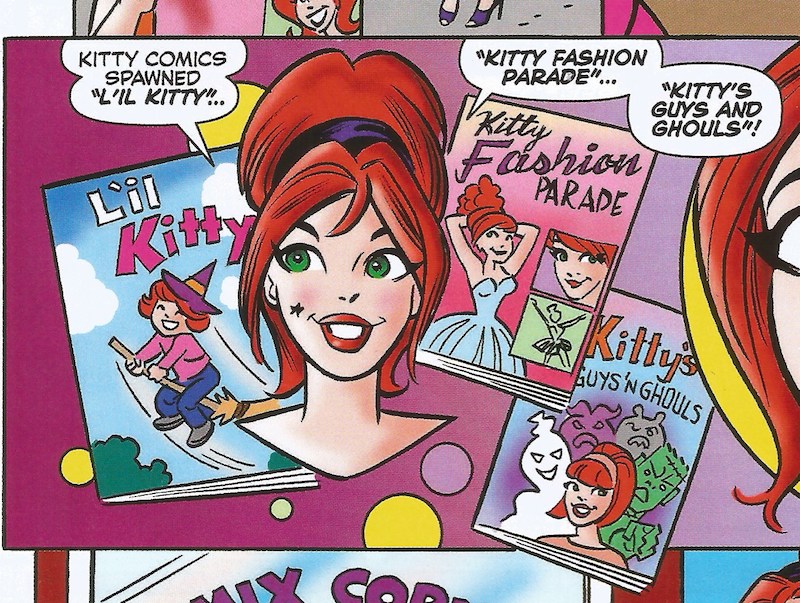
The knee-jerk response would be to suggest Kitty is in fact a send up of Sabrina, the Teenage Witch. That’s not actually the case. Kitty’s a riff on Wendy the Good Little Witch. The last card missing in a grotesque cavalcade of Harvey Comics' juvenile alternates.

With the exception of the ever-so awesome Black Cat, Harvey Comics made Archie Comics look like Playboy. If Archie was an all-ages book. Harvey’s Casper and pals were definitely for kids and absolutely harmless. Picking on them is particularly gutless.
The mogul of the now fading Kitty Empire offers to give Casper his own book if he kills Kitty. Casper is a ghost, and he can attempt to kill Kitty in numerous ways. Invisibility, density control, freezing powers are all potentials Casper can unleash, but for some reason he defies his motivation, his only motivation, in order to…

What. the. fuck.
The wit in this scene is non-existent. It lacks a single shred of sense and doesn’t figure into the plot. The moment just seems to be borne out of the artist’s desire to imply that Casper is depraved. Mind you. Parent does perform this sick feat off panel. I guess he wanted the sexual harassment to be in good taste.
By this time, you should know that Die Kitty Die is only for Dan Parent art fans. Parent is best known for his work on surprise Archie Comics, and he’s an exceptional cartoonist. Archie however requires cleansing. Parent here breaks loose from the restraints of standards and practices, but for absolutely no good reason and without courage.

Parent self-censors. I didn’t add any cute little ineffective censored text because I didn’t have to. Die Kitty Die is neither pornographic, nor even spicy. So Die Kitty Die fails in that respect as well. There’s nothing remotely daring in Die Kitty Die just a surfeit of stupidity.

The mogul plots his crime with two eyewitnesses, who are not only okay with the murder of an innocent woman but now also must be considered conspirators. If we accept the rules of this book, the real world constitutes normal humans and normal humans that practice magic. A normal cast a spell that cast off Kitty’s clothing. Kitty may be something more than human, but still. Human enough. In any case, not many people would know that Kitty is a real witch. They would doubt the evidence presented in a comic book. My point? Murder is murder, and the woman questioning whether it’s murder if the victim is a witch is an idiot. The police will not hesitate to arrest the whole lot of these cretins for conspiracy to commit murder.

The lack of morality in all three of the imbeciles probably plays into writer Fernando Ruiz and Parent’s critique of…drumroll, please…what’s wrong with comics. They take a tour of lousy comic book tropes and events. They travel this path through clunky ham-fisted dialogue spouted from multiple cast members.
That means, Die Kitty Die also becomes an irrelevant platform. Everything every character states has been criticized by better observers and more pertinently. Me, for instance. I’ve been doing this for quite some time. I’ve been a champion for Batgirl forever, and you know what? Batgirl is free of her wheelchair and kicking ass again. Babs Gordon’s mobility is symbolic of a new attentiveness to how a shared universe should work.
Nobody twists your arm to buy comic books. If you don’t want “52 chapters to know what’s happening in the main book,” a horribly gross exaggeration, don’t purchase them. Die Kitty Die is neither funny, appropriately critical, sexy or plotted well. It's got practically nothing going for it.

Having found what appeared to be a flying saucer, Hellboy spun into a weird, underground base and dropped into a nest of vipers.

Yeah. It’s Hellboy beating the crap out of Nazis building flying saucers. How can you not want this?
Hellboy just brought tears to my eyes. Mignola taps into a nerve we all possess. It throbs when Fourth Reich trash tries to save Hitler’s brain, or makes long winded speeches about how superior they are to we defective non-Aryan people.

The real Nazis were probably one of the most terrifying things civilized humankind ever faced, but we’ve taken them into our hearts to domesticate them into an enemy that we ridicule.

They were this crazy but not nearly as fun I imagine. The Nazis intend to use Hellboy to suck out his satanic life force in order to power their ships. Thereby allowing them to conquer the world. There’s but one flaw in this plan.