Pick of the Brown Bag
March 15, 2017
by
Ray Tate
The Pick of the Brown Bag, a weekly comic book review blog, looks at two chapters of Harley Quinn’s “Nether Regions,” which no matter how you phrase it sounds Shakespearean filthy. I’ll also examine the merits of Angel, Aquaman, Batman, The Deep, Green Lanterns, Red Sonja, Superman and Wonder Woman and the Bionic Woman. Remember, if you haven’t time for the blog, you can now check out condensed reviews on Twitter: #PickoftheBrownBag.

You wouldn’t have been able to tell from the cover of Harley Quinn number fourteen, but this is the issue where writer/creator Jimmy Palmiotti and Amanda Conner reunite their character Terra with Power Girl.

Wait, says you. I thought Power Girl returned home to earth two. She did, but the Palmiotti/Gray/Connerverse is tangential to the DC Universe proper. So, Karen Starr is Power Girl. She’s the cool exec of Starrware.

If you’re keeping track, Terra has encountered and befriended Supergirl, Power Girl, Starfire, a clutch of humans and Harley Quinn, who is technically human, but more of a cartoon. Except when she’s not.


…and Lurr from Futurama.

Admittedly, Zorcrom's got way better hair. Or hair even. Conner and Palmiotti conceive Zorcrom as an old enemy of Terra, but that’s a fib. Zorcrom hasn’t appeared with Terra in her mini-series or past cameos.
Compared to Zorcrom, Harley becomes the voice of reason. You can argue that she’s a brilliant psychiatrist and benefits from natural empathy. I however think Palmiotti and Conner are breaking from Harley’s usual wackiness to demonstrate an overall weakness in those who want to rule the world.

The difference between the fiction of Zorcrom and real life tyrants is that Zorcrom is capable of rational thought. Given time and education, Zorcrom might have adapted. Perhaps run for Senator rather than aim to enslave the populace.
As a result of this potential, Zorcrom is somewhat likable. He’s full of bluster, but as he speaks with Harley Quinn, he changes and calms. He’s still prone to bouts of anger and pettiness, but this is largely due to a misunderstanding of human culture.

Power Girl shows up for the lion’s share of Harley Quinn number fifteen. Thanks to the attractive cover, this time you know she and Terra are guesting, which gives you the opportunity to grab the past issue off the racks. Yep. That’s what happened to me. Oh, and since DC thoughtfully bagged the issue with a “bonus” Into the Badlands comic book, I couldn’t flip through that past issue of Harley Quinn. Anywho…

With Power Girl on the scene, Conner and Palmiotti delight in rekindling Harley’s crush on the Kryptonian. This time Power Girl, now in possession of her full faculties, kind of warms to Harley, but the clown is not her date for the evening.

Smart, funny…in so very many ways, both issues of Harley Quinn need to be in your collection. As an added bonus, Palmiotti and Conner work in three…

…Three interesting subplots. The first demonstrates the flexible reality of Harley Quinn even farther. Conner and Palmiotti imagine a future Gotham City that’s kind of like a kinder Mega City One with a neighborhood Jones for Batman.

The blocks sponsor a fighter in a kind of Ultimate Cage Match mixed with Batman themed lucha libra. The grand prize is a notable one.

While the Harley Quinn, Terra, Power Girl team-up is split between Khari Evans and John Timms, the Batgirl of the future subplot is illustrated by Palmiotti’s old cohort James Michael Linser, from Claws: Wolverine and the Black Cat. As such that particular subplot is a beautiful paean to female pulchritude.

Speaking of pulchritude Red Sonja opens with bathing nudity and continues with open-jacket and abbreviated scale-mail clad sword fighting.
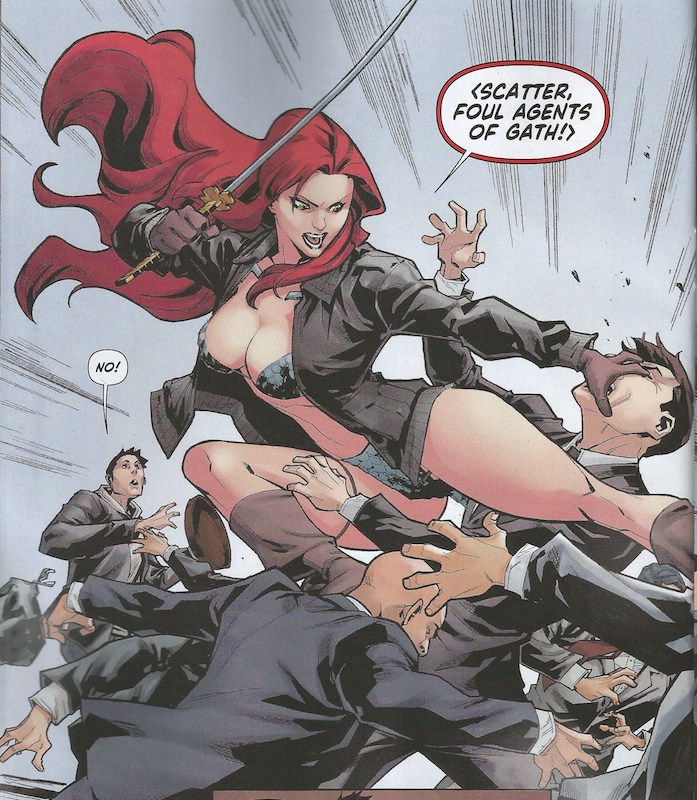
In short, freaking awesome. As the story progresses, Red Sonja changes into a jogging outfit. Boo. Hiss. Fret not, sensation seekers. She's soon back to being the scale-mail poster girl.

As I have stated many times, Red Sonja as depicted in the barbarian chronicles isn’t a textual reading of “Shadow of the Vulture” by Robert E. Howard.

This is Red Sonja’s only canonical story, and in that short, she’s operating around the 1500s. When Roy Thomas transplanted Red Sonja to the Marvel Universe in the Conan adventures, things changed. Her style of dress altered. In the 1500s Sonja wears period clothing. Makes sense, right? In the Marvelverse, she’s sporting a scale-mail bikini.

Why? Striking appearance? A penchant for drawing sensual barbarian women? Sexism? You decide. It doesn’t matter. The scale-mail became forever associated with Red Sonja, and as such, a lot of Red Sonja’s tales are loaded with sensuality. Sonja will not submit to a man’s bed unless he can defeat her in fair combat. Her skin is bait. He muscle and skill with a sword is reality. Sex is an underlying theme whether Marvel liked it or not.

Why? Striking appearance? A penchant for drawing sensual barbarian women? Sexism? You decide. It doesn’t matter. The scale-mail became forever associated with Red Sonja, and as such, a lot of Red Sonja’s tales are loaded with sensuality. Sonja will not submit to a man’s bed unless he can defeat her in fair combat. Her skin is bait. He muscle and skill with a sword is reality. Sex is an underlying theme whether Marvel liked it or not.

Lousy movie. Good Red Sonja.
My point is that if you choose to go with this version of Red Sonja, the skin quotient should ring the bell. Don’t even try to deny the sexploitation inherent in the Red Sonja tales. They were sword and sorcery grindhouse. Writer Amy Chu embraces these tributes to 42nd Street, and as a result, her Red Sonja resonates with greater authenticity. Although, there’s more to Sonja than nudity, Regina.
Chu's time travel plot is well thought out, and it differs from the classic issue of Marvel Team-Up that started this weird tradition of a time traveling Red Sonja. Chu's run thus far has certainly been better than the overlong Spider-Man/Red Sonja mini-series that rehashed Marvel Team-Up in five issues.
Chu's time travel plot is well thought out, and it differs from the classic issue of Marvel Team-Up that started this weird tradition of a time traveling Red Sonja. Chu's run thus far has certainly been better than the overlong Spider-Man/Red Sonja mini-series that rehashed Marvel Team-Up in five issues.
Numerous surprises await the Red Sonja reader. Sonja's intelligence and adaptability entertain as much as her lack of Conservative social mores.

Her relationship with Max is light, fun and unlike the alliances she made with frequently brutish men of the past. There's also a rich vein of feminism. The numerous women in Red Sonja's present day encounters are all smart and capable. They furthermore help her cope with modern life and suggest a cohesive sisterhood.

Her relationship with Max is light, fun and unlike the alliances she made with frequently brutish men of the past. There's also a rich vein of feminism. The numerous women in Red Sonja's present day encounters are all smart and capable. They furthermore help her cope with modern life and suggest a cohesive sisterhood.

Red Sonja is a real winner with Amy Chu evincing an almost instinctive insight into the She-Devil with a Sword and Carlos Gomez and colorist Mohan upholding Red Sonja's spicy reputation beautifully.

The latest issue of Wonder Woman and Bionic Woman is an excellent albeit flawed read. Diana and Jaime start off by cleaning up 1970s shipboard trash set off by the gorgeous action artwork of Judit Tondera and colorist Richard Pilcz.

The centerpiece of the book is telegraphed by the cover. With a missile launched, Diana must rope the wayward dogie while Jaime flies the Invisible Jet. That should stretch a grin to the fans of these characters from ear to ear.
Lassoing large projectiles is a Wonder Woman staple, and watching her perform is a nostalgic treat. It’s something you could see Wonder Woman do from the 1940s onward, but with a push to make comic books more realistic, Wonder Woman's signature move became rarer and rarer. More’s the pity.
Writer Andy Mangels however doesn’t just position the characters for familiar tactics. He recreates the actors’ portrayals through the dialogue. Lindsay Wagner’s Jaime was self-deprecating and often humble. She frequently resisted the nutty ideas OSI and Oscar Goldman conceived.
The idea of her piloting the Invisible Jet is daunting. Of course, Jaime comes through. That’s her signature. The key of Jaime’s recalcitrance is that she’s not really a government operative like Steve Austin. She’s an ex-tennis player who suffered a skydiving accident. Because of Steve Austin’s genuine love for Jaime, he orchestrated her conversion. Although Jaime acquitted herself remarkably well again and again in the field, she is technically a civilian. So, she’s always suspicious of a mission that seems to be ready-made for a trained super spy but not an athlete with cybernetic parts. It’s an engaging personality quirk that partially explains the success of the series.
In addition to these writing pluses, Mangels also draws upon Lynda Carter’s frequent bemusement over men. In a completely unconceited away, she finds most men including brilliant ones like Rudy Wells hilarious.

As this chapter of the historical team-up winds down, Jaime and Wonder Woman encounter classic foes from the Bionic Woman, and an infrequent guest star to the series willingly succumbing to Wonder Woman’s gifts from the gods.

I did say however that Wonder Woman and Bionic Woman is flawed. The villains from both television series get together and tell people what they already know in grand detail. This exposition though mostly tolerable is unnecessary and could have been edited to a mere few panels.

I did say however that Wonder Woman and Bionic Woman is flawed. The villains from both television series get together and tell people what they already know in grand detail. This exposition though mostly tolerable is unnecessary and could have been edited to a mere few panels.

Superman continues the reveal of the multiple Superman mystery. Superman’s son is trapped in the ether, and Lois has forgotten the tyke she spat out of her womb.

Yeah, yeah. I’m not really down with any of this, but it’s what we have to deal with. Anyway, the main difference between Peter Tomasi’s part in this story is that he infuses energy to something that’s really trite. Artist Patrick Gleason in turn makes these tired events visually arresting. When Superman and Lois Lane are in fact reborn at the conclusion, just as I predicted, the depiction bears a certain amount of gravity. He and Lois do look more certain and heroic.

This issue of Green Lanterns benefits from a classic villain from the Lantern Rogue’s Gallery.

Dr. Polaris returns in a younger but no less brilliantly mad form. Taking advantage of magnetism’s literal opposite poles, writer Sam Humphries follows the footsteps of other Green Lantern scribes to make Polaris a metaphor of the primal force. He's a paranoid schizophrenic who hears the voice of his alter-ego and sees him in his mind’s eye. The difference is that Humphries makes Polaris a somewhat pitiable figure in that he’s seeking a cure for his brother’s cancer and he is bereft of his medication.

Furthermore the government wants him on the Suicide Squad. Always a scuzzy development. That’s acting director Harcourt, a baby Amanda Waller, that’s on her way to becoming just as officiously evil. The Lanterns will have none of it though. The scene emphasizes how far these Lanterns progressed in their partnership and as heroes. They’ll stop Polaris because it’s the right thing to do not on behalf of Belle Reve’s Prisoner Check Out policy.
Green Lanterns is user friendly, historic but also up to date thanks to the presence of Harcourt. The art by Ronan Cliquet looks stunning. The realism helps sell the fantasy, and the Lanterns are entertaining characters to follow.

Last issue, Batman tricked Bane into following him into Arkham Asylum. Bane is in Gotham to recapture the Psycho Pirate. Batman needs the Pirate to undo the damage done to Gotham Girl’s mind. In this issue, we learn that Batman promised favors to the Arkham Inmates should they stop or delay Bane. Your level of appreciation for this issue of Batman depends on how much you care about Bane and the other Gotham crazies. If you’re like me, and the answer is not at all, you can safely skip it. Suffice to say that Bane cuts through the Arkham lunatics quickly leaving him to face Batman for the next chapter. The story does have one point of interest. Two-Face is alive. At the end of Batman and Robin, Two-Face committed suicide.

Writer Dan Abnett utilizes a Marie Celeste plot device in the latest issue of Aquaman. Doctor Who, X-Files and Aliens all employed the same idea. A just-abandoned military base presents an enigma for investigators. This fictional conceit is based on the famous or infamous Marie Celeste, a ship from 1872 inexplicably devoid of crew.

Aquaman isn't anything special per se, but it's well-written and gains advantage from potent artwork. The presence of the Aquamarines who have a volatile history with Aquaman add a nice feeling of an under the surface threat. You keep waiting for the soldiers to turn on Aquaman and Mera, but surprisingly that never happens.

Old favorites and a classic Aquaman villain help shake cobwebs off the favorite theme of science fiction writers, and of course Abnett presents these characters as distinctive necessities to the plot.

When the reveal comes, it's a good one. Because Aquaman and Mera are present, what could have been a by-the-numbers watery horror story turns into another example of DC's new 52 turnaround. Back in the day, the monster would have eaten Aquaman's arm or gutted Mera. Instead, Arthur decks the creature. This is Aquaman as he should have always been. Powerful. This isn't just any hero. He's a member of the Justice League. He's a go-to guy for protecting the earth.

Aquaman isn't anything special per se, but it's well-written and gains advantage from potent artwork. The presence of the Aquamarines who have a volatile history with Aquaman add a nice feeling of an under the surface threat. You keep waiting for the soldiers to turn on Aquaman and Mera, but surprisingly that never happens.

Old favorites and a classic Aquaman villain help shake cobwebs off the favorite theme of science fiction writers, and of course Abnett presents these characters as distinctive necessities to the plot.

When the reveal comes, it's a good one. Because Aquaman and Mera are present, what could have been a by-the-numbers watery horror story turns into another example of DC's new 52 turnaround. Back in the day, the monster would have eaten Aquaman's arm or gutted Mera. Instead, Arthur decks the creature. This is Aquaman as he should have always been. Powerful. This isn't just any hero. He's a member of the Justice League. He's a go-to guy for protecting the earth.

Last we saw of the Nektons in The Deep their exploring backfired on them. They spotted the monster all right. It ate them.

Naturally, the parents have a solution for this problem, but Fontaine's having none of this.

Her reaction is hilarious and sets the tone for the book. As soon as the group starts talking about a broken homing beacon, the penny drops in the fountain. You realize that the introductory issue was one of the most absurd methods of foreshadowing, and the actuality of the rescue pays off in giggles.


Naturally, the parents have a solution for this problem, but Fontaine's having none of this.

Her reaction is hilarious and sets the tone for the book. As soon as the group starts talking about a broken homing beacon, the penny drops in the fountain. You realize that the introductory issue was one of the most absurd methods of foreshadowing, and the actuality of the rescue pays off in giggles.

Angel bears a lot of Joss Whedon styled humor. Angel and Fred, host of Illyria, accidentally traveled back through time to a prehistoric age full of demons and demon worshippers. One of those demons is Illyria's past incarnation who demands sacrifice. Such a poor soul shared his home with the time travelers.

Angel first met Fred in a cave in another dimension. So this is a nice callback to the television series. The book also features a great moment of Angel vamping out, and Illyria mimicking a feat that you wouldn't be surprised to see in Supergirl.

Most of the comedy derives from the presence of pacifist demons that remind one of the Neutrals from Futurama. Their anachronistic speech patterns so very indicative of Whedon provide laugh out loud funny moments.

Angel first met Fred in a cave in another dimension. So this is a nice callback to the television series. The book also features a great moment of Angel vamping out, and Illyria mimicking a feat that you wouldn't be surprised to see in Supergirl.

Most of the comedy derives from the presence of pacifist demons that remind one of the Neutrals from Futurama. Their anachronistic speech patterns so very indicative of Whedon provide laugh out loud funny moments.