Showing posts with label gun control. Show all posts

Tuesday, March 6, 2018

POBB February 28, 2018

Pick of the Brown Bag
February 28, 2018
by
Ray Tate

As expected the GOP got down on their knees to service the NRA’s cocks by deciding not to debate any measures on gun control.  


You shit-holes are going to be voted out by an angry generation that you abandoned.  Some are the survivors of the gun violence that you lot enabled.  They see you for the fuck ups that you are.  You are out of here.


Criminal-in-Chief Donald Trump after promising the Parkland victims that he would stand up to the NRA backed down by hamstringing President Obama’s gun safety regulations.


On the flip side, give some love to Dick’s Sporting Goods.  Dick's will no longer sell assault rifles.  They in addition raised the age limit for purchasing guns.  We also can thank Enterprise, Hertz, MetLife, Delta and United Airlines for hitting the NRA where it counts.

In happier news, this week the Pick of the Brown Bag takes on All-New Wolverine, Batgirl, The Flash, Lockjaw, Mera Queen of Atlantis, Peter Parker the Spectacular Spider-Man, Rough Riders, Scooby-Doo Team-Up and new DC book The Terrifics.  Haven’t the time for the full dose of POBB goodness.  Check me out on Twitter: #PickoftheBrownBag.


It’s another perfect issue of Scooby-Doo Team-Up.  Scooby and the Gang take a holiday from ghost-breaking and have a picnic in Jellystone National Park.  Before you can say pork pie, Yogi Bear appears with a scheme to snatch Shaggy’s and Scooby’s gimongous picnic basket.


Sholly Fisch’s clever Yogi cons are worthy of the beloved moocher.  His meta gags are even funnier.  


The comedy portion in Scooby-Doo Team-Up is frequently laugh out loud and so varied.  The ghost is tailored to fit.


It seems a rash of picnic basket thefts set Mr. Ranger on high alert.  Naturally, he thinks Yogi is the culprit and may be behind the Ghost.


Yogi is not the culprit.  Indeed, Yogi though smarter than the average bear isn’t in Top Cat’s league.  Yogi may be a grifter, but he’s motivated by gluttony.  He doesn’t stack the plans like Top Cat.   

While Yogi can fast talk the foolish out of their culinary booty, he won’t go to such great lengths as faking a haunting to protect his stash of deliciousness.  Once tumbled, Yogi admits defeat or bids a hasty retreat.  That’s why despite the overwhelming evidence to the contrary, even the Gang appear to be on Yogi’s side.

The solution to the mystery isn’t quite fairplay, but certainly makes sense.  Fisch on the other hand well foreshadows the trap for the spook, and artist Walter Carzon captures the simplified cartoon design of Yogi Bear while amplifying the illusion of animation.

Lockjaw opens on the moon where the giant dog waits out Medusa’s and Black Bolt’s clothed canoodling.


The hound then visits Karnak.  Karnak recently metamorphosed into a sourpuss.  Nevertheless he still likes Lockjaw.  Who doesn't? Somebody without a heart.  That's who.


After a short tour of Attilan, the doggie teleports to earth where he immediately ingratiates himself to a small human.


Lockjaw loves humans and Inhumans.  He’s just an all around love-fest.  Surprisingly, Lockjaw does not stay with the earthling long.  It’s not that kind of book.  He moves on to his real purpose.

Lockjaw apparently has kin on earth.  Just by a happy coincidence, that canine lives next door to D-Man, short for Demolition Man.


Wrong Demolition Man.  D-Man is a goofy cross between Daredevil and Wolverine with a generic low-level Superman power-set.  Nowadays, he’s just got some wrestling prowess.


That said, helping Lockjaw take down some alien invaders out to kill an innocent puppy? Yeah, D-Man’s got that.


Although Lockjaw cannot be taken too seriously, the curiously named writer Daniel Kibblesmith and artists Carlos Villa, Roberto Poggi and Chris O’Halloran treat D-Man respectfully and give the antic a strong but plausible counterweight.

Tom Taylor takes a break from chapter-plays for a standalone in All-New Wolverine.  Laura Kinney is Wolverine.  Last year, she discovered the crazed individuals that created her also cloned sisters.  One of the bunch, Gabby, turned out okay.  Gabby lives with Laura and takes care of her.  

The story begins on a breeze that leads Gabby and her pet wolverine Jonathan to walkies.  All goes well until, Jonathan nearly tears Gabby’s arm off when he pulls her to a specific building.  Housing the scientists that turned him into the upgraded animal he is today.  


Gabby does the math, and she calls her friend Deadpool.  Due to his origin, a distant family member of the Wolverine Clan.  

Let the gleeful games begin.  Ryan Reynolds was the best thing to ever happen to Deadpool, and that’s who Taylor channels for the characterization.  Together, Gabby and Deadpool discover hilarious science fiction horrors and overcome them with the prowess you expect.


Wolverine begins to worry about her sister.  So, she tracks her down and discovers what’s been going on.  Wolverine is all about justice.  So, she’s in.


Taylor’s story injects new life into a tedious trope and comments on that chestnut’s characteristics in clever ways.  The camaraderie between Deadpool and Gabby is at once strange and sweet.  Wolverine joining the marshmallow roast neatly distinguishes her from the sometimes responsible adult that she needs to be where Gabby is concerned, and every panel is crafted with sublime care by Marcio Failla.


Peter Parker reaches its 300th issue.  If you’re wondering if that nap you took turned into a Rip Van Winkle the answer is no.  Not counting the one-shot magazine, the first volume of  Peter Parker the Spectacular Spider-Man began in the mid seventies.  Marvel ceased publication of the title in the late nineties before reintroducing the book last year.  Is this ballyhooed issue special?  Possibly.

Teresa Parker, Spider-Man’s maybe sister, appeared at Spidey’s doorstep with information about Graysword, a SHIELD department headed by Agent Mintz.  The mission statement aimed to root out and exploit the secret identities and the weaknesses of superheroes.


Always be wary of those seeking the greater good.  Spock being the exception.  Teresa hid the incriminating data in her DNA, a trick I first encountered on Star Trek: Enterprise, and based upon the science of junk DNA.  

The consequences of Teresa’s bravery led to she being declared a public enemy.  Spidey of course followed his sister on the list, in both identities.


At the same time, Spider-Man uncovered what appeared to be a phone network for villains.  This led to avenues of mystery and surprisingly tied into Agent Mintz’s bend to save the world no matter how scorched by his actions.

Multiple guest stars added to the scope of Peter Parker and made the title almost thematically Marvel Team-Up.  The Human Torch, Ironheart, Karnak, Ant-Man, Black Panther, Hawkeye and the Falcon signed in.  This issue introduces another guest-star, who partnered with Spider-Man way back in the day, and it’s that team-up writer Chip Zdarsky references as he takes Spider-Man smoothly from the street to the stars.

In terms of tone, Peter Parker Spider-Man pretty much gets everything right.  It’s uproarious, and the characterization recalls the Bronze Age Spider-Man I grew up with.  Still a young hero but old enough to hand out some advice.


Ironheart’s loss of armor connects to the grand finale in which an arch Spider-Man foe unveils his ingenious ploy and a measured turnabout that grants him some surprising depth.

The third act of “Perfect Storm” doesn’t move forward with any great momentum.  The best comes from Wally West.  Flash arch-villain Abracadabra took Wally out of time and space while he stayed hidden under another guise.  In conjunction, unknown forces edited twelve years out of the New 52, and Superman’s timeline rewove.  Perhaps as a result from the pattern of temporal disruption, Wally returned from the great unknown.  However, only a few people know that he ever existed, first as Kid Flash then as the Flash.


Writer Joshua Williams and artist Carlos D’Anda creates the perfect feeling for a man out of time.  Wally is a true hero.  He accepts the abominable trick that his foe played on him.  He moves beyond it save Central City one citizen at a time.  This isn’t about him.  This isn’t about his own problems.  It’s about them.  Wally saves the lives of the people he loves even if nobody will love him back.


Dan Abnett’s Aquaman epic needed another book to hold all that’s transpiring beneath the waves.  So, Mera Queen of Atlantis debuts.  Despite genuinely focusing on Mera, the tale unfolds with former King Orm the Ocean Master.

Ocean Master is Aquaman’s opposite number.  At least he used to be until Geoff Johns reintroduced the character for the New 52.  Originally, Ocean Master was Aquaman’s fully human step-brother who used technology to become an underwater threat.  

Johns turned Orm into a full blooded Atlantean who is the rightful King of Atlantis.  That changed when classic Aquaman advisor Vulko pitted Atlantis and the Surface World against each other.  Aquaman defeats Orm, and Orm is eventually remanded into Amanda Waller’s custody.  During Forever Evil, Orm escaped and eventually fell in love with the human woman Erin.


Orm should be declared innocent of all crimes, however heinous.  He acted on behalf of Atlantis.  Although his actions resulted in countless deaths, he knew no more of Vulko’s scheme than Aquaman.  That’s moot.


When Abnett turns his attention to the title star, he does so in style.  The Eel is one of the more obscure Aquaman Rogues.  Somebody’s hired the mercenary to ice Mera.


Abnett uses the battle to commit Mera to reverie about her life and how it's now being used against her desires.  Much as in Royal history, Mera’s Xebel pure bloodline makes her the ideal choice to retake the throne.  I trust I need not explain the Trump-like imitator that now rules Atlantis.


Mera would like nothing better but to marry and settle down with Aquaman at the lighthouse on Amnesty Bay, while being a superhero in the Justice League.  That Justice League issue is another example of Abnett expanding the Aquaman Family’s role in the DCU.  Batman invited Mera to join the League without inviting her to join the League.  So, you know it’s legit.

Illustrated by Lan Medina, Richard Friend and Veronica Gandini, Mera looks great in battle and expressive in Abnett’s character study.  Queen of Atlantis fosters a different tone than Aquaman.  This book is all about duty, destiny and desire and how they sometimes clash.  It’s a gem on the Trident of Aquaman.
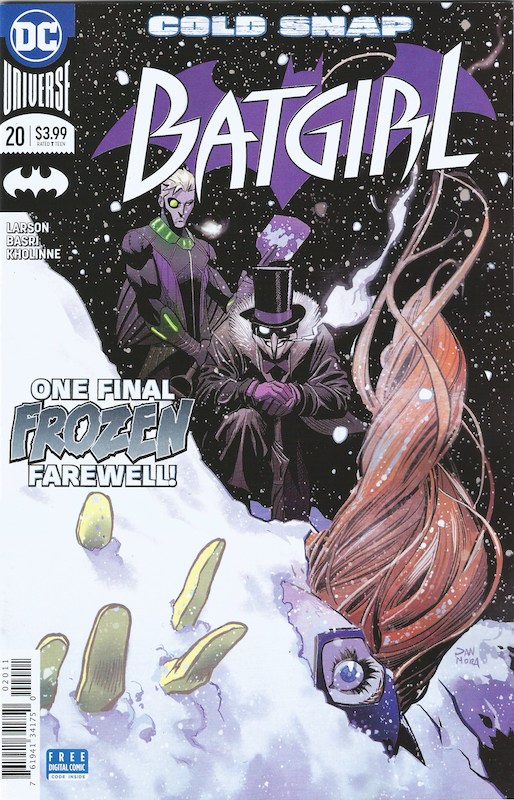

Hope Larson concludes her snow-shrouded Batgirl story with a satisfying battle against the Penguin and Son.  They’re on the cover.  They could have been a red herring, but come on, this isn’t really a spoiler.

The previous issue was a mystery, where Batgirl followed clues and attempted to solve a crime of obfuscation.  Somebody blinded the National Weather Service.  The technological tomfoolery allowed a snowstorm to sneak into Gotham.  The purpose, Larson reveals in this issue, and its a far-reaching doozy with ties to a classic Penguin gimmick.


Having been led on a wild goose chase, Batgirl relies on something more reliable than a computer her eidetic memory.  She maps out the streets to determine where a secret lab may be found.  There she discovers the creator of the McGuffin, her former Q Qadir.


Once she finds out what device Quadir fashioned, Batgirl determines the Penguin and Son are behind the whole white as snow forecast and aims to stop them.


Because of the nature of the device, Batgirl initially falls in line with other citizens of Gotham City.  Distance makes her mind stronger, and Batgirl opts for a direct confrontation.


Larson’s finally got her groove back.  Her characterization of Batgirl is spot-on, imbuing her with humanity and a fortified sense of justice.  Pitting her against the Penguin is a time honored Batgirl tradition, and the Penguin’s reinventions work in his favor.  Sam Basiri’s artwork is a boon for Batgirl.  Basiri uses multiple angles to energize the narrative while putting together an attractive snowy redesign of Babs Gordon.  He works equally well on detection as well as action, and the colors by Jessica Kholinne adding pink to Batgirl’s cheeks educe dimension and weight to Babs’ bone structure.  I won’t mention the green eyes.


The Terrifics are basically the Fantastic Four with Michael Holt aka Mr. Terrific as Mr. Fantastic.  Called to action when Simon Stagg opens a portal to the Negative Zone, or as DC refers to it, the Dark Multiverse, Mr. Terrific saves Ben Grimm now played by Metamorpho.  He enacts the rescue by activating the dormant Human Torch, Plastic Man.


Looks a bit different, doesn’t he?  Plastic Man apparently now wears a pair of horrid black bicycle shorts instead of his perfect classic costume.  


Ah, says you.  That’s only three FF members.  Where then is the Invisible Girl.  


Bgztl is Phantom Girl’s planet.  Tinya Wazzo is the Legionnaire’s real name.  Linnya is likely her ancestor.

With the team together again, for the first time, all we need to do now is enjoy the typical antics of the FF.  Doesn’t work.  

The relationship between Metamorpho and Plastic Man meant to accommodate the Ben/Johnny banter/bickering is forced.  Not counting a few Bronze Age issues of The Brave and the Bold, Metamorpho and Plastic Man never met until now, but they appear to be old rivals.  Furthermore, they never once had personalities similar to Ben and Johnny.


If you slog through the gobbledygook disguised as technobabble and the lackluster Fantastic Four imitation, you will be rewarded.  Although the characters appearing at the end of the book are an acquired taste.


The latest Rough Riders series takes place in 1906 when Alice Roosevelt married.  That sets the book about two years from the last Rough Riders adventure.  Tempers haven’t cooled.

Harry Houdini seeks out Teddy Roosevelt to use his connections and reunite the Rough Riders.  

Writer Adam Glass first honors Houdini’s status as one of the first debunkers of the supernatural.  He spins a yarn in atmospheric Pat Oliffe artwork that mirrors Teddy Roosevelt’s life.  Houdini however is no psychic.  He exploited fact to deduce the President’s history.  He employed the charisma of a bard to lure Roosevelt into believing the lie.


Houdini on one of his expeditions into the world of charlatans and parlor tricks uncovers a real supernatural threat that performs feats impossible for even the illusions of stage magic.  The fate of the world now rests on the Rough Riders shoulders.

Tensions are high in this series.  Thomas Edison is the Rough Rider most unlike his historical record, but this book never was meant to be a docudrama.  So, I've come to terms with Edison's bellicosity.  Edison meets up with Annie Oakley again.  Annie however is no longer the woman she was.

Had Edison used his genius to resurrect Annie Oakley because he was sweet on her, he might have gained sympathy.  She and the other Rough Riders discovered that she was Edison's experiment and nothing more.  


Of all the Rough Riders, Jack Johnson and Monk Eastman at the very least tolerate each other’s presence.  Monk still won’t shake hands with Jack, but he’s at least cordial with the boxer.  All these scenarios lead to the very interesting inclusion of a famed master of the occult.  Given this figure’s history I’ll be interested to see how he reacts to all the Rough Riders.


Wednesday, February 28, 2018

POBB February 21, 2018

Pick of the Brown Bag
February 21, 2018
by
Ray Tate

Democrats rarely support the NRA.  That doesn’t mean that some democrats can’t be overall morons. 

Tone Deaf House Representative Kimberly Daniels: “I believe it was God, and I heard a voice say, 'Do not politicize what has happened in Florida and do not make this a thing of division.”

And so, “In God We Trust” must now emblazon every Florida school.  Republicans fell all over themselves to pass that bill.  It was something that cost them nothing and made them look good in front of the Religious Right.  It was essentially a gimmee. 

Kimberly Daniels is wrong in many, many ways.  Most importantly.  There needs to be a division.  We need to divide ourselves from the NRA and their ass-puppets in the GOP.  Ms. Daniels, if this is the kind of legislation you intend to promote to stop gun violence, you can join them in the discard pile as well.

So, yeah…Comics.

This week in the Pick of the Brown Bag I review Aquaman, Astonishing X-Men, Batman, Brave and the Bold, Generation X, Green Lanterns, Heathen, Hellboy and the BPRD, Infinity Countdown, The Mighty Thor, Monsters Unleashed and Red Sonja.  Lacking time? Check me out on Twitter: #PickoftheBrownBag.


The fairy folk are at war in the mythical land of Tir Na Nog.  Tensions already were high between the goblins and…we’ll call them elves.  A king’s murder lights the match to a powder keg. Fertility God Cerunnos Cernach asks Wonder Woman for help.  Simultaneously, Batman notices peculiarities in Gotham City’s Irish Quarter.  His investigation leads to something Unseelie.  

The Brave and the Bold certainly looks like a finely detailed piece of art, worthy of framing.  Liam Sharp’s plotting and dialogue on the other hand needs a lot of work.


The first scene of the book exposits on the friction between goblins and elves and presents Cerunnos Cernach.  None of this is necessary.  The artist just wanted to draw a lot of strange looking dudes strangling goblins.  Cerunnos reintroduces himself in a later scene.  So, the expository speech is superfluous. 


Sharp should have started by depicting the death of King Elatha.  Since murder is the whole point.


This scene occurs near the end of the book.  Bad judgement in my opinion.  Sharp cuts to an Antarctic base where Wonder Woman and Steve Trevor enjoy some post-coital intimacy.  Diana and Steve had sex.  Good on them, but couldn’t their discussion be more playful?


I mean if that’s the best you can do, let’s not talk at all and just luxuriate in the niceness of the afterglow.  I’m also really not keen on the switch in point of view.  There’s nothing important to see.

No diss on Steve.  I just cannot discern the reason behind the “lensing.”  It’s like the “This is a close-up?” gag from Daffy Duck’s “Duck Amuck,” only done for an effect I can’t quite put my finger on.  It’s not the feminine gaze.  It’s not intimate.  It’s just kind of there.  

I didn’t actually hate The Brave and the Bold.  I just felt it was a mediocre debut, with a few exceptions.


I wish Liam Sharp had brought this attentiveness and inspiration to the entire story.  When Sherlock Holmes had a particularly nettlesome enigma to unravel, he referred to it as a three-pipe problem.  Meaning the time Holmes required to solve the knotty mystery lasted the smoking of three pipes.  Sharp updates the practice for Holmes’ successor.

Batman’s perturbation focuses on the unusual “chronic lethargy” the Irish Quarter exhibits.  When he arrives to investigate, Batman comes up with a fitting means to juice some adrenaline back into his subject.  He scares the living daylights out of him.


The book pongs back and forth between Batman and Wonder Woman.  Neither do they meet in this chapter.  Instead, Wonder Woman accompanies Cerunnos to Tir Na Nog,

Cerunnos is one long-winded cuss, and I can’t fathom why anybody needs to talk in this Escheresque scene.  The presence of word balloons disrupts the aesthetic use of space.  Once again Cerunnos is not just a god of fertility but also reiteration.  See pages one-through three and page ten.


Poison Ivy began as a flighty femme fatale with mind-control lipstick and a lust for Batman.  Over the years, Ivy became a  mad scientist dedicated to committing plant-based crimes, then an ecoterrorist.  In the New 52, Ivy joined the Black Canary and Starling as the Birds of Prey.  In this incarnation, Ivy flourished in the shade of gray.  During “The Night of the Owls,” Batman even returned Ivy to the Birds' custody, feeling that they would be a better influence on her already impressive reform.  Gail Simone fashioned one of the most brilliant developments in Ivy’s history.  She reasoned that Ivy suffered from a hyper version of seasonal affective disorder, and like a plant greened in spring, blossomed in summer, darkened in fall and became bitter in winter.  It’s definitely summer in Gotham, and Poison Ivy has a new scheme that encompasses all but her original, simplistic history.

The story begins in Wayne Manor when Batman as Bruce Wayne notices something wrong.  


He stumbles into the Batcave and works on an antidote for something he’s not even sure is going on.  That's how brilliant Batman is.  He can just taste the change in season, but it's enough.  Selina follows him and offers purrs, but Batman's not normal.  He sees through what appears to be characteristic behavior.  


He and Catwoman now benefit from his antidote.  He furthermore now has a partner in this investigation he can trust implicitly.

As Tom King’s story progresses, Poison Ivy’s plan opens like a rose, and you cannot help but admire her brilliance as Batman impresses her with his countermeasures.  This is no one-sided fight.  In the end, Ivy believes she has won, and she emphasizes the point by relating an early John Byrne Superman story involving the Joker.


King’s Wonder Woman and Batman team-up was a plot point for plot point Superman and Wonder Woman story.  Ivy’s knowledge of the John Byrne classic instead reads as a meta contextual anecdote that describes Batman’s and Catwoman’s situation perfectly.


Batman is notable for many elements, artist Mikel Janin’s return in high form being but one.  In addition, King’s latest nestles Batman and his myths firmly in continuity proper.  Superman and the Flash can be seen.  Ivy mentions Cyborg.  The plot depends upon Swamp Thing and the Green.  Catwoman and Poison Ivy, unlike their depiction in Harley Quinn, are neither friends, nor even colleagues.  Ivy is in fact more amiable with Batgirl.  Ivy furthermore gains a subtle upper hand that in the past would have signaled certain doom for Batman.  Now, it's a mere inconvenience.


Aquaman has a long history of abdicating or losing the Throne of Atlantis, but writer Dan Abnett made this latest recapitulation topical and meaningful. 

Like President Obama, Aquaman tried to draw Atlantis to the progressive future.  He opened an embassy on the surface world.  He intended to start trade with the same.  He hoped to forge an alliance and peace.  Events unfortunately dashed his dreams on the rocks.  The former Drift terrorist leader Rath staged a coup with willing Royal Court participants.  

Rath's first act as the new King was to institute The Crown of Thorns.  The Crown isolated Atlantis from all and allowed Rath to stockpile magical relics in secret for his ultimate goal, the destruction of the land dwellers.  The Crown kept Aquaman now public enemy number one inside and Mera outside so she could not add her formidable might to Aquaman’s cause.

The Klingon-like Captain of the Guard Murk appeared to kill Aquaman.  He in truth saved the King.  Murk feared sheer numbers would overwhelm Aquaman, and the Court would truly execute him and all hope for Atlantis.  Murk created and maintained the ruse of Aquaman’s death while in appearance serving Rath.  He actually hid the deposed King among Atlantis’ mutant forgotten.  

Aquaman first plied his trade as a Batman like ghostly figure, but once discovered as substantial, he allied with the throwaways from Atlantis.

In this issue, Aquaman leads the Undercurrent against the magic-using Silent School of Atlantis.  Loke, is the headmaster and loyal lapdog of the usurper Rath.  

Loke is not the only turncoat.  Writer Dan Abnett introduced these apparently loyal Court followers in previous chapters, set before the upheaval.  Because of the awareness, the fights have greater meaning, and there’s an underlying philosophical battle waged.

Rath's cabinet follows their racist leader lock-goose-step.  Aquaman’s removal revealed hitherto resentment of Arthur’s progressive ideals.  Abnett displays the xenophobia through Urcell’s dialogue when encountering Dolphin.


This isn’t just about killing Aquaman.  It’s about keeping Atlantis “pure.”  The Crown of Thorns acted as a wall.  Rath's collection of weapons that belong to the state reflects a reaping of wealth from taxpayers.  Rath's fear of Aquaman mirrors Trump's fear of Obama.  

Abnett introduced a number of different blocs to Atlantis.  The Undercurrent is the lowest of low.  The Widowhood is a matriarchal society dedicated to Atlantis but in a whacky way.  They use alleged prophecies to determine their actions.  They never wanted Aquaman as King.  They foresaw Atlantis' end should Mera be Aquaman's Queen and impeded the duo's marriage.  It turns out the Widowhood actually wanted Mera to be Queen alone.


Mera a moderate of Xebel blood will become Queen of Atlantis.  Aquaman who never wanted to be King in the first place is determined to seat his lover.  Rath really couldn't possibly predict this, and neither can the reader.  The thrust of Aquaman's determination takes the tried and true motif of Aquaman losing the throne to an even fresher level of storytelling.


The Green Lanterns uncovered a superhero human trafficking ring, and now press the lowest on the food chain to help them follow the money.


Scrapps accompanies Simon Baz and Jessica Cruz to an old Green Lantern Corps world where criminals rule.  Tim Seeley reminds readers of an obscure Green Lantern that was created by Jon Ostrander and Henry Flint.


You may ask why the planet's been renamed Hellhole if a Lantern cleaned it up.  That's a fair question, but the key to John T. Chance is that he never intended to clean up the planet, just prevent major horrors happening.  He was the Lantern Corps Bad Man.  That was the key to his success. 

Cruz and Baz disguise themselves as well known scoundrels and sidle into the criminal underbelly to further their investigation.


Comedy is high in this issue of Green Lanterns.  Simon Baz’s disguise is hilariously bad 1970s porno.  Jessica is trying to avoid even discussing the possibility of what the superhero dating app Caper decided to be her perfect match.  Baz.  


In addition, we have a high speed chase, creative Lantern constructs and a disgusting hot to trot femme fatale exacerbating the situation.  Meanwhile, Night Pilot one of the heroes taken appears to be more than just a fling for Simon. His reverie over her, grants him greater depth than a certain Hal Jordan who in the bad eras of comic books saw women as conquests.


Infinity Countdown is the one where writer Gerry Duggan introduces all the players seeking the Infinity Stones.


I’ve lost track of the alternate Logans snickting around. Duggan signifies this one through a relationship with Loki.  It’s not at all friendly.  Artist Mike Deodato takes advantage of Loki’s godhood by cutting Logan loose.  Not known for his humorous renditions, Deodato nevertheless embellishes the confrontation with disturbance and comedy.  Though perhaps not as funny as the revelation that an old Daredevil cast member possesses one of the stones.


Captain Marvel also guards one of the Infinity baubles. Duggan uses Carol’s name as the logical conclusion to reveal a multitude of stones in a multitude of universes.  That's a mind-blowing concept.  Something so powerful duplicated.  Marvel rarely keeps track of its many universes.  Occasionally, something will click, and that universe will become a fan-favorite.  The Elders of the Universe in Guardians of the Galaxy mentioned that the Stones went missing in each of the facets of the multiverse.  So, Duggan planned for an ambitious heist indeed.


Naturally the Guardians of the Galaxy will become involved.  Duggan writes the Guardians hilariously, and again Deodato pulls off some hilarious sight gags such as the above to match Duggan's wit.  So, that’s a bonus.  There are however some potential deal breakers in Countdown.


The Magus is such a putz of a villain.  The purple afro version of Adam Warlock, his own bad self a golden idiot.  Both of these dopes pale when compared to his High Evolutionary approved mate Her.


Blink and you could have missed Her, but she still packed more resonance than Warlock ever could muster.  In addition to Warlock and Magus, you can't have an Infinity Stones search without Thanos.  Not to worry.  He's here along with some other surprises.  As good as this gathering of eagles happens to be, I'm not absolutely sure I'm invested in the entirety.  It's the same dance routine after all.  Characterization is ultimately going to decide.


For those that came late to the party, Charles Xavier is alive and living in Fantomex's body.  Fantomex felt--or feels--that he had been programmed to be who he was, an annoying master thief who never could hit the bar for a drink without dumping it on himself.  Fantomex decided that if he switched with Charles and lived contently on the Astral Plane, he would have cheated his crafters.  Maybe so, but nobody trusts the Man Called X.


Psylocke called together this particular group of X-Men to battle the Shadow King--the fat guy with the fez from that special John Byrne/Chris Claremont issue of Uncanny X-Men.  In defeating the Shadow King, the X-Men appear to have accidentally unleashed something worse on London and there's not a TARDIS in sight.


This is no real spoiler, but the green energy vampire is Proteus, Moira MacTaggert's son from another classic issue of Chris Claremont/John Byrne Uncanny X-Men.  I'd say that writer Charles Soule is a fan of that particular era, but I'm not sure given the roster of X-Men he's chosen to be Astonishing.  In any case, Soule once again breaks new ground by going old school.  Is the villain really a villain? Can he be reformed.


The trip into Proteus' mind leaves a surprising cliffhanger.  Although this issue of Astonishing X-Men is as dramatic as previous ventures, it's also quite amusing in places.  Especially for somebody not really a student of the team.  Furthermore, the art by Paulo Siquiera, Walden Wong, Roberto Poggi and Edgar Delgado is bright and welcoming.


I hated when Marvel turned Jubilee into a vampire.  Vampires are the undead--Morbius being the exception.  So, essentially, Jubilee was a walking corpse.  A magical amulet allowed her to resist sunlight and retain her mind, but no way around it, she was still dead. So, without hesitation, I bought another X-Men book just to see Jubilee back on her feet.


Not disappointed.  Quentin Quire, whom I met in The Mighty Thor is the host for a piece of the Phoenix.  He sacrificed that shard as he calls it to save Jubilee from being destroyed in sunlight.  The Phoenix is a god.  I totally bought this resurrection.  The Phoenix reconstructed Jubilee atom by atom.  So, she lives, and she is pissed.  Writer Christina strain for an encore frees the cause of this turmoil, the X-Men Monet, who I barely encountered in the Grant Morrison era.


One of the most remarkable things about Generation X is that I understood what was going on and even grokked several of the new or newish X-Men.  Quire for example did an incredibly altruistic thing by saving Jubilee.  I got the gist of what turned Monet.  I also enjoyed the portrayal of sweet young, gay love of I don't know characters Benjamin and Nathan.  You can judge a writer's skill by her ability to clearly and concisely relate a story that also streamlines characters bogged down by the weight of history.  Christina Strain is a creative force to be reckoned with.


Monsters Unleashed made me laugh aloud.  The Kawades grounded their son Kei after his latest unauthorized excursion as Kid Kaiju. Giant robot Mekara agrees.


The interaction between Kei, Mekara and Aegis, the palooka giant robot, is light and bouncy.  As with any argument, the friction denotes the differences in personality.  The argument becomes moot when everybody’s favorite dog teleports onto the island.

Karnak sent Lockjaw from the moon to retrieve Kid Kaiju, who is also an inhuman.  The original Karnak was a little fellow with a powerful slice.  The new Karnak is a stranger, quirkier character that possesses a persona that matches his power to discover any weakness.  As such, though a straight man, Karnak catalyzes comedy.  He can't help it.


Mekara joins the three inadvertently, but her might will be needed against the Technoarch, a lovely Kirbyesque monster ably imagined by illustrator Alex Arizmendi, Chris Sotomayor and Marcio Menyz.


The secret of the Technoarch, a brilliant spoof of Superman, is the harbinger of its defeat.  Mekara's relative gender--she seems female--acts as a boon for the operation.  The done in one tale is at once antic and action-packed.  It's surreptitiously feminist and makes excellent use of the Inhuman guest-stars.


The War of the Realms called Mangog to Asgard.  That’s bad news for the Norse Gods who battle for survival.


Jason Aaron’s latest issue of The Mighty Thor is more than mere monster hands Norse Gods their collective asses.  The battle allows for some strange yet characteristic dialogue from Odin.  His speech throughout frames him as a warrior with a bloodlust and a want for an honorable death in battle.  It at seems valid and invalid.  I’m an adherent to the Stan Lee/Jack Kirby Odin.  He always appeared to be on the up-and-up.  A just god that testified at Reed Richards' trial and granted Beta-Ray Bill his own hammer of power.

In addition to this nuance, Aaron creates in Mangog a mirror for Jane Foster’s atheism.


Jane’s mother who died from the cancer that’s killing her we learn asked Jane to find a god to believe in.  She failed miserably, and instead became the Mighty Thor.  


Jane’s atheism drives her passion to do good.  Because nobody on high will.  In fact Loki took more responsibility in this story than any other of the gods.  He duplicitously betrayed Malekith in the most clever of ways.  He saved his mother's life, while at the same time removing Odin from the chessboard.  Loki also performed this act of--let's face it heroism--knowing that it would not atone for his sins nor win him Freya's love.  It's really an outstanding issue of the series and pays off the promise of the overall theme.


Natasha Alterici’s Heathen returns.  The story reexamines the Ring Cycle from a fresh angle.  Aydis is a Viking maiden who discovers that she’s gay.  When her village learns that she kissed a girl, the villagers give her father an ultimatum: kill the sick-in-the-head child or cure her through marriage to a strapping erect penis.  Her father seems to obey, taking Aydis out in the woods to slay her, but he instead sets her free.  Aydis is determined to destroy traditional misogyny and prove her worth as a person and a Viking.  To that end, she rescues Brynhild from the ring of flames ignited by Odin.  Little does she know that Odin’s curse is more than a wall of fire.

The mustachioed fellow is Brynhild’s true love Sigfried.  Aydis is not in love with Byrnhild.  She still though intends to undo Odin’s entire curse.  Aydis believes you should be with the one you love, not the one chosen for you.  This leads Aydis to book passage on a ship of women, not that warm on Vikings.

Aydis is the one laughing.  The Captain and crew tolerate Aydis’ presence.  She befriended the merpeople through the magic of apples.  They allow the ship safe passage through the most treacherous waters.


Though light hearted, Heathen’s not really a kids book.  Alterici’s story touches on some very mature subjects: lesbians, patriarchy,  rebellion and slavery.  


Just for good measure, Alterici’s underlines the 70s PG rating with the boobs of Norse Love Goddess Freya.  Actually I think a parent can read Heathen to a child and talk about the adult themes with no problem.  I’m however pretty liberal when it comes to sharing knowledge.


For most of her Red Sonja run writer Amy Chu stranded Sonja in the future, our present.  Sonja adapted to the bric-a-brac of time.  She also grew even smarter.  This amusing set of treks presented a vigorous chapter in the annals of the She-Devil.  During the span, Sonja met Sir Max and other cohorts.  Together they faced a time-displaced Khulan Gath. Sir Max fell into the past.  Sonja remained in the future to mount a rescue.  In conjunction, another denizen from Sonja's past, Professor Wallace contacted Sonja and together they traveled back in time, or did they.

The weird thing is that we may not actually be reading about the true Sonja and magi Professor Wallace.  They may be duplicates while our heroes stay in the present.  None the less, the duplicates or bona fides have an exciting adventure in hell and behave as if they were the genuine articles.  So, dig in for another lusty pulp.


Sonja remarks that she's been to hell before, and this version of it seems false.  The trappings however unfamiliar disguise a traditional pit of karmic payback for the guilty.


This is a standard barbarian versus undead hordes in a strange land scheme.  Sonja's characterization rifles through the ordinary terrain and exhibits the acumen you've come to expect.  Wallace experiences the emotional trauma of his history, and artist Carlos Comez contrasts the horrors of monsters and half-men with succulent depictions of Sonja's anatomy.


When your wife explodes in the Florida Everglades, who you gonna call? Hellboy and the BPRD.


Spontaneous combustion is a hoary old thing broached on such shows as Kolchak: the Night Stalker and its descendent The X-Files.  Mike Mignola and Chris Roberson bring this to Hellboy, but our eponymous hero is having none of it.

The story while presenting the imagery and investigation of a spontaneous combustion case quickly leaps into a different paranormal exercise soused winningly by psychic Sue Xiang. 


Though the tale follows the footfalls of many others of its ilk, the ultimate fun detour lies in the orneriness of Hellboy.  It's for this reason that he's intrinsic to the plot.  Anybody else would be a cinder.  Paolo Rivera's artwork displays high detail that also serves as an asset for the apparently simple plot.  The expressions from the cast furthermore enliven the the reading experience.