Showing posts with label Far Sector. Show all posts

Wednesday, February 5, 2020

POBB January 29, 2020

Pick of the Brown Bag
January 29, 2020
by
Ray Tate

Welcome to the Pick of the Brown Bag a weekly comic book review column.  For this excursion, I look at the latest issues of Count Crowley, Detective Comics Annual, Far Sector, Hawkeye Freefall, The Immortal Hulk, Thor and Vampirella and Red Sonja meet Betty and Veronica.  If you haven't the time for the fuller reviews, pop on over to Twitter: #PickoftheBrownBag.  First up Protector.


In Protector, the apocalypse arrives in an unexpected way.  The earth’s ecology hasn’t collapsed.  The consequences of nuclear holocaust do not appear to manifest.  Instead, imperialism and slavery resurfaced in broad society.  
Protector opens with the introduction of the protagonist, a runaway slave named Mari.


Mari is a Yanqui.  Yanqui is actually a variation of yankee favored by Latinos, and usually derogatory.  So, that United States ultranationalism? Really didn't pan out.

During the Mari chase which includes excellent bolos use, she falls into a pit and discovers Pacific Rim.


Somehow, the robot or the suit, or whatever it is, makes friends with Mari.  Naturally there will be hell to pay.


Protector is full of grim imagination courtesy of writers Simon Roy and Daniel Benson.  Artyam Trakhanov and colorist Jason Wordie provide a consistently engrossing visual narrative filled with unique aesthetic art.  The subject matter which seems more like an alternate history might even appeal to those like me who eschew the post apocalyptic genre.

Former ace reporter Jerri Butler is an alcoholic.  When her condition scotches her final stab at journalism, her brother and the owner of the station gives Jerri one last straw to grasp.  Because of Count Crowley’s sudden departure, the station needs a new horror movie host.


Right from the start this was a feminist book.  Writer David Dastmalchian bestowed a traditionally male name to a woman.  Thus, falling in the footsteps of Doctor Who and Marvel cinema. 

Though Jerri didn’t actually choose to become a monster fighter, the werewolf doesn’t really give her a choice.


At first she dismisses it.  Then she accepts the truth.  Here be monsters.  She investigates the original Count Crowley’s disappearance and uncovers a secret order that battles the monsters.


Unfortunately, it’s a literal old boy’s network.  


A lot of Count Crowley tickles the funny bone, and this is frequently due to the caricatures artist Lukas Ketner creates.  In the final issue in what I hope to be only the first miniseries, we discover that the real monster isn't the things that go bump in the night but misogyny.  It's not funny at all.


This is why Jerri began drinking.  It's why we instinctively took a liking to a lush.  Jerri chose to drink, but the underlying impetus wasn't her fault.  The trauma explains Jerri's dichotomy.  On the one hand she's a natural at kicking the supernatural's ass.  She's also aces in the research department.  So, why does she get soused and engage in risky behavior? 


In the conclusion, Jerri reclaims her dignity and faces a fantastic variant of the Frankenstein Monster.


Al Ewing reintroduced the Hulk as a horror protagonist within a setup similar to the Bixby/Ferrigno Incredible Hulk television series.  

The straight up terror provided by the oldest Hulk incarnation, morphed into a body horror tale; simultaneously mixing Lovecraft multidimensional science fiction and military exploitation.  


The Hulk overcame his enemies.  He took over Shadowbase and started a movement to kill the world as we know it.  

This vow threatened the worst offender in the Marvel Universe, Roxxon Industries.  Roxxon reflects the repellent companies of the real world.  Only in Marvel, it’s led by a Minotaur.

As Ewing evolved his run, he steeped The Immortal Hulk in the entire comic book’s history.  Rick Jones, Betty Ross and Doc Samson are all in Team-Hulk.  The Hulk’s various personalities like Joe Fixit manifested in unusual ways.  The Hulk most recently fought an avatar of his arch foe The Abomination.  Last issue the Immortal Hulk turned to Kaiju, that’s giant monsters like Godzilla for those not in the know.


It is here that we begin the latest issue.  The Hulk is being digested by one of the monsters.  Except he's not because with every bit of damage, he heals instantly, and this is the Hulk-No-Like-Monsters-Hulk-Smash version. 

Basically a level issue of The Immortal Hulk.  It's not a great issue like this series produces in a routine fashion.  It’s a good issue that starts off with the renamed Alpha Flight playing cards on the casket of Walter Lankowski.
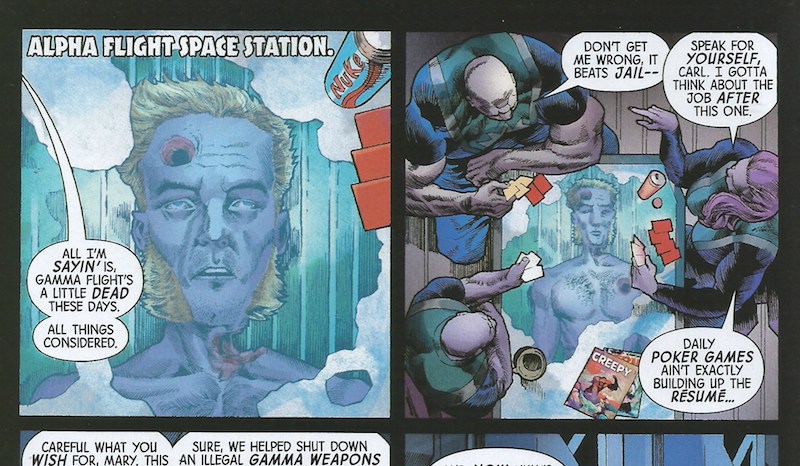


That may seem wtf, but it's actually nbd.  No big deal.  The idea is that anybody “belted by gamma rays” becomes immortal.  Kill the character.  Doc Samson, Betty Ross, whomever.  It doesn’t matter.  They’ll just come back and stay alive.  The Hulk absorbed all of Walter Lankowski's gamma energy, or most of it, and they're just waiting for him to get over the fatal gunshot wound in his head.

Gamma Flight as they call themselves speeds to where the Hulk was last seen.  The thing that comes out the most about Gamma Flight is that Puck is a bit less heroic than he was.  Al Ewing treats him more evenly.  In fact Titania, of all people, seems more heroic than Puck.


The Hulk is popular with The 99 Percent.  Marvel’s superheroes for the most part intend to stay out of his way until he presents a clear and present threat.  The 1 Percent selfishly want him destroyed.  Gamma Flight thinks ethically he must be stopped.  It’s not a clear cut bad guys versus good guys book.  It’s more complex and realistic despite the presence of monsters.
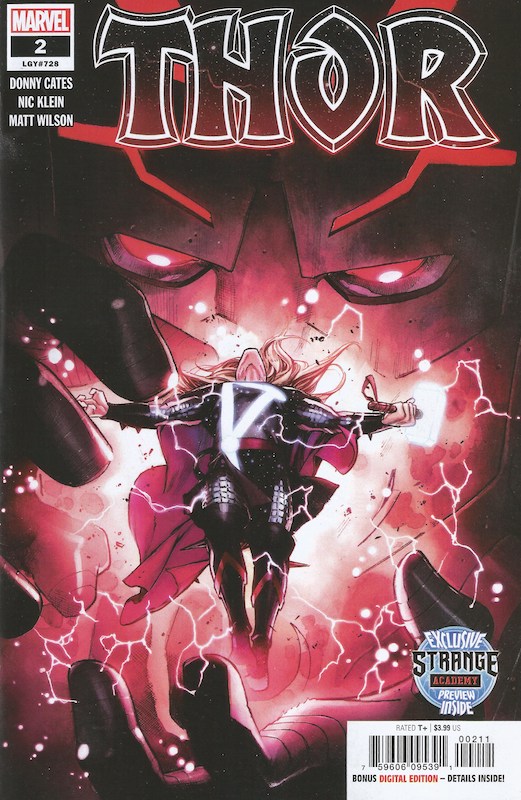


Okay.  So here's the spoiler free review of Thor.  Writer Donny Cates recharges Thor without giving the hammer to somebody else.  There's a lot to enjoy in this book, and Nic Klein's art is a major part of it.  There you go.  Now, for those who aren't afraid of spoilers, read on.  If not, go to the review of Far Sector.

S
P
O
I
L
E
R


A
H
O
Y

Things changed after the War of the Realms.  Jane Foster is no longer Thor.  Thor is the King of Asgard.  Loki the King of Jottenheim.  Land of the Frost Giants.  Sif takes the place of Heimdal, and Galactus fell to his death, killing the alien eternals of Asgard and destroying the rebuilt city.  Thanks a lot, Donny Cates.


Galactus comes with a warning, and in this issue of Thor, we get to see it in action.
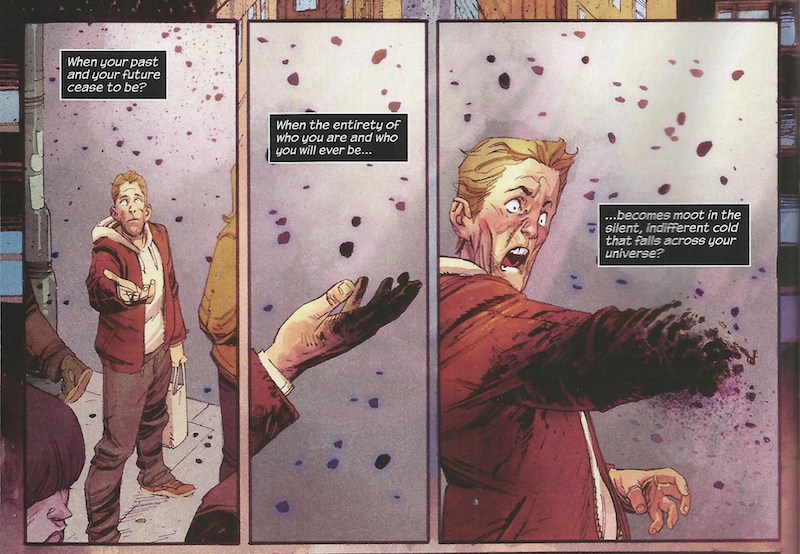


That's the Black Winter infecting another earth, one that will be familiar to any DC fan.  It's here that I will object.  Cates doesn't give the heroes of DC any credit.  

I get that he's just playfully needling the Powers That Be at DC, but honestly, I didn't like it.  He has them weeping and praying for their gods because they're useless against the Black Winter.  
Sorry.  No way.  


Superman's last word would be "Lois" as he plunges into the heart of Black Winter to tear it out.  Batman would just grin like Michael Keaton and charge against the Black Winter saving lives in the process.


The Flash would still be racing, trying to stop it, dying as he runs.  Green Lantern John Stewart would gutturally scream and just blast it with everything he got. Hawkgirl of course....


Wonder Woman would steer the Invisible Jet into it with a shout of "Hola!" Supergirl would burn it with her heat vision until she dropped.  


Batgirl would throw everything in her utility belt at the Black Winter and when that failed drive her motorcycle into it.  I strongly object to Mary Wolfman's portrayal of Batgirl in Crisis on Infinite Earths.  Batgirl doesn't give up.

Okay.  So I digressed a lot there.  There are certain things that cannot be ignored.  DC's heroes are valid heroes.  Marvel's heroes are valid heroes.  And who the hell knows what the X-Men are.  Let's leave it at that, shall we?


Galactus turned Thor into his herald.  You'll note that Thor's all healed up and rejuvenated.  So this new look isn't just cool cosmic.  It plays into the arm and the eye, which Thor lost to something or other.  Marvel's usually a stickler for explaining stuff.  So, when Galactus takes back his power from Thor, he'll probably leave him healed up.  Galactus isn't a dick.  He is however hungry.


Al Ewing in The Ultimates, evolved Galactus into the the Life Bringer, but I guess the Powers That Be decided that we can't have this.  We can't have Frankencastle either.  So, Galactus is starving, but he's still the guy you want to call when the Black Winter shows up.

It's funny, but there's this love/hate thing happening in all the books featuring Galactus.  The exception being The Unbeatable Squirrel Girl.  


Jack Kirby and Stan Lee created Galactus to be beyond good and evil.  He fed on planets, yet he's not evil.  He's part of the natural order and evolution of the universe.  The Ultimates wanted to positively solve the problem of Galactus.  So they completed his evolution.  He furthermore didn't want return to his prior existence.  

All of this makes sense, but lately, the writers are characterizing Galactus as just evil.  Thor in fact refers to him as a parasite.  Today, Galactus lacks the complexity of the past.   He was evil in a recent Fantastic Four, and he's fairly evil here.  He also seems to be extorting the universe. Feed me.  Be my herald, or I won’t fight the Black Winter.  That doesn't sit right with me.  


Far Sector introduced Green Lantern Sojourner Mullein.  She's a far from hip earth woman of color who leans omnisexual, which gives the book a mature flavor.  Although, it's not dealt with in an explicit manner.  instead, it adds to the drama and the comedy.


Unlike other Lanterns, Lantern Mullein patrols a single, artificial world created by the survivors of a savage war.  The species willingly blocked their emotions because they believe their passions led them to bloody conflict.  


On this world, Sojourner investigates a murder, the first in "Five Hundred Ish Years."  This is the core of the series, and in the current issue of Far Sector Sojourner interviews a suspect.  

The interview reveals some interesting facts.  The head honchos representing each species still flirt with emotions, but Sojourner resists the envoy’s charm and sticks to the sci-fi noir of the hardboiled detective.  

Outside of the murder investigation, Sojourner acclimates to the customs and expectations of the conglomerate.  


Each mini plot pertains to police duties.  This chapter presents a fascinating, historically laced moment of crowd control that also pertains to the matter at hand.


Vampirella and Red Sonja first came to Riverdale to investigate a murder that seemed to be the work of V's arch nemesis the Cult of Chaos.  


In the process they befriended Riverdale habitués Betty Cooper and her best friend Veronica Lodge.  Writer Amy Chu tied up this first arc with a satisfying and surprising conclusion.  However, It was clear she wasn't finished.


She left behind tantalizing plot threads such as the curious photograph that's uncovered depicting V and Sonja with Betty and Veronica in the sixties.  How this new story relates to that is anybody's guess, and the tale's first two chapters read like an original adventure whose only continuity is the camaraderie between the four women.

In the last issue, a mask murdered scientist Gautum Mukherjee before he could reach Betty and Veronica with a dread story.
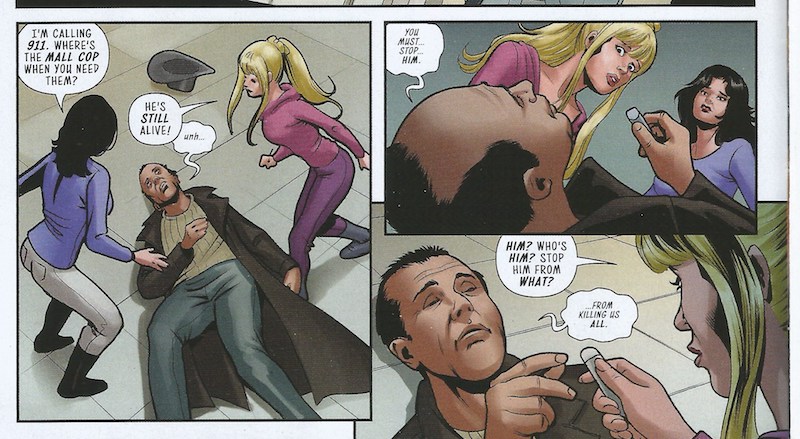


The ladies go to Riverdale's resident genius Dilton for help, but the thumb drive is too encrypted for Dilton to break.  He does however discover that Mukhaerjee's place of work Pulaski Pharma may be researching the ship that Vampirella originally commandeered.  That catalyzes a visit.

In this issue of the quartet, Chu reveals the secret of Pulaski's longevity.  Given the nature of the beast, I won't be spoiling it.  Suffice to say Betty and Veronica are in deep trouble.  In a way, the story reminds me of a Kolchak the Nightstalker episode.  Not one dealing with vampires.


Peter Tomasi in Detective Comics focuses on Alfred's espionage past which flickers in and out of DC's continuity depending on the political climate.  Originally, Alfred was just a rollypolly butler.  He evolved like everything else.  

The Bronze Age Alfred was a spy for the British government, fighting Nazis alongside the legendary Mademoiselle Marie, with whom he fathered a child named Julia.  Post-Crisis, Alfred became a mere thespian.  His World War II missions no longer fit with the relative rejuvenation.   Now, Alfred's history features in the Cold War.


Alfred speaks to a woman named H who ages into Helen Mirren.  She deduces Batman's secret identity and visits Bruce Wayne with a story about their mutual friend.


It seems that Alfred and she unwittingly worked with a Soviet double-agent.  He's holed up in a duplicate American city in the Ukraine.  

Supposedly, these facsimiles existed in the real world, but I'm not entirely convinced such alleged constructions are anything but apocryphal.

Nevertheless, this is a meaty, potent Batman story reminiscent of the Bronze Age Detective Comics introducing Julia Pennyworth. 

Alfred's resuscitated spy craft is a charming addition.  The return of Alfred's former lover and the ease of her tumbling Bruce's secret identity demonstrates the kind of acumen you expect from a Bond like MI-6 Agent.  


Artist Sumit Kumar provides cinematic thrills appropriate for the subject, and his fluid take on Batman is a treat.  The story furthermore features a vicious, severely obscure Batman foe to make things more interesting in terms of fisticuffs.
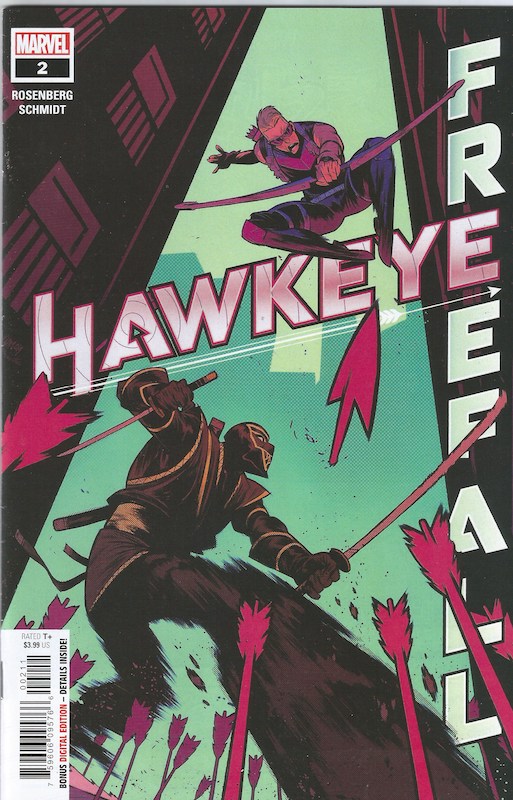
Hawkeye covers it all.  Writer Matt Rosenberg begins the story with a fun rivalry between Clint Barton and Tony Stark.
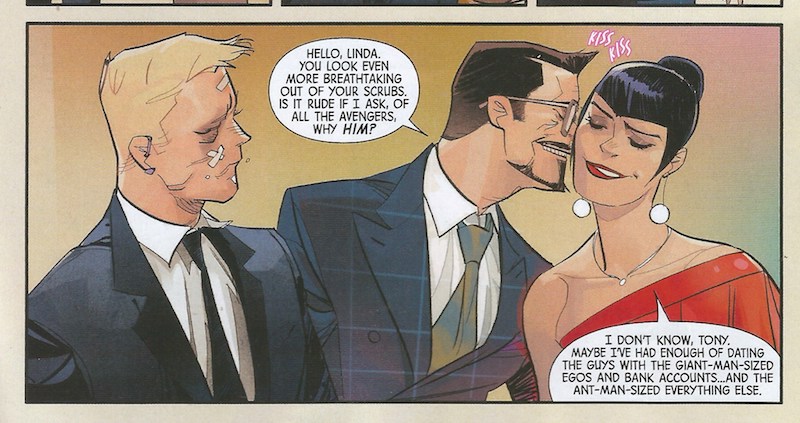


Linda Carter, no, not that one, is the artist formerly known as the Night Nurse.  She's now a doctor and Hawkeye's significant other.  Hawkeye looks beaten up because last issue a guy wearing his Ronin outfit beat him up.

Hawkeye donated a large sum of money to the charity of a lively May Parker.  So, you know Spider-Man cannot be far behind.  He's almost de-aged to Tom Holland appearance.


Spidey soon encounters Ronin, and he seems to be the only hero in town to believe in scientific evidence.  Ronin and Hawkeye cannot be in two places at once.  Luke Cage on the other hand...


This hilarious Hawkeye book just gets wittier with every turn of the page, and the illustration by Otto Schmidt who first caught my eye on Nightwing before Dick went screwy in the head is absolutely gorgeous.


Friday, December 20, 2019

POBB December 12, 2019

Pick of the Brown Bag
December 12, 2019
by
Ray Tate 


Welcome to the Pick of the Brown Bag a weekly review blog for comic books.  My name is Ray Tate, and this week I take a peek at The Butcher of Paris, Captain Marvel, Detective Comics, Dejah Thoris, Fantastic Four, Far Sector, Friendly Neighborhood Spider-Man, The Immortal Hulk, Mary Jane, Miles Morales Spider-Man, Tommy Gun Wizards and Vampirella and Red Sonja.  


If you can't be here for the blog, check out the itsy-bitsy teeny weeny reviews on Twitter: #PickoftheBrownBag.


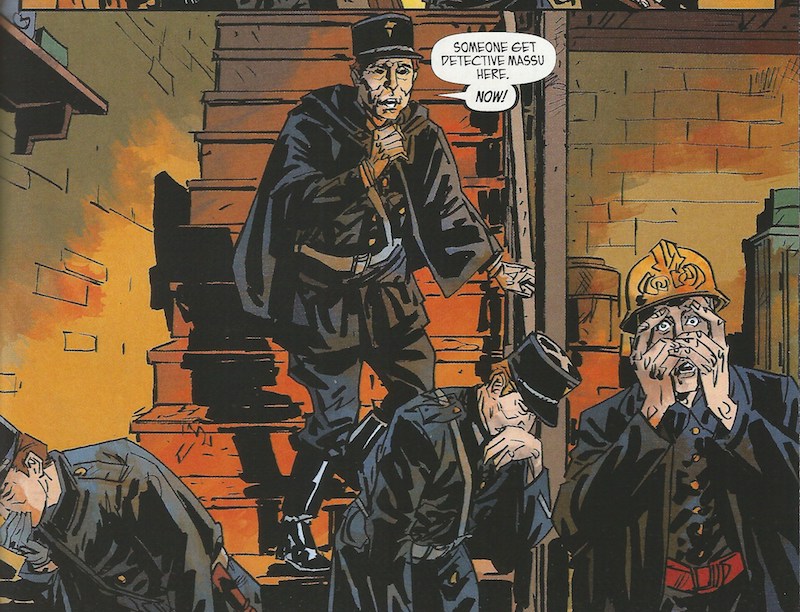
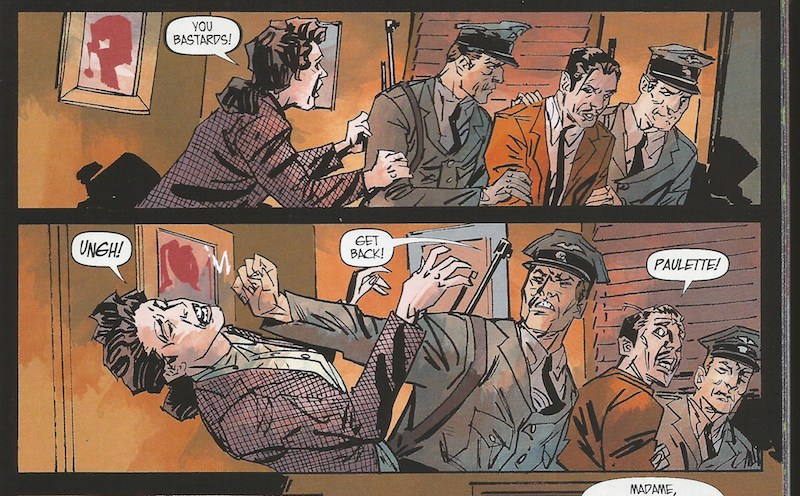
The Butcher of Paris is based on a true crime that I've never saw dramatized until now.  It’s the tale of Marcel Petiot, an organized serial killer operating during World War II.


The story opens in Vichy France.  For those not in the know, this is the time period of Nazi control.  Indeed Stephanie Phillips’ story opens with matters of the Fatherland.


Monsieur Dreyfus is one of many dedicated to rescuing Jews from Nazi tyranny.  Note the small talk amongst the Gestapo.  Phillips makes no effort to humanize Nazis.  They are the distillation of evil in her story, as history reflects.

The Krauts take their prisoner to the Surete.  There the Nazis demonstrate even more typical behavior.


The hunt for an Underground Railroad for Jews, using Dreyfus as a stalking horse leads the Nazis and the constabulary to a gruesome discovery.


There’s a frequent attempt to show honor in Nazis.  As if intellect alone can pierce through a brutal lust for murder.  The Nazis however lacked a scintilla.  


Phillips holds a mirror up to the Nazi ideal.  It’s ugly.  Her matter of fact dialogue, her lack of flourishes to the same gives the entire affair a docudrama feel.  

In John Carter Warlord of Mars Attacks artist Dean Kotz had a blast depicting cartoony humans, ghoulish Martians and boisterously outlandish violence.  Accompanying Phillips, Kotz transforms his style into a kind of court room rendering.  Thus, we receive the perfect union of art and story appropriate for historical atrocity.


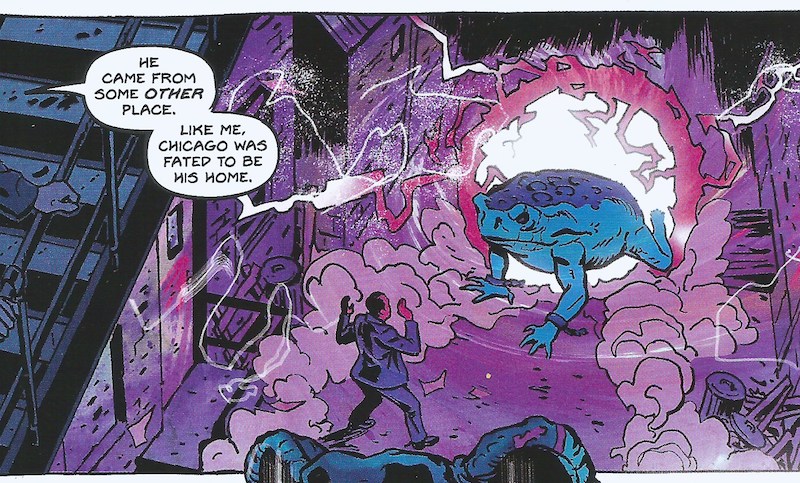
From a magical realm, the hunted Toad fled to earth.  Unfortunately the first person he met was Al Capone.  


The real Al Capone was a murderous mob boss that united the gangs and distributed smuggled alcohol illegal under the Volstead Act.  Understand booze was a means to an end.  The booze was immaterial.  The Volstead Act a mere catalyst.  If the government had banned rhubarbs, Al Capone would have been known as a rhubarb racketeer. 

The ban created a demand.  The demand created opportunity for Capone.  In Tommy Gun Wizards, the government bans a magical elixir called the Lick.  

The Toad produces the Lick in the same way terrestrial amphibians produce psychedelic substances.  The Toad however needs magic to become so common that there will be enough energy in the atmosphere allowing him to open a portal.  The Toad isn’t the villain.  He's an alien.  He just wishes to go home.


Eliot Ness and his Untouchables as they did in real history wage a war against Capone.  The witchery is a distraction to their true purpose.  Destroying crime.  


The blend of magic and mobsters is utterly brilliant.  Spells uniquely manifest as entities, and this twist on traditional sorcery plays a big part in the story.  The time honored pulp devices of alliances and double-crosses adds spice and unpredictability to the brew.   The sorceress Candice a former acquaintance of Eliot Ness engagingly plays both sides.  Ness a master Lick user himself comes off as an arch wizard.  In the end Ness’ loyalty to his fellow agents proves vital.  A highly entertaining series well worth your time.


Created by Edgar Rice Burroughs, Dejah Thoris "daughter of ten thousand Jeddaks," is the wife of John Carter Warlord of Mars.  Burroughs introduced her in The Princess of Mars.  She co-starred in two more novels before becoming a secondary character.  

Dynamite Comics took the opposite direction.  Dejah became the focus of her own long-lasting series and various miniseries before they ever introduced John Carter as one of the cast.  I wonder if Disney's film had something to do with this decision.  In any case, Dejah Thoris became a hit.

Dan Abnett scribes the latest volume of Dejah’s chronicles, and he's the main reason why I chose to try Dejah Thoris.  In short, not bad.

Abnett sees numerous parallels to our earth in Burroughs' Barsoom.  Abnett for example opens the story with Dejah investigating climate change.


Form the onset, you knew Barsoom was dying.  John Carter awakens on Barsoom amidst yellow moss that's evolved from that of dead seas.  Incidentally, Burroughs introduced Dejah as a scientist.  This is not a nod to modern sensibilities.  She will in fact appear as a less clothed scientist as the story progresses.

Unlike our earth, the advanced technology of Mars provides sole survival.  The city-states allow for atmosphere and water.  I always imagined the nations somehow contained either by Atlantean like bubbles or science fiction force fields.  I could never wrap my head around an artificially produced atmosphere blanketing an open system without spreading thinner.

Dejah brings her findings to the new Jeddak Kurz Kurtos, Abnett's creation, who is less than receptive.


If you have a conscience, you’ve been psychically wounded by the presence of Donald Trump in the White House.  Abnett’s therapy lies in his comic book writing.  He addressed Trump in Aquaman.  He does it now in Dejah Thoris.  Alternately, maybe he’s just basing his new Jeddak on the vainglorious rulers of yore, and I’m seeing the parallels.


Such as the rival city-state Zodanga, a Burroughs creation, being a mirror to Russia.  Whatever the reason, this back-stabbing, climate change denying Jeddak wants his former rational, benevolent ruler gone.  Kurz begins to hatch a plot with his advisor to assassinate Dejah Thoris.


Come on.  That’s Trump in a nutshell, yeah? 

Amidst the political intrigue, fans of the Burroughs' novels will take heart in familiar faces and creatures.  Tars Tarkas obviously.   Dejah’s right hand man Kantos Kan serves by her side. 

Dejah’s and John Carter's daughter Tara and granddaughter Llana of Gathol depicted above make appearances.   If you're wondering how about the ages.  Red Martians live for about one thousand years.  John Carter consistently arrives on Mars forever young.  Burroughs also granted a longer life span to Tarzan and Jane, who have a near adult son named Korak.  Burroughs appeared to want to write about these characters for as long as he had ideas.  He wanted to do so without having to worry the realities of aging.  That's apparent when you see youthful grandmothers, mothers and old daughters side by side.


This issue of Vampirella and Red Sonja spotlights the latter hero.  In a tale pre-Vampirella, Red Sonja finds herself amidst a band of men who have a beef with an old witch woman.  


When one mortally wounds the witch, Sonja goes after her.  She finds herself becoming Alice in a situation that becomes curiouser and curiouser.


Upon discovering the wounded witch, Sonja determines less a dangerous creature and more of a person in need. 


Although this Sonja is as bona fide as other versions, writer Jordie Balliere and artist Drew Moss present her as softer and more caring.  Even Amy Chu’s Red Sonja, easily the most modern, for reasons other than her teleportation to current day, wasn’t so empathic.  


The wounded witch seeing something in Red Sonja gifts her a magic stone that will become pivotal in her future life with Vampirella.

Mary Jane Watson combines forces with a disguised Quentin Beck to make his biopic and give herself a plum role.  The duo combat the deadly forces of bounced checks, equipment repo and in this issue a group of all-too real Spider-Man villains who feel their parts in the picture aren’t all that.


The hilarious issue features escapes in golf carts, prop trucks and a beautiful comeuppance for all involved in squashing Mysterio's dreams.  


Red Sonja's Carlos Gomez illustrates, and while his babes are gorgeous, the prize goes to the introduction of all-around actor Sonny Diperna.


Gomez bestows poise and an aura of astounding coolness to Diperna.  Writer Leah Williams makes him party to an inside joke based on a Leonard Nimoy trick.  The unflappable Diperna just stands out like an A-List celebrity should.  More surprises and guest-stars from the Marvel Universe await readers in this upbeat comedy well worth your time.


I objected to Aunt May contracting cancer in the Friendly Neighborhood Spider-Man simply because of the Mephisto implications.  

Remember.  In one of the dumbest moments in Spidey’s oeuvre Pete swapped out his happiness with Mary Jane for Aunt May’s life.  MJ features prominently in Spidey’s life.  So it’s not too big of a leap to associate the Bic C with Spidey becoming closer to MJ.  Oh, and It's not dumb that Peter saved Aunt May.  It's dumb that contrived hackery forced the choice.  Hope that's clear.

Although personally I feel there’s a loophole in all of this.  Spider-Man isn’t the same Spider-Man who made the deal.  The Marvel Universe changed after Battle World.  Anyhow, this is nevertheless a sweet story about Spidey being there for his Aunt May.


Writer Tom Taylor first demonstrates that Peter’s Aunt used to be young and Marisa Tomei vibrant, yet she assumed the responsibility for caring for her orphaned nephew.


When the lights go out, Spidey's responsibility meter kicks in.  He suits up and finds he's not needed at all.


It's really nice to see Spidey so loved.  Too often comic books like to create schisms between super-heroes.  It's just great that Iron Man, Heroes for Hire, Rumor, Miles and the FF care enough about Spider-Man to help him when he needs it.  Even the force behind the blackout thinks he owes Spider-Man a debt.


The Prowler is Miles Morales’ Uncle Aaron.  To safeguard his nephew, Aaron took on a hit-job.  Miles stopped him, but in so doing he started a John Wick like chain of dominoes.  Now, everybody and their aunts are out to kill the Prowler and anybody else that gets in the way.


That includes Miles.  It’s a freewheeling gauntlet that allows writers Saladin Ahmed and artists Javier Garron, Kevin Libranda, Alisha Martinez and David Curiel to pull in a cadre of D-List Spider-Man antagonists.


The creative team furthermore surprise the reader with the return of a Miles Morales ally, swooping in at an opportune moment.  The ultimate solution on how to alive the heat works well within the rules of engagement, and just in time for Aaron to meet his new niece.  The story should feel rushed, but the pacing is perfect, the time-saving twists clever and plausible.


The Immortal Hulk upends traditional heroism while advancing the Hulk’s and Banner’s intention to change the earth by destroying the human world of greed.  

On one front, Dario Aggar the head of Roxxon Oil must deal with the Hulk’s mortal wounding of the corporation.  He killed the company’s servers.


Nope.  Not taking it well at all.  Meanwhile, a smaller story unfolds as a cop father feels alienated by his teenage daughter.

Much like many of the GOP who are dead set on metamorphosing the country back to a mythical Utopia based loosely on the fifties, the cop wonders where it all went wrong.  Where did the little girl that he loved go?

The fact is she went nowhere.  The little girl he loved is right there in front of him.  He just can’t embrace or support the changes she made.  Listen if your child isn’t a criminal, nor physically damaging themselves, you should accept them unconditionally.  I’m not a parent, nor the most savvy people person, and even I know that.


The conflict leads to a pivotal heroic save by the Hulk.  The way the story evolves is wonderfully organic.  There’s not a hint of disbelief suspension needed.  The surprise behavior of the antagonist doesn’t really seem absurd.  It’s a surprise that develops from within the antagonist’s personality and microcosmic proof that the Hulk is right.


Reed, Sue, Ben and Johnny recreated their historic journey that ended when being hit by cosmic rays.  A Tac-Tac-Tac-Tac-Tac later and the Fantastic Four were born.  This time with better shielding, the FF succeed.  Their first stop is the planet Spire.

Advanced science foretold The FF’s journey, but the science fiction runes portrayed them as destroyers.  So the elder statesmen irradiated the denizens with the same cosmic rays that granted the Fantastic Four their abilities.

When the FF arrived, an all-too convenient communications failure and the prediction sent them speeding headlong into the path of Spire’s champions.  


Spire is in many ways like earth.  With a dominant humanoid population but more commonplace futuristic tech.   They also have one odd custom.


Doctor Who’s Time Lords as children stare into the schism, the raw time/space vortex, to discover great wisdom, great madness or great terror.  The People of Spire look into a different cosmic sigil to find their soulmates.


The entire conflict between the FF and the People of Spire arises from the foundation of their culture.  The sight triggered a government edict on genetic experimentation.  Reed and Sue are appalled.

The process also creates less than shiny super-heroes.  As a result, Spire creates a caste culture, disposing of the unwanted in an underground where they need not be seen.  That’s where Ben Grimm comes in.


I dismissed the first chapter of this story as just another FF versus throwaway analogs of the Avengers.  I also thought they may turn out to be the Thunderbolts.  The heroes of Spire need a little more meat to them.  They however distinguish themselves from other super teams.  No, they're not the Thunderbolts.  I was wrong about that.

No matter what though that first chapter was too dull.  It’s a pity.  These latest issues exemplify excellent, thoughtful and humorous science fiction, offering the Fantastic Four at their best.


I’m still not a fan of this Captain Marvel story, but at least it gives writer Kelly Thompson a means to reintroduce the concept of A-Force.  


She and the editor also admit that you’re unlikely to know what a Vox Supreme is, and that it's never bothered Carol before.  They furthermore come clean about Carol killing the Avengers relatively quick.  No.  She's not actually murdering her teammates and friends.

That said, I’ve never been interested in superheroes fighting.  So, this is really boring to me and not what I signed up for.


Well, alright.  At least Sojourner Mullein thinks she’s a Green Lantern.  I kind of hope she is.  Though she’s not a typical Lantern.

That’s probably why the Guarians assigned her to be the marshal of the Far Sector.  Currently she investigates a murder that solved itself.  Kind of.


The question now is who killed the killer and why?  The roads seem to lead to the grand poobahs of the alien species that cohabit a Dyson Sphere conglomerate formed by the survivors of war.  The science fiction setting offers a visual feast that artist Jamal Campbell brings to life.


The aliens identified their conflict as emotional.  So to broker a true peace, the aliens nullified their emotions.  That surprisingly doesn’t stop them from getting lucky.


Sometimes in the strangest of ways.


Green Lantern Arkiss Chummuck is unique amongst the Corps.  His people honor their foes by eating their corpses.  The strange Lantern must have stuck in the writer N.K. Jemisin's head.  Thus, one of the species inhabiting the Far Sector are reformed cannibals.  Others are winged dragons that possesses remarkable constitutions.


The differences in species generate potential motives, opportunities and humor.  Green Lantern Mullein compliments this diversity with intellect and curiosity.


Detective Comics presents a missing persons mystery that affects Bruce Wayne as much as Batman.  The story begins at the Martha Wayne Orphanage.  


A youth runs from the sanctuary, and Lucius Fox, conspicuously taking the place of Alfred, convinces Batman that the missing youth is his problem.


As Bruce Wayne, Batman visits the orphanage and fulfills his responsibility as the patron.


His meeting with the director of the orphanage is uninteresting, but he gathers what facts he can before heading out into the night as Batman.  Because Batman cannot divide his attention, he calls in his son Damien Wayne, Robin to take the lead.


Robin eventually discovers the teen’s whereabouts, and he and Batman both discover something wrong at the orphanage.

This is a bravely dark story with a purposeful wintery atmosphere by the Phantom's Fernando Blanco.  It at once shows Batman and Robin at their best and their most mortal.