Showing posts with label Doctor Who. Show all posts

Wednesday, July 13, 2022

POBB July 11, 2022

Pick of the Brown Bag
July 11, 2022
by
Ray Tate

Welcome to the Pick of the Brown Bag.  In this independent column, I review comic books as well as other media.  


Because the comic book Doctor Who is a spin-off of the longest running science fiction television series in the history of the medium, you’ll taste a sample of that versatility with this posting.  


If you’re looking for a quick decision on any of my subjects.  You’re better off checking me out on Twitter: #PickoftheBrownBag.


After you retrieve your booty from your friendly-neighborhood comic book store, I recommend that you tune in to the free Doctor Who audio broadcast Doctor Who “Redacted."  


That link will take you to BBC Sounds, which offers a lot of free podcasts as well as streaming music including the Glastonbury concerts.  


Anyhow, just stick in the word "Redacted," or "Doctor Who" in the search function.  Sorry for making you do more work than a Fox News pundit.  Trying to avoid broken, lost links.


The ten part story had me enthralled to very end.  The radio serial isn’t just a bit of fluff.  It’s authentic Doctor Who. 


Jodie Whittaker participates as the Doctor, along with some familiar voices from the show’s past and present. 


Incidentally, if you’re looking for the current Doctor Who series stream and you have no access to BBC America, join AMC+.  The new American home for Doctor Who.


By the way, I'm not getting paid in any way, shape or form from either industry.  I represent a public service to direct you to Doctor Who, a show that I love, and comic books worth reading.  Also trying to save you money by avoiding the bad ones.  That's all the Pick of the Brown Bag ever was and still is.


If you haven’t watched Doctor Who’s current season, you’ll still be able to enjoy the comic book which features the likeness of Jo Martin as the Doctor.  


Introduced in Jodie Whittaker’s Series Twelve as a mystery Doctor.  "The Fugitive of the Judoon" reprises her enigma in Series Thirteen, which comprises the Doctor Who serial "The Flux," now available on blu-ray.


By the by, a second viewing of "The Flux" especially with closed captions reveals a lot of good, solid science fiction and/or far-fetched technology introduced previously.  


There’s still some metaphysical tomfoolery regarding the nature of time, but the clutch of stories aren’t nearly as dumbfounding as they were the first time around.


"The Flux" further sheds light on The Division, an inscrutable organization also introduced in Series Twelve.  


The Division plays a big part in "The Flux."  The Doctor’s arch-nemesis The Master at the conclusion of Series Twelve reveals the Doctor worked for the Division, but they wiped out her memories of her association. 


That’s not really a new technique.  In fact it’s an oddball centerpiece of Doctor Who.


The Time Lords are aliens that live on the planet Gallifrey.  They forswore interfering in other cultures’ development except in the  rarest of occasions.  As a result they gave up casual time travel.  


The Doctor disagreed with his people.  So, he and his granddaughter Susan steal a faulty, decommissioned TARDIS to leave Gallifrey.  


The show gives many other reasons why the Doctor and Susan steal the TARDIS, but one remains steadfast.  The Doctor and Susan wanted to explore the space-time continuum in total freedom.


In Patrick Troughton’s final Doctor Who serial “The War Games,” the Doctor has no choice but to reveal himself to the Time Lords who eventually punish him for his crimes against Gallifrey.  Two of which include interference with other cultures and the theft of a TARDIS.  


The Tom Baker serial "The Deadly Assassin" indicates the Celestial Intervention Agency, perhaps the governmental Gallifreyan face of Division, intervened on the Doctor’s behalf.  


The Time Lords strike a bargain with the Doctor and use him as their operative, for those aforementioned rare occasions, as evidenced in the Colin Baker era episode “The Two Doctors.” 


What happens in between the "second" Doctor Patrick Troughton and "third" Doctor Jon Pertwee eras of Doctor Who is anybody’s guess.  


Suffice to say, Jon Pertwee as the Doctor now carries out the original sentence imposed by the Time Lords.  A new face.  Confined to the planet earth.  Although, curiously, they have rewarded him with legal ownership of the TARDIS he originally stole.  The Time Lords furthermore alter the Doctor’s memory so he cannot operate so much as the TARDIS’ flashing light atop its police box shell.  In one episode, the Doctor manages to transport himself into a pile of dust bins.  No.  This Doctor isn't going anywhere.


Now, we get to Jo Martin who retroactively predates William Hartnell’s first Doctor.  


This Doctor, whom we know little about, operated with greater knowledge of The Division.  At some point she becomes just as much as a fugitive as the Doctor we know and the Division obliterates her memory, not just alters it.


So, William Hartnell’s Doctor truly believes himself to be the first, the original.  As he often mentions. 


Reality Break


It’s somewhat unfortunate that show runner Chris Chibnall created this schism.  Doctor Jo Martin would have fit nicely in between Patrick Troughton’s and Jon Pertwee’s times as the Doctor.  It irritates me when people don’t take the simpler solution and instead create friction.  On the bright side, nothing in his treatment conflicts with the Doctor being “half-human, on his mother’s side.”  So, I’ll take what I can get.


Fiction Resumes


Jody Houser takes on the so-called fugitive Doctor.  I’m against this label because most of the Doctor’s life has been one of a fugitive.  Why she should be singled out is beyond me.  


Nevertheless, this is mostly unexplored territory, but Houser’s  characterization of the Doctor rings true.  She's also trying to balance out the Doctor as an operative for the somewhat lawful evil Division and as the Doctor we know.  It's not an enviable task, but she manages it with aplomb.


The story begins at the finish of a previous adventure with the Doctor teaming up with a Weeping Angel.  The Division uses any species to get the job done, including the Doctor's traditional enemies.  So, a truce is established.


The vignette which works as a short-short story smoothly segues to the Doctor's new mission and new companion, Taslo.


Perhaps because of Taslo's similarity to Buffy the Vampire Slayer, Rupert Giles shows up to handle the Doctor's and Taslo's mission.


Taslo by the way is a Time Lord, and Time Lord names are cumbersome.  It must be in their Constitution and some old asses from the Time Lord Council refuse to change it.  So Taslo is probably short for something like Taslocresceanumean.  Every Time Lord no matter class or status shortens his name or assumes a nick-name.


The Division want wholesale genocide of the cult that offends them.  To that effect, they issue the Doctor a ton of weapons to do the job.  What's hilarious is that they actually thought the Doctor would drop a bomb, no questions asked.


In the best example of Houser's balance between the Division's Doctor and our Doctor, the Doctor investigates rather than instigates.   


Being true to the Doctor's ideals, the Doctor does something quite Doctorish that will delight fans of the series.


The move does however put Taslo on notice.  The Doctor isn't so much working for the Division, but using the Division for her own ends.  A nice bit of insight from Houser.


If we accept that the Doctor is still the Doctor though perhaps more proactive, we may argue the hypothesis that she uses the Division's vast resources to better pin-point threats to the universe.  Ones that she can then thwart in her own way.


The Doctor and Taslo land on the planet they were meant to blow up, and it's here where in issue two, they meet the peaceful species that the Time Lords and/or/nor Division want to exterminate.


The second issue explores the question why.  Why do the Time Lords and/or/nor Division consider these fellows a threat? The aliens greet the Doctor and Taslo with open arms.


Some may be reminded of the myth of Thanksgiving.  It's not a bad comparison.  The Division sent the Doctor and Taslo to murder innocent people.  The people invite them to dinner and try to make friends.


Taslo as you can see cannot believe the Doctor's willingness to give the aliens the benefit of doubt.  This gibes with the idea of the Doctor's legend of being The Oncoming Storm.  Eventually, Taslo comes around.


Though not at first.  Taslo demonstrates fealty to the Time Lords in a similar way all the Time Lords seem to trust the ruling body throughout all but the recent episodes of the series.  


Though the Time Lords may have once been quite good.  Even the Doctor admits this in "War Games," they become much more corrupt as the series progresses.


Perhaps one shouldn't blame the Time Lords and instead look to the writers being exposed to corrupt governments all over the real world, but where's the fun in that?


Gallifrey apparently only has one golden age of government after "The War Games."  That occurs after Collin Baker's Doctor faces "Trial of a Time Lord."  Though it's not the gist of the episode, we learn that insurrectionists are using the Trial as a distraction to overthrow Gallifrey's current government.  Presumably this era lasts until the final days of Paul McGann's Doctor.


Taslo finally regrets her actions and sees the light when the aliens targeted for extermination reveal not a secret, but something that just didn't come up in conversation.


These first two issues of the new Doctor Who series are quite entertaining, especially with the elegant and accurate art of Roberta Ingranata.  


I must admit to growing tired of Houser's multiple crossovers and reiterations with the Doctor and her past incarnations, but this new series has all the energy and originality of Houser's much more memorable non-gimmicky run of Doctor Who.


Tuesday, June 2, 2020

POBB June 1, 2020

Pick of the Brown Bag
June 1, 2020
by
Ray Tate

In Doctor Who, the Doctor and Fam travel down a strange corridor of time and space.  There's a signpost up ahead.  You're next stop...


The Spoiler Zone

On television Steven Moffat introduced a new menace to Doctor Who.  The Weeping Angels are quantum locked creatures that resemble statues.  

Any statue, anywhere may actually be a Weeping Angel, even ones that don’t look like angels.  However, the Angels bear one weakness.


If you stare at them, they cannot move.

In their debut episode “Blink”—Don’t blink.  Blink and you’re dead—the Angels consign the Doctor and Martha Jones to their doom.  


The Angels are the “kindest serial killer.” They don’t murder you outright.  They send you back in time where you will age a natural death.  

Sans TARDIS, the Doctor and Martha end up stuck in the sixties.  This moment serves as the basis for Jody Houser’s superb four issue Doctor Who team-up.  


The current Doctor as portrayed by Jodie Whittaker only wanted to take her Fam—Graham, Ryan and Yaz—to Woodstock.  Alas, there’s turbulence in the Time/Space Vortex.  She ends up in 1969 London.


The Doctor senses a disturbance.  Events draw her into her past.  She soon meets her previous incarnation and reunites with Martha Jones.


Martha fell in love with the Doctor.  Unfortunately for her, having just lost Rose, the Doctor wasn't in the mood to start a romance, nor could he recognize Martha's feelings for him.

The Doctor’s reencounter with Martha educes guilt and the dawning overtness of her own previous blindness.  Not that she will rekindle any possibility.  Martha's history is a fixed point.  That just makes the Doctor feel even more guilt.

This unrequited relationship with Martha serves as an emotional underpinning amidst a subtle meeting between Doctors and a suspenseful adversarial pursuit from two deadly Doctor Who monsters.

Gifted with a bigger budget Doctor Who returned in 1996, but the new look Doctor Who properly premiered in 2005 with Christopher Eccleston fighting an old enemy, “window shop dummies coming to life.”  The Autons.  


Properly speaking, the Autons are simply plastic shells motivated by the Nestene Consciousness, and they’re operating in the sixties.


The Nestene are one of the coolest loser villains in Doctor Who.  They’ve appeared three times, only to be thwarted Time Lord and Time Lord again.  See what I did there?  They have the same goal.  Rule the plastic laden earth, and they largely attempt the domination through the same means.  


The presence of two Doctors awaken the Nestene Consciousness.  This awakening occurs before their respective future attack to be defeated by the Jon Pertwee Doctor, Dr. Elizabeth Shaw and a nascent UNIT led by one of the Doctor's oldest friends Brigadier Lethbridge-Stewart.  


Ironically, neither alien species knows the other’s in town, and that catalyzes Houser's splendid freewheeling finale in which the Doctors hatch a brilliant plan.


If my explanation seems steeped in Doctor Who lore and a little scary for newcomers.  Think of it as just color.  Houser leaves no reader in the dark.  Her plot and characterization detail the things you need to know.  Roberta Ingranata the second top artist for Doctor Who illustrates with a lively attention to cast resemblance, apart from Yaz I’m afraid.  


By the way, Happy Pride Month


Monday, June 1, 2020

POBB May 27, 2020

Pick of the Brown Bag
May 27, 2020
by
Ray Tate

It’s the return of comic book reviews in the Pick of the Brown Bag.  Still, I hope you enjoyed my fan-fiction placeholder.  Let’s get the show on the road.  This week I review The Butcher of Paris, Doctor Who, Exorsisters, Marvel Action Captain Marvel, Outer Darkness and Chew, Red Sonja, Red Hood and the Outlaws and Vengeance of Vampirella.

So, to make a long story short, every one of the issues above is worth adding to your collection, and because several either continue an existing story or finish a story, remarking on them even in general is fairly dicey.  

Each issue of the contenders is top notch in terms of writing and artwork.  

Butcher of Paris is historically sound and satisfying in terms of fiction.  Doctor Who’s rapid fire pace and writer Jody Houser’s characterization of the cast offers one of the best team-ups between Doctors in the comics.  


Exorsisters takes heaven down a peg or two in the welcoming cartoon style of Gisele Legace.  Captain Marvel entertains with the partnership between Carol and Nadia Van Dyne the Unstoppable Wasp.  

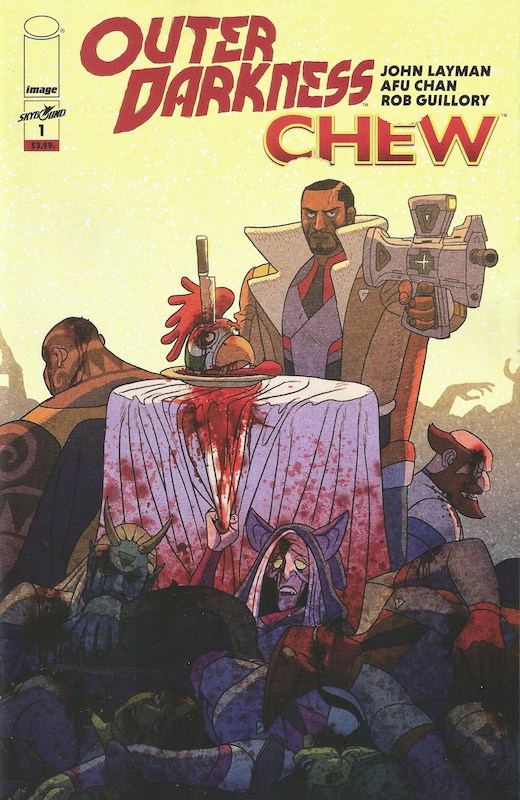
Outer Darkness and Chew takes a highly enjoyable twist.  Red Sonja draws on Mark Russell comic beats along with a pragmatism toward war and politics.  


Red Hood and the Outlaws requires no previous prep and just offers good super heroics.  Vengeance spotlights Vampirella’s heroism and humanity’s embrace of a vampire that can save them all.


This opening POBB is merely a sampling.  I'll be giving each book an in depth review during the week.  I chose to carry out this method simply because the recaps of the books will require more verbiage, even if editing down to the bone.

Tuesday, March 10, 2020

POBB March 4, 2020

Pick of the Brown Bag
March 4, 2020
by
Ray Tate

The Pick of the Brown Bag marches on with reviews of Black Cat, Conan and the Battle for the Serpent Crown, Dark Agnes, Doctor Doom, Doctor Who, Outer Darkness and Chew, Strange Academy and Red Sonja.  As always should you not have time in your busy schedules for all of the script, check me out on Twitter: #PickoftheBrownBag.


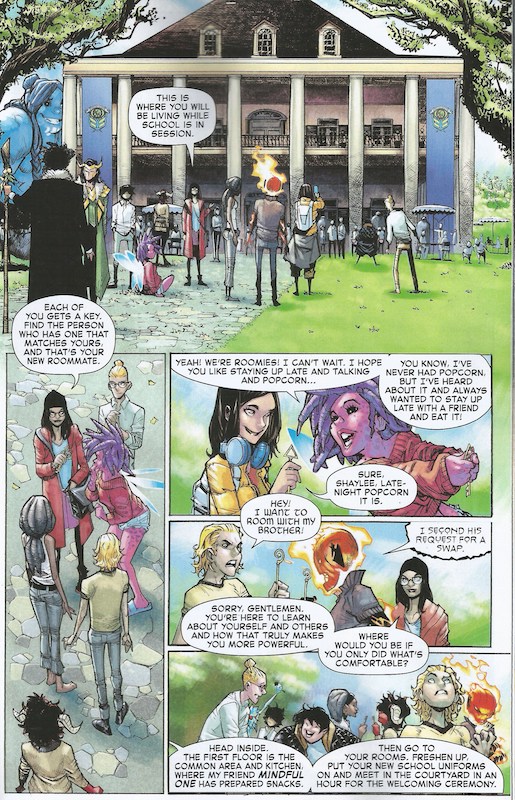
Strange Academy isn't the kind of book I normally buy.  It's a magic based story number one.  It's Marvel's answer to Harry Potter number two, but this charmer is a keeper.

Some of the scenes are so adorable that they can kill you.


Oh.  A floaty puppy on page one.  That's so...so...excuse me a moment.

The previews for Strange Academy have been everywhere, but they don't do the book any justice.  Humberto Ramos and Edgar Delgado offer a lush, organic tapestry of aesthetically winning illustration.  


The cohesive visual narrative establishes plot, setting and cast.  Writer Skottie Young follows our young puppy pilot through the ages.  Her good-natured practice of magic unwittingly leads to a dark threat.  Tolkein in nature.  Fortunately, the adult wizards and witches of the Marvel Universe are paying attention.


That's Zelma Stanton from Doctor Strange, but you don't need to know her history.  Young, Ramos and Delgado inform through the dialogue and the design.  

Zelma makes a straightforward pitch to Emily's parents.  I admired the honesty.


It's a refreshing change from the cryptic nonsense that I'm used to seeing from magic-based stories.  Emily's parents agree.  Zelma transports Emily to Strange Academy.

The grounds get a deserved double-page spread with a range that a scan will just undermine.  So, I'm not even going to try.

At the school, Young delves into Marvel's magical realms to find students with familiar backgrounds.  The cast is new.  Their origins not.  


The class consists of the human Emily, Asgardian Venture Brothers, an expressive fairy, son of Dormammu and more.  All except the Frost Giant sparkle with personality.  The faculty are recognizable alumni as the previews suggested.


Of course you also get Dr. Voodoo, a bemused Scarlet Witch and Dr. Strange his own bad self.  Benedict Cumberbatch is the best thing that ever happened to Dr. Strange.  He's made Strange approachable, and that's the Strange you get here.  You can't imagine the Dr. Strange from years past heading a kids school.  Strange Academy ironically feels natural.

On the starship Charon, a diplomatic situation goes horribly wrong.  

This forces Captain Riggs into doing something drastic.


Riggs and the crew of the crew of the Charon mistake Tony Chu to be a culinary master.  When in fact, he is a Cibopath.  


As you can see, if you don't know beans about Chew, you're in good hands as the creators of the story John Layman and Rob Guillory quickly and painlessly give you the basics as well as the color.


If you're a Chew fan but don't know beans about The Outer Darkness, you get a crash course from creators John Layman and Afu Chan.


This explains why you wouldn't want to stay in the Outer Darkness universe for very long.  Heck, even a second.  


It's the antithesis of Star Trek. The occult and science merge in the Outer Darkness, and there aren't any Orion Slave Girls.  Just death, death and more death.


When the great minds of the Marvel Universe band together to create the Antilion, somebody sabotages the project and frames Doctor Doom for the crime.  Now, Doom is on the run, but he's got company.


Kang is somehow related to Doom.  We don't know how, but the thread's been carried through decades of the Marvel Universe.  Writer Christopher Cantwell relishes the opportunity to make gags about the convolutions during Doom's and Kang's cross-country escapade.


Doctor Doom thus emerges as a bizarre send up of old time Bing Crosby and Bob Hope films.  They were always on the road to somewhere.


The same goes for Kang and Doom.  Of course, this isn't exactly all laughs.


Some, but not all.  Kang and Doom dope out how to put the kibosh on a black hole created by the Antilion sabotage.  The solution actually has some scientific teeth to it.


You may ask why Doom and Kang would bother.  Cause you can't conquer a planet if it isn't there.  

The amusing story features some satisfying murder, an abbreviated fight with a Marvel mercenary and oddly enough a Ghost Rider villain and a bizarre guest appearance by Thomas Magnum as played by...Timothy Olyphant.


It should come as no surprise that Doctor Who gives you everything you want in a team-up of incarnations: the current Whittaker Doctor and the Tennant Doctor.  Written with a spritely touch by Jody Houser and injected with oomph through the art of Roberta Ingranata, Doctor Who is that crisp, refreshing breeze on a sunny day.

The story takes place when the Weeping Angels ambushed the Tennant Doctor and Martha Jones.  The "kindest of psychopaths" sent the duo back in time to 1969, to die of old age, whilst they inched closer to capture the TARDIS.  Of course, the Angels failed, and maybe that's why there's another Weeping Angel in 1969 out to seek revenge.


You'll note that Yaz takes the lead while the Doctor's away.  The current Doctor and Martha Jones investigate disappearances in the locality.  They first return to the shop in which Martha secured a job.  Soon, they get to the bottom of things.


And no, I won't be talking about the second Doctor Who baddie.  The Angels have the cover.  So, identifying them is no spoiler.  

In addition to the double trouble, gags galore abound, the Tennant Doctor gets used to the new look TARDIS and the Whittaker Doctor plays defense against her thicker younger self to spare Martha any further discomfort.


Martha fell in love with the Doctor.  A gender switch isn't enough to quell feelings the Doctor is now aware of.


Martha as I said in the previous review is really going to be the one that hurts the most during the caper.  She's not going to remember anything when the timelines realign.  That may be for the best.  It's never the less sweet that the Doctor cares about Martha's feelings as much as she cares about what's attacking in 1969.


Black Cat needs to steal a painting for her former mentor the Black Fox.  This drops her into Madripoor and the home of Mr. Patch whom she discovers is her old friend Wolverine.  Alas, a snotty boy billionaire jerk named Kilgore Kade stole Wolverine's possessions.  Black Cat promises to steal them all back and to make a fine point, she snatches his shades.


Touché.  This however puts Wolverine and the Cat on the run in Madripoor.  There's naturally a bounty on their heads.


There's more comedy where that came from.  Backed by the spectacularly bouncy art of Kris Anka, Jed MacKay delights in the mismatched pair's interaction.  He takes unusual pleasure in the comedic regenerative powers of Wolverine and surprise guest star Deadpool.


Yeah.  I spoiled that one because anything that directs you to Black Cat is a good thing.  This laugh aloud funny issue also demonstrates Cat's skills as an arch thief and planner. MacKay parallels the present day with the past.


Introducing elements intimated in previous issues and granting some depth to Black Cat's current nemesis.  As well as the Black Fox who was just a one-off Spider-Man annoyance.

The Black Cat is but one of the guest stars in Conan and the Battle for the Serpent Crown.  Khulan Gath transported Conan to the present, or so he thinks, and the Cimmerian has been getting into all sorts of trouble.  Some of it heroic, like stopping human trafficking in Savage Avengers Annual.  Some of it not so much.


Black Cat stole the jewels Conan and companion thief Nyla intended to steal.  He's determined to get them back.


So begins the chase.  Whether you're a fan of any of the Barbarian series or not, you must acknowledge an ornate attention toward dynamic anatomy.  Luke Ross and Nolan Woodard provide strong artwork fitting for the history of Conan's comic book exploits.  


The story by Saladin Ahmed is comedic, largely due to the Black Cat as well as Barbarian out of Hyborea humor.  However, once you get used to the novelty of Conan in the twenty-first century, you can appreciate that this is actually an operatic drama with a tenor fiend behind the whole ordeal.

Hired as bodyguards, Dark Agnes and Etienne accompany Sister Marie and Helen on a coach ride that's interrupted by brigands.  They're hot for the money Agnes' carcass will fetch.  This allows for some superb swashbuckling art from Luca Pizzari.

Upon arriving at court, Agnes renews and old friendship and learns of an old enemy.  


Becky Cloonan's story is rich in character and plot.  She takes two solid set pieces and uses them to reintroduce characters and weave a good murder mystery.  


She also makes small talk interesting during the lull periods where you just enjoy the scenery and the costuming.


Red Sonja must petition for food to feed her war-torn people of Hyrkania.  She does so at the throne of the man who murdered her mentor Domo.  Her companion who is far better with diplomacy strikes a bargain that saves their lives.


Mark Russell's anachronistic dialogue provides a lot of lightness and humor.  He also presents some slapstick comedy from an untrained army.  Meanwhile, a reflective Sonja reflects upon the nature of the world, and finds it unforgiving.  The weight of victory lies heavy on her shoulders.

At the same time, Russell looks upon Isolde, regent of Hyrkania, ruling in a time of scarcity.   This parallel thread is a horror story dropping the mic with a nasty twist. 


Bob Q eschews cheesecake when depicting Sonja.  His emphasis on muscle over curves may upset some faithful fans, but his take on Sonja is just as valid as the wild Frank Thorne She-Devil with a Sword or Carlos Gomez's tribute to pin-ups and pulchritude.