Showing posts with label Black Canary. Show all posts

Wednesday, October 11, 2023

POBB October 3, 2023

Pick of the Brown Bag
October 3, 2023
by
Ray Tate

Hello, my name is Ray Tate.  I am the creator, writer and host of the Pick of the Brown Bag.  Simply put.  This is a review blog about comic books.  However, you'll get more than a thumbs up or thumbs down from me.  I also delve into the history and the currency of the subjects.  So dig into my look at Kelly Thompson's and Leonardo Romero's newest DC title Birds of Prey. 

The story actually begins years ago with the arrival of Supergirl.


Action Comics #252 (1959)

Batgirl and Supergirl became best friends.


From Superman Family #171 (1975)


Nowadays, Batgirl and Supergirl don't really know each other.  They're merely friendly acquaintances.  


Batgirl Annual #1 (2017)
Barbara Gordon's eyes are blue.  They're blue, baby.  Blue.

The schism is largely due to the original Supergirl's death in The Crisis on Infinite Earths.  

If ever you wanted proof that Supergirl is more powerful than Superman...there you go.


After the Crisis, a new universe Big Banged.  Supergirl returned as a clone of Superman's Smallville sweetheart Lana Lang.  No, no.  That's honestly true.  It's comic books.


Every version of Supergirl hence has been a variation on that clone, dubbed Matrix, created by John Byrne.

Matrix exemplifies Byrne's status as a world-building architect and the surprising longevity of comic book characters.  You expect to learn Batman and Superman existed for about eighty-five years.  It's surprising that a comparatively younger creation like Matrix made twenty.

Later, somebody decided...It had to be somebody on high...Screw it.  Let's reintroduce Superman's cousin.


That still didn't stop constant reinvention.


Without the stability of Supergirl's character history or any written consistency, Batgirl's historical friendship with Supergirl fell by the wayside. 


 "We'll still be together in the animated series."

Without a Supergirl in her life, Batgirl instead established a friendship with the Black Canary, whom in the previous multiverse she didn't know at all.  It's comic books.  

Writer Chuck Dixon and artist Gary Frank brought the two crimefighters together about twenty years ago.


I'm not sure you can argue Dixon and Frank created the Birds of Prey.  Dinah Lance alias the Black Canary existed since the 1940s.


Flash Comics #86 (1947)


Barbara Gordon alias Batgirl since the 1960s.


Detective Comics # 359 (1967) 
 

None the less, thanks to Dixon and future Birds of Prey scribe Gail Simone, Batgirl and the Canary have been inseparably bonded ever since.  


Indeed, Batgirl and Black Canary are currently best friends, a friendship that survived multiple DC Universe reboots.  


So what happens when an "unknown" party asks Dinah to reform the Birds of Prey without the 1960s Batgirl?  


We're about to find out.

One of the more interesting things about Birds of Prey is how Thompson and Romero depict the weight of betrayal the Black Canary feels she's dishing out to Barbara. 
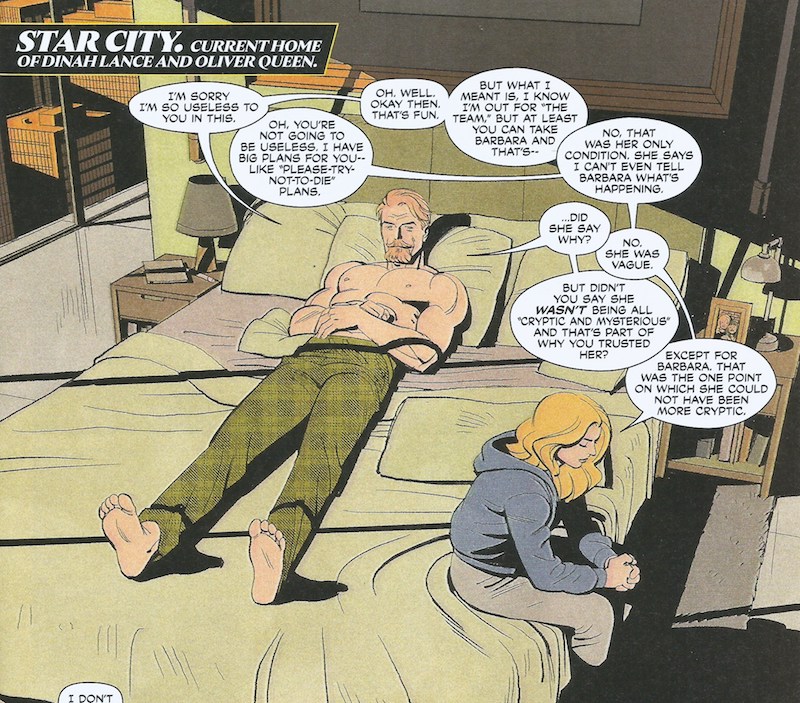

How she desperately wants to inform Barbara but is forbidden to do so.  That exclusion is somewhat but not completely explained.  In any case, events force the Canary into a difficult place.

The creative team lift the weight somewhat when Dinah asks Cassandra Cain to join the new Birds of Prey.


It used to be very problematic for me to accept Cassandra Cain as an actual character.  That's partly due to my own prejudice.  I loathed all of the superfluous substitute Batgirls foisted into the comic book world.  The Powers That Were at DC could have simply healed Barbara's spine.  It's comic books.

Regardless of her Batgirl status, introducing Cassandra Cain as an illiterate mute doesn't really speak highly toward women.  Pun not intended.  So, I had even more reason to ignore her.

I won't reiterate my vitriol against the character.  Click on the link and see the succinct.  

My feelings toward Cassandra Cain began to thaw when Jimmy Palmiotti and Amanda Conner presented what she could be.


That this new version of Cassandra Cain didn't exist at the expense of Barbara's continued mobility also factored into my reconsideration of Cassandra Cain.  I started to enjoy her team-up with the Spoiler under Barbara Gordon's new comic book Batgirls.  
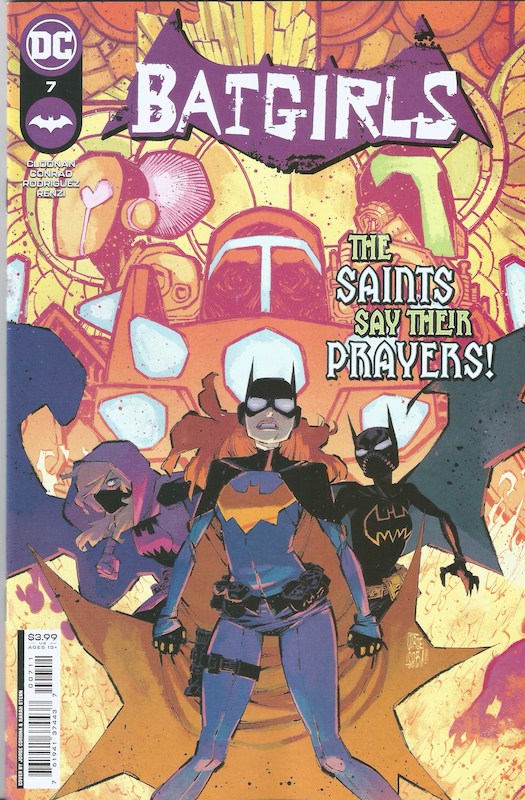
Cassandra Cain started to get some artistic respect.  Before she most often looked like a leathery bat-shaped sex toy.  


I have no idea why Harley is referring to her as such.  Cinnamon rolls are brown.

Artists such as Birds of Prey's Jordie Bellaire are starting to use contrasting colors against her "all-black" costume.  


There was really no excuse for her looking like somebody's pen had leaked.  After all, Cassandra Cain arrived after this gentlemen.

As you can see Romero follows suit with emphasis on shadow and light.  Colorist Jordie Bellaire takes advantage of the casting to give the costume some welcome grays and blues.  
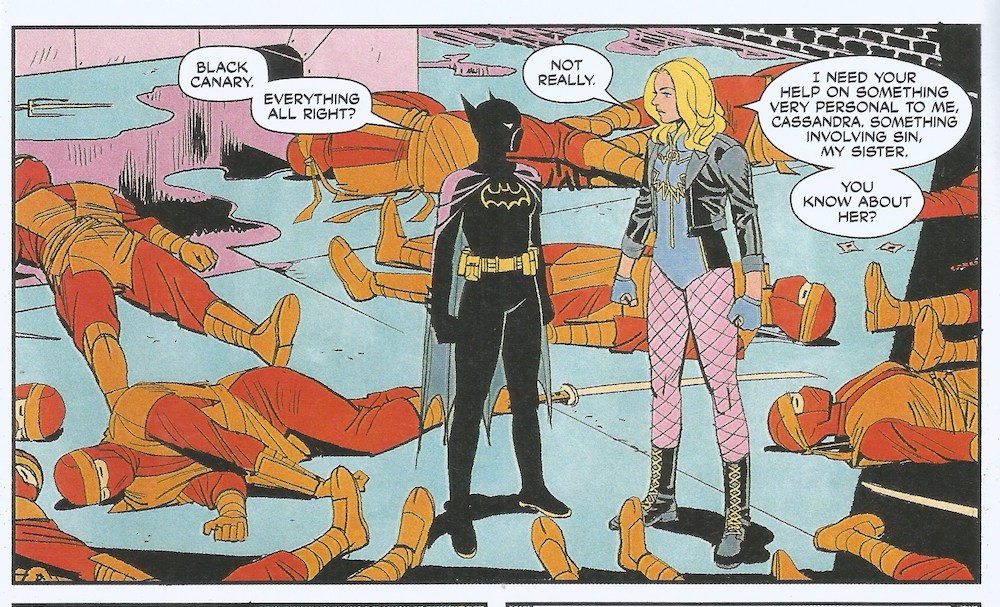

I still prefer Connor's and Palmiotti's abandonment of the outfit, but at least the artists of today illustrate her better than those of yesterday.  They simply made her look like an oil smudge.

Connor and Palmiotti in the Birds of Prey mini-series adhered to Cassandra Cain being mute, but thankfully eschewed the illiteracy.  Thompson sticks with the literate but reticently vocal Cassandra Cain from Becky Cloonan's Batgirls.


And has no issue making fun of the taciturn bat.  

Black Canary sends Cassie to recruit the muscle for the team.  


Created by Jack Kirby, Big Barda is a New God from the planet Apokolips.  She was one of Granny Goodness' Female Furies before siding and falling in love with Scott Free known as Mister Miracle. 

Allow me to translate that paragraph for casual readers.  One of the all time great creators of comic book worlds gave us Big Barda.  Big Barda worked as a shock trooper for an evil flunky of a legendary Big Bad until siding and falling in love with an alien escape artist.   She also always talked liked a stranger in a strange land.  Kudos to Kelly Thompson for replicating her speech pattern and amusing patter.  The "small bat" kills me.

If Big Barda seems familiar to you, but you don't really count yourself a DC fan, you may have encountered her on Batman Beyond in the ranks of the future Justice League.


Though you may think the red outfit isn't accurate.   It is.  Barda wears the ensemble when relaxing.

I'm very surprised the Canary included Zealot on the team.


Impressive, isn't she? I'm mainly surprised because I keep forgetting that Zealot is part of the DC universe.  

Zealot is an alien and originally part of the Wild C.A.T.S.  A supergroup once published by Image Comics.  The team's       co-creator Jim Lee moved to DC to become part of the reconstruction for DC's New 52: the universal reboot that restored Barbara Gordon's spine and subsequently fixed everything else that was wrong in a supposedly optimistic superhero rife cosmos.  That's right.  The whole snafu begins and ends with leaving Babs crippled by the Joker's bullet.  Fix that and you fix everything.

The last member of the team Harley Quinn ironically needs the smallest introduction.  


Harley Quinn created for Batman the Animated Series by Paul Dini, Bruce Timm and voice artist Arleen Sorkin as the Joker's henchwench.  She snowballed into an icon of feminism.

Harley Quinn became so powerful a pop culture figure that she became part of the DCU and to date reformed to become part of the Batman Family.  The battle she and Cassie fight in the flashback of Birds of Prey is in fact a case of oneupmanship rather than hero vs villain.

The first issue of Birds of Prey impresses through the gathering. Thompson did her homework.  When Cassie recruits Barda, she's in the midst of fighting the goons of an Apokoliptan nemesis.  She employs Canary's sonic scream in a judicious moment, and a surprising associate of the Batman family makes an appearance.  Leonardo Romero in turns makes this an exciting collection.  Hopefully the graphics I included whetted your appetite for a double page spread of Canary and Cassie battling Ninjas as well as the expertly choreographed four page comedic fight between Cassie and Harley.

Though we find out the whys of Birds of Prey's reformation throughout the premiere.  We don't get the details of it all until the second issue.


Dinah and the Birds of Prey intend to rescue Cynthia Lance (Sin) from the island of Themyscira.  That's Paradise Island for casual readers.  The home of Wonder Woman and the Amazons.  

How? We don't know.  I also do not know why Cynthia Lance is on Themyscira in the first place, how she got there, why the Amazons took her prisoner, etc.  In fact, I don't know how Dinah happens to have an adopted sister.  Fortunately, I don't need to know.  Thompson provides an example of their bond in a flashback.

I'm willing to gloss over a sudden, adopted sister.   Superheroes adopt kid sidekicks throughout all of comic book history.  

Two female superheroes of the past, the 1940s Black Cat and the 1950s Batwoman, followed suit.  So, there's precedent even if I discount males such as Robin and Bucky.  

The bond seems initially genuine enough.  We can thank Thompson's strong dialogue skills and Romero's ability to depict subtle emotions and intimacy.  Even Bellaire's odd color scheme enhances the mood.  If Sin lives through all of this, maybe we'll see the bond grow stronger.


Birds of Prey essentially is a heist.  I love a heist.  The team intends to get in, steal Sin and get out with no muss or no fuss.  


Of course, with any heist things are going to go wrong, and I'm impressed that the Canary knows this.  It shows she lives in a universe where heist movies play out.  

I'm further impressed that Kelly Thompson acknowledges the events going on in Wonder Woman and has the cheek to use Tom King's story as a plot point.  Speaking of Wonder Woman, Black Canary's former colleague on the now disbanded Justice League...


Ah.  Well, that's not a particularly good answer.  I really can't believe Wonder Woman would say no to the Black Canary.  Wonder Woman served as defense council for her former Nazi enemy Paula Von Gunther in a court of law.  I think she would be happy to defend Sin.  Likely succeeding as she did with Von Gunther.  

That being said.  There's a time travel implication that I'm willing to admit takes a big sledge hammer to reason.  

If history says Black Canary didn't ask Wonder Woman, in the same way that history says she didn't team up with Batgirl for this heist, then so be it.  She's stuck again.  It's either follow the breadcrumbs left by the time traveler or create a paradox that destroys the multiverse.  Damn butterflies.


The rest of issue two generates a split in the narrative.  On the flip side of the preparation for the heist, all of the Birds of Prey seem to require something at a magical emporium.  This bizarre twist threw me for a loop.  I also find it a little too convenient that everybody knows about this place.


Still, if you want to create the illusion of permanency, this is the way to do it.  Zealot in Gotham City.  You can't get more DC than that.

The trip to the bazaar also allows Thompson to recreate a Legends of Tomorrow feeling.


Though Constantine was more involved in...er...one way or the other with Sarah Lance, the White Canary, the Black Canary and John Constantine interaction is still valid.  

The convergence of Birds of Prey needless to say ends in another two page battle.  This time against stylish golems.


I'm afraid my scanner wasn't up to the task of capturing the full scope of the art, which remains stunning throughout.  The second issue of Birds of Prey is however a little more disjointed than I'd like to see.  It's a good issue but not a great issue like the premiere.  On the plus side, the team gel, and Sin gets a good introduction.  I have no idea whether or not this character existed before now.  On the minus side, the side trip isn't explained enough.  However, we may learn about its importance in a future issue.  As to the means in which the Birds intend to infiltrate the island, which I'll not spoil here, I'm ambivalent.  It's at once a little silly and a little sensible.  


Tuesday, August 15, 2023

POBB August 15, 2023

Pick of the Brown Bag
August 15, 2023
by
Ray Tate

Welcome to the Pick of the Brown Bag, I'm Ray Tate and sometimes, when I can carve enough time out of my busy, busy schedule, I read and review comic books.   If you don't see your comic book as a subject here, it may mean several things: it's mediocre and I didn't think it warranted review--cruel; I haven't gotten to it yet--okay; I haven't typed the review yet--lazy, or the ever popular I never heard of it--embarrassing.

Having time off from work, I read a slew of comic books.  A hell of a lot of them met the cruel criteria.  They were filled with boring art, boring stories and/or boring characters.  Hawkgirl ain't one of them.


Writer Jadzia Axelrod creates an engaging, unusual narrative that's split between multiple characters.  

Short stories normally rely on a single point of view.  The detective doggedly homing in on the killer, for example.  In a novella, novel, or even a long short story, you can parcel.  In other words, one chapter, or break, is seen through the eyes of character A.  The second chapter through B. 

This kind of thing can be ham-fisted.  The reader can become confused by constant vacillation.  I've tossed books that do this.  Too many characters.  Too many points of view.  Another one for the "dumpster."

Axelrod however is writing a comic book, and she very skillfully exploits its unique nature as a medium to flawlessly blend multi-person narratives.

Comic books unlike film do not require segues or visual trickery to convey meaning.  The writing/art presents a perfect amalgam for the eye.  

The comic book is a slow, subjective, immersive medium.  You sit down and decide the reading pace of a comic book.  Whereas in film, the filmmaker subjects a pace for the viewer, who is nevertheless seated.  

Optical trickery such as segues, blends, fade outs and tinting signify the time and space should it be required.  Not so in a comic book.

Axelrod begins the story with the introduction of new characters.
  

Who are these cast members? I must admit, my brain started cataloging Hawkman and Hawkgirl associates, for various periods and found nothing of use.  Nevertheless, by the time you're finished reading Hawkgirl, you'll know why the ladies are in the book, what are their goals and this scene's very clever importance.  

Using the device of the necklace, the writer shifts time on the third page.

On that page she kicks off the story proper with the infusion of the alien.  Not Hawkgirl, who appears with the Justice League on page four, but something else.


Axelrod lets the dialogue, the interaction between old teammates and the beautiful action-filled artwork of Aman Nahuelpan and Adriano Lucas to draw the reader into this new chapter for Hawkgirl.  It's an easy enticement.

For these colorful scenes, narration is unnecessary.  Everybody can spot Superman by sight, but not everybody knows Power Girl and the Black Canary.  Axelrod smoothly identifies each character in the dialogue.  She makes that introduction part of the story.  

Within the conversation, Axelrod reveals the ins and outs of Hawkgirl: her history, published and otherwise, her relationships, her abilities and more important for this story, her vulnerabilities.


It turns out that Hawkgirl may be putting on a brave front.  All those lives, the voices in her head may be taking a toll.  In addition because Hawkgirl's life is one of reincarnation, she may be prone to self-destruction, as indicated in another scene.  On the other hand, it's possible outside forces influence her actions.  Whatever the case, Hawkgirl does not die and reincarnate for her debut.

Axelrod surprises with a new hero.

Galaxy isn't actually new.  Axelrod introduced her in a graphic novel gauged for younger readers.  However, she knows you may have missed it.  So the narration returns.

Mary Sue alert? No.  Not really.  Hawkgirl is the star of the book, and she gets the focus.  Galaxy's presence is merely sauce for the goose.  Perhaps, Axelrod wanted to give Hawkgirl a protege, or merely a friend outside the Justice League.  A feat she duplicates in a different way when Kendra meets up with a college chum. 


It's nice that Axelrod isn't just dealing with Hawkgirl nor her many incarnations.  In fact with regard to the latter, none show up.  Not even in flashback.  She's more interested in looking at Kendra as a person.  With that in mind, Abeline isn't just window dressing for Kendra.  Axelrod briefly but succinctly builds on Abeline's characterization and history.

Normally, I would object to smashing real world politics and limitations into a comic book, but Nazis exist in the DCU just as unfortunately they still exist in our twenty-first century reality.  So, Black Lives Matter and protesting bigotry is fair game in a comic book even when in the presence of men and women who routinely defy gravity.

If Axelrod hasn't sold you on Hawkgirl yet, she's got one more all-in move.

That's right.  Batman.  And hell, didn't Nahuelpan and Lucas pull out all the stops for the depiction? When you're given the opportunity to professionally illustrate Batman, you don't turn in shoddy work.

Batman and Hawkgirl served in the Justice League before the Crisis on Infinite Earths, before the whole reincarnation thing smooshed all the hawks together.  More importantly, Bruce Timm's animated Justice League suggested a substantial relationship between Batman and Hawkgirl.  Right from the get-go in the pilot, Batman suggests that he knows Hawkgirl from a previous encounter.  Perhaps even encounters.  As the series progresses, their banter indicate a growing friendship.   So, Axelrod reinforcing that camaraderie as well as restoring the detective colleagues aspect pretty much puts Hawkgirl over the top.  

As to whether or not you should buy now or wait for the trade.  I advise buying now.  The paper quality in the comic book is excellent for bringing out the best in the art.  If DC publishes this on shiny paper, you might lose something in the transfer.


Wednesday, July 1, 2020

POBB June 30, 2020

Pick of the Brown Bag
June 30, 2020
by
Ray Tate


How dare you.  

I am not letting you take these words as your own, you Turner Diaries humping Nazis.  

Fuck you.


And while we're at it fuck your attempts 
to claim Hawaiian shirts.  I don't wear them myself, but your perversion of innocent pop culture is unacceptable.

You know what you can have?  White dunce caps.  They fit.

And with that out of my system, welcome to the Pick of the Brown Bag.   For this issue, I review Harley Quinn and the Birds of Prey, Book Two: Electric Boogaloo.  No, no, it's not subtitled Electric Boogaloo.  I'm just following my long tradition of referring to sequels with the delightful phrase Electric Boogaloo.

Oh and fuck you, Nazis.


Okay, now that that's out of my system.  Amanda Conner and Jimmy Palmiotti present the second issue of the first credible Black Label series.  Although you should have bought Harley Quinn Book One, you needn't have read it, in order to understand the current issue.  In fact, each book so far stands on its own.  

The story began with Harley Quinn seeking revenge and justice against the Defeo Mortgage Company.  She did this through over the top violence.  If you're not interested to see what transpired as the trigger, Palmiotti and Conner summarize on the first page, and no more.


Book Two actually begins thusly.  Harley Quinn is in Gotham City ostensibly looking for payback against the Defeo Mortgage Company.  GCPD's Renee Montoya quickly detains and apprehends Harley.  The newest incarnation of the Birds of Prey sit in on the conversation as interested parties.


Harley recently reacquainted herself with the Birds on the train ride to Gotham City.  They appear to be here just to satisfy their curiosity, which is a fine rationale for any detective.  Palmiotti and Conner pepper the dialogue with double-entendres and Harley insanity, and honestly, I didn't find it all that funny.  Humor's subjective.  Cassandra Cain's voiceless reactions?  Hilarious.


I harbored a long loathing for Cassandra Cain.  Not just as an unnecessary Batgirl substitute, but also as anti-feminist and a symbol of creative laziness.  I won't get into a long tirade about how DC kept giving just anybody a Batgirl costume rather than heal the bona fide version.


I'll just say that introducing a female character as an illiterate mute sends the wrong message.  Dressing her up from head to toe in a black costume that makes her resemble a Batman-styled dildo is equally depressing.  

I've stated that Cassandra Cain is a handy substitute for any character any editor doesn't allow in another book.  Say you wanted Catwoman to team up with Batman? No.  Can't have that.  Just get some White Out then for the dialogue and some India ink to cover the figure.  Scribble some ears.  Boom Cassandra Cain.  

Amanda Conner and Jimmy Palmiotti make Cassandra Cain my favorite character in the book. 

Although Black Label books aren't supposed to be part of continuity, the creative team nevertheless explain some plot details using continuity, DC's broad gamut and their own.  One of the things they cover is Batgirl.  Old Blue Eyes is Back.

Yes, absolutely correct.  They're blue, Baby.  Blue.

Thank you, Alex Sinclair.  Not only do you give me colors that pop like candy, but the proper blue-eyed Barbara Gordon.  

Batgirl only makes a cameo appearance, but it's an important cameo.  Palmiotti and Conner use this one cameo to demonstrate that this is Babs Gordon back as Batgirl, or never crippled in the first place in the Harleyverse.  


They find a funny and realistic means to knock her out of the action.  They also demonstrate that Babs approves of Cassie.  She lends Cassie a Batgirl costume.  The action furthermore displays Babs' confidence in her alter-ego as Batgirl.  She doesn't feel threatened by Cassie.  

Conner's art for Cassie turns this appalling character around.  She's mute, but it's no longer just some hack writer's trick trying to circumvent the creation of dialogue.  The body language and her expressions characterize Cassie Cain.  Babs' amusing "Chatty Cassie" is as well a nice touch that bolsters both of the players in the scene.  You also can tell that Cassie's intelligent by the look in her eyes, the way she behaves and literate, given her reading the amusing signings on Babs' cast and her use of a phone.  Why couldn't DC have introduced this character?  Not as a Batgirl substitute, mind you.

When Cassie chooses a uniform, Conner goes above and beyond the leather fetishist's wet dream--funny given this is a Black Label book.  She designs something attractive and practical to signify Batgirl without contributing to the outright theft of the persona that DC abetted.


Sanctioned by Gotham PD, Cassie and the Birds of Prey with Renee Montoya follow Harley's lead to the Joker.  The battle exhibits knowledge of Joker tactics, a surprising amount of police effectiveness, a smooth working relationship with the capes and cowls, a helicopter tailing in which the women pilot and a great Black Canary moment.  

Conner and Palmiotti perform another coup.  Once again, there's this aspect of stand-alone quality in Harley Quinn.  If you hadn't read about Harley's previous encounter with the Defeo Corporation, you may just very well believe that the entirety of Book Two is Harley's vengeance upon the Joker, delivered through the sword of Birds of Prey.  This presumption works out beautifully for an entertaining reading experience.  Even if this is one component of Harley's planning.


The Palmiotti and Conner Joker is a substantial criminal.  The post-Crisis Joker is largely one-note; which of Batman's cast will he cripple and/or kill next.  Who had Sara Essen in the Dead Pool?  Scott Snyder and Tom King re-energized the Joker for the New 52.  Conner and Palmiotti though produce a decidedly unique Joker.

Palmiotti's and Conner's Joker is sane and evil.  You can tell by the way he intelligently observes situations.  He also doesn't seem to understand why so many people follow him into hell.  He is quite willing to take advantage however.

By the way, Harley Sinn's slight boobage reveal is about as explicit as the book gets.  So, those looking for anything in the vein of the piss-poor strangle-fuck sequence in Batman Damned will be disappointed.  That wasn't explicit either.  So if you've got some kink on your mind.  Put it out.

Harley Sinn derives from Conner's and Palmiotti's regular Harley Quinn series.  She's an ideal psychopathic foil for the Joker who displays his sadism, his sexism and overall crudeness.  Harley Sinn is the henchwench you expect a killer to have.  Harley Quinn was always just too nice to be part of the Joker's lethal schemes.  In fact, Paul Dini and Bruce Timm put together Mad Love to explain how the Joker essentially brainwashed Arkham Asylum's Dr. Harleen Quinzel.  They presented Harley as the Joker's mentally and physically abused victim.  

With that in mind, Conner seldom illustrates the Joker as playful.  Conner depicts the Joker with a difference.  He's creepy instead of comical.  She adds this motif in the art that identifies with body horror, emphasizing that the Joker's visage is a result of a chemical bath.


It makes him more unsettling.  She also displays the hate in his eyes.  The Conner and Palmiotti Joker isn't out for laughs.  He's out for himself, to kill the world and leave a smile on every face.  That is only implicit in the artwork, not the writing.  While a lot of writers in the past accented the Joker's spree and serial killings, Palmiotti and Conner make the Joker as well a larcenous villain.  Indeed, the Joker began his criminal career as a murderous blackmailer.  

The Joker's wealth is key to this story.  It creates a surprising opportunity to reintroduce another Palmiotti/Conner creation that I'll not spoil here.  Suffice to say that you really should have expected her appearance.

Conner and Palmiotti write the Joker more like a criminal overlord set in a science fiction world.  We get to see his practical use of firearms.  He's a known quantity in Gotham City.  So all the first responders know of his love of for bombs.  Palmiotti and Conner also make modified use of his 1950s penchant for robots.  I've never been a fan of villains.  Some I'm happy to see.  Batroc for example.  I found the Joker to be tiresome in the post-Crisis.  The New 52's talent made the Joker fascinating again, and this version of the Joker is remarkable in so many ways.  Conner and Palmiotti somehow make the Joker threatening without relying on mass murder.  They make him even dangerous in a sound defeat.

Book Two read as a whole is a massive blowback against the Joker, set up by Harley Quinn, yet this visceral battle against the Birds of Prey is a means to an end.  Her total obliteration of the Joker's threat relies on a super-powered heist, and even this is part of a complex counterattack against the corrupt Defeo Mortgage Company.