Showing posts with label John Carter. Show all posts

Wednesday, November 6, 2019

POBB October 30, 2019

The Pick of the Brown Bag
October 30, 2019
by
Ray Tate

This week it’s Annual Season, specifically Batman, the Savage Avengers and Wonder Woman.  I also review the last issue of Contagion.  Will the conclusion satisfy as much as the rest of the series?   Hint.   


I’ll look at the finale to Jeff Parker’s John Carter Warlord of Mars Attacks and have a few words about Greg Pak’s last James Bond.  I’ll examine the latest from Friendly Neighborhood Spider-Man and the new book Vampire State Building.  As always, you can enjoy short-short reviews of the current batch on Twitter: #PickoftheBrownBag.


The Batman Annual by Tom King is an anthology of short stories paced to an entire month and a half of bat activity.  The year is hazy, but we begin on March 7th where Batman conducts a rooftop steeple chase.


The gallop lasts four pages before the next day when Batman fights a dragon.  


Though you may think I'm spoiling the fun.  Simply identifying the problem or problems doesn’t undermine King's stories.  King enriches every word of Alfred Pennyworth’s narration and packs an enormity of detail in a brevity of pages.

March 9th, Batman takes a page from one of my favorite television series, Banshee.  Identity stealing Sheriff Hood also challenged a UFC Champion.

King however makes this a western with a young gun dueling the veteran.  The vet not wanting to fight but forced into it by ethic.  Batman’s decision mirrors Hood’s, but King executes the scenario quite differently.  

Jorges Fornes who graced pulpy goodness to Catwoman's dream encounter with the Question demonstrates his skill when rendering a spectrum of genres.  From fight choreography to absurdist science fiction.  He returns to his forte the next day.

March 10th is a fair play whodunnit with two approaches to solve the mystery.  I chose door number two, and arrived at the same conclusion as Batman.  His of course is far more detailed.

March 11th shows Batman’s heart.  His empathy with humanity in consummate noir.  March 12th is daring terrorist trap.  March 16th, sharks.  And the stories continue from there through April 24th.  Each one a gem.
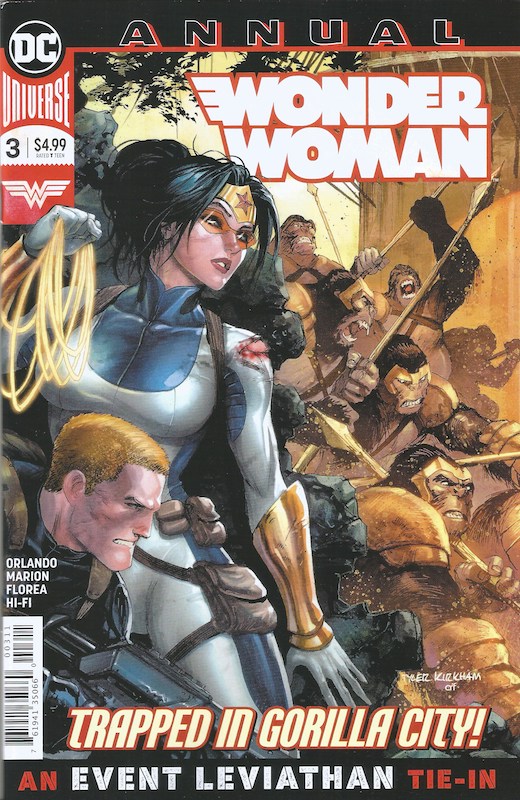

Steve Orlando’s short run on Wonder Woman knocked me out.  So I bought his latest, the Wonder Woman Annual and ended up unfortunately disappointed.  That said.  Orlando’s characterization of Wonder Woman is the strongest component of the story.  It’s the surround sound that comes off as scratchy and hissy.

In The Arrow, ARGUS is plain and simple cutting edge technological CIA.  From whence the organization originated is another story.  To this day, I have no idea what ARGUS stands for and what their mission is.  Apparently, they’ve been around the New 52 at least ten years, and worked with Wonder Woman that long. Here, we see them doing the FBI’s job.  Fighting Nazis.


In Arrow ARGUS agents are clad more often than not in spy trench coats and suits, which is what you expect. 


In battle they wear dark as pitch Kevlar body armor.  The comics present ARGUS in quasi-Checkmate armor, silver instead of gold, mixed with a little SHIELD.  Their dress uniforms look like hand me downs from Captain Action.


I'm with the band.  Marching band that is.

Wonder Woman of course will have none of this.  When she’s a spy she’s in her spy clothing. 


This modified sixties design actually appeared first in the comic book spin-off of Smallville where Wonder Woman joined the DEO run by Steve Trevor, her “secret boy.” Smallville never heard of ARGUS.  Good for them.

The gist of the main where Wonder Woman battles Grodd.  Where she attempts to stave off a war between Gorilla City and humanity is perfectly serviceable.  Wonder Woman’s position of non-violence and diplomacy is also perfectly in character.  Her use of the lasso brilliant.   I just wish the daft association ARGUS had zero involvement, as it contributes nothing.  Ditto for ARGUS’ gorilla spy.  That’s just…


In any case, the overall framework should have been better developed.  By all means, include Steve Trevor.  The Wonder Woman film initiated a renaissance, and I haven’t enjoyed the character in the DC Universe this much since Lyle Waggoner’s earnest portrayal.  

However, couldn’t we eliminate ARGUS? Couldn't actual government agencies get wind of a gorilla uprising?  Couldn’t bad eggs in the Pentagon order Colonel Steve Trevor to do a flyby similar to the spy piloting done over Cuba during the Kennedy Era?  High tech equipment could have been used to penetrate the cloak around Gorilla City. We didn't need a gorilla spy.  Couldn’t the government then sabotage Steve’s plane hoping Wonder Woman would become involved and quash the uprising?  Wonder Woman then could discover the whole truth of the fiasco, thus preserving the point buried underneath all of this ARGUS nonsense.

Helen Paul’s maturation intertwines with ARGUS, but I just cannot understand why that growth must be within this story.  Her importance is non-existent.  She could have been any generic female agent.  In fact Orlando could have shortened her story to dialogue.  

“Helen! How lovely to see you again.”
“Do you know, Agent Paul, Angel?”
“Diana—That is Wonder Woman saved me from a burning building during a terrorist attack.  I was fourteen at the time.”

Helen’s story just seems to be an excuse to trot out that bad penny Leviathan.  
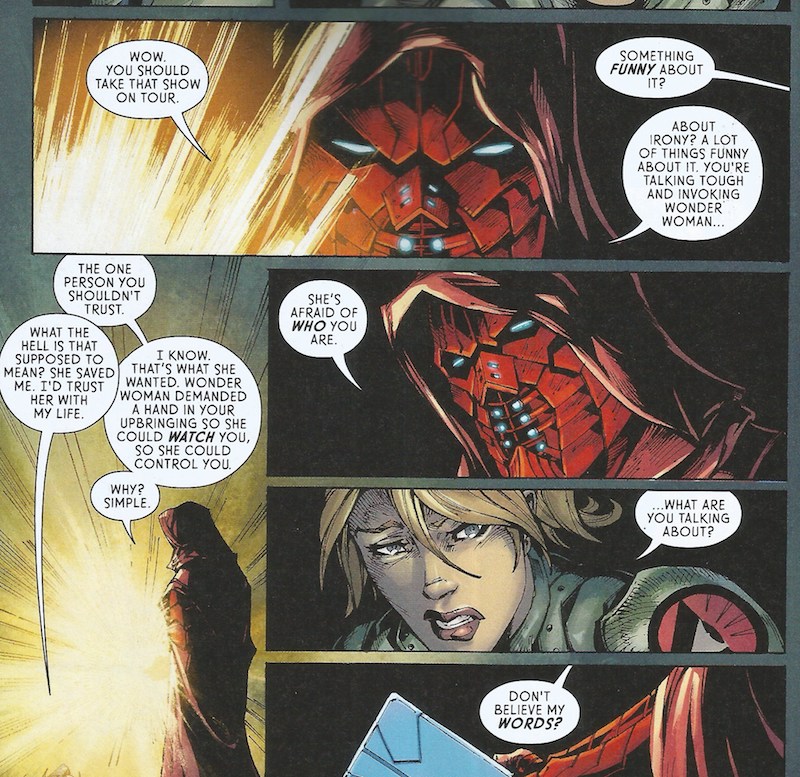

By the cosmos, Leviathan is annoying.  That's what you want in a major player.  Not threatening.  Annoying.  Has anybody considered that he may be Ally Babble? Or Kobra? Just saying.

So, if you’re keeping score.  Half of this story—the gorillas— makes sense; although it could have used more care.  The other part isn’t as good as Green Lantern/Svengoolie advertisement.  

Helen’s maturity, the alleged blood feud, that idiot Leviathan do not easily connect.  Leviathan’s words are utter bullshit, and Helen just chucks her real life with no problem to embrace the good old days of a Golden Age character she now represents.  That Wonder Woman antagonist actually had greater substance because of her situation and Wonder Woman’s creators aim to demonstrate redemption.


The Savage Avengers Annual pits three top dog Avengers against human traffickers.  As a result Gerry Duggan creates a satisfying done-in-one story that essentially pits Godzilla against Bambi.  The story begins realistically to highlight the plight of these unfortunates; suppressed by the promise of a better life only to end up worse.


Duggan continues the verisimilitude via a sympathetic sheriff whose priorities and resources center on his community. 


By doing his job to the best of his ability, the sheriff unwittingly entangles the Black Widow.  Duggan thus respects the tragedy before plausibly pulling in the fiction to address the subject in a heroic upheaval. You'll also want to note the name Nat assumes in this guise.  It foreshadows the humor contrasting the nasty reality.

In another part of the world, the victimized offer prayers.  One such missive reaches the new King of Hell.  Damien Hellstrom.

The atheist in me just love the idea that this woman prays to satan, and gets results.  Hellstrom’s more repellent aspects have been scrubbed by whatever event you’d care to name.  He and Hellcat may have been married, but it didn’t work out.  No madness involved.  It was an amicable parting.  They even bake each other muffins on occasion.  Honestly, I’ve always been against scorched earth policies.  So, I don’t give a rat’s behind.  

In Savage Avengers Hellstrom is legit.  As is Conan the Barbarian.


Duggan's Conan is pretty close to the Robert E. Howard creation.  Conan was always a man of decency.  Despite given the monicker of barbarian, he never raped or pillaged.  His funny commentary about killing slavers as a hobby, accurate.

This is not the first time Conan appeared in our time.  He materialized in a highly predictive What If story.  Now, once again, Khulan Gath is responsible for the time displacement.  Conan and Red Sonja what are the odds?  

In any case you may ask what makes Conan so special.  Afterall, he’s just a normal guy with a sword.  Mmmn.  And Batman’s just a normal guy with a cape.  Fact is.  No matter how much you’ve trained and how much of a soldier you think you are.  These fantasy figures are going to clean your clock.  Conan’s cleaning involves extreme prejudice, and he’s not even using a sword to get the job done.


Before long the trio collide in a rip-roaring slaughter of human traffickers that’s brought to life by the always welcome Ron Garney.  I’m not reading the regular series Savage Avengers.  I just don’t care for the roster, but this group of substitute Savages tickled me.


Contagion.  I just can’t get over how good this series was.  I really cannot believe it.  In this final chapter, the heroes learn that the fungus can control an entire army.


So, Moon Knight enacts his plan.


Things get trippy after that.


The point of the exercise is to find out if their friends and allies are still inside the fungus or trapped within the comatose bodies being eaten by the fungus.  

Ed Brisson accurately depicts the characterization of multiple Marvel heroes and villains.  The Thing is heavily involved.  Moon Knight’s plan actually makes sense and intrinsic to his history.  Jessica Jones is more than tolerable.  A new to me female martial artist and kid Iron Fist takes a well deserved spotlight.  Cut-rate magicians become the saviors of humanity.  The perfect Yancy Street punchline.  Pure bliss.  

I’m sorry Contagion is over and glad as well.  Five issues is the perfect length.  The tale never felt askew in terms of pacing, and it was self-contained.  The story didn’t spread to books I had no inkling to buy.  As a result, Brisson filled this series with Marvel characters that may not have been able to sustain my interest in solo efforts but combined became magical.
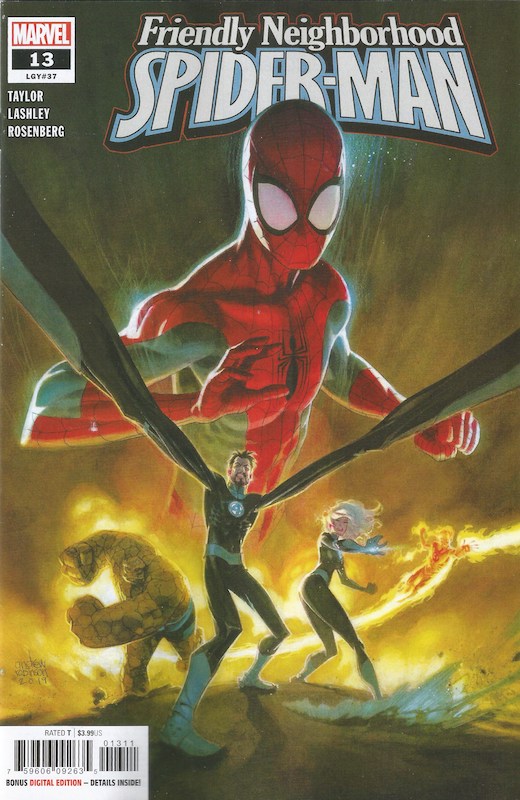
The FF guest star in this week’s Friendly Neighborhood Spider-Man.  This is another conclusion to an ongoing story of which I read little.  I tried the premiere of the title and it just didn’t click with me.  So, I mostly ignored the successive chapters.  

Last issue, a Big Bad attempted to kill Spidey, and a lot of people in New York think he succeeded.  This is in a large part due to a hasty journalistic conclusion.  Spidey was a little surprised at his passing, and after allaying Mary Jane’s fears, he popped in on his best buddies the FF.

With the FF, Spidey intends to take the fight to the Big Bad.  A purple dude ruler of the underworld of Manhattan.  No, no.  I mean a literal underworld.


This sounds familiar.  It sounds like a Jack Kirby idea.  I’m not absolutely sure about the origin.  So don’t quote me.  In any case, whether readdressing Jack Kirby or emulating him, writer Tom Taylor is in the zone.  From the honest conversations between Spidey and the FF to Sue being the spokeswoman of the team, Friendly Neighborhood is just entertaining as all get out.

Taylor utilizes the teams strengths and weaknesses to full advantage in the tale.  As a result, you enjoy the sibling comedy.  The Thing’s toughness.  Not invulnerability, mind you.  Just a kind of obstinate refusal to budge when faced with a salvo of gunfire.  Also, Taylor remembers that Spidey is a genius.

Four artists—Ken Lashley, Todd Nauck, Ig Guara and Dike Ruan—present very different styles, yet they all fit together for a seamless visual narrative.  Friendly and superior all at once.


You know, often covers don’t tell the whole story, or they’re just outright lies.  The legendary fantasy illustrator Greg Hildebrandt renders a cover to John Carter Warlord of Mars Attacks that represents what you get in the book.  John Carter for example really does have mutton chops.  Dejah Thoris is practically naked.  


Dejah and John are the perfect couple, probably fucking like mad bunnies at night and killing Topps Martians with gusto in the daylight.  

John’s strength and Superman like abilities are well-documented by creator Edgar Rice Burroughs.  So, Hildebrandt’s depiction of Carter leaping and the casual shoulder throw of his wife is at once comedic and true.  This also may allude to famous Frank Frazetta movie poster The Night They Raided Minksy’s.  In any case, Deja’s reaction upends the potential caveman sexism associated with the positioning.  That joyous bellicosity can also be found in the issue.

Jeff Parker’s and Dean Kotz’s brilliant mashup is a treasure trove of Martian lore.  From both ends of the spectrum.  John Carter fans simply cannot miss this.  Science fiction fans will love the central idea behind the story, and fans of good girl art cannot go wrong with Kotz’s natural depictions of Barsoomian exoticism.  


The cover to James Bond’s final issue before the reboot is also actually a good call on what’s been going on in this reimagining of Goldfinger.  


It’s funny but Bond early in this adventure promised to kill the new Oddjob.  He rather stupidly based the desire on the testimony of another agent’s encounter with the original.  Turns out the new Oddjob is a South Korean agent who fell in love with a compromised fellow operative.  He’s been working against the new organization ORU to get her out.  Bond at first gets in his way, but by the end, they part as friends.

Greg Pak wisely started with the unfamiliar before introducing Goldfinger into the mix.  This issue Bond and Goldfinger actually combine forces to prevent more death and fight a common enemy.  What takes the story out of the realm of fan-fiction is the conclusion, which brings back the big, bad James Bond that fans are familiar with.


Vampire State Building is a mostly by the numbers vampire story well executed and given much un-life by X-Files artist Charlie Adlard.  Yes, on the cover, he’s touted as Walking Dead illustrator, but sorry.  I know him from Topps’ superb X-Files series.  

When I say by-the-numbers, I don’t mean necessarily bad.  I mean that for a while, we’ve got a group of people that don’t recognize the very bad situation they’re in.  Vampires.  The authorities outside certainly don’t believe that, but the police snipers start to buy a vowel and respond with the loving violence of special munitions.  


That’s the show-stopper.  An expert archaeologist shows up to cleverly link the vampires with some of the construction of the Empire State Building, but you just wish Kolchak was here to be thrown out on his keister before becoming the only sane man in the story with the means to win.


Monday, October 7, 2019

POBB September 25, 2019

Pick of the Brown Bag
September 25, 2019
by
Ray Tate

Welcome to the Pick of the Brown Bag.  If you need just a thumbs up/thumbs down type of review, the tweets are already up and running: #PickoftheBrownBag.   This week I look at Batgirl, Detective Comics, Ghost-Spider, Gods and Gears, John Carter Warlord of Mars Attacks, Margo Intergalactic Garbage Collector, Marvel Team-Up, Omni, Red Hood, Red Sonja and Vampirella Meet Betty and Veronica, Scooby-Doo Team-Up and The Wolverine Annual.


Spare me your Carnage crossovers.  Give me more Acts of Evil annuals.  These one-shots are based on the premise of selecting a hero, boiling her down to her essence and pitting her against an unfamiliar villain.  No current continuity to worry about.  I love it.  Ms. Marvel vs Super-Skrull, Moon Knight vs. Kang the Conqueror, Spider-Gwen vs. Arcade, She-Hulk vs Bullseye.  Now from Doctor Who’s Jody Houser, Wolverine vs. Morgan Le Fay. 


The story begins in Wolverine’s present day, where we get a sudden Spider-Man and Wolverine team-up.


Oooo.  Could this be the machinations of Omega Level Mutant Wind-X? Doesn't matter.  The duo make short work of the collector figurines.  No high fives though.  Wolverine heads off in a huff because "he's got places to be."  Specifically, a senior living home.


This is not going to be like the Peggy Carter and Captain America reunion in 1970s Avengers comics.   

I remember reading a Chris Claremont and/or John Byrne interview before Marvel established Wolverine's immortality.  One or both of the talents always intended for Wolverine to be older than he looked. Perhaps not eternal.  

They planned a story where Captain America recognized him as an ally from World War II.  So even if I never read the whole business pertaining to Wolverine's longevity, I get it and accept it as a modification on the basic premise.  

Wolverine seeks to atone for a mistake he made years ago.  The lion’s share of the tale occurs in the 1950s in the hey day of motion pictures.  Logan sparks a romance with budding young actress Celia.  


She finds fame and fortune, but her ambition leads to a ruthless change in character.  She breaks up with Logan.  Broken hearted, he simply finds construction work at the studio.  So he can still be close to her. 


If Logan were a normal human being I would say that he stalked Celia, but Logan isn't.  I suspect his eternal nature gives him a skewed sense of time.  As the story continues, Celia lures Logan to what appears to be one of those backroom Hollywood Satanic cults that conspiracy nuts always talk about, but it's much worse than that.

The Wolverine Annual is elegant and straightforward with a several good twists.  Houser benefit from an underplayed visual narrative by Geraldo Borges, Marcio Menyz and Miroslav Mrva.  


The quiet scenes build up to an explosive climax even better than what's on the cover.  If you’re a fan of either/both Wolverine or/and Morgan Le Fay you won’t be disappointed.


Ghost-Spider starts out as a average day in the life of Gwen Stacy alias Spider-Gwen alias Spider-Woman.  J. Jonah Jameson springing his son is the first ripple.


Yup.  No use protecting the secret.  He was all over the covers anyhow.  Man-Wolf went real bad in Gwen's universe.  Whereas John Jameson was the innocent victim of a parasitic gem turning him into the Man-Wolf.  Here, he’s an articulate lycanthrope with eyes on crime.

Addressing Man-Wolf will need to wait.  Gwen now has a secret identity and a college on Earth-616.  That's Marvel Continuity Proper for anyone unfamiliar with Marvel's multiverse.

The running gag in Spider-Gwen and Ghost Spider is that web-slingers temporarily lose their powers when making dimensional hops.  This power-loss shouldn't be a shock to Gwen.

Gwen's powers began just as Into the Spiderverse detailed.  Bitten by a radioactive spider she gained all the complement abilities of an arachnid.  She lost those talents and started using a drug to mimic her original gamut.  That wasn't an acceptable solution, but she soon found a gestalt Symbiote that bonded with her.  Now they grant her the webs of the spider.

Unlike Spider-Man's Venom suit, Gwen and her cluster experience mutualism.  Lately the powers have been failing, but that changed with Peter Parker's input.  Gwen must feed her partners.

As you can see this is a very laid back issue of Ghost Spider, but don't you worry.  It's not all about making new friends and fitting into college on another earth.  It's also about hitting bad people and a special guest villain who makes a startling entrance juiced to the fullest by artist Takeshi Miyazawa.

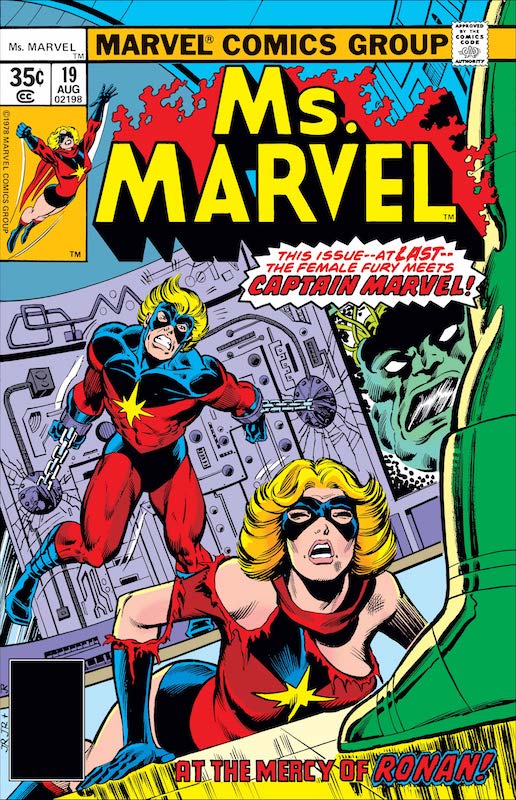
Ms. Marvel and Captain Marvel teamed up to suss out a technology thief.  It turned out to be Walter Lawson dressed in Kree uniform.  Lawson intends to lure the Kree to earth in order to wreak his vengeance.  Captain Marvel is down with that.  Ms. Marvel not so much.  

Marvel Team-Up is simply bad.  I’ve already discussed the number one reason.  Walter Lawson.  Even if I accept Lawson at his word, which let me be perfectly clear, I do not, Carol lacks a reason to trust this lunatic.  She cultivated a friendship with Captain Mar-Vell.  Emotions don't just turn on a dime.  Carol also should have no beef with the Kree.  The Kree never did anything to Carol Danvers to warrant her resentment.


Wait, says you.  Are you mad? Not at all.  This is not cinematic Carol Danvers.  She was never betrayed by the Kree.  I don’t think she ever set foot on either Kree home world.

Only a handful of Kree meant to do Carol harm.  In a pivotal issue of Ms. Marvel, the Supreme Intelligence sends Ronan the Accuser to abduct Carol Danvers.  She’s what he’s been looking for forever; the solution to Kree evolutionary stagnation.  The Intelligence is a sentient A.I. that’s above the Kree.  Ronan is his thug.  Lots of people dislike Ronan the Accuser, but they don't blame the Kree for him.  Dr. Minerva is also causing trouble in Kelly Thompson's run of Captain Marvel, but Dr. Minerva is a mad scientist.  She doesn't represent the norm of the Kree.  Your average Kree is like your average Roman soldier.  Bellicose? Sure.  Unreasonable? Dependent on the individual.


I would give McElroy credit for creating a branch of Kree seeking to preserve fair judicial conduct, but they're more of a plot device to artificially contrast Lawson's obsession and fan the flames of Carol's newfound prejudice.  McElroy is far more focused on dismantling the legacy of Captain Mar-Vell and demonstrating his poor understanding of Kree history, biology and gadgetry.


Mar-Vell became super powered via his experiences and technology not through native Kree ability.  For example, a character named Eon gifted Cosmic Awareness to Mar-Vell.  


The Psyche-Magnetron rebuilt Carol Danvers based on this template of Captain Mar-Vell.  First it metamorphosed Carol into a human/Kree amalgam.  I would say hybrid, but that’s not biologically accurate.  Despite being a Kree/human amalgam, Carol at this stage possessed no powers. 

Carol still incubated.  In fact, Carol didn’t know she was Ms. Marvel.  She believed she experienced blackouts.  In reality, the Psyche-Magnetron used Nega-Energy to teleport and fit a costume it designed for her.  

The costume duplicated the powers she would eventually possess.  The Nega-Energy also broke the Ms. Marvel personality from Carol until she could fully accept her dual selves.  

Even so, Carol is more than Kree and more than human.  Using the Nega-Energy siphoned from the Nega Bands, the machine made her into a female counterpart of Captain Mar-Vell.  So Carol is more powerful than a Kree.  She is more powerful than Captain Mar-Vell when he first arrived on earth.  

Lawson rebuilds a Psyche-Magnetron.  A dubious claim.  He envisions using it to nullify Kree powers, including those of Carol Danvers.  The machine however can’t simply strip away the powers another model catalyzed.  It doesn’t/can’t work that way.  It's not magic.  It's advanced technology.

Even though the Psyche-Magnetron fulfills the user's dreams, it still must adhere to reality.  The best it could do is begin the process of recreating Carol as a full human.  Carol would still be Captain Marvel for the interim.  She would gradually lose her abilities.  She would likely still have the strength of a female weightlifter, the stamina of an Olympian.  As to the Kree.  The machine should not affect them at all.  They are in fact already human.  Albeit blue.  On earth, the lower gravity gives them an edge.  If it did work, If you used the machine to alter their physiognomy, you would simply create an army of extremely skilled warriors that can't lift a half a ton or so but can do five hundred quite nicely.  You would have to reshape them into ectomorphs.  It just gets overly complicated.  Suffice to say.  It can't be done even if you write it to be so.

The fact of the matter is that this entire story serves only two purposes: to destroy the heroism of Captain Mar-Vell and to strip Carol Danvers’ of her intellect.


Double threat writer/artist Jim Whiting introduces Margo the Intergalactic Trash Collector.  Now to be sure, this is not a new concept.  

My beloved Quark broke the ground, but it's definitely not an oft-used concept.  Margo furthermore enjoys an unlimited special effects budget represented by illustration that's a cross between Kirby and Tank Girl. 

Margo works for IWM, Intergalactic Waste Management.  We first find Margo in dire-straits.  


Margo's intelligence, coolness and skill saves the day.  This is what I'd hoped the comic book would be.  First don't knock custodians.  They clean up after us efficiently and mostly behind the scenes.  I expected that a future trash collector would have future knowledge, and Margo Intergalactic Trash Collector doesn't disappoint.  She's a pilot.  She's an engineer.  She's a woman with agency.


A future custodian that traveled through time and space could easily rule this world, but that's not what we're aiming for here.  Whiting's book is pure pulp science fiction.

The brush with death and inundation of outdated parts inspires Margo to seek shore leave.  She uses her mother's influence to sway her commander's opinion about the holiday, or so she thinks.


That "No Return Directive" is gong to cause Margo a lot of problems.  Our mystery blob resembles the Imperious Leader from classic Battlestar Galactica.  Good thing as far as I'm concerned.  I generally like updated nostalgia.

The nefarious schemes befit men of power, and you realize that Margo isn't really a comedy like Quark.  There are funny bits, but this is more adventurous.

Still under the impression that she really is on shore leave, Margo takes on the hottest new club in the universe.  To say she's disappointed is an understatement.


The Commander however positioned her there to meet an alien she refers to as the dwarf.  Real name Porthos.  At first she thinks he's hitting on her.  The fellow however has dishonorable intentions.


That was a very nice depiction of sleight of hand.  You also don't expect it from what appears to be a clumsy looking alien with thick fingers.  

The device the dwarf pockets leads to he and Margo becoming pawns in a chess game played by their terrible bosses and a fundamentalist cult that worships Glom.  You see that White Trees? You can make up names that sound good and carry weight to them.


The conflict leads to Margo displaying her action-chops, but a surprise encounter with a seemingly innocuous device culminates in an unfortunate event.


Believe it or not, Whiting still has more in store for the reader.  The device Porthos the Dwarf planted in Margo's cloak, isn't a McGuffin.  Its nature fuels the last act.  


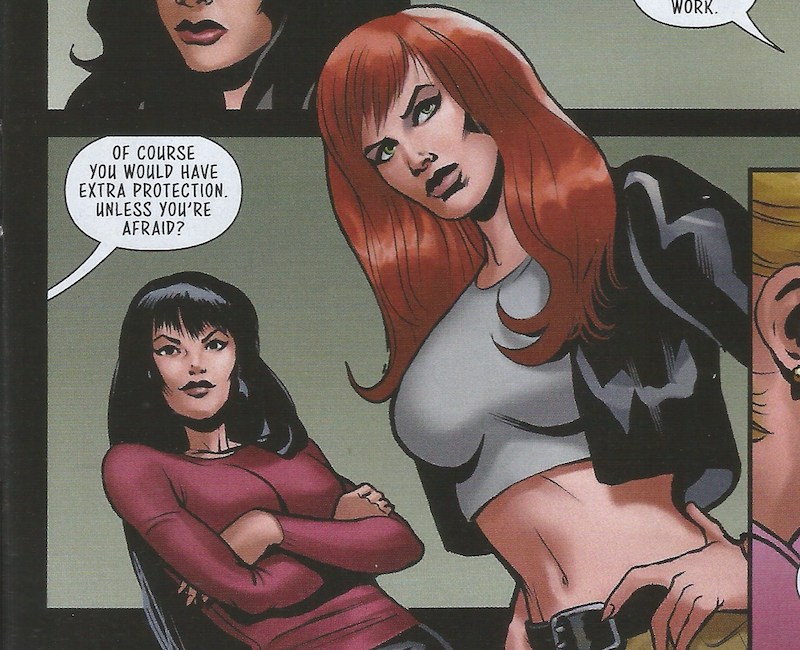
Betty and Veronica investigate murders in Riverdale.  During their snooping, they bump into Vampirella and Red Sonja who became interested due to the apparent Cult of Chaos involvement.  And the loss of innocent life.  Amy Chu presents Vampirella and Red Sonja as white hat heroes.  Weird white hat heroes, but white hats nonetheless.

Betty asked third tier Archie Comics character Dilton to help her with some research.  That's when somebody turned out Dilton's lights.


In this issue, Chu reveals the true culprit behind the murders, and if you've been paying attention, you'll know whodunnit.  The murders' connection to Archie Comics is harder to dope out.  Not due to the unfamiliarity with the brand but in the very sneaky way Chu hid the clues.

If the mystery elements fail to float your boat, you may enjoy Chu's characterization of the star quartet.  Betty and Veronica are affectionate toward Dilton.  


They actually care about him and remind the reader that these aren't just bodies falling to the ground but their friends and acquaintances.


Alternately Vampirella and Red Sonja are the professionals. They're the Avengers, out to rid Riverdale of the scourge.  They set about guarding Dilton who naturally becomes bait.  Chu can't help but put in more clues during the fight.


Vampirella is an alien vampire.  What can be as fast as she?  Yet, the Cult doesn't appear to match what we know of the Chaos worshippers, nor do they harbor the strength and stamina of creatures.  What indeed.


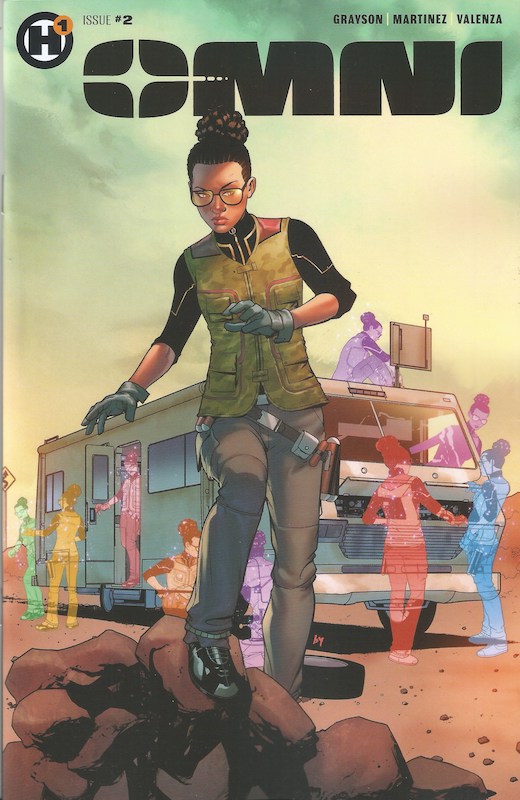
The second issue of Omni is lot less hectic and Sherlock.  It's the issue that starts to carve out the central character's uniqueness.  A cartoon explains the gist for people who missed the premier, and then we get to Dr. Cecilia Cobbina, her assistant Mae, and innocent victim of the Ignition Antony.

That's no lie.   Though the police take Antony into custody, Cecilia makes a series of incremental moves adding up to consensus comprehension.  Whereas the premiere of Omni was rather po-faced, this issue lightens up.  Devin Grayson finds comedy in the strategy Cecilia uses and the fact that she's tight-lipped about her plans.


Another moment of comedy occurs when Cecilia begins to think more things out rapid fire but in the process totally ignores Mae.  Mae believes Cecilia has evolved beyond her, but she's not insensitive to Mae's feelings.  She's just overwhelmed by the data of her mind.


Batgirl is a mess.  New kid on the block Cecil Castelucci attempts to touch every ball in the air that the Powers That Be are juggling.  With the exception of Doomsday Clock.  Because nobody knows if and when that story will end, nor can they guess if there will be any ramifications.  

This is mostly a Year of the Villain storyline.  Lex Luthor is teleporting here and there to give villains gifts.  These gifts will either grant them their greatest desires or beef them up to fight their nemeses.  Sometimes both.

Everybody knows that Babs Gordon assumed the identity Oracle when she was crippled for twenty-five years real time.  As Oracle Babs dug up information for superheroes.  That’s it.  So, for the life of me, I can’t figure out why she’’s trying to restore the Oracle Program.  The scene does though give us her best green-eyed moment.


Yeah.  I hate the green eyes on Babs.  Already said.  Anyway.  Babs was Oracle.  If she created a program, it was just a database and an avatar.  It wasn’t A.I. sentient or otherwise.

Okay.  So let's just really grasp at straws.  Maybe somebody created an android.  Let's say Doc Magnus.  Because that's what he does.  

He abandons the droid... for some reason.  Another person comes along, finds the android and downloads Babs' database into the robot.  Let's say...Frankly.  I'm coming up blank on this one.


TBD

Then Luthor comes along and imbued sentience to the droid.  I think that he thinks Oracle was always this thing.  That just about works.  In the slimmest confluence of all possibilities.  

Also annoying, ripping off Person of Interest.  Person of Interest is light years ahead of this dreck, and I shouldn't be connecting this perfect show to faulty wiring.  But yeah, Oracle runs multiple simulations, like The Machine, in which she combats crimefighters. 


If she knows she’s a crimefighting robot, why can’t she dope out not to hurt crimefighters? Why does she ally with people she recognized as criminals?  So many questions.  No answers.

In other parts of Batgirl, Castelluci positions Jason Bard to be the love interest, with Babs commenting on "his nice eyes."

The square from the1960s returned to modern times in Batman Eternal, which is canonical to Batgirl.  Let me remind you what happened.  

Jason Bard obsessed over the death of his red-headed partner/lover in Detroit.  He framed Commissioner Gordon for gross negligence thereby confining him to prison.    He assumed Commissioner Gordon's role then outlawed the Batman Family.  He attempted to kill Batman, blowing up the Batmobile in the process.  Jason celebrated the death of Batman by trying to talk his way into Vicki Vale's skirt.  Bullock and the rest of the cops left in disgust. 


The surprisingly spry dead Batman punched Jason in the face, just like Vicki Vale predicted.

What a prize.  This nice-eyed piece of shit wannabe Batman killer.

Last but not least, for the rotting cherry on top, Castelluci mentions the Batman Who Laughed business that's going to make most of DC's comic books unreadable in the months ahead.  Batgirl is one of the stupidest things I've read in awhile.


Lex Luthor contacted the Red Hood to become teacher to future super-villains.  Little does Luthor know that the Red Hood is a ruse.  The Red Hood is Jason Todd former Robin to Batman.  Jason simply wants to make certain that these kids live through their growing pains.  Also along for the ride Scott Lobdell’s and Kenneth Rocafort’s creation Dr. Shay Veritas.

The story pits the kids against Doomsday Jr.  Because these kids are super-villains in training, Rocafort’s emphasizes their nightmarish aspects.  

Rocafort got a lot of online heat due to his style of illustrating Starfire, but this should settle matters about his skills.


Nothing sexy or exploitative about that.  


The very first Scooby-Doo team-op that’s actually canonical to Scooby-Doo Where Are You occurred with Batman and Robin.  A pair of skeletons were scaring people.  These turned out to be the Joker and the Penguin.  They were looking for buried loot or something.  Not exactly a murderous affair, but it’s a kids show.  

The final issue of Scooby-Doo Team-Up celebrates the event with a fiftieth anniversary hosted by Bat-Mite and Scooby-Mite.  The number and anniversary reflects the run of Scooby-Doo Team-Up not the actual date of the broadcast.  

Writer Sholly Fisch and artist Dario Brizuela introduced Batman as the first co-star in the book.   It’s a nice elliptical idea that the concept of partnering Scooby and the Gang with celebrities and icons began with Batman and Robin, and they end on the partnership with Batman and Robin.  

The story begins with the Dynamic Duo battling a goofy villain that’s actually from the silly 1950s era of the Caped Crusaders.

The villain seems to get the better of our heroes but he didn’t expect the involvement of Freddie and Mystery Inc.


Neither did Batman, who in a call back to the last season of Super-Friends, chastises Robin.

Needless to say, Robin is innocent of the infarction, but before they can debate, Elseworld Batmen show up.


Followed by Elseworld Scoobies.


It's a shame that Dario Brizuela doesn't contribute to the issue, but Scott Jeralds does a good job of capturing all the myriad versions of the cast.


I do wish that DC sprang for an extra larger size for the comic book to better the detail.  The photography her is often too small.  

The celebration continues with the ultimate foe.  Not Moriarty.  Somebody far, far worse.


He as well though isn't what he seems, and I don't just mean the manifestation of Bat-Mite's and Scooby-Mite's 5th Dimension advanced science.  The final issue of Scooby-Doo Team-Up is a delight for Batman and Scooby-Doo fans, especially those that sampled every incarnation of Scooby-Doo even the bad ones; when Scooby-Doo was bad it was very bad.


After what seems like a lifetime of cover teases, Mr. Freeze takes his place as the main villain in Detective Comics.  

The story begins like Batman Sub-Zero.  Mr. Freeze attempts to revive his frozen wife Nora by kidnapping women.  These women unlike Barbara Gordon aren’t meant to be donators of body parts.

Though the story ties in with Year of the Villain, it's links are slight.  Luthor gifted Mr. Freeze with a means of thawing Nora.  Freeze however doesn't trust Luthor and seeks to test the miracle before risking Nora's life. 

Though Mr. Freeze kills more women than a giallo does, he does not actually hate women.  He’s obsessed with bringing Nora back from the brink of death.  If he had emotions, he might express remorse for in what his mind must be done.  I’m presuming that this version of Mr. Freeze is in fact identical to the creation in Batman the Animated Series.

Peter Tomasi on the other hand generates that animosity in Mr. Freeze’s men.  They have no excuse for their actions.
  

One of the victims gets away, and her escape attracts the attention of Batman.


Freeze chastises the man who made the fateful decision and sends the others back to finish the job.  Mr. Freeze cannot afford loose ends.  Although a good tactician, Mr. Freeze's arrogance trips him up with this bad strategy.  Freeze's error allows for a dynamite cliffhanger by Doug Mahnke, Jaime Mendoza and David Baron.


The idea of mixing hocus-pocus and Eliot Ness is a mad original idea.  Still if you would have told me it would work this well, I wouldn’t have believed you.  Yet Tommy Gun Wizards does just that.

Reflecting real history, Eliot Ness declares war on Al Capone and the mob.  Unlike history, Ness and his crew of Untouchables fight the import of magic and the sorcerers that use arcane knowledge.  Also unlike history, Eliot Ness is a wizard.

The story begins before the Volstead Act banned magic.  A sorceress named Candice arrives to entice men and women to the wonders of fantasy.  She takes a young man to the Curtain Room.

There we encounter Eliot Ness.  He’s just having a little Lick, the stuff that empowers the magic.  Candice reveals where the Lick originates, and fantasy becomes horrific.


This is where Eliot Ness becomes an enemy of magic.  The story skips ahead to an Untouchables raid of a corrupt church.  Eliot is late to the party, but he knows how to make an entrance.

A lot of people believe Eliot Ness to be an exaggerated figure, and he’d probably be the first to agree with you, but Ness was the real deal.  So watching him act like an action hero makes perfect sense.  This however is only round one. 

Al Capone uses magic to lord over Ness and the Untouchables.  It’s the kind of showy nonsense you expect from Capone.  With the festivities announced, the guests arrive.

It’s the Untouchables vs. magical super-villains.  This is not a one-sided fight.  Even without Eliot Ness magic user at the fore.


Writer Jeff Parker presents a quantum state planet in which the observer John Carter determines the nature of the world.  It doesn’t actually matter what happens to it.  In the premiere issue, the Mars Attacks Moon Heads, as the opposition refers to them, destroyed life on Mars and forced Deja Thoris, the Princess of Mars, to engage a spoilsport ploy thereby ending the Moon Head threat and her life in the process.  John Carter however returned to earth.  Delighted by the progressive attitudes of the modern world.  Obviously pre-Trump.

The planet however isn’t bound to John Carter’s whims.  When in modern times humans send a Martian probe, the Moon Heads appears and attack on earth.   The observer creates the situation on Mars.  Perhaps in times of high anxiety the observer snaps Mars to the vicious quantum state where Moon Heads rule.  Perhaps we expect to be slaughtered.  Perhaps it’s only a comic book with a neat little idea.  The concept however is astounding and ties into the consequences of the Crisis on Infinite Earths.


Barsoom returns with the arrival of John Carter.  The Moon Heads by and large disappear.  However, think about this.  The entire history of Barsoom rewrites.  Just like the earths of DC comics.  The earth is at least 4.5 billion years old.  Mars 4.6.  These fictional planets when reborn are reborn with ancient history intact.  That means the rebirths rewrite billions of years of history.  It’s an impossible, yet fascinating concept.

In addition to the science fiction questioning, other factors favor John Carter Warlord of Mars Attacks.  The adherence to Edgar Rice Burroughs esoterica such as the hilariously, creative foreshadowed return of John Carter’s pet.


The rousing appearance of Tars Tarkas John Carter’s loyal comrade and the precursor to Chewbacca the Wookie. 

As well as the puberty inducing Deja’s Thoris.


Dean Kotz also provdes the illustration for Ryan Winn's entertaining mashup from Alterna Comics. 

 Gods and Gears combines Racer X.


In a fantasy setting, with giant mushrooms and precocious tykes.

The enemy, or at least the seem to be enemy, are refugees from Planet of the Apes.


It's too early to determine if Gods and Gears will be successful, but this debut is highly entertaining.  The newspaper print, which of course used to be the traditional medium for comic books, picks up the details of Kotz's art and Winn's colors.