Pick of the Brown Bag
November 21, 2018
by
Ray Tate
I’m stuffed. How about you? It's time for the Pick of the Brown Bag. In this blog, I look at the best and the worst of the comic books. For this edition, I review Astonishing X-Men, Batman, Doctor Who, Exorsisters, Immortal Hulk, Iron Man, Nightwing, Project Superpowers, Stellar and West Coast Avengers. First, a commentary of the new book from Image Bitter Root. As always should you not have time for the POBB Blog, you can check out fresh tweeted reviews on Twitter: #PickoftheBrownBag.

Shaft writer David Walker, Chuck Brown and Sanford Greene bring the engaging Bitter Root to the comic book racks.

The Harlem Renaissance, a superb musical era of enlightened humanity, serves as the backdrop to all sorts of weird shenanigans met by an equally strange family.

In the premiere of Bitter Root, Berg and Cullen Sangereye introduce themselves. Berg is the big fellow with the beard and Cullen is the thin man with the cap.

Berg’s dialogue and Cullen’s physique identify a source of inspiration. Doc Savage's gaunt and verbose associate William Harper Littlejohn. Johnny.
The Doc Savage references continue with the feisty intruder to mens’ work, Doc’s cousin Pat Savage. Here, transformed into Blink.

As you can see from their opponent, the Sangeryes deal with what appears to be the supernatural, but that’s not actually the case. At least it’s not the entire matter.

The metamorphoses follow the vein of Doc Savage’s science fiction based affairs. The Sangeryes thus are scientists as well as troubleshooters.

Their goals furthermore make them champions. Rather than simply kill the monsters, the Sangereyes use their intellects and martial prowess to solve problems. The Jinoo, the monsters are people. The formula mixed by matriarch Ma Etta changes them back.
Though the Sangereyes are the good guys, they also happen to be black. Racism issues throughout the plot. Nevertheless, the writers show examples of tolerance. Not all the police pull out guns on the Sangereye. Some even collaborate with the family.

Because of the time period, it’s only reasonable that the fuckwads in the dunce caps show up. It's because of the era that this cut to the backward state of Mississippi and Ford Sangerye feels natural. Ford isn’t the would be victim in the depiction. Ford provides the rousing Blaxploitation styled conclusion and hand off to the next issue.

Last issue ended with Nightwing meeting Nightwing in a bid to save the amnesiac Dick Grayson's new friend Burl. Burl is a dispatcher that hired Grayson.

The art by Travis Moore, Patrick Zircher and colorist Tamra Bonvillain ticks up the realism a notch, which is a better style for this story that brings Dick Grayson down to earth.

The recapitulative aspect of the story allows the reader to see Robin anew. What we took for granted becomes fresh in the eyes of a newcomer experiencing it.

The new Nightwing is actually a Bludhaven cop who investigated the scene of the fire that Dick set to better restart his life. It's a pleasure to see somebody not trained in the way of the Bat meet the fall, sometimes literal, sometimes metaphorical, a normal person would encounter.
Because Alphonse is a police officer, he has access to firearms and knows how to use them. While he attempts to put the kibosh on a black market kidney selling ring, Dick subtly spirits his friend to safety and a hospital, something Alphonse will need once he shakes hands with human exhaustion. The Batman Family are used to the grind.
Meanwhile, Dick fresh as a daisy hovers around the aptly named Prodigal Bar where he changes one life, possibly two, for the better. Dick or Rick as he calls himself now actually is in a positive place. Despite the negative circumstances that dropped him there.

In Arkham Asylum, a spider spins a web. No, it’s not the hitman Black Tarantula, and this spider doesn’t wear a rictus grin. The mastermind has been orchestrating the worst strikes against his arch-foe Batman. However, the spider’s intricate design begins to unravel, or does it?
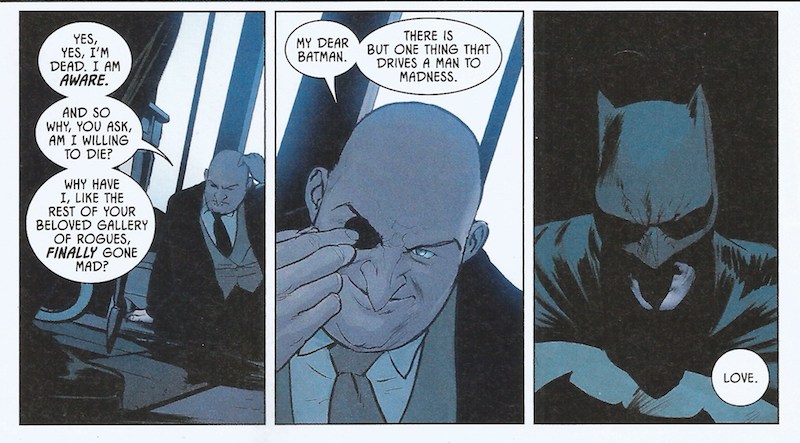
Demanding the Penguin’s fealty through the assassination of a loved one seems foolhardy. Now, upon witnessing Batman’s futile confrontation with the spider, you begin to see that the Penguin’s betrayal just may have been part of the spider’s plan.
The spider seeks to destroy Batman, but he’s doing it piecemeal, and if his plan is to isolate the Dark Knight, it will take longer than he has. The blow to Batman’s psyche was a good one. The assault on his son, a kick in the balls.

This chapter appears to estrange Batman from the police. However, he’s friends with each member of the Justice League. They trust Batman as does the rest of the Batman Family. Even Jason has his six.
The cover to this issue of Batman shows Batman battling against a corrupt Gotham PD. The Penguin suggests this very thing in the story. However, Batman's encounter with the police turns out to be less violent than the cover implies. The Gotham PD appear to be on the up and up. Alternately, perhaps, the corruption is so well hidden that it will take a more than a cursory glance to discern.
Batman listens to the Penguin, determines his innocence in this scheme of schemes. He faces the Big Bad, and readers know of the guilt. The Caped Crusader on the other hand soars way with more questions than answers, and that’s a first for Tom King’s Batman.

I’ve always had a soft spot for Crusher Creel. His powers are interesting. The Jack Kirby design appealing. Stan Lee’s meat and potatoes villain-talk colorful yet realistic. Crusher Creel symbolized the motif of common criminal turned super villain. Creel is a nemesis to Thor and the Avengers, but he also apparently went up against the Hulk at one point.

I like that Crusher hasn’t any false bravado in the Hulk department. Al Ewing takes a page out of Agents of SHIELD. He fastens a new Crusher Creel metamorphosis at the center of his underlying theme of Gamma Bombs opening doorways to hell.

It seems that Hulk’s dad, rather than the more familiar demonic being Tanaraq, possessed Sasquatch. The Hulk absorbed Sasquatch’s gamma radiation, and he also acquired the ghost of Bruce Banner’s father.
I know little about Banner’s father. I guess he’s bad news. Ewing explained his abusive influence, but this is the least involving part of the story for me. Fortunately, Crusher Creel shows up now with the backing of the government's new Hulkbusters. Things get fun.
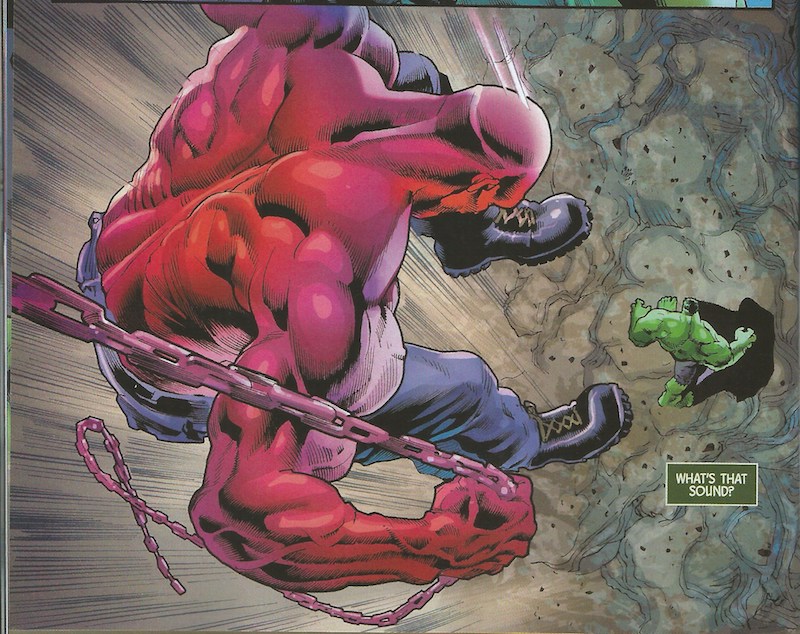
However, Ewing’s preoccupation with body horror persists, and there’s something nasty in store for the reader. Don’t read The Immortal Hulk on a full stomach.

Tony Stark, the Invincible Iron Man released an immersive virtual reality game, and he unwittingly catalyzed a whole heap of trouble. First, the hotness of the game artificially increases its value.

The winsome Wasp and Tony are testing relationship waters, and that’s why she’s along for the crimefighting and cracking wise about diamonds. It’s pretty hilarious that Tony unwittingly ripens a target for thieves. He must then in turn prevent the theft.
Second the game naturally attracts all sorts of bad pennies. Fortunately, there’s an Arsenal for that.

Arsenal not to be confused with one of the sobriquets of Green Arrow protégée Roy Harper is a creation of Howard and Maria Stark. The duo programmed Arsenal to fight Nazis. It mistook the Avengers as goose-steppers. In a classic Avengers Annual, the digitized spirit of Maria confronted her son in the Iron Man armor and realized the error. It’s fitting that Tony uses an Arsenal avatar to patrol the Tonyverse for violations of service terms. Of course something goes wrong with the convention, and the virtual world turns realistic.

Meanwhile, Jocasta gets an unwelcome visit from her ex Machine Man boyfriend and Bethany Cabe begins to figure out the source of her blackouts. The Big Bad forgettable Marvel foe makes his move while Tony contends against Arsenal, and the Stark Team handle Tony suddenly and rudely dropping dead. Dramatic stuff, but underpinned by humor.

The conclusion to Kelly Thompson’s first West Coast Avengers story is filled with comedy. An invasion of Land Sharks convinced Kate Bishop that Los Angeles needed defended. She recruited several heroes to the cause including America Chavez, Hawkeye senior, boyfriend Fuse, Gwenpool and X-Man Quentin Quire.

Quire brought the entourage of a reality film crew for observational humor.
Before anybody could say "Avengers Assemble," Tigra enigmatically turned up large, fierce and destructive. New kaiju joined in on the attacks. Fortunately, although Kate Bishop is the resident detective, the team didn't need too much detective work to solve the mystery.

BRODOK who is not so secretly MODOK makes the second mistake of turning Kate Bishop into a giant hawk.

Once free of the mind control, she expresses extreme prejudice in a slapstick moment that involves the velocity of an unladen giant head.

In addition Thompson takes a moment from the comedy to address the freedom of choice, as well as toxic masculinity. MODOK turned himself into BRODOK thinking the golden boy would better net him a date. The trouble is MODOK is a perverted monster, and his concept of dating is utterly horrible. Thompson's insight is that a sexual predator is always a sexual predator. Predation is not an issue that can be solved. The perpetrators are giant heads to be batted.

Spoiler alert. Tigra makes it out of this story alive and full of personality. Tigra is love, and the team drop in on a special guest-star, which prompts a phone call from Captain America. West Coast Avengers is an atypical team book with a unique narrative style that you'll either love or hate.

Some damn good displays of power from Dazzler and Banshee beautifully illustrated by highlight the conclusion to Astonishing X-Men.

The story also redeems Havok. I only know the Summers sib from old issues of Uncanny X-Men.

So he was always above board to me, but whatever. I get what Matt Rosenberg was shooting for, and regardless, his moment is recognizable.
The story started out with Havok searching for redemption and forming a new X-Men team out of Dazzler, Beast, the formerly dead Banshee and Warpath. He did this against Kitty Pryde's wishes. Kitty owns the trademark.
Havok and his team ran afoul of a government organization called ONE. Never heard of them either, but their archetypal enough to grok. The ONE's moves forced Havok to broker a truce with the Reavers. Nope got nothing on them either. These appear to be cybernetic mercenaries. Last issue they synched up with Sentinels. This issue, Dazzler, Banshee and Havok decimate those Sentinels and gain the respect of Kitty and the other X-Men.
The series ends with seventeen due to the Big Event going on in the X-Men titles. Astonishing X-Men started out impressively with realistic artwork and a genuinely mature approach. You got the impression you were watching a dramatic movie rather than reading another X-Men adventure. The book failed to find its footing and dragged quite a bit. Matt Rosenberg came along and acted as a tonic. This new volume of Astonishing X-Men is easy to read, frequently laugh-out-loud funny and beautifully illustrated by Greg Land, Jay Leisten and Frank D'Artmata. It's a shame that this team didn't go on.

Project Superpowers begins with Diana Adams alias Maquerade reminiscing about a pleasant encounter during World War II.

The moment does several things simultaneously. First and foremost, it frames Diana as a warm, loving person. Second, it reminds her of sacrifice and recharges her want to do good.

Diana remembers this history while she battles the hero formerly known as Dare-Devil. As it turned out though, the original died, but Bart Hill appeared to imbue his essence to the costume, and the costume fought crime amongst the powers. Though possessed, the costume attempted to warn the Green Lama of the coming doom, but too late. The cosmic Big Bad possessed the suit.
Dare-Devil attempts to kill the new American Spirit. The flag bonded with Imani, a girl of pure optimism who came to the aid of the heroes and ignited the feeling of hope. That said. Sometimes you just need a blunt force, and the impressive Black Terror provides that.

The battle takes place on three fronts. Masquerade, Black Terror and the American Spirit battle Dare-Devil in Imani's hospital room. The Mighty Samson, descendent of the original, tackles overgrown germs from space, and high-tech Silver Scarab attacks the problem from whence they came.

Pandora who is nothing like the comely, curious Greek girl is such a threat that you cannot help cheer when this arrogant SOB fails to predict the heroism of Samson.

Writer Rob Williams and artist Sergio Davilla imbue the scene with understated humor, inherent to the strong man and the situation. These comedic moments give the reader welcome contrast to a drama with scope and purpose.
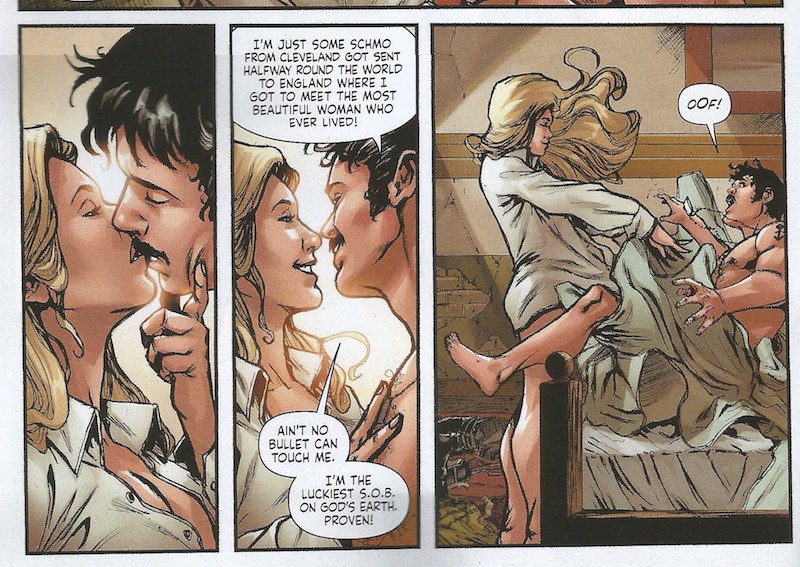
The moment does several things simultaneously. First and foremost, it frames Diana as a warm, loving person. Second, it reminds her of sacrifice and recharges her want to do good.

Diana remembers this history while she battles the hero formerly known as Dare-Devil. As it turned out though, the original died, but Bart Hill appeared to imbue his essence to the costume, and the costume fought crime amongst the powers. Though possessed, the costume attempted to warn the Green Lama of the coming doom, but too late. The cosmic Big Bad possessed the suit.
Dare-Devil attempts to kill the new American Spirit. The flag bonded with Imani, a girl of pure optimism who came to the aid of the heroes and ignited the feeling of hope. That said. Sometimes you just need a blunt force, and the impressive Black Terror provides that.

The battle takes place on three fronts. Masquerade, Black Terror and the American Spirit battle Dare-Devil in Imani's hospital room. The Mighty Samson, descendent of the original, tackles overgrown germs from space, and high-tech Silver Scarab attacks the problem from whence they came.

Pandora who is nothing like the comely, curious Greek girl is such a threat that you cannot help cheer when this arrogant SOB fails to predict the heroism of Samson.

Writer Rob Williams and artist Sergio Davilla imbue the scene with understated humor, inherent to the strong man and the situation. These comedic moments give the reader welcome contrast to a drama with scope and purpose.
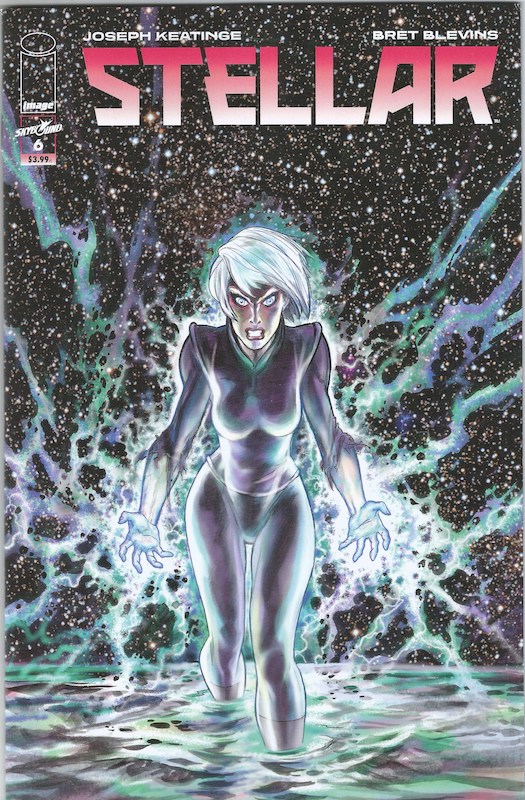
Throughout Stellar writer Joseph Keatinge promoted the idea of war being an ultimately futile pursuit. Stellar is a creation of war. You can see the power that crackles from her on the cover. She is a weapon of war that simply saw Keatinge's message sooner than others in her troop, who follow the baddest of them all Zenith.
Zenith returned to harass Stellar back into his service in a war taking place in a multiverse. However, when he invaded a world that Stellar hoped to protect, he rationally discovered nothing to fear.

Keatinge seems to go back on his words with this issue of Stellar, but upon absorption, he really doesn't.
Zenith is who he is because war twisted him to such an extent that he can think of no other way. While some may argue Stellar's actions are far too extreme, viscerally depicted by Brett Blevins, she sees the futility and addresses it head on. Ultimately, Stellar proves her point when she returns home and the book becomes elliptical with the finish being the start.

The lates volume of Doctor Who begins with the new Doctor in the form of Jodie Whittaker.

Rachel Scott naturally presents a dead on accurate model with all of Whitaker’s expressions and body language helping to create the illusion.
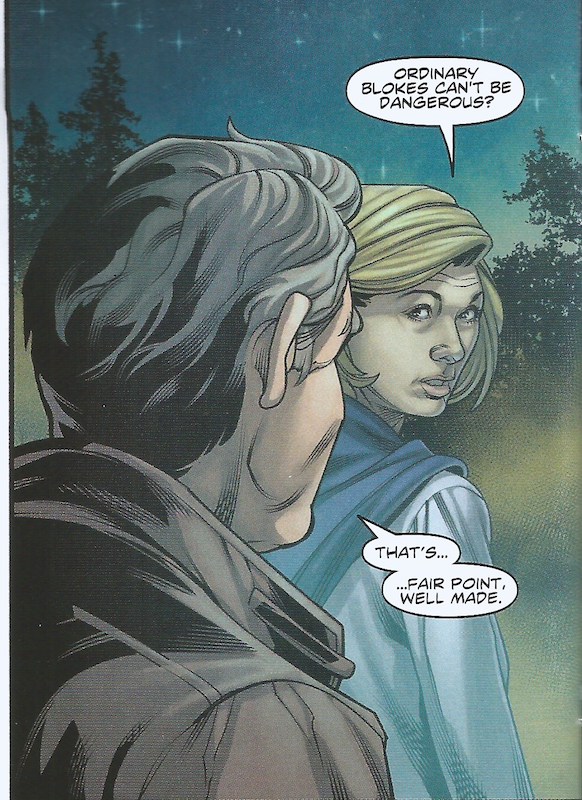
The companions Yaz, Graham and Ryan also reflect the actors. The dialogue by Jody Hauser furthermore picks up on the quirks and accents.

Our story begins with a pair of time travelers stealing a painting for reasons unknown. The Doctor detects their Vortex Manipulation devices and bounces across the cosmos to capture the proper signal. Upon rescuing one of the time travels, the Doctor lands in it as always, setting up the cliffhanger.

In Peter Pan, Wendy Darling sews Peter's shadow back to his person. Co-creator Ian Boothby alludes to that children's classic in his decidedly mature Exorsisters.
The second issue begins with an exorcism. A frightened mom hires Cate and Kate Harrow to rid her home of a demon. There's no hocus locus or speaking in tongues. Nope, the Harrows are hands-on gals. Kate literally pulls the demon out of its host, and Cate uses the bane of the demon to kill it ala Buffy.
This is merely the James Bond styled opening to introduce the main characters and their field of expertise. The lion's share of the book details the origin of Cate and Kate. It's not as simple as the birds and the bees. In fact Cate's Dad left her at an early age, and Mom sucks.

Mom attempts to find a job to support she and Cate, but throughout her tale, she blames her daughter for their plight. She doesn't put it in words, but she she keeps dwelling on Cate's piano lessons as being the proverbial straw.
Mom's quest leads her to what appears to be an honest trade in candle's sales, but these aren't ordinary candles, and when the other shoe drops, Mom makes a deal to save her skin. This is the deal that changes Cate's life forever.
Suffice to say, that not only do you enjoy lovely expressive cartoons from Gisele Lagace, but also you get such a brilliant, original concept from Ian Boothby.


