Showing posts with label Detective Comics. Show all posts

Wednesday, November 13, 2024

POBB November 11, 2024

Pick of the Brown Bag
November 11, 2024
by
Ray Tate

Welcome to the Pick of the Brown Bag a comic book review blog by yours truly Ray Tate.  Writer Tom Taylor begins his run writing Batman in the latest issue of Detective Comics.  


Taylor’s been Batman’s director before.  


Batman: The Detective
ISBN-13: 9781779519870
ISBN-10: 1779519877

I heartily recommend that collection.  Click on the link for my in depth review.  The book may look like DC’s version of What If.   Instead, Batman in modern day London investigates an attack on two of his colleagues: The Knight and The Squire.  The art by Andy Kubert adds to the worth.

Taylor also refined his take on Batman when the detective frequently guest-starred in Nightwing.


Awwww…Dude…

In Detective Comics, Tom Taylor offers readers a fresh start.  Taylor demonstrates who the Batman is.


Batman is a haunted individual forever wondering if he could have changed things back in the day.  In a way, his behavior reflects the greatest of all detectives Sherlock Holmes.  

Holmes left to his own devices sought the needle.  He detested being bored.  Solving crime gave Holmes succor.  When Batman doesn’t have a crime to solve, he turns to his tragic past.

Thankfully, yet unfortunately, a crime distracts Batman.  Only, it’s not what one expects.


With this scene, Taylor draws on Batman’s hatred of guns.  The cowardly Joe Chill used a gun to murder his parents.  Ever since Batman reserves extra anger for those who commit crimes with guns.  He also doesn’t like to work with people who use them.  

Batman controls himself.  He slaps the baby criminal with his open hand.  That’s however not enough restraint in his opinion.  In fact Batman would have been better off slapping Sam harder.  Knocking him out.  Preventing him from running.  A forgivable error from the man who is ten steps ahead.  

Batman gives chase.


This scenario combines Batman’s role as protector and his unmatched knowledge of Gotham City.  It’s subtle.  Taylor makes every word count, informs yet makes it all sound natural.

Sam is quite dead.  With Sam’s death Taylor begins the main detective story.  Batman seeks out the White Musk Killer.  


Batman is rueful over his actions.  As well, he begins feeling the realities of age hampering his want to save innocent lives.


Batman’s age is always a touchy subject.  Historically, Batman’s eighty-five.  He’s perpetually thirty to forty in the comics.  I usually pin-point him at thirty-five in context.  Giving Batgirl a twenty-five on the index and Nightwing twenty-three.

Taylor has enough wiggle room in the subject of Batman’s age to generate a new theme in his story.  He does this by first introducing a new character into the mythology.


I sometimes simplify comic book narratives.  In this way, I can better review a book and immediately argue its worth to the reader.  Or the opposite.  Taylor’s narrative jumps around time.  Comic books being a visual medium are really good for writers using this technique.  You always know where you are in the story.  You can see it.  

When Batman as Bruce Wayne speaks Scarlett’s full name, he’s referring to the flashback Taylor and artist Mikel Janin unveiled earlier in the story.  The idea of a character speaking another character’s full name is usually, usually, a lazy device countering realism.  In this case, Batman likes to say Scarlett’s full name because she honors his mother.


Taylor portrays the Waynes as wonderful people.  


This fits the longstanding history that when Joe Chill ruthlessly slays them, Gotham City starts to rot.  The area where Chill kills the Waynes known historically as Park Place is renamed Crime Alley.  

Taylor creates comic book writing I like.  On the surface Taylor’s creation is as open and clean as the artwork by Mikel Janin.  So easy to read.  So simple to comprehend.  Within the apparent economy of storytelling lies recursive complexity.  


Some bit of characterization is important to the plot.  Some bit of plot is important to the characterization.  Continuity feels like history.

Scarlett apparently grew up to become a genius.  She now offers that genius to Bruce Wayne.


Alas…There’s a chance Scarlett’s the mysterious villain Batman faces in the book’s time out of joint opening.  


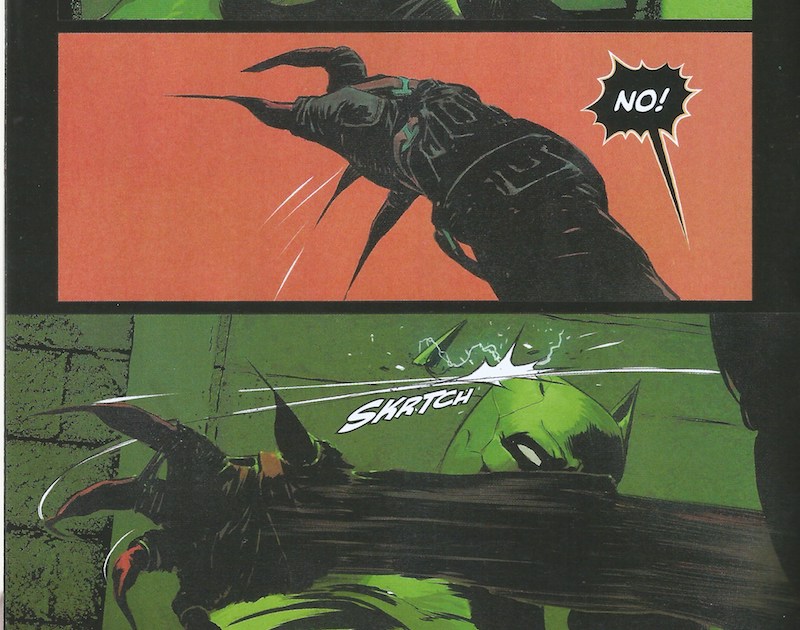
Back in the Bronze Age of Comics, Batman would on occasion lose an ear to an opponent.  He later turned them into welding torches for escapologist purposes.

Though I can’t help thinking that’s where my mind is supposed to travel.  The book is titled Detective Comics.  Taylor I expect is leading me to the dead end of a maze.

Tuesday, April 20, 2021

POBB April 15, 2021

Pick of the Brown Bag
April 15, 2021
by
Ray Tate

Welcome to the Pick of the Brown Bag.  For those of you who came late to the show, my name is Ray Tate, and I review comic books.  

I've been reviewing comic books since the nineties: on the usenet, Comics Bulletin and this blog.  No matter the strata; from raw, self-published independent to well known Marvel.  

Of late, I've been concentrating on the DC Multiverse.  After this post, I'll be breaking from their Infinite Frontier brand and returning to the potpourri approach.  You can also find encapsulated reviews on Twitter: #PickoftheBrownBag.


The Joker War took a big chunk of same Bat-Time.  It must have been successful because nobody wants it to stop, even if Infinite Frontier gave everybody an excuse.  

I've had good experiences with Mariko Tamaki's writing.  I liked her stint on Tomb Raider.  I enjoyed her run on X-23.  She gets Batman, and the artists uniformly present fresh dynamism.


Tamaki notes that Batman is far from dour.  He has a very twisted sense of humor.  Updated for modern times, Batman texts a knock, knock onomatopoeia and distracts his targets.  Sticking to the shadows, Batman scares the living hell out of them as he picks off the gang one by one.  I really couldn't ask for anything more.

Yet.  

I give up.  

The environment Batman now operates in isn't for me.  The creative teams seem unified.  There appears to be no escape from the lukewarm Mayor One-Eye and a mediocre supporting cast.

The patch doesn't make Mayor One-Eye any more intriguing.  Nick Fury, black and white, was just as interesting a character without the patch.   Neither can One-Eye be considered original. Rupert Thorne marketed the technique of legally stamping out Batman in the Bronze Age.


Rupert uses the full weight of his mob/political machine to ban the Bat.  He nevertheless maintains the pretense of being an upstanding citizen.  Rupert Thorne is ingrained in the Batman mythos for a reason.  Mayor One-Eye will be forgotten tomorrow.

Rupert debuted in the first issue of Steve Engleheart's historic run of Detective Comics.  Engleheart took great pains to explain Thorne's consistent presence in Gotham City.  Deborah Donovan exists in Batman just because DC Editorial says she does.


I'm sorry.  Where the hell did you come from? If you're the Kolchak of Gotham City, from when and how? 

Gotham City only had three journalists of note: Vicki Vale, Summer Gleason and Alexander Knox.  Deborah, you're older than Lois Lane.  How is it that I've never heard of you before?  Never mind.  I don't care.


I loathe all the leftover Joker War villainy.  Why do the antagonists need to be Joker-inspired thugs? Incidentally, we have a failure to communicate between Tamaki and artist Daniel Mora, however stellar.


Whoops.

That looks like jewel theft to me.  Other logistical problems manifest.

Bruce Wayne just happens to be at Mayor One-Eye's function, to gather intel.  The jewel thieves happen to break in at the same time Bruce is there.  They also somehow happen to elude the Huntress, positioned outside on page one.


She does nothing to stop the hoods.  She never cameos again in the book.  So, I don't know why she's also on the cover.  In fact, given her participation, why is she here at all?

This poorly planned heist isn't the gist.  The central mystery occurs within Batman's new sphere of influence.  


Something happened in the Joker War that reduced Batman's fortune down to measly townhouses and satrap caves.


I know.  I wish I were that poor.  None of this affects the way Batman operates.  So I don't know why you would turn your back on the cool robot dinosaur and the giant penny just to create a superficial man of the people.  I assume this is the whole purpose.  Batman's just one of us.  He's not one of the one percent.  

You know what never interfered in my relishing the Batman stories? Batman's wealth.  I never said to myself.  Gosh, I could appreciate Batman's superior intellect and his status as the World's Greatest Detective if only he weren't so wealthy.  

Never.  

No, I never aspired to be as wealthy as Batman.  I aspired to be as smart, skillful and good as Batman.  The whole idea of expunging Batman's wealth so he can crawl out of a sewer is ridiculous.

Batman's wealth is simply another tool to wage a war against crime.  Present tense.  Cause, let me clue you in on a little secret.  If you own multiple townhouses with caves under them.  You're still super-wealthy.  

In fact post Joker War Batman is still wealthier than the original, who only owned one stately Wayne Manor and the acreage surrounding it.  Batman happened upon the cave on his estate and gradually added more expensive equipment: the Batgyro and a modified roadster that would evolve into the Batmobile.  My point is.  You didn't go all the way.  Something tried before.  You didn't impoverish Batman, which would have sucked.  However, this wishy-washy wealthy but not business is just as bad.

Batman's fall from status reduces him to sleuth rather than professional.  See, if Mayor One-Eye weren't in charge, Commissioner Gordon would be calling in Batman to solve this kidnapping.  Who's Commissioner these days? Perhaps some chap with one ear.


Instead, Bruce just stumbles upon the mystery like a butch version of Jessica Fletcher.  Furthermore that five dollar price tag is a killer. I'm not poor enough to buy a townhouse.  Drop.


This is the first time since the advent of the New 52 Harley Quinn reconnected with continuity.  To be sure.  Harley Quinn appeared in DC proper, but she had nothing to do with the more familiar Amanda Conner and Jimmy Palmiotti incarnation.  That version of Harley Quinn joked through about sixty plus issues and three spin-off series.  Unfortunately, the newest volume of Harley Quinn is just another consumption of the Joker War.

You may argue that I'm being unfair to writer Stephanie Phillips. Surely, Harley Quinn in continuity would naturally, in some way, link with the Joker War.  I disagree, and that's mainly due to Riley Rossmo's art.


The illustration is so different from what is considered House Art or even classical comic book art, such as what's seen in Detective Comics, that it's better suited for an unique universe.  

Renewing and Rebirthing the multiverse was the whole point of Infinite Frontier, yet Harley Quinn is set in the Townhouse Universe.  I don't understand why.  

Palmiotti and Conner basically related their stories in a bubble.  I get the impression, they would have done that any way, whether or not a multiverse existed.  Just try to recoup as much as possible--an Earth-Two Power Girl for example-- before the editors caught on.  The Powers That Be at DC now have a contextual reason to do the same.  So, why not use it?

The best part of the book is Harley Quinn's quest to get a Bat Toaster.  

That's the kind of absurd humor I want to see.  The lion's share is underwhelming.  

The story opens in what looks to be a stand alone vignette with Harley apologizing to Killer Croc.  


I don't know.  Maybe their schism occurred in the Joker War.  Maybe not.  It's not important.  Gibing with the Townhouse Universe motif, Harley leaves the arena via a manhole.  She immediately meets up with some disgruntled Gothamites.  


I'll give Harley this.  She's exhibiting far more restraint than I expected.  You also won't find any slapstick violence in the style of Conner and Palmiotti.  A damn shame because I'm sure Rossmo would be astounding at the depiction.

Harley finally plays on team Batman.


Though it should be noted, Harley Quinn creators Paul Dini and Bruce Timm established Halrey's inevitable reform when they explained that she was in an abusive relationship with the Joker.  

This is why audience members were so pleased when Harley found Poison Ivy.  It's not the male gaze lesbian erotica.  At least not totally that.  With Ivy, she remains a criminal, but Ivy is a loving partner.  

Traditionally, nobody with a conscience likes a wife beater.  So, it's no surprise that Harley joined Team Batman or that Batman's checking up on her.

After explaining that she intends to apologize to everybody she hurt and make amends for her partnering with the Joker all these years, things become a little meta.

So, apparently, the Joker attracted a cult.  They tattooed his face on various parts of their bodies.  They did his bidding, and now, it's payback time for ordinary Gothamites.  


It's difficult not to see a parallel between the clown tattooed yahoos and treasonous bastards that attacked the Capitol at  the behest of Donald Trump.  Especially when one of the Gothamites speaks of accountability.  


Batman is of course a way better person than I am.  I'm not sure I would have lifted a finger to save a Capitol Rioter from being beaten up by a crowd.  The events culminate in a House of Mirrors where Harley makes a decision that I'm guessing is the theme of this series.


Good point about the medical license.  For those not in the know, Dr. Harleen Quinzel is a former Arkham Asylum psychiatrist, which means she's also, believe it or not, a medical doctor.  That's right.  Harley could have hung up a shingle had she not been brainwashed by the Joker.

One of the things about Batman: the Animated Series that I feel helped propel it to the level of love is that the writers never exalted the criminals to a higher level than they were in the original comic books.  

The Joker in the Animated Series is a dangerous, psychopath, but that's all he is.  He's not supernaturally persuasive enough to attract a cult.  He doesn't have the resources or the ingenuity to mount a successful war against Batman that leaves Gotham in ruins.  

Batman is a deterrent in the Animated Series.  Plain and simple.  The Joker can never be the almost James Bond villain he is in modern comics because Batman exists to thwart him.  

This is why I avoided the Joker War in the first place.  I am philosophically opposed to the whole concept.  For Harley Quinn.  Ignore.  Perhaps pick up the trade for Rossmo's artwork.

Gene Luen Yang adapted the Adventures of Superman radio serial, "The Clan of the Fiery Cross," into a superb all-ages mini-series; viscerally known as Superman Smashes the Klan.  I therefore shouldn't be surprised by the quality and pure fun of Yang's delightful debut issue of Batman/Superman, yet given the shape of the Batman titles, I am.


The book is four bucks, but you get two stories unfolding simultaneously, illustrated to utter perfection by Ivan Reis, Danny Miki and colorist Sabine Rich.  


Been a fan of Ivan Reis since his Ghost days.  I'm also aware of Danny Miki's accomplished inks.  I've never heard of Sabine Rich.  So, let me just emphasize despite Yang essentially relating two stories occurring in two different universes inspired by black and white serials, the colors are luxurious.

The mechanics of the tale unfold classically.  A threat presents.  The hero notices.  Takes a stand.  except each spool of film manifests a deeper secret to uncover.


Yang draws upon numerous old time sources to enrich the art team's vivid visual kinetics.  For example...

Carol Forman portrayed the Spider Lady in the Kirk Alyn Superman serial.

Gale Sondergaard debuted a year later as The Spider Woman in the Basil Rathbone Sherlock Holmes films.  Nobody called her Spider Woman in the movie, but the name stuck to her and became zeitgeist. 

Soon Spider Woman would become synonymous with femme fatale.  Yang resuscitates the Spider Lady for his spiffy double feature.

Looking smashing to boot, but Yang isn't just interested in bringing back memorable imagery to the World's Finest tales.  These changes pack substance and take full advantage of a multiverse.  So far this is the only book living up to the Infinite Frontier label.

If you'd like to take my word for it and subscribe or follow, nothing more needs to be said, but if you'd like a few spoilers to sauce the goose, read on.

S
P
O
I
L
E
R


A
H
O
Y

The premises of both filmstrip universes is that something changed to deprive the Superman period of Batman, and the Batman period of Superman.

The stories start out naturally with Superman battling a familiar bald gentleman and Batman pursuing the Rogue's Gallery from Arkham Asylum plus one.  Batman hunts in a superb reconstruction of the 1940s Batmobile.  His costume is a throwback as well.


Note how the creative team emphasizes the leathery texture, more organic look to Batman's classic costume.  The boots, the ears are all practical.  The cape snaps onto the collar of the cowl.  I love this.  Can this be Batman's look from now on?  

Superman also gets a makeover that mimics his original outfit almost perfectly, especially the trunks.  The only difference lies in the Shield on his chest.  The S replicates the era's S, but there's a few flourishes outside the original.


You think you have an idea of where Yang is headed until the very end of the book, where something truly weird and wonderful happens.  It's a surreal metaphor turned real.  That's all you get from me and spoiling all that was just traumatizing to a tight-lipped someone like myself.


Monday, November 9, 2020

POBB Nov 8, 2020

Pick of the Brown Bag
November 8, 2020
by
Ray Tate

Welcome to the Pick of the Brown Bag.  For those of you that discovered the blog late, my name is Ray Tate.


Sink Me.  I'm a poet.

I read and review comic books.  I first started the Pick of the Brown Bag in the nineties on the usenet groups.  I later became a part of Comicsbulletin.com before rebooting the POBB in blog form.  

This used to be a weekly column where I'd look at the best and worst of the Wednesday yield.  Practicalities of the world we now live in killed a lot of my free time.  I'm hoping to someday return to my normal schedule, but for the now, the POBB is an occasional publication.  

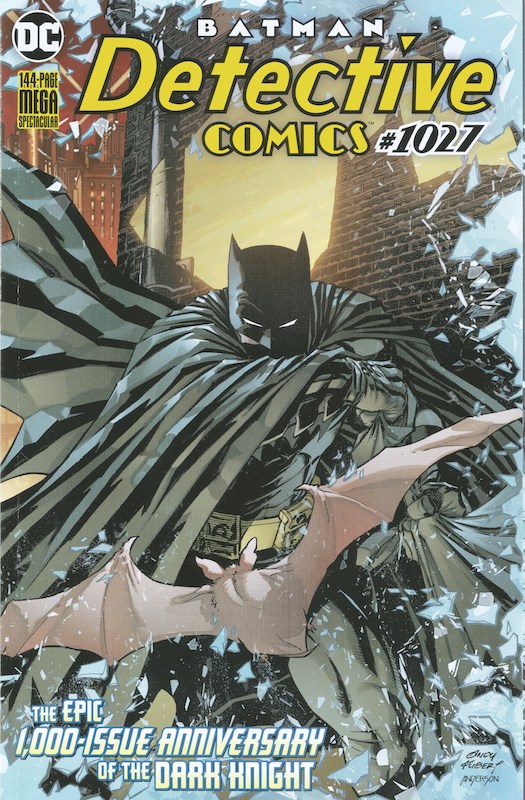
Today's subject is a Detective Comics special, likely still available at your local comic book store.  It can even be purchased at various book dealers.


What's so special about 1027? Batman first appeared in Detective Comics #27 in 1939.  


Yeah, that's pretty wild. 

Let's talk meat and potatoes.  The book costs 9.99, which is a bit pricey for a comic book.  However the Powers that Be at DC treat this issue of Detective Comics like a graphic novel.  

It's not floppy and benefits from a thicker, non-glossy paper-stock.  Square-bound, Detective Comics lacks advertisements and runs 144 pages; comprising twelve tales and the here and there pin-up.

Art by Lee Bermejo based on the 1940s Batman serial

Each of these stories offers something good for the Batman Family fan.  Even the writers I usually do not care for impressed me, and all the artists give their best.

A death trap courtesy of the current Detective Comics creative team opens the anthology.


For some, death traps are hoary melodramatic cliches.  I do not share that opinion.  I like a good death trap.  I think against larger than life heroes, they fit with the arrogance of the villain.

Tomasi revamps this particular Houdini stunt.  Through the villain's anticipations, he factors in Batman's past escapes, his skills and his tactics.

The gist of Tomasi's story allows for Brad Anderson, Andrew Hennessy and Nathan Fairbairn to dedicate a few pages to each of Batman's rogues gallery and gorgeously illustrate either actual moments from the Caped Crusader's crime fighting career or unseen tales.


Why, yes, Batgirl's eyes are blue.  Why do you ask?

Our Dark Knight foils the trap-master's ploy through a traditional Batman method.  Esoteric knowledge that some may consider a cheat or as equally cheesy as a death trap.  Once again, I do not share that opinion.

Murder attracts the entire Batman Family in Brian Bendis' and David Marquez's pleasant read.  


Blue eyes courtesy of Alejandro Sanchez


Who killed Gotham City Police Detective Dungeon? The World's Greatest Detective teams up with his prized students: Batgirl, Robins, plural, Nightwing, Red Hood and Spoiler to determine the truth.  


Oh, I should point out that a lot of these stories only pay lip service to continuity, proper.  Though if you're really obsessive you can place this short before the shot to the scalp that made Dick Grayson not dead, but screwy in the head.  

As you can see by the acrobatic pose, David Marquez presents each hero with distinctive visual personalities, adding to the quality.  Some of this is no doubt stage direction from Bendis, but the subtle movements of the characters I expect is all Marquez.

The next tale by Matt Fraction is a dark comedy in which we discover the Joker gives Batman a birthday present every year.


I'm not a fan of villains.  You'll never see me wearing a tee-shirt that celebrates the Joker.  Even I must admit.  This investigation is funny and twisted.  It brilliantly demonstrates that chaos is the logician's nemesis.  

Chip Zdarsky, known more for his writing, provides technically accomplished artwork.  You may be very surprised by how good Zdarsky's tableau looks and how it resonates through a range of mood and tone.

Greg Rucka is a former Batman writer.  He also created the highly regarded spin-off Gotham Central which focused on Gotham PD.  His contribution to Detective Comics blends the two works.  

The focus character is a rookie police officer.  Hence the name of the story.  Batman operates tangentially.


The rookie enters Gotham Academy and stays clean while operating amongst a group of corrupt cops.  

Smudges of dirty cops in Gotham City always irk me.  In Year One, Batman waged a war on Gotham corruption.  That campaign should have been successful at the very least by Year Three.

It's believable that some dirty cops like flies may gather and think to start up the band again.  It's unbelievable to think Batman would let that happen. 

Rucka's story works as a personal vignette for the rookie as well as an exemplar of Batman's decisive presence.  He inspires and determines the honesty of Gotham Central.   

Artist Eduardo Risso presents duality in a brevity of pages.  He contrasts the realism of the Gotham City street against the fantasy of a hero in black who lives in a cave with a magnificent computer and a robot trophy dinosaur.

James Tynion's "Ghost Story" isn't just an outstanding Batman and Robin duet.  It's also the best Deadman story I've read since the post-Crisis began back in the 1990s.  I kid you not.
  

Created by Arnold Drake and Carmine Infantino, Deadman is the spirit of a slain acrobat named Boston Brand.   The deity Rama Kushna employs Deadman as her agent and grants him the power of possession.  During Deadman's hunt for the Hook, the lone sniper that murdered him, Boston meets Batman and artist Neal Adams who puts the Deadman feature on the map. 

While ostensibly writing just a throwback team-up that pits Batman, Robin and Deadman against a new spectral foe, Tynion provides depth to Batman's character.  We discover why Batman isn't afraid of ghosts.

"Ghost Story" is Deadman tonic after Brian Azzarello's character assassination in the bloated, gassy Batman: Damned.  Tynion's words and Riley Rossmo's playful art make the narrative a joy to follow.  Colorist Ivan Plascencia compliments with a bright, cheery palette that suits the freewheeling mood. 

Kelly Sue DeConnick, mostly associated with Marvel Comics, presents a rare Batman story that demonstrates Batman and his alter-ego Bruce Wayne making Gotham City a better place.  


Half of the tale takes place in the rain.  There Bruce plays a stupid golf game with an unscrupulous businessman that's also dirty in crime.  His name is Mr. Steele.  No relation to Cliff.

The second half drops in a recent flashback where Batman breaks Mr. Steele's racket and uses his methods to find out who's the boss.  

As with "The Rookie," DeConnick's story deals with crooked cops in a smart way.  John Romita's artwork energizes the optics of the whole affair. 

Marv Wolfman, scribed Batman for a short run and The Teen Titans for oodles of years.  In "Odyssey," Wolfman connects the clues for a strong detective yarn.  Wolfman's tale also adds to the reading pleasure by updating a handful of gumshoes that moseyed through the pages of DC Comics.  


The legacy of Roy Raymond TV detective, Captain Mark Compass, Slam Bradley and Speed Saunders combine forces with Gotham sleuth Bruce Wayne and Batman.  Together the investigators solve a historical mystery on the Scottish Coast that ties into Wayne Family history.   


I'm of two minds about the artwork.  Emanuela Lupacchino is best known for her cartoony style vividly displayed in the too quickly cancelled Starfire.  The presence of legendary Bill Sienkiewicz as inker results in a grittier look to Batman.  While the images of regular folk at times resemble a cast Neal Adams may have illustrated.  Mind you.  I love Jordie Bellaire's nuanced colors.  Nevertheless, I'm curious to know how the pencils appeared before embellishment.

Grant Morrison goes straight for the funny bone with "Detective Comics #26."  An above average wannabe Mystery Man after studious research becomes...


He even puts together pieces of "The Case of the Chemical Syndicate," Batman's first foray.  Alas, things don't go so well when Batman shows up. 


Artist Christopher Burnham infuses the original Batman adventure with an astonishing amount of energy.  He replicates the events to the letter but creates kinetic imagery unheard of during the historical period.  

I'm being pretty cagey with the graphics, and that's because I don't want to spoil a single of the laughing Scotsman's perfectly executed jokes.  Trust me on this.  "Detective Comics #26" is laugh out loud funny.


Tom King, him again, and Walter Simonson also re-imagine a Batman episode.  This time, Batman's fight against Dr. Phosphorous.

There's not a whole lot I can say about this thoughtful exercise in history.  Walter Simonson co-created the glowing ghoul, based in part on Golden Age foe Professor Radium.  It's fitting that Simonson solos in the orchestra that Tom King conducts.


For those not in the know, Tom King in his impressive run of Batman restored much of the Batman Family's classic and Bronze Age stories.  I respected and enjoyed the hideous amount of Batman goodness that King produced.  

This piece is the final piece in the continuity King rewove.  Starting in the street, reaching a crescendo with Batman and Catwoman, following through with the birth of Helena Wayne and finally concluding here.

Before Tom King, Scott Snyder was Batman's mad guru.  He returns with "As Always."  Commissioner James Gordon narrates, and in this narration, you can feel the friendship he shares with Batman.  


That hasn't always been the case.  

Historically, Gordon is as old as Batman.  He also premiered in "The Case of the Chemical Syndicate."  


From 1939 to 1941, the Gotham P.D. officially hunted Batman.  Treated him as a vigilante.   Then, something weird happened.  Gordon shook Batman's hand and in a succeeding story granted him special deputy status.  Since these canonical moments unfolded, Gordon and Batman became trusted allies and at least by the 1950s friends.

The hunt, the meeting, the alliance and friendship rewound through every new reiteration of the Dark Knight and Lieutenant James Gordon.  The friendship fractured at times, and occasionally it stopped making sense, but history always seemed to repeat itself regardless of the context of fiction.

The Bat Signal, constructed in 1942, is a symbol of Batman's and Gordon's long history together.  When real-life Batman Adam West died, Los Angles lit up City Hall with a make shift Bat Signal.  Snyder's story is about the signal and the friendship of two men making Gotham City a better place.

The story begins with the definition of a Black Rooster Case. This is essentially something that looks big but turns out to actually be small.  The story segues to Batman being called to the Justice League satellite where he discovers the League detected something affecting the sun.


Gordon learns of this second hand, but just having the knowledge indicates what Batman thinks of his friend.  Gordon then imagines the events that led up to the discovery and how the League addresses the situation.  This is where Justice League artists Ivan Reis, Joe Prado and Marcelo Maiolo express their imagination.  


The editing knocks me out the most.  Snyder begins the story with tradition.  He flashbacks to explain the verbal McMuffin.  The artists create a mini-Batman story within that explanation.  Batman's called to the Justice League, where the gist unfolds.  The League investigate.  The artists create the essence of big blowout issues where the League facedown their most powerful foes.  They consult with their friends and colleagues in the summation of fan-bait team-ups.  They cannot find the solution.  Batman figures it out, and his answer recapitulates to the beginning of the story and the verbal McGuffin.  The creative team accomplish this breadth of plot and information, this scope of street level to cosmic all in twelve pages.

Dan Jurgens, not really a Batman writer.  However, Jurgens had his run-ins with the Caped Crusader in crossovers and Big Events.  He often made Batman a pivotal part in his story.  In this tale Jurgens produces words and pictures.


Jurgens cleverly uses Batman's status as the inheritor of Sherlock Holmes who eliminates the impossible in the opening.  Jurgens also corrals Kevin Nowlin, an excellent known quantity Batman artist for finishing his bare bones illustration.  The combination creates a sense of certainty in reading.  Ah, hah, says you, what I'm actually perusing is a variation on The Hound of the Baskervilles.  

When Jurgens adds a new wrinkle to Batman's first-person narration that reveals the madman behind the whole plan you cannot help but applaud.  The confrontation is special.  The conclusion expected but exciting no less.  You think the story will end, but turn the page, and the tale goes off the rails in a good way.

The final story by writer Mariko Tamaki introduces the Joker War.  Generally speaking I've enjoyed Tamaki's writing.  You'll find reviews on this blog of Tomb Raider and X-23.  I plan on giving her new run of Wonder Woman a go.  

At the same time I usually hate Big Stupid Events.  I've avoided the main Joker War thing, mainly because I'm not hung up on villains.  They don't appeal to me.  By dint of subscription, I do have some of the Joker War tie-ins, and I'll be doing a special POBB for them in the future if I spot something notable.  

Tamaki's tale serves as a prelude to the Joker War is good because of what it's not.  The Joker material is almost incidental, which works in the tale's favor.  It could have been any madman creating havoc.  It didn't need to be the Joker.  There's nothing significantly Jokerish in the story.  No "rictus grins" for example.  Not even extortion.

The story opens with Bruce getting ready for patrol.  For some reason, he's staking out a target at a hotel.  Soon, though, he's off into the night, investigating a break-in at Wayne Enterprises and saving cops from being diced in the crossfire.  Typical Batman stuff with his thoughts turning to his father, and artist Dan Mora and Tamra Bonvillain providing a neon-noir.


And that's all folks.  One last inside cover pin-up before the book bows out.  I think you'll agree, this is a lot of entertainment for the value.  1027 also may be that perfect Christmas Gift for the casual Batman fan on your list.  These stories require no deep dive into Batman lore nor an understanding of how he is now, just a love for the character and the want for good, solid detective stories accented by great art.