Pick of the Brown Bag
September 9, 2015
by
Ray Tate
The Pick of the Brown Bag faces a killer week of comic books including Amazing Spider-Man: Renew Your Vows, Batman and Superman, Doctor Who, Earth 2 Society, Gravedigger, Harley Quinn: Road Trip, Justice League United, Holy F*cked, King Tiger, Little A vs. X, Onyx, Red Hood and Arsenal and Starfire.

All the pulp staples punctuate the visual excitement of Gravedigger. The intelligent woman betrayed by her greed and short-sightedness.

The duped gang of killers who see the light too late. The familial bonds that lie in the center of a maelstrom that threatens to pull the framed man down.

These plot devices smolder in panel after panel of kinetic energy and Lee Marvin coolness courtesy of Rick Burchett. They finally roll like a filmstrip into a duel to the death that fosters a vicious climactic bite.

It’s always nice to be surprised by a book. King Tiger appeared to be about a master of sorcery and martial arts who chose to defend the world after being a ne'er do well. You know, the usual entertaining stuff that feeds comic book fans.

The varied menaces all link to King Tiger in a strange way and present ample opportunity for Tiger to demonstrate his prowess. Writer Randy Stradley is after a little more than the typical fare. He reveals the secret behind the plot and how King Tiger fits in.
Stradley performs this feat with the perfect timing of artist Doug Wheatley. Together they proceed to engage in a psychological torture wringer for one of the cast.

In the end, our hero lies demoralized and defeated. Friendless, without love or even honor.
King Tiger makes you think it's something that it's not then pulls the trick again at the very end for a devastating line and look that serves as the perfect cliffhanger.

It looked bad for Spider-Man. Regent placed him under glass and absorbed his Spider-Sense, but Spider-Man possesses what few heroes do. A family.
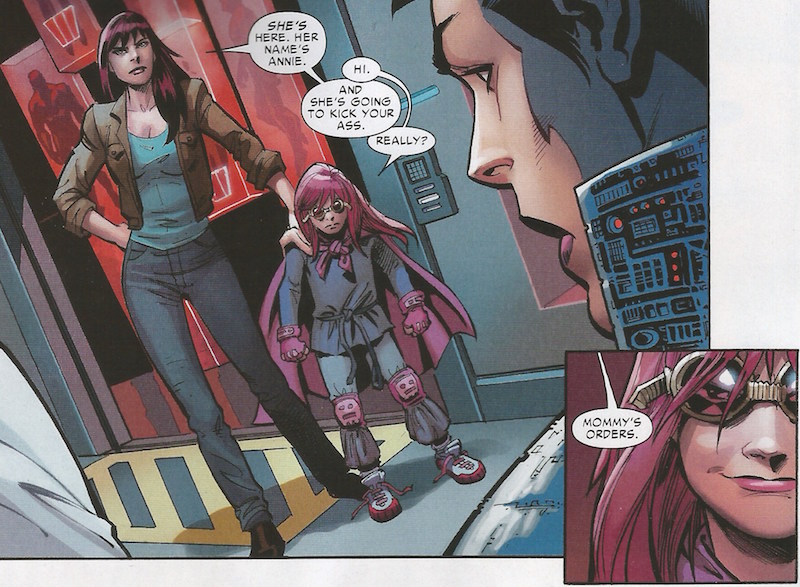
The satisfying conclusion to Renew Your Vows puts an end to Regent and his threat to the Parkers. Everything about this mini-series was smart. Mary Jane’s contribution. Annie’s emergence. Dynamite heroism from Spider-Man, and the exploitation of his brilliance. The epilogue furthermore suggests a longevity beyond the mini-series, which is a nice thought.

Little A vs. X ends hilariously with twins Zach and Zoe finding the right group to join. Before that, the little Avengers and X-Men face off against Little Medusa and the Inhumans.
Medusa’s offer isn’t the greatest thing under the sun, but it does lead to a killer bit of slapstick from Black Bolt and Cyclops followed by a visually funny four page spread of everybody battling the crap out of each other. This amusing little mini-series never really disappointed and was a highlight of the whole Battleworld shindig.

Holy F*cked. You know I can barely review this. Jesus and Satan are a couple. Maria gave up her habit for helping the unfortunate, and Hercules seeks vengeance for his father Zeus. I’m sorry if this seems vague, but the gags start right after Jesus reveals skateboard juice and don’t stop. Watch out for that shower scene. That’s all I can say.

Amanda Conner and Jimmy Palmiotti are on deck for two comic books this week. First, another Harley Quinn special. Obviously Road Trip is full of gags that will definitely produce the yuks. So I'd like to address the subtler aspects of the book.
Conner and Palmiotti characterize Harley Quinn deeper than most. Primarily the duet of writers maintained the Bruce Timm origins of Quinn; Arkham psychiatrist brainwashed by the Joker to become his henchwench, but in Road Trip they suggest how it was done.
Harley acquires an RV motor home from her deceased Uncle Louie, and she will use the vehicle to transport her Uncle's ashes to Los Angeles where they will be interred at the cemetery where her aunt is buried. This catalyst allows Palmiotti and Conner to walk down memory lane where you see Harley as a little girl.

Harley's childhood doesn't fit with the traditional criminal hell that offers little hope and facilitates a turn to felony. Harley is actually quite happy and creative as a little girl. You can easily imagine her growing up to be the Quinn you see today, albeit without the homicidal past.
I propose that Harley's stint as a psychiatrist was actually an anomaly and that perhaps the Joker tapped into the little girl that was seeking expression. That’s how the Joker twisted Harley’s mind. Without the Joker's influence, Harley might have retired early from the psychiatric field and become an artist or a writer. Timm and company meant Quinn to be that psychiatrist just to show how powerful the Joker's will can be. However, Palmiotti and Conner have done a lot of work to stabilize Harley and insinuate her into society. As such, their treatment of Harley Quinn is richer, and it all meshes together quite well.
Harley calls upon Poison Ivy and Catwoman to accompany her on her road trip. This roster exemplifies Conner and Palmiotti picking and choosing their continuity. In this history, Ivy's not a murdering psychopath who hates humanity and loves only plants. Let’s face facts. We don't want her to be. The majority of readers are rational human beings that care what happens to the planet. That's why Ivy's ecological slant is so appealing. When Duane Swierzynski reintroduced Ivy as a bona fide protagonist in Birds of Prey, it felt right. Ivy is better described as a vigilante. She's taking the law into her own hands, and even Batman seems sympathetic.

Batman makes only a cameo appearance in Road Trip, once in the Ivy vignette and again in Ivy’s hallucination, brought on by laced soda pop. That will make sense when you read the special. It's fitting that Batman should appear since he has provided impetus to all three of the ladies' lives.

The other companion Harley Quinn calls upon is Catwoman. In the new 52 Catwoman and Harley do not know each other. Once again Palmiotti and Conner invoke the Timm Exception. The trio made infrequent team-ups on the animated series Gotham Girls, which was collected as extras on the Birds of Prey DVD set. Another reason why this underrated television show should be on your binge list.
With the companions simpatico, Harley begins her laugh-filled road trip, and along the way, Palmiotti and Conner nod to the lesbian relationship first inferred by the audience of the various Bruce Timm animated series. What's different is that Harley appears to be equal to Ivy in pursuing such romance. On Batman: the Animated series, Poison Ivy was clearly the dominant individual in the subtext.
Unsurprisingly, Conner and Palmiotti are not interested in creating a threesome with Catwoman, whose bisexuality was introduced recently in the new 52. In fact, they make the point of reinforcing Catwoman's love for Batman. This is not to say that Catwoman cannot be interested in women as well as the Dark Knight. She’s just not interested in Harley and/or Ivy. More importantly, Palmiotti and Conner eschew the mobbed up goings on in Catwoman’s series, which bore me to tears.

They instead recreate Selina as an honorable thief in a character arc that involves Selina outwitting dorky villain Darkwolf who has all the impact of Brother Power the Geek. Darkwolf is likely based on the Chuck Dixon comedy nemesis Hellhound, who barked in the Balent days and also coincidentally carried all the impact of Brother Power the Geek.

In terms of illustration, Harley Quinn: Road Trip is a good girl art extravaganza; the lion's share courtesy of Brett Blevins who is something of an expert in the field. There's no exploitation involved. Blevins who has done more risqué drawing is clearly restraining himself from going too far. Blevins was also the storyboard artist for numerous episodes of Batman/Superman: The Animated Series. So he knows about standards and practices. In any case, the moments of comic spectacle far outweigh the entertainment value of scantily clad ladies. Also, when the cast wears skin tight uniforms or skimpy clothing, the results are very tasteful, with Blevins emphasizing the female physique, not pulchritude.

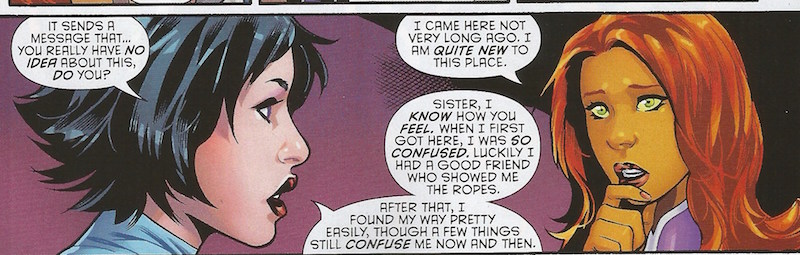
Of the two books on Palmiotti’s and Conner’s docket, Starfire is in my opinion funnier than Road Trip. Starfire’s comedy arises from the alien nature of the orange-skinned centerpiece. Starfire is not trying to be funny. This is just how she behaves. Starfire thinks she’s a straight man. In truth, she’s an unwitting comedian. If Starfire ever told a joke, we probably would not understand it. She comes from a different culture. With the addition of Terra, also from a unique culture, the unintended comedy just doubles.
Harley Quinn isn’t really set in a world that’s reflective of our own: continuity be damned and an occasional lapse of physics. Starfire is. All the people surrounding Starfire mirror normal appearances and normal personae, and while supporting cast member Sheriff Stella Gomez’s outburst may have been patterned on Kermit the Frog, it’s not that she’s attempting to be comical. Starfire’s and Terra’s non-human reaction to the spasm turns the situation funny.

Emanuela Lupacchino is one helluva find.
Like Harley Quinn, Starfire is a treasure trove of information that goes beyond the realm of funny. In the pre-Crisis, Kori got beaten up badly and tortured. At one point, she was even hospitalized. Palmiotti and Conner suggest that Starfire is actually in the range of Superman/Supergirl power.

Starfire’s creators Marv Wolfman and George Perez never advanced such a thing. Though last issue, the duet of writers also implied that unlike the Kryptonian cousins, Kori can dwindle. Kori’s like a rechargeable battery. Superman and Supergirl are dynamos of stored solar and kinetic energy.
It’s actually Superman and Supergirl that set the precedent. The scientific reasoning for most of Superman’s and Supergirl’s abilities lies in growing up on a planet with a higher gravitational pull. This explanation fell by the wayside in favor of the yellow sun fueling their mitochondria. So, Conner and Palmiotti took this idea as an undeveloped DC theme. Some alien species can harness the power of the yellow sun to become supermen. Daxamites like Mon-El replicate the feat. It’s reasonable to conclude the same goes for Tamarans like Kori.

When Conner and Palmiotti turn to Atlee alias Terra, they preserve all of her history from Supergirl and Power Girl. Palmiotti, Justin Gray and Amanda Conner combined forces to reintroduce Power Girl to a less than receptive audience. At the time, DC was still being viewed by people who thought it was just dandy that Power Girl was an ancient Atlantean and great, great granddaughter of Arion. Palmiotti and Gray defied that idiocy. They made Power Girl the last survivor of the pre-Crisis. In other words, their Power Girl was the original created by Gary Conway, Ric Estrada and Wally Wood.
The Power Girl in Starfire and the Power Girl in Harley Quinn and Power Girl are one-in-the-same. This despite the idea of a really flexible reality associated with the Harley Quinn books. She’s also the Power Girl from the post-Crisis and pre-Crisis whom Palmiotti and Gray revealed were one in the same; most of her memories just didn’t survive the transition. Where does new 52 World’s Finest come into play? In the past. I propose that the Palmiotti/Conner books are all set in the future, and that Power Girl will return to earth one. On the other hand…

It appears to be the time for deeper than expected characterization and history. The usually uproarious buddy comedy Red Hood and Arsenal this week is a mostly serious affair although still written by Scott Lobdell.

Red Hood believes that the fascinating concept of Underbelly, originated in Gotham City, specifically during an episode where he was Robin to Batman.
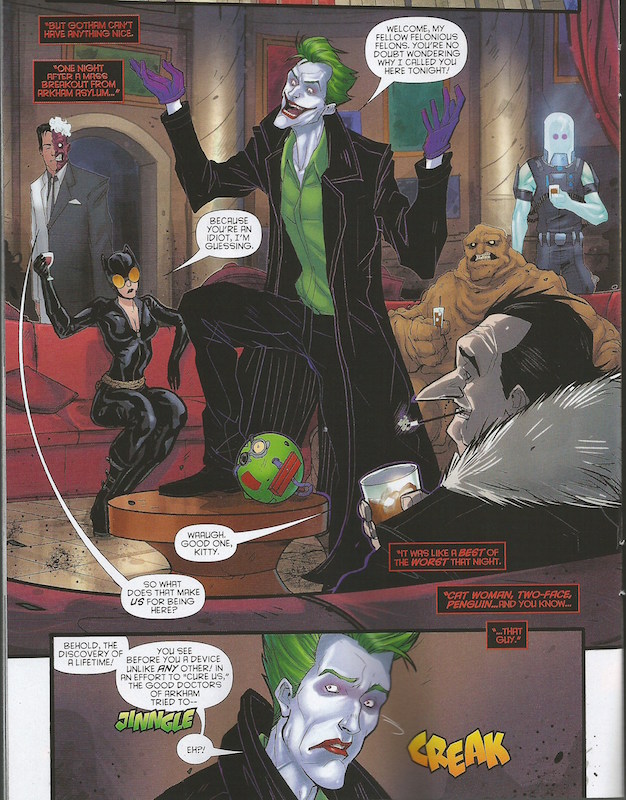
Very rarely does Jason ever remember in yellow, red and green. This issue, with its coming home again motifs, he does. That’s not all Jason remembers.

The random meeting grants Jason more of the illusion of life. He’s not just Abbot to Arsenal’s Costello. He’s a meaningful character in a series of stories. While this may appear to be an act of desperation to build on a shallow figure’s background, it’s really not. That’s because despite Red Hood being a horrible concept, Jason Todd since bursting on the scene of the new 52 has gained so much gravitas.
Ignore the fact that he assumed the former identity of the Joker. Ignore the fact that he came back from the dead in the most unlikely way possible, and he becomes the prodigal Robin from Batman’s past. The Robin that didn’t work out because of an intrinsic philosophical disagreement. Jason felt it was all right to eliminate the opposition, even when they were human.
Previously, Jason was a phone-in-and-kill-the-sidekick gag. He was nothing. He was still nothing in the post-Crisis; DC kept playing fast and loose with whether or not Red Hood was Jason or Clayface or Parcheesi, but in the new 52, Scott Lobdell generated real tension between Batman and Jason that finally broke when Batman became a human being in the new 52 and Jason stopped blaming Batman for his own problems. So Jason’s revelations this issue evolve rather than stick on.
Arsenal also becomes more than just a cracker of jokes. He’s an alcoholic, something that shouldn’t be ridiculed. Lobdell explores Arsenal’s sobriety with a visit to Killer Croc.

Now, everybody knows that Speedy was originally Robin to the Green Arrow’s Batman, and there was nothing wrong with that, especially when amongst the The Seven Soldiers of Victory in Leading Edge comics.

Then comics had to become relevant leading to this now hilarious moment in comic book history.

Marv Wolfman, a fine contributor to terribleness in his own right, did something rather good in The New Teen Titans. He brought Roy Harper back clean.

He used the whole we can be Marvel fad to create a story that while still being relevant nevertheless surged with the idea of Roy being a survivor, a hero for beating his addiction. That was easily the last really good appearance of Roy Harper until Red Hood and the Outlaws.
The Bat Bunny incident is almost incidental to the meat of the tale, which all lies in the characterization, yet the battle against the new Batman still offers the reader some entertainment beyond comedy. So overall with a surprising amount of depth Red Hood and Arsenal outstrips a lot of books on the racks including the Batman and Superman titles.

Bat Bunny also manifests in this week’s Batman/Superman. This is where Greg Pak goes too far. The inclusion of Aquaman to an otherwise tightly written team up of crappy versions of well known super-heroes just doesn’t make any sense.
Wayne Technologies created an artificial sun. Ukur, the warrior from Subterranea, introduced in Action Comics wanted the sun for his world, which was unfortunately forever altered by Superman’s humanitarian interference. Ukur now includes humans that escaped the Batman/Joker endgame under his protection. Ukur isn’t the only player in this solar shell game. The racist faction dubbed the Dawn Order also want the sun. Superman wants to believe that he’s still super even without the full gamut of his powers. Bat Bunny just wants this madness to end. Can you see Aquaman fitting anywhere? He just seems to be here to say “Hey kids, new Aquaman, not like your Daddy’s Aquaman.” Except. He is.

Pak treats Aquaman better than Cullen Bunn, who as I have said before turned Aquaman into Arion. Here, Aquaman’s got Atlantean strength, a trident that’s only a trident and not a sword. He controls the beasts of the sea. There’s no magic involved. He’s just drawn differently.

The best part of Batman/Superman occurs at the end where Pak recapitulates his onset of the series. Clark and Bruce meet again, but neither is the man he used to be. Still, to get that, you’ve got to wade through a confusing mess. At four bucks, that’s not worth it.

Earth 2 Society is also not worth it. I didn’t follow the series that came after the winning Earth 2, but Val-Zod was interesting for two reasons. One, he was the son of Zod. Two, he was a pacifist. All these super-powers, and he foreswore violence. He still saved lives, but he defied convention.

Turning Val-Zod into another flawed, caped asshole is really dull, and why all this sudden love for Terry Sloan, who betrayed Batman, Superman and Wonder Woman and the entire world because capable of defeating Darkseid with a specific plan? Terry Sloan was nuts, and trying to show him otherwise is a fail.
Nevertheless, the new Batman investigates the suspects that might have been responsible for killing, beloved Terry Sloan.
I like the call back to a classic Justice League of America, and I would find it hilarious if it turned out the Spirit King killed Terry again.

Val-Zod is suspect because we learn that he’s been keeping a pretty nasty skeleton in his closet that triggers the break-up of he and Power Girl. This also necessitates a scene with Power Girl holding a gun. Power Girl with a gun. So very nineties.

The reasoning behind this little foible is that earth two two orbits around a sun sun. One of the suns is red. So Power Girl and Val-Zod lose their powers. There’s that yellow dependence again. The binary system does two things. One it highlights how badly the yellow sunlight explanation is. Two, it excuses gun-toting Power Girl imagery. Except it doesn’t.
I don’t think writer Daniel Wilson gave earth two two a sun sun to fulfill a wet dream of Power Girl packing more than plump pumpkins. He just thought. “Hey, I can make Power Girl so helpless that she’s forced to pick up a gun.” See how terrible an idea that is? Power Girl is helpless. Just because of the lack of yellow sunlight? I don’t think so.

Justice League United already an impressive variation on Justice League Taskforce improves with the addition of Paul Pelletier.


Gritty Sergeant Rock meeting urbane Vandal Savage in the demolished theater of World War II. It’s scenes like this that make me wonder why Viagra exists. Why has nobody ever thought of doing this until now? It makes so much sense.
Vandal Savage is an immortal. He can guest star anywhere at any time. The idea of his clashing with Sergeant Rock is such a no-brainer. This is what continuity is good for, and why I love shared universes so much.
This whole shebang is just fascinating. Right up front. I still don’t care for the split between Alanna and Adam Strange. It’s even worse when the Zeta Beam was just a teleportation phenomena. Maybe before Parker leaves the title, he’ll repair this damage.

Paul Pelletier makes a simple gathering of teammates and exposition of the story so far beautiful. Kudos also to Jeromy Cox. A pity DC's color gremlins are going with green eyes, but kudos anyway.
In any case, the conceit allows for the story to begin. Adam is now a Power Zeta type and can see where a threat to the world or the universe begins. He also has magnified intelligence that allows him to predict which operatives will best enhance the mission’s success.
Even though Justice League United is a mission, the heroes aren’t soldiers, and there’s very little military themes involved. Rather, they operate more like a cosmic IMF.

That’s Impossible Mission Force, not International Monetary Fund.
Our team this week is Batgirl, Steel and Robotman from the Doom Patrol. Oh, and a little ol’ immortal named Vandal Savage who doesn’t take kindly to being recruited. Adam Zetas the team to…

It’s here we learn that somebody has kidnapped soldiers from different times and places to fight their war somewhen else. How does this particular team extricate a time traveling puzzle, and what do they contribute to the strategy quickly becomes evident in action-packed panels.

It’s here we learn that somebody has kidnapped soldiers from different times and places to fight their war somewhen else. How does this particular team extricate a time traveling puzzle, and what do they contribute to the strategy quickly becomes evident in action-packed panels.

Fortunately, the new 52 Robotman is made of stronger stuff than his Silver Age originator, but this is precisely what Robotman did in the Doom Patrol series. He at times demolished his body. The body was expendable. The brain it housed was not. Steel is Dr. John Henry Irons. So he’s the guy doling out the scientific explanations. Vandal Savage has years of experience that gives him insight into The Art of War. Batgirl. Batgirl’s just cute.

No. She’s an arch observer. As the story progresses, more and more guest stars arrive on scene, in perfect character and appearance. Oh, and there’s that cliffhanger.


George Mann writes a done-in-one Doctor Who that pretty much captures the flavor of the show. Something alien happens in a recognizable time period that mixes and matches fact and fiction. The Doctor arrives. He sorts it out usually with an explosion or fire. Oh, shut up. You know it’s true.

The TARDIS materializes in Regency era London. There, the Doctor and Clara meet two lovely girls named Charlotte and Ellen. The meeting facilities the Doctor traveling to North Lees Hall to discover a house besieged with dreaming sickness. The Doctor smells something afoot.
Mann characterizes the Doctor and Clara beautifully. He reconstitutes their onscreen chemistry. Artist Marciano Laclaustra and Luis Guerrero further Mann’s aims with dead-on likenesses of Pater Capaldi and Jenna Coleman. In addition their interaction appears completely natural and bears none of the stiff photostills that can plague some spin-offs. They're full of liveliness these characters.
The supporting cast offer an engaging dynamic that reinforces the period, while not undermining the Doctor/Clara double-act. If anything they serve to enhance it.
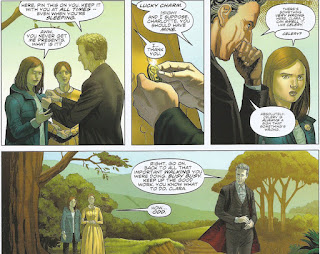
Clara can still be stunned and flummoxed by the Doctor’s behavior, and the inclusion of historical figures that have no idea of who he is or what he’s up to gives you a neat little gauge of just how eccentric the Doctor looks. Clara’s been with him the longest, and she still cannot decipher his actions until the results become apparent, but to Charlotte, he’s at once an enigma worth learning about and something that can never be understood. The truth doesn’t disappoint either. The alien creation is at least as impressive as some of Doctor Who’s minor monsters, and it blows the third tier monsters away.

A different defender of the cosmos arrives by way of Rom: The Space Knight in Onyx. That’s not inference. “Storytellers and creators” Gabriel Rodriguez and Chris Ryall admitted to harboring Rom love, as should we all, and that Onyx is their version of Rom. It is thus interesting to see how the two Space Knights compare and how Rodriguez and Ryall accomplish the same goals of Rom without copying word for word the majesty of Rom.

Clara can still be stunned and flummoxed by the Doctor’s behavior, and the inclusion of historical figures that have no idea of who he is or what he’s up to gives you a neat little gauge of just how eccentric the Doctor looks. Clara’s been with him the longest, and she still cannot decipher his actions until the results become apparent, but to Charlotte, he’s at once an enigma worth learning about and something that can never be understood. The truth doesn’t disappoint either. The alien creation is at least as impressive as some of Doctor Who’s minor monsters, and it blows the third tier monsters away.

A different defender of the cosmos arrives by way of Rom: The Space Knight in Onyx. That’s not inference. “Storytellers and creators” Gabriel Rodriguez and Chris Ryall admitted to harboring Rom love, as should we all, and that Onyx is their version of Rom. It is thus interesting to see how the two Space Knights compare and how Rodriguez and Ryall accomplish the same goals of Rom without copying word for word the majesty of Rom.
First and foremost Onyx is female, and she may or may not have bonded with her armor. Whatever the answer, she hasn’t totally lost her humanity, or is this face a monument like that of Robocop?
Ah, but if she hasn’t lost her mortality, how then can she be even similar to Rom. Rom made a sacrifice to bond with the space armor in order to rid the universe of the Dire Wraith scourge.

Rodriguez and Ryall submit the proposition that the fact that Onyx is on an alien world may change things. This is doubly intriguing since usually when a character lands in an extraterrestrial domain, that figure gains something. Here, Onyx loses.
Onyx doesn’t face the same problems as Rom. Once Rom and human Steve Jackson revealed the Dire Wraiths to be true, Clairton, West Virginia readily adopted him. The super-hero community also quickly welcomed Rom. The soldiers that have allied with Onyx on the other hand see her as a tool, to be used and salvaged. The alien within destroyed.

Whereas, Rom’s ally and love interest was a normal human named Brandy Clark. Onyx’s closest comrade is Abby a telepath, whom she saved last issue. The telepath cannot pinpoint the duplicity against Onyx, and that reduces her usefulness to an amateur detective with suspicions of impending doom. She's powerful yet impotent.
All these assets make Onyx no mean entertainment. Then there’s the Spore itself, taking the place of the Dire Wraiths and creating intriguing monsters out of genetic mutations, which presents a whole new level of danger. Recommended, and not just for fans of Rom: the Space Knight.