Showing posts with label Medusa. Show all posts

Monday, February 8, 2016

POBB February 3, 2016

Pick of Brown Bag
February 3, 2016
by
Ray Tate

The Pick of the Brown Bag drops in on A-Force, Angel and Faith, Barbwire, Batgirl, Captain Marvel and Rocket Raccoon and Groot.  If you miss the POBB, but need some quick comic book advice, I also tweet the reviews under: #PickoftheBrownBag.


Whereas in most fiction, magic is a force of nature, the magic of Magic Town is sentient.  As a result, several foreshadowed factors come into play for this issue of Angel and Faith.  


The Big Bad Archaeus attempted to persuade the magic to side with him.  So, the monster gave the magic a gift that all sentients require.

However, the way writer Victor Gischler characterizes the magic suggests that the gift isn’t quite the end all to be alls.  The magic mostly acts benign.  People don’t quite understand its actions.  That’s part of Archaeus’ plan.  Archaeus’ gift is the whisper in the magic’s figurative ear.  That the magic will never be accepted and it should become part of the Archaeus Family.  It’s the typical why serve in heaven when you can rule with me in hell trick.

Gischler doesn’t treat the magic as a threat.  Instead, he looks at the entity’s point of view and Nadira’s influence.  As we learned in previous issues, Nadira is a Slayer, but her instincts slant toward finding a peaceful/harmonious solution to all problems.  The magic as we learned likes to solve problems and be part of the solution.


The plot twist thus serves four purposes.  To redefine the magic of Magic Town.  Grant an extra level of cunning to Archaeus, while at the same time demonstrating the shallowness in his character and strengthen Nadira’s already inspiring resolve.  As to four…That would be telling.

In the action portion of the series, Angel confronts crooked cop Brandt.

I like how Gischler takes a Whedon cut-to-the-chase approach in this act.  Angel knows that Brandt knows.  Brandt knows that Angel knows.  Somebody needs to hurt.  Unfortunately for Angel, Brandt is a cop.  So, he’s never alone.


Angelus wasn’t a loner.  Angelus was in a league of vampires controlled by the Master.  Angel became a loner because he thought that was the only means to fight Angelus.  It would take years, but Angel became part of a family, and when he left that family, he built up another.  He would never be a loner again.  A trusted ally from the series became his partner in the comic book.  Faith.


Gischler uses the conflict that’s tied to the overall storyarc, to actually serve as an excellent introduction to how Angel’s and Faith’s friendship works.  

Angel and Faith are good together because of the humor, the pragmatism from both characters and the history of corruption from which both stars emerged.  Largely due to each other’s influence.

Angel and Faith is so well written that if doesn’t feel written at all.  Gischler seems to reconstitute the television series into the comic book as easily as Will Conrad and Michelle Madsen mimic the actors’ personages.

A midnight picnic and the growing romance between Batgirl and Batwing segues to fighting the larceny of hard-light hologram harnessing hoodlums.


The encounter’s totally familiar to Batwing but not to Babs.  Her eidetic memory once again fails, and this is the issue of Batgirl where writers Cameron Stewart and Brendon Fletcher resolve the gaps once and for all.

Though the story begins with a Batwing/Batgirl team-up, the lion’s share of the book belongs to the partnership on the cover.


Batgirl teams up with Black Canary to fight the enemy responsible for Babs' memory loss.

The superb story functions with a strong visual narrative courtesy of regular artist Babs Tarr.   The tale acts as a fair play mystery where suspects and clues introduced in past issues and this one bear scrutiny from the reader and the detectives.

Black Canary’s return to the cast adds much needed toughness and encouragement to a situation that’s turned Babs vulnerable and given her friend Frankie too many worries.  Dinah on the other hand comes onto the scene fresh and direct.


Canary picks up the slack.  She’s confident that Babs isn’t losing anything.  Rather somebody or some thing must be taking.  She’s out to protect her friend in the most violent way possible.  She’s in short a female character after my own heart.


The story flows to an action-packed conclusion that will more than sate the thirst of thrill-seekers missing the Dinah/Babs dynamic.

Barb Wire revisits Avram Roman, and discovers he's not the man she remembered.

Unbeknownst to Barb, she led the Feds straight to him, but in a juicy twist.  That was Avram's plan all along.


Avram intends to make a Butch Cassidy and Sundance Kid stand against government forces, but Barb's conscience gets the better of her.

Barb's participation turns what could have been tragedy or massacre, into a smart-ass comeuppance that even Avram couldn’t have predicted.  That’s entertainment.


Captain Marvel leads Alpha Flight on an exploration of an unknown spaceship, and the craft proves to be full of surprises.


This issue of Captain Marvel doesn't break any new ground when it comes to science fiction, but it uses the traditions well.  The starship backdrop serves to flesh out the cast and examine their shared history.

Aurora as first imagined by Chris Claremont and John Byrne suffered from multiple personality syndrome.  She seems a lot better now, and apparently turned her flirtation with Sasquatch into a full blown romance at one time.  That's over now, but Sasquatch apparently still harbors feelings for the mutant hero.

The relationship between Sasquatch and Aurora is a kind of anchor in an otherwise brand new group, less Puck and our title hero.  The new characters deserve some examination.  Wendy Kawasaki for example is vivacious and curious.


The heroes by the way do not stay in the dark throughout the story.  Instead, artists Kris Anka and Matthew Wilson step up their game with striking visuals that will be familiar to anybody who to their sorrow watched Prometheus.


I’m not suggesting a direct correlation.  Rather, in general, Captain Marvel takes and admits the Alien franchise as its inspiration.  At least early on, with the red lights and organic ship, it’s a favorable comparison.  When the lights come on though, Prometheus gets a good kick in the shins.

The last issue of A-Force was instantaneously better than the first volume since writers Kelly Thompson and G. Willow Wilson focused on actual Marvel heroines, rather than confusing, ersatz doppelgängers.  This issue of A-Force is better through the virtue of being damn enjoyable to read and bearing the stunning art of Jorge Molina and colorist Laura Martin.

A cosmic blue being appeared in the Marvelverse.  She's a refugee from the previous volume of A-Force dubbed Singularity.

She was friends with versions of Marvel's female champions.  Singularity's first instinct was to seek out her allies, but something else noticed her.  Christened Antimatter, the being wants to kill Singularity because she causes him pain.
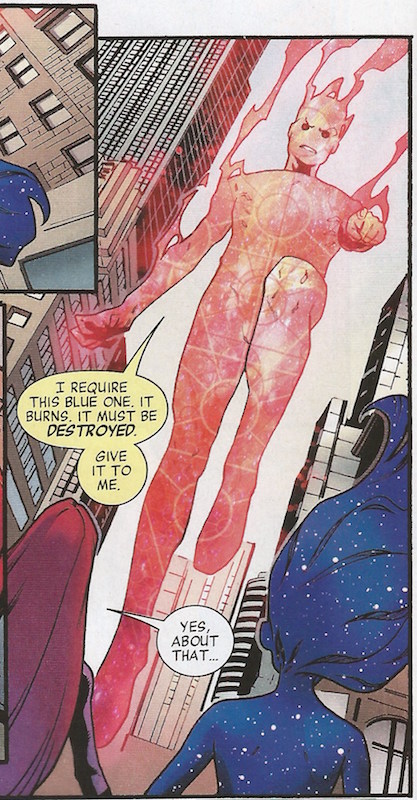

Though not friends with Medusa, She-Hulk or Captain Marvel, Singularity quickly becomes at least liked by the heroes, who defend her out of principle.  Well, almost.


Of course, Medusa quickly sobers up and remembers she was one of the Fantastic Four.


This is just one of Medusa's impressive moments.  Indeed, the creators of A-Force build up all the team.

At a certain point, Singularity, She-Hulk and Medusa seek out Nico, of the Runaways.  Nico and Singularity were in fact the best of friends in the prior universe, but strangers here.


I'm not overly familiar with Nico or her powers, but Wilson and Thompson quickly inform through and during the comedy of a wedding gone awry.  


I know enough now to say that I like Nico and appreciate the limits of her abilities.  I’m a tough sell for any magic-basis.  Giving the sorcery boundaries that affect the character and make a sort of sense is a big incentive.

Thompson and Wilson demonstrate that each of the heroes is capable of combatting Antimatter but not getting rid of him permanently.  This at once does justice to each character and explains why they must band together with Dazzler...


...to once and for all eliminate the threat to Singularity and the earth if not the universe.

Rocket Raccoon and Groot is losing me fast.  Under the conceit of a campfire story, writer Young hacks out a story that lacks the charm, warmth and humor of the solo Groot miniseries.  Essentially this tale posits that Groot lost Rocket Raccoon during Battle World or Secret Wars and has been looking for him ever since.


Two questions.  Why do the Guardians of the Galaxy believe Groot and Rocket to be dead, as seen last issue, when the heroes of earth could have just informed the Guardians that Groot, at least, is alive?  Why does everybody all of a sudden understand Groot?  Nobody understands Groot’s language except Rocket.  Former Groot writer Jeff Loveness spent a whole Brian Kesinger lovely issue of Groot explaining just how Rocket picked up Groot’s tongue.

Anyway, Groot believes he found Rocket in the raccoon tyrant.

Maybe, but who wants to read about an amnesiac raccoon torturing his friend?  I'd rather retread scenes from Groot such as this:


From Groot

And this.

From Groot

And this.

Best Silver Surfer Ever in Groot

Groot, just Groot, is superior to Rocket Raccoon and Groot by parsecs.  Young isn't giving me anything entertaining.  So, no, Marvel I don't "want to know what happens next.”


Groot is now available in a sweet twenty-four-ninety-five cents hardback.  ISBN # 978-0-7851-9552-8.  By not buying Rocket Raccoon and Groot thus far, you can invest eight dollars into buying that hardback.


Yup.  This scene is in Groot as well.


Tuesday, January 12, 2016

POBB January 6, 2016

Pick of the Brown Bag
January 6, 2016
by
Ray Tate


“You lot.  You spend all your time thinking about dying.  Like you're gonna get killed by eggs, or beef, or global warming, or asteroids.  But you never take time to imagine the impossible. Like maybe you survive.”—The Doctor

Welcome to the first Pick of the Brown Bag of 2016.  In this blog, I review the worst and the best of comic books from the week’s yield.  Feel free to comment on anything you like or dislike.  If you’re in a rush and on the way to the comic book store, I also tweet teensy summaries of the reviews and sometimes new teensy reviews on Twitter: #PickoftheBrownBag.

This week I review A-Force, Action Comics, Angel and Faith, Barbwire, Doctor Who, Mythic, Rocket Raccoon and Groot, Swamp Thing and The Ultimates.


When the New 52 began, Swamp Thing was no longer.  Dr. Alec Holland survived.


Alan Moore first broached the idea of Alec Holland never being Swamp Thing.  According to Moore’s run, Alec Holland died in the swamp.  Holland’s Bio-Restorative Formula imprinted his basic form and mind onto the vegetation.  The Swamp Thing that arose from Len Wein’s and Bernie Wrightson’s original mire was in fact a plant replication that believed he was Alec Holland.  

After accepting these new discoveries, Swamp Thing grasped his new life with gusto.  Maybe he wasn’t a man, but he still could score, and with a hot vegetarian.


Writer Scott Snyder preserved all of Swamp Thing’s history, and thanks to that, he was able to regenerate Swamp Thing once again without tramping on anybody else’s creations.  


For example, Abigail Arcane remembers her love for walking salad.   However, until Snyder reintroduces her, Abby doesn’t actually know and has never met Alec Holland.  Alec and Abby fall in love for the first time in Snyder’s epic.


In Snyder’s rebirth of Swamp Thing, Alec Holland doesn’t die through an explosion.  He’s instead mortally wounded by followers of the Rot, a force for death.  As you can see in the depiction Alec Holland chooses to become the Champion of the Green, but the Parliament of Trees, Moore creations, cannot transform Alec Holland without the Bio-Restorative Formula he synthesized.  


In a sense, Snyder related Wein’s and Wrightson’s origin tale against a new dramatic backdrop.


The wheel turns once again.  This time it clicks into the place of Swamp Thing’s creator Len Wein.  Wein returns to the series he created with an immediate reestablishing of Swamp Thing’s origin.

It’s unsurprising that Wein ignored Snyder’s contributions to the Swamp Thing mythology, but thanks to Snyder, Wein’s big boom is still valid.  Alec Holland’s first death involved a big boom.  He simply didn’t re-emerge from the swamp as Swamp Thing.  The Bio-Restorative Formula reconstituted his body.  It just took time.  Holland however suffered the memories of Swamp Thing’s life even if he never lived it.  So, Wein’s glossing over of all that came after him isn’t necessarily defiance.  It’s just inelegant and less informing.

As a result, the newest advent of the newest volume of Swamp Thing by creator Len Wein isn’t bad, it’s just not as rewarding as Scott Snyder’s deconstruction followed by reconstruction.

Wein’s story begins with Swampy arguing with an alligator that wants to turn him into lettuce.


Swamp beasts and alligators don’t get along.


It’s tradition.

Wein tries to breathe fresh air into the tired lungs of this cliche, but I have to ask why he even bothered? The alligator attack doesn’t really pertain to the main story.  It doesn’t do anything.  Neither does the presence of the Phantom Stranger, whom I usually like to see.


The real beginning of the story occurs on page nine, where Swamp Thing hears a cry for help and proceeds to intervene.


The tale of woe involves a quack doctor conducting I’m guessing Flatliner experiments on the couple’s son.  Things go awry, in experiments that shouldn’t have been trusted in the first place, and a new monster is born.


As Wein points out early in the story Swamp Thing “…shambled away across the length and breadth of the world to face monsters and terrors beyond human ken.”


Wein’s narration is actually the best part of the book.  It’s filled with awesome descriptions that would be better served in prose: “The creature before him has the skin and texture the color of ancient parchment that flakes and crackles as it moves.”  In fact artist Kelley Jones is ill-equipped to match Wein’s description.

It’s not that Jones’ art is poor.  On the whole I liked Jones’ run on Batman and Detective Comics in the late nineties.  It’s also fine for Swamp Thing.  The illustration however fails to capture the visual horror that Wein implies.  Wein’s narration belongs in Weird Tales.  Jones’ art in Creepy or Eerie.

In the latest Angel and Faith, Archaeus, the Big Bad, aptly Conrad grotesque, seeks to enslave the magic of Magic Town.


For that reason, he kidnaped Nadira, a very special Slayer.


In order to get to Nadira, Archaeus recruited Drusilla, the second in the Spike-Dru couplet from the television series.


Dru and Archaeus decided to use Nadira's association with Angel to lure the hero and release Angelus the vampire. If you're unaware that Angel and Angelus share the same vampire husk, stop what you're doing and view the fourth season Angel episode "Orpheus."  It neatly explains the schism.  


While Angel or Angelus deals with Archaeus, Faith, with backup from Fred, Giles' sisters and Koh combats Dru and her forces.

It all winds up with a battle to the death between Dru and Faith, or does it.


Without giving away the surprises, I can only say that Victor Gischler's story, aided by the art of Will Conrad and Michelle Madsen, is smart, funny and fitting.  It’s exactly what a Buffy the Vampire Slayer/Angel story should be.


Barbwire still in federal custody relates the finish of her encounter with Avram Roman.  Her action-filled flashback reveals a deal.

Thus, writer Christopher Warner characterizes Barb as a woman of honor, while Pat Olliffe illustrates her as a woman of kinetics.

One of the things of note is how Olliffe turns this choreographed fight into a more realistic endeavor.  Barb and Roman do not face just one good at time.  There’s an authentically rendered pile-on going on.   


Kudos to Olliffe for not backing down from drawing such a fight and just adding more and more characters as the story unfolds.

Robbie Morrison's Doctor Who starts a new story with an eerie opening that neatly reminds people that yes, Doctor Who is science fiction but it's also frequently terrifying.  Some creative talent behind the show in fact said that Doctor Who's whole purpose was to send children rushing behind the sofa.  No joke.  Adults who watched the show as kids were frequently scared out of their wits, but it was a good kind of scary.

Rachael Stott must be commended for turning her clean line work into credible terror images.  The shadows, the mood, the pacing all lend to an homage to Hammer films.

At first it appears Morrison and Stott call forth not just Dracula's castle but also The Village of the Damned, based on John Wyndham's Midwich Cuckoos.  This answer to the terror-filled question however quickly shifts to something even more impressive, and allusive to the horror genre.

Meanwhile in space and time, the Doctor finds himself in a battle of wits against the witless.


Here we see the perfect blend of dialogue and art to replicate the performance of Peter Capaldi.  Tell me you don't hear the man himself.

If you're concerned that the Doctor and Clara have gone their separate ways, no worries needed.


This looks to be a terrific Doctor Who story, and I cannot wait until the next chapter.


Last year's Groot mini-series delighted with a pleasant fancy and warm, quality artwork.  Alas, the new Rocket Raccoon and Groot only confuses.  The only good thing about the mishmash is the first page where Rocket Raccoon and Groot relate a campfire tale.


After that, you just keep asking questions.  Number one, I get that the Guardians of the Galaxy roster changed, but why when the movie was so successful?


Number two, even if the roster changed and Kitty Pryde is now Starlord, for some reason, why is she masked among friends?  If memory serves, Peter Quill wore the mask for protection against hostile environments.  Kitty stands in earth atmosphere equivalent.  I know this since Ben Grimm needs to breathe.

Number three, why are we following the adventures of Pockets and Shrub?


If this is some gag on Marvel's multiverse, it's not funny.  It just reminds the reader how ephemeral Marvel's multiverse is.  The parallel earth cosmos only started to foster concrete analogues such as Spider-Gwen.  It didn’t have a Huntress and Power Girl.  Merely individuals differing by a hair.  Pockets and Shrub are weak doppelgängers of Rocket and Groot.  Although, the name rhyming with a better known duo is genuinely funny.

Number four, do Pockets and Shrub exist in the same universe as Groot and Rocket Raccoon?  Are they visitors.  Is this our Groot?

Is this our Rocket?


I’m willing to give Rocket Raccoon and Groot a little more time to mature into something worth reading, but as it stands now, it’s worse than A-Force from The Secret Wars thingy.

Speaking of which, yes, a shameless segue…


A-Force improves through the virtue of simply being what it was supposed to be in the first place.  A Marvel female superhero centric comic book series.  The difference is that rather than brick you with Lord Doom and Sheriff Strange, Queen Medusa and feudal versions of She-Hulk, Medusa, Dazzler, The Movie Star, the Professor and Mary Ann, writer G. Willow Wilson characterizes the bona fide articles.

The tale begins when a refugee from that justifiably killed universe materializes in Marvel proper.  Singularity (A transformed Miss America Chavez?) naturally seeks out her friends.  Only they don’t know her.


Wilson and artist Jorge Molina do a great job depicting Singularity’s loneliness.  That one factor makes her immediately sympathetic.  Even if you only kind of know her.


As the tale progresses, we discover Singularity may be the bane of something else that coincidentally resurfaced.  It also causes her pain.  So, she makes a hasty retreat only to end up on earth where she encounters the She-Hulk.


This book is so much improved that I’m going to forgive the atrocious Superman/Kents gag that wasn’t as funny as the creators thought it was.  Don’t mess with the S.
Shulkie attempts to the beat the stuffing out of the Anti-Matter Being, but she gets thwarted only to be saved by Singularity.  The save naturally leads to Singularity’s final encounter.

Medusa provides the big cliffhanger, and it’s probably a fake out.  Though a queen, not of the realm, Medusa is usually depicted as honorable and level-headed.  She was a member of the Fantastic Four after all.

A-Force is a lot of fun, and I never thought I would say that after the version in Secret Wars reeked like a dead squirrel.


“For whatever knows fear, burns at the Man-Thing’s touch.”  Likewise, wherever Galactus goes, Queen Lilandra of the Sh’iar Empire follows.


The Imperial Guard, created by Chris Claremont and Dave Cockrum, were jokes on the Legion of Super-Heroes.  Writer Al Ewing sticks to the gag in a hilarious throwaway prologue.

The comedy continues when the Gladiator yells at Captain Marvel and her cronies the Ultimates.  The great thing about this is, Ewing isn’t interested in revealing that two hour harangue.  Instead, he demonstrates that the Ultimates don’t give a rat’s ass and goes onto their next subject.

Right.  The Ultimates are going to repair time.  This involves some fun cameos the least revealing of which I’ve shared and a guest star I never heard of but welcome given Ewing’s crafted persona.

It also demands commitment.  Black Panther's wonderfully droll time travel joke prompts some extraordinary dialogue from the young hero that's most familiar with time travel.


In addition to this mind-blowing aim, Ultimates drops the camera down small to reveal new powers in Spectrum’s gamut, and an overall sense of camaraderie that makes this title so winning.


In this issue of Action Comics, we discover why Vandal Savage stole Superman’s power.


“Savage Dawn Assault” is not by any means a great story.  It’s however better than it has any right to be.  Greg Pak and Aaron Kuder answer the nagging power question, and while the answer isn’t totally satisfying, it’s an overall acceptable motive for Savage’s actions.


Action Comics is a book where you spot out things that are neat while puzzling at the minutia from chapters you may not have read.  While, I don’t know who Wrath is other than a duped relation of Vandal Savage, I support the appearance of Justice League United.


Geoff Johns is busily humming to himself; ignoring other books and writing the Justice League as they should be written, but in every title not written by Johns, the Justice League isn’t all there.  Batman is still amnesiac.  Aquaman is still Arion.  Wonder Woman has just been captured by Frankenstein, suborned by Savage.  Superman has been sapped of power.  On the flip side of all that, Justice League United was awesome while it lasted, and it’s great to see the team substituting for the Justice League.  

Normally, you’d say to yourself, okay, who let those also-rans in the book, but Justice League United maintains a valid right to claim the name.  I’d be happy if the team shortened their name to Justice League.

In addition to Justice League United, Pak and Kuder bring in one of their favorite characters, probably of all time.  Lana Lang.

The first thing Pak and Kuder did when they took over Action Comics was to reintroduce Lana Lang.  She then took part in almost every story since and narrated her history with Clark Kent.

Next neat thing? The Atom, rocking a new Brandon Routh look as he takes his place in Legends of Tomorrow.  The Atom isn’t however in Action Comics to merely look pretty.  He provides a terrific, integral plot point.


So what if I have little idea of how exactly Savage is using some sort of black goo to attack the world?  Who cares about Wrath?  The neat stuff outweighs the overall sensibility of the plot.  Action Comics is a popcorn book that provides much more pleasure than the average title.


Mythic provides a rationale for the players on the other side and at the same time creates a thoughtful framework for its magically based cosmos.


That’s a really fresh idea.  Incensed logical beings attack Mythic since in a sense it defends the world’s chaos.


Part of that chaos comes in the form of Frost Giants courtesy of the Midgard Serpent, but Mythic has a secret weapon.  Although the team may look like modern men and women and gods, some actually wield great power.

Others are just really intelligent, and creatively exploit magical objects in unusual ways.


Joining the main story, writer Phil Hester and artist John McCrea continue unveiling the sad origin of Waterson, and his magical connection to his brother.