Showing posts with label Red Hood. Show all posts

Monday, November 9, 2020

POBB Nov 8, 2020

Pick of the Brown Bag
November 8, 2020
by
Ray Tate

Welcome to the Pick of the Brown Bag.  For those of you that discovered the blog late, my name is Ray Tate.


Sink Me.  I'm a poet.

I read and review comic books.  I first started the Pick of the Brown Bag in the nineties on the usenet groups.  I later became a part of Comicsbulletin.com before rebooting the POBB in blog form.  

This used to be a weekly column where I'd look at the best and worst of the Wednesday yield.  Practicalities of the world we now live in killed a lot of my free time.  I'm hoping to someday return to my normal schedule, but for the now, the POBB is an occasional publication.  

Today's subject is a Detective Comics special, likely still available at your local comic book store.  It can even be purchased at various book dealers.
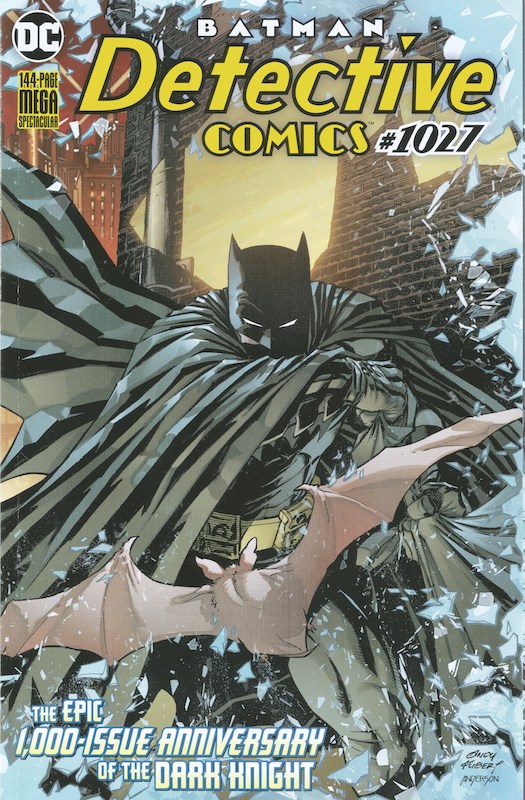

What's so special about 1027? Batman first appeared in Detective Comics #27 in 1939.  


Yeah, that's pretty wild. 

Let's talk meat and potatoes.  The book costs 9.99, which is a bit pricey for a comic book.  However the Powers that Be at DC treat this issue of Detective Comics like a graphic novel.  

It's not floppy and benefits from a thicker, non-glossy paper-stock.  Square-bound, Detective Comics lacks advertisements and runs 144 pages; comprising twelve tales and the here and there pin-up.

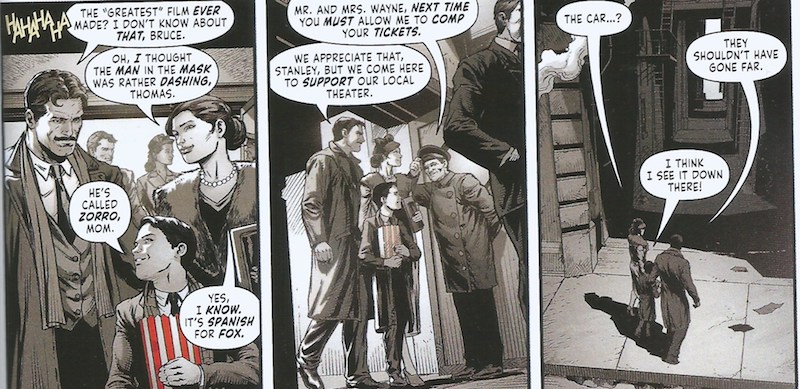
Art by Lee Bermejo based on the 1940s Batman serial

Each of these stories offers something good for the Batman Family fan.  Even the writers I usually do not care for impressed me, and all the artists give their best.

A death trap courtesy of the current Detective Comics creative team opens the anthology.


For some, death traps are hoary melodramatic cliches.  I do not share that opinion.  I like a good death trap.  I think against larger than life heroes, they fit with the arrogance of the villain.

Tomasi revamps this particular Houdini stunt.  Through the villain's anticipations, he factors in Batman's past escapes, his skills and his tactics.

The gist of Tomasi's story allows for Brad Anderson, Andrew Hennessy and Nathan Fairbairn to dedicate a few pages to each of Batman's rogues gallery and gorgeously illustrate either actual moments from the Caped Crusader's crime fighting career or unseen tales.


Why, yes, Batgirl's eyes are blue.  Why do you ask?

Our Dark Knight foils the trap-master's ploy through a traditional Batman method.  Esoteric knowledge that some may consider a cheat or as equally cheesy as a death trap.  Once again, I do not share that opinion.

Murder attracts the entire Batman Family in Brian Bendis' and David Marquez's pleasant read.  


Blue eyes courtesy of Alejandro Sanchez


Who killed Gotham City Police Detective Dungeon? The World's Greatest Detective teams up with his prized students: Batgirl, Robins, plural, Nightwing, Red Hood and Spoiler to determine the truth.  


Oh, I should point out that a lot of these stories only pay lip service to continuity, proper.  Though if you're really obsessive you can place this short before the shot to the scalp that made Dick Grayson not dead, but screwy in the head.  

As you can see by the acrobatic pose, David Marquez presents each hero with distinctive visual personalities, adding to the quality.  Some of this is no doubt stage direction from Bendis, but the subtle movements of the characters I expect is all Marquez.

The next tale by Matt Fraction is a dark comedy in which we discover the Joker gives Batman a birthday present every year.


I'm not a fan of villains.  You'll never see me wearing a tee-shirt that celebrates the Joker.  Even I must admit.  This investigation is funny and twisted.  It brilliantly demonstrates that chaos is the logician's nemesis.  

Chip Zdarsky, known more for his writing, provides technically accomplished artwork.  You may be very surprised by how good Zdarsky's tableau looks and how it resonates through a range of mood and tone.

Greg Rucka is a former Batman writer.  He also created the highly regarded spin-off Gotham Central which focused on Gotham PD.  His contribution to Detective Comics blends the two works.  

The focus character is a rookie police officer.  Hence the name of the story.  Batman operates tangentially.


The rookie enters Gotham Academy and stays clean while operating amongst a group of corrupt cops.  

Smudges of dirty cops in Gotham City always irk me.  In Year One, Batman waged a war on Gotham corruption.  That campaign should have been successful at the very least by Year Three.

It's believable that some dirty cops like flies may gather and think to start up the band again.  It's unbelievable to think Batman would let that happen. 

Rucka's story works as a personal vignette for the rookie as well as an exemplar of Batman's decisive presence.  He inspires and determines the honesty of Gotham Central.   

Artist Eduardo Risso presents duality in a brevity of pages.  He contrasts the realism of the Gotham City street against the fantasy of a hero in black who lives in a cave with a magnificent computer and a robot trophy dinosaur.

James Tynion's "Ghost Story" isn't just an outstanding Batman and Robin duet.  It's also the best Deadman story I've read since the post-Crisis began back in the 1990s.  I kid you not.
  

Created by Arnold Drake and Carmine Infantino, Deadman is the spirit of a slain acrobat named Boston Brand.   The deity Rama Kushna employs Deadman as her agent and grants him the power of possession.  During Deadman's hunt for the Hook, the lone sniper that murdered him, Boston meets Batman and artist Neal Adams who puts the Deadman feature on the map. 

While ostensibly writing just a throwback team-up that pits Batman, Robin and Deadman against a new spectral foe, Tynion provides depth to Batman's character.  We discover why Batman isn't afraid of ghosts.

"Ghost Story" is Deadman tonic after Brian Azzarello's character assassination in the bloated, gassy Batman: Damned.  Tynion's words and Riley Rossmo's playful art make the narrative a joy to follow.  Colorist Ivan Plascencia compliments with a bright, cheery palette that suits the freewheeling mood. 

Kelly Sue DeConnick, mostly associated with Marvel Comics, presents a rare Batman story that demonstrates Batman and his alter-ego Bruce Wayne making Gotham City a better place.  


Half of the tale takes place in the rain.  There Bruce plays a stupid golf game with an unscrupulous businessman that's also dirty in crime.  His name is Mr. Steele.  No relation to Cliff.

The second half drops in a recent flashback where Batman breaks Mr. Steele's racket and uses his methods to find out who's the boss.  

As with "The Rookie," DeConnick's story deals with crooked cops in a smart way.  John Romita's artwork energizes the optics of the whole affair. 

Marv Wolfman, scribed Batman for a short run and The Teen Titans for oodles of years.  In "Odyssey," Wolfman connects the clues for a strong detective yarn.  Wolfman's tale also adds to the reading pleasure by updating a handful of gumshoes that moseyed through the pages of DC Comics.  


The legacy of Roy Raymond TV detective, Captain Mark Compass, Slam Bradley and Speed Saunders combine forces with Gotham sleuth Bruce Wayne and Batman.  Together the investigators solve a historical mystery on the Scottish Coast that ties into Wayne Family history.   


I'm of two minds about the artwork.  Emanuela Lupacchino is best known for her cartoony style vividly displayed in the too quickly cancelled Starfire.  The presence of legendary Bill Sienkiewicz as inker results in a grittier look to Batman.  While the images of regular folk at times resemble a cast Neal Adams may have illustrated.  Mind you.  I love Jordie Bellaire's nuanced colors.  Nevertheless, I'm curious to know how the pencils appeared before embellishment.

Grant Morrison goes straight for the funny bone with "Detective Comics #26."  An above average wannabe Mystery Man after studious research becomes...


He even puts together pieces of "The Case of the Chemical Syndicate," Batman's first foray.  Alas, things don't go so well when Batman shows up. 


Artist Christopher Burnham infuses the original Batman adventure with an astonishing amount of energy.  He replicates the events to the letter but creates kinetic imagery unheard of during the historical period.  

I'm being pretty cagey with the graphics, and that's because I don't want to spoil a single of the laughing Scotsman's perfectly executed jokes.  Trust me on this.  "Detective Comics #26" is laugh out loud funny.


Tom King, him again, and Walter Simonson also re-imagine a Batman episode.  This time, Batman's fight against Dr. Phosphorous.

There's not a whole lot I can say about this thoughtful exercise in history.  Walter Simonson co-created the glowing ghoul, based in part on Golden Age foe Professor Radium.  It's fitting that Simonson solos in the orchestra that Tom King conducts.


For those not in the know, Tom King in his impressive run of Batman restored much of the Batman Family's classic and Bronze Age stories.  I respected and enjoyed the hideous amount of Batman goodness that King produced.  

This piece is the final piece in the continuity King rewove.  Starting in the street, reaching a crescendo with Batman and Catwoman, following through with the birth of Helena Wayne and finally concluding here.

Before Tom King, Scott Snyder was Batman's mad guru.  He returns with "As Always."  Commissioner James Gordon narrates, and in this narration, you can feel the friendship he shares with Batman.  


That hasn't always been the case.  

Historically, Gordon is as old as Batman.  He also premiered in "The Case of the Chemical Syndicate."  


From 1939 to 1941, the Gotham P.D. officially hunted Batman.  Treated him as a vigilante.   Then, something weird happened.  Gordon shook Batman's hand and in a succeeding story granted him special deputy status.  Since these canonical moments unfolded, Gordon and Batman became trusted allies and at least by the 1950s friends.

The hunt, the meeting, the alliance and friendship rewound through every new reiteration of the Dark Knight and Lieutenant James Gordon.  The friendship fractured at times, and occasionally it stopped making sense, but history always seemed to repeat itself regardless of the context of fiction.

The Bat Signal, constructed in 1942, is a symbol of Batman's and Gordon's long history together.  When real-life Batman Adam West died, Los Angles lit up City Hall with a make shift Bat Signal.  Snyder's story is about the signal and the friendship of two men making Gotham City a better place.

The story begins with the definition of a Black Rooster Case. This is essentially something that looks big but turns out to actually be small.  The story segues to Batman being called to the Justice League satellite where he discovers the League detected something affecting the sun.


Gordon learns of this second hand, but just having the knowledge indicates what Batman thinks of his friend.  Gordon then imagines the events that led up to the discovery and how the League addresses the situation.  This is where Justice League artists Ivan Reis, Joe Prado and Marcelo Maiolo express their imagination.  


The editing knocks me out the most.  Snyder begins the story with tradition.  He flashbacks to explain the verbal McMuffin.  The artists create a mini-Batman story within that explanation.  Batman's called to the Justice League, where the gist unfolds.  The League investigate.  The artists create the essence of big blowout issues where the League facedown their most powerful foes.  They consult with their friends and colleagues in the summation of fan-bait team-ups.  They cannot find the solution.  Batman figures it out, and his answer recapitulates to the beginning of the story and the verbal McGuffin.  The creative team accomplish this breadth of plot and information, this scope of street level to cosmic all in twelve pages.

Dan Jurgens, not really a Batman writer.  However, Jurgens had his run-ins with the Caped Crusader in crossovers and Big Events.  He often made Batman a pivotal part in his story.  In this tale Jurgens produces words and pictures.


Jurgens cleverly uses Batman's status as the inheritor of Sherlock Holmes who eliminates the impossible in the opening.  Jurgens also corrals Kevin Nowlin, an excellent known quantity Batman artist for finishing his bare bones illustration.  The combination creates a sense of certainty in reading.  Ah, hah, says you, what I'm actually perusing is a variation on The Hound of the Baskervilles.  

When Jurgens adds a new wrinkle to Batman's first-person narration that reveals the madman behind the whole plan you cannot help but applaud.  The confrontation is special.  The conclusion expected but exciting no less.  You think the story will end, but turn the page, and the tale goes off the rails in a good way.

The final story by writer Mariko Tamaki introduces the Joker War.  Generally speaking I've enjoyed Tamaki's writing.  You'll find reviews on this blog of Tomb Raider and X-23.  I plan on giving her new run of Wonder Woman a go.  

At the same time I usually hate Big Stupid Events.  I've avoided the main Joker War thing, mainly because I'm not hung up on villains.  They don't appeal to me.  By dint of subscription, I do have some of the Joker War tie-ins, and I'll be doing a special POBB for them in the future if I spot something notable.  

Tamaki's tale serves as a prelude to the Joker War is good because of what it's not.  The Joker material is almost incidental, which works in the tale's favor.  It could have been any madman creating havoc.  It didn't need to be the Joker.  There's nothing significantly Jokerish in the story.  No "rictus grins" for example.  Not even extortion.

The story opens with Bruce getting ready for patrol.  For some reason, he's staking out a target at a hotel.  Soon, though, he's off into the night, investigating a break-in at Wayne Enterprises and saving cops from being diced in the crossfire.  Typical Batman stuff with his thoughts turning to his father, and artist Dan Mora and Tamra Bonvillain providing a neon-noir.


And that's all folks.  One last inside cover pin-up before the book bows out.  I think you'll agree, this is a lot of entertainment for the value.  1027 also may be that perfect Christmas Gift for the casual Batman fan on your list.  These stories require no deep dive into Batman lore nor an understanding of how he is now, just a love for the character and the want for good, solid detective stories accented by great art.


Wednesday, September 23, 2020

POBB September 21, 2020

Pick of the Brown Bag
September 21, 2020
by
Ray Tate

Welcome to the Pick of the Brown Bag, I'm Ray Tate, and I review comic books.  The COVID-19 epidemic has seriously curtailed the frequency of this blog, but I'm still here.  The comic books keep on coming, and maybe in a year, I'll reach homeostasis.  This week another in depth look at a new title with one of the oldest characters in the genre.  Today I review Batman Three Jokers.  


Through a series of subtly connected set pieces Geoff Johns uses the promised freedom of the Black Label brand to emphasize the historical damage the Joker wrought on Batman, Batgirl and Jason Todd, the second Robin now operating under the alias of the Red Hood. 

A flip-through at The Phantom of the Attic sold me on the art.  Jason Fabok impressed on Detective Comics and Batman.  He's a no-nonsense type of illustrator, suffusing his work in anatomical dynamics, traditional design and detail that relies on cross-hatching and old-school mechanics.  


Batgirl's heavy involvement in the story factored into my purchase.  Due to the atrocious writing of Cecil Castellucci, I dropped Batgirl from my subscription list.  

I miss reading about this hero.  

Batgirl became my favorite DC icon after I tirelessly fought for twenty-five years for her restored mobility.  That's two years in New 52 time.  Add ten real time for the frustration of seeing men in comics consistently chucking their wheelchairs and tap dancing.

They're Blue, Baby.  Blue

In Three Jokers, Batgirl, properly expresses Brad Anderson blue eyes, rather than why are they suddenly green.  She also throws the Joker through plate glass.  


That was all I needed to take the first issue of Three Jokers home.  I should point out that Anderson's hues really appealed to me since they meshed with Fabok's paradigm.  A lot of comic book colors if not done correctly look over-rendered, but Anderson's highlight, and entrench the book in the realism necessary for the story's efficacy.


The tale begins in a cliche fashion.  Alfred patches up Batman.  Batman remembers the source of each of his scars.  


Along with the murder of his parents.  


I could harp on this, but it's a Batman book, and a moody one at that.  Nine times out of ten, you're going to watch a replay of the Waynes being murdered.  

I'm just not sure any of this--the scars, the trip down memory lane--is necessary to establish Batman and the setting.  Two pages, maybe three, sure.  Seven? That's a bit much.  

The scene segues through a television broadcast watched by Batman in the cave and Barbara Gordon in the gym.

Here we discover how Barbara regained the use of her legs.  It's a little different than continuity proper implied. 


Clearly, Johns like myself wondered why DC never gifted Barbara a pair of cybernetic legs, available to DC Comics since 1980.  

Even earlier in general science fiction.

In fighting for Barbara's regeneration, I encountered people who wanted to keep her in a wheelchair.  I get why people who are actually in wheelchairs looked to Barbara Gordon for representation.  I get why people with working legs wanted that representation for those without.  However, and many of those folks understood my argument, wheelchairs do not make sense in the context of an alien and magical universe.  


Then, there was the majority, persuaded in part by DC's glamorization of Barbara's crippling.  Suggesting that this was just a minor change.  I mean it's not like she can't have sex with Nightwing, the first Robin all grown up for those not in the know.  

DC even rejuvenated her so that there's no icky May-December Thing with Nightwing.  Besides, Barbara's A-OK with not having the use of her legs, cause she can still have sex with Nightwing.  She's actually happy in the wheelchair, because she can have sex with Nightwing.  Not that she had sex with Nightwing, but the potential for sex with Nightwing is always there.  That's what's really important.


Hey, baby, right back at you.   

Here's what happened to Barbara Gordon.


The Joker shot Barbara.  A bullet tore through her abdomen, ripped through her spine and exited out her back.  Then just for laughs the Joker stripped Barbara and photographed her bleeding and naked.  


That's what happened to Batgirl in The Killing Joke.  It's utterly ghoulish.  DC did not need to incorporate that in their shiny new post-Crisis but they did.  They stained their cosmos from the very beginning with a very real thing in a very unreal shared universe.

So, I applaud Johns and Fabok for showing this ugly scar on a beautiful woman because it's nothing that the wheelchair-chic think about or want to think about.  It's nothing that the writers or Powers That Be at DC thought about.  For Barbara though that scar is a constant.  The memory of that night doesn't go away.

Next in Three Jokers we get to see a replay of the Jason Todd telethon.  The one where people phoned in to vote to kill or save Jason Todd, one of the most unlikeable characters ever reinvented.  

Jason actually debuted harmlessly in the pre-Crisis with a vastly different origin.  Alan Moore author of The Killing Joke in the Superman tale "For the Man Who Has Everything" ironically gave Jason his best moment.  A springboard for anybody paying attention.  Nobody did.

Jason really didn't come into his own until Scott Lobdell adopted him.  He imbued him with a sense of humor, built on Jason's history with Batman and turned him into a kind of low-rent private eye who just happens to be a superhero and trained by the World's Greatest Detective.  

Jason's solution to crime is simple.  Eradicate it.  Jason is a murderer.  Batman however cannot bring himself to arrest Jason.  In truth, most of Jason's killings can be defended as self-defense.  Not all of them, but the lion's share.

That's a lot of review, but this is what happens within the first act which basically introduces our main heroes.  It takes about sixteen pages before we get to the first event.  Batman and Batgirl investigate the murders of three individuals at Ace Chemicals.  This scene also presents a puzzle.


I imagine Geoff Johns writing a Batman book threw a lot of people.  Johns however began writing Batman since the New 52 began.  He wrote Batman for at least three years.  Readers tend to forget.   Batman is a founding member of the Justice League.  As such, Johns' Batman plays well with others.  Especially his own family and despite Three Jokers running under the flag of the ultra mature Black Label.  Anybody thinking that the Black Label excuses Batman being horrid to his proteges can breathe a sigh of relief.


A plot twist changes the venue from Ace Chemicals to an ambulance ride.  This moment is novel.  I can't say I've ever seen anything like it before.  It draws Jason Todd into the picture, starkly distinguishes him from Batman and Batgirl and presents his unusual method for crime-solving.

Now, we get to the title of the book.  The Three Jokers.  

Perhaps, the most surprising thing about Three Jokers is that Johns answers a question posed in Rebirth, a mainstream one-shot reinforcing shared universe continuity, within an off tangent mature Black Label book that's ambivalent toward universal continuity.  The maturity of the story incidentally lies not in nudity or sex but in the exploration of violence.

The Batman Family think the Joker isn't working alone, and Johns doesn't resolve that question until the end.  Before that, we get a very curious scene reintroducing three familiar Jokers.


I say its curious because this scene lacks a reliable witness.  The scenario could simply be a hallucinatory episode from one Joker's fractured mind.  It also explains why each Joker seems to be like a Sunnydale vampire.  

Preserved in a moment of time, we have the Killing Joke Joker, the classic Joker and the "lead" Joker.  I'm about ninety-five percent certain this act occurs in the Joker's head.  Johns however throws in a good plot twist at the very end that makes the five percent of uncertainty loom large.


The Joker having departed from Ace Chemicals and colluding with his other selves returns to Gotham Aquarium to revisit a Denny O'Neil and Neal Adams seventies battle.  Johns incorporates a number of Joker motifs in this final act of Batman Three Jokers, but he and Fabok give the entirety a different spin from the Batman Animated Series episode that did the same.  And yes, this is the moment where Batgirl throws the Joker into plate glass.  Let's see that again.


Geoff Johns relates an interesting story and superbly characterizes the Batman Family in an easy to understand internal consistency.  The puzzlement over Three Jokers being the understandable exception.  

Batman Three Jokers is furthermore a surprising development from the Black Label brand.  Not only does the Three Jokers present the consequences of the Joker's actions in uncensored detail.  Jason Fabok pulls no punches with his realistic depiction of the Batman Family's countermeasures against crime.  

You get to see the unvarnished damage that the Batman Family dishes out.  The execution is rather exhilarating, and quite frankly, this is the book that should have debuted DC's Black Label line, not the remarkably awful Damned.


Wednesday, October 30, 2019

POBB October 23, 2019

Pick of the Brown Bag
October 23, 2019
by
Ray Tate

Welcome to The Pick of the Brown Bag, in this blog I review the brightest and the dimmest books for the week.  For this posting, I look at The Amazing Mary Jane, Aquaman Annual, Contagion, newly minted Count Crowley, Detective Comics, Ghost Spider, Immortal Hulk, Red Hood and the Outlaws, Tommy Gun Wizards and Red Sonja and Vampirella Meet Betty and Veronica.  If you haven’t the time for the full blog, check me out on Twitter where I'll have a few words to say about even more contenders: #PickoftheBrownBag


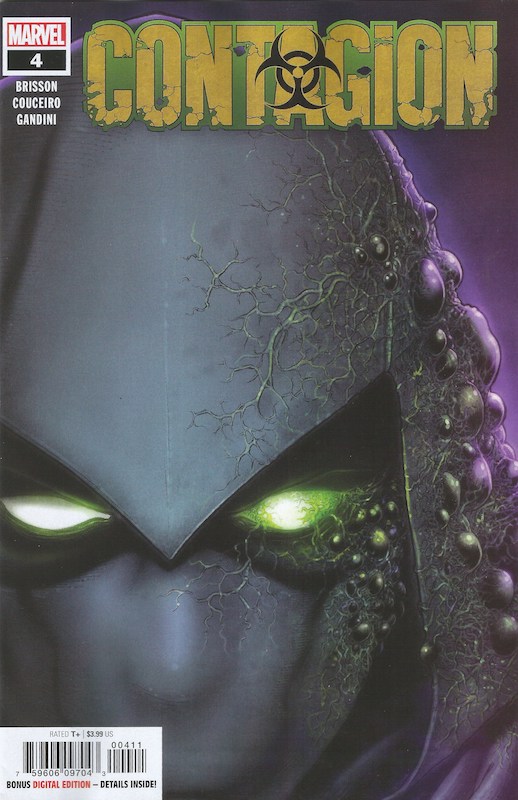
Contagion, you already had me.  You didn’t have to bring in the Wrecking Crew.


These fellows are larcenous old school bank robbers.  They started as Thor’s enemies but memorably fought Iron Fist who teamed up with Captain America.  Later they spread their love throughout the superhero community.  Getting beaten up by the likes of Spider-Man, Namor, She-Hulk and most recently teen Jean Grey.

The fungus they fight is a gift from an enemy of the K’un-Lun people.  It took out the heaviest hitters:  the Fantastic Four, Dr. Strange and the Avengers.  Events look dire.  

On the genuine hero side, who’s left you ask?  


Some of these heroes will not be left standing.

The defacto Defenders only have a few days before the changes become permanent and the fungus kills the fallen.  However, you cannot help but think that there’s light at the end of this series.  

Ed Brisson’s tale isn’t art house dark.  It’s 1950s horror movie dark.  I mean Frank Castle, The Punisher, acts like a protector not a means-to-an-end executioner.  


In terms of pace, there’s no real aching drama.  It’s all gotchas, character-driven comedy and action.  It helps to knock out the orators of the Marvel Universe, like Reed and Dr. Strange, first.  Leaving behind meat and potatoes heroes like the Thing and Moon Knight who aren't known for their momentum crushing speeches.


Holy crap! What was that? I barely understood this double-sized issue of the Immortal Hulk.  I’m not sure that you need to buy it in order to extend the flow of the current series.  On the other hand if you're looking for something strange tangentially connected to the Marvel Universe.  This may be the issue for you.  As near as I can figure, here’s what you get.  

Al Ewing trips out with the last survivors of a doomed universe.  Guest artist Germain Garcia creates a tapestry of cosmic oddness that only takes shape when turning green. 


You need to really study his art in order to glean what’s going on, but that’s due to the highly alien nature of the characters not a flaw in the visual narrative.  


Somehow Mothra shows up, and the savior of the earth attempts to use the Hulk as a time machine to get a message to the one man capable of stopping the madness.  At least I think that’s the gist of the book.


The much anticipated Mary Jane isn’t bad but neither is it Frankencastle.  Mary Jane notices some peculiarities on the set of a Spider-Man movie that she’s shooting. 


Can there be a familiar fish-bowled villain behind the whole shebang? Is it a ruse? Has he killed the director Mr. McKnight and replaced him?


In the past, Mysterio messed with Spider-Man’s head something fierce.  Following suit in the newest Spider-Man: Far from Home.  So, it’s a little surprising to see Mary Jane on board with Quentin Beck, who looks exactly as he did back in the day.  Complete with the More-cut.


Still, Mysterio didn’t kill, nor sleep with, any of Spider-Man’s girlfriends, nor did he threaten his aunt.  He played by the rules of engagement and saw only Spider-Man as fair game.  So, yeah.  I suppose I can give him an even shake. 

Later, in the privacy of her hotel room, MJ contacts Peter with some cute selfies and innocent frolic.  All of it rendered by Red Sonja’s Carlos Gomez, who knows his bodacious babe business.  


Ghost Spider splits between Earth-616 and Gwen’s Earth-65.  Thanks to Peter Parker’s sponsorship Gwen attends college on Earth proper.  So, we see Gwen making friends and studying different subjects.


Writer Seanan McGuire also explains from whence that giant rat Spidey and Gwen fought a few issues ago came.  I suspect many readers just wrote off the rodent as a non-sequitur menace.  Turns out the rodent is part of a long game.  Not Tom King long, but long enough.


When Gwen returns to Earth-65, McGuire shocks the audience with a dramatic twist that begins with Gwen investigating a gunshot.


McGuire banks on the short history of Spider-Gwen and her faithful fans for a literally sweet payoff.  

However, the main feed to Ghost-Spider is spoilt on the cover.  This issue is about the lurking threat of Spider-Man villain the Jackal.  

What’s interesting about the exploration is that there are two Jackals.  Originally, the Jackal was just an Empire State University professor that had a serious Jones for Gwen Stacy.  Her death drove him deeper to madness, and he worked his considerable acumen into a clone of Gwen Stacy, with the memories of the original.  His fuzzy mien is another story that I really don’t get.


On Earth-65, the Jackal isn’t part of academia, never met Gwen Stacy until she became Spider-Gwen, and he’s not lusting after her.  He’s a chemist for hire, and James Jameson’s employee.  A bit disgruntled.


Furthermore, his grip on sanity is far stronger than his counterpart on Earth-616.


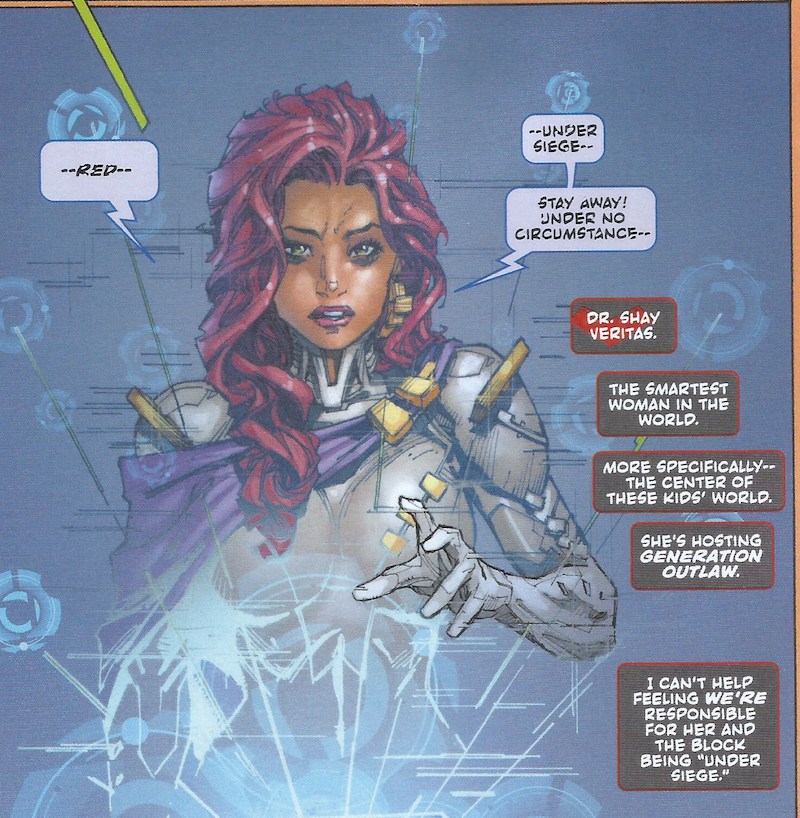
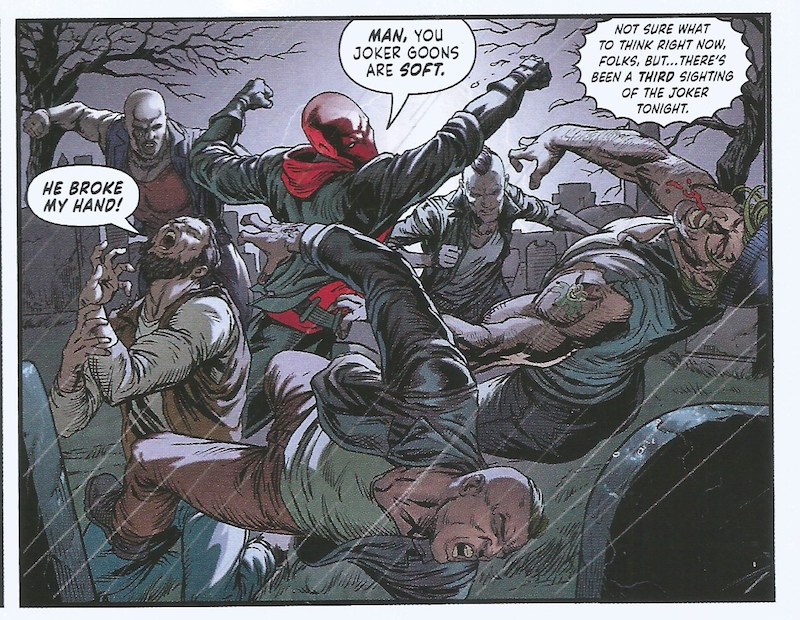
Jason Todd former Robin and now Red Hood continues his tutelage of earth’s next villains,   After concluding that the miniature Doomsday wasn’t a threat Jason and his students uncover a covey of hilariously poorly designed bad eggs.


In the vein of Mystery Science Theater’s Night of the Blood Beast, the head idiot begins to speechify.


That went well.  Writer Scott Lobdell’s Red Hood and the Students vs. Loser Villains: The Next Generation is a massive joke with good laughs. On the serious side, Dr. Shay Veritas is in danger for the cliffhanger.


In an alternate timeline, Artemis and Bizarro must contend with a newly freed Ma Gunn. 


Artemis is an Amazon who in a previous continuity took the role of Wonder Woman.  Artemis in this cosmos is an Amazon exile from a lost tribe.  She gained employment as a Lex Luthor mercenary and developed a grudging respect for Diana of Themyscria. 

Batman 408 introduced Ma Gunn as a Ma Barker/Fagin cross.   Lobdell took advantage of the New 52’s clean slate continuity and turned her into a redemptive, sympathetic character.  She and Jason developed a friendship. 

Lex Luthor has been creating imperfect clones of Superman since Man of Steel.  In the New 52, he began the practice in Forever Evil.  Luthor was unaware of the current Bizarro, but he saved his life anyway out of his empathy toward the last.  This version of Bizarro is independent of the one currently causing troubles on the cover of The Terrifics.  The Bizarro in Red Hood and the Outlaws is above board.

Bizarro became hooked on a drug that preserved his super-intelligence.  A side effect of Lex Luthor’s life-saving serum.  The super-smart Bizarro literally trapped Ma Gunn in a bottle to prevent anybody from discovering his secret addiction.  

Part of that Red Hood volume bestows an explanation about how Bizarro’s stuffed toy Pup Pup became sentient.  Believe it or not, Pup Pup’s animation isn’t actually all that strange an occurrence in comic books.  In fact, Lobdell’s Pup Pup parallels Batgirl's newest villain Oracle.  

The difference lies in the evolution.  Oracle is a contrived piece of garbage with no rationale for its construction.  


Batgirl didn’t build it, and as I stated previously she never needed a computer program with tactical ability.  So what exactly powers the robot’s intellect?  

In her persona as Oracle, Batgirl simply provided information to crimefighters.  Either tapped from her photographic memory or organizational databases that she hacked.  So the Oracle robot is doubly inexplicable.

Pup Pup on the other hand debuted in Red Hood and the Outlaws.  Jason gives Pup Pup to Bizarro soon after he finds him.  Bizarro kept Pup Pup around even when turned genius.  In other words, Pup Pup unlike the Oracle bot was a constant, and because of that consistency the more resonant comic book creation.  


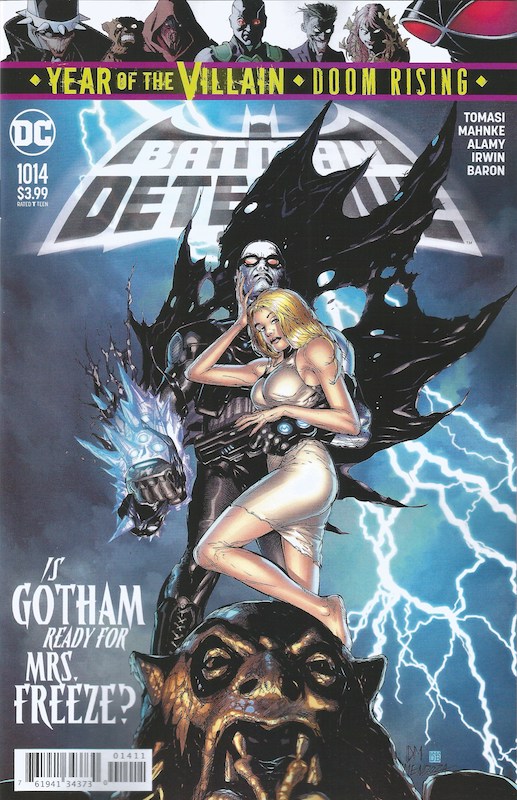
Detective Comics is without a doubt the most original of the comics in this week’s batch.  Writer Peter J. Tomasi is known for his whacky run of Batman comic books where almost anything an happen.  This issue, he comes up with an idea that was just sitting there for anybody to take.


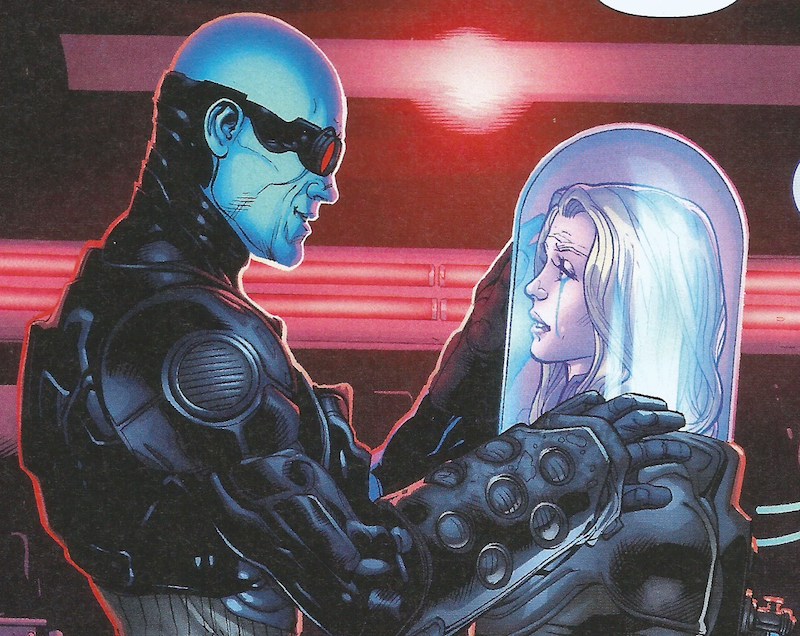
Mr. Freeze frees his wife Nora from suspended animation.  She becomes his counter part in every way.  This is the most novel concept I’ve seen in a Batman comic book.  

Outside of that how is the issue? Tomasi’s story is subtle.  As the tale progresses, Nora’s emotional connection with humanity decays.  Just as Victor Fries lost his empathy.


She can muster sympathy and emotion for individuals like Bruce Wayne but by the end of the book no longer cares for people in general.  


Thus, Detective Comics works in the context of Batman’s latest duel with Mr. Freeze, as a general Batman themed story and surprisingly as a literate horror story.


In a sharp deflection of tone, series writer Kelly Sue DeConnick teams with Marvel's Acts of Evil Vita Ayala for a comedy that also acts as a tour of Amnesty Bay’s locals.  

The half-human Aquaman grew up in Amnesty Bay, and it’s more of a home than Atlantis.  The story begins with Aquaman and new Aqualad Jackson Hyde tackling a low-rent villain.

The gun however is serious hardware.

Sea Daddy becomes the catalyst for events.  The wayward blast destroys Amnesty Bay's chance of a fireworks display.

Salty, also wandered off after Aqualad saved him.  The search for Salty and the remounting of the celebration invites readers to follow along with Aquaman as he introduces Tula his cousin and former regent of Atlantis.


Tula used to be known as the original Aqualad’s dead girlfriend, unrelated to Aquaman.  Needless to say Tula benefited greatly from the New 52.


The store owner Randy reaped the rewards from the soft reboot Rebirth.  Geoff Johns introduced a Randy as a sexually harassing abuser.


No worries.  Mera took care of the flotsam.  However, the Rebirth rejiggered time and space to apparently eliminate that unsavory aspect.  Aquaman's on first name terms with him.  So, this incident likely never happened.

In addition Officer Erika Watson enjoys the resurgence from DeConnick’s decision to base Aquaman in Amnesty Bay, her characters the sea gods demonstrate a stronger cohesion with the overall plan to mix deities, heroes and humans.  This folksy Aquaman Annual is brimming with good will, and it would almost be bad manners to rip on it.  Fortunately, it's written and illustrated rather well.  So, just one spoiler.  Sally’s okay.

Murders in Riverdale attracted the attention of Red Sonja and Vampirella.  They soon encountered school newspaper reporters Betty Cooper and Veronica Lodge.  The ladies forged a fast friendship and pooled their resources.  The gang uncovered numerous clues, but the culprits remained stubbornly out of reach.  That said, as writer Amy Chu lays out her cards, we discover this isn’t exactly a Sherlockian mystery.  Her supernatural elements mislead the art of deduction.  Although one clue derives from the purest form of sleuthing.

As Chu begins her revelations, comedy arises from the nature of the villains' schemes.  Chu also dabbles with  science fiction elements; fitting for a book whose one star is an alien vampire from Drakulon.  Red Sonja soon enters the fray, and Riverdale's denizens prove their worth in a satisfying denouement.  Loose ends answered in two months because apparently Red Sonja and Vampirella Meets Betty and Veronica isn't ending quite yet.  


Count Crowley combines a number of things I like: horror movie hosts, classic monsters, strong female protagonists and of course terrific artwork from The Witch Doctor's Lucas Ketner.  The story introduces alcoholic reporter Jerri Butler who loses her cool during a Renaissance Festival.


Her brother gives her one last chance which casts her as horror movie host Count Crowley.  Jerri attempts to be her own miserable self, and so we get Elvira without the charm or the tact.

She also happens to right about Jesse James Meets Frankenstein's Daughter.  It's in the Hall of Fame for Bad Movies.  Prometheus though is far worse.  Unsurprisingly Jerri is a hit, and that's bad news for the reporter.  She's going to be Count Crowley for awhile.  Worse, she discovers after the show that some monsters are genuine.


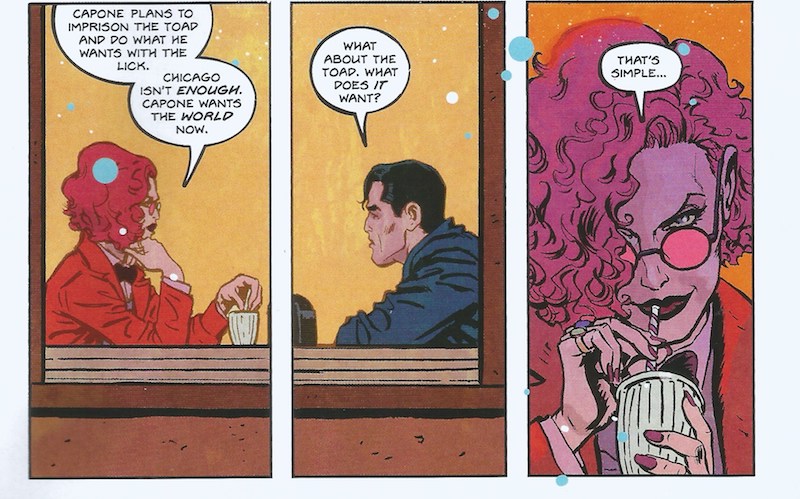
The Untouchables real life crime busters led by Eliot Ness combatted the machinations of Al Capone and his lieutenant Frank Niti.  In Christian Ward's story that hasn't changed, but instead of booze, the Lick is the thing that's been banned.  The Licks gives ordinary folk a taste of magic.

Ward though mainly oils the gears and cogs of tale with double-crosses, old flames, betrayal and old fashioned detective work.  The difference lies in the nature of these things.  For example, Al Capone isn't running the show.  The Toad is.  

Ward's been detailing the Toad's adventures in the back up narrative.  Although ruthless, the Toad may not be the true bad guy of the tale.


Surprises abound in Tommy Gun Wizards.  Ward's explanation of wizards is a new one.  When fellow Untouchables investigate a Lick distribution plant, they uncover something sinister afoot that's given significant hoof by artist Sami Kivela and colorist Ward and Dee Cunniffe.  Whether film, television or reboot, The Untouchables is always awash with testosterone.  Any woman that appears on The Untouchables is bound to be bad.  Candice appears to be no different.  Though Candice stands out, Ward makes certain that the good side of the female gets a seriously cool and unexpected moment.