Showing posts with label Bechko. Show all posts

Tuesday, August 31, 2021

POBB August 25, 2021

Pick of the Brown Bag
August 25, 2021
by
Ray Tate

Welcome to the newest Pick of the Brown Bag.   I'm your comics guru, Ray Tate.  For this posting, I take a tour of the new DC Wonder Woman title Sensational Wonder Woman.  A play of words on Wonder Woman's original home.


Sensational Wonder Woman is ideal for somebody that doesn't want to subscribe to Wonder Woman and/or doesn't want to get involved in a story arc.  This reader likes Wonder Woman, not necessarily her continuity, and the occasional good Wonder Woman adventure. 

Sensational Wonder Woman consists of stand-alone Wonder Woman tales with differing writers and artists.  Continuity is flexible, and so far DC published six issues.  The first I reviewed in depth earlier.  

The second issue of Sensational Wonder Woman by Andrea Shea pits Wonder Woman against frequent foil Artemis.  It didn't  start out that way.  Wonder Woman answered an sos from Artemis.  They nevertheless end up fighting in the gladiator pit on War World.  How they reach this point offers a twist or two.


Even if you don't know what a War World is, you'll catch on quick.  Older fans will be surprised at some of the new wrinkles in the shtick.  Of course there's always the tried and trusted.


Master of War World, Mongul becomes involved in the duel, and there's much rejoicing when Wonder Woman and Artemis soon hand this perpetual loser his ass.  

Mongul only had one moment of Bronze Age glory, which is one better than Kobra.  In Alan Grant's and Dave Gibbons' "For the Man Who Has Everything," the feature of a Superman Annual, Mongul overcomes Superman with the Black Mercy and stands toe-to-toe against Wonder Woman.   


If you gave Ally Babble an immersive hallucinogenic weed, he would have partially succeeded as well.  Come to think of it.  So would Kobra.  I'm also pretty sure Wonder Woman had the sniffles that day.

The art of Sensational Wonder Woman by Bruno Redondo is absolutely mouth-watering.  Dynamic anatomy in multiple clashes, and Redondo is equally adept at depicting the quieter moments.

In the third issue, Colleen Doran brings her skill for writing and art in a tale that depicts a kind of day in the life of Diana.  First Wonder Woman explodes onto the scene.  


The sharks are in fact Megs, which have somehow become the royal escorts of Themyscira.  They also show up in the adventures of Young Diana in the backup feature of Wonder Woman.  I don't recall them appearing anywhere in the Bronze Age, the television series or the films however.  Oh, well.  Not important.

After a meet and greet on the beach, a local blaze, not Johnny, quickly catches Diana's attention.  During the focus on Wonder Woman, Doran reboots one of Wonder Woman's nineties cast members, depicted on the cover.


She looks quite different.  So, this isn't a spoiler.  I never had any affinity with the cast member.  Still, Doran demonstrates the woman's worth and her sense of ethics in business.  That puts on a different spin.  

Doran's Wonder Woman gibes with the Lynda Carter version of the character.  She's friendly, an idol to millions of people and casually powerful.

In the third issue's side B Alyssa Wong throws a "Museum Gala" with invitees Diana Prince and Bruce Wayne.  


Mr. Freeze shows up, and Wonder Woman, who seldom needs to protect her secret identity, even when she had one, goes into action.

This story works through a combination of wit, the friendship between Diana and Bruce as well as the cartoony, energetic art of Eleonora Carlini.  Colors by Enrica Eren Angiolini add pizzazz.

In the fourth issue Corrine Bechko opens her story with Diana attending a climate change conference.  There she meets a woman who claims to be able to control the weather by moving the clouds to where they need to be.


Of course, this is a potty theory.  Nevertheless, she makes it rain without placing a single bet on Draft Kings.  Unfortunately the experiment gets out of hand, and Wonder Woman under the auspices of artist Dani finds herself battling her old enemy the Blue Snowman.

Nope.  I never heard of this character before either.  Can the wikipedia save us?  Apparently so.

A secret villain pulls the Snowman's strings.  This villain is well known to Wonder Woman fans.  Bechko though in dialogue shorthand explains what you need to know.  Even had you never read a single issue of Wonder Woman, you would still know what floats the boats of both foes.


With the fifth issue, Amy Chu teams up with Maria Laura Sanapo for a time-spanner that delves into Wonder Woman's World War II history as well as her current history.
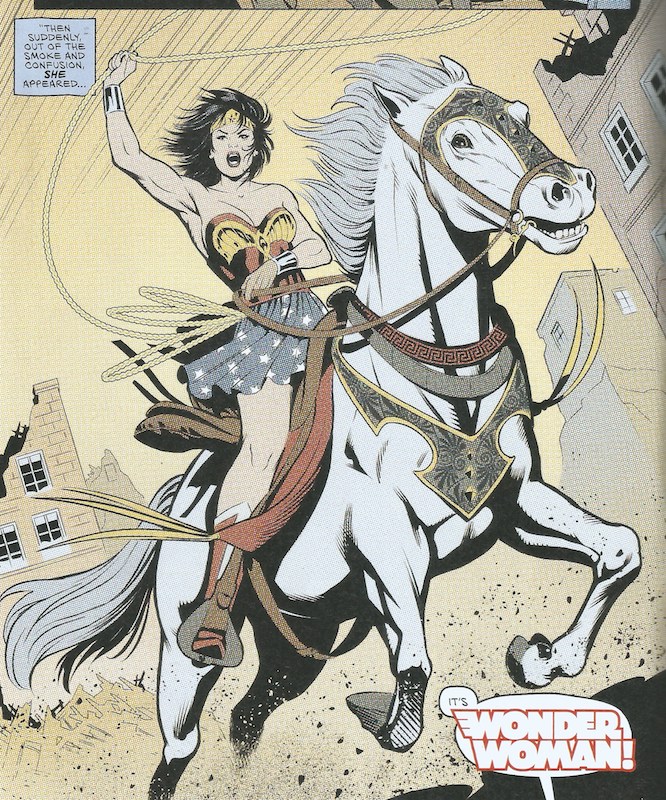

This issue is a good example of how Sensational Wonder Woman doesn't follow the rules of continuity but looks at the historical canon.  

Since the nineties DC Comics eschewed Wonder Woman's World War II history.  George Perez reintroduced her as a contemporary character.  Subsequent reboots followed suit.  

Chu and Sanapo instead embrace Wonder Woman's immortality and present her as a Nazi fighter and an everlasting symbol of justice and feminism.


An elderly woman relates the story of her long friendship with Wonder Woman, but this history threatens her existence.  Since nobody believes her.  For the same reason, mad science in a comic book is just science, it will come to nobody's surprise that Katie speaks the truth.  

Yes, Chu's story is predictable, but nobody wanted to see this sweet, old woman put out on the street because of a potentially hyperactive imagination.  It would have been a disappointment had Wonder Woman not shown up, validated Katie's recollections and saved the day.  This isn't a Black Label book.


Sina Grace in the most recent issue presents a collage of Wonder Woman continuity.  Paul Pelletier is just the artist to illustrate this fun little villains team-up.  First, Artemis leads the Amazons on an attack on Parliament.


The opening scene reflects the universally reviled mini-series Amazon Attacks.  However, Diana knows something's up on page three.  

It doesn't take six miserable issues to find out the gist of it all.  Let me just say at this point.  I love Paul Pelletier's, Norm Rapmund's and Adriano Lucas' art even when Pelletier is not having characters bash each other's heads in.


That moment of realistic body language is just beautiful. Enhanced by the subdued colors.   

Diana's investigation leads her to Themyscira where she meets the first attacker from her Rogue's Gallery.  I don't really count Artemis as a rogue.  She's more of a hot-headed rival.


The design on Silver Swan is modern, and it's clear to me that Sina Grace didn't want to muddy the very streamlined plot with the question of the Swan's secret identity.

If this version of the Silver Swan were in fact Vanessa Kapetelis, Diana would have referred to her as Vanessa and try to reason with her friend.  As such, this is just the villain Silver Swan, an impediment to be squashed.

In a bit of a battle twist, Wonder Woman meets the host of this fight dance toot sweet.


If she looks familiar, you're not mistaken.  This is Queen Bee the head of HIVE.  Though this may not be the Queen Bee you're familiar with.  

Over the years, Queen be transformed.  Originally a Silver Age foe against the Justice League, the alien Bee became decidedly human or at least more humanoid in the nineties as a femme fatale in the Giffin/DeMatteis/Maguire League.  Grant Morrison returned her to his JLA as an alien menace.

In the New 52, she became the blonde fusion you see in Wonder Woman and the head of old Superman turned Teen Titans baddie group HIVE.  HIVE stands for...er...a little help?


Queen Bee not in a sharing mood continues the boss fight section of Wonder Woman.


Giganta inspired by the 1943 film Captive Wild Woman and the 1958 shlock Attack of the Fifty-Foot Woman.  Introduced as an ape turned woman in Wonder Woman #9 and given the size changing powers sans simian history in the classic Saturday morning treat Challenge of the Super-Friends.  


We also see Dr. Poison looking extremely uncomfortable in full leathers on the tropical Paradise Island.  This is a deucedly fun exercise that's dependent on the smooth mix of easy-going dialogue full of quips and barbs, some hilarious use of Wonder Woman canon and of course Paul Pelletier's ability to illustrate every character in the DC Universe to perfection.

Sunday, October 11, 2015

POBB October 7, 2015

Pick of the Brown Bag
October 7, 2015
by
Ray Tate

The Pick of the Brown Bag roars back onto its self-imposed schedule with reviews of Aliens vs Vampirella, Angel and Faith, Barbwire and Groot.  I'll also review The Monuments Men.  The new book Rowans Ruin however is my first subject.


Rowan’s Ruin is a mediocre, weak tea horror story that’s just bucking for a miserable PG-13 rating, once pitched to an eager Hollywood.  Every cliche you can think of lies within these pages, and the innovation is practically nil.


The story begins promisingly enough with a woman calling 999 as she escapes something wicked coming her way.  For some reason instead of following the momentum, writer Mike Carey immediately bounces back to the incredibly tedious stuff.

Here, Emily and Kate, our protagonist, swap dwellings.  Some may argue that this is thoroughly modern, but it’s not.  All the swap does is create an artifice of currency.  It’s a mere contrivance to drop our heroine alone into a strange environment.  In this case, England.  So, the spooky can occur.  There’s very little difference between a residence swap and Kate inheriting an old house; Kate being lured there by a recently met friend only to find an empty house; Kate checking into an eerie inn, hotel, motel , etc, etc.

The switch won’t be the only conceit to conceal a chestnut.        E-mail has never been any different than letter writing.  It's just more immediate, and everybody knows one of the most famous uses of letter writing to assemble a horror narrative.


Carey also inflicts the selfie upon an unsuspecting audience.  That’s right up there with the lowest rung of horror.  Found Footage.

I mean this kind of crap ranks below torture porn which at least tries to be cinematic rather than do-it-yourself rubbish.  Found Footage Horror is kind of like America’s Funniest Home Videos only with jump scare attempts replacing hits to the groin.  Although most Found Footage Horror films do feel that way.

The only Selfie I ever wanted to see in media.

Rowans Ruin dredges on with Kate having a bad dream, but this dream isn’t apparently pertinent to the tired creepy she’s about to experience.  The dream is a repeat.  It would have happened had she vacationed in the haunted house or not.  So why is it here?

For the most part the goings on are uneventful.  


Oh, noes! Not the shadow at the window!

There's a good chance that Kate deserves what's about to happen to her.  Since she defies a cardinal rule of horror.


Never ignore the don't enter warnings, don’t open the book warnings, don’t go into the lake warnings unless you happen to be accompanied by one of thirteen men.


Not to worry.  Nothing happens.  There’s a whole lot of nothing that happens in Rowans Ruin.  Kate entering the forbidden room is just setup that would probably have violas or a piano playing a few notes of incidental music relating to the audience that you need to pay attention to this.  It'll be important later.  Way later.  Next issue or the issue after that later.

Trying to put the strangeness out of mind, Kate goes to the pub, and we have the single most enjoyable sequence of the whole damn comic book.


That’s funny.  Kate’s reaction is funny.  The hooligan’s behavior is funny.  His ignorance is funny.  Everything about the scene is just hilarious, but back to the alleged horror story…

Oh, no wait.  It’s a fucking love story now!  Son of a bitch!

What is this doing here? I mean what is this doing here! How did we get from the escape to this?  Damn it.  The love story stops whatever treacly velocity the tale had.  There’s not even a sex scene.  Fortunately as we reach the finish line for a race by congested snails, Kate takes a shower.


So not even tits then?  A G-Rated shower scene in an ostensible horror story!  No.  No.  I quit.  Here's an uncensored shower scene in a better horror flick; that’s not Psycho.

I give you Death Ship a thoroughly nasty piece of work, as horror should be.

And just in case you think I'm saying horror movies must have bare breasts in them to be good, here’s a superior terror film with no nudity in it.  

Invest the money you might have spent in Rowans Ruin and go see either movie.  You won’t be sorry.


In many ways, Angel and Faith is the antithesis of Rowans Ruin.  They start similarly.  A young woman runs away from a threat.  

The difference lies in the follow through.  Whereas Rowans Ruin drops confrontation in favor of an extra-long flashback, Angel and Faith carries the impetus forward.

Vampires flock to Magic Town, and they decide that Fred, the young woman running, looks appetizing.  Fred however is a recently resurrected associate of Angel’s, and she’s got a secret that the vampires will find most electrifying.


In the next pages it appears Fred might have dreamt the whole thing, but this is a fake out for the reader.  Writer Victor Gischler and probably the showrunner—some guy named Joss Whedon—based the crossover between this title and Buffy the Vampire Slayer on the mixed up dreams of Angel and Spike.  So it seems even more likely that Fred may have dreamt the whole thing, but the incident is not a dream.  Angel guards Fred who dropped exhausted from the ordeal into bed, and Fred confirms that the prologue happened.


When Fred awakens settled she joins Angel, Faith, Giles’ Sisters and Koh in a kitchen conference.  The beauty of this is that you don’t need to know any of these characters.  By reading the distinctive dialogue, you’ll come to understand each one; comprehend the overarching plot and appreciate a well-written, energetic expository scene, in which the weird is juxtaposed with ordinary—Koh drinking tea.  


While the realism of the artwork, such as that capturing Eliza Dushku, imbues the scene with a natural feel.

The group splits into teams of two.  Faith and Koh find the local pub torn to shreds.  Rather than falling into the trap of blaming the hero for the moths that fly close to the flame.  Rory, the owner of the pub, instead says this.


It’s such a wonderfully written moment filled with the sincerity of people who need help because they haven’t been forged in battle.  Faith’s reaction is perfect.  Faith wasn’t always on the side of  good.  She bears the wisdom of atonement.  She’s taken aback by Rory’s request, and a little afraid she won’t be able to make it so.

The culprits behind the destruction are a brilliant addition to the flock of vampires.


Football hooligan vampires, serving the mistress Drusilla.  When her school for vampires—busted wide open by Faith last issue—fails, Dru is in the market for new muscle.  


Note the characteristic little touches like Dru preferring to go barefoot.

The hooligans are all kinds of rotten.  They’re rotten to Angel, the folk of Magic Town, and the more youthful vampires whose shells still bear the remnants of punk, emo and Goth.  The people that football hooligans in general hate.


Dru sends her new charges out on a mission, and this brings them into conflict with Angel and Fred, quickly leading to a potent and unexpected cliffhanger.  This book practically melts into the mind like an exquisite caramel does in the mouth.

Our other vampire book pits Vampirella against Ridley Scott’s Aliens.  The crew of an exploratory mission discovered an ancient Nosferatu city taken down by the Aliens.  Despite the best preparations, things go chest-buster in a short period of time.  The most surprising thing about the infestation is that it gestates in  Vampirella as well, but being a unique vampire has its advantages.


The script by Corinna Bechko is smart.  Vampirella and Lars don’t intend to do anything but save the incoming rescue team by locking them out and going on a bug hunt.  Unfortunately, Vampirella’s one hundred percent altruistic history weighs little against her otherness.


The crew make assumptions based on classic vampire lore and force Vampirella to fight both human and alien.  The humans however soon see the errors of their ways.  Alas, far too late.  In the end running and in Vampirella’s case flying seems to be the best option.


Quick and dirty Alien action against the vampire from the stars.  Vampirella vs. Aliens sells itself.


As does Barbwire and Groot, both conclusions to their first stories.  In the case of ten year old character Barbwire it's the finish to the first story in a new volume of hopefully a long run.

Part of the appeal of Barbwire is artist Pat Olliffe.  The title always benefited from good to excellent artwork, and I've been a fan of Pat Olliffe since his days on Untold Tales of Spider-Man.  Take a look.


The best way I can describe Olliffe is that he's got a workhorse ethic when it comes to detail and narrative.  In the vein of Bob McLeod, Rich Buckler, Graham Nolan and Kerry Gamill.  Damn good artwork with few frills.  Oliffe's illustration also packs the kinetic charge of the hot young artist.  That makes him perfect for Barbwire.

This isn't to knock Chris Warner's story, which is excellent.  Barb is in dire straights because her bar turned nightclub needed repairs after Wyvern Stormblud, the big bloke chasing her, wrecked it.  Left with few options, she tracks down the demigod, who’s way outside of her weight class, and seeks to capture him for the bounty.

Things go awry almost immediately.  A misstep in unfamiliar territory alerts Stormblud, and he immediately disarms Barb.  Barb packed a weapon designed by her brother Charlie to whittle down Stormblud’s power levels.  After a chase, Barb traps her quarry in an old foundry.  By rights this should be enough.  By rights.


Warner's story from beginning to end drops Barb into various bad situations.  The tone is similar to the classic television show The Rockford Files.  If you haven't seen the series, please do.  Throughout the episodes, Jim Garner portrays a hard-luck private investigator named Jim Rockford who gets beaten up and seldom paid for his services.


Barbwire gets banged up though not badly by Wyvern since that would kill her.  Gravity is the culprit.  When things appear to look sunny, a semi-comical slap carries her backward.  Like Jim Rockford, Barb cannot get ahead of the game even though she found a way to play it from an angle.


Finally we have the knockout hit Groot.  Abducted by a bounty hunter, Rocket (Raccoon) saves his buddy Groot…


…from her clutches.  Through a long journey that took an economical four issues, Groot returns return the favor.  He's backed up by a cadre of unusual characters better suited for a Hitchhiker’s Guide to the Galaxy book than a superhero story.

It all works though, but the bounty hunter proves to be a true villain and not just out for the bucks.  She captures Groot’s friends and this issue intends to kill them.  Groot may not be up to solving this particular problem.

Then again.


Groot is funny, warm and filled with action.  Writer Jeff Loveness draws a lot of humanity from these alien characters that appear to be the result of a recently discovered Chuck Jones experiment.  Kudos to artist Brian Kessinger.

The Saturday Afternoon Movie


The Monuments Men is a charming, understated movie that despite benefiting from a lot of early buzz ended up being a critical punching bag.  The docudrama details a small band of soldiers that rescued the art that Hitler and Goering stole.  

Everything about this movie flows beautifully, and I think that’s why critics hated it.  It’s not flashy.  It’s not gritty.  It’s not cinema verite.  It’s kind and matter-of-fact.  It’s the story about the Monuments Men who risked their lives so that anybody can go into a museum and see something that could have been destroyed by the Third Reich.  The acting is very natural and suits the mood, especially when the Monuments Men are struck in awe when they discover a new piece of work.  The characters also get along.  So I feel that the filmmakers should deserve even greater respect for creating an enjoyable work that doesn’t rely upon the friction between protagonists to generate a story.


The Real Monuments Men

A number of historians criticized the accuracy of the film, but there’s a difference between fact and fiction, and there’s a lot the movie gets right.  Furthermore, the film raises issues in history that just are not taught in the classroom.  For example, I learned that Hitler was a failed artist after I checked the fiction of Norman Spinrad’s alternate Hitler novel The Iron Dream.  A pitch black comedy by the way.  I’d like to think that people who see this movie might look further into the Monuments Men and the actual history of the stolen art and the men and women that saved it.


Monuments Men is based upon the non-fiction of Robert Edsel.  So clearly the script writers had a blueprint and chose when to discard and preserve the facts in order to make a visual narrative that has an airtight quality and never wavers from the central point.  Save the art.  Save the culture.  Save humanity.