Showing posts with label John Wick. Show all posts

Tuesday, March 5, 2019

POBB February 27, 2019

Pick of the Brown Bag
February 27, 2019
by
Ray Tate 

My name is Ray Tate.  Welcome to the Pick of the Brown Bag.  If you don’t know the drill, it’s simple.  I pick the best and worst of current comic books to review.  Notable this week Batgirl, John Wick, MegaGhost, Star Trek and The Transformers.  That is all.  Annoying this week, The Flash, and a thumbs down vote for the Forgotten Queen.  Check out the Twitter feed for commentary on Detective Comics, The Fantastic Four, Life and Times of Captain Marvel and West Coast Avengers: #PickoftheBrownBag.


Greg Pak is writing James Bond and John Wick for Dynamite.  In each title, he’s presenting his own characters to compliment the established licensed figures.  Sometimes the concentration he gives to John Lee, his new Oddjob, undermines the star James Bond.  With John Wick it’s a different story.


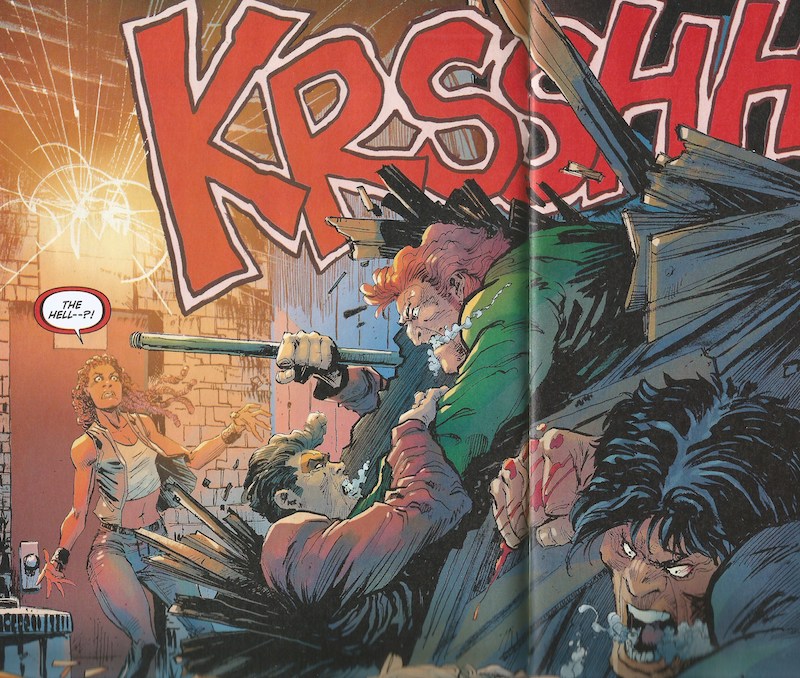
Pak introduced a suitable origin for John Wick that tied into the actions of a murderous gang.  The killers were colorful in their own mind.  They based their names and their superficial appearances on western legends Buffalo Bill, Pecos Bill and Calamity Jane.  

They obviously didn’t know the stories.  Buffalo Bill Cody was a Pony Express Rider and a scout for the Union during the Civil War.  Pecos Bill is an imaginary cowpoke and Calamity Jane a nebulous person from the old west whose deeds and alignment are open for debate.


Only Wick earns the reader’s sympathy and fascination.  The gang are mere psychopaths who fancy themselves as something special.  It makes them just slightly more memorable than cannon fodder.

Those expecting a typical shoot ‘em up finale or even an over the top escalation of affairs just may be slightly disappointed.  Others I think will enjoy the twists.


Pak immersed this series in the world of John Wick.  His attention to detail is impressive.  After all there are so far only two films with admittedly thin plots propped up by outré deviations such as a hotel that caters to enforcers and a bravura performance by Keanu Reeves. 


Pak added his own insights about John Wick’s character.  These insights ring true.


Writer Mairghred Scott concludes her first political thriller in Batgirl.   

In previous issues, Scott put Babs through a ringer of electrocution.  The attack induced the failure of the chip and artificial neural network that grants her mobility.  Nevertheless, these scenes can be argued as "fantasy violence."  This series of Batgirl chapters is brutal.


Scott successfully turns the once nigh all-ages read into a book leaning toward a mature audience.  This is not to say that you’ll see skin in Batgirl.  Rather, Babs suffers severe bruising, swelling and other damage when defending herself against a professional killer.  


The Cormorant infiltrates a television studio where his target congressional hopeful Luciana Alejo is about to be grilled by a reporter.  Previously, Scott revealed the excellent motive behind Cormorant’s employ.  For this issue of Batgirl, Babs must team up with Jason Bard to stop Cormorant from fulfilling his contract.


The way the story plays out offers the reader original suspense within the framework of a tried-and-true plot.  Make no mistake.  Paul Pelletier’s eye-catching illustration enhances every riveting word in Batgirl.  


Scott drew her version of Jason Bard from the Bronze Age and his corrupt return to prominence in Batman Eternal.  I already covered the well-meaning square from the past.  

In Batman Eternal, Bard demonstrated a psychological hatred for Batman.  He tries to kill him after framing and succeeding Jim Gordon as commissioner of Gotham City. 


In the story, Alejo hires Bard and his security service to protect her and investigate the threats she received.  Bard claims to be better than the man reintroduced in Batman Eternal.  The reader should recall what a low bar Bard must overcome.  Batgirl on the other hand and the Batman Family though accused of being vigilantes are superheroes.  They acknowledge a higher standard.


I will never buy a book written by Josh Williamson again.  Originally, Tom King created Gotham and Gotham Girl as new protégés for Batman.  


The combination of Amanda Waller, Professor Hugo Strange and the Psycho-Pirate turned Gotham murderously insane and drove Gotham Girl into a fear-induced state of madness.  Whether or not King planned this out or the story evolved that way is moot.


Batman along with an IMF team comprised of villains invaded Santa Prisca. The goal: to snatch the Psycho-Pirate and reverse the damage done to Gotham Girl’s mind.  Batman succeeds.


I already explained why I don’t like to see Batman fail, and this was a big win.  So, you had better have a good reason to present Claire as the antagonist in your Batman/Flash team-up.

In a recent King Batman Gotham Girl stood amidst the villains in Bane’s circle.  That confused me.  I now feel that this was an editorial direction to the artist.  Not a decision from King.  I have my reasons.

Number one, the above scene depicts Batman and the healed Claire reaching an agreement for her to train in Europe.  Claire also knows that her powers will kill her.  She's made the logical decision to try not to use them in their fullest capacity.  Batman accepts her decision.  King appeared to be writing her out of the story, but not through a glass so darkly.   

Number two, this issue of The Flash conflicts with the precedent Batman.  According to Williamson, Batman decided only now to accept Claire's decision.  He only now seems prepared to help her train as a superhero.  

Number three, after this issue of The Flash...


...Gotham Girl is back to normal.  


So, let me get this straight.  You took something that was fixed, broke it, just so you could fix it again? You answered no questions and advanced nothing.  You asshole con-artist hack.  You just took me for twenty bucks.  That’s the last twenty bucks you’ll get from me.


I didn’t really hate Tini Howard’s The Forgotten Queen like I did Josh Williamson’s The Flash.  Howard’s latest is just ordinary with a few flaws.  Howard juxtaposes the past and the present.  I’ll deal with the past first.  Since, this is where most of my peeves arise.


The immortal Forgotten Queen also named Tibutu sows the seeds of instability and chaos wherever and whenever she treads.  

She gets a kick out of using her power to incite violence, usually amongst men, so you can just dismiss the idea that The Forgotten Queen carries a feminist message about toxic masculinity.  

No, this is a pure fantasy with a supernatural anti-hero that just happens to be female.

Howard demonstrates Tibutu’s catwalk through history, but her main storytelling period arises in the era of Genghis Khan.  

Another example of Howard eschewing a simple sermon.  She portrays Genghis Khan accurately right down to his wife and concubines.  


Tibutu now known as Vexana seems intent to impress the Khan until she becomes his confidante.  There’s a tactical sense to this move, but you don’t get the impression that she’s interested in strategy.  Instead, it's an amusement.  The Forgotten Queen is smug, viperous and thoroughly unlikeable.  That’s all subjective.  


Objectively, I’d love to know why masked profanity was necessary.  Any expletive Vexana used should have been florid and descriptive like, son of a cursed dog or dung of camel.  

Our swear words do not have a lineage that dates back to Ghengis Khan.  They only go back to about the 16th century, but those words are the roots and actually common.  The masked profanity is intensely distracting.


In the present day, some looney tune is searching for Vexana under the pretense of being an archaeologist, excuse me "preservationist" seeking her relics.  She risks and kills one of two divers in the process.  So, I’m really having a hard time finding anybody to root for in this book and won’t likely continue.


The conclusion to Star Trek/Transformers is basically payoff after payoff after payoff.  The entire mini-series is a must buy for fans of either series.  So, if you haven’t been paying attention.  John Barber and Mike Johnson with artist Phil Murray and colorist Josh Burcham mashed the Transformers cartoon with the Star Trek cartoon.  For that reason, we get to enjoy Lieutenant M’ress, a feline crewman of the U.S.S. Enterprise.
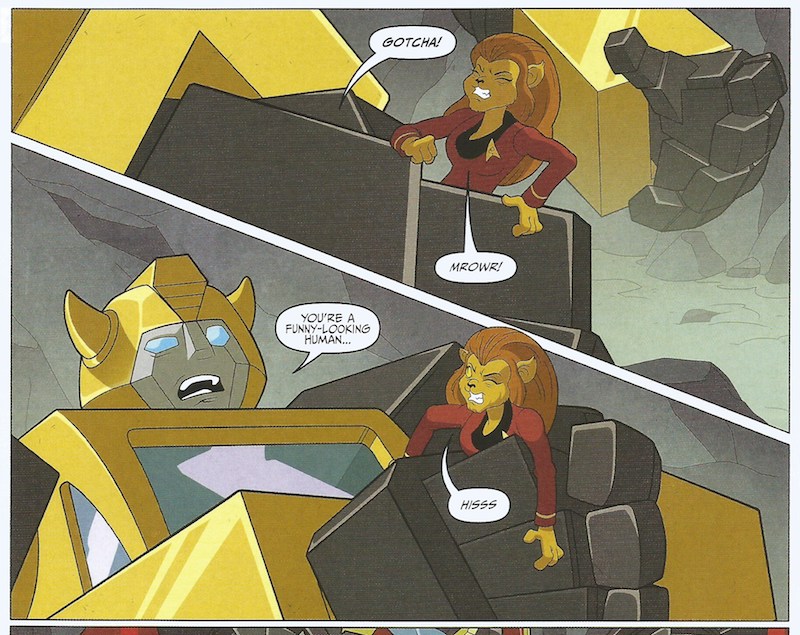
The story began with a group of planes strafing a dilithium mining outpost on Cygnus Seven.  Naturally, Captain James T. Kirk and the crew of The Enterprise investigated.  They found something more than meets the eye.


Oh, yeah.  You did not misread.  I dare.  The planes transform into a very familiar group of Decepticons.  Even more surprising the Klingons make a pact with the new lifeform, but not before a heroic talking semi-truck appears to save everybody from the attack.


One Mind-Meld later, and suddenly, the Federation personnel know the Autobots are alive and not just clever tech.  After a few misunderstandings the Autobots buried on Cygnus Seven team up with Starfleet.  This camaraderie includes the creation of an Autobot Fortress.


That’s right.  Kirk is mentally controlling a transforming Enterprise duplicate.  If that doesn’t warm your heart nothing will, but playing to type, Starscream makes his move, and it’s a brilliant, devious one culminating here.


Starscream takes over Kronos, the Klingon homeworld, forcing Kirk to ferry his Autobot allies into Klingon Territory.  This violates a whole kit and caboodle of Starfleet regulations, but Kirk wouldn’t be Kirk if he didn’t buck the system occasionally.  I will say this.  Kirk never bends the laws of the Federation flagrantly.  He always harbors a good, moral reason for his rogue actions.


Megatron is none too pleased by Starscream’s action.  He however registers no surprise at Starscream’s duplicity.  Starscream’s main protocols are cowardice and backstabbing.  It’s why we love to hate him so much.


Megatron is soldier.  He meets Prime in battle, and the rest of the Decepticons combat an away team of new Autobots that call back to numerous moments in both series.

The very final scenes impress even more since they not only rely on unexpected arrivals but also defy the conventions of traditional crossovers that usually end on a reset to the status quo.  Instead, the creative team embrace their little corner of insanity and let the story taper to its logical conclusion.


In this very special issue of MegaGhost Martin Magus learns a valuable lesson about sibling rivalry.  

I’ve already stated that MegaGhost is some weird H.P. Lovecraft themed Hanna-Barbera cartoon.  This one’s got a lesson that may have been found at the end of first season episodes of The Super-Friends.  It’s at once funny and meaningful.

Martin’s feeling pretty good about himself.  He and MegaGhost have been taking care of whatever supernatural menace the Ultra-Ghoul decides to unleash.  He’s also allowed himself some bragging rights.  His sister already learned about Martin and MegaGhost last issue.  We now include Cameron and Thelma in the inner circle.


When Ultra-Ghoul releases his latest menace on Dunwich Heights, Martin and MegaGhost meet the Familiars.  The name's actually a double-entendre.  Since, Martin recognizes them when they remove their masks.


At heart, the book is a boys vs. girls type of story in which Martin realizes he’s been a male chauvinist ass.  Ultra-Ghoul sees possibilities in the schism and exploits them to the fullest.  Ultra-Ghoul however loses much more.  Anonymity.  Now, Martin knows who’s behind the monsters.


To be fair, Ultra-Ghoul probably thought his latest scheme would ensure victory and saw no harm in introducing himself.  Alas, the Mechtoskeletons fail to live up to their threat.

In addition to all this goodness energetically illustrated by Gideon Kendall, writer Gabe Soria demonstrates how the women work cohesively, and in a surprising twist with science.  Stereotypically women simply aren’t good with important stuff like science.  Thankfully, rational society—not flat earthers—is turning this sexist idea off.

Wednesday, January 2, 2019

POBB December 19, 2018

Pick of the Brown Bag
December 19, 2018
by
Ray Tate

Welcome to the Pick of the Brown Bag.  For the last comic book buying week of the old year, I review Aquaman, Batman, The Champions Annual, Exorsisters, the new book Hardcore, James Bond, John Wick, Nightwing, Red Sonja, and West Coast Avengers.  If you haven’t time for the meaty reviews on the blog, you can always check me out on Twitter: #PickoftheBrownBag.


The Champions Annual properly introduces a new young hero by the name of Amka Aliyak code-named Snowguard.  


Inuit in ancestry, Amka possesses shape-shifting powers that allow her to change into the creatures of the north.  

You're thinking of Snowbird from Alpha Flight.  I can tell.  Amka is a Snowbird fan.  She took her name to honor she and the Guardian.  Snowguard's power replicates Snowbird's abilities, but that's where the similarities end.  Amka's characterization is starkly different.  There is no way you can mistake one hero for the other.  Amka’s ethnicity alone would paint you the fool, especially given artist Marcus To’s care in representing her as a Native and an individual.

Writers Jim Zeb and Nyla Innuksuk create a fascinating modern tribal experience through Snowguard.  


For example, Amka’s opinion on facial tattoos seems justifiably strange to me.  That’s because I’m not from her culture.  Though I would not, others from white America with an homogenous mind-set toward beauty might argue that it's an ugly practice.


I also like the smile on the tattoo practitioner.  This is a rite of passage to adulthood, and she’s proud to be part of it.  

Amka achieves graduation from girl to woman, yet she still faces reverse racism from her school chums.


Unlike other characters that choose to live in the civilized world, Amka is only getting this gruff from the ass of the group.  The rest of the community accepts Amka, as do her diverse team, The Champions.


The heart of the story is really a kind of day-in-the-life homecoming for Amka.  After the tattooing, she enjoys a traditional dinner with her mother, her friends and her neighbors.  


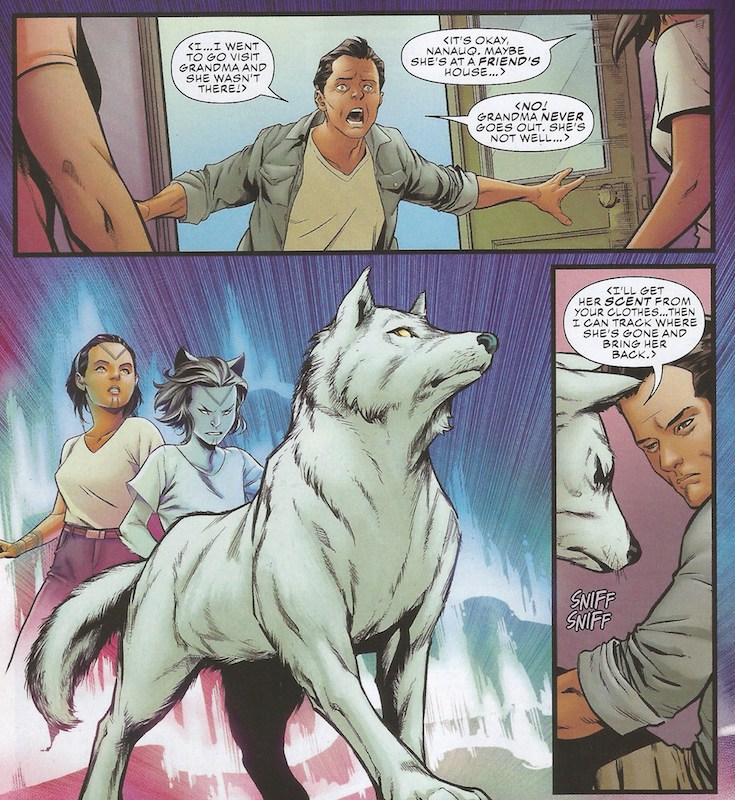
The drama begins when a grandmother goes missing and Amka uses her powers to seek her out.  It seems to be a case of dementia.  You see news reports of afflicted elderly people wandering off all the time.  


Dementia is a symptom of disease.  There are perfectly sharp elderly with full command of knowing where they’re going.  Zub and Innuksuk use that preconception to their advantage and create further distraction through a non sequitur encounter with mythology.


This meeting lends to the idea of The Champions Annual being a throwback to the sort of Tall Tales related over the campfire and helps give the book an original tone.  The giant isn't the only folklore creature you will meet in these pages, and this bestiary will prove a challenge for Snowguard.


West Coast Avengers is mostly a departure from the whacky debut issues.  With the exception of Gwenpool, who also exhibits restraint, Kelly Thompson surprises with a straight up super-hero vs super-villain issue.  This is revelatory.  Even when you strip Thompson’s story of its reality show asides, the goofy Gwenpool dialogue, Kate’s acerbic wit and America Chavez’s deadpan threats, the story's still damn good.


The new Masters of Evil consisting of MODOK, who gave the Avengers their original troubles, Satanna—who’s usually a strange hero—Lady Bullseye and the Eel captured the team under the leadership of Tony Stark’s former lover Madame Masque.  Madame Masque fosters a grudge against Kate Bishop.  That's a damn shame.  Kate eluded the criminals and now follows her mother Ellen Bishop through underground tunnels.


I know beans about Ellen Bishop.  The narration indicates that she’s supposed to be dead.  She also seems to be a spy of sorts, undercover as a Masters of Evil flunky.  Perhaps she’s actually working for them.  Whatever the rationale, because of Thompson’s dialogue and Danielle Di Nicuolo’s art you cannot help but be affected by the relationship, and you hope that this isn’t a trick on Kate.


While Kate effectively copes with the emotional assault from the returned from the dead mom and the physical assault by one of the Masters, the rest of the team practice their escapology.  Clint Barton displays his ingenuity and experience in matters of incarceration.  Quentin Quire exploits his telekinesis to pull off a dramatic moment, and Fuse motivated by the love for his sister, America's date, pushes his absorption powers to a new plateau.


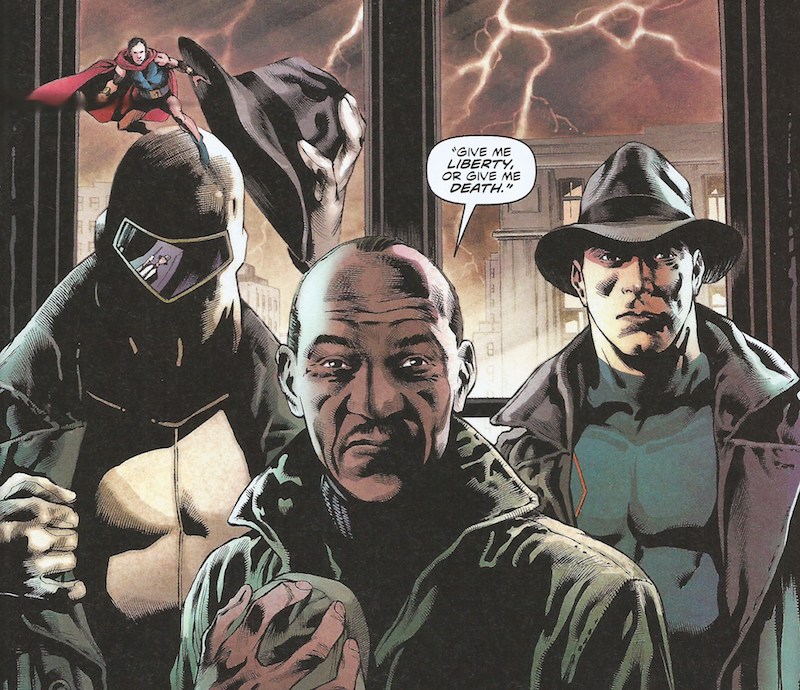
In Justice League of America, DC comics debuted the Freedom Fighters on a parallel earth where the Nazis won World War II.  Prompted by fan interest, the fighters soon starred in their own 1970s series, which took place on earth one proper.

Historically, Uncle Sam, Black Condor, The Human Bomb, Doll Man, the Ray and Phantom Lady arose as individual heroic characters; circa the 1940s in Will Eisner’s and Jerry Iger’s Quality Comics. 

I like the Freedom Fighters.  Their fifteen issue series evinced their credibility.  They crossed over with Batgirl and the original Batwoman.  So, I had plenty of exposure to them.  They made guest appearances elsewhere and they fought in the Crisis on Infinite Earths.

Every so often, DC needs to renew their trademark, so the Freedom Fighters periodically return in brand new series.  This latest iteration is unfortunately underwhelming. 


Supergirl, The Arrow, the Flash, Legends of Tomorrow all crossed over to Earth-X in a better story than what’s presented here.  However, even had the more powerful heroes stayed home, the newest version of the Freedom Fighters would still be a chore.


This is the same-old-same-old with regards to DC’s other half-hearted attempts to revive the characters.  The problem is that they continue to sacrifice the originals for inheritors and subsequently diminish resonance.  

Before you ask, there’s no reason why you cannot tweak the originals for diversity’s sake.  They don’t all need to be white and straight.  The CW Ray is gay, but he’s still the original character.  Black Condor could have always been a black guy.  The Phantom Lady always could have been a Latin-American woman.  That's not as important as keeping the originals together and alive.


So, we’re back on Earth-X again, and the Nazis rule the planet.  They’re so evil that they allow baseballs to be sold although banning the sport.


Clever, evil bastards.  Daleks take note.  Distribute baseballs to your human slaves and exterminate them for having them.  Oh! What’s that grinding sound.


The death of the Freedom Fighters occurs in the past where the resistance is led by a familiar face.  This is really the only moment that you see a spark in the writing by Robert Venditti.  Pun not intended.  It’s an inspired appearance, but the real story of Jesse Owens and the Olympics of 1936 is more fascinating.  

Another caveat lies in Uncle Sam’s efficacy.  If DC keeps killing off the original Freedom Fighters, then Uncle Sam’s leadership skills must be called into question.

What made the nineteen seventies version of the Freedom Fighters memorable is that Uncle Sam led the original team not to their deaths but to their success as super-heroes.  Furthermore, if you keep killing the Freedom Fighters, you're giving the Nazis too great a victory.  That's unacceptable.


Kelly Sue DeConnick debuts as the new Aquaman writer and chooses amnesia as her means for a fresh start.  She also introduces a mysterious new character


Aquaman’s arrival on the fishing island mirrors that of his mother in Amnesty Bay, with Caille subbing for Aquaman's dad.  Mind you.  Aquaman may have been fine had she just left things alone, whereas Aquaman's mother suffered injury and expulsion from Atlantis.


I found myself less interested in the story which is standard amnesia fare and more interested in Robson Rocha’s artwork.  Rocha impressed me on Supergirl, World's Finest and Birds of Prey.  Daniel Henriques' delicate inks bring out the detail in Rocha's pencils, and perhaps add more.  Colorist Sunny Cho furthermore enhances the illustration to give Aquaman a decidedly art nouveau look.


Tom King's Batman is an issue that's impossible to review without giving away secrets.  Instead, I'll fudge some facts a bit and critique the artwork by Nightwing's Travis Moore.

Batman investigates a slaying similar to that of his parents.  The same plot unfolds in Detective Comics courtesy of Peter Tomasi and Doug Mahnke, but the plots differ strongly.  Tomasi's mystery involves a copycat crime.  Batman is a different sort of animal.


Batman's investigation takes him to low-life bars where stool pigeons are ready to be plucked off the ground.


The information carries him to the higher echelons of crime where even the classier criminal who feels he's made it finds terror in the sight of Batman.


Finally, Batman trails the culprit on the lam.


Listen.  If a story involves a train, chances are you're in for a treat.  There's never been a bad train story: Murder on the Orient Express, Horror Express, Sleepers West, The Lady Vanishes, Silver Streak, Amok Train and so many others.  True, we don't spend too much time on the train, but it's the cherry on top.

Moore's artwork perfectly blends the perfection of Batman's anatomy with expression and body language grounded in realism.  At the same time, he creates a fast-paced narrative which displays moody detective work and Batman in his best action.

Wait.  That's not Nightwing on the cover.  What's going on?  So, you're new to Nightwing.  Not a problem.  Here's your crash course.  Robin renamed himself Nightwing.

Something really bad happened to Nightwing in Batman, but he got somewhat better.  The problem is that though Ric Grayson remembers his previous life as Dick Grayson, he no longer possesses the emotional connection.  

He looks upon his life as a reader might look at a book that's technically good but not fulfilling.  He can admire the craftsmanship that went into the work, but he gets no feeling from it.  

The Nightwing on the cover is one of four new Nightwings consisting of Detective Sapienza, cop brother and sister Collen and Zak Edwards and firefighter Malcolm Hutch.


Sapienza investigated the destruction of Nightwing's Bludhaven lair and discovered his treasure trove of costumes, old and new, and gadgetry.  You can add up the rest.

Our other player on the cover is Jonathan Crane, the Scarecrow.

The Scarecrow harbors a vendetta against the original Robin.  Dick Grayson.  Seen in flashback, Robin appears to be fearless, and since Scarecrow promotes himself as the Master of Fear, Robin sticks in his craw.

Scarecrow seems to know that Robin grew up to be Nightwing.  No idea if this is public knowledge, or a sign that the public is fluent in addition.  Perhaps, just Crane and Vicki Vale doped out Nightwing's former identity.  In any case, the Scarecrow moved his operations to Bludhaven in order to attract Nightwing and kill him once and for all.  Thereby ending his own personal fear.


Crane's latest scheme collides with Ric Grayson's new life.  Despite being Grayson's therapist, Crane hasn't sussed out Ric Grayson's connection to Nightwing or Robin.  


The result of all of this, which could have been a real mess, is a superbly written comic book.  Nightwing  sells because of the exquisite building of the entire cast's characterization and seamlessly enmeshing that characterization with the plot.


Andy Diggle's and Robert Kirkman's Hardcore is an update of the spy genre.  Bonnie Price liaison to the Defense Department begins the oversight of the Hardcore Program.


The Program's "drone pilot" is Carter Drake.  Basically, the agency using sci-fi tech hack into assets' neural network to get close enough for assassination.  


This seems to be a bloody waste of time if you ask me.  They should be using the program to gather intel ever so silently.

It's nevertheless an interesting premise, and it becomes more interesting as the inevitable spanner comes slamming into the works.


At first writer Greg Pak seemed to be relating a nondescript John Wick story that hit all the right notes for artist Matt Guido to wow the already ardent admirer of the films. 


Pak though surreptitiously injected a theme in John Wick.  Wick as a child did't just run from a group of ordinary thugs.  These thugs had names reflecting heroes and outlaws of the old west.  Introducing Calamity Jane.


Very little is known about the true life Calamity Jane.  Most of what's recoded is likely false or exaggerated.  What can be said, is that she's got a great name, and she in all likelihood married Wild Bill Hickok.  So almost anything is game including making her namesake a sadistic killer.

But you see what I mean.  Pak introduced thugs as thugs.  Then christened them Pecos and Wild Bill.  The female of the species is Calamity Jane.  It's a flourish, but it's a noticeable one and kind of clever.


John is still in demand by Russian Delegate Maria and the Continental.  However, Wild Bill's gang want him even more and send goons to prove their lust to kill John Wick.  

Naturally, this fails miserably and stylishly.  Pak also introduces a motif I really didn't notice in the films but does make sense and is evident. 


From the opening page, the reader knows that she is in an alternate Jame Bond Universe.  This is not a first.  The movies also represent an alternate Bond Universe.  


Goldfinger though was a mostly faithful adaptation of the novel.  Its deviations often enhanced and streamlined the original story.

The second chapter of the latest James Bond comic book attributes the pounding Bond experienced at the hands of Oddjob to another agent.  Indeed, Agent Edmundson's routine surveillance was Bond's in book and novel. 


The difference lies in the execution.  Because this is another agent, Pak can upend Bond escapism.  Turn it into realism.  The carnage Bond suffered would have killed another man, and so this other man sustains permanent damage.  Presumably, in this universe the Goldfinger Affair must not have occurred or was stymied by friendly intelligence forces.


In any case, Bond promises vicarious revenge through the assassination of Oddjob Jr.  This is rather mean and pointless misdirected machismo.  Oddjob Jr. doesn't have anything to do with Agent Edmundson's condition.  So Bond is promising to condemn a man for an echo.  That's the only note in this two issue restart that rings falsely.  The rest of the story reads like Bond, James Bond.


Bond visits Q Branch, and here again, Pak presents a blend of Bond material.  Q Branch is mentioned in the novels.  The character dubbed Q, introduced as the Armorer in the movie Dr. No.  The filmmakers later gave him the name Boothroyd.  His rank is major presumably in the Royal Army since the Navy lacks the designate.  

In the comic book Commander Bond refers to him as Armorer.  Marc Laming draws him to resemble John Cleese, the next Q in the films.  The whole scenario plays out like one of the many humorous episodes from the films.


The mission is still in play, and Bond is right on the money again.  Pak and Laming paint Bond and Lee as opposite numbers.  This mirror imagery comes to a head.


Both agents talk.  They make attempts to reason before getting into an inevitable gun fight on the waves and reaching a common goal.


Perhaps because Oddjob Jr. has a name, Bond drops the whole wrongful vengeance thing.  Maybe he realizes it was a silly thing to say.  


Whatever the reason, Lee and Bond end up working together as uneasy allies, much to the consternation of Moneypenny who graduates from M's personal assistant to Bond Handler.

Another done-in-one Red Sonja is notable for a reversal of cliche.  The story begins with Sonja searching for grub only to almost run down a crone.  Hunger sharpens Sonja's temper, and the crone punishes Sonja's haughtiness with a trip that begins here.


Now, this scene could appear in any sword and sorcery production.  The key is that Sonja who lacks her male counterparts' lust for female flesh, or at least she hides it well, is only interested in the drink and repast.  The wench's comeliness works two-fold.  Not as carnal seduction, but as a ruse of innocence and foreshadowing.


Kate and Cate Harrow are the Exorsisters.  In truth, they're a lot closer than sisters.  No, not in that way.  The relationship is original and complex, but they are partners who have each other's back no matter the circumstance, including a court in Hell.

Every Simpsons fan knows that Hell of course conducts trials.  They're a civilized lot, and Cate speaks on behalf of the hapless plaintiff.  As with The Simpsons, of which writer Ian Boothby is definitely familiar with, the Court is designed to be biased.

The consequence of this bias is a two page action-filled cartoon by Gisele Lagace depicting the Exorsisters beating the snot out of the denizens of Hell.  It's at once legitimately  adventurous and comedic illustration.

Because fighting demons is messy, Cate thanks her fans by taking a shower.

As I have said time and time again, the shower scene is the actress apologizing for the bad movie you're sitting through. In this case the cleansing is fit with the plot and chaste.  Normally, I'd complain about the censorship from the suds, but you can clearly see that this is a decision from the artist not some Legion of Decency maven.


Never trust a soul-patch.

The speaker in the shower is a special guest-star.  I don't want to give away the surprise imagery, which will delight students of old animation.  The encounter catalyzes a flashback which not only gives the reader a peak into Cate's life before Kate but implies the length of time Cate and Kate found themselves separated.  It also begins Cate's demon brokering in a mesh of comedy and dark fantasy.