Showing posts with label Geovani. Show all posts

Tuesday, July 23, 2013

POBB: July 17, 2013


Pick of the Brown Bag
July 17, 2013
by 

Ray Tate

This week, we're on time with Batman and Catwoman, Batman Beyond Unlimited, Birds of Prey, Justice League of America, Red Sonja, Simpsons Comics, Supergirl and Wonder Woman.


The Trinity War continues in Justice League of AmericaIn last week's Justice League, Superman seemed to fricassee a League of America member.  This goes down badly with both teams, and a slugfest breaks out.


A Scene Would Have Been Unthinkable Two Years Ago

Superman blames himself, and it should come to no surprise to anybody when he demands...


Yes, that's the Big Red S.  Every version of Superman winds up in jail at some point in his career.  The George Reeves' Superman also found himself behind bars.  You old universe holdouts who still want to see a boring Superman, an ineffectual Wonder Woman, an automaton Batman and a crippled Batgirl can go to hell.  The New 52 is awesome and in essence more accurate.

After Superman gets his wish, both Leagues lick their wounds.  Friendships do not form, and the Atom experiences buyer's remorse.  She turned out to be a League of America spy.  Even old friends such as Steve Trevor and Wonder Woman distance themselves, but one chain continues to be unbreakable.  The historical elder statesmen of the superhero genre, Batman, Superman and Wonder Woman, stick together.
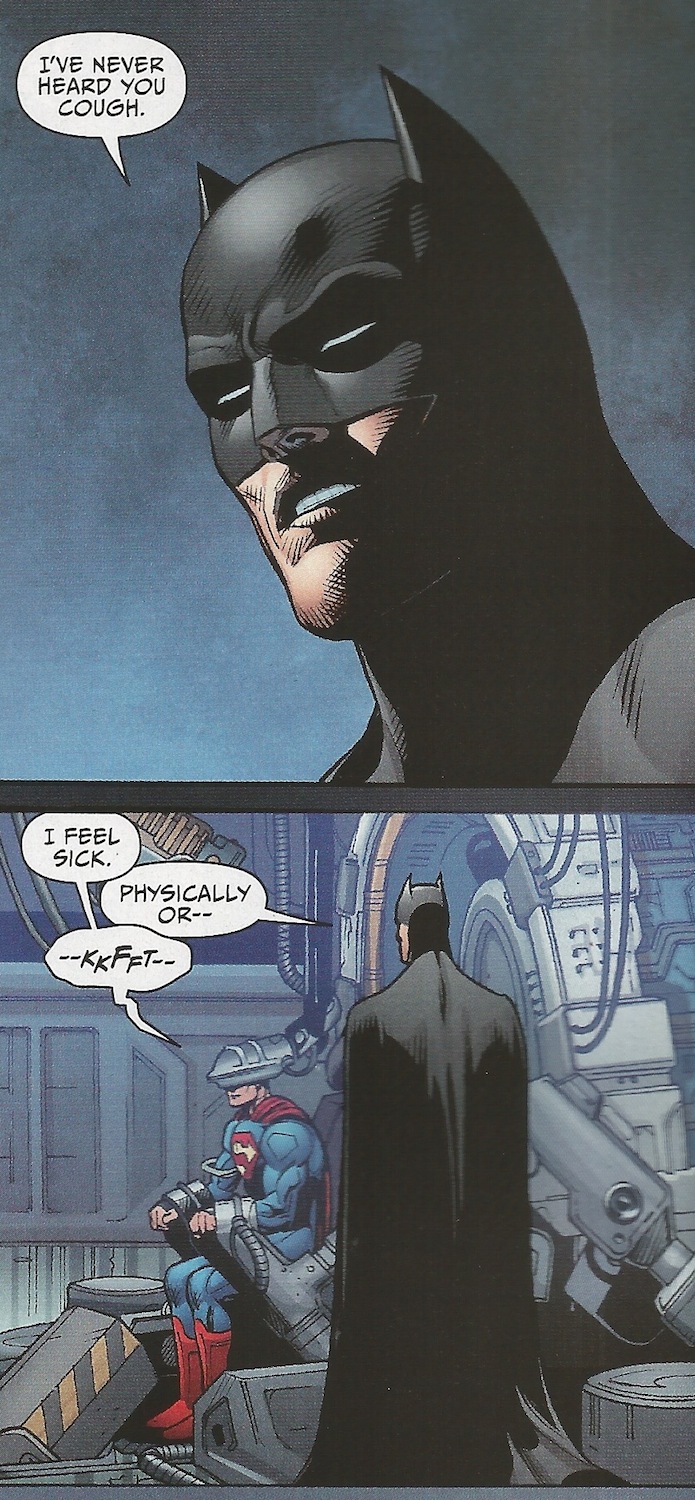
Batman and Wonder Woman do not believe Superman to be responsible for the death of the League of America member.  They intend to investigate Superman's explosive behavior.  Batman observes and deduces.


Wonder Woman follows the trail of Pandora's Box.  When Trinity War had been first hinted at, DC made a big whoop-de-doo over a schism between Batman, Superman and Wonder Woman.  Thankfully, that was rubbish.  Despite disagreeing on the philosophy of each other's pursuit, Batman and Wonder Woman are on the same wavelength.  Though they do not know it, they are not alone.


Batman and Catwoman earns the most improved book award this week.  Batman still suffers from the loss of his son Damien.


However, he's no longer insane: leading him to do such things as disassemble Frankenstein to discover the secret of life.

Batman's past breakdown and overall nastiness is a little easier to take now that Peter Tomasi clues the reader into exactly when these books have been taking place.  

Batman for example beat Catwoman's motorcycle helmet to death in her feature title.  This issue, Batman replaces the helmet, with a note of apology.   That means Batman and... is a more or less daily log of Batman's life.  It runs concurrent with Catwoman.  

Superheroes in the new 52 apparently have some action-filled days.  I always thought that unless the story continued from issue to issue, weeks had passed between each, regardless of the comic book company.

Batman and Catwoman also sychronizes well enough with Batgirl.  When our title Daredoll appeared in Batman and Batgirl, Batman recognized her decision to rip off her bat symbol, but his state of mind precluded any empathy he felt for her situation.  Alternately, Batman as seen in the latest from Batgirl's title has already been assuaged by Catwoman's presence in Batman and Catwoman.  

Batman and Catwoman begins with even more continuity, however delivered smoothly.  Steve Trevor notifies Catwoman in mid-heist that he has a job for her on behalf of Justice League of America. 

Catwoman calls Batman for help, and he answers.  It turns out, Batman and Catwoman is the comic book in which Batman learns about the existence of Justice League of America.  

Since Batgirl also fits into this timeline, we can now say that Batman does not yet know of James Jr.'s participation in Amanda Waller's Suicide Squad.  It is likely Batman knows about Waller.  He was already aware of Black Canary, and both she and Waller served on Team 7.  He now knows that Waller is active once again and will learn about James Jr. during his investigation.  It still doesn't make the James Jr. moaning in Batgirl easier to stomach, but at least there's an explanation.

Even when setting aside the continuity and timeline interest, which admittedly may only fascinate me, Batman and Catwoman still delivers an exciting adventure that demonstrates the playful and respectful relationship Batman and Catwoman have.

Catwoman lightens Batman's load, a lot.  Batman discovers the true nature of Catwoman's assignment, but rather than express anger over being duped, Batman tears through the opposition.  


Patrick Gleason's and Mick Gray's evocative fighting cinematography turn Batman and Catwoman into a natural martial arts team, a costumed John Steed and Emma Peel.  It is an absolute joy to watch Batman and Catwoman decimate these bastards. 


One may argue that Catwoman set up Batman for his own good; having sensed something wrong with her sometime lover in her own title.  Indeed, Catwoman probably would have been able to perform Trevor's mission by her lonesome, but she sagely saw this as an opportunity for Batman to heal, from whatever damaged him.


After three or four issues of Batman going bat-shit crazy, Batman and Catwoman feels like a breath of fresh air.  Recommended for any fan of the Bat or the Cat.

In Birds of Prey the continuity becomes concrete.  Batgirl zooms away on her bike to battle James Jr....


Before

then comes back traumatized by the whole affair.  


After

In addition to observation of the Batman Family timeline, Christy Marx promotes the Canary's smarts.  Starling betrayed the team by throwing in with Mr. Freeze to take down the remaining Owls.  So, Canary burns, sometimes literally, everything Starling associates with the Birds of Prey.

I'm ambivalent about the rest of the book.  Marx introduces a new team of super-villains led by a vaguely familiar Big Bad that follows the classic rule of sanity being inversely proportional to the eccentricity of the hat.

Black Canary's and Condor's relationship progresses, but I'm just not into them.  Strix returns from the non crossover with Talon.  Ultimately though, there's not enough hitting, leaving stellar artist Romano Molenaar nothing to do but visually twiddle his thumbs.


Adam Beechen introduces a new Batgirl to the future world of Batman Beyond, and for once, I actually like somebody wearing a Batgirl suit that's not Barbara Gordon. 

The reason why I accept this newest Batgirl is simple.  She's not a substitute.  Babs is still Batgirl in the same way Bruce is still Batman.  When DC introduced any other woman in a Batgirl costume--Helena Bertinelli, Cassandra Cain, Misfit, Batwoman, Booster Gold's sister, Stephanie Brown--it meant one thing.  DC was not going to heal Barbara Gordon.  My answer was always the same.  Screw you.


The new Batgirl fights alongside a fully mobile, fully kickass Babs Gordon.  That is fun, and the new Batgirl has a different personality than our ebullient Darknight Damsel.  She's surly, with a massive chip on her shoulder.  She has good reason.


The plot of Beechen's story is basically the GOP kills poor people by using Venom to inflate their muscle and escalate their anger.  When Babs and Batgirl confront the bastard behind this, they get treated like a woman under the thumb of the Texas Legislature.  Babs though as Batgirl notes could have easily taken down the Big Bad.  She just wanted to see what the new Batgirl could do once facing the Perry of the piece.  The terrific standalone is complimented by a backup that reveals whatever happened to the Metal Men.  This was just lovely.  Batman always liked the Metal Men, accepting them as they are and treating them as human beings.


I was a little nervous when I heard that the Supergirl team was departing, but judging by this current plot, the new Supergirl Scoobies have got a good act to follow.


Poisoned by Kryptonite after saving the world from H'el, Supergirl decides to take a cosmic road trip using an experimental scooter, she borrowed from Dr. Veritas.


Hmmmmn.

Her first stop was a planet whose inhabitants can bring imagination to simulated life.  A giant monster appeared to attack these inhabitants if they are indeed a species and not a dream within a dream.  Supergirl dealt with it, and the Grand Poobah apparent welcomed her to imagine Kryptonian legends.  Naturally, there's something more to the whole scheme than making a young Kryptonian girl's wishes come true.

Last issue ended with the startling new 52 introduction of the Cyborg Superman.  Originally Hank Henshaw, the last survivor of a defacto Fantastic Four who gained nothing from radiation exposure except death, the new Cyborg Superman is a different animal.  


Supergirl sure didn't conjure him up.  How could she?  She never met him, and she certainly doesn't want what he's serving.


Michael Alan Nelson's plot is a little odder than the typical good versus evil tradition, and his dialogue for the Girl of Steel is riotous.

Artist Diogenes Neves makes up for the loss of Mahmud Asrar.  His Supergirl is appropriately deceptive.  While she seems to be an innocent teenager who wears her emotions on her blue sleeve...


...she's also a Kryptonian with immense power to put villains down.  In short, this is still the Supergirl we fans all want to see.


Writer Brian Azzarello after announcing Wonder Woman to be a horror comic book series mostly made good on his promise.  

Azzarello demonstrated the pettiness and cruelty of the deities with "good god" Apollo sending three innocent women plummeting to their deaths after he used them as vessels for prescience.  

Partner in crime Cliff Chiang clad Hera in peacock feathers and nothing more, to infuse primal terror in the hunt for the latest of Zeus' conquests, an earth woman named Zola.

Azzarello and Chiang of course could not go full throttle.  The presence of Wonder Woman made such an aim impossible.  Heroes stop the progress of evil.  They do not facilitate it, nor do they simply sit idly by and watch evil grow.

Wonder Woman has been most proactive in this new series of adventures.  She not only combatted and defeated the gods.  She also lived up to the intent of her creator Dr. William Moulton Marston.  


Marston saw his brainchild as an alternative to the machismo violence that he perceived Batman and Superman exhibited.  Wonder Woman in fact rehabilitated one of her arch-foes, Gestapo agent and scientist, Paula von Gunther.  After Marston, Wonder Woman became many things: traditional bellicose Amazon, wise immortal, certified diplomat, Modesty Blaise type adventurer.


Azzarello's Wonder Woman combines the best of all the worlds.  We first saw her at a hotel in London, not the usual milieu for the Princess, but perfectly reasonable given her past Nazi fighting, not yet recognized in the new 52.  Azzarello indicated that Wonder Woman was a seasoned fighter, not the neophyte superhero from the premiere of Justice League.  

A young, pregnant girl sought Wonder Woman's help, and the Amazon quickly established herself as Zola's protector.  Through the Hero's Journey, Wonder Woman learned about herself and her newfound siblings including the tragic Lennox, son of Zeus.  


Recently, Azzarello did something very unusual.  He introduced the new 52 versions of the New Gods in Wonder Woman.  The New Gods have never been before associated with Wonder Woman, but Azzarello makes it seem like such an obvious place for their premiere.  Artist Cliff Chiang reveals himself to be a secret Jack Kirby fan.  His streamlined clean art nevertheless expresses the flourishes of Jack Kirby's distinctive illustration.


The New Gods are distantly related to the Greek Gods, and Highfather, who we meet this issue as more knight and less hippie, ostensibly sent Orion to kill Zeus' and Zola's baby.  The Greeks fear that Zola's baby Zeke will usurp the ruler of Olympus.  So it seems that two different pantheons have the same information.  There was much more to worry about.

Last issue Orion, Wonder Woman, Hera, Zola and Zeke escaped the First Born, Hera's first son, via Boom Tube.  This issue Azzarello defines Wonder Woman and consolidates the careful characterization he developed for this latest incarnation of Diana of Paradise Island.


Azzarello makes Wonder Woman a warrior, but one that inspires others to greatness.  She's not the typical Amazon.  Azzarello already exposed them as the followers of Greek tradition, the rapists and killers of men, not the perfect Utopians who saw man's world as folly.  Fascinating enough.  Diana is one that forgives after kicking ass.  Her exposure to cultures outside of Paradise Island also gives her a more cosmopolitan world view.  She really believes that everybody can live in peace and harmony.  That in some ways reflects the George Perez Wonder Woman, but there's that ass kicking part of her that recognizes that peace must be fought for, and asses that need to be kicked are a universal impediment.


Oh, did I mention the Jackal Men of London?

Gail Simone takes over Red Sonja, and it's a little bit Black Adder blended with Magnificent Seven and a strong feminist slant.

The story opens in the past with King Dimath securing a city and rescuing its tortured souls from the dungeon.  Sonja becomes involved with Dimath in a unique way that may just upset some the She-Devil's fans, but Simone likes to defy expectation.  Sonja isn't Supergirl.  She can be overwhelmed.

The story skips ahead with Dimath calling on Sonja to help him thwart the Zamorans.


No not those.

Sonja becomes Dimath's general, and this is where The Magnificent Seven come in.  Sonja trains an army consisting of young girls and a few good men.  When she leads the group forward, she finds a surprise waiting for her in the saddle of the opposition.

Simone's Sonja is mostly the same from other versions, but she relaxes the character somewhat and tempers her anger.  For example, when a group of young brigands try to rob her, she tries her best to avoid combat.  She only picks up the sword when they leave her no choice.  Simone's Sonja is also a little smarter than previous treatments.  Simone furthermore pumps up the idea that above all Sonja is a heroic adventurer, not just a mercenary.  She follows a code of conduct.

If these tweaks disturb you, faithful Sonja followers should take heart in seeing Walter Geovani's and Adriano's Lucus' definitive Sonja illustration beautifying the book.


For those coming late to the story, Ned Flanders remarried Edna Krabappel in The Simpsons' "Ned n' Edna's Blend."  Writer Mike W. Barr bases his comic book story on this remarkable shred of actual Simpsons continuity.

In the past you could say that The Simpsons started up from scratch each episode.  That all changed with Maude Flanders' death.  Now, the thread you can actually follow is an interweave between Ned and Edna.

You don't really need to know everything that happened previously to enjoy Barr's tale, but in all honesty, you'll have a richer experience if you do.  For example, Bart's relationship with Edna Krabappel is for the most part adversarial, but several Simpsons stories reveal a friendship between the two.  Edna for example in a conceptive season took pity on Bart when he tried his hardest to study and still failed.  Bart as a prank began writing Edna love letters only to feel horrible when she fell too deeply for Jacques.  Bart also became an intermediate between Edna and Principal Skinner.  We get some of this kindness between the two in Barr's story.

Ned's parents are Beatniks, and that makes it easier for the two to spend time with the Simpsons, who have always been surreal.  Barr eventually evolves the story to a supremely satisfying finish where the Flanders reunite and find common ground.  Before that though, Barr finds comedy in the family dynamic spinning out with a centripetal force that ensnares all.  

The outstanding issue of Simpsons Comics is brought to you by Phil Ortiz, Mike DeCarlo and colorist Art Villanueva.  One of the things you notice immediately is how the relatively realistic body language defines this tale as more dramatic.  This isn't going to be a goof where elephants eat people.  The other thing immediately apparent is the overall happy look to the characters.  Barr's story doesn't rely on bitterness or slapstick to relate the jokes.  Ned and Edna are perfectly okay with the senior Flanders' spending time with the Simpsons.  Homer's delighted to find somebody who knew his rebel mother.  Edna's spirit isn't being crushed.  She looks positively buoyant as a result.  Because of the pure character design and this emotional uplift, you can imagine Marcia Wallace's voice as a blend of Edna's and Carol's from The Bob Newhart Show, and that works beautifully for this special issue of Simpsons Comics.


Tuesday, December 4, 2012


Pick of the Brown Bag
November 27, 2012

by 

Ray Tate

The Pick of the Brown Bag saddles up for A+X, All-Star Western with Jonah Hex, Aquaman, Bart Simpson Comics, Batman: Dark Knight, Batman Beyond Unlimited, Flash, Justice League Dark, Lookouts, Masks, Prophecy, Superman and the return of The Witchdoctor: Mal Practice.

When last we left Ben McCool's Lookouts, their hot-headed member Dore had just kiboshed their chances of playing by Troll rules to cross a bridge.  The Master Ranger believed the Troll to be a perfect training wheel for the much deadlier Sphinx, it's riddles demonstrating greater complexity.

This issue's goals split into two.  In the present day, the Lookouts return to face the Troll with a clever riddle of their own.

In the past, McCool spotlights Voel's wild-child life, and the artists' rendering of wolves and future Lookout recall the Chuck Jones made for television Rudyard Kipling specials.

Though the illustrators render the wolves as fantastic cartoons, the drama still issues throughout the panels as death, betrayal, love and honor frame the four-legged characters.

In Ron Marz's Prophecy, another literary figure appears in Victorian times to abscond with the Obsidian dagger that will eventually fall into Kulan Gath's shriveled hand.  This player is an unexpected and smart addition to the burgeoning cast.  

Who Is This Man?

Sherlock Holmes could not have deduced a factor so random, yet the periods of the two foes agree. The explanation as to how our mystery guest involved himself neatly results from cleverly concealed foreshadowing from last issue. His characteristic sense of unbridled hedonism impels his actions, and when you think about it, he's the antithesis of Holmes, arch-maven of logic and order.

Jumping ahead to the present day, our odd team of protagonists--Ash, Athena, Dracula, Eva, Pantha, Red Sonja, Vampirella and Herbert West--face the evil gods resurrected by Gath.  Needless to say they acquit themselves easily, but one of the gathering surprisingly falls. 
  

Walter Geovani and colorist Adriano Lucus beautifully visualize the dancers in the fantastique noir, and in the previous time frame, Geovani designs a particularly fitting Sherlock Holmes.  Recommended for fans of unusual crossovers and readers of classic literature.


Amalgamation appears to be Dynamite's middle name.  The Powers That Be also kickoff another crossover.  In Masks, The Shadow, Green Hornet and the Spider combine forces to fight tyranny in America.  Criminals have taken over politics, bending the law into a pretzel.  When the law fails, only the bringers of justice can prevail for the common man and woman.  I have to admit that I had a lot of doubts about Masks, but these were alleviated upon reading.  My trepidations concerned the Shadow.  

I first encountered the Shadow in Batman.  Batman suffered a sort of nervous breakdown in which gunfire triggered post traumatic stress, before such a phrase was coined.  The gunfire reminded him of the murder of his parents.  The reaction incapacitated him.  The Shadow stepped in to aid the Dark Knight, whom he considered his rightful successor, and even offered him the gift of twin .45 pistols at the end of the case.  Well, I went right to the library after that.  Who was this Shadow?

After the trip, I knew the gist.  The Shadow originated in radio, and he wasn't like the comic book character.  In the radio show, the Shadow could become invisible through the ability "to cloud men's minds," and had this crazy catch phrase: "Who knows what evil lurks in the heart of men?  The Shadow Knows.  Ha-Ha-Ha-Ha-Ha-Ha-Ha-Ha-Ha-Ha!"  The invisible Shadow didn't send me.

Maybe a couple of months later, I picked up a paperback reprinting a Shadow adventure, The Black Master by Maxwell Grant.  The character in the paperback reflected the comic book character that helped Batman.  

It would take me a year to discover that Maxwell Grant was only a house name, and that the true author of the Shadow's adventures was a magician named Walter B. Gibson.  Legend has it that Gibson was so prolific a writer that he typed until his fingers bled.  Given the volume of Shadow mysteries Gibson produced, I still can believe it.  

I like to consider myself a Shadow connoisseur.  I realize there are as many different versions of the Shadow as there are Batman, but for my money, you can get the look right, but if you miss the personality, you've got nothing.  

The Shadow of the pulps was human.  He was one of the most lethal humans ever to skulk, but still human.  Gibson's Shadow relied on no supernatural powers.  Gibson made him a magician.  He hypnotized people with the Girasol blazing on his finger.  He picked locks and scaled walls with suction cups, a trick Batman would use.  Facilitated by a black cloak and slouch hat, the Shadow used pattern recognition to disappear and reappear, and he fought crime not through invisibility but by blasting big holes through criminals.  

Something else Gibson strived to convey.  Though often implacable and unreadable, the Shadow could feel complex human emotions like empathy.  He expressed unswerving loyalty to his agents and valued their contributions to his crusade.  He might risk their lives.  He might even sacrifice their lives, not that such a thing happens in the adventures, but he never does so wantonly.  That's where I think Howard Chaykin and Garth Ennis missed the point.  They see the Shadow as a bastard, which is easy to write.  It is my firm belief that the Shadow wasn't a bastard at all but a champion, and that makes him harder to write.  He's a hero, but not by clearcut conventional standards.

With Masks I'm happy to say that Chris Roberson and Alex Ross go old school.  The flesh and blood Shadow battles Kato as he and his boss mistake the Shadow for a mobster's enforcer.  The Shadow exhibits no such misconceptions.  He knows that the Green Hornet's parasitic pursuit for a piece of the action is only a pretense. 


Deducing the Hornet's secret identity is almost a parlor trick for the Shadow.  In fact, the Shadow welcomes the Green Hornet to the Cobalt Club.  He almost expresses a kind of admiration that somebody would independently take up his fight, and throughout the book, the Shadow takes on the role of educator.  As he did with Batman.

Criminals nationwide come to New York to join the so-called Justice Party that infiltrates government from the ground up, and that turns the Hornet's insides.  He believes in the law as well as justice, but now he faces something that he could have never imagined.  The Shadow on the other hand appeared to be preparing for this scale all along. That's the kind of intellect and human nuance I expect from the granddaddy of all the dark heroes, and that's why Masks earns my highest recommendations.

In All-Star Western, Jonah Hex and Tullulah Black hunt down Dr. Jekyll's formula last seen turning circus folk into stark raving madmen.  The Barbary Ghost searches for something more valuable, her mother in Gotham City's Chinatown.

On the surface, this issue of All-Star Western is average, and by average, I mean extraordinarily good.  Make no mistake.  Writers Jimmy Palmiotti and Justin Gray set the bar high, and they keep reaching the top issue after issue.

Their partner, artist Moritat, rips through the panels and sometimes double-page spreads.  It's as if he were hooked up to a device that fed him images from the films of Sergio Corbucci and the Shaw Brothers directly into his brain.  


Moritat's display of action is quick, ferocious and breathtaking, but All-Star Western isn't solely about swordplay and shoot-em ups.  As we close this chapter of literary mashup, horror awaits the reader.  Before the gruesome conclusion occurs however, the moment below will make you giggle.


I have no idea what the hell's going on.  Is Tullulah Black bisexual?  Is she giddy with the prospect of leaving Gotham City, a city that Hex and she hate with equal passion, and just funning?  Is she merely enjoying something soft and warm that's handy? Perhaps the answer lies in the midst of all three possibilities.  Whatever the rationale, it's the perfect capper to her involvement in the story, and the Barbary Ghost's priceless expression merely doubles the comedic impetus.

In the backup feature, Gray and Palmiotti go beyond history text books to uncover solid research about post-Colonial America.  The hero here is Tomahawk, but a decidedly different incarnation of Tomahawk than the old comic books fostered.

There are two views to most wars.  The Native Americans were defending their land and way of life from white invaders.  Primitive Americans often considered the Natives no more than ignorant savages.  Some of the Founding Fathers saw Natives as obstacles to overcome.  The British viewed them as allies of convenience.  Gray and Palmiotti with lank designs by Phil Winslade cover the gamut of opinion in these back-up adventures.


To be fair, DC once published comics featuring Native American heroes such as Strong Bow and Pow-Wow Smith, but calling a white character Tomahawk could be construed as insulting to an entire culture.  Gray and Palmiotti restore the name to a more suitable champion.  


This issue of Batman Dark Knight is simply put horror/adventure at its finest.  The Scarecrow has been abducting the children of Gotham City to conduct the same psychological experiments his father conducted on him, but his aims are far more lofty and insane.

First, the Scarecrow seeks to use the children's pheromones found in their fear-induced sweat to perfect his toxins.  Second, Jonathan Crane seeks to make these children stronger, in the sick way his father made him "stronger."

Batman deduces his scheme, but the Scarecrow accounts for this contingency.  He captures the Dark Knight and uses him as a guinea pig.  What he cannot predict is how the toxified Batman reacts.  

Batman instigates one of the most horrific countermoves against a foe I have ever seen, and I've been reading Batman since I was about ten years old.  I mean, back in the day, the Golden Age Bat-Man, who had a penchant for snapping the necks of his enemies would have been shocked at what his future incarnation does in Batman Dark Knight.

Artist David Finch perfectly times the scene for the greatest impact.  He executes the moment flawlessly, and he makes Batman meaner-looking than ever before.

That said.  This chapter of what can be described as an unsung masterpiece, deserving of a Bram Stoker Award, is also strangely uplifting.  As the Scarecrow's plans go to blazes, the Scarecrow's last act--he cannot believe he will survive--is one of heroism.  He's suffering from tremendous pain, but he goes beyond the agony that Batman inflicted and behaves nobly.  It's a bizarre moment in which you actually root for the Scarecrow yet not empathizing with the lunatic in any way.

Batman furthermore exhibits extraordinary humanity when he finds himself in need of rescue.  The Scarecrow not only mentally abused the Dark Knight but also physically damaged him during his escape.  The blood loss weakens Batman, and Hurrwitz and Finch convince you that he could have died ignominiously if not for the timely intervention of one of the Batman Family.  I don't like this particular member, but the character gains remarkable resonance in his scenes with Batman.

Despite ushering the reader on this emotional roller-coaster, Hurrwitz and Finch still aren't finished.  While this story has a beginning, middle and end for the chapter.  The tale restarts with the fruition of the Scarecrow's plans for Gotham City, again exploiting an arch-enabler of crime thus reinforcing the idea that this new 52 version of a classic Batman foe is no mere grotesque.

This is one of the best issues of Batman Beyond that I have read.  The grim doomsday of the earth appeared to be a sure thing, but Bruce Wayne had an ace up his sleeve that nobody expected.  If you haven't read the last issue, just take my word for it and go to the next review.  This is a must purchase.  For everybody else, skip below the spoiler space.


Bruce used the ashes of Jason Blood and his successor Batman Terry McGuiness to host Etrigan.  Merlin called the Demon to prevent the fall of Camelot.  Terry unwittingly invoked the Demon to save the earth from the giant snake god worshipped by Kobra, the cult headed by the extremely formidable Kali Yuga.

Batman villain Spellbinder ensorcelled Atom predecessor Micron, and he still seems to under the cult's spell, but the whole of Kobra's plans fall apart through the actions of the Justice League, Bruce Wayne and the heroic sacrifice of a character, beloved by many comic book readers.

While the past issues have been the harbingers of doom, this issue represents an optimistic uptick.  Though one cast member dies, another resurfaces in a superbly staged moment by Derek Fridolfs, and a surprise guest star closes the book on a note that rings with friendship and warmth.

Who is this Woman?

In the second tale, Norm Breyfogle, known more as an action-artist, eerily depicts writer Adam Beechen's nihilistic psychopath, and as the Jokerz run rampant, Batman and Catwoman Beyond team up with older members of the Batman Family to bandage Gotham's wounds.

Meanwhile, Bruce Wayne demonstrates that he may be old, he may be hospitalized, and he may have voluntarily relinquished his identity to Terry, but he's still the Batman. 

A+X was pitiful.  On the surface I'm sure an Avengers/X-Men team-up book seemed like a good idea, and honestly, I'm not against the concept.  The problem lies in Chris Bacchalo's and Peter David's writing, and in the latter's case, it's not the actual technique that I'm complaining about.

Bachhalo's artwork is scrumptious as always, but sometimes you cannot tell what's going on when Rogue or Black Widow smacks down the Sentinel.  

For example, is Rogue using the remains of the Black Widow's car to squash robot.  That would make the most sense, but you cannot ascertain the possibility from the visual.

I never actually considered Bacchalo a babe artist, but it's very clear from this story that he is.

Must be a Little Nippy 

Of course, I like well done cheesecake.  I like Rogue and Black Widow, and Rogue and Black Widow cheesecake should be a boon.  It sort of is, but that's all this book is about.  Bacchalo's tale is so fluffy that it very well could float away and dissipate on the wind.  

AIM wants to steal a device made by a pair of students who intended to sell their creation to the defense department.  So, why aren't we seeing Black Widow and Rogue taking out bee-keepers?  I'm guessing because Bacchalo felt he had to justify the presence of an X-Man in an Avengers book.  What goes with X-Men? Sentinels.

Why would AIM use Sentinels to steal a gizmo?  Sentinels have one purpose, to kill mutants, and as I recall, they were a lot tougher than the bargain basement Dalek that AIM uses.  Wolverine could Ginsu a Sentinel, but Cyclops had to get rid of them by convincing them that the source of all mutation is the sun--kind of true.  They were that tough.  Only the Scarlet Witch with her probability affecting powers could damage these robots.  How times change.  Now, ordinary ammo can penetrate their armor.  


Guns on a Sentinel? Please.  That's just ridiculous.  Armor piercing rounds shouldn't be able to penetrate the Sentinel's carcass.  

In the second short, Peter David mimics Robert Downey Jr. in his presentation of Tony Stark a.k.a. Iron Man.  However, his idea for Kitty Pryde is just awful.  Oh, he characterizes her well, but he takes advantage of a rotten recent happening.  Kitty was apparently impregnated by the Brood, again! 

Now, the story itself could have been a cute idea.  Except, you just know some other writer is going to take advantage of the continuity David just added.  Now, Kitty is going to always be just on the edge of giving "birth" to more Brood, and cosmos help us if its a different body fluid.  

On the other hand, I really like Mike Del Mundo's artwork.  It's a unique find in a comic book.  Like fashion art but given a little more liveliness.  Nice color choices as well.

Has Aquaman snapped? Is Aquaman the Ocean Master? It's an unworkable idea, but it would explain much of the confusion.  

Why do we never see the Ocean Master's face nor any of his Atlantean subjects except a silhouetted woman?  Could all this be in Aquaman's head?

What upset Vulko so much? How does the individual with the scepter know where Aquaman sealed the Piranha Men from the first storyarc?  It makes sense if Aquaman in fact freed them from containment?

Aquaman certainly wouldn't be the first hero to experience a nervous breakdown.  In The Untold Legend of Batman, an injury triggered Batman's psychotic break.  Superman's execution of Kryptonian criminals in a pocket universe split his psyche into the vigilante known as Gangbuster.  Wonder Woman lost it when Steve Trevor died a second time.  So, maybe it's Aquaman's submerged guilt over defending a surface world that hates he and his kind that fractured his mind into the Ocean Master.  Time will tell.


Scott Lobdell has only just started his run on Superman, but he's shaping the character for the new 52 more so than his predecessors.  He demonstrates what makes this new incarnation different from the post-Crisis and pre-Crisis versions.  He also defines Superman's character in a pivotal scene.


This is another occasion where I read a book and I said to myself, "That's not Superman."  It turns out I was right.  That's H'el.  The alleged Kryptonian beating Superman on the cover.  Bonus? Superman deduces H'el's plan.

Kara's and Kal-El's relationship is much more flinty in this universe.  Supergirl isn't like Superman.  She doesn't like humanity all that much.  She's a Kryptonian, proud and true.  Superman in turn is flummoxed by his girl cousin, who causes him no end of trouble.

All through the book, Lobdell and artist Kenneth Rocafort carefully establish that Superman and Supergirl get along like oil and water, but Superman is good-natured about it.  He sees her as a pest because of the cultural difference between them.  Her opinion on his secret identity is particularly hilarious.  Easily the best issue of Superman so far.

The Flash is good, but compared to the last chapters, it's just not spectacular.  This is probably because it's too connected to the next issue.  This is all setup you see.  The relationship between Barry and Patty advances.  The new 52 Solovar manifest.  Gorilla Grodd and the Flash have a hellacious fight, and the Rogues battle on.  The focus turns away briefly to David West's search for his sister Iris West, lost in Speed Force limbo, and that I think was a misstep in an already scattered issue.  As usual though the art is stunning.

Justice League Dark is a clear inventory issue, but it does have the solid layouts of Graham Nolan, one of the more recent Phantom artists and current artist for Rex Morgan M.D.  Graham Nolan having anything to do with Black Orchid almost erases any objectivity I claim to have.


However, it's a decent story with Frankenstein, Black Orchid and Amethyst--admit it, that's a team you never would have imagined--touring the House of Mystery and running into all sorts of trouble, not to mention John Constantine's secret spying on all the heroes.  This observation reveals some interesting secrets behind the petals of the Orchid, or does it?  Writer Jeff Lemire isn't admitting to anything in this fun stand-alone.

Vincent Morrow, the Witchdoctor, gets lucky, but his date becomes a little possessive.  The dangerous red head as illustrated by Lukas Ketner Andy Troy is an exotic trap that any man or woman, inclined, would fall for.

The aftermath of the date however takes an outré turn, and Morrow is canny enough to know he's been had.  However, his associate Penny Dreadful is less than enthused until she gets a whiff of what exactly inveigled the Witchdoctor.

What appears to be a humorous one-off extrapolates into a devious plot by an unseen mastermind.  As expected, Brandon Siefert's story is a comedic, weird tale engrossing in scope and focus.  Siefert exhibits a love of monsters, and his imagination as interpreted by Ketner and Troy fruits remarkable creations.  I'm already intrigued.

The Xmas issue of Futurama was weak, but Bart Simpson Comics more than atones for the lackluster showing.  In "Good Cop, Bart Cop," writer Ian Boothby pairs Bart and Ralph Wiggum as duly deputized Kid Cops, attacking juvenile crime with a rare gusto.

   
The tale naturally fosters a lot of heart, with The Chief's unconditional love for his son and Bart's humanity toward Ralph.  These moments could have been schmaltzy in lesser hands, but Boothby through comedy accents genuine feeling in the characters.  

Artist John Delaney, with emphasis provided by inker Andrew Pepoy, captures the unique bond between Bart and Ralph and keeps the escapades action-packed for a faithful adherence to cop show conventions.

Pepoy and superb colorist Nathan Hamill return for the second tale. "For a Limited Time Only" by John Jackson Miller concocts an inspired fancy that mimics the convoluted nature of the television series.  

The story starts off with well-known staple of comic book stores that segues naturally to a coupon obsession spurred on by James Lloyd's Burt Convy flourished Larry H. Lawyer, one of the more obscure characters from The Simpsons episode "Pray Anything."  In any case, two stories.  Big laughs.