Pick of the Brown Bag
August 2, 2017
by
Ray Tate
Welcome to the Pick of the Brown Bag. I’m Ray Tate, and I review the best and worst comic books of the week. This edition features Batman, Green Lanterns, Guardians of the Galaxy, James Bond, Justice League, The Phantom and The Unstoppable Wasp. I'll also look at Fantagraphics All-Time Comics. First a review of the new movie Atomic Blonde. If you haven't the time for these lovely gooey rich reviews, check me out on Twitter: #PickoftheBrownBag. Atomic Blonde already tweeted.
Saturday Afternoon at the Movies
Atomic Blonde emerges as a lost Ian Fleming novel set against John le Carre’s dense, impenetrable world of espionage. Right from the start, you know this is not a diplomatic game of cat and mouse conducted in the fog by benign-looking men.
Charlize Theron is Lorraine Broughton, a British spy sent to East Berlin to investigate the death of a fellow agent. The agent possessed a global list of spies and secrets.
Theron portrays Broughton subtly. She could be any participant in a clinical espionage chess match. However, when she angers, she smolders, and when she fights, she erupts. She is James Bond, appetites intact, in all but name.
Atomic Blonde is a vicious R rated movie filled with sex, nudity, blood and violence. It eschews outlandish set pieces, grindhouse excess and big budget world saving. Instead, Atomic Blonde favors sincere drama and death matches occurring in spurts that often exhaust each contender not yet expired.
Though this is Theron’s movie, a sharp cast aids her ascension in the Hall of Kickass Women. Toby James and James Faulkner essay Smiley’s people. John Goodman comports himself ably as a professional CIA agent. James McAvoy is her egocentric ally in Berlin. Roland Miller demonstrates Stasi thuggery. Sofia Boutella conveys vulnerability and an underlying toughness. Let Atomic Blonde be the first Lorraine Broughton film of many.
James Bond fares quite well this week. Obviously, it’s not in the class of Atomic Blonde, but it stands up to other issues of writer Benjamin Percy’s run. In a two page spread by artist Lobosco, Bond kills the Big Bad, Saga Genji’s men, one by one. It almost looks like a filmstrip.
Bond then meets up with the death mask collecting mercenary again for round two, and learns some vital information that immediately shifts the focus of his mission. It’s a given that Bond slays Genji. Genji was not a great Bond villain. Nevertheless Bond shuffles him off in satisfying bloody fashion.
Meanwhile, MI-6 and the CIA are both counting on Bond to retrieve the Black Box, but Selah Sax as stated last issue wishes for him to destroy the Box thus preserving everybody’s secrets. Bond never fails a mission. He finds a clever means to complete his assignment and ensure just desserts for all as well. Bond, James Bond.

This chapter of Batman’s “War of Jokes and Riddles” briefly examines the police’s role in the war. They’re basically the clean up crew. It’s a little strange that the Joker and the Riddler allow the police to enter the battle zone to remove the bodies, but I guess neither one wants the smell of corpses about. Nevertheless, this adherence to civilized conduct by the Joker stands out.
Tom King lets his co-conspirator Mikel Janin do most of the talking for the story, particularly when the centerpiece fight between Batman, Deathstroke and Deadshot occurs.
The wonderfully brutal bout which recalls Norm Breyfogle's habit of illustrating Batman attacking multiple foes simultaneously establishes Deathstroke in Batman, not the Teen Titans. This gibes with Dan Abnett’s Titans metafiction regarding new 52 history and Rebirth. However, the main draw to this issue is once again the relationship between Batman and Catwoman.
King previously restored Catwoman’s and Batman’s first meeting in history. As the Cat, aboard a ship.
He now pulls together Catwoman’s two conflicting eras of existence the Jo Duffy/Chuck Dixon/Jim Balent period and her appearance in the Long Halloween.
The consistency lies in Tom King’s characterization and interaction between Batman and Catwoman. In the more innocent golden and silver ages of comic books, Batman and Catwoman could not have sex except in the reader’s imagination. Though not explicit, the Bronze Age implied a more mature relationship between superheroes and their paramours. The new 52 underlined what we all knew, and King does something in Batman that’s quite subtle yet extraordinary.

King creates a seamless continuity between the ages. Although Batman and Catwoman didn’t meet in the 1940s, from the perspective of fiction, the bones of the rendezvous did happen. Presumably, some of the other 1940s stories also can be recapitulated. The post-Crisis Catwoman stories might still exist in space/time. The more modern Brubaker tales likely do since Catwoman currently wears the Mrs. Peel inspired black leathers, but the key is that Catwoman’s character did not change throughout time. In other words, her look is post-Crisis. Her words reflect the throughly modern Catwoman King molded. The effect is brilliant and fresh.

“Lost in Time” continues spryly in the Green Lanterns. This issue highlights Simon Baz’s and Jessica Cruz’s meeting with the original seven Green Lanterns. Their inductions already covered as subplots in previous issues. Except for this issue's new Kryptonian Green Lantern. A startling addition.
Any time you bring up Krypton, it’s inevitable to think of its demise. Writer Sam Humphries celebrates its life. He fleshes out Krypton’s interesting past. Above we see Krypton as explorers and colonizers. At this young frame of reference Kryptonians are deeply religious despite being spacefarers. It’s a stark contrast to the advanced species that will unfortunately meet its doom.
The focal point of Lanterns doesn’t go smoothly. Each Lantern harbors his or her own reason for accepting the ring, and these reasons are not necessarily as altruistic and selfless as one may hope.
The presence of Cruz and Baz, who if we regard from past issues always were back in time, changes an outcome that would have likely decimated the Corps before it began. It's surprising and satisfying that Jessica once a preyed upon introvert takes charge while Simon deals with not having a ring. Although that may change.
This move against the Kryptonian is a little convenient, but it also preserves the unusual history Green Lanterns have had with the planet Krypton. In this scene through action, Humphries explains why Superman and Supergirl though good enough to wear a Green Lantern ring do not.
Humphries story may not be meaty. It addresses very basic plot points: a gathering to stop the menace of Volthoom, the conflict between superheroes, linear time travel. That said, Eduardo Pansica's artwork will more than make up for any loss you may feel. He brings out an amazing cosmic sense of diversity amidst the Lanterns and wonder as they begin to realize they're part of something bigger.

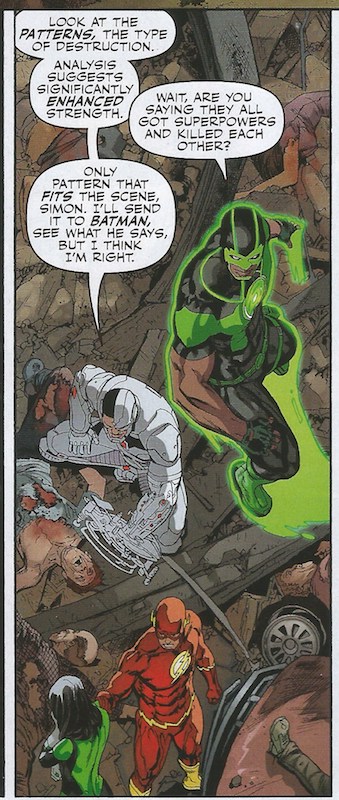
 I’m opening the Justice League review with this graphic because it demonstrates Bryan Hitch’s and/or the editor Brian Cunningham’s poor comprehension. The Justice League do not arrive late to the party. They detect problems and prevent them from happening. The destruction of Midway City is just a sloppy little short-hand to pretentiously make Justice League something other than an entertainment.
Hitch uses the conceit Cyborg identifies to frame Wonder Woman’s generalized argument on hate in the world and her failure. The story and reflection isn’t satisfying because Wonder Woman’s words are just nonsense.
The whole we can make the world a better place if we take control but oh no we’d be dictators argument is a chestnut in comic books and fiction that lacks substance.
Hitch argues what happened in Midway City is a metaphor for what would happen in the real world. Maybe, but then, it needn’t be written that way.
Therein lies the shallowness of his rationale. What Hitch seems to forget is that the Justice League are fictional powerhouses that can be written to be fictional powerhouses. Hitch stacks the deck against them, in such away that undermines their purpose.
Back in the day, when America went to war against the Nazis, in the comics the Justice Society fought saboteurs and quisling sympathizers of all ilk. It’s crap-rubbish to suggest that you cannot engage the Justice League in such things today.
We allow hate organizations to exist because ultimately we are kind. We are not despots. We adhere to the Bill of Rights. The First Amendment protects free speech, even when spouted by distasteful idiots. However, when these organizations cross the line, they become criminals. Then law agencies take them down.
I do not trust anybody in the Trump Administration, but good, competent people still work in the Justice Department, the FBI, local law enforcement. They will attempt to punish criminals.
To suggest a fictional agency like the Justice League is incapable of combatting super-powered hate is absurd because you can write them combatting super-powered hate.
World's Finest #286
To suggest the Justice League can’t combat realistic hate groups without becoming dictators is ridiculous because you can write them combatting realistic hate groups without becoming dictators. Like Tom DeFalco did recently.
Hitch’s ultimate message is that of Lord Acton, “Power tends to corrupt. Absolute power corrupts absolutely.” That credo cannot apply to characters written to be “the world’s mightiest super-heroes.”
So, everybody in Midway gets superpowers. They immediately let these powers fuel their prejudice. You know what happens? Superman happens. Wonder Woman happens. They’re not too late because what seems to be immediate is going to set off a warning in the Batcave. Batman is always watching for signs like this. The Flash and Cyborg figure a way to reverse the process. I find Hitch’s story to be utter twaddle.
What’s sad is that there’s a better story in the making. All the elements are there, but the creative team cannot see it. Midway City should sound familiar to any Bronze Age aficionado. Suppose you started the story out with people getting superpowers. Suppose there was a body count, but not the complete destruction proposed. The Justice League stop the mass demise. As they act, they remember, echoes of a time when a husband and wife team from Thanagar patrolled the skies of Midway.
This may lead them to conclude something wrong with time and space. This may lead to the Justice League going back to find out what happened to Hawkman and Hawkgirl.
The story should have been about the League once and for all fixing Katar and Shayera Hol’s continuity mess, restoring the timeline and thus preventing the body count from happening in the first place. What can Hawkman and Hawkgirl do to interfere in a potential doomsday scenario? That’s up to the imagination of the writer. All I know is that the hypothetical story will involve a mace.
Oh, and there’s some dumbassery about the Justice League’s kids traveling through history to prevent them from catalyzing the creation of Monarch substitute the Sovereign.
Guessing the boobies indicate either Wonder Woman or Mera behind the mask. Since Hitch builds up the dissatisfaction of Wonder Woman, it’s probably not her. It’s more than likely Mera, who doesn’t say a word in this adventure.

Guardians of the Galaxy opens with a meditation session between Gamora and Drax.
The meditation however does not help Drax who recounts why he chose to become a pacifist. The story explains quite well, and operates on the principle of no good deed going unpunished.
Though Drax sought the moral high ground, he just couldn’t predict the consequences of his actions. This is also a result of there being no Babel Fish in the Marvel cosmic universe.
Gerry Duggan’s story though poignant in a way still maintains the comedy inherent in a Guardians of the Galaxy production. In keeping with the previous issue, he builds on the connections between Drax, Gamora and his previous incarnation.
For those not in the know, Drax the Destroyer is actually a resurrected earth man. He is in fact Moondragon’s father. Moondragon though a high priestess of Titan is nevertheless human. This earth history allows for Duggan and guest artist Greg Smallwood to play with some absurd, yet with the explanation, sensible imagery.

In the last issue of The Unstoppable Wasp, Nadia Pym experienced a very bad day, and her stepmother Janet Van Dyne stepped in to help. During the process, Nadia unwittingly gave Jan a list, and we saw her addressing each problem one-by-one as the story unfolded. At the same time, Jan’s narrative unspooled to reveal her history and why she bothers with Nadia at all. This issue of The Wasp offers the fruition of the list. Beginning with Nadia’s penchant for violence.
Jan tackled the question of Nadia’s parentage, and here, we see her clever solution.
Jan then rescues Nadia’s intention to create a girl-centered think tank of engineers and scientists to challenge the all-boy network. It's a damn shame this is the last issue, because Jeremy Whitley just made the book better by giving Bobbi Morse a home.
The last thing to occur in The Unstoppable Wasp demonstrates how although all-ages fun, the stories nevertheless could address mature subjects in a manner that neither seems preachy or superficial. Credit must also be given to artist Ro Stein and Ted Brandt for the expressions that flicker on the faces of the Wasps.
Nadia learns of her father’s imperfections and for a moment it devastates her, but Nadia being Nadia goes beyond this revelation and finds a means to honor the real hero of the picture. Her stepmom Janet Van Dyne. I'm going to miss The Unstoppable Wasp terribly.

The Phantom is fairly ham-fisted I’m afraid. After glossing over the events of JFK’s untimely exit from the PT 109, writer Ian Herman throws the Phantom and the future President together on the rescue mission.
Herman’s orchestration is ordinary. Although he tries to infuse the scene with action, via a Japanese soldier, the moment is still forgettable in comparison to the Phantom’s other historical and cinematic encounters.
The Phantom #74
Don Newton’s period rendition is moody and full of shadowy suspense. The Phantom is at first off panel. Newton draws the atmosphere out of a simple ring, it’s appearance and sudden sound signaling Ben Franklin that he has an important unannounced visitor.
I believe Herman’s mistake lies in choosing the Phantom’s alter-ego Kit Walker as the medium. Herman should have had the Phantom in full effect rescue Kennedy. There need not be an explanation of how he merely appears on the island. The Phantom does that.
Herman’s story jumps ahead to 1962 with a shooting at Jimmy Chan’s. The attempted assassination is to prevent Kit Walker’s involvement with the coming intrigue associated with the Cuban missile crisis.
The woman Kit rescues is Althea Kirkland, a complete fiction created by Herman and artist Sean Joyce. She’s actually the best thing about The Phantom. Smart, funny and brave, Althea is a crackerjack reporter in the mold of Lois Lane. Frankly I wouldn't mind seeing more of her adventures, though in a better constructed historical or pulp.
Herman’s story veers wildly from fact with a purpose that escapes me. JFK’s aide informs the Phantom about a Gemini space mission that had an ulterior espionage motive. This is inaccurate and it's impossible, not improbable.
Gemini essentially consisted of beta tests for Apollo, the manned mission to the moon. Although the Pentagon intended to repurpose Gemini for the potential spying, the idea never bore fruit because the camera necessary to take spy pictures of targets added too much weight. The remarkably useful U-2 spy plane confirmed the existence of the missile sites. Valorous pilots risked their lives to snap those damning pictures and shifting the credit to what all sources define as a failed experiment undermines those aviators’ contributions to world peace.
Outside of that the Phantom’s actions against the Russian spies and overall characterization, particularly his sense of humor, is perfectly in keeping with the comic strip.
Unfortunately an added element of sexism overrides this positive. It’s not the sexism within the story, such as a jackass’ comments about JFK meeting Diana before she met the Phantom. Rather it’s the weird prevalence of ladies in underwear talking on the phone.
We might chalk this depiction to femme fatale tradition, but why then is Diana depicted in the same manner?
I guess she's thanking the FBI for watching the house.
All of this could have been negated by having at least one man answer his phone in boxers. Alas.

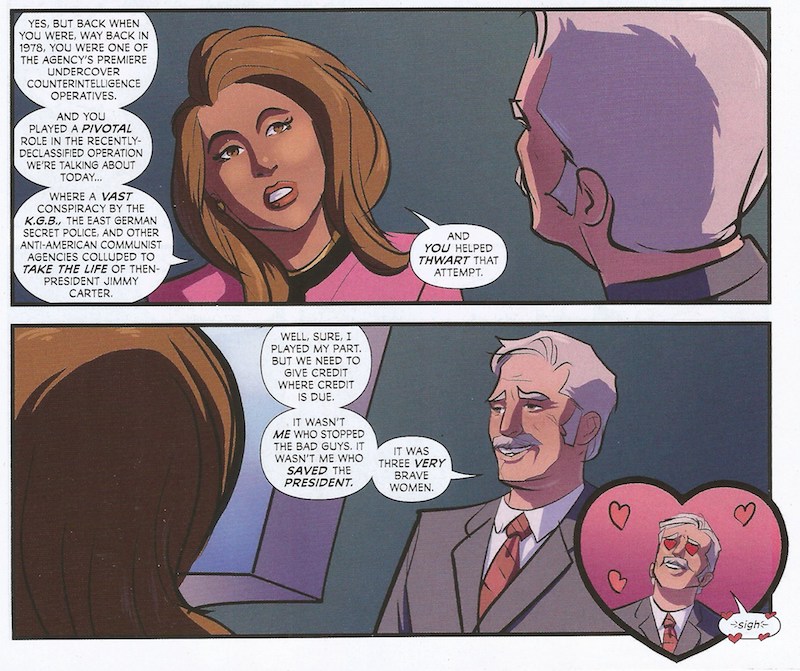
Last but not least, we have All-Time Comics a wacky postmodern look at costumed vigilantes. The format and the style all have an old timey quality, and the violence takes a page from the Golden Age. Though the subject of this issue is way out there.
The story begins with Dr. Knutty and Dr. Whetcroft talking about taking a sabbatical from the trauma center they run to help the victims of war. Writer J. Bayer introduces the characters quickly and efficiently, sets the scene without unnecessary exposition and creates plausibility at the same time. The spotlight then shifts to the hero of the story Justice, the alter-ego of patient Mr. Schrader.
How to describe Justice? Place Rose and Thorn, the Spider and Darkman into a jigger, and shake well. Schrader appears to be a vegetable except when Dr. Knutty is threatened. This triggers a bizarre response.
I haven’t read enough of this series to make a definite observation, but I hazarded some guesses. Like Thorn, Justice appears to be the stronger—way stronger personality—of Schrader, but whereas Rose could function quite well as an individual, Mr. Schrader is essentially a walking coma.
As the story continues, modern day pirates attack Knutty and Whetcroft’s ship. Fortunately, Justice stowed away, and the pirates are not at all pleased by this development.
Here lies the Spider side of Justice. Dishing out bloody scale for evildoers. The most obvious difference lies in the reliance of a club to do most of his talking. Disaster befalls the ship, and the survivors of the wreck swim ashore unfortunately to pirate island. This brings a whole new nastiness to the situation and also catalyzes Justice’s return.
All-Time Comics features energetic artwork serving a good piratical story that while basically no-frills in the depth department nevertheless appeals through a bizarre hero, a weird love story and genuinely frightened bad guys. It's an excellent pulp, and although it appears Knutty is being unduly humiliated, in later scenes she joins the mayhem. So, gender equality exists even in this bizarre comic book.