Pick of the Brown Bag
July 26, 2017
by
Ray Tate
June Foray

1917-2017
The Pick of the Brown Bag begins anew with a smattering of reviews that include Batgirl, Blue Beetle, Doctor Who, Rough Riders, Scooby-Doo Team-Up and Shirtless Bear-Figher. I know.

The weight of the comic book world dropped on my shoulders last week with a whopping sixteen reviews, and this week, it’s less than half. Comics. Anyway, if you can’t get around to reading the blog. Check out #PickoftheBrownBag on Twitter.

Blue Beetle finishes up a storyline I haven’t actually been following, but it seems like Arion’s heyday of Paul Kupperberg and Jan Duursema long since passed. Blue Beetle is set in the aftermath of a big fight against Arion, whom Dr. Fate is about to cart away. Ha. Ha.

I’m not broken up about Arion turning evil. I’m more excited that Dr. Fate is wearing full on tights instead of Pumaman pants. This is the New 52 version of Arion. He’s not related to the one I remember as being a fairly decent swashbuckling sorcerer guy, and he also hasn’t any ties to Power Girl to keep him on the straight and narrow, like the post-Crisis fellow. For those, not in the know, Arion was a stopgap explanation for Power Girl’s post-Crisis origins. No, don’t even worry your pretty minds over it. It’s gone now. It made no sense whatsoever anyway. Good riddance.
As the story continues, writers Keith Giffin and J.M. DeMatteis smoothly re-establish the status quo with the spiky art of Scott Kollins. Jaime Reyes is the Blue Beetle. Ted Kord is his mentor. Jaime has a stable family, Dr. Mom and mechanic Dad. A little sister, girlfriend, friends, one of whom connects to his nemesis from a telenovela by way of Lex Luthor.

The scarab itself is a character now, which is interesting, and mysteries involving Giffin’s Justice League surprise with their reappearance. I’m stunned that I didn’t pick up on the links myself. Last but not least, DeMatteis and Giffin end on one helluva guest cliffhanger.
In summary, this issue of Blue Beetle is a good point to jump on and see if it appeals. It's the finish of an adventure and an interlude reflecting the ins and outs of the Blue Beetle. The story offers numerous cameo appearances by fan favorite superheroes, and Scott Kollins' artwork is easy on the eyes if you take a liking to his evolved style.

Hope Larson’s Batgirl is a bad comic book unless it’s Batgirl 66’. Then it’s perfectly fine. No great, but all right.

Forget all the updated computerese in the dialogue and background. Forget that the little girl is Esme a student in Barbara Gordon’s coding class. That’s all superficial. The entirety of Larson’s story and characterization can be very easily transposed to a Batgirl special from Adam West’s Batman.

That’s not necessarily a bad thing, but I would just like to know what the heck is going on with Batgirl. What is this title’s mission statement, target audience, etc. I mean, it's all over the place. Larson debuted with a cool travelogue of Batgirl learning more martial arts in Asia. She followed up with an excellent Poison Ivy team-up, but then it rock bottom with the Penguin's son. She seemed to come out of the nose dive last issue with a credible ghost story that wasn't. Now, this campy thing.

Okay. So the story starts out with a little girl facing a group of mutants or punks. You’re thinking. That’s almost post apocalyptic. Didn’t you just say…

This is the important part though. They’re stealing bicycles. They’re a teenage mutant ring of bicycle thieves.
Bicycle theft is a legitimate crime. Nobody’s saying it isn’t. However, why do the bicycle thieves look like refugees from Return to Nuke-Em High?

From Troma, of course.
There’s no real reason for it. It’s just an attempt to shade a low-level crime with future shock gloss to create the illusion of an edgier story. It’s ridiculous. Fortunately, the crime Batgirl will be investigating is far more serious.

That’s right dognapping.

Now, to be fair, Veronica Mars investigated a dognapping, and that simple investigation uncovered a massive lucrative conspiracy. Batgirl’s plot kind of works the same way, but in a dumbed down fashion.
After learning of Rookie’s disappearance, Batgirl’s on the case, but she immediately spots more attractive crimefighter game.

Batgirl does not and never has liked Catwoman. In any continuity.

Although she grudgingly sometimes works with Catwoman, she and Catwoman harbor a natural animosity toward each other. Naturally, they get into it, and we learn why Catwoman is in the neighborhood.

Isis of course is Catwoman’s feline from Batman The Animated Series, but in the comic book, Isis is just a black cat, not the Siamese, which isn’t a quibble. Just an observation. I am however going to protest strongly about this development.
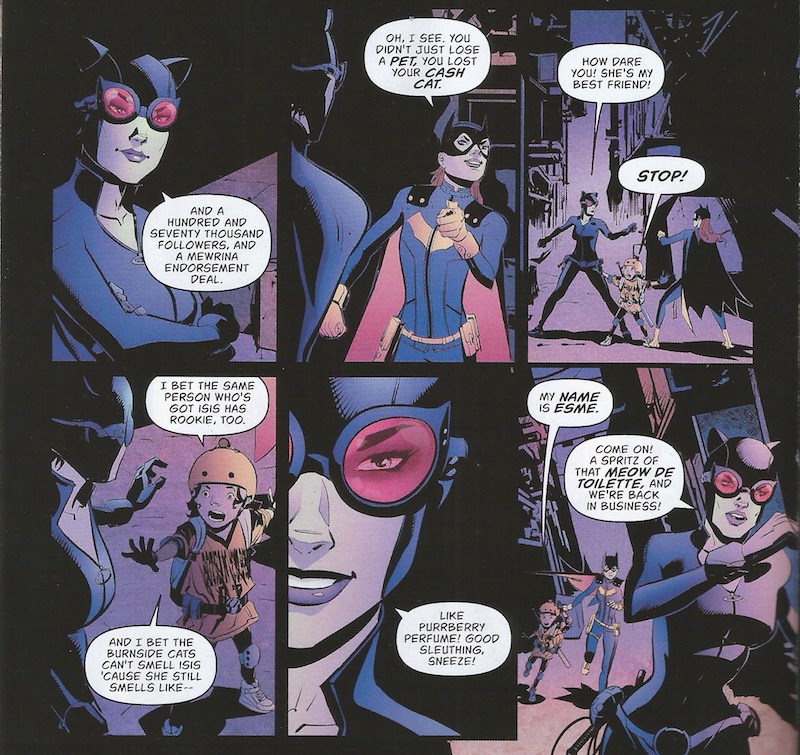
How can a wanted felon be an advertising pet wrangler? If this was Batgirl 66’ this sobering—for lack of a better word, we’ll call it a twist—would not be an issue. In Batman, Catwoman owned several properties despite being Catwoman. That was just the norm of an absurd television series, but Catwoman’s side business is insane given what she is to the DC Universe now.

Between Catwoman and Batgirl, solving the mystery is child’s play, but the resolving fight is straight out of Batman.

WTF. No. Seriously. WTF.

Is the Batman theme playing in your head? Are you hearing the POW and OOF notes! The trouble is that if Batgirl is homage to Batman, it still doesn’t make sense. Adam West isn’t on the scene. Yvonne Craig died two years ago. If Batgirl is meant to be a light-hearted romp, the Big Bad still demonstrates no motive for the dog and cat theft. The only good thing about Batgirl is Inaki Miranda’s amazing artwork, but hell, couldn’t it be in service for something better?

This perfect Scooby-Doo Team-up begins with Fred rummaging around in the attic to find an account by his great, great, great grandfather, but before the story transports the reader back to the old west, there’s time for one spectacular present day joke.

I laughed out loud at that. It’s rare to see Scooby and the Gang at rest and just poking some good-natured fun at each other. Next page, the reader’s in the Old West, and writer Sholly Fisch has new characters albeit in the same field of their descendants to play with.

After a gag involving the period Mystery Machine, the Gang mosey into town where they introduce themselves to the suspects behind the supernatural, including an announced guest-star. He’s also not the only gent behind the curtain. Scooby-Doo Team-Up is another wagon train of DC history.

Nope. See the end of the review for the Spoiler Graphic.
Suffice to say that Scooby and the Gang meet up with Jonah Hex, and Fish keeps him in character.

Although Hex’s stories tend to be grittier, Hex isn’t really as family friendly as Fred and friends. Hex’s reactions and interactions suit him. Given his quarry’s nature, Hex isn’t out for blood, and his rules for bounty hunting conduct could have easily been written by Jimmy Palmiotti and Justin Gray. Artist Dario Brizuela makes Hex one of the Gang’s more gruesome guest-stars. Hex of course first appeared in Batman: The Animated Series, but I think it would still be startling to see him in a Scooby-Doo cartoon.

As Fred quickly discerns, Hex is no monster. Just one of those strange folks rambling with the tumbleweeds. The actual creature is one of the more imaginative inventions of the creative team, and sharp eyed spaghetti western fans will note the tribute to A Fistful of Dollars while history buffs glom the real life allusion to a specific transportation agency.

In Rough Riders, Teddy Roosevelt gathered great personages of the time to form a team to deal with an alien takeover. The historics of interest included Annie Oakley, Harry Houdini, Jack Johnson and Thomas Edison. Added to the ranks Monk Eastman a true life founder of criminal enterprise. Technically speaking, one can argue that none of these individuals are superheroes. However, Glass counters that argument throughout the two series, and this issue he cleverly demonstrates that they all had actual secret identities.

Glass and artist Pat Olliffe liberally mix fact and fiction to establish a unique parallel earth. Roosevelt for example started his career as a science hero like Doc Savage; even rescuing some of the victims of the Triangle Shirtwaist Factory inferno that led to the creation of fire safety standards and fair workplace protocols adhered to and improved upon today.

Annie Oakley died in the previous adventure, but Edison reversed engineered alien tech to resurrect her into a super woman. She has thus far survived a direct blast from a bomb and exhibited superior speed and stamina. It seemed like Edison was sweet on Annie, and that’s why he pulled a Frankenstein. However, events in the current series now put a damper on that kind idea.

The real Thomas Edison was a highly intelligent proponent of science. Although a record holder for the number of patents, lawsuits proved that he wasn’t beneath industrial espionage to add to his wealth and fame. Many things credited to him were actually invented by other individuals. On the other hand, some of the nastier things said about him are likely false to middling true. The anti-Semitic and racist suggestions he makes in Rough Riders may have a basis in his character, but it’s best to say that Edison was no more of a bigot than the average man of his time. He was certainly not a raging Nazi like his good buddy Henry Ford.
Careful reading of Glass’ story suggests wiggle room in the possibility of betrayal and an adherence to the actuality of Edison. If so, Edison would never throw in with the Anarchists of Rough Riders. They kill to reach their ends, and use Edison’s own science to aid them in their cause. Thomas Edison was a pacifist. He spoke out against perverting science to the cause of war. It’s more likely that Edison’s association with the Anarchists is a ruse, and he’s playing up his personal prejudices to secure the illusion. On, the other hand, as evinced by a perfectly potty finale, Rough Riders isn’t a docudrama.

The surprising thing about Doctor Who is how well writer Cavan Scott played a long game worthy of show runners Russell T. Davies and Steven Moffat. Particularly of the latter, because the story follows the rule of Sherlock Holmes: “When you have eliminated the impossible, whatever remains, however improbable, must be the truth.”
Eliminating the impossible in Doctor Who has always been challenging, but this issue is in a sense the climax to a fair play mystery that you probably weren’t even aware you were part of. The tale starts out fresh.

The spheres allow the Doctor, Rose and comic book companion Tara Mishra to search for the missing Captain Jack Harkness. This also gives Rose the chance to bluff as the Doctor, a theme carried through Series One through Two.

It would be folly to suggest Rose’s role acknowledges Jodie Whittaker’s forthcoming ascension. There’s no way the creative team behind this comic book could have known and gotten everything done in time. Pun not intended. Consider it a happy coincidence.

As the Doctor and company traveled, Jack learned more and more about the events expunged by the television series law organization known as the Shadow Proclamation which we discover is the force behind Time Agents. A clever, apt idea from Scott.

The villain of the piece is reminiscent of many a Russell T. Davis antagonist. So, Scott not only puts together a brilliant culmination that loops back to Christopher Eccleston's comic book premiere, but also recreates the feeling of a Davis era Doctor Who adventure. Add some dead-on art by Chris Bolson and Adriana Melo and you’ve got a can’t miss Doctor Who.

Shirtless Bear-Fighter’s second issue is just as remarkable as the first. The bears are revolting, but Shirtless is absurdly effective.

I love bears. Nature's moochers. Clowns of the highest Youtube order. However, there’s something about seeing this reject from a Chuck Norris movie smacking around cartoon bears that’s absolutely rib-tickling. The story isn’t just about Shirtless taking out stock in fur. It’s also a reverie about the time that Shirtless met his best friend FBI Agent Burke. Naturally, they met in Nam. Cause, it’s the only war where heroes in these B movies meet.

So, let me break this down. The flashback is about a green soldier in Viet Nam who should be about ten if we factor in real time, but hey, that’s a foul in the game of action flicks. He encounters a displaced lethal panda bear, and he's rescued by Shirtless Bear-Fighter who has no reason to be in Viet Nam. Other than I suppose he sensed a panda bear about to kill. I mean. How can you not love a book that lacks a single iota of logic while stubbornly maintaining a semblance of reason that’s as thin as threadbare bear rug? Although, I heartily recommend Shirtless Bear-Fighter, I must warn you that there are things in this book, that you’ll not be able to unsee. So, watch out for the cover character. He's bad news for the eyes, and his aims are going to sit on your brain for awhile after you're done reading.
The Spoiler Graphic

One of the guest-stars in Scooby-Doo Team-Up happens to be Bat Lash.


