Pick of the Brown Bag
March 28, 2015
by
Ray Tate
A short week with quality books means the Pick of the Brown Bag is on the air. This week, I’ll look at Aquaman, Bart Simpson Comics, Batman 66, Batman and Robin, Big Thunder Mountain Railroad, Joe Frankenstein, Jungle Jim, Tomb Raider and The Valiant.

Big Thunder Mountain Railroad might sound like the literal translation of a Japanese anime, but it’s really a Disney World ride.

Disney owns Marvel. So, Marvel and Disney got together to make comic books based on their amusement park attractions. It sounds disastrous doesn’t it? The key is that Disney allowed an enormous amount of creative freedom for the writers and artists. The rides simply become the backdrops to original stories. That’s it. I’m guessing that Disney is just counting on osmosis and using the comic book medium for brand recognition.
Big Thunder Mountain Railroad attracted my attention for three reasons. First, it’s a western, and like my father, I love a good western. Second, it’s by Dennis Hopeless, who impressed me with Spider-Woman. Third, the art by Tigh Walker and colorist Jean-Francois Beaulieu stands up as a pretty damn good flip-through. Even better with a close up inspection.

The story begins with the introduction of main character Abigail Bullion, a classic Tom Boy in proper dress. Wait. Strong female lead, says you? Now, you’re just pandering to me.
Abigail is the daughter of the mine-owner who seeks to tame the wild filly he doesn’t know by putting her in boarding school. She of course breaks rank and gets into mischief.

Abigail’s hi-jinks are highly entertaining. Although she might seem anachronistic, the truth is women really did have a certain amount of equality in the west, as long as they could shoot and fight a man that is.
Abigail’s playfulness extends to exploring the mine. Now, for me, a mine is a dangerous place where one can gain a new acquaintance with silicosis, Abigail has a completely original point of view.

The art in the mine is perfect, not too dark, with a strong sense of texture that makes the mine indeed a magical, otherworldly place. We can also credit Hopeless for making the most of the setting—whether it be exposing dinosaur bones or referencing a period phrase popularized by Boyd Crowder in Justified.
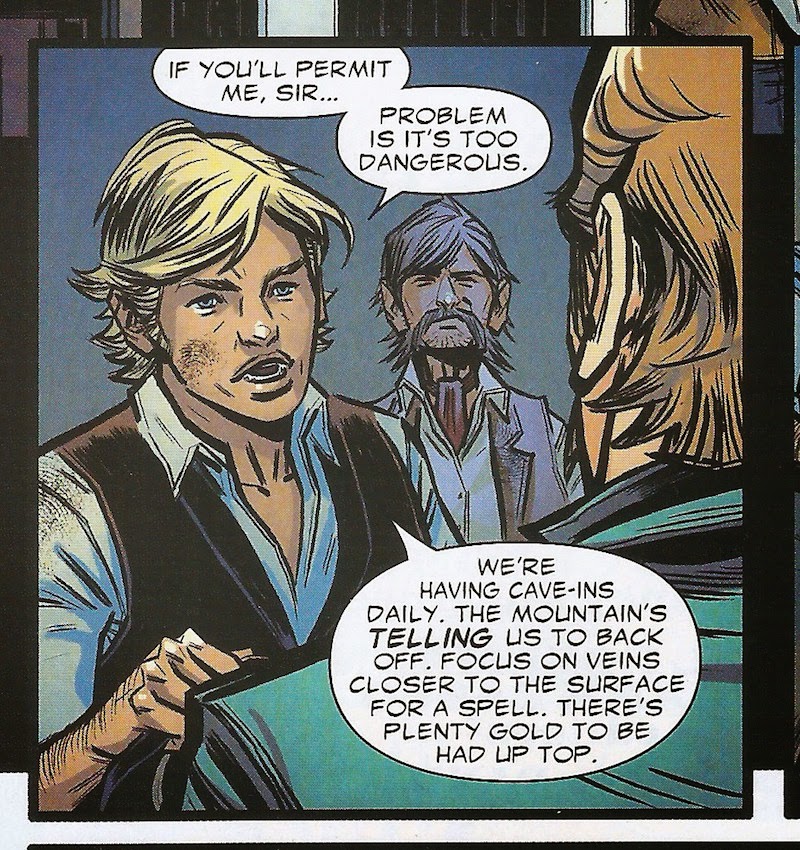
Big Thunder Mountain Railroad is not A Fistful of Dollars. It’s an all-ages title that doesn’t talk down to the audience. It's a refreshing find. While you can argue that the authenticity of the western town is about equal to that in The Apple Dumpling Gang, it’s still kind of grimy and gritty enough to surpass the polished westerns glorified in nineteen fifties.

Worst. Western. Ever. Actually hurtful.

Although not a games player, I’ve always liked the concept of Tomb Raider, and I’m always willing to try a Tomb Raider book. What I’m looking for is a similar kind of depth that Angelina Jolie instilled to the icon. I prefer the sequel, The Cradle of Life which is a lot more richer in pulpy goodness.

With the advent of a new writer on the Dark Horse series, I was certainly willing to give “Dark Waters” a dip. The story opens with a dream sequence, or is it a memory? Whatever it is, I don’t have a clue to what it means. “Ruh. Roh.”
Fortunately, Rhianna Pratchett dispels this glimpse quickly, and she lays out what’s going on succinctly. Bad guys: The Snakes Who Walk. Organized group of n’er do wells with eyes on Lara Croft. Good guys: Lara, her friend Sam, Jonah and Kaz. The Raid: actually none. They’re out to save another friend named Alex Grim.
Pratchett puts some thought in the character dynamic, much more so than other writers from Tomb Raider’s past. When I tried previous issues of Tomb Raider, Lara frequently seemed friendless and isolated, and that’s just not interesting to read. One of the themes in Cradle of Life is that Lara has a friend in every port, makes friends readily and values loyalty above all else. So, Pratchett is already on the right track. Lara's friends create a loyal support team, and the whole plot is ostensibly about Lara helping her friend. She furthermore makes another ally along the way. However, the friendship motif also generates friction.

That’s the one scene that bothered me. I just can’t see anybody let alone Lara Croft blowing off such a strange reaction. Nobody, cranky or otherwise, goes “Leave me alone, John Smith!” People don’t use full names like that. Otherwise, we have sharks, and it’s as fair a portrayal of sharks as in Cradle of Life. Also, as you can see, Derlis Santacruz’s, Andy Owen’s and Michael Atiyeh’s art combine for a pleasant blend of accuracy, anatomy and animation.

A different kind of explorer ends up on Mongo. He comes from the 1880s, and his name is Jungle Jim.

Massive divergence
Jungle Jim began as a comic strip B-Side to Flash Gordon. Co-created by arch-illustrator Alex Raymond, Jungle Jim was a big game hunter from the 1930s. He wasn’t a bantering British imperialist.
Whoever thought this change should be knighted. It’s the kind of hilarity that livens things up in what could have been a straight-faced, politically incorrect bwana.
Though Jim comes from the time of Imperialism, he’s clearly not interested in the enslavement of people. Rather, he’s more of an adventurer in the purest of senses, and when he finds out about Ming, he decides to do something about him.

Things don’t go exactly as planned, but Jim demonstrates a remarkable understanding of the enemy’s psyche, thus leading to the cliffhanger of plan B. So behind the jabber, Jim actually displays surprising cunning and a knowledge of how to use his shape-shifting powers best.

Well, you know that I’m going to buy a book with Batgirl in it. Batgirl enters the picture when Robin has been dazzled by the Penguin’s latest scheme. That’s not a euphemism.

I have to admit that Batman 66 was very strange to read. I’ve gotten so used to Batgirl being an integral part of the Batman Family, now embraced by all but the most Oracle-embittered, that seeing Batman and Batgirl as professionals in crimefighting but also strangers feels a little askew.

Yet it’s also interesting to see. Jeff Parker’s Batman is a consummate detective, but he respects Batgirl so much that he doesn’t bother trying to figure out who she is. That wasn’t always the case in the television series. Batman occasionally gets tempted. Besides delving into her secret identity would have been poor form since he asked Batgirl to accompany him to Japan.

Batgirl and Batman follow the clues to Lord Death Man. Lord Death Man is the whacked out dude on the cover. Although, Mike Allred took artistic license. He’s not really a skeleton, just a screwball in a skeleton costume kind of like something you would see from Super Inframan.

Those crazy Shaw Brothers
Lord Death Man appears obsessed with suicide by Bat. He lures Batman and Batgirl into a mountainous trap, doses him with all sorts of mind-altering drugs and tricks him into believing in Batgirl's untimely demise.

Batman 66 is one weird trip. I think most it will go over kiddie heads, but they’ll get that a skeleton man wants to kill Batman and Batgirl, which is strange in itself since most of Batman’s villains on the Adam West television series only saw killing Batman and his merry band as a side-effect in their want for ill-gotten gain. The traps are also more based in reality, rather than giant typewriter guillotines and such. Parker’s story could be edited into a serious Batman story, which makes me wonder if it wasn’t. How does Parker write these things? I think Parker writes a bona fide Batman story first then starts tweaking it.
Incidentally, Parker’s aide-de-camp Sandy Jarrell is the same illustrator of Jungle Jim. Jarrell’s art captures the look and feel of the Batman cast. Both Batman and Batgirl resemble their essayers Adam West and Yvonne Craig. In contrast to the pop sets and colors of the series, Jarrell evokes a haunting Japanese environ that could have been featured in authentic samurai films. So, definitely something to add to the collection.

 As place-holder Convergence rears its ugly head, two books end their volume run with fortieth issues. These titles will likely return after Convergence, possibly with new numbering, but for a few months we'll not be seeing Aquaman or Batman and Robin. Both books are well worth your time and coin.
Damien returned from the dead with superpowers. Batman has been for the past three or four issues attempting to adapt to his son being more powerful. Rather than make this turn of events into a poignant drama writer Peter Tomasi turns Batman and Robin into a sly comedy.
Last issue, Batman introduced Robin to the Justice League, but their encounter was interrupted by an emergency in Japan.

This looks like a job for Robin. It turns out that there's a reason a giant robot attacks Japan in emulation of the common anime. Batman had a rationale beyond acquainting Robin with people having superpowers.
The cool story gives the Justice League the opportunity to cut loose and have some fun thanks to the youthful addition to their roster. It's very telling that the League would get together on Batman's behalf, indicating that these heroes are more than colleagues. Despite some rough patches in the formation of the team, they're now friends.
Aquaman finishes it's impressive run with a reaffirmation of femme power. You know back in the dark days of the post-Crisis, a woman would have been raped or killed just to justify the restoration of Aquaman back to the Throne of Atlantis.

No woman suffers rape or dies in Aquaman. I know. Spoilers and everything, but really that’s something I think we can all stand behind. Mera displays her remarkable control of water. Aquaman’s mother demonstrates her power, and it's her acceptance of Arthur as her son that provides the drama. Aquaman exemplifies what makes the new 52 the strongest of all the continuities. Gender-equality.

Family provides the impetus in Joe Frankenstein. The creation sees Joe Frankenstein as his kin, and we discover a twist in the tale that makes it more than a metaphor. Meanwhile creative partners Chuck Dixon and Graham Nolan also build on the importance of Joe's adopted family, and the way in which Joe's Mom is a natural Mom.

On the flip side, Dixon and Nolan turn a traditional protagonist into a villain, and the inclusion of a giant super computer just cements the feeling that Joe Frankenstein was a rejected Hanna-Barbera cartoon from the seventies, for adults. If you know me, you know that's a high compliment.

Bart Simpson Comics offers two tales. In the first, Bart becomes an employee at the Kwik-E-Mart to earn the bread necessary to buy tickets to a Wrestlemania type show. James Bates story provides ample opportunity for amusement and outright laughter.

The second tale features an updating of Otto’s flexible work schedule; he loses his bus driving job again. In Shane Houghton’s tale, Otto becomes a driver for an Uber like company. The giggles come fast and furious, and I particularly like how Mike Kazaleh and Alan Hellard give the characters a visual bounce in their step.

No laughs in The Valiant. I'm not sure that writers Jeff Lemire and Matthew Kidnt deserved their unhappy ending. Maybe I'm touchy about spinal injury thanks to Batgirl, but I really don't like investing in a new character just to see decimation for the sake of a timeline with rules not clearly delineated.

The time travel angle seems to suggest linear time with a single history that must be preserved. That said. It doesn't quite add up and basically does what The Brave and the Bold did with Zatanna retroactively setting Babs up for The Killing Joke. The ending to The Valiant just feels unnecessarily sour, but because I really don't know these characters, I can't work up any rage, similar to the vitriol I hissed on behalf of Batgirl.
Is it 2016 Already?
“Here, Indiana steps forward to protect the constitutional rights and privileges of freedom of religion for people of faith and families of faith for people in our state and this avalanche of intolerance has been poured upon the people of our state.”

Gay Klan burns cross on the yard of Christian Bakers Association. Business as usual in Indiana. “Somebody should write a law to stop this persecution,” bemoans Christian Florist.
Don't feel bad for Indiana Governor Michael Pence. He wants you to feel bad for him, but don’t. He knew very well what he was doing when he signed the so-called Religious Freedom Restoration Act into law. He knew what the impact would be. He cannot claim to be incredulous. The Indiana Chamber of Commerce told Governor Pence in no uncertain terms what this bill would mean for business, and Pence ignored them.

That's because Pence doesn't give a rat's ass about Indiana. He's hoping to run for President. In order to do so, he feels the need to court the whacko wing of the Republican Party. That is to say. The Republican Party. That’s right. This controversy didn’t start over gay rights or religious rights. It was triggered by one man’s ego.
Pence hoped for a modest amount of bad publicity. You know the chestnut, and to an extent it's true. Pence wanted to draw attention and promote himself as the Ultra Conservative choice. Well, not choice. They hate choice. Let's go with option.

What Pence didn't count upon was becoming a hilarious overnight sensation. So the POBB would like to congratulate Governor Michael Pence for not only screwing himself out of even being a contender for the Republican nomination but also for screwing himself out of politics forever. You see some Democrats don't like Hillary Clinton, but Pence's kind of stupidity is the sort that unites Democrats and convinces the many moderate rank and file Republicans to stay home. I can’t wait to see what Jon Stewart does with this.
"Different is good. So, don't fit in. Don't sit still. Don't ever try to do less than you are," she said. "When somebody tells you you're different, smile and hold your head up high and be proud. And as your villain, I would also say — cause a little trouble. It's good for you."


