Showing posts with label Huntress. Show all posts

Tuesday, November 22, 2022

POBB November 21, 2022


Pick of the Brown Bag
November 21, 2022
by
Ray Tate

Welcome to the Pick of the Brown Bag.  I'm Ray Tate, and this week I take a break from such books as Batgirls, Nightwing and The Human Target, which inadvertently became frequent subjects, to cast an eye at The New Golden Age and Star-Girl The Lost Children.  I promise to review some Marvel and indy books in the near future.

I would include #PickoftheBrownBag for Twitter users, but what with Elon Musk burning Twitter to dust, that doesn't seem logical.  I'm still sticking with Twitter for now and will post some short thoughts of the books under that hashtag, but you know....ah...well...c'est la vie.  Twitter had a good run.

So, for the current and future postings, I'm going to add something to the first paragraph just before the body of the review.

Pick up The New Golden Age and Star-Girl The Lost Children.  Even if you're not keen on the well-written stories, the art in both will wow you.  See? That was easy.  


The Golden Age boasts the pedigree of writer Geoff Johns, artists Jerry Ordway, Todd Nauck, Steve Lieber, Diego Olorteguei, J.P. Mayer, Scott Hanna, Scott Kollins, Viktor Bogdonovic, Brandon Peterson and Gary Frank.  

With color art by Nicolas Filardi, John Kalisz, Matt Herms, Jordan Boyd and Brad Anderson, Golden Age clocks in at forty-eight pages with no--repeat--no ads.  But is it worth the five dollar price tag?  Affirmative.

The story opens with young Helena Wayne enjoying a snowy day in Gotham City.  


Created in 1977 by Paul Levitz and Joe Staton, Helena Wayne is the daughter of Batman and Catwoman.  Helena becomes the Huntress to avenge her mother's death.


For those not in the know, DC thrives on the concept of parallel earths and the multiverse.  Defined in the name.  

The above scenario occurred on earth two.  Gardner Fox and Carmine Infantino who gave us The Flash of Two Worlds. conceived earth two for pure entertainment.  Other writers used the concept to explain character ages.


Historically Batman existed for eighty plus years.  He doesn't look like he's aged a stick.  It's a fictional conceit, but how to explain it in context?  The Powers That Be split Batman in two.  


The then modern Batman from the seventies' Bronze Age actually began his career in the nineteen sixties.  


The original led his life on earth two.  He started in 1939, married Catwoman, had a daughter and retired his cowl at the same time his counterpart built his considerable reputation.  More or less.

Writer Johns rationally points out that by now the earth two Batman would be dust.  So he takes the Batman Family on a new spin.  


Johns distinguishes this Batman and Catwoman duality in another way.  Catwoman and Batman plied their trades against the character backdrop of the Justice Society.  The 1940s group that started all superhero associations in comic books.


The story nevertheless focuses on Helena Wayne enjoying a snowy day in Gotham City.  What could be more innocent? Reading on, we discover Helena's being watched.


This is no child's nightmare.  
.  


The villain of the piece flits through this new earth two's history at will.  Past, present, future.  


His motive is suitably bizarre and it laces the proceedings with intense drama.  Furthermore, the figure appears to tie-in with Johns' other major work that's flying under the radar.  


The Star Girl Spring Break Special suggested that somebody or something kidnapped all the hero sidekicks from time and space.  The Golden Age introduces readers to those partners in heroism.

Johns even creates dummy Who's Who in the DC Universe entries for these new heroes and villains.  


So, yes, The Boom's entry states she first arrived in Flash Comics #10, but that's utter rubbish.  Flash Comics literally relates another, more innocuous story.

With the creation of Robin in 1940, Bob Kane and Bill Finger invented the kid sidekick.  The concept of the sidekick still didn't catch on until much later.  Most of the Justice Society did not have kid sidekicks.  

Johns cheekily contradicts that they did.  The heroes just don't remember them because some force abducted them from history.  

The New Golden Age closes on the death of Batman.  This moment which factors historically into a lot of JSA stories of the past becomes pivotal in kicking off a new mystery to be solved by the daughter of Catwoman and Batman, the new Huntress of earth two.

As previously stated, The Golden Age also reignites the mystery Star-Girl's been investigating with the Red Arrow, Emiko Queen, sister of the Green Arrow.  


You can be forgiven for not knowing who Emiko Queen is.  She's relatively new and partially the result of Willa Holland's wonderful portrayal of Oliver Queen's sister Thea on The Arrow.


To confuse matters more, Emiko actually did manifest in The Arrow during its final seasons.  Emiko played by Sea Shimooka.


The Lost Children begins with the obscure heroes TNT and Dan Dynamite engaging in a typical high speed chase in pursuit of garden variety bank robbers.  An indication of a more innocent time.


Though Johns created new sidekicks in The Golden Age, I'm here to tell you.  These guys actually are historical heroes from the comics.  They just didn't make it big.  


They're part of "...and others."

Of course TNT also represents Johns' double joke.  The original Star-Spangled Kid, the former sobriquet of Stargirl, naturally started in Star-Spangled Comics.   So, The Lost Children in a way continues the umbrella titled book from the 1940s.

Anyway.  Courtney's and Emiko's investigation takes them to the research of a now elderly Dan "Dynamite" Dunbar.


As you can see, Courtney's as in the dark about some of these sidekicks as we are...psst...that's because many never appeared in any comic book until now.

Perhaps I'm getting ahead of myself though.  Maybe you don't even know who Star-Girl is.  


Geoff Johns and Lee Moder created a new Star-Spangled Kid, whom Johns based on his late sister Courtney.  

Make no mistake. For Johns, Star-Girl is real personal.  She's appeared in several iterations on television, including Smallville and Legends of Tomorrow, before gaining her own television series.  Its her current state that influences the story and background of The Lost Children the most.


Actress Amy Smart makes Coutney's mom the everyman, moral compass of the show.  Because of Smart's humanistic treatment of the character, Courtney's mom gains much more substance in the very first issue of this series.


Courtney's step-dad Pat Dugan is actually an old 1940s hero named Stripesy.  Nowadays he tools around in a big mechanical suit, known as STRIPE.  Johns transforms Pat.  He becomes more relaxed to match his essayer Luke Wilson.


The natural fusion between television series and comic book character combined with her multiple appearances forms a more interesting and richer superhero.  Stargirl still boasts the optimism that Johns wanted to preserve for his sister's memory, but Courtney is now more seasoned than before.  She's measured rather than headstrong.  That makes her an ideal partner for the Red Arrow as they investigate the mystery of The Lost Children.

While writing this entry for the POBB, Kevin Conroy died.  In every interview I saw, every appearance, I just knew.  This guy was one of the good ones.


The underrated Island City

His death hits hard, but Kevin lives on as Batman.  
Hopefully forever.


Monday, May 17, 2021

POBB May 17, 2021

Pick of the Brown Bag
May 17, 2021
by
Ray Tate

Welcome to the latest edition of the Pick of the Brown Bag.  It's another title focused posting this week, as I try to catch up on all the comics I've read but not yet reviewed.


I mentioned Tom King's Batman and Catwoman in passing, but I decided to give it an in depth look now that DC published four issues.  

Let me once again state.  I am not a fan of the Black Label DC Brand.  The insulting Batman: Damned scorched any enthusiasm I can muster for a new Black Label title.  In fact, when I see another of those things on the racks, I kind of cringe.  

If not for Jimmy Palmiotti's and Amanda Conner's Harley Quinn and the Birds of Prey, I may have just ignored Batman and Catwoman.  And I'm a Tom King fan.  So, King owes them a debt.

On a scale of one to ten where Harley Quinn is a ten and Batman: Damned is negative thirty.  Batman and Catwoman so far rates a positive seven.  

At first I believed King extended the continuity he wrote for Batman into the Black Label title, but Batman and Catwoman is too screwy to be associated with continuity.  It takes a bit of this and a bit of that and meshes this-that into something that's entertaining in places, head-scratching in others.

After the backlash over Batman's penumbra of a penis, the Powers That Be appear to have rethought the whole for mature audience Black Label directive.  Batman and Catwoman for example presents no nudity, nor even proper swearing.


So it looks like DC is reinventing the Black Label title.  Perhaps they now define the subjects thusly: 

DC titles that are sometimes risqué but always off-tangent from the DC Universe proper.  These books do not necessarily relate the time Victorian Batman fought Jack the Ripper or when Superman stopped the Confederacy cold.  So don't you dare go looking for that.  We don't do those anymore.  These books also will not, repeat not under any circumstances feature Batman's offending member.  Don't panic.

The root of Batman and Catwoman can be found in Tom King's Batman run.  In Batman forty-nine, the Joker takes a wedding hostage.  Batman and Catwoman investigate.  Joker blows up Batman into unconsciousness.  Catwoman and the Joker mortally wound each other, and they're the only ones left talking, if not standing.  


Catwoman will not kill.  At least that's her reputation.  She is a thief not a killer, nor even a purveyor of brutal violence.  This serves the character from the Golden Age to the Bronze Age.  
The New 52 and Rebirth reinforced the consistency.

However, King's Catwoman though not a heartless murderer, isn't above killing.  She's a harder, more realistic figure that incorporates nearly all of the character's history from comics.  Including Batman Year One.  

Frank Miller implied that Catwoman and her cohort Holly were man-hating prostitutes.  DC ran with that--Catwoman Year One--until then new Catwoman writer Jo Duffy elegantly dismissed the suggestion.  She explained this misogynist concept to be a ruse setup to roll Johns, which is far more in keeping with Catwoman's status as arch-thief.

Anyway.  In Batman forty-nine, Catwoman is willing to kill the Joker.  She's willing to do what Batman will not do.  Not out of malice or even blood lust.  Rather as a public service.  

That's the Continuity Proper answer, but King took a second look at his creation.  I suspect he looked at the scene askew.  Batman and Catwoman is the consequence.

Batman and Catwoman takes place in three different time frames.  Two where Batman is alive, and another when Batman is dead.

King provides an answer to what kills Batman in Detective Comics #1027.  He also portrayed Batman's last day and set up his Batman and Catwoman future in a speculation presented during his Batman run.  That speculation will also be crucial to Batman and Catwoman.

When Batman is alive, he's with Catwoman.  He lives, she lives in stately Wayne Manor.  Alfred is alive except in the near present.  Alfred died in King's Batman run.


The story begins when one of Batman's former lovers comes looking for her child, who ran away to Gotham City.  Batman and Catwoman go on the hunt.

Apart from the identity of the mother, events begin rather normally, and Batman and Catwoman seems to be just that extension of Batman I identified.

The child unfortunately runs into the Joker, and things take a turn for the worse.  It's that misery that catalyzes everything that occurs in Batman and Catwoman.  

That's about all I can safely say about Batman and Catwoman without giving away the plot, the identities of the characters, everything.  

I can tell you, if you do not wish to go on, that Clay Mann's artwork is smooth as silk.  King's story is full of quirks and eye-brow raising surprises; none of which make sense except outside of the context of Continuity Proper.  As a result, Batman and Catwoman reads like a stream of writer's consciousness.  Though it's a controlled body.    

I can also recommend the book to Catwoman fans.  Batman does not really get a point of view in the story, for obvious reasons.  A lot of events go behind his back, when he's not dead.  

Batman isn't aware of what's happening.  He doesn't have a clue until Catwoman spells it out for him.  One can argue that love blinds.  One can argue this was the whole original point of the liaison.  In the end though, Batman unaware of what's going on is a little too difficult to grasp.  He's supposed to be ten steps ahead of everybody.  That closing gap is the flaw in the series.


For Catwoman fans, however, Tom King writes Selina Kyle like no other.  He really has a taste for her and knows how she prowls.  Despite the events having little basis in comic book history or Continuity Proper, Catwoman behaves as you expect her to given the situation.  If you accept the premise of King's story, you're in for a good ride.  If you can't accept it even as a glimmer of quantum possibility, then maybe you should stick to King's Batman run.

This review will be filled with spoilers as soon as the graphic warning manifests and continue that way.  I just didn't see any other means around it.


S
P
O
I
L
E
R


A
H
O
Y

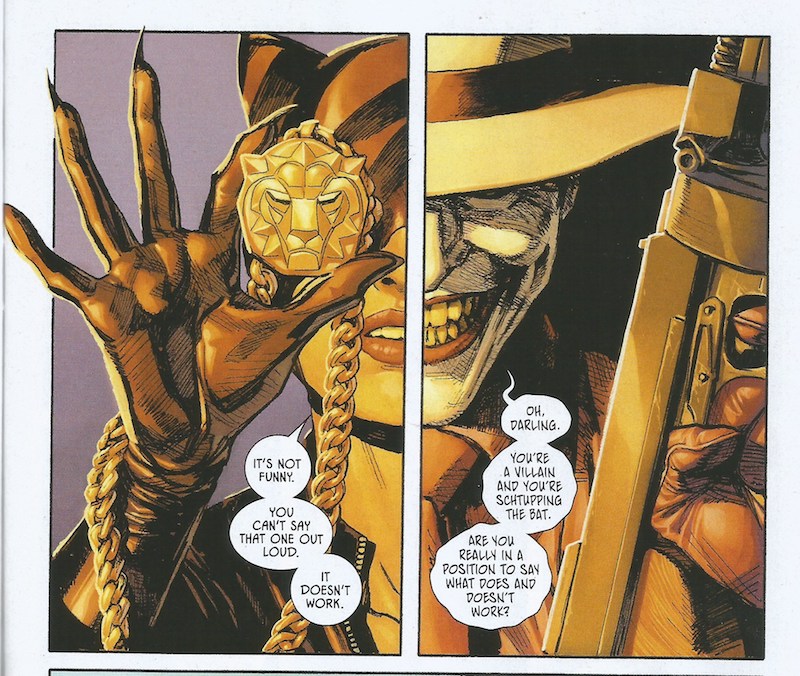
Three time periods all unfolding during Christmas comprise Batman and Catwoman.  In one, Batman is dead.  In a second, recent past, Batman and Catwoman hunt for Andrea Beaumont's son.  In the third, distant past, Catwoman and Joker subsist in symbiosis to undermine Batman's strengths.  


Though many scenes speak for themselves.  The time-hopping can be confusing if there's no frame of reference.  Clay Mann provides that frame through fashion.  Catwoman in Black is the distant past.  Catwoman gray is the recent past, and older Selina is obvious.

In issue one, Selina visits an old man in Florida.  This catalyzes the reflections of the more recent past where King incorporates Batman Animated Series continuity into the decidedly un-cartoony artwork of Clay Mann.


Andrea Beaumont for those unfamiliar with the character appeared as Batman's first love in The Mask of Phantasm.  The best of the Batman films after Batman Returns. 


The theater select original animated feature offered the audience not just a tweaked Batman origin but also drew in Mike Barr's and Al Davis' Reaper stories from Batman Year Two.

During the course of Batman's and Catwoman's investigation of Andy's disappearance, more Animated Series recreations arrive on scene.  You may begin to think that Batman and Catwoman is in fact an extrapolation of The Animated Series.


Yet.  Batman and Catwoman isn't quite the animated continuity either.  King's Joker in this story appears as different incarnations, none of which would fit in the The Animated Series, save for this one.  There's a sense that the Joker alters his appearance to placate Batman.  The purple-garbed murderous clown better suits Batman's world rather than the straight up gangster who appears before Catwoman.


Batman and Catwoman also reintroduces Helena Wayne.  Though she's not Helena from earth-two.  Neither from the Bronze Age nor the New 52.  This is Batman's and Catwoman's daughter, briefly seen in King's speculation about Batman's last day.

Different costume as well, and here's where the Black Label becomes a little more racy.


I mean, there's really no reason for that bit of fan service other than it's a Black Label book and they can get a way with it.  

I suppose you can make the argument that the social mores of the near future lean toward permissiveness, but come now.  This is gratuitous.  


One good look at Helena's rear and you're likely to forget everything else that happened in the series.  Fortunately, I take notes.

Batwoman, Helena's not Huntress, in King's future not only investigates the murder of an old man in Florida.  She's looking into the Batman's rogues.  The case in Helena's present appears to link to the the deaths of the Joker's former henchmen.  


For the audience it's no mystery.  The usually tight-lipped Tom King divulges the secret.


Andrea is once again Phantasm.  The death of her son destroys her peace of mind, and she even goes so far as kidnapping Selina.

Once the first issue of Batman and Catwoman ran through its course, I questioned whether or not I'd be interested in the entire series.  King isn't after all creating a fair play mystery.  We know practically everything.  I don't believe Catwoman would ever willingly partner with the Joker, but I can tenuously accept the premise for this series.  Still, it's not something I'd choose out of all the comic books in the world to read.

Then King and Mann introduced Batwoman.  She's the most exciting and visually striking character in Batman and Catwoman.  I want her series.

Certainly, my subjective love for Helena Wayne lends bias, but I can also prove the argument objectively.


Batwoman bases her outfit on Batgirl as much as Batman.  She must be a fan.  Dick Grayson, now Commissioner of Gotham City, trusts her.  So she is entrenched in the Batman Family.  The rogues recognize her as Batman's successor and heir.  Imbuing greater resonance.

Helena seems determined to bring her mother to justice for the original murder in issue one.  She behaves a lot like her father.  Looks like him too when striking a pose.


Unlike Batman, the dynamic between she and her mother is different, and her pursuit generates the friction.  


Furthermore, the LGBT community lose none of their representation.  Batwoman is gay.  Helena Wayne is gay.  With the addition of Helena Wayne, Batman and Catwoman becomes a must read, rather than a pleasant enough time waster for those with a surplus of funds.