Showing posts with label Tom King. Show all posts

Tuesday, June 30, 2026

POBB Jun 26, 2026

                                Pick of the Brown Bag
                                    June 26, 2026
                                                by
                                            Ray Tate


Supergirl Woman of Tomorrow is a good movie with moments of greatness, and Milly Alcock is a great Supergirl.  Keep in mind.  I'm not comparing her to Helen Slater, Laura Vandervoort, Melissa Benoist, nor Sasha Calle.  The Powers That Be never picked a mediocre Supergirl.  All these talented actresses did justice to the part.  They all brought something interesting to the role and never betrayed Kara Zor-El.  Milly is the latest actress to imbue Supergirl with dignity. 


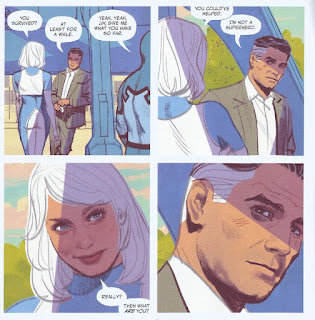
Woman of Tomorrow is loosely based upon Tom King's and Bilquis Evely's outstanding work of the same name.  


Both projects are grounded in True Grit ; with Supergirl taking the place of Rooster Cogburn.  Kara being a helluva lot more powerful not to mention much comelier.


Neither the book nor the movie are remakes.  Rather, True Grit serves as a vault to launch original ideas.  Furthermore, there's enough deviation in the Supergirl script to give honest credit to screenwriter: Ana Nogueira.  


Some of that deviation is particularly inspired.  Nogueira adheres to the western themes more so than Tom King does.  For example, King is probably kicking himself for not including the bus (train) holdup in his semi-western chapters with Evely.  Those Nogueira recapitulations are staple scenarios of the genre.

The film starts out faithfully.  Supergirl bases herself on a red sun world to celebrate her birthday.  She's twenty-three.  Twenty-one in the book.  However in the film there's a darker undercurrent to the celebration that her cousin Superman has intuited.  Self-destruction.  He even voices concern that he's afraid; someday Kara won't be coming back.  Scenes in Argo City depict Kara wanting to die with her parents.  She appears not to have lost that survivor's guilt.  Trouble is.  She's practically unkillable.  

As with King's and Evely's work, Kara finds a bar and in that bar meets Ruthye.  In the movie, Ruthye is the last survivor of her family.  All murdered by the cowardly Krem.  Krem only kills her father in the book.

Ruthye seeks a mercenary to hunt down the killer.  She offers her father's finest crafted sword as payment.  In the movie, Ruthye's father is a sword-smith.  

Already the filmmakers create the streamlining you expect from an adaptation.  Krem isn't just known to the Brigands, which Evely and King introduce later in the series.  In the film, he's the leader of the Brigands.  

It's a classic case of seeing things with fresh eyes.  Why do the Brigands visit Ruthye's world.  For weapons crafted by her father.  He gives them all the weapons.  Krem murders Ruthye's family anyway because the frog cannot trust the scorpion.  Plain and simple, Krem likes to murder people.


Ruthye's loss parallels with Kara's loss, yet they do not become fast friends.  

Kara as with King's/Evely's graphic collection interferes when an alien steals Ruthye's sword.  In the book, it's an art nouveau Conan.  

In the movie, it's an alien's alien.  The film designers drop Bilquis Evely's belle époque style.  They instead opt for a dystopian future depicted in many a European comic strip.  

The shiny optimism of the Legion of Super-Heroes cannot be found in the backdrop.  Sure there are wonders in our eyes, but they have fallen into the grime and soot of industrial commonplace. 

Supergirl, a bright and shiny penny, drops into the deep inky well and creates unexpectedly violent ripples.  


Krem very likely could not believe Kara chased him through the galaxy, found him and beat the snot out of him.  Nor like Calvera from The Magnificent Seven could he possibly fathom why.  Krem is not a complex villain, but he does possess raw cunning, a band of ugly followers and a multitude of weaponry.  He also wields fear over the planets he and the Brigands sully.  

For many comic book readers, reason is seldom explored.  We don't ask why Supergirl interferes.  She is Supergirl.  That's enough of an answer for people who imbibed her adventures for a lifetime.  The film nevertheless offers the root of Kara's rationale.  Kara carries her dying mother's words with her.  "You don't have to be nice.  You do have to be good."   

For these reasons Kara is less "light-hearted," a perfect description from the film, than her cousin Kal-El.  It's rather surprising that the gravitas of the voice-over line prominent in the trailer "My cousin sees the good in everybody.  I see the truth," is reduced to a blink and you may miss it conversation.  I think the filmmakers made the right choice.  Stylistically after building up that boom here is the difference between Kara and Kal-El, in context Supergirl really doesn't even think about it.  She's not a speechmaker.  If you're a villain, she's in your face.


Superman is so terrified of accidentally hurting someone, he instinctively holds back.  Supergirl? Not so much.  

All the way back to The Brave and the Bold #160

That's why at the cost of her life she was the one to rip the Anti-Monitor a new one.   Not Kal-El.  He held back.  Supergirl did not.  


Despite being on a red sun planet, Supergirl is really tough.  Her muscles evolved on a world with higher gravity.  A yellow sun grants her godlike powers.  A red sun reduces her strength, stamina, etc to original Jerry Siegel and Joe Shuster levels of leaping over tall buildings in a single bound, and being able to deck aliens with only the consequence of a stinging hand.  No invulnerability on a red sun world, but as I said.  She's tough.  She gets back up when getting knocked down.  


In both book and movie, the girl knows how to fight and stubbornly survives everything thrown against her.  She's furthermore confident she can win.  This confidence vibrates from Milly Alcock's performance.  She is confident she will win because of who she is, but she's not unmindful that she can lose.

Ruthye tries to convince Kara to hunt down Krem and help her dish out revenge.  In the film and comic book series, Ruthye wants to kill Krem herself.  She needs an experienced tracker and somebody that's capable of capturing Krem so she can deliver the coup-de-grace.  

Kara tries to back out of being the hunter Ruthye needs.  While eschewing the job, she receives unwanted visitors.  Krem and the Brigands board Kara's boat.  It's a simple scene but contains a lot of information.  The Brigands approach Kara's vehicle from the opposite side.  She can't hear them because the red sun reduces her senses to human level.  Krypto catches sight of the Brigands and leaps to Supergirl's rescue.  As with King's and Evely's terrific comic book series, a poisoned arrow fells the brave canine.

Supergirl still does not agree to Ruthye's demands. In the book Ruthye and Supergirl quickly join forces.  Mostly because Kara doesn't want Ruthye to be killed.  

In the movie, Kara instead hunts Krem for the antidote by herself.  Rather that's her intent. Ruthye boards the train (bus) and there's nothing Kara can do to stop it.  


Surprisingly James Gunn, notable for his humorous approach chucked the comic moments that occur on the train in King's and Evely's work.  Ana Nogueira and Gunn instead evolve their own humor during that juicy train robbery updated for science fiction.   

Supergirl complies with the bandits for the most part but then sees an opportunity.  Once again brimming with confidence that she can win, Kara takes on the train robbers in a memorable fight.  All the fights in Supergirl are quick, good and different.  I hate it when a prolonged fight and fights that differ by a razor's edge pad out a film. 

Supergirl overcomes overwhelming odds, and soon has a lead to Krem and the Brigands.  This is a needed departure.  Woman of Tomorrow was a limited series that was collected.  It's not truly a graphic novel.  In the third issue for example, Kara visits a city of racism, exacerbated by the Brigands.  In the fourth issue, Kara sees some of the Brigands' handiwork.  Another issue details a magical trap Krem sets for Kara.  


The series was naturally episodic.  The movie is the more cohesive medium continuing the space western that began with issues one and two.  King and Evely didn't drop the theme entirely, but they also overlapped other genres including the Untouchables era of corruption and swashbuckling moments of Kara fighting space-pirates that behave like pirates.  They brought in Comet the Super-Horse from out of Supergirl lore.  These elements are not in the film.  I didn't expect to see them.  However, it's a pity Gunn and Nogueira couldn't fit one particular moment from Woman of Tomorrow into the story.


I really like this scene.  It represents a complexity in Kara's persona.  Supergirl is at home anywhere in the universe.  She can adapt to any world, and doesn't mind at all losing her godly sun gifts.  Still, she's from a civilization.  Civilized people wash their hands.  It's an unspoken contract that says you care enough about yourself to not carry germs on your person, spread germs to others, nor infect your fellow citizens.  None of this polish prevents her from grinding somebody that can take it into the ground.  Supergirl is a woman of many facets.

Following the lead, Kara finds that the Brigands count child slavery in their trade.  They steal humanoid female children to be sold as "brides."  Sex slavery is a crime designed for a superhero to destroy.  It's been on the plate of many a seventies exploitation film, and slavery unfortunately has never gone away.  It's also a subject indicative of something you might find in a Judge Dredd comic book not a superhero story.  However if you accept that comic books to a certain extent mimic reality, then neither Superman nor Supergirl would turn away when confronted with such crime.  It's therefore a valid concern and certainly can be used as a subject in a superhero film.

Pitting Supergirl against such evil is notable.  It's like the filmmakers are saying.  The world is dangerous.  It's not nice.  What you're seeing on screen.  That happened in the past, that happens in the present, it will happen in the future if we don't band together and stop it, but what if there was an alien superhero? Supergirl is the wish fulfillment juxtaposed against a real world terror that's disguised in science fiction darkness. 

While on route to snatch the antidote and maybe let Ruthye have Krem, Supergirl discovers something horrible.  She must therefore confront the horror and defeat it.  Sure.  I get it.  The brides may insult your delicate sensibilities.  Grow up.  Get over it.  Watch a hero succeed.

On the planet, Kara encounters Lobo portrayed perfectly by Jason Mamoa.  Lobo is more of a known quantity than Supergirl.  Even Supergirl knows of him.  Lobo agrees with the evil universe Krem and the Brigands inhabit.  Supergirl does not and should not.  She's a visitor from a science fiction pulp novel.  She's the drifter who comes into town, sees injustice and takes out the trash.  She may hope that she dies in the process but nevertheless fights to live.

Supergirl's revelation as the last daughter of Krypton occurs during the aforementioned conversation between Ruthye and Kara.  James Gunn and Ana Nogueira present the classic origin of Supergirl.  They skip over nothing.  The sci-fi forcefield that "saves" the city of Argo.  The kryptonite poisoning emitting from the ground.  They mention the lead lining that temporarily protects the citizens.  They also include a happy addition of Krypto the pup meeting his mistress for the first time.  Krypto is the one living thing that gives Kara Zor-El a brightness in a life that seems haunted by death.  The death of her parents and Argo City, which survived Krypton, is the tonic that wakes Kara up to the universe's unkindness.  Allows her to see the truth.

I would have liked to have seen the inclusion of Kara hammering lead plates into Argo City to stave off the Kryptonite radiation.  

That scene from Evely's and King's series gives Kara a physicality before she gained her superpowers.  It also helps forge her indomitable will.  I'm fairly certain the filmmakers would have included it in the film if they had decided to extend the running time.  Perhaps it too much contrasted the theme of Kara's death wish.

After an impressive attempt to kill Kara fails, she faces the Brigands and what can be termed as round one.  Supergirl succeeds in rescuing a lot of the brides from the Brigand cells, but she also clues the Brigands into something strange going on with the flying, blonde in the long, brown coat.  

The Brigands finger her for a Kryptonian and test that theory by trapping Kara on a binary sunned world.  One of those suns happens to be green, as in the graphic collection.  


Here the comedy and terror from Evely's and King's work doesn't translate to the film.  In the series it's an issue.  In the movie, it's a scene.  Ana Nogueira uses this moment to draw Kara into fully accepting her role as Supergirl.  Evely's and King's Woman of Tomorrow is after all merely another thrilling, daring adventure of Supergirl.  Supergirl is already comfortable being a champion.  

Though the dying Kara half-chides Ruthye for bringing her uniform to her.  She never the less puts it on and lives up to its meaning when the yellow sun rises.  


Kara at the beginning of the movie is trying to either forget about responsibility or die in a fight.  At the climax of the film, she wants to live as Supergirl and symbolize everything that name stands for.

The Brigands capture Ruthye and who should be in the adjoining cell but Lobo.  


Lobo explains the differences between he and the Brigands.  He hunts for money.  His word is his bond, a new myth for the Main Man.  I don't recall Lobo being remotely  as honorable as Dr. Doom.  Fine though.  I'll hold you to that in future films.

The Brigands attempt to con Ruthye into giving up Supergirl's location for freedom.  Ruthye doesn't buy any of it.  Lobo keeps watching and keeps being impressed by Ruthye.  I am as well.  We can thank actress Eve Ridley for that.  Ruthye is a child forced into adulthood.  She can't be so easily tricked. 

Lobo doesn't team up with Supergirl or Ruthye.  Their needs simply align.  Lobo isn't looking to destroy the Brigands.  They just happen to be in his way.  He's only being paid to execute one of them; in a refreshing twist, not Krem, nor Kara, which would have been mighty predictable.  You can imagine a scene in a lesser movie or comic book where Supergirl won't let Lobo kill the Brigand he's after.  Thus comes the inevitable slugfest.  Not so in Supergirl.  She doesn't care if Lobo kills the Brigands.  The less of them the better.  She just wants to make certain Ruthye doesn't get diced in the crossfire.


Supergirl returns to decimate the Brigand forces.  At one point, Ruthye stands amidst a circle of mayhem that implies Supergirl's presence.  You don't see her in the billowing dust clouds.  You see flashes of heat vision.  You see vehicles being tossed around like toys.  One of my favorite ways to describe Supergirl is that she's the one who can bench press a tank.  It's an impressive scene that unites effects and characterization.  

I am happy to say that we get ample demonstrations throughout the movie of Milly Alcock as Kara Zor-El and Supergirl punching, throwing and destroying evil tech as opposed to just CGI smears representing such.  The choreography is all brilliantly done.  It really looks like Milly Alcock's Supergirl is smacking around these stronger than normal thugs.  I wouldn't be surprised to learn that a lot of these scenes resulted from old fashioned wire-work.  They're that good. 

The film ends with Supergirl finishing her celebration, now a little brighter with company and returning home to meet up with her super-cousin.  They're awkward around each other, but you get the sense that Supergirl is now more accepting of her role as a superhero.  She sees earth as her genuine home and that dark undercurrent of seeking death ebbs.  By the end of the film, every audience member should see what makes Supergirl worthy of their time and energy.  They should also see her as a distinctive hero who shouldn't be dismissed as Superman's little girl cousin.


Superman Family #182


Tuesday, September 26, 2023

POBB September 21, 2023

Pick of the Brown Bag
September 21, 2023
by
Ray Tate

Welcome to a wonderful Pick of the Brown Bag with your host and creator Ray Tate.  As you might have guessed from the description, the subject is the newest number one of Wonder Woman.  


Yes.  Under normal circumstances, a new number one would be redundant, but what're you gonna do? ...Comic books...

First a brief recap of what happened before... 

In 1941, United States Air Force pilot Steve Trevor crashes on the isle of the Amazons.  


After consulting the Greek Gods, Queen Hippolyta determines that an Amazon must go to Man's World to return Steve Trevor to the armed forces. 


More to the point, one Amazon must stay in Man's World to battle the Nazis and tip the balance in the Allies' favor.  

This envoy will be determined by an Amazon Olympics that culminates in Bullets and Bracelets.


Princess Diana cared for Steve on the Isle and fell in love with him.  


Disobeying her mother, Diana dons a mask and competes in the contests.  Naturally, she wins.  She becomes Wonder Woman.


The story hasn't drastically changed and neither has Wonder Woman.  


Her stability is just when considering her contextual immortality.


In this latest issue of Wonder Woman, a group of idiots accost an Amazon.  She defends herself.  Events escalate.


Alas.  The United States, instead of investigating the alleged crime and granting the Amazon due process, goes apeshit.  


The government singles out Amazons, ships them back to Paradise Island or, preferred, murders them.


Heading these efforts.  Perennial asshole Sarge Steel whom I last saw as President Reagan's attache in a nineties Superman Annual.  


To be fair, he never started out a sphincter.  He's also not the first detective to turn secret agent.  


Homicide detective Captain Amos Burke of Burke's Law jumped the shark by becoming a government agent in the final season of his otherwise entertaining series.

Naturally anything concerning Amazons, concerns Wonder Woman, and when she comes to the stage, she elegantly shoves Sarge Steel's vaunted metal hand up his colon. 


It may seem that I've broken one of the cardinal, subjective rules of the POBB.  Honestly, though.  I haven't really spoiled a thing.

Wonder Woman is actually a very deep and pertinent book.  I'd expect nothing less from writer Tom King.  His story is about bigotry, plain and simple.

Because an Amazon committed the crime, she's labeled a terrorist, rather than a criminal.  Personally I hate the word terrorist.  It's a word loaded with xenophobia.  The consequences of that word often lead to generalizations that get innocent people killed.

I prefer to think of habitual lawbreakers as criminals.  No matter their country of origin.  Donald Trump is a criminal.  So is Putin.  One of those criminals admires the other one.  I'll not say who.


Much like other innocent global citizens, all Amazons suffer the accusal because of their marginal association with the fugitive.


Hypocritical members of Congress are eager to get their hands dirty, in secret.  An interview with the average Joe indicates a deep-seated hatred of the Amazons.


He excepts Wonder Woman either because he doesn't realize she is an Amazon, or he counts her as a reformed Amazon.

You can also read in his dialogue an inherent fear and loathing of women who choose to pursue an untraditional lifestyle.  

He further exemplifies the mirror argument of racists.  

Because I hate you, you must hate me.  You're no better than me.  Therefore, this is a matter of survival.  Yeah.  That's total rubbish.  

When unfair laws governing Amazons on American soil pass, the government plummets into fascism.  


Sergeant Steel and his AXE Squad, perhaps purposely named after the masculine body spray, transform readily into the Gestapo.  

Honestly, I think the original Sarge Steel from Charlton Comics would be horrified by this guy and punch him in the mouth.

Sarge Steel and his AXE Squad likewise reflect the Ku Klux Klan of the eighties and nineties who tried to present a softer image.  The Dunce Caps hawked an alternative to exterminating black people; they just wanted to ship them back to Africa.  

It's very easy to transfer this argument to DACA.  Dreamers arrived here as children.  They don't know the countries from whence they came.  Some of them don't even speak the language.  Even if not born here, they grew up here.  They are more American than some sphincters in Congress.


Yeah.  That's right.  Looking at you.  You putz.

Steel and his AXE Squad demonstrate some success due to technologically advanced armament that overwhelms any of the Amazons living in America.  

Why Amazons would stay in the USA isn't explained very well.  The Amazon fugitive visited the continent to do charitable work.  Others have family, but I'm not sold on the idea of raising a child in America being better than raising a child on Themyscira.  So let's just call this a conceit to better the metaphor.

The Ameri-Nazis aren't above aiming an assault weapon at children, who will be removed from the Amazon families.


Separating children from the parents of illegal immigrants, by the way, is a Trump initiative.  However, it's a practice patterned after Russian and Nazi tactics.  Indeed the Nazis suborned Paula Von Gunther, who became Wonder Woman's archenemy, by holding her daughter hostage.


Wonder Woman later fights on Paula's 
behalf in a court of law.  That's right.  Diana is perfect.

If you object to how quickly America descends into autocracy in Wonder Woman.  You haven't been paying attention.  


If Donald Trump wins the election against President Joe Biden, this country as you know it will cease to exist.  Democracy dies if Trump is reinstalled in the White House.  He will not leave.  There will be no more elections.

Ah, but Wonder Woman is a comic book.  Just a simple comic book.  It's really about wish fulfillment.  We don't have a Wonder Woman, but if we did...

Steel and AXE arrogantly attempt to murder Wonder Woman.  I mean they've got improved armament, right? What can possibly go wrong.


There's so much delicious artwork by Daniel Sampere and Tomeu Morey to feast upon.  

The illustration throughout is glorious.  When Wonder Woman resists being murdered--the nerve of her--it's just panel after panel of history in motion.  

Everything you remember about Wonder Woman plays out in these final scenes.


Monday, February 28, 2022

POBB February 25, 2022

Pick of the Brown Bag
February 25, 2022
by
Ray Tate

Welcome to part two of the Pick of the Brown Bag's investigation into Christopher Chance, alias the Human Target.  Yes, you can also still find me on Twitter: #PickoftheBrownBag.


Tom King and Greg Smallwood team up to grant some respectability to the hit and miss DC Black Label brand.


King's excursion blends two different genres beautifully: the detective novel and the science fantasy of the superhero.  In a first person narrative Christopher Chance discovers his time is limited.  

He seeks out the individual that either tried to kill him or inadvertently killed him, while aiming for Lex Luthor.  He interviews the suspects.  In between, he gets mixed up with the right kind of dame, or is she in fact a femme fatale?

The nature of the characters and the placement of Christopher Chance distinguishes his latest and perhaps last case from even the above average dead man walking mystery.  

DC's Black Label brand gave King the excuse to cut Christopher from the superhero world of DC.  Instead, he plants him right into it, which is historically proper.

The first book of The Human Target sets up the premise and introduces you to Greg Smallwood's artwork.  Smallwood is a vital part of the book's success.  His illustration, which looks like it's searching for its lost 1940s private eye novel cover home, suits the tradition of Christopher Chance's visual history of clean comic book artwork.

As Christopher lays "dying" his mind turns back the clock to when he accepted the Lex Luthor assignment and first partook of the poison.  Of special note, Christopher does not remember getting into his car, driving and crashing.  


Also notable, Lex Luthor calls the Justice League when his people find Christopher.  It's possible the poison guaranteed Christopher wouldn't travel far off the Luthor grounds.  It's equally possible that Luthor is setting up Christopher Chance to be bait, to lure the Justice League into a Byzantine scheme, quoting the Blue Beetle in Human Target book four.  

However because of Christopher Chance's familiarity with the superhero world, Luthor very well may be on the up and up and called the League because he felt that Christopher was one of them.  As a result of Luthor's call, Christopher ends up under the care of the original Dr. Mid-Nite.


Here again, King uses the Black Label to his advantage.  He doesn't need to explain Dr. Mid-Nite being the original.  He doesn't need to go into a footnote about how Dr. Mid-Nite and the rest of the Justice Society ended up alive and well.  They just did.  

This technique furthermore agrees with King's overall attitude when writing superhero books.  In Batman he recovered the entire chucked history of Batman and Catwoman.  So, seeing the Golden Age Dr. Mid-Nite hale and hearty in King's latest should almost be expected.

Dr. Mid-Nite proves he hasn't lost any of his skills.  He determines the nature of the poison.  He also points Christopher into the direction of the most likely and most unlikely suspects, the Justice League.


I'm not absolutely sure where the Bwa-Ha-Ha-Ha Justice League of the nineties lands in current DC continuity.  With Black Label I don't need to.  For this series, they existed.   

King expresses a familiarity with the Giffin/DeMatteis/Maguire Justice League throughout The Human Target.  That's great for fans of the heroes as well as followers of what appears to be a fair-play mystery.  Meaning, the motive for killing Lex or Chance must make sense and must agree with each suspect's personality.


In book two, The Woman arrives to complicate the detective's linear search for justice, or to help Christopher find the culprit.  I use the phrase The Woman quite purposely.  The femme fatale, the duplicitous love interest of the detective first emerged in the case files of Sherlock Holmes.  


Before Irene Adler, female characters in crime fiction were either good or either evil.  Never a complex blend.  All of the dames that betray Sam Spade, Philip Marlowe or have a change of heart and rescue Travis McGee and Lew Archer owe a debt to Doyle.  Surprisingly, Ice is The Woman in The Human Target.


Ice of the Justice League strongly derives from Icemaiden, a character created by E. Nelson Bridwell and Ramona Fradon, for the Super-Friends comic book series.  


Because of an error regarding Icemaiden's secret identity, the Justice League superhero grew ever more distinctive from her source.  Other writers and artists continued to diverge Ice's and Icemaiden's history as well as their appearance and behavior.

King takes a deep dive into Ice's history.  A lot of it completely unfamiliar to me.  I knew Ice died...somehow...having seen her as a ghost in a Justice League annual and witnessing a despondent Fire beg for J'onn to shape-shift into the form of her old friend.  Occurring in The Martian Manhunter.  

Ice in The Human Target relates two different histories--one mythical, which I vaguely remember, the other terrestrial; nope.  She identifies the old Justice League Detroit villain Overmaster as her slayer.  Drawing a blank.


Overmaster also somehow colluded with Lex Luthor, which I suspect is King's artifice.  Therefore most likely a red herring to give the Justice League motive to kill Lex.  Sorry.  Still not sold on any of the League poisoning Lex Luthor.

The entirety of book two offers the kind of melancholic mood one habitually finds in the classic private eye novel.  It's peculiar how Ice of all people works so smoothly as a female catalyst.  She at once conveys world weary wisdom, the image of the injured party and the enigma but never abandoning her bwa-ha-ha-ha origins.  As a character piece, book two of The Human Target is hard to beat.


Book three splits between Booster Gold and Guy Gardner.  Guy Gardner takes on the role of the "heavy."  He doesn't like Christopher Chance warming up to Ice, his ex.  


Part of what Guy does in book two answers the need for the detective to be beaten up in the novel.  The difference lies in Guy's independence.  Normally, the "heavy" is the lieutenant of the main crook.  Here, Guy acts on his own.  The Green Lantern element furthermore takes his harassment out of the detective genre.  

Guy's appearance, his behavior, his relationship to Ice all consolidate into a prime suspect, especially given the Lantern rings being subject to a Three Laws of Robotics code.  In other words, the rings cannot directly harm a life form even if the bearer wills it.  

If one harbors a grudge, but one cannot use his magic power to kill, poison may seem like a great idea.  Guy is also one of three people who first knew of Lex Luthor's hand in Overmaster's scheme.  


These facts draw Fire and Ice to the forefront of the suspect list.  Yet Fire and Ice could have kiled Lex in so many overt and subtle ways.  Guy not so much.

Yet I doubt.  Guy Gardner simply isn't smart enough to concoct such a scheme.  To emphasize, Christopher Chance demonstrates how easily it is to outwit Guy.  The scene also depicts that though Chance is on a mostly cerebral quest, the comic book isn't above action.  

Action-packed anything is often looked down upon by the snobbish.  I am certainly not one of those people.

The Booster Gold investigation goes as one may expect.  Booster Gold is hilarious.  


That reputation springs purely from Justice League, where Booster and Blue Beetle became the best of friends and a comedy double-act.  Before the League, Booster was a self-serving jackass out to upstage Superman.  Booster stole future tech to travel back into the past to become famous.  I can easily see that Booster poisoning somebody.

In Human Target, Booster is opening up one of what he hopes to be a bagel franchise.  


It's preposterous to suggest Booster has the brainpower, motive or want for revenge.  Furthermore, he would somehow need o ditch his robot companion Skeets.  Same reason as Guy's ring.  King in fact glosses over Booser.  Presenting him as a minor suspect, but he includes one interesting fact.  Booster cannot remember where he has been.  That could be simply Booster, or it may be a symptom of a grander solution to this mystery.  Overmaster controls minds.  Mind control will play a part in Human Target book five.  Booster also apparently could have obtained the ingredients to the poison, which seems to obvious a tell from King.  So, naturally, I'm dismissing it.


In the fourth book, Christopher and Ice go to question the Blue Beetle.  King and Smallwood really do a number on the Blue Beetle.  With Kirbeyesque abandon, they paint a striking picture.


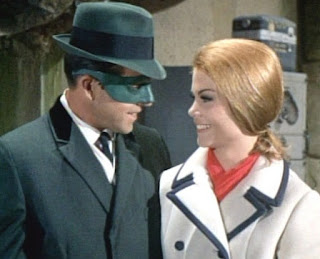
The Blue Beetle is a credible, albeit small potatoes, super-hero and a successful technology tycoon.  They also add a dash of Green Hornet, to Ted Kord's pursuits.  Like Lenore "Casey" Case, his secretary Nancy knows his secret.


Based on a 1939 public domain superhero, Ted Kord's Blue Beetle originated with Steve Ditko in Charlton Comics back in the sixties.  DC bought the Charlton characters when the company dissolved.  Though Blue Beetle features in Crisis on Infinite Earths, he made his biggest splash in Jon Ostrander's and John Byrne's Legends where the new Justice League formed.

Whereas Booster Gold isn't smart enough to pull off the murder of Lex Luthor, Blue Beetle is almost too smart to do it.  This is a stark contrast to the way Keith Giffin and J.M. DeMatteis portrayed Beetle in Justice League, but gibes with what he is supposed to be.

Smallwood presents Blue Beetle's intellect through his technology, and King depicts the Beetle's absurdity through the same.  Why does Ted Kord need some kind of replicator to don the Blue Beetle suit?


No idea.  Even if the suit's made of some kind of special fabric, the process seems superfluous but also the kind of comical quirkiness that you expect from a goofy character like the Blue Beetle.  Book four of Human Target is so off-kilter due to the Blue Beetle that it really needs to be accompanied by a mouth harp.

Beetle's tech knowledge originally described his purpose with the Justice League.  He was their pilot, and they traveled in Blue Beetle's Bug.  

The original Justice League of America didn't have transport vehicles like the Quinjet of the Avengers.  So many of the members flew under their own power they didn't need such transport.  You would often see Batman and/or Black Canary riding on a Green Lantern constructed platform.  

In the Bug, Beetle transports Christopher and Ice to various crime scenes dotting the country.  Blue Beetle doesn't have a territory like Batman.  He simply goes where the action is.  Although the action is very low level danger in comparison to the threats he and Ice faced in the Justice League.


Ice and Beetle team up, and it's here that Christopher notices something about the partnership.  This doesn't play into the mystery.  Rather it remarks on just how incredibly powerful almost every superhero can be given the specs of those powers.  

I frequently point out that Dazzler, created as a business deal with a rock singer, is incredibly, stupidly powerful.  All she does is use her mutant powers to create light shows and blind bad guys, but if she wants to, she can transform sound into a laser beam and bore a hole through the moon.  It's ridiculous.  


As he teams with Ice, Beetle dissects the reasons he could have killed Lex Luthor and the reasons why Lex Luthor may be behind the whole scheme.  


Throughout the Human Target, King predicts the reader's suspicion.  He brings up Lex as a suspect quite surreptitiously, but often enough to discount the labyrinthine thinker.  The biggest problem I have with Lex is motive.  I can only think of one possibility.  


Lex in fact detected the poisoned coffee, determined the nature, but couldn't deduce who in the League poisoned him.  So he set up Christopher Chance to do the legwork for him.  In this scenario, he may have even exploited the gunman that Christopher succeeds in stopping.  Perhaps even calculating how much poison Christopher would have thrown up after being shot.  Thus, Lex uses Christopher as a stalking horse to quietly cut down the League's murderous member and free himself from any possibility of payback, and yet...


Book five, the most recently published of the series, draws Christopher face to face with the Martian Manhunter.  

The Martian Manhunter began his career in 1955's Detective Comics.  He arrived on earth by accident.  


The Manhunter used his shape-shifting abilities to blend in with human society as Detective John Jones.  King parallels Christopher Chance and the Martian Manhunter on numerous levels.  You'll see how only if you read book five.

There is a lot of things going on in this chapter of The Human Target.  Some I cannot reveal.  What I can say is that the woman on the cover is not Diane Meade.  

Introduced in 1957, Diane Meade is an "emergency police woman"--no idea--and the Commissioner's daughter.   She fully joins the Martian Manhunter cast in 1960.


Though not Diane Meade, the woman on the cover is steeped in DC history and exemplifies King's ability to create complex characters.  She exists in Christopher's past. 


Other scenes in the book, demonstrate King's ability to add depth to already established characters and use the Black Label brand for the sake of legitimizing plot elements that could only be hinted at in a mainstream title.  


The expressive realism in Greg Smallwood's art contrasts the shifting tenses that can only work in a comic book.  Not just any visual medium.  The convoluted narrative expertly timed by Smallwood details Christopher's origin, his past meeting with the woman on the cover, his recent past with Ice, his present with the Martian Manhunter and the Manhunter's past.

This juxtaposition of scenes added to the DC history cements King's determination that Christopher Chance is part of a superhero universe.  Indeed, he must be.

For those following the mystery, this book is the big one.  The one where King divulges a lot of clues or generates devilish subterfuge.  

It sure looks like the guilty party reveals himself, but I don't know.  The revelation seems way too easy.  Notable, the guilty party doesn't explicitly admit to the crime.  In addition the stream of consciousness is somewhat unreliable.  How do we know the visuals we see haven't been influenced by Christopher's own experience?

Five books in, and I really don't know who poisoned Christopher Chance.  My best guess is still Lex Luthor.  However, who poisoned the coffee in the first place?  


I'm thinking G'nort, the hapless screwup dog Lantern.  Contaminated with the radioactive poison, he fell into the water used for Lex Luthor's coffee, or something like that.  I can't envision any of the Justice League raw enough to poison Lex Luthor.  None have a score to settle with Christopher Chance.  I also cannot help but wonder why King and/or Smallwood included G'nort among the heroes.  G'nort was at best a mascot, and King knows that.  They depict for a reason.