Showing posts with label Django. Show all posts

Tuesday, May 26, 2015

POBB: May 20, 2015

Pick of the Brown Bag
May 20, 2015
by 
Ray Tate

Welcome to the Pick of the Brown Bag, or maybe I should call it Vampirella in the Brown Bag.

In the 1970s, Vampirella was a newsprint styled magazine.  It became a comic book.  It reverted back to a magazine, albeit glossier, then returned to comic book format a second time.  Dynamite publishes no less than three Vampirella titles at the same time, and there’s another on the way.

Not much I can add to Legendary Vampirella.  This book rocks.  Back in Legendary, the Big Bads in their pursuit of the amnesiac Red Sonja announced themselves as Vampirella's enemy by tearing her Scarlet Club a new one.  While Vee intended on helping Red Sonja anyway, the wreckage made it personal.  That vendetta continues. 

In this chapter Vampirella demonstrates her feminist side by relying on the women of Steampunk.


Some of Vee’s confidants and allies are in fact based on reality. 

Pancho is Pancho Barnes.  Pancho was an honest to goodness adventurer in the vein of Indiana Jones turned movie stunt pilot. 

The art by David Cabera expresses the extreme pleasure Vampirella takes out of life.


Vampirella’s bedmate is a really obscure character from literature.    If you read the book, or saw one of several movie adaptations, the name Rudolph Rassendyll will plague you, as it did me.  I had to look him up.  Why shouldn't you?Thanks, wikipedia.  

The name dropping however isn’t important.  Vampirella demonstrates a positive attitude toward sex, and writer David Avallone puts her on equal footing with James Bond.  The sexual liberation isn’t the only aspect Vampirella shares with Bond.

After disposing of the stormtroopers, the Big Bads make Vampirella an offer they feel she cannot refuse.


Yeah, it’s a little too late to kiss and make up.  Kurtz though drawing from the wellspring of Citizen Kane also embodies the nut-bar Colonel Kurtz more from Apocalypse Now than Heart of Darkness.  His political ambitions seem less and less likely to bear fruit now that Vampirella knows him, but just as the story appears to be coming to a close, Dr. Moreau interrupts with a surprise designed specifically to kill our lady of darkness.  Will the thing succeed? Find out at the stirring finale, which spotlights Vee’s resilience.

Vampirella takes the title character into different territory.  When Vampirella killed her brother Drago to rid herself of the curse her arch-nemesis inflicted, she inherited a kingdom.  She is the queen of the Nosferatu.

Full-blooded author Nancy Collins could have blown that off, using the implication as a mere backdrop.  Instead, Vampirella attempts to rule.  Her first act seen by the reader.  To shut down a blood farm.  


This was another easy out for Collins if she chose to take it.  She could have simply said that feeding on blood was wrong.  Vampirella is one of the few allegedly altruistic vampires that can justifiably argue this side.  Only under the most desperate circumstances does Vee feed on humans.  Those occasions can be counted on fingers and toes in a span ranging from the seventies to present day adventures.   Vampirella's supreme control of her thirst distinguishes her from her ilk.  In any case, Collins establishes Vee's willingness to accept blood as a necessity to nourish her kingdom.  She's simply not willing to take the blood.  

As the story continues, Collins sketches a day in the life of Ella Normandy, Nosferatu queen.  Eve holds court.  She meets a loyal, royal relation.


She learns about the brother she had to kill, and the insight exemplifies Collins' fine skill.  Collins drops a moving short horror story amidst the normal trappings of Vampirella.  That tale within a tale focuses on Drago and his human wife. 

Despite the relative quiet unfolding of this Vampirella issue, Patrick Berkenkotter's artwork doesn't lose a tic of quality.  Berkenkotter is known better for his depiction of pulchritude and violence.  Here, he takes advantage of the opportunity to present realism in expression amidst an argument, Vee's foul mood and the contentious countenances of various plotters seeking to overthrow Vampirella's rule.  Berkenkotter even approaches the drama in the flashback with Drago subtly.  He furthermore originates characters as the story progresses, and you can appreciate the diversity he gives to the uniformly grotesque Nosferatu.

Vampirella teams-up with Dynamite’s other femme fatale Jennifer Blood in a Nancy Collins’ tie-in to The Swords of Sorrow.  I’m not reading the main title.  So I have no idea what’s going on there, what the swords of sorrow are, etc.  Fortunately, I didn’t need any previous knowledge.  This is just a really well-written Vampirella team-up book with some underlying themes that enhance the plot rather than muddle it.

The story opens with Vampirella encountering the Pacifica Slasher, uncovering his secret and rescuing a would-be victim.  Vee calls such a chain of events Thursday.  The guy would have been toast had it not been for a convenient escape phenomenon probably triggered by a Sword of Sorrow.  Vampirella naturally follows.  She ends up on a parallel earth populated nevertheless by certain people in the know.


Throughout the story, Collins assumes Vampirella is self-explanatory, and only includes strategic mentions of her updates.  Collins spends more time informing the reader about Jennifer Blood.  This is a wise decision since multiple generations have been exposed to Vampirella in some form or another.  Even if a comic book reader has never once read one of her adventures, they still know of her.  Jennifer Blood, not so much.

Jennifer Blood is a massive train wreck of a character.  I’m glad I ignored her book because I doubt I could find it plausible for a few seconds.  Benevolent vampire hottie from Drakulon is a helluva lot easier to accept.

Jennifer Blood is on the same trail but from a different starting point.  Collins’ villain only assumes the identity of a serial killer.  He’s much more than that.  Nevertheless, Collins sticks to crime terminology to explain his actions and that tiny touch further grounds the story into Kolchak territory; i.e. monsters prowling in the modern world and being mistaken for ordinary human refuse.

This split is also seen in the artwork.  Artist Dave Acosta keeps Vampirella squarely in superhero/action territory.  She rescues the damsel in distress.  She high kicks the bad guy and dives right in for more danger.  She tucks a dagger in her boot like Modesty Blaise might and drops from the sky as if she were a Kryptonian from the shadows. 


Jennifer Blood is a different sort of animal with a different type of arena.  Acosta’s Jennifer Blood is seedy in disguise amidst seamy surroundings.  She works out, and she’s blunt with axes and blades.  


In terms of characterization, Collins, while not shying away from Jennifer Blood’s less savory past, treats her like a protagonist rather than hero.  Blood likes killing, and she targets the villains of the world because she possesses a margin of decency.  Vampirella is as always an outright champion.  She likes humans and doesn't want to see them harmed.  While Vampirella and Jennifer Blood do not get along, their personalities entertain with friction as well as an overall union in the hunting monsters that would prey on the innocent.  I look forward to the next issue.


Django and Zorro finishes with a massive upheaval of the Archduke of Arizona and his fledgling empire.  While Django becomes a narrative archaeologist on slave culture, with an insider's view, he leads a revolt of the natives the Archduke forced into servitude.


Oh, and he kills that son-of-bitch.

Anvil's death is not really a spoiler.  It's the way Django kills him that proffers the dark humor of Django's personality.

Equally impressive Don Diego De La Vega confronts the so-called Archduke with a derision of his selfishness and divine right.  

Every precise word of Don Diego's speech is remarkable in that as you read you realize that only Zorro could have possibly have said such dialogue.  This is how Don Diego really feels.  He is absolutely sincere in his belief that the nobility must serve the common good.

As Don Diego speaks it seems so obvious that he is in fact Zorro, yet the Archduke is so wrapped up in his blind vision that he can't see it, even when he puts on the mask.  You become aware that secret identities in general are often protected by the self-delusions of others.

Tarantino and Wagner drop their focus to Zorro and Django, but they also with artist Esteves Polls, visually cue The Mark of Zorro with its extras filled finale.  


Taking Django and Zorro into consideration with the classic, the message is clear.  Zorro is a symbolic catalyst.  Wherever Zorro goes the downtrodden rise up and overthrow their cruel oppressors.  He inspires others, even the cynical Django, to follow the conscience.  From start to finish Django and Zorro is something special.


I was really hoping A-Force would be something big, but it’s just odd, and that’s because it relies on Marvel’s big house cleaning Secret Wars as its story shaper.  


Baroness? What the hell?

So, based on what I gleaned from this book...A version of Dr. Doom has somehow taken over or established a barony and appointed She-Hulk as its Baroness.  She and a team of super heroines protect the barony from menaces like this issue's Megalodon, an actual prehistoric shark displaced by parties unknown.  Although a seeming Utopia, Doom has laid down rules to obey.  Else punishment results.


A-Force isn't like X-Men, which is just the female X-Men kicking ass and being superheroes.  The personalities of the Avengers feel disconnected resulting from I don't know...growing up in a barony? Mind-Control? You decide.  That's not what I came here for.  I wanted banter based on long friendships, a good story and cool uses of superpowers.  What I got was confusing characterization that undermined the super powered woman fighting giant shark scenario, which should have been an easy sell.


The whole culture and history of these familiar-looking heroes is different, and you might like that, but I didn't.  Loki's back to being a woman, and she's the guardian of Captain America Jr. and the raven-haired gal.  Medusa's looking for any opportunity to usurp She-Hulk's rule over the realm.  Captain Marvel is off, and the friendships between the women lack the resonance drawn from the sliding six-year scale of history that Marvel traditionally followed.  


This is also another case of really good artwork going to waste for a subpar story.  I mean if you're a fan of female super heroes, you want to see them at their best, and Jorge Molina gives you that in spades.  

No, Jill Lepore, these women do not look like porn stars, and I'm certain quite a few adult performers keep in tip-top shape like a minority of regular folk.  The Avengers look like athletes.  

Learn the difference.  If Jorge Molina continues to be part of the series, I'll definitely pick this up in trade or hardback.  The art is worth it.


John Shaft determines who murdered Arletha the woman he loved, and proceeds to beat him to death with his bare hands.


David Walker's conclusion to Shaft results in the grindhouse hero fully matured.  Throughout the book you saw how John Shaft could have had a happy, normal life, sublimating a killer instinct honed in Viet Nam, with the sincerity of love and purpose.  Thanks to the events depicted in Walker's superb hard-boiled treatise John Shaft is an outlier. 


Our final contender has a long and esteemed history.  Douglas Adams is best known for creating multi-media hit The Hitchhiker's Guide to the Galaxy.  Lesser known is that Adams was a writer and script editor for Doctor Who during the mid seasons of the Tom Baker era.  The novel Dirk Gently's Holistic Detective Agency was in its rough draft a script Adams wrote for Doctor Who.  So, if you notice a similarity between Dirk Gently and The Doctor, you're not seeing things.

The main difference between the two besides of course a different character history is that Dirk Gently doesn't believe in randomness.  He sees the universe as inexorably connected, and will go to absurd lengths to prove the point.  The Doctor is a scientist and therefore much more rational.  Even if he appears mad, the Doctor always has a method.  Dirk Gently not so much.


The bag theft leads to a hunt in which Gently is unaware of being the quarry.  The jovial, perplexing Gently is in good hands with writer Chris Ryall, and the fun art by Tony Akins and company adds to the bounce of the whole absurdity.


Sunday, April 26, 2015

POBB April 15, 2015-POBB April 22, 2015

Pick of the Brown Bag
April 15, 2015--April 22, 2015
by
Ray Tate

Welcome to the Pick of the Brown Bag.  This week I review Archie vs. Predator, the final two issues of Avengers Millennium, Django/Zorro, Legendary: Red Sonja, Legendary: Vampirella, King: The Phantom, Reyn, Shaft, Thor, Tomb Raider and The Unbeatable Squirrel Girl.


All through this story arc, the Powers That Be were promising a matchup pitting Squirrel Girl against Galactus.  That seemed preposterous.


However, the way in which Squirrel Girl defeats Galactus is the most sensible, positive way I've ever witnessed.  Doreen's explanation as to why Galactus always returns to devour the earth encompasses Galactus' conscience, his hunger and his Power Cosmic.

In short, even if the charm of The Unbeatable Squirrel Girl hasn't enticed, this issue is a must read for all Marvel fans because of the history steeped in Galactus streamlined by Squirrel Girl in one fell swoop.


After invading a Hydra base, the Avengers discovered a time portal leading back to prehistoric times.  Trouble is that during a time hop, which Spider-Man recommended against, the Avengers experienced turbulence.  The phenomenon split the team into three.  Cap, Quicksilver and Hawkeye traveled into the past where they found Hydra agents trying to rule primitive mankind and the mammalian ancestors of the fauna that populate the planet.  This led to some savvy saves from the Captain.


The Hydra Agents explained that the Avengers just experienced a one way trip.  This development concerned Hawkeye and Quicksilver, but Captain America had a plan.

In the third issue of Avengers Millennium Iron Man, Black Widow and Spider-Man stranded in World War II Japan discover another piece of the Hydra plan.


Mike Costa takes a page from Joss Whedon and turns the unpowered Black Widow into an important player, while Spidey provides the jokes and Iron Man observes the fruition of Cap's scheme.


Next we skip to the future where Hulk and Wanda fight Hydra.  Unfortunately, for Cap's plan and Iron Man's understanding to work, the Hulk is the last person needed.  Not to worry.  It hasn't escaped me that at only four issues The Avengers weekly almost appears like needling of the distinguished competition. 


The final issue cleverly reunites the Avengers for one last battle against Hydra in the present day.  The organization finally reveals its plan, and it's suitably whacky.  Remember their name.

The conclusion features some great teamwork by Spidey and Black Widow as they totally undermine the future Hydra Agent's gloating, and of all people, Hawkeye figures the way out of this mess through impressive logical thinking.  You wouldn't expect that given scenes like this in contrast.


Marvel's weekly was an exercise in brisk storytelling; packed in a lot of comedy courtesy of Spidey and Hawkeye and featured excellent super-hero action amidst a time travel plot that makes sense and evolves a nigh paradox free finale.


Frustrated by the enigmatic, female Thor, Odin sends the Destroyer to snatch her hammer.  In addition, writer Jason Aaron considerably narrows down the list of suspects who might be Thor.


I'm in the minority.  I don't really give a rat's behind who the female Thor is.  I'm a fan because she's well-written and more modern than Odinson.


When Jason Aaron reveals her thoughts, he dialogues them in the vernacular, and that contrasts what verily comes out of her mouth.


This technique breathes fresh air in the stale halls of Asgard. That's also why I like the male Thor from the films.  Thor talks in pronounced English, a step up from the faux Shakespeare he spoke in the comics, and Chris Hemsworth imbues Thor with greater depth.


In terms of context, Thor and the Aesir comprehend the modern world.  They know that their swords and armor have science fiction equivalents.  They may see themselves as gods, but they realize there's a teeming diversity in the cosmos.  That's why Sif and the The Warriors Three are at the end of  Guardians of the Galaxy.  Not standing out, but fitting in.


But back to Thor.  Aaron also has an ear for Coulson.  More than in any other appearance, Coulson sounds like Clark Gregg.  


Coulson's interaction with SHIELD agent Roz Solomon, prime suspect for Thor, generates ample humor that compliments the action-packed artwork by Russell Dauterman and Matthew Wilson.  The spotlight battle between Thor and the Destroyer is really worthy of witnessing.


One caveat.  In Thor, Odin behaves like a complete ass, and I'm not exactly thrilled with that.  Odin's image has been besmirched over the years.  I like to think of him as the one good, sane lead "deity."  


Anthony Hopkins embodies Odin in the Thor films.  Odin was always a little blustery, but his intent was usually for the best.  A case in point occurs when Odin orders a new hammer forged for Beta-Ray Bill.


Thor #338

If you're looking for that Odin, he cameos this week in Loki, which your reviewer found confusing; writer Al Ewing appears to be implying that Loki is a Time Lord.


Reyn continues to be a hoot as the title Warden and Steph a witch with technology infiltrate the salamanders' lair.  

This issue is more visual than read.  Reyn serves shotgun for the techno-mages and fights amongst them against all sorts of robots.  When the team find the area of the ship that gives Warden Reyn a case of deja-vu, those that haven't caught up yet should finally hear that last penny drop, and you also get this priceless scene.


Archie vs. Predator.  Well, this was just too hard to resist, wasn't it?  Archie and its subsequent spin-offs haven't changed an iota for at least fifty years.  Archie is enamored with both Veronica and Betty.  Reggie wants Veronica.  Betty wants Archie.  Jughead wants a sandwich.  Scooby-Doo is a lot more complex.  On the plus side, Archie vs. Predator is actually a pretty good read.  


Jughead wins an all-expenses paid for vacation to an island paradise, where the Riverdale bunch are picked off one-by-one.  What Archie vs. Predator ends up being is the typical horror film setup...  


Erica Durance from House of the Dead

...Archified.  


Archie and the gang are basically hapless dupes misidentified by a wayward Predator as combatants.  DiCampi exhibits remarkable imagination in his quest to orchestrate fights between people that basically like each other.  I mean.  Yes, Betty and Veronica always have been rivals...


...but they've also always been friends. 


DiCampi accomplishes this no mean feat through Rube Goldberg type accidents and red-headed catalysts.  Newish character Cheryl and her brother Jason are essentially mean-spirited, shallow rich people.  Veronica used to fulfill that description, but I guess she mellowed over the years because people started to like her.  She never started out that way anyhow.


The art in Archie vs. Predator by Fernando Ruiz is superb and exhibits all the good girl needs of an above average Archie.  In addition, Ruiz makes the most of the on-model faces.  Archie and the gang are quite expressive. 


Archie and the Predator aren't the only mixes in the book.  A hilarious one page joke drops a famous wanderer in he midst of the new, spooky version of Sabrina.  So even if you're not an Archie fan, and I'm not, you'll probably get a kick out of this book.


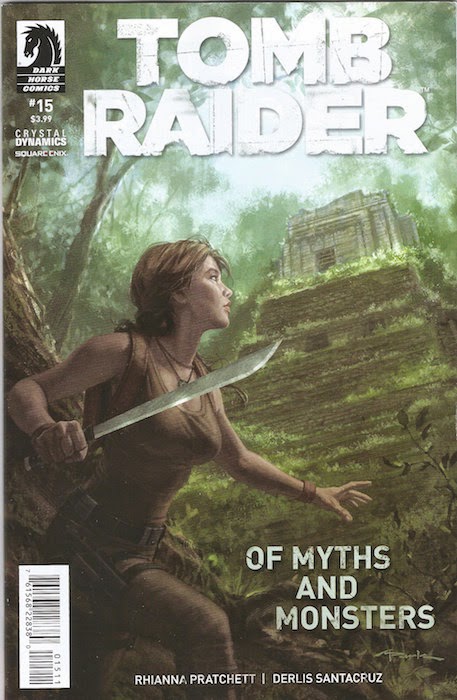
Lara Croft the Tomb Raider winds up searching for a missing child as her friends maintain the ruse of being investigators in the unknown.  

Not to worry.  The Chupacabra doesn't factor into writer Rhianna Pratchett's fancy.  Lara believes that her enemies Las Serpientes Que Caminan may be behind the disappearance.  Pratchett however doesn't take the easy route.  Instead, she demonstrates the young Tomb Raider earning her sobriquet, and in the process offering a more plausible explanation for the little girl's vanishing act.

I like how Pratchett balances the needs of the story and the characterization with the necessity of Lara naturally making an archaeological discovery.  This combined with the artwork of Derlis Santacruz who captures the exuberance in Lara's work gives Lara an identity that distinguishes her from say Indiana Jones or other unpowered adventurers.  


Red Sonja wakes in Victor Von Frankenstein's prison on The Nautilus.
Captain Nemo sadly will not be joining the Legendary role call as villain or hero.  Though writer Marc Andreyko surprises with the presence of another Jules Verne character.  You'll not recognize his appearance but the literate will catch his name.

Although Sonja can use all the allies she can get, the She-Devil with a Sword mainly uses her guile and her survival skills to discover a means of escape.


Star Wars tributes also help out.  Mind you, this is more than a garbage dump.  


Andreyko the creator of Kate Spencer alias the Manhunter is well known for his feminist stories.  Once Roy Thomas drew Sonja into a chainmail bikini, and gave her the curious pledge to the goddess who saved her life, Sonja became a feminist symbol.  Andreyko is having a lot of fun with this wonderful steampunk world, but he hasn't forgotten his roots either. Sonja is fighting one of the ultimate male chauvinists, who more than most see women as property.  


The cabal of villains from literature proved to be remarkably bad at it in the world of Legendary.  Let's count their accomplishments shall we.


Exactly.  The villains colluded to sacrifice Red Sonja to their dark supremacy.  What they instead managed to do was to bury the Sonja persona beneath a new, kinder facet named Magna.  She proceeded to charm every would be hero in the Legendary canon.  If anything, the villains of the piece made the heroes stronger by catalyzing the formation of a League to protect Magna Spadrossa.


The organization of heroes, which included such stalwarts as Green Hornet, the Phantom and Zorro, turned into an army that ultimately decimated their foes' forces.  One of their own, Miss Lidia Valcallan rather than throw away her plan with the others decided to sacrifice some poor sap and marry the demon from the nether realm.  This lead to an unfortunate dependency for souls.


Now, the villains seek to remove one of the most deadly of thorns from their side.  Vampirella.  


Miss Ella through the years experienced numerous changes, but she started out as an alien vampire from the planet Drakulon.  The Legendary version of Vampirella is clean of adherence to the Biblical reference that accumulated in Vampirella's proper history.  


The return to zero makes sense given the more overt science fiction trappings of steampunk.  As a result, Vampirella when facing famous vampire hunter Professor Van Helsing doesn't succumb to the usual banes of the vampire world.  


Once more the cabal of villainy fails miserably, and Vampirella with her network of friends gains the upper hand even quicker in an exciting chapter that banks on the artwork of David Cabera to capture the hero's otherworldly bloodlust.


"I swear vengeance against the Singh, against all piracy, greed and cruelty.  I swear that as long as my descendants walk the earth, the eldest male of the family shall carry out my work."


That is the oath spoken by the first Phantom, but in King's Watch the then current Phantom died without an heir.  A good man, the Phantom's friend, instead became the successor.  The lineage of the Phantom formerly welcomed him when he sacrificed his life to stop Ming the Merciless. Now, the former associate of Mandrake the Magician, Lothar takes up the mantle.


Lothar's Phantom immediately stirs up the routine by infiltrating a mercenary gang known as the Vultures.


They're a new form of an old Phantom enemy first appearing in the 1970s comic strips.  Lothar and Guran however aren't the only spies in the house of love.


The presence of a captive throws a spanner in a plan that's already way outside the normal Phantom's wheelhouse.  Lothar also distinguishes himself when he calls on a favor from his old friend Mandrake.


Writer Brian Clevinger balances the idea that Lothar does things differently from the Phantom with the concept that Lothar really is the Phantom.  Lothar's design snafus the moment you open the book, and we see the Phantom, Lothar, doing something the Phantom would never be caught doing.  Lothar though isn't relying on the decades old traditions of the Phantom.  He's depending on his own guile and his own knowledge of how the world works.  


Lothar's plans to discover the identity of the moneyman behind the Vultures unravels, but he still comes out winning thanks to the help of some friends and one really great illusion, or is it?  It takes genuine skill to create a Phantom that's not a Phantom, but nevertheless resonates like a Phantom.


In a twisted version of the World’s Finest trope, Django takes the guise of Zorro to protect Don Diego’s identity and mete out a sprier form of justice.  Though not a swordsman, Django uses a whip just fine, and knows a variation of the Moe.

Events however take a dark turn when Django discovers the so-called Archduke’s method for quelling rebel rousers, and that’s when he stops playing hero and starts playing Django.  The change in tone vexes Don Diego, but this story was nasty to begin with despite there being a Zorro in it.  It’s a depraved grindhouse movie, and we can thank the cosmos for that because if Django is in it, that means the worst bastards in history deserve him.

Let’s recap this twisted tale.  First of all, the Archduke commits a remarkable bit of fraud.  That isn’t really a big deal in terms of crime, but the it’s the way he goes about it that makes you ill.  He espies his son’s girl playmate.  He cultivates her, in what you think is an attempt to make his son happy; thus giving him a shred of decency that’s often found but not limited to western yarns.  It turns out though he educated the girl, turned her into a proper lady all to suit his diabolical con.  That's bad, but then, he marries her and fucks her.  I could sugar coat that, but the Archduke is such a shitty human being, the kind of crap person that Quentin Tarantino loves to set up for a massive fall.  Despite the depth of debauchery Tarantino explores in his films, his movies still foster heroism.  Though perhaps not in the classic sense.  In short, this slime of a man deserves Django.


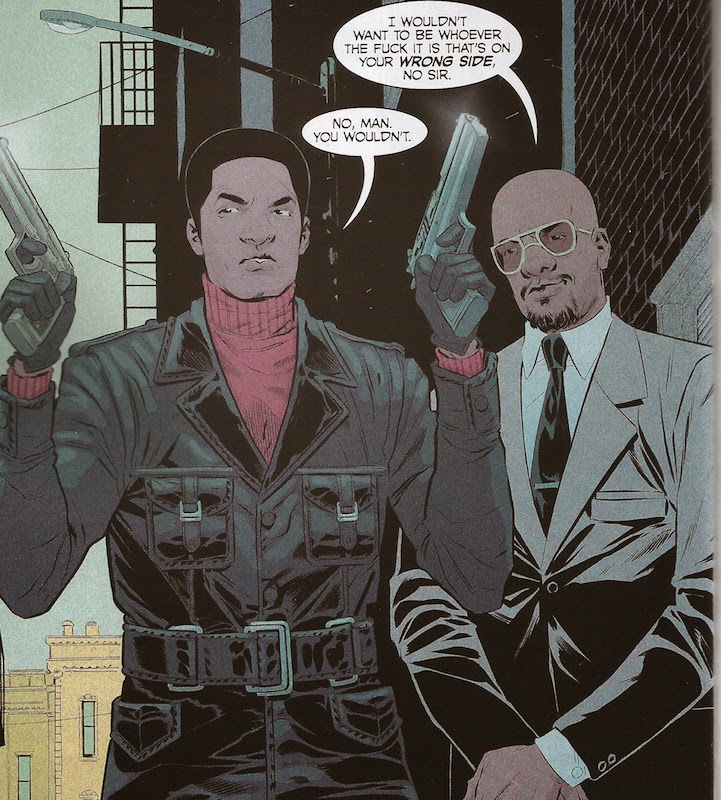
Django represents the fusion of blaxploitation and spaghetti western.  The most infamous of the blaxploitation heroes finds out why his lady love Arletha was murdered.  David F. Walker’s Shaft story goes straight to the gutter, and artist Bilquis Evely shows Shaft boiling toward this happy cliffhanger.

Oh, yeah.  This is the tale of Shaft gathering the villains of the piece in one place to make it easier for him to kill them next issue.