Showing posts with label Ortiz. Show all posts

Monday, October 21, 2013

POBB: October 16, 2013


Pick of the Brown Bag
October 16, 2013
by
Ray Tate

Welcome to the Pick of the Brown Bag.  This week, I review Ame-Comi Girls, Baltimore, Batman Beyond Universe, Batman and Superman, Birds of the Prey, Justice League of America, King's Watch, Rogue's Rebellion and Wonder Woman.

In Justice League, Batman and Superman met for the first time.  In Greg Pak's Batman and Superman, the two heroes meet for the first time.  What's more they meet their earth two counterparts for the first time.  The final issue of the first Batman and Superman storyarc solves the conflict in a traditional way, and that's where one of this title's problems lie.  

Batman and Superman is a very traditional book that was hyped as something different.  The title should have been momentous, but it changed nothing and did nothing special to explain the added dollar to the price tag.   The World's Best team's encounter in fact is less interesting than the interaction between the earth two Catwoman, Lois Lane and Wonder Woman, who have the rapport of old friends, because in this universe they are.  I'd rather  see a book based on them.


Art wise, Jae Lee went literally too dark on two issues, but for this chapter, he returns to a better balance of light casting, even a little brighter than his opening gambit.  As a result, we can enjoy the expressions of the characters and marvel at their musculature, especially the mid-air battle between Wonder Woman and a New God of mischief.  Hopefully the second story in Batman and Superman will spin a better yarn.

Batman and Superman's story was mediocre with a few good bits of characterization.  Justice League of America's scenario is bog-standard with practically no characterization.  J'onn J'onnz wakes in a super-powered prison that really shouldn't contain the more experienced heroes of the Justice League.  Wonder Woman, Superman and Flash nevertheless all remain impotent against the psychological succor of the high-tech jail.  They're just as easily suckered as Captain Marvel.  The issue is just really a puffy place holder consisting of empty calories.


I really like Diana's coat in Wonder Woman.  As for the story, it just establishes the status quo of the Olympians trying to make her sit in Ares' place, Strife plotting vengeance against Diana for slaying her brother and...ah...a lot of talking and no hitting.


Unlike Birds of Prey.  It's really great to see Batgirl in action again and with a partner.  Judging by the yellow bat symbol on her chest, this story occurs before the moment when she ripped it off, or maybe her Ninja costume is in the wash again.  Whatever.  The story's forgettable, but Batgirl behaving strong, confident and in charge is like a warm ray of sunshine on the face.

Jimmy Palmiotti and Justin Gray expand the Ame-Comi Girls femmeverse.  In the culmination of the first issue, the duo surprised the reader by obliterating their carefully constructed reverse genderfication of the DCU.  Their reboot wasn't all that inviting.  They introduced a kind-of, sort-of zombie Jesse Quick, which I wasn't all too keen about, a pretty weak group of horror show Teen Titans and space pirate Big Barda, whom I can take or leave.

In this issue, Palmiotti and Gray restore the Justice League: Batgirl, Robin, Power Girl, Wonder Woman, Green Lantern, Steel.  Our heroes however only cameo.  Still, it's nice to see the more familiar characters I enjoyed in the first volume of Ame-Comi Girls, alive and well.  The League are recruiting new members.  So they watch the updates in wrap around segments that integrate with the story, as opposed to acting like narration.

Gray and Palmiotti conceive an ingenious origin for the White Canary that incorporates the Canary Cry with a nifty little twist.  The authors hint that this particular short is akin to a grindhouse movie, and the Canary's origins mirror some of the street level elements of the genre.  Her martial arts mastery, which artist Adam Archer details with gusto, fits smoothly in the chop-socky intent, and the writing partners furthermore preserve Canary's history.  They institute a clever means to draw in the Canary's choker.  The 1940s Canary completed her classic ensemble with a silk choker that sported a hollowed out amulet containing whatever she needed to complete an adventure, usually a knock-out gas capsule or smoke bomb.


The other two stories are okay, but the comedy in the Big Barda feature was a little too broad for my tastes.  Palmiotti and Gray rejigger Darkseid as an evil princess, but she just seemed like a  female cosplayer.  Miss Miracle is also a goofy concept; perhaps if I saw her without the full-face mask.  In the last tale, while Mera gains a crown independent of Aquaman, she doesn't quite radiate the potency of her new 52 counterpart.

Batman Beyond Universe just didn't pay off.  Last issue Terry, our future Batman, fought the originals Batman, Robin, Nightwing and Batgirl.  Frankly, there was no way I wasn't going to be disappointed with the explanation.  

The Superman side-B is just a bloody fight between The Man of Steel and Jax-Ur in the Phantom Zone, but stick with it, and Aquagirl gets her due in a spectacular moment.


Best book of the week.  King's Watch.  The second issue of the Defenders of the Earth redux features the same fantastic, realistic art that recalls some of the best newspaper strip illustrators.  The scenarios spotlight Flash Gordon and Dale Arden fisticuffs against the Cobra's minions in serial glory, a stunning manifestation of Mandrake the Magician, performing more than mere illusion here and The Phantom being a guide in the marvelously diverse African habitat.  


Jeff Parker doesn't so much recreate these legends from the newspaper.  Rather he returns them back to what they were, even cleverly absorbs the original polo background of Flash Gordon into this modern update.  He only makes changes to the figures that were the product of societal pressure.  

Lothar was always a bad example of stereotyping until most of society, those not in the Tea Party, grew up.  So Lothar becomes a mirror to his cartoon persona, albeit without the sort of action hero background.  Parker instead gives Lothar a more realistic avenue to pursue that's interrupted by the nightmare beasts seeping into the earth through quantum tunnels opened by science fiction devices so powerful that they follow Clarke's Law, a law that Dale Arden understands.  


Parker turns Flash Gordon's girlfriend into Sarah Jane Smith, although with an edgier personality.  Doctor Who fans will know that Sarah was a science reporter, and that role fits the new sophisticated Dale Arden to a tee.  To be fair this was neither the first time Dale became a reporter or fluent in science, but it's nice to see these attributes come back in a sophisticated package.


Second best dramatic comic book of the week.  Baltimore: The Infernal Train.  Finally, some action.  Too many Baltimore books were just dull, unconnected horror stories.  This one is pretty damn good, and pure Baltimore.


Our lordship duels the crazed inquisition priest Duvic as he affirms his stance.  Baltimore isn't an atheist.  He believes whatever force created the universe died.  This is a rational man, who when faced with insane horrors concludes that no benevolent deity could allow such terror to exist.  

In the eyes of Duvic, Lord Baltimore blasphemes, and his obsession to kill Baltimore through purification carries through the entire book.  Even when a greater evil presents itself, there's no throwing in with the enemy.  It's every man for himself and then I'll skewer you with my trusty sword, in god's name.  

Such craziness makes Infernal Train outstanding entertainment.  In fact, Duvic's mental issues often usurp the title danger, which is a pity, because it's a fantastic mash of the Doctor Who episode "State of Decay" and the bizarre cult classic Amok Train, which you should watch with somebody you love.


Rogue's Rebellion played out exactly as I thought it would.  The Flash Rogues are bank robbers who haven't any chance for survival in the superpowered dictatorship spawned in moments by the Crime Syndicate.

The Flash writer Brian Buccellato also relies on a personal reason for two of the Rogues to resist.  Lisa Snart, alias the Golden Glider lies in a hospital that the Syndicate orders to be razed to the ground. 


The Rogues are so off board with the Syndicate that they even release the cops, that were miraculously left alive after Grodd's slaughter of Central City.  This occurred in one of those lame "Villain's Month" fiascoes   So, I know nothing about it, but it's awfully nice of the monkey to keep the Flash's supporting cast breathing, for a fickle of reasoning.

Patrick Zircher orchestrates the artwork, but you're unlikely to recognize Zircher's usually fine pencils or draftsmanship because Scott Hepburn and colorist Nick Filardi turn everything dark and nearly Vertigo strange in look.

Dark subject matter gets turned on its head in Ian Boothby's Simpsons Comics.  The long dormant Springfield Volcano erupts prompting Diamond Joe Quimby to make a life-affirming decision.  He decrees that the most innocent Springfielder will be sacrificed.  Innocence translates to dumb, and the candidates left include the following.


Numerous gags ripple through a contest of cretins.  Boothby keeps all the cast--however moronic--in character.  That includes a sweet little move by Chief Wiggum to save his son Ralph from the gaping maw.  The tactic once again exemplifies Wiggum's unconditional love for his son.  Putting aside the sugar, Boothby also makes time for hilarity symbolized by such tomfoolery as Cletis' kid catapult.

Though Boothby's tale is set in the normal stomping grounds, artists Phil Ortiz, Mike DeCarlo and Art Villanueva have plenty to do as slapstick strikes and weird non sequitur guests drop in for more laughs.  


Tuesday, July 23, 2013

POBB: July 17, 2013


Pick of the Brown Bag
July 17, 2013
by 

Ray Tate

This week, we're on time with Batman and Catwoman, Batman Beyond Unlimited, Birds of Prey, Justice League of America, Red Sonja, Simpsons Comics, Supergirl and Wonder Woman.


The Trinity War continues in Justice League of America.  In last week's Justice League, Superman seemed to fricassee a League of America member.  This goes down badly with both teams, and a slugfest breaks out.


A Scene Would Have Been Unthinkable Two Years Ago

Superman blames himself, and it should come to no surprise to anybody when he demands...


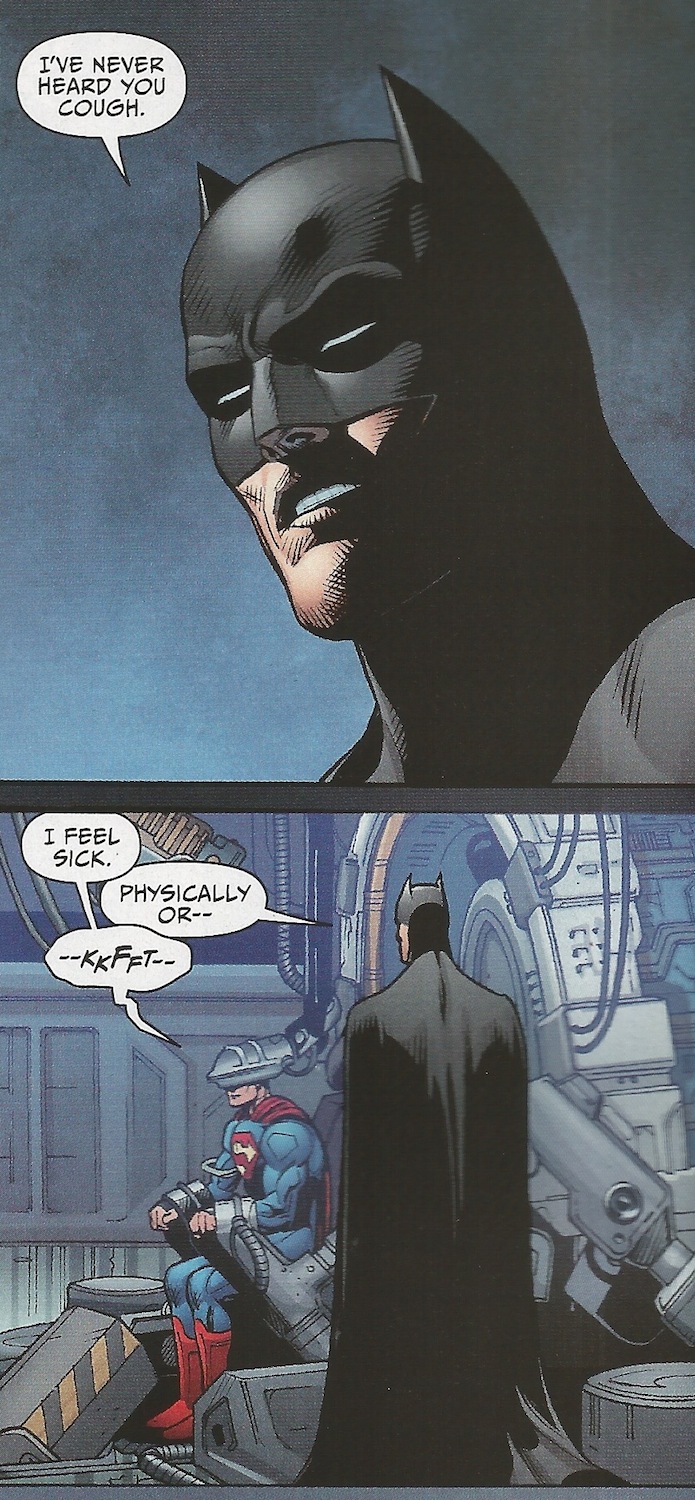
Yes, that's the Big Red S.  Every version of Superman winds up in jail at some point in his career.  The George Reeves' Superman also found himself behind bars.  You old universe holdouts who still want to see a boring Superman, an ineffectual Wonder Woman, an automaton Batman and a crippled Batgirl can go to hell.  The New 52 is awesome and in essence more accurate.

After Superman gets his wish, both Leagues lick their wounds.  Friendships do not form, and the Atom experiences buyer's remorse.  She turned out to be a League of America spy.  Even old friends such as Steve Trevor and Wonder Woman distance themselves, but one chain continues to be unbreakable.  The historical elder statesmen of the superhero genre, Batman, Superman and Wonder Woman, stick together.

Batman and Wonder Woman do not believe Superman to be responsible for the death of the League of America member.  They intend to investigate Superman's explosive behavior.  Batman observes and deduces.


Wonder Woman follows the trail of Pandora's Box.  When Trinity War had been first hinted at, DC made a big whoop-de-doo over a schism between Batman, Superman and Wonder Woman.  Thankfully, that was rubbish.  Despite disagreeing on the philosophy of each other's pursuit, Batman and Wonder Woman are on the same wavelength.  Though they do not know it, they are not alone.


Batman and Catwoman earns the most improved book award this week.  Batman still suffers from the loss of his son Damien.


However, he's no longer insane: leading him to do such things as disassemble Frankenstein to discover the secret of life.

Batman's past breakdown and overall nastiness is a little easier to take now that Peter Tomasi clues the reader into exactly when these books have been taking place.  

Batman for example beat Catwoman's motorcycle helmet to death in her feature title.  This issue, Batman replaces the helmet, with a note of apology.   That means Batman and... is a more or less daily log of Batman's life.  It runs concurrent with Catwoman.  

Superheroes in the new 52 apparently have some action-filled days.  I always thought that unless the story continued from issue to issue, weeks had passed between each, regardless of the comic book company.

Batman and Catwoman also sychronizes well enough with Batgirl.  When our title Daredoll appeared in Batman and Batgirl, Batman recognized her decision to rip off her bat symbol, but his state of mind precluded any empathy he felt for her situation.  Alternately, Batman as seen in the latest from Batgirl's title has already been assuaged by Catwoman's presence in Batman and Catwoman.  

Batman and Catwoman begins with even more continuity, however delivered smoothly.  Steve Trevor notifies Catwoman in mid-heist that he has a job for her on behalf of Justice League of America. 

Catwoman calls Batman for help, and he answers.  It turns out, Batman and Catwoman is the comic book in which Batman learns about the existence of Justice League of America.  

Since Batgirl also fits into this timeline, we can now say that Batman does not yet know of James Jr.'s participation in Amanda Waller's Suicide Squad.  It is likely Batman knows about Waller.  He was already aware of Black Canary, and both she and Waller served on Team 7.  He now knows that Waller is active once again and will learn about James Jr. during his investigation.  It still doesn't make the James Jr. moaning in Batgirl easier to stomach, but at least there's an explanation.

Even when setting aside the continuity and timeline interest, which admittedly may only fascinate me, Batman and Catwoman still delivers an exciting adventure that demonstrates the playful and respectful relationship Batman and Catwoman have.

Catwoman lightens Batman's load, a lot.  Batman discovers the true nature of Catwoman's assignment, but rather than express anger over being duped, Batman tears through the opposition.  


Patrick Gleason's and Mick Gray's evocative fighting cinematography turn Batman and Catwoman into a natural martial arts team, a costumed John Steed and Emma Peel.  It is an absolute joy to watch Batman and Catwoman decimate these bastards. 


One may argue that Catwoman set up Batman for his own good; having sensed something wrong with her sometime lover in her own title.  Indeed, Catwoman probably would have been able to perform Trevor's mission by her lonesome, but she sagely saw this as an opportunity for Batman to heal, from whatever damaged him.


After three or four issues of Batman going bat-shit crazy, Batman and Catwoman feels like a breath of fresh air.  Recommended for any fan of the Bat or the Cat.

In Birds of Prey the continuity becomes concrete.  Batgirl zooms away on her bike to battle James Jr....


Before

then comes back traumatized by the whole affair.  


After

In addition to observation of the Batman Family timeline, Christy Marx promotes the Canary's smarts.  Starling betrayed the team by throwing in with Mr. Freeze to take down the remaining Owls.  So, Canary burns, sometimes literally, everything Starling associates with the Birds of Prey.

I'm ambivalent about the rest of the book.  Marx introduces a new team of super-villains led by a vaguely familiar Big Bad that follows the classic rule of sanity being inversely proportional to the eccentricity of the hat.

Black Canary's and Condor's relationship progresses, but I'm just not into them.  Strix returns from the non crossover with Talon.  Ultimately though, there's not enough hitting, leaving stellar artist Romano Molenaar nothing to do but visually twiddle his thumbs.


Adam Beechen introduces a new Batgirl to the future world of Batman Beyond, and for once, I actually like somebody wearing a Batgirl suit that's not Barbara Gordon. 

The reason why I accept this newest Batgirl is simple.  She's not a substitute.  Babs is still Batgirl in the same way Bruce is still Batman.  When DC introduced any other woman in a Batgirl costume--Helena Bertinelli, Cassandra Cain, Misfit, Batwoman, Booster Gold's sister, Stephanie Brown--it meant one thing.  DC was not going to heal Barbara Gordon.  My answer was always the same.  Screw you.


The new Batgirl fights alongside a fully mobile, fully kickass Babs Gordon.  That is fun, and the new Batgirl has a different personality than our ebullient Darknight Damsel.  She's surly, with a massive chip on her shoulder.  She has good reason.


The plot of Beechen's story is basically the GOP kills poor people by using Venom to inflate their muscle and escalate their anger.  When Babs and Batgirl confront the bastard behind this, they get treated like a woman under the thumb of the Texas Legislature.  Babs though as Batgirl notes could have easily taken down the Big Bad.  She just wanted to see what the new Batgirl could do once facing the Perry of the piece.  The terrific standalone is complimented by a backup that reveals whatever happened to the Metal Men.  This was just lovely.  Batman always liked the Metal Men, accepting them as they are and treating them as human beings.


I was a little nervous when I heard that the Supergirl team was departing, but judging by this current plot, the new Supergirl Scoobies have got a good act to follow.


Poisoned by Kryptonite after saving the world from H'el, Supergirl decides to take a cosmic road trip using an experimental scooter, she borrowed from Dr. Veritas.


Hmmmmn.

Her first stop was a planet whose inhabitants can bring imagination to simulated life.  A giant monster appeared to attack these inhabitants if they are indeed a species and not a dream within a dream.  Supergirl dealt with it, and the Grand Poobah apparent welcomed her to imagine Kryptonian legends.  Naturally, there's something more to the whole scheme than making a young Kryptonian girl's wishes come true.

Last issue ended with the startling new 52 introduction of the Cyborg Superman.  Originally Hank Henshaw, the last survivor of a defacto Fantastic Four who gained nothing from radiation exposure except death, the new Cyborg Superman is a different animal.  


Supergirl sure didn't conjure him up.  How could she?  She never met him, and she certainly doesn't want what he's serving.


Michael Alan Nelson's plot is a little odder than the typical good versus evil tradition, and his dialogue for the Girl of Steel is riotous.

Artist Diogenes Neves makes up for the loss of Mahmud Asrar.  His Supergirl is appropriately deceptive.  While she seems to be an innocent teenager who wears her emotions on her blue sleeve...


...she's also a Kryptonian with immense power to put villains down.  In short, this is still the Supergirl we fans all want to see.


Writer Brian Azzarello after announcing Wonder Woman to be a horror comic book series mostly made good on his promise.  

Azzarello demonstrated the pettiness and cruelty of the deities with "good god" Apollo sending three innocent women plummeting to their deaths after he used them as vessels for prescience.  

Partner in crime Cliff Chiang clad Hera in peacock feathers and nothing more, to infuse primal terror in the hunt for the latest of Zeus' conquests, an earth woman named Zola.

Azzarello and Chiang of course could not go full throttle.  The presence of Wonder Woman made such an aim impossible.  Heroes stop the progress of evil.  They do not facilitate it, nor do they simply sit idly by and watch evil grow.

Wonder Woman has been most proactive in this new series of adventures.  She not only combatted and defeated the gods.  She also lived up to the intent of her creator Dr. William Moulton Marston.  


Marston saw his brainchild as an alternative to the machismo violence that he perceived Batman and Superman exhibited.  Wonder Woman in fact rehabilitated one of her arch-foes, Gestapo agent and scientist, Paula von Gunther.  After Marston, Wonder Woman became many things: traditional bellicose Amazon, wise immortal, certified diplomat, Modesty Blaise type adventurer.


Azzarello's Wonder Woman combines the best of all the worlds.  We first saw her at a hotel in London, not the usual milieu for the Princess, but perfectly reasonable given her past Nazi fighting, not yet recognized in the new 52.  Azzarello indicated that Wonder Woman was a seasoned fighter, not the neophyte superhero from the premiere of Justice League.  

A young, pregnant girl sought Wonder Woman's help, and the Amazon quickly established herself as Zola's protector.  Through the Hero's Journey, Wonder Woman learned about herself and her newfound siblings including the tragic Lennox, son of Zeus.  


Recently, Azzarello did something very unusual.  He introduced the new 52 versions of the New Gods in Wonder Woman.  The New Gods have never been before associated with Wonder Woman, but Azzarello makes it seem like such an obvious place for their premiere.  Artist Cliff Chiang reveals himself to be a secret Jack Kirby fan.  His streamlined clean art nevertheless expresses the flourishes of Jack Kirby's distinctive illustration.


The New Gods are distantly related to the Greek Gods, and Highfather, who we meet this issue as more knight and less hippie, ostensibly sent Orion to kill Zeus' and Zola's baby.  The Greeks fear that Zola's baby Zeke will usurp the ruler of Olympus.  So it seems that two different pantheons have the same information.  There was much more to worry about.

Last issue Orion, Wonder Woman, Hera, Zola and Zeke escaped the First Born, Hera's first son, via Boom Tube.  This issue Azzarello defines Wonder Woman and consolidates the careful characterization he developed for this latest incarnation of Diana of Paradise Island.


Azzarello makes Wonder Woman a warrior, but one that inspires others to greatness.  She's not the typical Amazon.  Azzarello already exposed them as the followers of Greek tradition, the rapists and killers of men, not the perfect Utopians who saw man's world as folly.  Fascinating enough.  Diana is one that forgives after kicking ass.  Her exposure to cultures outside of Paradise Island also gives her a more cosmopolitan world view.  She really believes that everybody can live in peace and harmony.  That in some ways reflects the George Perez Wonder Woman, but there's that ass kicking part of her that recognizes that peace must be fought for, and asses that need to be kicked are a universal impediment.


Oh, did I mention the Jackal Men of London?

Gail Simone takes over Red Sonja, and it's a little bit Black Adder blended with Magnificent Seven and a strong feminist slant.

The story opens in the past with King Dimath securing a city and rescuing its tortured souls from the dungeon.  Sonja becomes involved with Dimath in a unique way that may just upset some the She-Devil's fans, but Simone likes to defy expectation.  Sonja isn't Supergirl.  She can be overwhelmed.

The story skips ahead with Dimath calling on Sonja to help him thwart the Zamorans.


No not those.

Sonja becomes Dimath's general, and this is where The Magnificent Seven come in.  Sonja trains an army consisting of young girls and a few good men.  When she leads the group forward, she finds a surprise waiting for her in the saddle of the opposition.

Simone's Sonja is mostly the same from other versions, but she relaxes the character somewhat and tempers her anger.  For example, when a group of young brigands try to rob her, she tries her best to avoid combat.  She only picks up the sword when they leave her no choice.  Simone's Sonja is also a little smarter than previous treatments.  Simone furthermore pumps up the idea that above all Sonja is a heroic adventurer, not just a mercenary.  She follows a code of conduct.

If these tweaks disturb you, faithful Sonja followers should take heart in seeing Walter Geovani's and Adriano's Lucus' definitive Sonja illustration beautifying the book.


For those coming late to the story, Ned Flanders remarried Edna Krabappel in The Simpsons' "Ned n' Edna's Blend."  Writer Mike W. Barr bases his comic book story on this remarkable shred of actual Simpsons continuity.

In the past you could say that The Simpsons started up from scratch each episode.  That all changed with Maude Flanders' death.  Now, the thread you can actually follow is an interweave between Ned and Edna.

You don't really need to know everything that happened previously to enjoy Barr's tale, but in all honesty, you'll have a richer experience if you do.  For example, Bart's relationship with Edna Krabappel is for the most part adversarial, but several Simpsons stories reveal a friendship between the two.  Edna for example in a conceptive season took pity on Bart when he tried his hardest to study and still failed.  Bart as a prank began writing Edna love letters only to feel horrible when she fell too deeply for Jacques.  Bart also became an intermediate between Edna and Principal Skinner.  We get some of this kindness between the two in Barr's story.

Ned's parents are Beatniks, and that makes it easier for the two to spend time with the Simpsons, who have always been surreal.  Barr eventually evolves the story to a supremely satisfying finish where the Flanders reunite and find common ground.  Before that though, Barr finds comedy in the family dynamic spinning out with a centripetal force that ensnares all.  

The outstanding issue of Simpsons Comics is brought to you by Phil Ortiz, Mike DeCarlo and colorist Art Villanueva.  One of the things you notice immediately is how the relatively realistic body language defines this tale as more dramatic.  This isn't going to be a goof where elephants eat people.  The other thing immediately apparent is the overall happy look to the characters.  Barr's story doesn't rely on bitterness or slapstick to relate the jokes.  Ned and Edna are perfectly okay with the senior Flanders' spending time with the Simpsons.  Homer's delighted to find somebody who knew his rebel mother.  Edna's spirit isn't being crushed.  She looks positively buoyant as a result.  Because of the pure character design and this emotional uplift, you can imagine Marcia Wallace's voice as a blend of Edna's and Carol's from The Bob Newhart Show, and that works beautifully for this special issue of Simpsons Comics.