Showing posts with label Iron Man. Show all posts

Saturday, June 3, 2023

POBB May 29, 2023

 Pick of the Brown Bag
May 29, 2023
by
Ray Tate

Welcome to the Pick of the Brown Bag.  My name is Ray Tate, and I review comic books.  This week, I look at the newest incarnation of The Avengers and the second issue of Scarlet Witch.

If you were to judge by the tags, you would come to the conclusion that I'm not an Avengers fan.  That's not exactly true.  It would be better to say that I haven't enjoyed the direction of The Avengers since the 80s.  

I sampled The Avengers here and there, but nothing really stood out like the cinematic Avengers.


Nor the old-school Avengers of my youth.  


Because of my appreciation for Jed MacKay's writing, I felt it was definitely time to give The Avengers another try.  Incidentally, I also still subscribe to MacKay's Moon Knight, which features Tigra as a co-star, and the Black Cat, which is now Black Cat and Mary Jane.  I just haven't had the time to read as much as I'd like.

Jed MacKay has a knack for characterization and sensible but often times twisty little plots.  A short hand description for the kind of writing I like.  Furthermore, you usually never feel lost in a Jed MacKay book.  Let's see how he does with Marvel's flagship title.

Already, I'm feeling positive about this choice.  The story is about the formation of a new team of Avengers and their rationale for joining.  It's also about Carol Captain Marvel Danvers.  Right on page one, we get that.  MacKay is making the story about the characters not events.

The former members of the team vote in Captain Marvel as the new leader of the Avengers.  A precedent reminiscent of the Legion of Super-Heroes.  Captain Marvel gets to work establishing herself and recreating the Avengers.
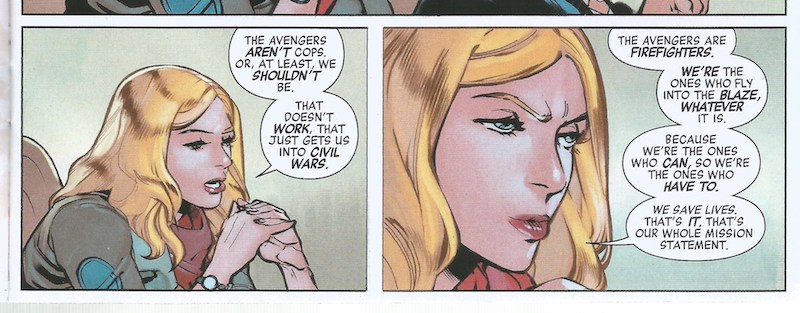


All of Marvel's heroes gained baggage over the years, and it doesn't help that Marvel seldom blows up its multiverse and starts over again, like DC Comics.  


To say that MacKay pays lip service to the at times confusing history of the cast would be unjust.  Rather, he uses the events in the comic books as episodes in the characters' lives.


I've lost track of Vision.  I didn't know about his active role in the Marvel Universe.  I didn't know he's sporting a more aesthetic look with the color scheme of his original costume.

I don't actually know what Vision's talking about, but the way MacKay writes the scene, and the way Black Cat artist C.B. Villa stages the scenario, tells me that this recent continuity impacted the Vision.  

I don't need to buy those back issues to find out what the hell bothered the Vision.  I've got this moment summarized through superb dialogue right in The Avengers and art that presents emotional depth.

There's been an overall effort to reclaim the Scarlet Witch and the Falcon--now Captain America.  So, MacKay makes their encounters with Captain Marvel playful and provides the much needed humor to balance the gravitas of world ending threats.


The metal fellow may look familiar to John Byrne fans.  That is Terminus, who first tried to destroy the earth in The Fantastic Four.  He's a scorched planet kind of thing connected to an old enemy of the Celestials, from The Eternals.  If you didn't know that, well, Iron Man has got you covered.


You see.  You can go into this book blind.   MacKay will give you everything you need to know without belaboring the point.  


The increasing danger is another fascinating element.  It's easy to dismiss the first issue of The Avengers as just another round one.  Instead, MacKay positions a heavy-weight threat for the Avengers to face, and as the battle ensues, the solution turns out to be something that just might wipe them all out.  That's the unexpected twist to which I alluded.  I really didn't expect one Avenger possibly sacrificing himself to save the world in the premiere of the new volume.
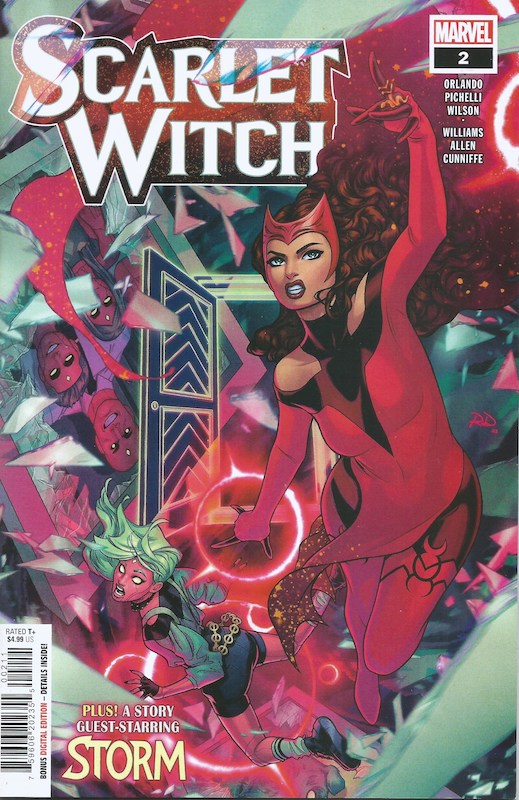

The debut of Steve Orlando's Scarlet Witch, established Wanda's new gig as the proprietor of an occult curiosity shop that also doubles as her base of operations.  

A person in dire need will find herself at the opposite side of a special door that leads to Wanda's place.  The epilogue last issue depicted Viv Vision walking through Wanda's door.

Viv Vision is the constructed daughter of, you guessed it, the Vision.  Vision decided to make himself a family in his eponymous Tom King horror themed superhero mini-series.  It's definitely recommended but not your usual fare.


It's your right to question whether a synthezoid can have nightmares.  However, this is not Blade Runner 2049.  For comic book fans, who don't need some tedious stab at existentialism, Viv is alive.


After a really nicely staged conversation between Wanda and Viv about their connected history, Wanda puts she and Viv to sleep.  In Viv's dreamland, Wanda confronts the problem.


Do I know who this whacko is? Nope.  Do I care? Only after Wanda begins her supernatural/dream battle against her.

Dreamqueen is no lightweight, but Wanda runs her down as if she were roadkill.  One should expect that.  

So what we have in Scarlet Witch is a feminist, empowering bit of beautifully illustrated entertainment courtesy of artists Sara Pichelli, Elisabetta D'Amico and Matthew Wilson.  Keep 'em coming.

Oh, what? There's more? Stephanie Phillips and artists Chis Allen and Dee Cunniffe partner Storm with the Scarlet Witch in a short story pitting them against a Hippocampus.


Or given the green, a Kelpie if you prefer.  The Hippocampus is the earlier beastie.  The steeds pull Poseidon's chariot in Greek myth. 

Anyway, in the brief sweetly illustrated pages, Phillips brings up the idea of Storm sharing more than teammates with Wanda.  Chris Claremont raised the idea way early in The Uncanny X-Men.  The deific ancestry often falls by the wayside when most writers emphasize Ororo's mutant status.  Bonus points for the literary reference.

Wednesday, July 8, 2020

POBB July 6, 2020

Pick of the Brown Bag
July 6, 2020
by
Ray Tate


Farewell to the maestro.


Welcome to the Pick of the Brown Bag, this time around, it's Avengers Empire.  I would refer to Empire as Empire with a Y, but the spellcheck just hates that.  Any time I go back to edit, it thoughtfully corrects my error.  I also don't think Empire with a Y deserves being learned.  It's not even real English.  It's like Pig-Brit.  So herein, it's Avengers Empire.  


Empire is the Big Stupid Event of the Marvel comic book season.  The Kree and the Skrull put aside their differences to exterminate the Cotati.  That's a lot like Superman and Lex Luthor getting together to expunge hippies.


If you don't know who the Cotati are, don't worry about it, because baby, they are obscure.  They're a sentient plant species that thrived in the Kree solar system and play a part in the 1970s Avengers saga of the Celestial Madonna.


Stop me if you've heard this one before.  Steve Englehart and Don Heck create a Vietnamese female master of the martial arts.  So far so good.  Inclusive and bad ass.


Dubbed Mantis, she learns her skills from renegade Kree priests.  The Priests of Pama unlike the bellicose Kree seek peace and harmony.  They don't get it, but they seek it.


In this pursuit they tend to the Cotati.  So, basically, they're alien Buddhist gardeners who strike a home on earth only to be harassed by the warlike Kree.  

That's not too nutty.  I mean we are talking about comic books.  Englehart and Heck could have just made Mantis a really dangerous Buddhist monk, but I guess that would be too much like Kung-Fu.


The priests train Mantis because they believe her to be the Celestial Madonna.  Okay.  Now, we're getting into trippy territory.  

Why not train the girl, just because?  Why do you need a scuzzy ulterior New Age motive?  Kung-Fu sometimes featured a female Buddhist monk, and the Shaolin trained the girl just because.

You can argue that Englehart and Heck presented a hero in rebellion against her destiny.  I've heard that position before, as well as Mantis eventually freely choosing that destiny.  Honestly though, I find the whole Mantis/Celestial Madonna thing kind of sleazy.

Englehart and Heck produced the perfect mate for Mantis.  A dead guy reanimated by the Cotati, who returns at an opportune moment in Avengers Empire.  


I never thought that much of the Swordsman.  Cheapjack Black Knight, nine times out of ten a super-villain betraying the Avengers.  Now, with fungus.

So, let me just tick off the boxes.  Despite everything accomplished, woman's only importance is to be a vessel.  Check.  Necrophilia.  Check.  Plant-Animal Loving.  Why not.  Check.  

Englehart wanted to see his plan fruit so badly that when he left Marvel, he completed his masterstroke in Justice League.  Here, he and the phenomenally underrated Dick Dillin presented the consummation.  


That's just weird.  Not the sex scene itself.  Just the idea of going to another company and saying, "At last! Now I can orchestrate the sex scene between Mantis and her Ficus!"  

Willow as Englehart christened her in the DC Universe furthermore enamored every male Justice Leaguer on that mission.  Essentially, she became the femme version of Eros.


I'm not bad. I'm just drawn that way.

After producing the Celestial Messiah this time at Marvel Comics, Mantis went on to become an even more highly confusing character.  She turned green.  I guess because she made it with a plant.  She sported some antenna.  Because artists mistook hair sprayed and shaped into antenna as literal antenna.  

Mantis though is a human being.  That was the whole point.  Forging her into the ideal mortal vase for the perfect rose bush grown on fertilizer.

It's no wonder James Gunn and the writers of Guardians of the Galaxy thought Mantis was an alien.


Empire continues the shaky claim of saga for the Cotati.  The tale begins when Iron Man mimics his cinematic counterpart and dreams of the Cotati slaughter on the Blue Area of the Moon.  

Captain Marvel also gets an SOS from the Celestial Brain, whatever that is, and before you know it, we're off to the moon.


I'm not wild about Avengers Empire.  Addressing the plight of the Cotati and a dubious alliance between Kree and Skrull just seems perfunctory.  As I pointed out I wasn't a fan of the Celestial Madonna business either.  So I admit to being bias about the continuation of a storyline that should have died some time ago.

That said, Al Ewing does give me a better She-Hulk than I've seen recently.  The last version of She-Hulk I loved served as part of A-Force.  This dumber, pumped up one is better than the Gray She-Hulk in that dopey mini-series and Jason Aaron's debut She-Hulk.


I also like Ewing's treatment of Thor.  He's very cosmic, expressing the age and wisdom of an ancient alien.  He may not be as knowledgable as Tony, but like his counterpart in cinema, he's no dummy.

Ewing had the opportunity to write for Captain Marvel before, but that was during a period that she started a second Civil War, or something.  She and Black Panther set at each other's throats.  It's nice to see Ewing's Captain Marvel without any drama.  Save that inexplicably brought up by Iron Man.

What the hell, Tony.  I also question given that line the colorist giving Carol's nose a boozy red sheen.  Nobody else gets a boozy red nose.  Just Carol.  Iron Man also delivers the Avengers Assemble speech, and that just feels wrong when Cap is on hand.  Maybe Ewing just wanted to experiment with something novel.  Not every experiment succeeds.

Wednesday, September 18, 2019

POBB September 11, 2019

Pick of the Brown Bag 
September 11, 2019
by
Ray Tate 

Welcome to the Pick of the Brown Bag, home to Ray Tate the blogger that selects the best and the worst of the previous week to offer tantalizing reviews and history lessons. The subjects this week include Batman, Black Cat, Captain Marvel, Catwoman, Detective Comics, Gogor, Monsters of Gotham City, Moon Knight Annual, Red Sonja, Sabrina the Teenage Witch and The Unbeatable Squirrel Girl.  It's a lot to take in, and that's why there's a cheap and dirtier way to get thumbs up or thumbs down reviews.  Check me out on Twitter: #PickoftheBrownBag


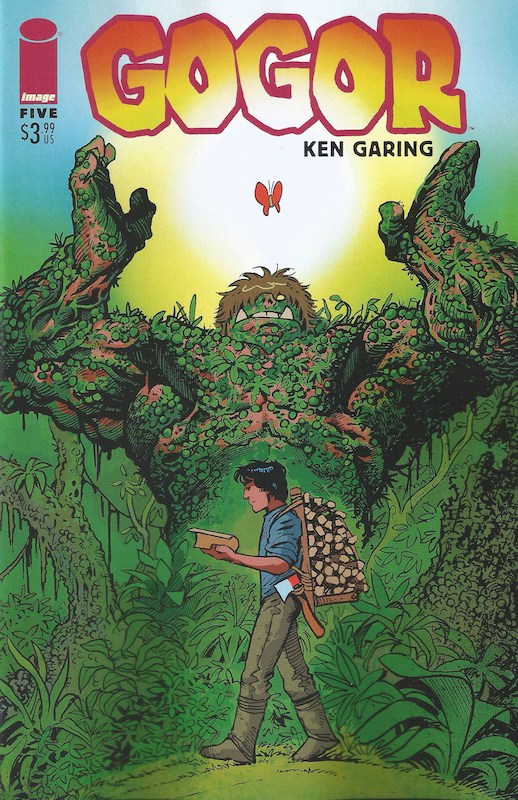
Gogor concludes with this issue, but creator Ken Garing doesn't leave the reader hanging.


I know.  Bad.  Just bad.  What can I say? I know who I am.  Last issue, Garing seemed to be trashing our obsessions with phones.  He's got a point, but I thought it was a little heavy-handed.  Computers are tools.  Humanity is the abuser.  Perhaps, humans are too adaptable.  They become addicted quickly.  

In any case, Garing better defines the aims of the Big Bad, who as you can see makes an accelerated appearance in this final issue.  Along with a welcome return of his snake man servant Amphax.

With Armano in trouble, Gogor cannot be far behind, and this leads to a nice kaiju battle recalling previous issues and also displaying the issue's finality.  

Normally, the Big Bad appears at the conclusion to either lord it over the hero or simply beat the crap out of him.


Armano quickly uses his freedom to call for his jewel skiff and get he and Gogor the heck out of harm's way.  Garing next begins his story proper, offering middle and a fitting end.

Armano writes that he doesn't understand the big picture of Gogor, and how his chronicling can help his friends.  Armano released Gogor to rescue his teacher and his fellow students, but Gogor has a mind of his own.  He seemed to be going the opposite way.  Gogor makes a difference in the story, but it's just not one that's the dramatic climax Armano seeks.  Maybe that was the point.  Armano released Gogor to make a difference in small ways.


Sabrina the Teenage Witch concludes her first story arc with a reveal of the Big Bad behind all the monsters stalking in the woods.  His identity isn't exactly Nancy Drew fair play, but it's nice to have a bit of a detective story going on to even out the hocus-pocus excitingly illustrated by Veronica and Andy Fish.

Motivated when the mystery man abducted her aunts, Sabrina takes drastic action.  She raids Hilda's and Zelda's closet for an armory of occult weaponry.  With her transformed cat Salem, Sabrina flies into battle.


Sabrina destroys each artifact with each use.  Thus, writer Kelly Thompson creates a self-cleaning story.


Sabrina though isn't just a strong adventure not even a strictly feminist tale.  Mind you.  You can't help but see the maniac as a reflection of toxic males.


He's not actually burning witches, but that's only because this isn't a Chilling Adventure.  Thompson keeps the story all-ages in tone.  The threat is blatant.  Thompson rationalizes the exercise by presenting the fellow's arrogance.  He can't just kill the witches.  He must prove he's smarter than they and more powerful.  He's not.  
Sabrina beats him royally.  However humanistically.


Perhaps again because Sabrina the Teenage Witch is an all-ages affair, Thompson restrains herself from going for the jugular.  This in effect grants the witches more humanity.  Although not human.  Instead of wiping out the humans that attempted to snuff them, they persuade memories to become dreams.  It's a poetic kind of victory as well as smart.

IIntroduced in Werewolf by Night, Moon Knight was nothing more than a jazzed up werewolf hunter.  Later, co-creator Doug Moench developed him into a modern day Shadow, adopting different identities to better fight crime.  

The whole thing started with a battle in an Egyptian tomb.  Moon Knight’s original persona, professional adventurer Marc Spector, lost his life to the machinations of the villainous Bushman.  

Khonshu resurrects Spector.  Khonshu is the Egyptian Protector God of Travelers in the Night.  Marc adopts the vestments of Khonshu’s priest and seeks revenge.  

Moench wrote the first and second series of Moon Knight’s adventures.  He kept those stories grounded in the real world.  He never mentions Khonshu again except when recounting the origin.  Other writers on the other hand...


In ancient Egypt, a priest conducts the usual rites honoring Khonshu only to be interrupted by infidels directed by Kang the Conqueror.  Kang created by Stan Lee and Jack Kirby is a time-traveling warrior bent on ruling the cosmos.  

Cullen Bunn’s characterization for Kang is dead-on.  He’s not thoughtful.  Kang lacks even a basic concern for the time stream.  Instead, he’s an intelligent, egotistical, wanton force of destruction.  

The damage is done in a eye-blink.  Kang reshapes the earth into something to his liking.  Surprisingly Khonshu takes matters into his own hands.


Khonshu scatters the artifacts through time and space.  Thus forcing Kang to fetch.  In each moment, however, a Moon Knight defends the relics.  


This amusing Phantom-like addition by Bunn allows for the creation of period Moon knights.  Each quite cool, artistically and prosaically.


Khonshu further hedges his bets by preserving Marc Spector.  He can now pull his favorite Moon Knight out of Kang’s altered reality.  Moon Knight in turn gives chase and backs up his brethren.

Kang recently attempted to defeat Squirrel Girl.  Bunn comes up with a different done-in-one time travel scheme that suits the villain.  Turning Moon Knight into a Phantom is a welcome change from the tired old pitfall of multiple personalities.  Something I don't think Doug Moench ever intended.   Bunn's Moon Knight is quite balanced.  Moon Knight's visions of Khonshu are not delusions.  He behaves like a down to earth Marc Spector who just happens to be a costumed crimefighter.  That also allows Bunn to inject some humor into the otherwise straight-up action fueled trip.
  

I don’t know what to make of Monsters of Gotham City.  Steve Orlando’s setup is royally convenient.  There’s a section of Gotham City that Bane doesn’t care about, and here be monsters.

The majority of these monsters are actual Gotham City habitués.  Hence the name.  Larry Hama and Scott McDaniel created Orca for their short run of Batman.  


Lady Clay originated in Batman and the Outsiders and of course Killer Croc needs no preamble nor explanation.


Star of I…Vampire Andrew Bennett visited Gotham City in The Brave and the Bold.  


The Frankenstein Monster hasn’t ever been a tourist as far as I know.  Though Batman memorably dissected him to discover a means to resurrect Damien Wayne.


The debut opens with the return of the Monk.  The Monk is a half-vampire/half-werewolf hybrid that the Golden Age Batman dispatched years ago.


Of course as any Hammer fan knows, methods exist to resurrect vampires, even ones reduced to ash.  So, I’m not going to question how the Monk is up and about.  


The altruistic vampire Andrew Bennett fighting the Monk certainly makes sense, but it’s somewhat old hat and lacks the power of that original Batman story unfolding so many years go.

I think it’s because the Monk is surrounded by other red-robed vampires.  Whereas originally, he only began his operations with Dala whom Batman also destroys.

I’ve always had a problem with lots of vampires or a vampire civilization, and that’s because it’s a sign that the hero isn’t doing his job.  

Joss Whedon showed Buffy the Vampire Slayer on patrol waiting for the vampires to rise and dusting them before they could murder anybody else.  Whenever Dracula gained so much as a foothold, a descendent of Van Helsing appeared to stop him.

I think I would have been happier without the vampires, and this just turned out to be a normal human cult that Andrew Bennett can lay waste to.  

In any case, we’re stuck with the Monk.  The Monk wants to resurrect Grant Morrison creation Melmoth, whom the Frankenstein Monster killed on Mars.  Naturally, Frankenstein is pretty cheesed off at this idea.


Orlando excels when writing Frankenstein.  Frankenstein is attached to SHADE, despite the organization’s dissolution, and sees its intended mission as vital.  He breaks out into poetry and philosophy.  His dialogue sounds deep timbre to recalling Hanna-Barber's Frankenstein Jr.  Up to the conclusion, this is a sterling Frankenstein.  His actions against Bennett however are inexplicable.  They seem to only act as an artificial shock for the cliffhanger.


To show a commitment to the environment, Bruce Wayne and other like-minded millionaires boarded a single plane to attend an economic summit.  Little did they know somebody hired the assassin Deadshot to retrieve one of the rich little lambs.  Little did anybody know that the plane would be struck by lightning.  

Bruce went into Batman mode, saving the lives of all he could before the plane crashed on an island.  There Bruce met two rival-survivors of World War II.  

Although I objected to the silly, chestnut premise, I cannot deny that this issue of Detective Comics is a helluva lot of fun.

No.  The premise hasn't changed.  The survivors are still implausible, but they fit into writer Peter J. Tomasi's zany vision.  The duo humiliate Deadshot in a show-stopping opener before Batman finishes the job via the terrific fight choreography of artist Christian Duce.


The comedy in the duel comes from Deadshot's complete obtuseness.  He's fighting a guy that looks and moves like Batman, but for some reason, he can't make the connection.  I'd normally say that it's an example of poor writing, but Tomasi's absolutely correct.  Deadshot is an idiot, especially when compared to Batman's other Rogues.  

I also kind of get why Tomasi did all of this.  Reading Deadshot's tough guy dialogue as he takes on a foe he should know but doesn't is utterly hilarious.  Had Batman found only the relics of a World War II battle and say a journal of Hiroshi's and Clarence's survival and ultimate demise, the entire tone of the tale would have changed.  Taking on a funereal atmosphere instead of an absurdity that Tomasi draws gleeful delight from.

Batman hands Deadshot his ass.  Spoiler alert.  Tomasi continues the gags with Batman in rare form.


Yet again.  Batman needs somebody to talk to make the gag work.  He needs confederates.  Tomasi in addition includes a lovely after thought that presents Batman in a far more human light.  


This is a moment that Tomasi never would have gotten away with in the post-Crisis.  For that reason, Detective Comics is the perfect book for fans of the Bronze Age as well as the New 52.  I don't care what anybody says.  That is Batman.


Previously on Magnum P.I....after Higgins is presumed dead, Robin Masters’ hideous new caretaker ejects Magnum from the estate.  

In this episode, suffering from PTSD, a homeless Magnum ends up back on the beach with a woman from his past.

Will Selina help Magnum, now operating under the pseudonym Matches Malone, overcome the darkness, or will she draw him farther into the abyss?


Meanwhile Rick and T.C. attempt to sell Hawaii-Five-O memorabilia only to wind up between the cross hairs of the Yakuza.  Tune in tonight for Magnum P.I.


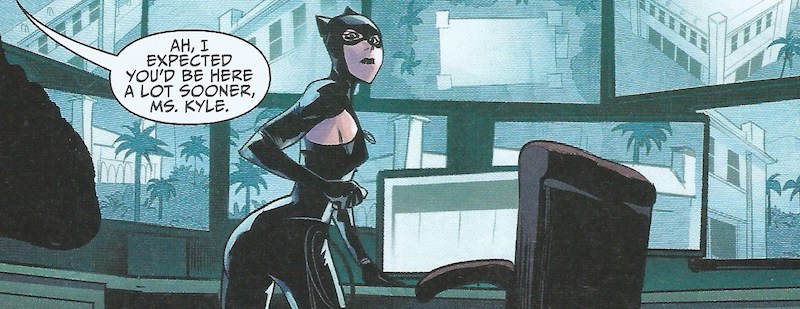
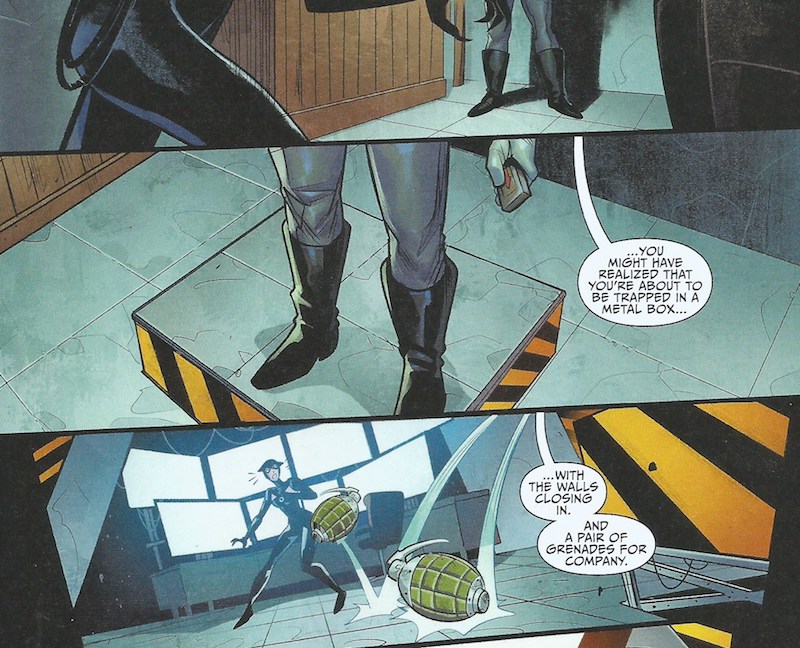
Looks like I lied.  I honestly thought last issue of Catwoman was stand-alone, and that really exemplifies Ram V's excellent skill.  He ends chapter one with Catwoman tracking down the creeps that tried to kill her.  You can supply the details, but this issue V expands on the finish.  Here are some details.  I think you'll like them.


Catwoman discovers the culprits, but it's another trap.  Ho-hum, right.  Except Ram V's reveal of the trap-maker is a pleasant surprise.  


As pleasant as the gentleman caller from last issue.  He makes an appearance this issue as well to conclude his business with Catwoman.  She's a woman of her word.

It's difficult to explain how good this story is without divulging the plot.  You know how the story is going to play out.  Just not the precise measures, yet it's still a wonderful experience to watch unfold.  V in fact plays with idea of inevitability by coming up with a Schrödinger Cat joke. How can you not love Catwoman?


Black Cat cozies up to the Human Torch in order to steal a book in Red Richards' collection.  All the opaque preparations serve to break into the mythical and mystical Thieves Guild's Vault.  

You may ask.  What the heck is the Torch doing with his BFF's ex, and why the hell does he trust Felicia in the first place?  Chris Evans that's why.


That's a brilliant description of the Torch and surprisingly deep.  As Black Cat saunters through the FF's headquarters, she also informs the reader that you have to be an idiot to steal anything from the FF's stock.


The reasons though are anything but obvious, and one beautifully sets up a most unexpected cliffhanger.  Jed McCay's narration for the Black Cat fits like a velvet glove, and the revelation of the first reason is so in keeping with her character.  Travel Foreman's art is perfect.  He captures Felicia's slinkiness, her deceptiveness.


The Big Bad Melissa Morbeck revealed Squirrel Girl's secret identity.  This led to Doreen Green's apartment building exploding and an invasion of B and D Level foes at the computer lab.


The dialogue so smart and so true is one of the things I love about Unbeatable Squirrel Girl.  Writer Ryan North asks the question every issue.  What if everybody was just a little bit smarter and listened to reason?  By answering that question, North orchestrated Squirrel Girl plausibly reforming former enemies and gaining the respect of Big Bads from all around the Marvel Universe.


The circular logic of Doom is utterly breathtaking.  With one snatch of dialogue, North explains Doom's collusion and his lack of investment in the proceedings that will ultimately allow him to save tin-plated face when he up and leaves.


I would be remiss not to mention Derek Charm's toony yet effective artwork.  I've never seen a super-leap portrayed in an angle such as this.


Carol Danvers is Captain Marvel, but lately she hasn't been feeling so marvelous.  Power outages, swaying public opinion and a total wreck of her military career sent Carol literally and figuratively careening to the ground.  Last issue Captain Marvel discovered whom she thought was behind her troubles beaten to a pulp.  So she carted Dr. Minerva back to Tony Stark's lab.


Dr. Minerva is a Kree scientist debuting in Bronze Age Captain Marvel.  She intended for the original Captain Marvel and she to mate and produce a super-race.  The passive tense is used purposely.  Minerva never actually loved Captain Marvel.  She didn't even like him.  Hers was a scientific pursuit.


Kelly Thompson spruces up Minerva's intent for modern times but doesn't really alter it drastically.


Minerva still wants to use Captain Marvel in her aim to create a super-race, but not for in this case parthenogenesis.  Her aims now involve the preservation of the Kree. 


Her genetic manipulation is uncomfortably Dalek-like.  However, you cannot fault her for trying everything in her power to rescue the Kree from evolutionary oblivion.  That makes her a richer antagonist.  Of course, Minerva suffers from the same affliction that crippled Frankenstein.  Her creation is high on power and low on the progenitor.


How Minerva's creation works isn't exactly instinctively plausible.  You have to think about it for awhile.  The giant monsters Captain Marvel fought contaminated her with nano-machines.  The nano-machines built a transceiver inside of her.  So, Minerva could transmit her power to her creation without Captain Marvel actually knowing or even sensing what occurred.  It's ingenious and scientifically complex.

I'm not spoiling anything by revealing that Minerva's creation is the young, previously never seen before superhero Star, and yes there's a fight, but it's a battle that's more serious than most.

Artist Carmen Canero and Tamra Bonvillain lay out a legitimate duel between two very powerful foes that's equal to if not better than anything you'd see from a pair of male opponents.  This is I kid you not strong stuff, capable of making you wince.  

When Mark Russell introduced his version of Red Sonja he turned her into a bedraggled ex-warrior.  Something happened to her that snuffed out her flame.  That changed when Dragan intended to conquer her home Hyrkania.  The people elected her Queen, and she found a new purpose in protecting her kith and kin from the insatiable conquerer, who often seemed more like Grouch Marx as Rufus T. Firefly than a typical Robert E. Howard human-monster.  

For the most part, Sonja has been inexplicably winning.  Outresourced, outmanned, Sonja nevertheless led her people into a guerrilla war against Dragan.  She employed all of her stratagems learned from the legend Domo.  All of this is of course made-up, but so is every comic book version of Red Sonja.  Robert E. Howard's Red Sonja is quite different.

Nevertheless Mark Russell's Red Sonja is one of the most unique and memorable avatars of the She-Devil with a sword.  Russell and artist cohort Bob Q downplay Sonja's pulchritude in favor of an earthy beauty that belies a beguiling mind.

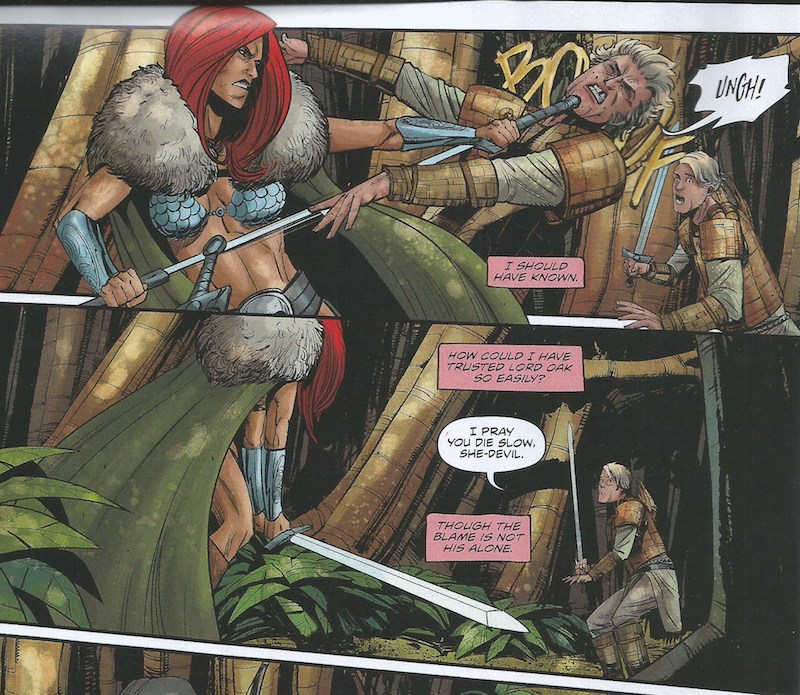
In this issue of Red Sonja, as she burns everything in her wake, Sonja attempts to ally with the Woodland Tribes.


Her arguments are well-reasoned, and she's even humble in the presence of Lord Oak.  That's something we haven't seen before.

As Lord Oak considers the pact, unbeknownst to Sonja or even Dragan, a changeling infiltrates her camp.


The outstandingly bizarrely loyal to the Zamoran Empire Foghor seeded discord in the Woodland Tribes before arriving at Sonja's camp with a warning that unfortunately fruits.

This doesn't turn the tide of battle or anything, but it precludes Sonja from gaining an ally.  In fencing, this would be a hit a palpable hit.

The Spoiler Section


So, yes.  Batman does assume the guise of Matches Malone.  Matches looks like Thomas Magnum when on the beach, but this is more of a Tom King Batman issue than a joke about Magnum P.I. 


The story begins at the beginning with Batman and Catwoman on the boat.  Batman's involvement in essentially a caper was a rarity in the Golden Age. He was usually killing mad scientists, mobsters or a combination of both.  He had no intention of killing the Cat.


So for those living in a cave, Batman and Catwoman intended to get married, but this whole affair was orchestrated by Bane.  He gave Batman love, only to take it away.  Thus breaking him in a whole different fashion.  In the New 52, Bane never actually broke Batman's back physically.

The villains were much more subtle in Tom King's first issues.  You didn't know they were the villains, but Gotham Girl always served Bane.  Holly Robinson always served Bane.  With two confidants in his pocket, Bane tricked Batman and Catwoman into rekindling their relationship.


That's the problem with fire. You can't control it.  The flames spread in directions you never intended.  Bane in reigniting the spark in Batman and Catwoman risked an inferno.


Tom King's message may seem trite.  It's love conquers all.  Even two fiercely independent figures like Batman and Catwoman.  Made for each other back in the day but kept apart until now.  Tom King created a wonderful impediment to explain why Batman and Catwoman were no longer together.  Seems Catwoman murdered hundreds of people, but it wasn't her at all.  Bane's plan demanded a sacrifice, but that sacrifice removed the one thing stopping Batman from acting on his feelings.  


They've figured it out.  Maybe not the all the whos or hows, but they've figured it out, and now begins Bane's downfall.