Pick of the Brown Bag
September 12, 2018
by
Ray Tate
It's that time again. It's the Pick of the Brown Bag, and this week, I take a gander at Charlie’s Angels, Detective Comics, Fantastic Four, Mystery Science Theater 3000, Nancy Drew, Peter Parker the Spectacular Spider-Man, Red Hood and the Outlaws, Supergirl, Titans, Wonder Woman and X-23. I’ll also review the new books Cemetery Beach, Moth & Whisper and the Wrong Earth. If you're looking for quick decisions and not rumination Ha-Ha-Ha-Ha. You've come to the wrong place. Seriously though, you can always go to #PickoftheBrownBag for a staccato of these reviews.
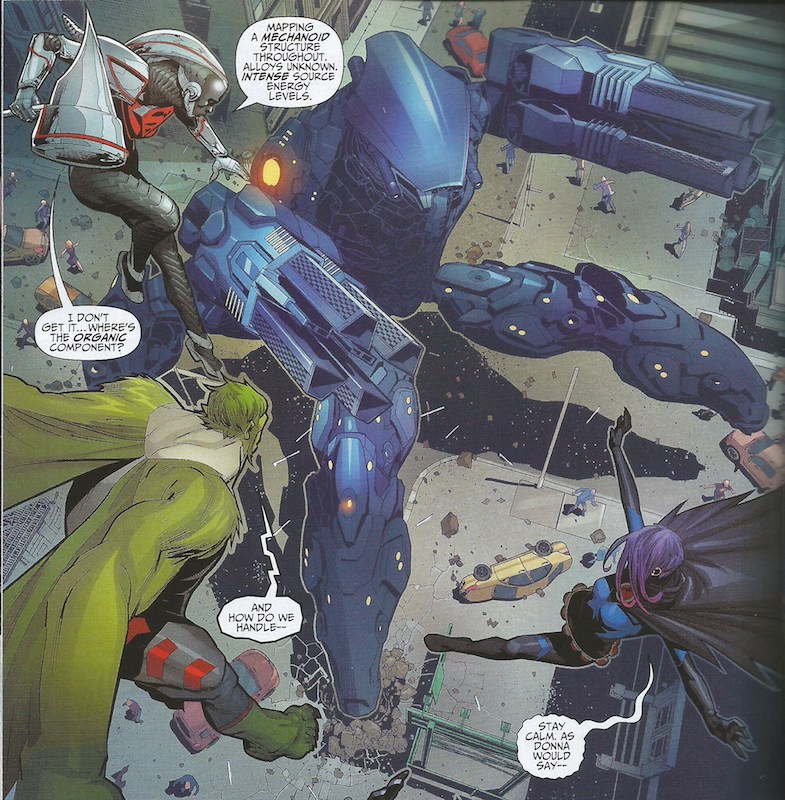
This is a mostly bog standard issue of Titans and not the anniversary issue deserved by fans. Steel and Beast Boy fight a tinker toy animated by the Emergent Energies of the broken Source Wall.
Let me translate for those who don’t speak Jack Kirby and the surprisingly unimportant yet pivotal miniseries Metal. A big cosmic doo-hickey broke and released weird energy all across the earth, presumably throughout the universe. Humans sometimes absorb this energy and gain super powers.
Raven also serves on this Away Team, but is Raven truly Raven? A fictional character dubbed Prince Travesty created by an Emergent possessed her last issue. Either she/he is lying about the soul self, or Travesty supplanted that portion of Raven. Either works.
Raven’s soul-self used to be a sort of mashup between astral projection and Negative Man from the Doom Patrol. No idea what it’s like nowadays.
Nightwing and Miss Martian get tapped inside a television set, due to those weird energies I was talking about. This allows for a showcase for some amazing artwork by Guillem March.
The scenario however isn’t as remotely entertaining as the Supernatural Scooby-Doo episode. Because it’s Nightwing, he and Miss Martian almost make a close encounter of the fourth kind.
Titans has one saving grace and it’s a real surprise.
I never cared that much about Donna Troy after the Bronze Age. Once again the Powers at DC Comics made me pity a character. Originally Donna was a human baby saved by Wonder Woman from a fire, taken to Paradise Island to be raised by Amazons. Simple, right? Her origins get mucked up something fierce after Crisis on Infinite Earths. She also marries horrible individual Terry Long. Her crap husband and kids die, and in the New 52 she’s a homunculus created to kill Wonder Woman. Forget about all that.
This is Donna Troy's moment to shine. Powerful, confident and funny, Donna beats the crap out of some Brother Blood flunkies. While the cult differs from the Bronze Age goons and disillusioned followers, the changes are easy to digest. So nothing gets in the way of this good vs. evil cage fight.
Donna also teams up with fledgling scientist and reporter from Catco Ben Rubel, late from Supergirl. Ben represents the every man within the context of the story.
He doesn’t know one whit about Donna Troy but plainly sees the most important aspect lost in a morass of reboots, deaths and overall stupidity. Donna is a superhero. She wants to help.
Help she does. Her story is the most successful because it’s actually nothing more than what you see. For a character like Donna, that’s intoxicating.
This issue of the Fantastic Four explains what Reed and Sue and the rest of John Hickman’s Future Foundation did during their absence from earth. It’s pretty cool.
Franklin Richards’ powers always seemed to be an undefined dues ex machina. In this story, he births universes and strings them like beads on the tapestry of the multiverse.
Marvel’s multiverse isn’t as defined as DC’s Bronze Age and this random creation fits perfectly with Marvel’s anything-goes scheme of things. All good things however.
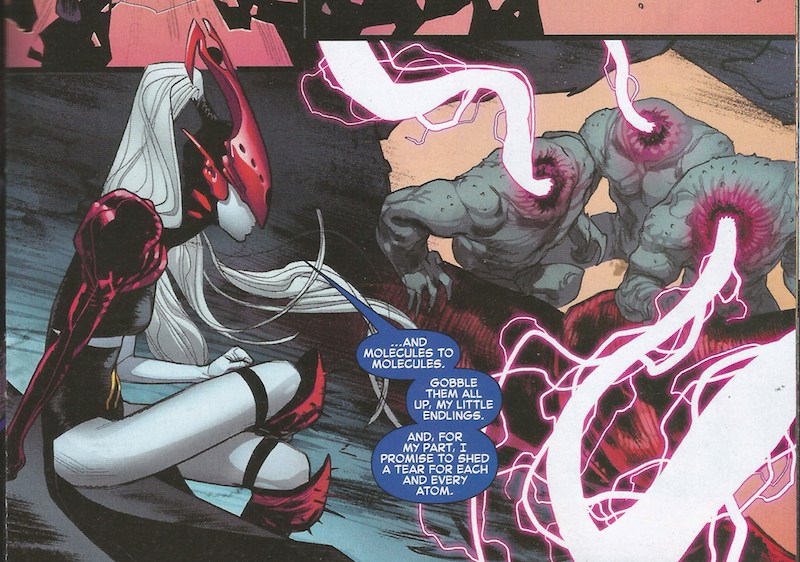
Franklin didn’t create the entire multiverse, and with his power exhaustion, something peeks in. An analog of Dormammu.
Sure she’s the sexier version of the Dread One, but you can’t fool me with your rechristening and gender-switching. Those gray blobby gents are Mindless Ones. Mindless Ones only serve one being. They’re not for hire.
Things go real bad for the Fantastic Four, and they decide to make one logical last stand. What they didn’t count on was Valeria’s feelings for a crimson-skinned Namor type.
That's all right Mr. Fantastic can work with it. Alas, things don’t turn out as expected, but the Griever, as Ms. Dormammu likes to be known, falls victim to hubris.
Can you be more of a sucker? That’s where this issue ties into the last, and though the reveal is spoilt next chapter, I’m not saying a word.
When last we saw Spider-Man he attempted to help the Sandman pass from this mortal coil, but something went on in between. Sandman began having memories of a life not lived.
How to explain this without spoiling the plot? The story weaves into first major arc since Peter Parker Spectacular Spider-Man returned to the racks.
The tale grants even greater dignity to the Sandman. The foundation for that dignity took place in a Christmas issue nineteen seventies' Marvel Team-Up, where we find that the Sandman is human after all and not all bad. The Human Torch who accompanied Spidey on his Noel kick factors into the story, and the entirety comments on how Spidey is sometimes closer with his enemies than the police.
Scott Lobdell redefines the Red Hood with Pete Woods fight choreography. If you were to tell me when I was a kid that I’d actually be taking Jason Todd seriously, as a fighter and an avenger, I’d suggest you go back to your time machine and have your head examined for brain worms.
Jason Todd split with the Batman Family when he killed a classic Batman rogue on national television. He’s on the run from the law and the superhero community. The story opens on a bus that makes a fateful stop.
The Fed is on the up and up. So naturally she tries to take Jason in. She’s in no shape to do so, but that doesn’t stop her for making a valid effort. Predictably, she cannot stop the Red Hood. Unpredictably you cannot imagine how much damage one person can inflict with road flares.
Beyond that Jason once again zig-zags in terms of philosophy. Upon being resurrected, Jason chucked his ties to the Batman Family. When the Joker attacked the group, open arms welcomed him back. Batman even convinced him to stop killing criminals. At the same time, Jason insisted he was his own man and did things his own way. Now that he’s apparently off the rails and an outlaw he embraces his Robin past. He seems to realize he never would have been able to do what he feels must be done without Batman’s past training.
Although Red Hood transforms into a bona fide drama, with a life being threatened, another being extinguished, and Jason taking names, Lobdell still imbues the episode with humor.
Jason takes pleasure in ending the lives of scum. He doesn’t approach the task with a military bias that describes Mac Bolan. He also cares about the innocent people who get chewed up in the gears of major crime.
Consider Jason to be DC’s Punisher for real, not a send up. His history lies with Batman. He sees the need to kill criminals but is as much as a crusader as his erstwhile mentor. He’s a colorful figure and just as symbolic as a cape. He presses forward with bravado rather than grim determination.
If Tom King didn’t exist this would be an excellent issue of Detective Comics. Instead, it’s merely good by comparison. Writer James Robinson tries to get Batman back to basics but in an original way.
In the Post-Crisis, Batman would suffer some kind of trauma. Very rarely would Batman return to form without alienating his friends or family, but Robinson humanizes Batman in a more empathetic way simultaneously addressing the title of the book.
Batman’s investigation draws him closer to his most trusted contacts. Alfred was not always Batman’s Watson but Sherlock Holmes did not start his consulting detective work upon cultivating Watson’s friendship.
Batman’s ratiocinating is fun to watch, and you realize that you haven’t seen Batman behaving like a genuine sleuth in a mystery novel for a long time. Even King presented Batman as a modified detective, not one finding a dead body in a locked room. So to speak.
A new Firefly interrupts Batman’s quiet uncovering of clues, and Robinson makes some interesting choices during this tête-à-tête.
The new Firefly is a woman and just as psychotic as the old ones. Batman only heard a rumor of the new arsonist, but this encounter confirms. It may only be subjective, but I find it fascinating that Batman is on the ground level for the knowledge to his database.
The inferno allows Batman to reaffirm his commitment to recovery. Batman rescues a tenant only after saving her dog. He does not foolishly attempt to do it alone. He calls upon the professionals. He also observes and deduces. Robinson’s Detective Comics is definitely more than just an also-ran to Batman.

Nancy Drew elegantly interrogates her latest lead on a series of murders occurring at a pirate cove in the Hardy Boys’ hometown of Bayport. Any browser of Nancy Drew can tell you that the girl detective resides in River Heights. So despite Kelly Thompson’s assurances to the contrary I must respectfully disagree.
The interview yields fruit, and all the clues Nancy picks up on are right there in the dialogue for budding detectives to see. Nancy Drew is mostly all-ages, without being juvenile.
Sure, there’s Danica, Georgia Fayne’s girlfriend, and a drug themed crime in addition to the murders, but a sharp kid can read this book and not suffer any psychological damage. The art by Jenn St-Onge is also inviting with a diverse character design more reflective of our time and place.
Nancy Drew’s complexity lies in how Kelly Thompson works the evidence to emphasize Nancy’s wicked intelligence and experience in sleuthing. She also shrewdly shows how Nancy Drew in fact has only evolved superficially.
Case in point. One of Nancy’s gang meets a long-time Nancy Drew foil. Although St-Onge illustrates her in a different style you may have imagined, the general description fits. Another of Nancy’s crew gets knocked out, tied up, gagged and tossed in a trunk. If I had a nickel for every time that happened to Nancy Drew or a cohort, I’d be able to retire to an island I just bought.

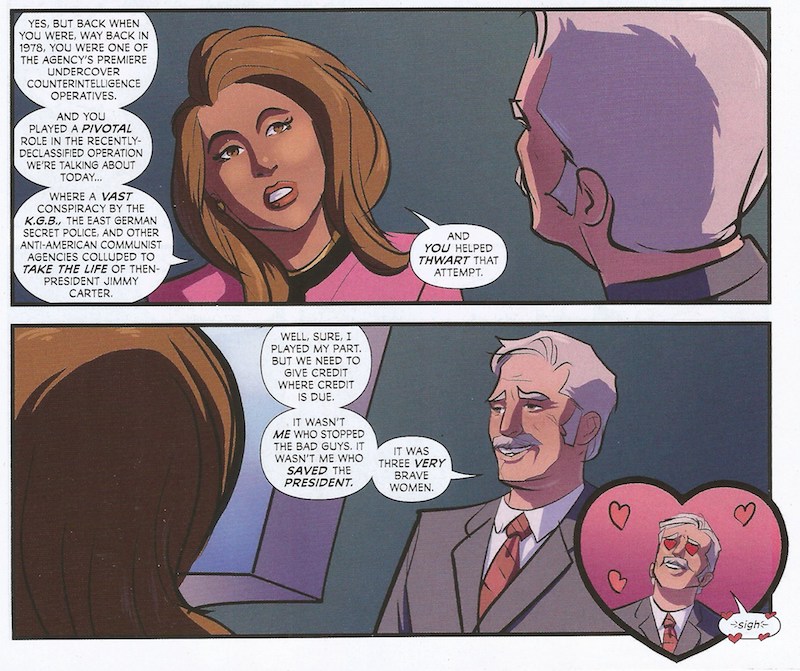
Charlie’s Angels is slick fun. A pair of Russian agents want to kill President Carter and intend to leave the Angels as their fall gals. To that end, they’ve kidnaped Charlie and impersonator Ted Gardner, who led the Angels to falsely attack a deep cover CIA agent. In the first act, the Angels proved to be too smart for the Russians. So, they hired the Angels’ opposite numbers. Helena’s Devils.
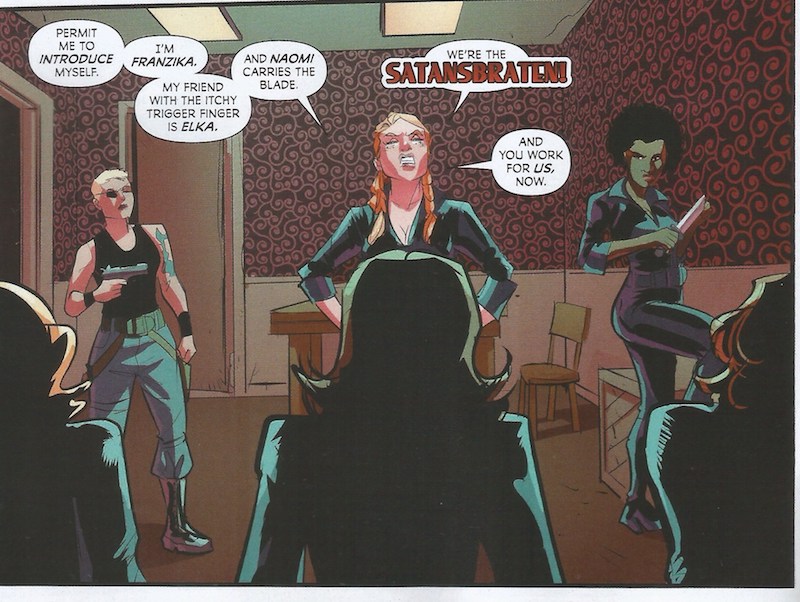
The Devils capture the Angels using tranquilizer darts and distance. They promptly truss them up and lord over the information that they have on them.
The information, the Devils' smugness and the quick thinking on the Angels’ part flips the cards. The Angels play up the scheme in a chef routine that’s a classic act from their deck of cards. They quietly lead the Devils into a trap
Basically writer Jon Layman asks the question what if the standards and practices governing Charlie’s Angels were looser in terms of dramatic writing. What if the Angels were allowed to actually use martial arts to hit bad guys? What if they were allowed to out think the opposition and that the opposition were worthy opponents? What you get is this.

In Steve Orlando’s last two issues Wonder Woman teamed with Artemis to free the legendary figure Atalanta, who volunteered herself to fight an everlasting war against the Aztec god of death and his minions. Thus preventing them from entering our world and taking it. Now, Wonder Woman pilots the Invisible Jet—YES—to deliver Atalanta to the home she helped found, Bana-Mighdall.
Long ago, Atalanta disagreed with her sister Queen Hippolyta enough that she formed her own Amazon nomadic tribe. Despite Atalanta self-humbling, her people can't welcome her enough.
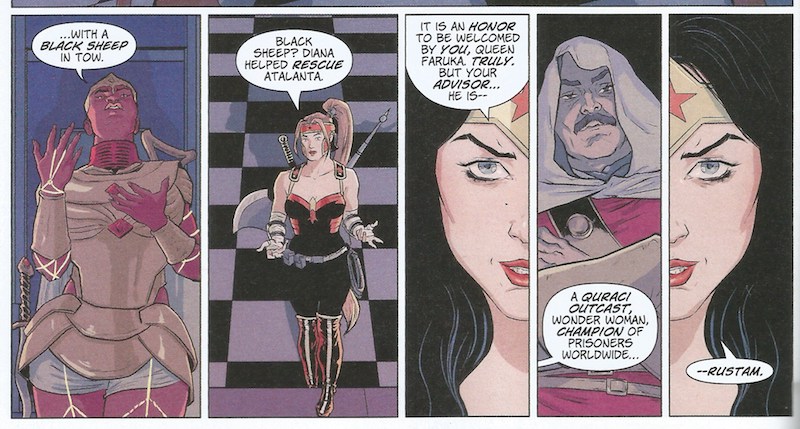
The return alerted Queen Faruka last issue in the cliffhanger, and she doesn’t even try to act surprised. Wonder Woman however notices a decidedly male stench in the throne room.
Don’t be surprised if you’ve never heard of Rustam. He’s apparently a Suicide Squad character whose name is based upon an Arabian knight. Orlando and artists Raul Allen, Patricia Martin and Borja Pindado summarize the who, what and were in an economic single page. They'll do that again in a display of bullets and bracelets. The summary also demonstrates why Amanda Waller should be put into prison.
Rustam’s revenge motivates the proceedings. He wants to kill make-believe DC staple Qurac. The Queen sees this as an opportunity to rid Bana-Migdhall of an edgy neighbor. Neither Atalanta nor Wonder Woman approve. And so…
But…
Steve Orlando and I have a hit or miss writer-reader relationship. Some of the stuff he produces is mediocre. I shrugged when reading his Justice League of America for example. I totally disagreed with his concept of the Shadow. However, after a rocky start, his Supergirl run grew on me. On Wonder Woman, Orlando excels. This is the third good Wonder Woman story that Orlando conceived. He approaches Wonder Woman’s history with respect. His Wonder Woman characterization is perfect. His dialogue entertaining. I know people are waiting for Ms. Marvel writer G. Willow Wilson, but frankly, I wouldn’t mind if Steve Orlando stuck around a bit longer.

Supergirl is on the hunt to find out who if anybody hired new villain Rogol Zaar to kill Krypton. She first consulted with Green Lantern Hal Jordan for information on Rogol’s axe, a powerful weapon that Kara took from him. However, both Hal and Kara were surprised to find out that somebody redacted the file. Hal suggested Kara actually go to Green Lantern planet Mogo to search the archives.
Superman didn’t want to lose his cousin to vengeance. He gave her the gift of Krypto to keep love in her heart.
On the way to Mogo, the axe demonstrates its grind.
In the New 52, Kryptonians still need air to breathe. That wasn’t always the case, but it started in the nineties and consistently stayed that way despite reboots. So I’m guessing we can call it intrinsic. Fortunately, Kara piloted her craft close enough. The Green Lanterns execute a rescue.
There’s a nice, layered disconnect between what Kara’s thinking and what she expresses. These restrained emotions get the royal treatment by modern day Chuck Jones Kevin Maguire. The creative team also brilliantly utilize both Kara’s telescopic vision and the underused Kryptonian historical ability of total recall. Although it’s probably the least important draw of Supergirl, as promised, she also shows off her Supergirl-Batman-Stealth suit. The axe exhibits far more power than expected. Supergirl causes a lot of problems amongst the Corps necessitating hilarious and decisive Krypto action. It finally turns out that she was right. There's a conspiracy afoot, but we’ll need to wait until the next issue to sort that all out.

So, I cannot share a single image from X-23 without spoiling the whole enchilada. I can't really talk much about it either. Suffice to say that Juann Cabal’s artwork is phenomenal. Perhaps this is his best. Colorist Nolan Woodward provides attractive pyrotechnics and enhances what’s going on.
Meanwhile, writer Mariko Tamaki demonstrates the extent of Laura’s power to heal from any damage. At the same time, there’s a bizarre family theme playing out. The Stepford Cuckoos are clones of Emma Frost. The Cuckoos are a family unto themselves. Laura is a clone of Wolverine. Gabby a clone of Laura. They’re all sisters in a way because of their association with the X-Men. Strangely then, this is a family squabble with Gabby being torn in the middle.

Moth and Whisper from Ted Anderson and Jen Hickman present a pair of famous thieves that comprise the title. The thieves disappear and leave behind a son.
The son attempts to carry out his Mom’s and Dad’s s skullduggery while searching for a sign of their whereabouts. Strong writing and art with a high concept entertains people like me who loves a good heist.
The story is set in the near future or maybe the cutting edge present. Moth is a disguise artist using the latest technology to create personae. Whisper is all about not being seen. The son employs both methods while maintaining a ruse. His parents are still operating in the city. Now, who may be surprised by that. This issue doesn’t allow the reader to cross off any suspects, but Nikki has his eye on a particular strong man. In the meanwhile, enjoy his sleight of hand.

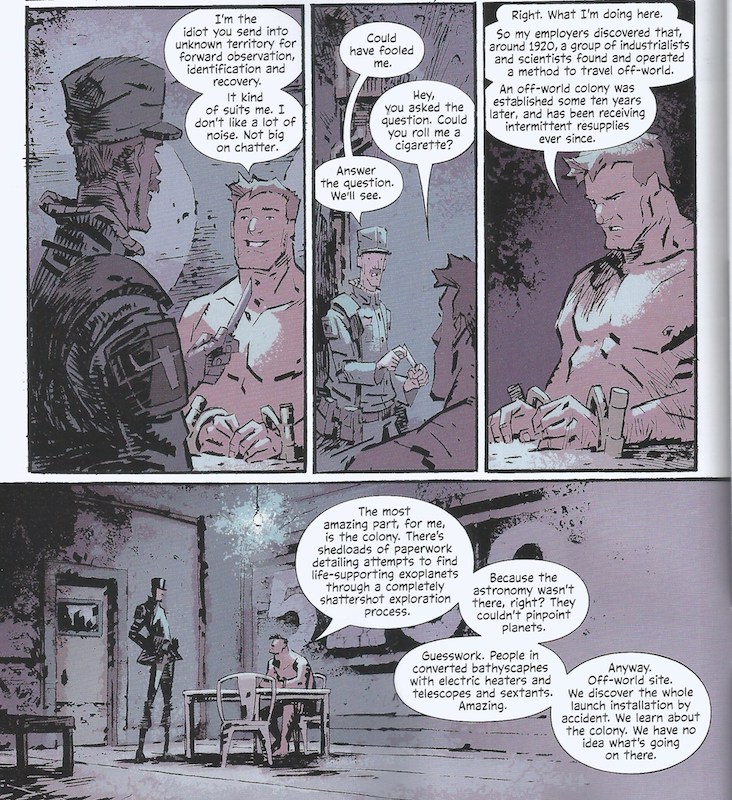
Warren Ellis’ Cemetery Beach is an interesting twist on the parallel world sub-genre of science fiction. The story opens with a warder and his prisoner, but it doesn’t go quite how the warder expects.
The prisoner introduces himself and promptly relates to the reader and the warder what’s known. If you read the graphic you’ll see that Ellis manipulates the Jules Verne concept of Imperialism among the stars, an idea recently explored in Doctor Who.
Ellis also explains the establishment of a Star Trek principle. The idea of starting colonies based upon history: whether they be the west, Nazi Germany or Gangsters. The warder is the product of an evolution of culture from the 1920s, and that’s why artist Jason Howard depicts the soldiers as a type inspired by the Foreign Legion. These are not honorable men. Neither is the protagonist. Although perhaps he’s less sadistic and more pragmatic. The lead comes off as a cross between James Bond and Captain Kirk. A good blend for a new character.
You know it’s a wonder why nobody thought of The Wrong Earth before. Such an elegant concept. Two Dragonglies, and one’s even a Dragonfly Man. The earths they operate on are very different. Neither remotely real. Although I’m just as guilty as every other critic terming things realistic.
That’s not realism. That’s darkness. Certainly there’s a hero. He introduces himself by beating on several thugs in the employ of psychotic criminal Number One.
Meanwhile another Dragonfly Man faces a beatable death trap and pop colored villainy from another Number One.
The mirror serves as an escape. Thus, DC immersive writer Tom Peyer pays homage to The Flash, progenitor of Earth Two.
The contrasts become more evident when Dragonfly Man’s young sidekick falls victim to the callousness of Dragonfly’s criminal quarry. The swinging sixties Number Two tries to help Stinger, which means that Number One and Two knew that their nemeses would somehow find a way of escape from the death trap. That means their crimes and craziness are all games.
An amusing Stinger cartoon rounds off the the book, along with a prose story by Grant Morrison and interviews with Stuart Moore, Terry Moore and artist Jamal Igle.
For those who have never seen Mystery Science Theater 3000 shame on you, but the layout is in the song.
Caught up? So, here’s a confession of sorts. I’ve used the Mystery Science Theater concept back in the nineties to riff on really bad Doctor Who books and to review a terrible oversized special Justice League book, ironically named Heaven’s Ladder. More of a plummet from a rooftop. So, having a MST3K comic book is kind of wish fulfillment.
Like the writers of this book, I also had to come up with an explanation on how to get Mike Nelson, who assumed Joel’s role, and the Bots into a novel, as if they were witnessing it like a movie. Naturally, the scribes, which include MST3K creator, and original captive, Joel Hodgson come up with something much more fun and creative than I could.
The flunkies by the way are evil minions from Kamen Rider knock-off, the awesome Shaw Brothers' Super Infra-Man. I have yet to make the time to watch MST3K’s new run, even though I contributed a meager pittance to the Kickstarter, but I’ve been well-informed. Felicity Day plays the daughter of Dr. Clayton Forrester. There’s a TVs Frank, and a new captive with our friends Tom Servo and Crow.
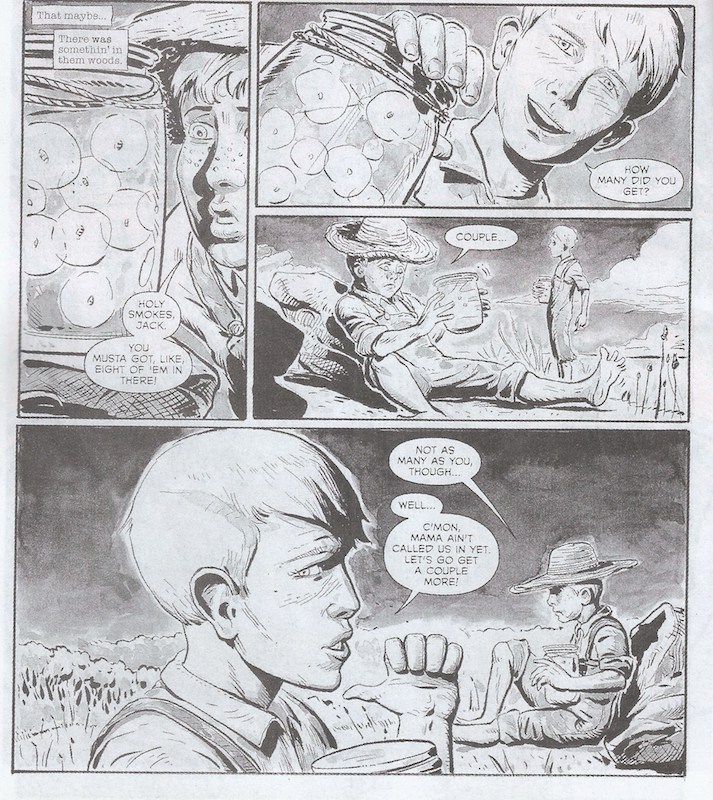
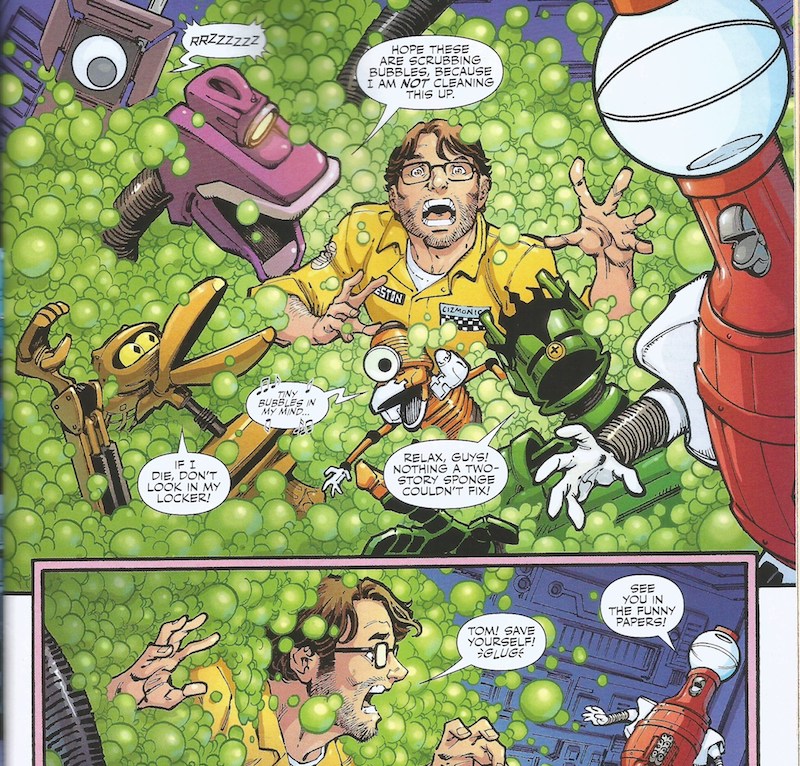
The story sets up the series with Jonah and the Bots, including Gypsy who runs the higher functions of the Satellite of Love, being sucked into a cheesy comic book instead of a cheesy movie. Tom however wants this. Badly.
The little sexually frustrated robot must have read Johnny Jason Teen Reporter and singled out the blonde for his sweetheart.
As you can see in addition to outside riffing signified by bubble framing, Jonah and the Bots also become characters in the story. With Tom, it’s completely absurd, and gets even crazier. However, like the series, MST3K’s best riffs are those puncturing the super white conformity years. MST3K is throughout amusing, but when Tom becomes familiar with a “typical” 1950s household, the gloves come off, and the glory of MST3K subversiveness comes out.