Showing posts with label Kuder. Show all posts

Monday, March 10, 2014

POBB: March 5, 2014

Pick of the Brown Bag
March 5, 2014
by
Ray Tate

Live from Pittsburgh! It's the Pick of the Brown Bag.  This week I look at the Batman/Superman Annual--which is not part of the Huntress/Power Girl and Batman/Superman team-up.  I also examine the fate of Nightwing in Forever Evil,  Warren Ellis' take on Moon Knight, the conclusion to Action Comics, Futurama, Loki, Scooby-Doo Team-Up, the second issue of She-Hulk and Swamp Thing.


The cover to Forever Evil says it all.  Doesn't it? Actually it doesn't.  Nightwing's fate doesn't have anything to do with the cover.  It turns out writer Geoff Johns had something more devious in mind than merely mussing Nightwing's good looks.  

The Grid decided to obey Owlman and Ultraman.  Owlman told Grid to protect Nightwing.  Ultraman ordered Grid to secure him so he doesn't escape.  No problem for an idiot A.I.  There is a problem however when Batman, Lex Luthor, Catwoman and the Injustice Gang penetrate the Crime Syndicate's headquarters.   


Upon seeing his son in the Grid's trap, Batman drops pretenses and exposes his humanity.  Not only does the Dark Knight apologize to his former sidekick.  This lowering of shields leaves Batman vulnerable.


Lex Luthor acts like a villain even if he doesn't believe he's one.  Villains rarely think of the consequences of their actions, and the ramifications of Lex Luthor's assault and his inadvertently threatening Nightwing unleashes a whole world of bat-shit crazy.


The key here is Batman would have done exactly what Luthor intends, albeit in a kinder manner, but Batman, and Catwoman, on team Batman throughout this exercise, overreact.  They let their emotions cloud their judgement.  

Catwoman has always been more instinctive than logical.  So, her reaction is in her nature.  As to Batman, it's more than just his feelings over Nightwing directing his response.  Batman's running on steam.  He's the only Justice Leaguer left on the planet; he doesn't know about Cyborg's resurrection.  Batman justifiably distrusts Luthor.  Luthor of course doesn't tell Batman his full plan and the bald baddie's lifelong hate for Superman doesn't warm him to anybody but Bizarro.  It also doesn't help matters that Batman's working with a group of killers that he'd rather put behind bars.  Saying Batman's under a lot of stress is an understatement.

Batman's actions ironically jeopardize Nightwing's life because part two of Luthor's plan is elementary.  All this conflict and threat though arise naturally and not through a stupid contrivance.  This is still a surprise to me because of Geoff Johns' incumbency of sloppy writing in the post-Crisis.  Credit where credit is due.  Forever Evil is tight and well-thought out.


The rest of the Injustice Gang--Black Adam, Black Manta, Captain Cold, Deathstroke and Sinestro, concentrate on the task in hand.  They kill two of the Syndicate outright, and Manta has a shock in store for the deadly lunatic Atomica.

Not only am I now convinced that Nightwing will make it out of Forever Evil alive, but I suspect he will emerge physically unscathed.  I though he would end up disfigured to predicate his taking over the Red Hood role.  The Red Hood switch is still a possibility, due to his secret identity being blown, but Nightwing's assumption of the role will not be due to resulting battle scars, which honestly would have been too convenient and likely wouldn't stick for long.


Red Hood (Jason Todd) is one of the two Batman Family members Batman takes with him into space to fight on War World.  Batgirl is the second, and as you can see, Batman's haunted by both of their pasts.  This offers a change. 

With few exceptions, The Powers That Be only saw Jason Todd as Batman's momento mori.  Barbara couldn't even be an occasional reminder of Batman's pain.  Seeing Babs in a wheelchair every day should have eaten Batman alive.  Nah.  That was just hunky-dory.  Cause that's where she belonged.  Fortunately, rational minds prevailed and Batgirl finally returned.  Jason returned sooner, from the dead, but hey, water over a thirty-five year old bridge.


The Batman/Superman Annual acts as a superior done in one sequel to a subpar opener.  In that former confusing tale Mongul, the Darkseid wannabe of the galaxy, attempted to take over the earth and kill the Man of Steel and Dark Knight in the workings of a virtual reality game.  Now, Mongul's son comes to earth to offer a more direct challenge and a save for the planet.


Though the annual isn't as interactive as I would have liked.  There's no historic meeting of Batgirl and Supergirl.  It is filled with exciting action and smart character bits that fuel continuity.

Pak adds cement to the relationship between Batman and Superman.  Though neither would admit it.  At this stage, they're friends not just colleagues.  Pak focuses on their dual nature, but not just their disparities also their similarities.  Superman comes out of the story looking more lawless than Batman, who believes in redemption.


Pak also grants the families some good moments.  Supergirl is tough and selfless; identifying her metamorphosis into a Red Lantern all the more ridiculous.  Steel is determined and studious.  Batgirl smart and hilarious.  Krypto brings some baleful visual humor to the book, and some bite.  Jason and Batman pull off a quirky double-act that characterizes Jason as a former Robin that actually spent quality time with Batman and not just soon ended up dead.  Formerly, Jason's best moments occurred in the pre-Crisis.
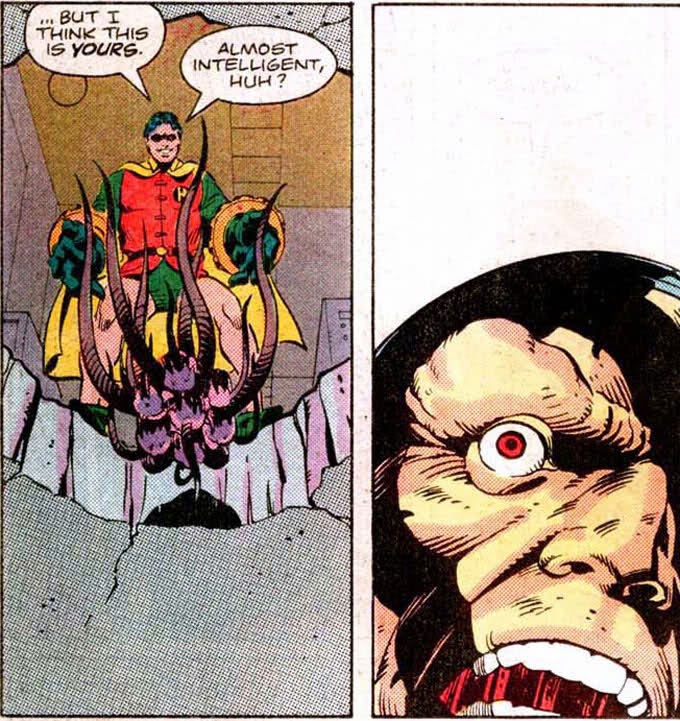


This is the second time Jason thwarted a Mongul.

You don't think for a moment either group will fail or make a sacrifice, nor would we want them to, but it's still fun to watch them succeed.  


Pak's run on Action Comics began inauspiciously with a Zero Year tie-in introducing a flatly characterized Lana Lang, and Superman dealing with natural elements.  As a consequence, I had serious doubts about Pak's ability to write either Superman or Lana. His second story changed my mind.

Pak introduced Lana as an engineer, which was fine.  We can always use another smart woman in the DC Universe.  The emergence of a dragon from a geothermal drilling experiment gone wrong chimes the call for Superman, but Pak instead of opting for an obvious Superman vs. Subterranean battle chose to use the dragon as a metaphor for the Man of Steel.  

Superman, seeing a little of himself in the creature, instead of destroying the beast takes him back to the Fortress of Solitude.  There the beast undergoes transformation into a more peaceful form.   As the story progress, Lana and Clark discover an ancient civilization and a new hitherto unseen enemy organization which provides the technology for antagonists like the Ghost Soldier.


Lana Lang and Superman this chapter witness and experience a horrible tragedy that shakes Superman's resolve and greatly pisses him off.  Lana's pissed as well, but she doesn't have heat vision.  That makes all the difference in the world.


Artist Aaron Kuder brings a superb sense of anger to Superman's expression and actions.  This guy is scary when enraged.  Not at all the Boy Scout for which so many people take him.

Superman's angry not just because bad guys murdered innocent lifeforms or threatened his friends.  Superman's anger is almost existential.  Ignorance is why his friend Baka had to go back to the underworld.  Certain individuals destroy what they do not understand, and he's angry because these humans are still fearful and ignorant.
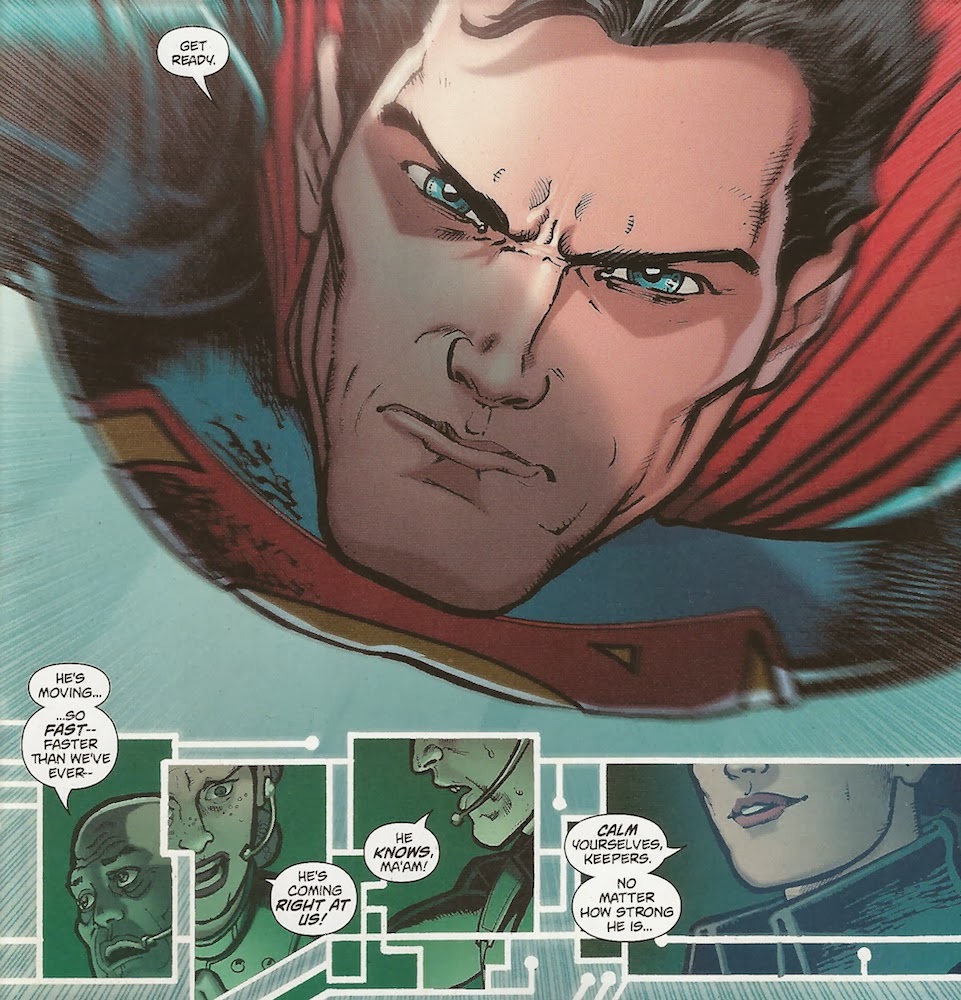


As Action Comics enters Pak's third story, dovetailing off of this one, it becomes apparent that this is the Superman book.  

Moon Knight debuted in Werewolf By Night, but you more than likely encountered him in the seventies in The Hulk, the last of the Marvel Magazines, before he graduated to his own tamer comic book.  Co-creator Doug Moench based Moon Knight on the Shadow; although most saw him as Marvel's Batman.  

The Shadow's true identity was not Lamont Cranston as so many thought.  He was in fact Kent Allard, a World War I aviator.  Allard assumed Lamont Cranston's identity when the playboy traveled to Europe.  Cranston wasn't the Shadow's only sobriquet either, but no matter the guise, Allard was always the Shadow.  His personae were just one of many sleights of hand the Shadow's prolific arch-developer, if not creator, magician William B. Gibson innovated. 


Moon Knight began as Marc Spector a soldier of fortune who lives after being mortally wounded in the shadow of Khonshu, a minor Egyptian deity.  Spector upon returning to the U.S., establishes the new identity of wealthy dilettante Steven Grant, followed by Jake Lockley cab driver and of course Moon Knight, who flew over the city in a crescent moon long before Tim Burton and company came up with the Batwing. 

Over the years other writers took cracks at Moon Knight and failed miserably.  Some emphasized the Egyptian connection that was only meant to be a tweak of magical realism.  At one point, Moon Knight instead of remaining a man became the avatar of Khonshu.  A lot of writers predictably took the joke too far and suggested that Spector actually suffered from multiple personality disorder.  At the extreme, Brian Michael Bendis defecated all over the concept by giving Moon Knight the personalities of Wolverine, Captain America and Spider-Man.

Warren Ellis' Moon Knight is a fascinating composite that mostly reduces the figure back to a reset point but never the less incorporates all that went before and answers Bendis' lousy "contribution."  Thus operating within Marvel's ludicrous mantra that every comic book still counts within a sliding scale of time.  So, let me get this straight.  KGB agent Natasha Romanov seduced Hawkeye to attack Iron Man six years ago? Really?  Fine.  Keep believing that.


Ellis introduces Moon Knight as Mr. Knight, a facetious device to explain why he's not arrested by the cops.  The threat of jail would mean something if the law actually did anything to superheroes, but they usually don't.  

The Mr. Knight guise is an entertaining conceit, turning Moon Knight into Nick, without Nora, Charles.  Ellis draws upon Spector's knowledge as a strategist from his days as a mercenary, six years ago.  Ellis furthermore explains Moon Knight's predilection for wearing white and glowing in the dark quite admirably.


Moon Knight investigates the death of a pair of innocent night travelers.  This leads him into a labyrinth where waits a modern Minotaur, not to be confused with another Marvel villain.  

Upon dispatching the beast, Moon Knight flashes back to the immediate past, I guess a year ago?  Ellis here explains exactly what Moon Knight is, and he really sells the answer.  No bones to artists Declan Shalvey and Jordie Bellaire whose work is truly breathtaking but without Ellis, we might have been stuck with a concept just a shade worse than Bendis' cretinous Crescent Crusader.


Charles Soule's foray into Marvel continues with a second issue of the She-Hulk.  Last issue Jen opened up her own law office, and here we discover what insane person would have rented her office space.  We next watch Jen weed through the many applicants who answered her want-ad for a paralegal.


My money is on the monkey actually being the entity Jen hired, and Ms. Huang is his host.  Kind of like the Brain Slugs from Futurama but in a more symbiotic relationship.  The monkey could be one of the many simians from the Red Ghost's menagerie.  


Whatever Soule chooses it's equally funny.  Either Huang is an efficient if abrasive weird individual or the monkey is an efficient if abrasive weird individual.


After the stress of the office, Jen relaxes with best gal pal Hellcat.  I would have preferred Tigra, a licensed private investigator, to join the title's cast, but I can see Soule's reasoning.  Any time you put Hellcat in anything, that anything's fun increases exponentially.  Tigra is however on her way.  Greer's one of the defendants in the infamous blue file litigation that Jen's former firm allowed her to keep.


Charles Soule has a flair for green. Swamp Thing last issue discovered his home had been invaded by a cult that worships Avatars such as himself.  Meanwhile, the former Avatars that he freed from the Green vacated his home for mischief.

The story at first resembles Bewitched, with Lady Weeds and the chubby Avatar taking the role of Sam's wilder cousin Serina and Uncle Arthur.  The Sureen appear to come straight from Monty Python's Flying Circus, but just when you think Soule is orchestrating a farce, the book becomes decidedly dramatic.


No drama can be found in Scooby-Doo Team-Up.  Bat-Mite doesn't do drama, and frankly, he doesn't do comedy very well either.
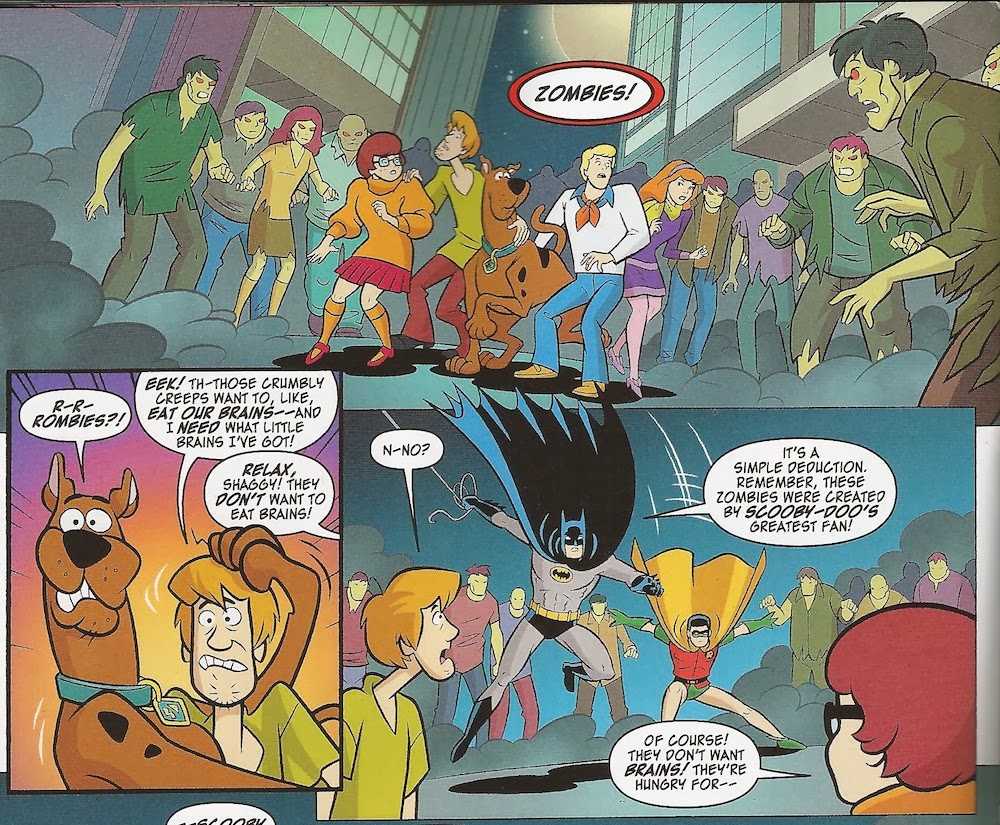
Surprisingly though, Sholly Fisch's latest is pretty amusing.  That's because Fisch takes the logical next step in a shared world whose inhabitants include Batman, Robin, Scoob and the Gang and cosmos help us all Bat-Mite.  It also doesn't hurt one bit that Dario Brizuela provides elegant artwork that's perfect for the cartoony and the slightly more serious. I'd love to see him on a Batman all-ages title.


Loki's second mission for the All-Mother coincidentally ties in with Marvel's Agents of SHIELD on ABC.  The trio of goddesses send Loki to fetch former paramour and all around trouble maker Lorelei, who appeared in the cliffhanger last episode of SHIELD.  

Loki finds his quarry in a Speed Dating bar, but humorist Al Ewing cons the reader into accepting things at face value.  Loki begins palming the pea by relating a story within a story.  Loki caught up in with Lorelei in Las Vegas.


How I wish this was the basis of Catwoman.  Ewing even calls Lorelei's crimes a heist.  A combination of Charlie's Angels and the excellent Now You See Me, the story takes another little twist when Loki pulls off some classic switches and terrific little scams.  

At the same time, Ewing introduces engaging new characters and once more emphasizes Loki's want to change from cackling evil to bona fide trickster.  Lee Garbett and Nolan Woodard accompany Ewing on this journey of redemption, and they do so with a light touch and sublime lines that impress with a perfect handling of subtle comedy in a realistic backdrop of artwork.
  

Last but not least, Jesse Leon McCann returns to cartoon spin-offs with Futurama Comics.  The crew of Planet Express all catch a cold, leaving Bender in charge of the ship and delivering the packages.  What could possibly go wrong? So much that the Professor decides to make a deal with the devil in order to return to youth, giving his brain a jog in order to discover the cure for the common cold.


In Futurama, the devil is a robot, but all the good rules still apply, the Monkey's Paw gotcha and the ever important signing the contract in blood.  
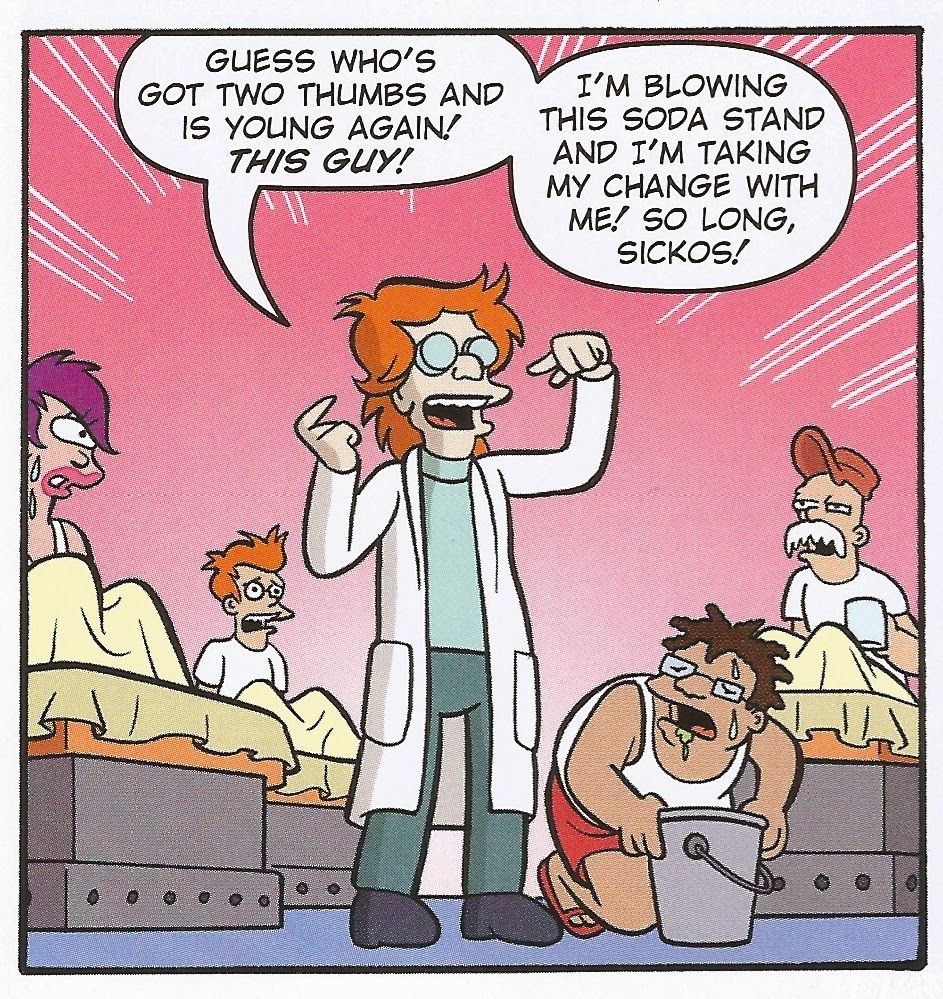


Now, young again the Professor and Bender take on Las Vegas, but the devil follows, skulking like a vulture to snatch the Professor's soul.  

McCann's story is a riotous romp in which the Professor beats the devil, returns to the wrinkles and saves the world.  One of the more unusual twists McCann plies pays Bender back in kind, and the clever but insane means in which the Professor beats the Robot Devil jibes right along with the zaniness of the television series.

James Lloyd, Andrew Pepoy and Nathan Hamill bring the whole cast to life in the panels, and when I say whole, i mean the entire populace of New, New, New York.  


The sight gags which gravitate around Bender are laugh out loud funny, and the judicious slapstick is a hoot.  In addition, the artists draft some genuinely beautiful scenery that you wouldn't think to see in a funny book.


Tuesday, February 11, 2014

POBB: February 5, 2014

Pick of the Brown Bag
February 5, 2014
by
Ray Tate

The Pick of the Brown Bag is a weekly blog where I choose the best and worst of comic books on the rack.  On today's docket Action Comics, Baltimore, Batwing, Forever Evil, The Fox, The Movement, Painkiller Jane, Swamp Thing and new books Loki and Ms. Marvel.


The Fox concludes its bizarre Diamond Queen story in which the multifaceted beauty transported Paul Patton to a surreal world run by an evil Druid that bewitched her King.  The Fox isn't the first hero to walk in the realm.  As a result, the story excuses a Red Circle team-up.  

I get the feeling the tale was meant to explain the absence of the Red Circle heroes from the comic book racks.  It's essentially what the Time War is to Doctor Who.  The writers though quickly hedge their bets by demonstrating that time and space does not flow quite so linearly in the diamond dimension.  Thus, a year in weirdsville is only ten minutes in our world.


Dean Haspiel's and Mark Waid's Fox is essentially by-the-numbers fun albeit with superior artwork, but actually Haspiel and Waid take a few leaps that must be lauded.  For example, the Red Circle heroes distinguish themselves with an attention to previously taboo subjects.  


It's not a huge move considering the people behind Archie Comics introduced Kevin, a wildly popular gay character who genuinely broke new ground in Riverdale.  Still, the diversity is a nice touch.

This issue also surprises with technique.   The Shield stars in the the back story.  The major powers battling for the earth in World War II get representatives, and these avatars of Allied Forces, Nazis and Japanese battle a foe that judges humanity, not just the Third Reich, as a weed to be eradicated through its own machinations.  It's a remarkably cynical aspect from a patriotic hero's tale and sharply contrasts the theme of love in the main story.


Jimmy Palmiotti's and Justin Gray's Batwing shakes off Gothtopia for a straightforward vigilante-hunting-loved-one plot.  Eduardo Pansica is also back on art duties.  So, it's a fantastic looking book. 

Gray and Palmiotti better establish Batwing as a Gotham fixture by bringing in Commissioner Gordon to referee the proceedings.  He doesn't make that much of a contribution, but it's nice to see him in a book where he's not trying to kill Batgirl or deck Batman.


The writers further cement the status of Batwing in a scene where he's mistaken for the more recognizable Batman.   This scenario also allows Palmiotti, Gray and Pansica to flex their funny bones.  The gangstas sound a lot like a low-tier comedy troupe, albeit armed and semi-dangerous.  Batwing puts them down with absolutely no problem, but his viciousness exemplifies the sincerity in his pursuit.  Had not a family member been taken, Batwing probably would have had some laughs and taken his time to defeat the hoods. 

Batwing shows no signs of fatigue.  I wonder if our hero will be taking Nightwing's slot in the Batman Family after Forever Evil ends.  The Year Zero issue established that Batman knew Luke Fox when young.  He also fought beside the youth.  Fox was also Batman's first choice for Batwing.  Hmmn. 


I have no interest in The Movement.  I tried the premiere, and the rodent king turned me off. Vampires control vermin.  Not heroes. The rest of the cast didn't interest me either.  However, Batgirl guest-stars in the story, and I wanted to give Gail Simone another chance to prove that she can still write the Darknight Daredoll.  I will say this.  Batgirl is a lot lighter here than she is in her title book.  


Last I saw she was moping around, if not outright weeping, over the fate of Ricky, the would-be car-jacker with a heart-of-gold and no prospects what-so-ever.  Oh, and her Dad, the Commish, literally wanted to kill her since she sent psychopath-with-a-heart-of-gold James Jr. to his spinal snapping, that is eye-stabbing, demise.  Here, Batgirl's positively quippy, oh and drawn perfectly.


Batgirl travels to Coral City to hunt down a fugitive.  The U.S. Marshals' service in the DCU is apparently as effective as its constabulary.  The murdering-bastard-with-a-heart of gold however is under the protection of the Movement, who also foster one of Batgirl's rogue's gallery.


I'll give Simone this.  
She knows Babs' got legs and knows how to use them.

Katharsis is one of Knightfall.  I'm trying to remember if the winged menace was in the debut of The Movement or not.  I know she didn't register, and that's probably because Simone scrubbed her villainous personality.  Here's how Simone characterized Katharsis in Batgirl.


Keep in mind that Katharsis "marked" a mostly harmless sad sack that's missing his leg from the lower calf down.  One marvels at exactly how this scene played out.  "Hey, kid, I'm sorry about the leg.  That was evil, but I'm just mean.  So, I'm gonna scar your puss a little.  You might need plastic surgery when I'm done, but at least I'm not going to set a bear trap to take out your other leg. Yeah?"


In The Movement, Katharsis is just a bitch who has a severe problem with Batgirl.  She's half a step away from being the Cordelia who trips a book laden Babs in high school.  

So, did The Movement convince me to return to Batgirl? No. Just because Babs is normal here doesn't mean she's better in her own title.  Simone's lack of consistency with Katharsis convinces me that she doesn't keep notes, and that she might in fact unwittingly plague Batgirl with mood swings.  One moment, she's a sobbing Ninja who refuses to wear the bat symbol.  The next issue she'll be the Darknight Damsel we all know and love.  Frankly, Simone is just a sloppy writer, and I'm starting to think those two wonderful opening arcs of Batgirl were the exceptions, not the rule.


Tom Taylor's Earth 2 is engrossing.  The story advances along nicely, and the characterization of Batman and the rest of the Earth Two champions entertain to no end.  


Barry Kitson is what's different about this issue of Earth 2.  I was lucky enough to meet the man at the Pittsburgh Comicon last year; yes, with great reluctance, I gravitated away from Daphne Ashbrook.  Kitson was kind enough to illustrate a Black Canary bust for me.  You can see the image below the reviews.


Barry Kitson's actually fairly unfamiliar with these characters.  He's an old school type of guy, but he does a bang up job visually representing the heroes' personalities and powers.  He nails their costumes.  It also looks like he was enjoying himself immensely when depicting Marella, alias Aquawoman.  His manifestation of the elements is absolutely breathtaking.  You just sit back and go ooo.


The inks by Robson Rocha and the colors by Pete Pantazis enhance the pencils.   However, at the con, I watched Kitson complete a nearly all-day fully costumed Azbat.  I can guarantee that the fluid movement and depth of the water had already been incorporated in his originals.


Kitson next wowed me with his visual narrative of Lois Lane convincing Val the young Kryptonian to step out into the sun and gain his birthright.  Lois is dead on earth two.  Her mind lies in the circuitry of the Red Tornado.  

Kitson's depiction of the gamut of emotion at play through the panels is really beautiful.  It's even more impressive given that he really doesn't have a lot to work with.  The body housing Lois' mind isn't quite as featured as a human face.  Kitson however rises to the challenge.  

No bones to Nicola Scott, Earth 2's regular and remarkable illustrator, but I really wouldn't mind seeing more of Kitson's work on the title.


Greg Pak is turning out to be a helluva Superman writer.  For his run, he reintroduced Lana Lang to the mythos.  She's an electrical engineer in the new 52 and confidante of Clark Kent from Smallville.  She knows that Clark is Superman.  While working on a new power complex, Lana discovered a monster, and Superman quickly darted in to take care of the fellow, just not in the way Lana and the others believed.


Superman saw himself in the misunderstood monster, and that self-reflection paid off.  The creature metamorphosed into the little guy clutching onto Lana's leg.  The trio delved into a lost underworld, and here Aaron Kuder went nuts, creating numerous species and characters as if there were no tomorrow to read about them.


Still in the under world, Superman and Lana meet the Queen.  You know that if she were sealed up.  Something must be rotten, and Pak will get to that in surprising turn after turn of events.  


Pinned to all of this goodness, the interaction between Lana and Clark forges history from scratch.  The byplay between the two Smallville denizens reads genuine, and their humor bridges a masterful comprehension of what makes these characters tick.  Pak couldn't have done any of this in the post-Crisis.  Lana's character there was static, and Aaron Kuder's artwork is too outside the concept of painted musclemen and gravity defying beauties to be welcomed.


Forever Evil is a weird one.  Lex Luthor and his team of super-villains collude with Batman and Catwoman.  Sinestro, with extreme prejudice, deals against Power Ring, and the Crime Syndicate appears to be splitting at the seams.


Geoff Johns' latest reads like an episode of Challenge of the Super-Friends, if broadcast on prime time television.  There's oodles of death and ghoulish violence in these pages, but you cannot get worked up about it.


All of it is at the expense of the super-villains of the DC Universe, and there's a certain bit of black comedy in the murders, especially for somebody who follows comic book history.

These elements Johns juxtaposes against antagonists who really sound like their old selves on Saturday mornings.  This is especially true of Luthor and Black Manta.  Don't care if the latter is black.  Here, he sounds like Ted Cassidy enhanced by that tinny echo effect that the makers of Super-Friends employed.


How many times have you asked.  Why doesn't a comic book company produce a comic book that actually mirrors what occurs in the offshoot movies? Ask no more.  Loki is that comic book.  

Loki is no longer the evil, cackling bad guy of the Stan Lee/Jack Kirby originals.  Instead, he's Tom Hiddleston portraying secret agent Loki.  This works.


If you're asking how does Tom Hiddleston's super-spy Loki jibe with the films, well...In Thor: The Dark World, Loki reveals that he doesn't hate Thor, and he loves his mother, who showed him only mercy.  He hates Odin.  So, in the film, Loki allies with Thor for reasons I won't spoil here, and he also promotes his own agenda that will allow him to one-up Odin.  Still have doubts? Look who the Avengers are.


It's true that Iron Man's color scheme is all wrong, but Marvel thoughtfully brought the Avengers from the movies in to confront Loki.  They all in fact behave like their movie counterparts.  Hawkeye and Black Widow for example just hang out.  None of their past history is ever broached.  You wouldn't know that Natasha was a former Russian spy who seduced Hawkeye into going up against Iron Man.  These two are the SHIELD agents.  Everybody likes the Hulk.  In fact it's only when Al Ewing brings up past Big Stupid Events that the book chimes a false note.  

To be fair, Ewing isn't trying to erase Marvel history.  Loki is.  It's how he's paid, and that's a real clever premise.  Loki doesn't actually want to be that maniacal character of old.  He wants a fresh start, and he's a god.  So by golly, why not?


Given this really funny Loki story, it's easy to overlook Lee Garbett's contribution, but Garbett's art goes a long way to sell Loki's earnestness.  He makes Loki such a young, molded in the image of Hiddleston figure that you can't help but to accept him.  You find yourself even wondering why the Avengers have such angry bees in their bonnets.


Ms. Marvel has been getting a lot of attention for its depiction of a Muslim heroine, but really this is just the old Marvel Spider-Man love of a young, outsider gaining superpowers. It's a good solid read, but it's not actually as groundbreaking as a lot of people claim.


Our protagonist isn't a fundamentalist because heroes can't be.  It doesn't matter what religion.  A fundamentalist Christian can be just as terrifying as a fundamentalist Muslim or Hebrew.  Christian terrorists and Muslim terrorists are just terrorists, and even that is a little lofty a definition.  Terrorists are just plain murderers.

Kamala's a teenager with a moderate Muslim upbringing.  Her father is a businessman.  Her mother is a little shallow in her depiction.  So, I can't really pin-point her.  Her brother is essentially a Muslim hippie.  He's using the faith for his own inaction.  Her sister is a little more reverent to her culture.  Kamala has a Flash Thompson as well.  The rest of the jocks are morons.

A few Buffy the Vampire Slayer nods foreshadow the picture of the independent female super-hero to come.  While cues to Bollywood offer a singular, inviting goofiness.  There is one sharp difference that I don't believe will benefit the future of the character's staying power.  

Spider-Man's origin is a streamlined classic.  Peter Parker gains the hair of the radioactive arachnid that bit him.  Reduced, the original Ms. Marvel is the product of accidental exposure to an alien device, but the new Ms. Marvel's origin is tied to the exposure to Terragen mist.  The problem is that she shares the origin with others.  I would have preferred something unique to her to bathe her in super powers.


This is the stuff.  Painkiller Jane concludes with a satisfying conflict of character that manifests in a violent duel to the death.

Jane of course survives the fight.  Her hyper healing factor kicks in, but Palmiotti demonstrates that there are fates worse than death for somebody who can survive almost any damage.

When Jane recovers, she displays her detective skills, tracking down the absconded Princess Poonwalla and lover Tony, her bodyguard.

Palmiotti has balls for identifying the tradition in the plot, and it shows he's not frightened of recycling.  So long as it's done in an interesting way.  The simplicity of the gist allowed Palmiotti to play with Jane's characterization, identifying what kind of woman she is; revisit her history with Maureen, her best friend and police "handler"; add modern twists to generate freshness in the tradition and much more.

The new life of Painkiller Jane as an Icon imprint hits just the right mature tone for pulp readers and artist Juan Santacruz is comfortable when depicting anything Palmiotti throws at him or Jane.


Writer Charles Soule splits Swamp Thing with two tales.  He opens the book with the aftermath of Alec Holland's attempts to free himself from the Green and resume his position as Champion.  In order to do that he lulled the Green into dormancy and beat the crap out of his successor.  This leaves him three very rusty former Champions on his hands, and now they have regained their humanity.


The second story reveals the origin of Capuine, and it's a classic that's nevertheless well told and gorgeously captured by Javier Pina.  Capucine is the second new 52 protagonist that's tickled me.  Starling was the first.


Mike Mignola and Ben Stenbeck conclude the first chapter of Lord Baltimore's life with vampire slashing and the reaffirmation of a codependent relationship between vampires and humans that almost seems natural. 


Mignola's conclusion also kicks off the second part of Baltimore's story by manifesting the image of the Big Bad hinted at in the Infernal Train.  He and Stenbeck conclude the tale with one of the most macabre moments in horror lit, and it also serves as a startling finale that reveals Mignola's allusive inspiration for the whole of the tale.