Showing posts with label Malsuni. Show all posts

Tuesday, March 3, 2015

POBB: February 25, 2015

Pick of the Brown Bag
February 25, 2015
By
Ray Tate


Leonard Nimoy died on February 27, 2016.  I share the sadness of millions of fans.  As a child, when watching Star Trek, I stuck masking tape to my ears to bring them to points.  I liked Kirk and the rest of the Enterprise crew, but I identified with Spock.


Leonard Nimoy was Spock, and without Spock, I would be a different person.  There is no doubt in my mind.  I grasped the fundamentals of logic and reason through Mr. Spock.  I also found myself expanding my vocabulary because of Mr. Spock.  To this day, anomaly is one of my favorite words.  

I owe Leonard Nimoy a lot.  So, in his memory, I will try to “live long, and prosper.”  I will continue to be ever logical, but not forget my human side when appropriate.


Welcome to the Pick of the Brown Bag.  This week I review Aquaman,  D4ve, Django/Zorro, Futurama, Joe Frankenstein, John Carter: Warlord  of Mars and The Phantom.   But first...The wait is over, people.  Spider-Gwen is here!  Let me just say, right off the bat.  I love that Marvel actually christened the book Spider-Gwen.


Gwen Stacy  also known as Spider-Woman returns to her alternate universe.  Nothing much has changed.  J. Jonah Jameson still blames her for the death of Peter Parker.  She's wanted by the authorities.  Her father, Captain Stacy, who discovered her identity in the premiere, wants to talk about these developments.  The Mary Janes, who consist of Glory Grant, Mary Jane and Betty Brant, took their hit single "Face It Tiger, You've Hit the Jackpot!" off the charts.  Gwen won't have any part of their fame if M.J. has anything to say about it, but the group's experiencing problems replacing Gwen's expertise at drumming.


If you missed out on The Edge of the Spider-Verse one-shot that introduced the welcoming world to Spider-Gwen, you need not fear.  Writer Jason Latour frames the status quo with Gwen using her spider powers to crawl around the edges, as quietly as her namesake, to let the reader eavesdrop and introduce new characters like Randy Robertson, son of Daily Bugle editor Robbie Robertson.


Simultaneously, Latour segues through cell phone to distinguish this universe farther.  After dirtying Matt Murdock in the debut, Latour places Foggy Nelson in the District Attorney's office and brings in a surprising change that will definitely make things interesting if not hazardous for Spider-Gwen in future issues.


For Spider-Gwen's first official issue, Latour and returning artist Robbi Rodriguez pit the Vulture against Spider-Gwen.  The duo go back to the basics of Adrian Toomes.  He's old.  He's vicious, and he's almost not human, with Rodriguez adding a grotesque nuance to his features.


Spider-Gwen sees the Vulture's rampage as an opportunity to clean up her image.  That's not an entirely altruistic rationale for going after the Vulture, but Gwen is still new at this.  Furthermore, she's just found out that she's not alone and that the various worlds can be quite receptive to some of her fellow Spider-Men.  Nevertheless it's brave to show Gwen without heroic purity, and it hearkens back to some issues spotlighting Spider-Man’s mortal flaws.


As the self-appointed Archduke of Arizona ponders what happened to his pigeon LeQuint, Don Diego de la Vega sends Django out on a fact-finding mission.  


Django doesn't quite know what to make of his current employer. After seeing Zorro threaten LeQuint, thus necessitating the Archduke's backer's swift retreat, Django begins to connect the two.   


As Django speaks with the railroad workers, Zorro stirs the masses with a rousing speech on justice, and that’s really just for starters.

Django Zorro is the team up you’ve always wanted but you didn’t know possible.  It’s Quentin Tarantino bringing his inimitable style to the pages of a comic book, along with no slouch Matt Wagner.  Zorro and Django as a result sound like the real deal, and they ply their trade in a history lesson of the haves and have nots. 

The Archduke appears to be based on the historical personage James Gadsden, a racist Army Officer from South Carolina who was responsible for numerous Native American displacements.  He became the President of the South Carolina railroad company and attempted to build a railroad through the Southern territories, which is the similar setting here.

Tarantino and Wagner naturally pull in some common racism against Django, but nothing like what he faced in the film Django Unchained.  For one thing, Django has a champion in Don Diego, and for another, Django is full on bounty hunter.  In addition, the twit from Richmond is all by his lonesome.  So this latest Django excursion is a trifle calmer and less brutal.


The current issue of John Carter Warlord of Mars relates how Edgar Rice Burroughs gentlemen, ex-Confederate Virginian meets his opposite number in blue coat homicidal maniac Joshua Clark, the creation of Ron Marz and artist Ahbishek Malsuni.  The lion's share of the story is therefore one hellacious sword-fight superbly choreographed Malsuni. 


Inker Zsolt H. Garisa had his work cut out for him, but shadows and light along with the hues of Nathan Jamberi emphasize detail and symbolic color schemes over traditional grit and despair.  

Some may take offense at turning historical bloodshed into entertainment, but this is a comic book, and there's supposed to be a motif of swashbuckling.  John Carter isn't about the Civil War.  It's about the title character and his sense of honor.

In addition to the duel, Dejah Thoris caught in an escape attempt exhibits her strength of character, which sets up an execution or a daring rescue at the cliffhanger.  I'll let you choose the most likely candidate.

Two classic characters return in different roles as the Phantom contends against the Singh Brotherhood.  There's not much I can say about the latest from Peter David and anatomist Sal Velluto without spoiling the identities of the guest-stars.  

Suffice to say that, you can judge by the cover that David positions these characters as an alternate Tarzan and Jane.  There are some amusing distinctions however.

The presence of Falling Water in the middle of the jungle is a pretty good joke, as is the twist on Tarzan's hidden escarpment.  David's contrast between the Phantom and Diana relationship-greetings with the de facto Tarzan and Jane is extremely amusing.  On the other hand I felt the animosity and jealousy the Phantom displays over the Tarzan was over the top.  Still, it's difficult to complain about a book with this kind of action.


Aquaman locates his mother Atlanna, but it's far from a happy reunion.


Jeff Parker and Paul Pelletier bring another awesome issue of Aquaman to the racks.  The story is filled with action and terrific illustration of a  Pellucidar type lost environment ruled by Atlanna.


Parker reintroduces the mythology of the purple-eyed outcasts, which played an important role in the formation of the former universe's Aqualad.   He also starts to smooth out the history of Atlantis by giving Atlanna a strong point of view, and a stronger sense of justice.  Mind you, she might have gone mad.


Also interesting is her expression of love for Aquaman's father.  I didn't really expect that given the iteration of a usurper dynasty in past issues.   I anticipated instead a mating of convenience, but it seems that Atlanna possessed true feelings for Aquaman's surface-world father.

Aquaman takes drastic steps to survive in a one-sided battle, and these moves are surprisingly underhanded, especially for a shiny hero.  That just builds on Arthur’s character as a tactician and King.  Mera also gains good dialogue and moments as she for once holds back her might to keep from denting her mother-in-law.  An excellent issue that’s over far too soon.


A pizza delivery boy, shades of Futurama, finds himself at first in what he believes a porno situation.  


Looks like Joe forgot his Star Trek..  Any strange woman on an alien planet not first met by Kirk or Spock is ninety-percent likely to be some sort of vampire.  Fortunately our pizza boy has a guardian angel that he never knew about.


Former Detective Comics partners Graham Nolan and Chuck Dixon, team-up once more for the latest reiteration of Mary Shelley's Frankenstein.  The monster in the novel lives up to its sobriquet.  Despite exhibiting early moments of conscience, the nameless creature in Shelley’s novel is ultimately cunning and murderous. 

Boris Karloff's performance as the simple, misunderstood beast helped set the public's mind.  Frankenstein's Monster was now a sympathetic being, and even a tragic hero in The Bride of Frankenstein who absolves his creator from blame.  It was a short road from there to the jovial good-natured Herman Munster to the downright heroic Agent of SHADE.

So how does Dixon's and Nolan's twist on Frankenstein’s creation stack up?  Quite on par with other beneficent creatures and benefiting from a focus that turns the Universal sequels upside down.  Turns out there was a reason for all those Frankenstein descendants meeting the monster.  In short Joe Frankenstein is a lot of fun and an excellent addition to the collections of Frankenstein freaks.

Ian Boothby crafts a book-length adventure in Futurama by destroying the What-If Machine, and unleashing a whole lot of reality-bashing confusion on New New York.


The narrative follows Fry and Bender, the only crew unaffected since they were present in the eye of the storm, trying to recover pieces of the device to reconstruct all and restore the continuity line.

Boothby's science fiction plot is actually better than than the jokes, which are pretty hilarious to begin with.  For example, the denizens find themselves transformed into Pooh characters.


Some of these gags however could be lost on newbies.  A lot of the amusement arises from twists in characterization and stories from the television series.  Whatever your comfort level, the plethora of imagination evident in the artwork by James Lloyd, Andrew Pepoy and Robert Stanley, is an immediate draw.


D4ve is a cross between The Terminator and Tony Isabella’s and George Perez’s short story "War Toy" from Marvel's Bizarre Adventures.  Humans built the machines and without John Connor, the machines took over.  However, they were not alone.


The robots defended their newly won property, but now, things have quieted down.

D4ve has gotten some rave reviews, and it's all right, but it's not laugh out loud funny yet.  Things could change, but for now the most interesting thing about the book is the idea of robots becoming human out of habit because they have no other role model.  That said.  A lot of the stabs at comedy such as robot strippers, robot Gone With the Wind have been done, to better effect, on Futurama.



Wednesday, November 12, 2014

POBB: November 5, 2014

Pick of the Brown Bag
November 5, 2014
by
Ray Tate

This week I review Angel and Faith, The Death-Defying Dr. Mirage, Detective Comics, Earth 2, John Carter Warlord of Mars, Scooby-Doo Team-Up, Swamp Thing and Vampirella.


I once described a writer’s premise as being the equivalent of getting down on one’s knees and serving a Big Stupid Event.  Previously I had expressed a lack of appreciation for another writer masturbating over Airwave as a Big Bad moved the moon, which also happened to be, at the time, the home of Justice League headquarters.  “Oh, thank god.  Airwave is here!”  No.  When somebody moves the moon, you want Superman, not a dude that can merge with radio waves.

Well, my friends, what we have from Earth 2 isn’t quite so monumentally bad.  Oh, don’t misread.  It’s bad all right, but it’s more like the timid hand-job from a neophyte hooker/masseuse.  A shy little brush from a shaking finger tip, and the inexperienced worker satisfied her job is done.  What’s genuinely surprising is that it takes eight prostitutes to instill the feeling.  The colors also aren’t up to snuff, but I’m giving Pete Pantazis a pass because he probably threw up a little in his mouth when he saw the mess he had been asked to finish.

It’s difficult to support a title named Earth 2 when in fact the story occurs on four different planets: Czarnia, Warworld, Apokolips and Mars.  Yes, I know technically this is really the Earth 2 universe, but up until now all the action astonishingly enough took place on earth-two.  The threats were directed at earth-two, and the characters all arose from earth-two.  Even earth-one visitor Mr. Terrific was quickly waylaid by Terry Sloan, n’er-do-well of earth-two.


So the book opens on Czarnia where only Lobo has a name.  To be fair, perhaps the female protagonist's real name is in fact Girl, and in the native tongue, Girl translates to “I Spit on Your Czarnian Grave.”  


I don’t actually believe that the lack of naming Girl is a sign of sexism.  Rather, it’s a symbol of overall writer and editorial torpor.  They didn’t name name names.  I will.  Tom Taylor.  Marguerite Bennett.  Rickey Purdin.  Eddie Berganza.

So, there’s a pox spreading through the lower castes on Czarnia, and Girl happens to be part of that caste.  Lobo of course is the Main Man and he can’t be anything but above the caste he nevertheless consorts with.  The Girl, not even the Main Girl, on the other hand gets busted when trying to steal medicine for her dying parents.  This places her in the hands of…

No-Name Bitch.  We must credit the artist for this memorable bit of body language.  Even though No-Name Bitch doesn’t have a name, you can tell that she is in fact a No-Name Bitch by the way in which she comports herself.  The rest of Alison Borges’ work is illustrated from unconvincing angles and apparently designed to hide detail as well as the speed she found herself forced to attain.  All this for a mishmash of inexcusable expository excrement.  Not even for the benefit of the regular superhero cast—who do do not appear—but for ciphers we care nothing about and emanate lethargy.

No-Name Bitch convinces Girl to carry the plague to Apokolips.  What puzzles me is why they would even think that the plague would affect the New Gods, emphasis on Gods.  Even if you thought them only to be long lived aliens, the long living should have clued you into the fact that these aliens are tough, and it’s going to take a little more than Girl with a case of the sniffles to stop them.  She doesn’t, and Apokolips suggests a more beneficial proposal.

For everybody that pined for Warworld.  Here it is.  Suddenly, you realize that this piece-o-shit story is really an anthology of anus.  The second short takes place on Warworld, which is at least drawn with some enthusiasm by Trevor Scott.  It’s not written an iota better, but at least it’s prettier.  Mongul hosts Steppenwolf at the games where a Big Yellow Female Muppet Thing kills and eats her victims.  


Once again, we’re not given a name.  Events transpire badly for Mongul, but is that really surprising?

The tedium continues with a trip to Apokolips and Big Barda, who has yet to fall in love with Scott Free.  She therefore has the substance of a stale wedge of sponge cake.  You could easily replace her with Girl in fact.

In a twist that’s so ingenious it may make you yawn, a child rockets to Apokolips and kills a slew of Parademons.  Rather than murder the tyke, Barda inducts the child into the ranks of Granny Goodness’ Furies.  Finally, we get some names.  Not that it matters.  Ohhhh, I get it.  The writers are agreeing with their audience that the names of these characters do not matter since they only serve as one-dimensional functions.  They add to the emptiness of the book.  Earth-2 is actually jejune French existentialism.   Screw you.

The story continues to shlep forward where Betta, the Orange Little Bastard, murders somebody in every other panel.  No, this is not as exciting as it sounds because first, you have no reason to root for Orange Little Bastard because even though he has a name, he may as well not.  Second, this is not the well-focused choreographed mayhem of a Liam Neeson or Jason Statham film.  Rather it’s a perfunctory measure to lamely disguise the Trojan Horse artifice that’s engineered to suck up three dollars from each pull list.  

In the final story, Darkseid gets it on with a nameless Martian woman.  Do not buy this even if it drops to a quarter.  The eighth of a stroke wasn’t worth a dime.  You end up instead frustrated and cheated. 


Scooby-Doo Team-Up on the other hand is the perfect meeting between Scooby and the Gang and the Flintstones.  Sholly Fisch doesn't miss a beat and proves himself a student of Flintstones continuity.  Using a prehistoric time machine, Professor Einstone--a stone-aged pun right up there with Ann-Margrock--transports Daphne, Fred, Velma, Shaggy and Scooby to Bedrock.  Einstone knows Fred Flintstone and asks for him to look after the kids.  Fred is only too happy to be host.  

Scooby-Doo exists in the real world.  That is despite Scooby learning how to speak human, the Gang live in a world that mirrors our own; which is why their detective stories work.  Science trumps all, and magic doesn't exist.  That said.  The Flintstones live in a topsy-turvy world where mammals and dinosaurs live together in relative harmony.  A blatant fallacy.  

The Flintstones and creationism have been linked before, but it's important to remember a few items.  The Flintstones existed as a concept before creationism which occurred in modern form no earlier than the seventies.  The creators of the Flintstones only had one goal, make you laugh.  So lighten up.  Enough.  Let's not talk about the supposed implications.  Let's talk about the plot.  It's a classic.


This is when Fisch really shines.  He uses the underlying theme of gender battles in The Flintstones--high-minded albeit prehistorically nuanced motifs versus low-art past times namely bowling--to set up a brilliant mystery that blatantly sets Fred up as the most likely suspect.  Fred in fact saves the day with his particular skill set.


Fred's twinkle-toes moves put the capper on perfect, on-model art by Scott Jeralds

Before we get to the main gist of the plot, the creators lavish a number of culture clash jokes on the audience.  They  furthermore relish a barrage of more characteristic humor from the cast, and the way back home, which alludes to the continuity of the team-up title itself, calls up a brilliant cameo appearance.  If you have fond memories of Scooby-Doo, Where Are You? and The Flintstones, you need this book.

Unfortunately, the serious-minded Detective Comics is an annoyance.   Batman, succumbing to a genetically engineered virus, drifts through Gotham International Airport in an attempt to find a cure and the culprit behind the infection.

To do this though, he needs to call Grayson, a gratuitous cameo if I ever saw one.  Worse, writer Benjamin Percy portrays Grayson as a James Bond type who seduces in order to get the information.  Frankly, if Dick Grayson were real, I don’t think he could seduce a mannequin let alone a breathing woman.  I've never understood the need to make Dick Grayson a lothario, and the new 52 gave us puzzled readers one of the greatest gifts of all.  A sander for Grayson's bed post.

In any case, The World’s Greatest Detective shouldn’t have needed help figuring out that the virus maker was in the airport.  That’s not really a spoiler.  “Terminal” isn’t a true detective story.  It’s more of an idea under development that just got the green light because DC needed some filler.

The best part of Percy’s tale occurs when Batman does something nice for Gotham International Airport’s Chief of Police, a fellow virus victim and simpatico cop.  Paul Leon’s dark artwork suits Batman to a tee, but you can do much better than this, especially when presented with a four dollar price tag.

Angel and Faith on the other hand is good, solid entertainment from Victor Gischler and Will Conrad.  Our heroes are still worlds apart.  Angel plies his trade in the magically infused London.  The story opens with his being beset by murderous dreams.


I have a suspicion of what’s happening, but I’ll keep mum about this.  Fortunately there’s much more going on to talk about.  Amy Madison came to Angel to help her dead boyfriend Warren out of a jam jar.  I went there, and I'm proud of it.

Angel’s answer is really wonderful to read.  I can just imagine David Boreanaz reading these lines and performing in the way Conrad imagines him.


While Angel battles Amy in London, Faith supports Sam, Riley’s wife, in the jungles.  Now a jungle trek can be boring, but Gischler uses the opportunity to craft some really rich dialogue for Faith’s attempts to atone for past transgressions against Riley.  Mind you, boinking him while inhabiting Buffy’s body is probably the nicest bad thing she could have done.  I do understand how she feels, that she used him, and I like the interaction between she and Sam.  It feels honest.


Nancy Collins concludes the Umbra saga in Vampirella.  The Cult of Chaos chose Ella, how Vee refers to herself, to host the evil goddess Umbra.  She had no say in the matter and has been killing vampires under the direction of her half-brother Drago to gain the strength to fight the curse…or so she thought.  Slight spoiler ahead.  If you’d like to be surprised and take my word for it that this issue of Vampirella is worth adding to your collection.  You may cease reading….now.


So the battle begins, and it’s a good one, imagined well by artist Patrick Berkenkotter.  I like furthermore that it’s not a drawn out affair.  The duel is quick and to the point.  

The climax isn’t the outcome of the fight.  Ella still has much to do.  In order for the ritual to be complete, Ethan Shroud must exploit the body of a father to sacrifice his daughter.  This is what started the whole ball rolling in the first place, and trust me when I say that Vampirella’s journey isn’t an easy one.

Collins reminds readers that Vampirella made enemies out of the people she once served, and that her series is an advent to a new direction in the mythos without shrugging what went before.  Instead, Collins uses Vampirella to expose the hypocrisy of the Church, and in my opinion, she gives Ella a moment, again perfected by Berkenkotter, that’s much more powerful than her nevertheless impressive battle against Drago.  I knew Collins on Vampirella would be an ideal match, and I haven’t yet been disappointed.


Likewise for The Death-Defying Doctor Mirage.  I’ve enjoyed Jen Van Meter’s Cinnamon reinvention, but I’ve often had little interest for the Valiant characters.  I was never a fan of Doctor Mirage, but Van Meter reintroduced the character as a female occult investigator with true psychic gifts that tapped a seventies vibe similar to that of Dr. Michael Rhodes from Second Sight.  The artwork by Roberto De La Torre looked like an amazing homage to the style of Jim Holdaway from Modesty Blaise.  All of these factors made me interested in Doctor Mirage.  Reading the book just raised that intrigue to the power of ten.


Van Meter sets up Shan Fong as a forlorn widow taking up the mantle of Doctor Mirage to search for her husband Li Hwen.  In the process she gains fame as a demonologist, who doesn’t behave like a superhero and instead resembles an adventurer from a really good comic strip.  This story finds Shan under the employ of a millionaire who wants to be rid of his connection to a bound demon.  The trouble is that he’s part of a tontine, and the other members of the brotherhood don’t want him out.  Doctor Mirage travels the spirit ways to find a means to break the spell.

The story opens with Shan’s relating a tale from the past to ghost children who accept the fable as payment for their guidance.  There’s a lot of interesting tit-bits like that in Doctor Mirage. The idea that you can pay spirits or ghosts with objects of power or stories is a good one and sort of makes sense.  What good is money to the dead? Undead creatures that stalk the earth.  Sure, but the insubstantial hanger-ons are different matter.  The occultism of Van Meter’s worlds depends upon ancient rules that everybody abides by.  Through these devices Van Meter eschews the inherent omnipotence of hocus-pocus.  The gist of the tale relies heavily on these rules and demonstrates Doctor Mirage’s intelligence and adaptiveness.  It all leads to engrossing entertainment beautifully illustrated.


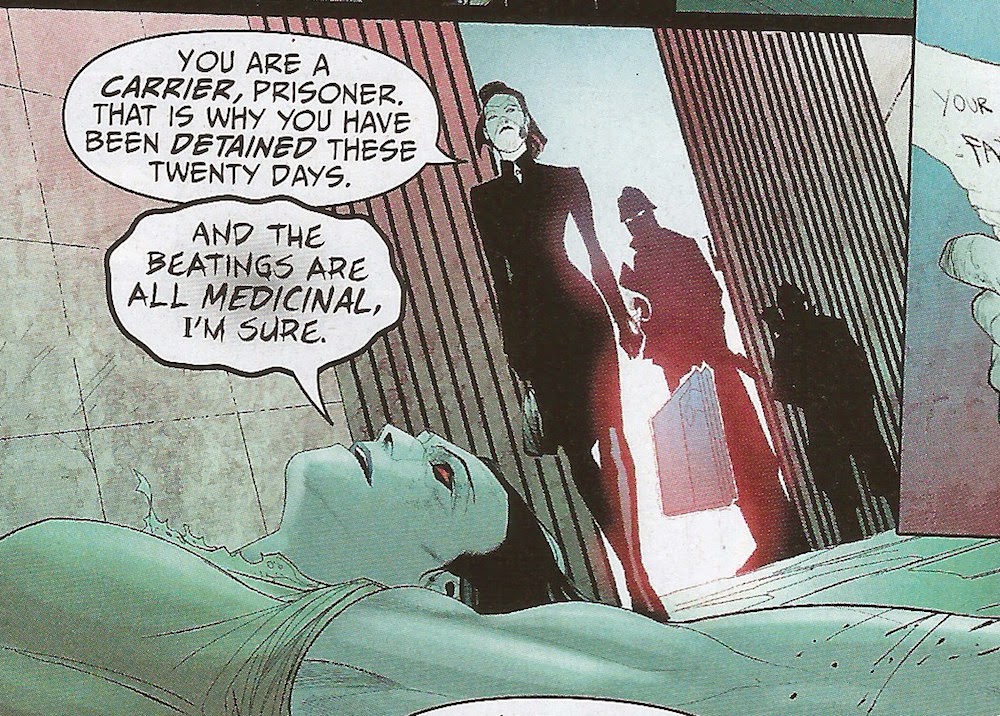
John Carter returns to comic books after a repellent debut some years back, but Ron Marz has got the stuff, and artist Abhishek Malsuni’s artwork graced by the gorgeous hues of Nanjan Jamberi is certainly apropos for the swashbuckling science fiction.  Mind you, Dejah Thoris is pretty damn bodacious.  

Whereas in the books, she’s portrayed as a petite woman due to the fact Red Martians reproduce by egg laying.  No joke.

Still, Malsuni’s sense of proportion is noticeable.  Maybe Dejah is a little larger than she should be, Maisuni balances out the breasts with strong depictions of sinew.  It’s probably wise of Marz to open the story with Dejah Thoris since she has actually been the star of Dynamite’s Edgar Rice Burrough’s Mars line and more familiar to faithful readers.

Marz’s story is full of pure pulp bravado, and distinctly flavored with John Carter’s prototype science fiction.  Marz details Carter’s abilities first through the words of his wife who a mystery villain targets with mind-worms that force her to tell the truth.  In a beautiful allusion to the sort of spice Burroughs imbued his Princess of Mars, she uses the assault to her advantage.


When the story shifts to John Carter’s adventures far in the deserts of Mars, the quality doesn’t.  There’s exciting swordplay, examples of Carter’s friendship with giant, four armed Green Man Tars Tarkas and his superhuman abilities that result from being exposed to a different set of environmental attributes on Mars, such as lower gravity.  Recommended.

Because it’s Swamp Thing, you really should just expect it’s going to be good.  The cover doesn’t do a bit of Charles Soule’s story justice.  

First of all, you immediately understand the importance of the Swamp Thing Annual in terms of continuity.  Readers who passed on that are going to find themselves slightly confused at the depiction of a transformed Capucine, and unlike the passive Parliament of Trees that Holland forced into dormancy, the feisty duelist continues to parlay with blades rather than speech.

These scenes are all due to the surge of a new Kingdom.  The Kingdom of Machines.  At first they seemed to want to strike a deal with Swamp Thing, but that turned out to be a con game.  So Alec has an offer for them.


Yeah! Swampy doesn’t for a moment believe that the Machines will honor any agreement so he prepares another contingency by meeting the Avatar of another Kingdom, The Rot.  This avatar happens to be his former lover Abigail Arcane.  The Machines’ fascinating attempts to harvest an avatar for themselves displays primo geek thinking.  Each candidate, a DC stalwart, is logically discarded.  


Swamp Thing is just a joy.  It’s everything that comic book readers want.  A strong hero.  A formidable supporting cast.  Monsters fights.  Unique science fiction ideas that masquerade as horror, and it’s all lovingly illustrated by Jesus Saiz.