Monday, September 10, 2012


Pick of the Brown Bag
September 5, 2012

by 

Ray Tate

Hello, and welcome to the Pick of the Brown Bag.  Thanks to a number of premieres and the infamous zero issues of DC's new 52, the yield this week is even larger than last week.  In fact, main competition Marvel Comics looks pretty anemic in comparison.

For once, the biggest news floating through the humanoshere, isn't the GOP's war against women, sexual orientation, science, or voters, nor is it "turbulent priests" molesting kids or trying to silence nuns.  No, today we turn to biology.  Mind you, former President Bill Clinton's speech at the DNC, was awesome beyond awesome.  It easily rates second place by a hair's width to this news item.

Scientists have discovered that eighty percent of so-called junk DNA in the human genome actually controls neighboring genes encoding for the probabilities of human disease.  These activated genetic switches amongst the "junk" are in fact stepping stones when explaining such things as why some people in the same family contract cancer while others do not.

"Junk" DNA is a frequent device used in science fiction to describe all sorts of maladies and mutations, but have no fear.  Few novels and television series need to be rewritten.  While eighty percent of the "junk" is actually useful, that still leaves creators with twenty percent of approximately three meters of DNA to play with.  For now. 

A more thorough foray into the findings can be discovered in the latest issue of Nature, and for a good overview, read the September 6, 2012 issue of The New York Times.  No subscription? Support your local library.

Fair warning.  I've decided to ditch the rating system.  I never used one when I first started the POBB on the usenet back in--geez, am I that old?--and it's just a little ridiculous.  I know some people like some shorthand for whether or not to buy a book, but honestly, if you can't figure out what I like or dislike from the first few paragraphs then I'm not doing this properly.  Oh, occasionally, hopefully only occasionally, the kick to the groin rating will reappear.  I kind of like that expression of misery.

Far From Zero

In general the zero issues of DC Comics present heretofore unknown facts about the origins of our favorite heroes, review those beginnings and/or paint the landscape of the new 52 in less abstract brushstrokes.

Ann Nocenti adds a prelude to Green Arrow's marooning on the island in which he sharpens his skills.  The incident on the oil rig draws in the fallibility of the Green Arrow from the seventies, but doesn't do much else.  

During the Denny O'Neil and Neal Adams run, the Arrow accidentally kills a criminal.  Green Arrow's guilt over the criminal's death sends him into a deep spiral of despair.  He renounces his superhero status, destroys his equipment and gets thee to a monastery.  

Nocenti uses the new 52 Arrow's miscalculation during a hostage siege to motivate the hero he will become.  Freddie Williams provides decent if busy artwork but Green Arrow is really only a supplemental purchase.  Likewise for Animal Man and Swamp Thing.  

Animal Man doesn't cover any new ground, but Steve Pugh fans will not want to miss it, and Scott Snyder in Swamp Thing dispenses with the organized crime angle causing the fateful explosion that swallowed Alec Holland and instead embraces a dubious Rotworld tweak.  

Batwing rehashes most of what we already know into a bona fide origin story competently told by Judd Winick and Marcus To.  G.I. Combat features the Unknown Soldier, but I'm sorry to say that the Palmiotti and Gray version pales when compared to the original master of espionage and disguise from the Bronze Age.  Having the new 52 Soldier be a master of combat just isn't interesting enough in a multiverse filled with martial artists, dead-eye shots and of course the Batman Family.

World's Finest is easily the best of the zero issues.  Here, we discover how Helena Wayne became the Robin of earth-two, under what circumstances she met Supergirl and how Darkseid and the war against Apokolips affected her life.

Writer Paul Levitz sticks to Supergirl's traditional origin.  The Superman of earth-two keeps Supergirl's existence secret.  The pre-Crisis Power Girl didn't stand for that.  Indeed, she wasn't kind or sweet, but abrasive and forward.  She mellowed a tad over the years, but just a tad.  

The clandestine Superman tactic of the Silver Age always catalyzed argument among Supergirl fans.  One camp said that it made Superman look sexist.  The other camp averred that the scheme simply kept Superman's and Supergirl's adventures separate.  I tend to stand with the latter.  

Numerous imaginary stories appeared during the course of Superman's history in which Lex Luthor or another foe kills him.  The writers of that era were good to their words.  Once Superman died, Supergirl sought vengeance.  The writers weren't doing this to save face.  Sexism was rampant and commonplace at the time.  So they wouldn't even know how to define such a thing.  Instead, the writers paid off the reader with the logical consequence of Superman's death.  Supergirl becomes the protector of the planet, as he always intended.


The earth two Superman is definitely not keeping Supergirl's existence hush because she's an untrained girl cousin.  He does have personal reasons, but there is an actual war being fought against Apokolips.  The environs on earth two are more hazardous than those of earth one, and Superman will die, as we see in the premiere of Earth-Two.  Thus, it makes sense to keep Supergirl hidden as a literal secret weapon. 

Levitz created the Huntress with Joe Staton.  In World's Finest, Levitz factors in the new realities of the new 52 to imagine a new origin for, beloved by fans everywhere, Helena Wayne.

In the original story of the Huntress, Catwoman's henchman forged blackmail material to extort his former feline boss into committing one last crime. The semi-retired Batman answers the call, and tragedy strikes.


Batman vows to give up his cape and cowl forever.  He eventually becomes Commissioner of Gotham City, but Helena Wayne has other ideas.  She takes the guise of the Huntress, the toughest heroine of the pre-Crisis, and seeks vengeance for her mother as she honors her father.  

The relative youth of the new 52 plays a key role in Levitz's new designs.  Batman did not retire on earth two, and he married Catwoman while younger.  He and Catwoman are still active when Helena becomes Robin.  Although Batman objects to Helena risking her life as Robin, Selena...ahem...convinces Bruce that Helena is ready.  

Artist Kevin Maguire perfectly syncopates comedy that's wrapped in the history of the characters.  First Batman and Catwoman would fight.  Then they would love.  Nothing has changed although both heroes now fight alongside each other as husband and wife.  Neither their marriage, nor their child, cooled their heat at all.

It's a testament to Levitz's ability that he can recognize the potential of the setting.  Catwoman's death in World's Finest isn't as tragic as her death in the pre-Crisis.  She dies completely evolved as a defender of the earth, as Batman's teammate, his wife and the mother of Robin.  She in fact has had it all in a full, rich life.  Her demise triggers the creation of not just the Huntress, but the World's Finest team.  I cannot think of a better way for her to go.
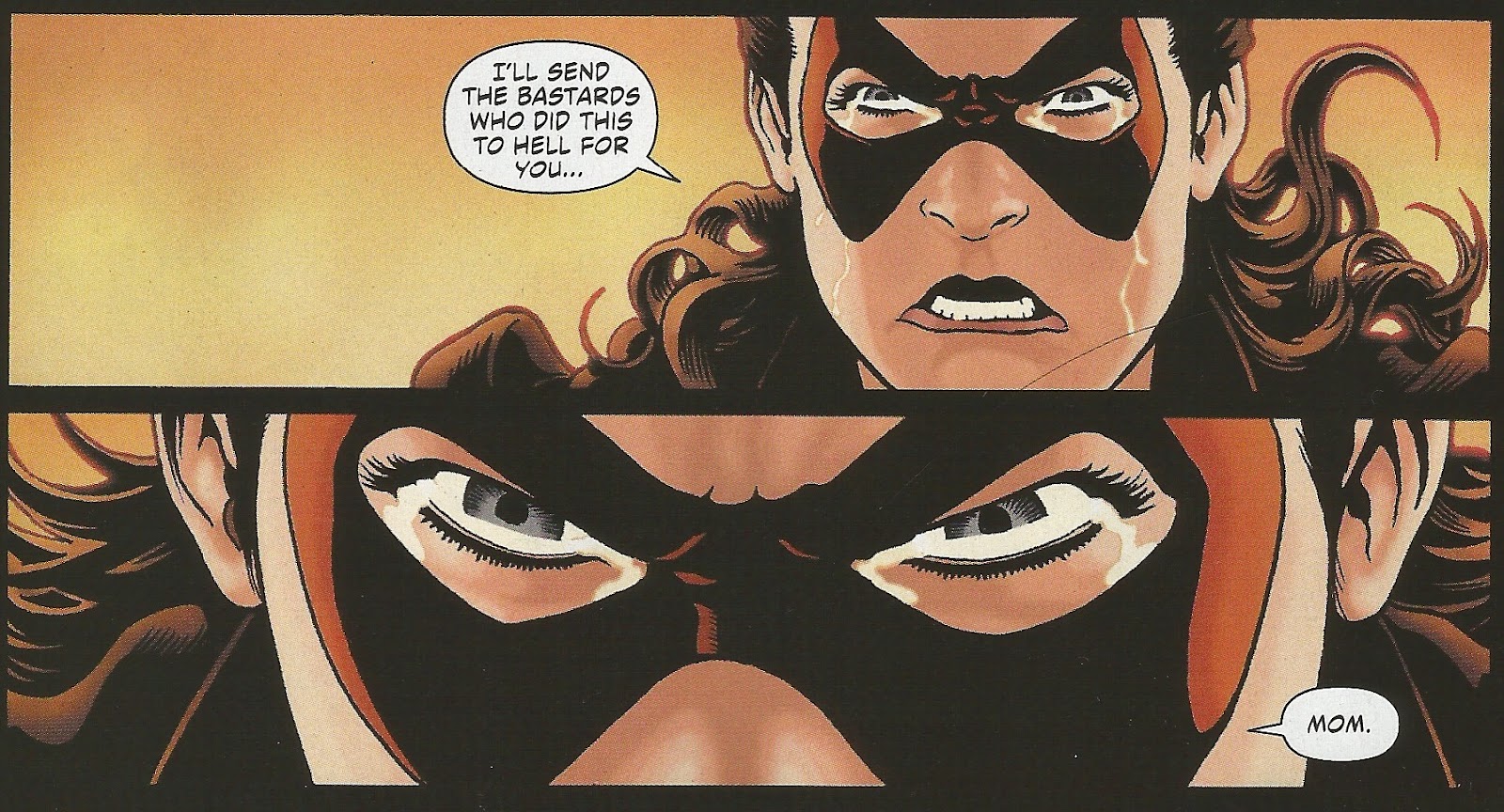
   

Each death of each incarnation of Catwoman suits the world in which she lives, but the new earth two's Catwoman's life could have spanned a series of novels cataloguing the character's changes.  Although we don't really know this version of Catwoman, we know that something very special has been snuffed out by an underhanded trap set by Darkseid.  There is simply put no better comic book to buy this week.

The second best written zero issue surprises for two reasons.  One, it's a comic book I don't normally buy, and two, Peter Milligan writes the book.  

Although I loved his nineties Batman stories, Peter Milligan sucked on Justice League Dark.  His team was an unlikeable and just made me feel sad.  Stormwatch is a different animal.  Working together for a better world, Stormwatch consists of artists formerly known as the Authority and the Martian Manhunter.  Jenny Quantum explains it best.   Stormwatch is a family, her family, not just a superhero team.  They're the modern day Super-Friends.  

I would say that they have updated ideals, but The Super-Friends never spoke their opinions on sexuality and to assume they would have a Republican parochial mentality about gay marriage or a woman's role in society would be an injustice.  The Boards of Standards and Practices would have forbidden such talk, but on the whole, I'm of the belief that the Super-Friends would have reflected the values of Stormwatch not the Romney-bots of the world.  

"Hah! Hah! Tommy has two daddies! Tommy has two daddies!"
Whoosh!
"It's Superman!"
"I was flying overhead when I heard you taunting poor Tommy.  Why the teasing, kids?"
"Tommy has two daddies, Superman! It's weird!"
"Not at all.  Lots of kids adopted and otherwise have two daddies or two mommies.  What matters is that these children have parents that love them, as much as your parents love you."
"Gee, Superman.  We never thought of it like that."
"Uh-oh.  Looks like trouble on the moon!  The Prankster's about to vandalize Neil Armstrong's footprint!  Got to go, Kids.  Up, up and awaaaaaay!"
Whoosh!
"Hey, Tommy, we're sorry."
"Yeah, we were jerks."
"That's okay, fellas.  Let's go play some B-Ball!"

In any case Adam-One, Stormwatch's Benjamin Button, informs the reader and Jenny Quantum of the Jennys that came before her.  This turns her into a quasi-Buffy the Vampire Slayer.  Appropriate since former Buffy artists Will Conrad and Guy Major are responsible for the sumptuous realism that swathes the visuals.  

The artists put a lot of charm in the scenes, but they shouldn't be given sole credit.  Milligan injects the dialogue with an equal amount of caring between the two teammates, and reveals a well reasoned history tying into one of DC's other new 52 teams.  

Milligan samples the group's antics in episodic events, some plausible--Princess Jenny meets King Arthur--and others ludicrous--the dolphin invasion, a ridiculous notion pre-parodied by The Simpsons twelve years ago.  Stormwatch furthermore presents a vital clue to the future of the DCU.  It's a portent of doom echoed in last week's sneak peaks in Justice League and this week's Earth Two zero issue.  World's Finest brings the heroes in focus.   Stormwatch reaches out for a broader view of the new 52, the team's place in the DCU and the future, which hints that DC hasn't finished dominating the comic book industry.

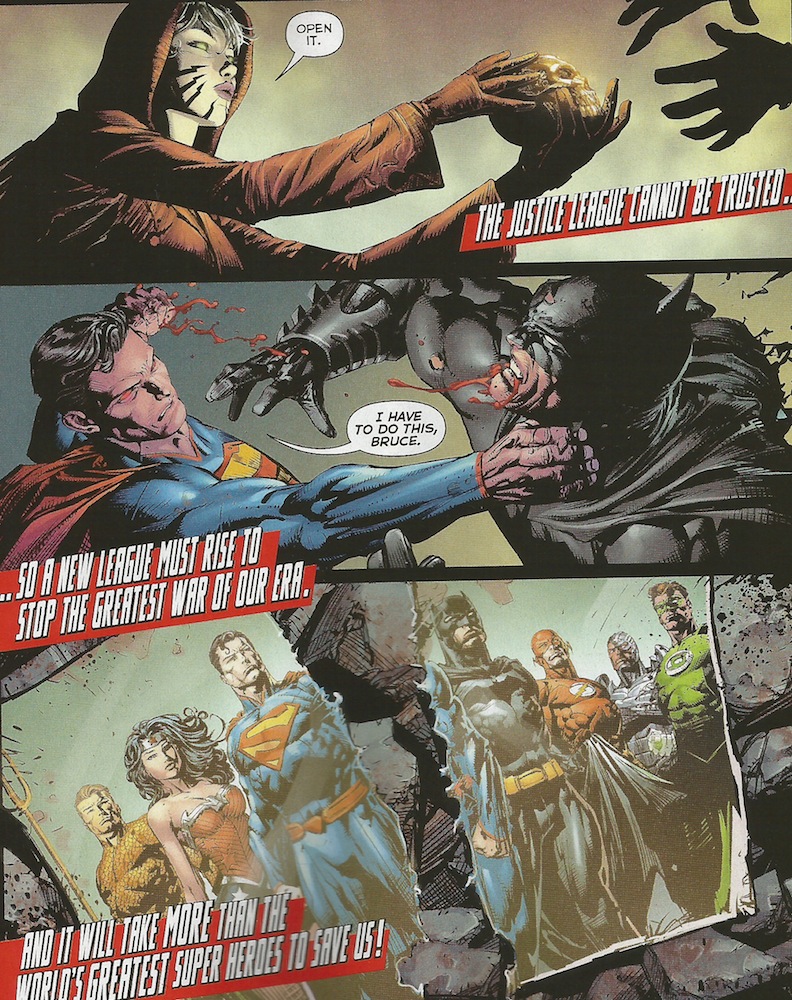
If you notice the cover of Earth 2 you'll see a stranger among three of the most recognizable heroes.  The identity of the stranger is critical, for this ally's avatar operated under another name back in the day.  He's an old hero from the forties, and his new name reflects a new attitude that clashes with the stalwart champion of yore.  This was necessary.

Although the guardian's resurgence was largely due to his death in the pre-Crisis, if you're an admirer of the superhero concept, then you really do not want to see these guys dragged through the mud.  So with that in mind, writer James Robinson very thoughtfully rechristened him.  He may share the same identity with this new embodiment, but that's all the two characters share. The 1940s hero remains untarnished.

In Earth 2, ally becomes enemy in a series of flashbacks lushly rendered by newcomer Tomas Giorello and colorist Nathan Eyring.  

There's almost a Gene Colon nuance to the shadows, but a stronger command of anatomy, offering an ideal mix of evocation and concrete physique.  

As you can plainly see, Catwoman does not appear in this issue.  I suspect that DC didn't want to undermine her debut in World's Finest but forgot to edit the dialogue.  Communication snafu aside, Earth 2 stacks up as a pretty potent read with a strong motivation for a foe that's right under the Trinity's noses. 


Not all of the good team books are zero issues.  Guarding the Globe presents a for all intent and purpose new team of diverse heroes that patrol the world.  

Because Phil Hester is writing and Todd Nauck, of Young Justice fame, illustrates, Guarding the Globe is a wholly entertaining book that's superior to the last arc of Justice League.  
Hester offers just the right blend of action and personal drama, with a good dose of humor and thought in dealing with the long-term ramifications of alien invasion.  Hester deals with the real life problem of autism in a non-sensational way, and he economically introduces the cast with such skill that you may already pick favorites by the end of the story.  Japandroid is mine.

The Mighty Crusaders consisted of the Fly, Flygirl, Jaguar, the Web, the Shield, The Comet, the Black Hood and some lesser players from the Red Circle Archie comics books.  Some may be surprised to learn that only one of those heroes, the Jaguar, arose during the Silver Age.  The rest of the team operated individually in the 1940s, and the Black Hood, a rather blatant Phantom imitation, even manifested in a few pulp magazines.  

The actual team formed in the sixties but didn't last long.  In the nineties, Archie partnered with DC to return the Red Circle heroes to comics.  Soaring under the banner of Impact, a pool of talent illustrated the adventures of new versions of the Archie characters in uniformly enjoyable adventures; Mike Parobeck, Rick Burchett, Tom Lyle, Jose Marzan Jr. all graced the line.

Now, Archie, one of the most consistently successful comic book companies in the history of the industry, is publishing the Mighty Crusaders.  On the back of the cover, some goof compares this book to Watchmen.  Yeah...um...no.  This is like the anti-Watchmen as well as the anti-Before Watchmen.

Whereas Watchmen introduced the whole idea of deconstructing heroes and giving them highly mortal feet of clay, Mighty Crusaders is simply a really good legacy book.  One of the Crusaders isn't a traitor out to save the world by killing the others.  Instead, the Crusaders have matured, maintained strong bonds as a team through the years and vanquished most of the evils of the globe.  In short they won.  

The victory itself offers a difference in philosophy.  The heroes are not bored with peace.  They're not without purpose.  Rather, they simply have become fighters against political injustice, pursuers of science and good parents.  The story begins at a place where the heroes are happy.  It's a big difference from Watchmen, which is suffused with angst.  In fact even the old pre-Crisis Justice Society wasn't as happy as The Mighty Crusaders.  

The Crusaders meet for an anniversary dinner, and this time they've brought their sons, daughters and proteges with them.  As the kids get to know one another and renew old acquaintances, an old enemy crashes the party and wreaks havoc.  Fortunately, one of the Crusaders never believed the fight could end, and he made preparations.

Writer Ian Flynn charges the dialogue with familiarity and camaraderie.  He crafts a simple plot that obviously lays out the path for the next generation but in a way that just seems suitable for these neophytes.  Artist Ben Bates demonstrates a mastery of cartoon style, but make no mistake although Mighty Crusaders appears to be all ages, there is still gravity in the story which Bates dramatically visualizes.   Gary Martin usually associated with Steve Rude and Nexus contributes a crispness and clarity to the art, and Matt Herms adds special effects through color.  As well he emphasizes the drama through blood red.

The usual suspects on my subscription list do not fare all that well this week.  Vampirella is a mish-mash of confused writing and features an artist who wants to illustrate Vampirella well but nobody else.  This leads to a sub-par presentation.  Damn fine cover though.

Avengers Academy is depressingly cliche.  Last issue, the highly annoying Jeremy Briggs took away the powers of the Cadets.  This issue they get them back, and artist Di Vito tries to inject power into the moments, but we always knew that Hazmat and Mettle, the characters who want their powers the least, would of course step up to retrieve them for the common good.  Gage works best when his touch is light.  This was a heavy-handed story.

I could not for the life of me follow the narrative in Thunderbolts or Dark Avengers or insert new title here, which for this time traveling issue is a Judge Dredd spoof, juxtaposed with an assault on T-Bolt HQ and adventure on the moon with also-ran villains indentured into heroism.

Thor seems like a fairly straight-forward kind of hero.  He's a guy with a hammer that likes to wreck things with said hammer.  Once Matt Fraction talks about Odin and Frigga, or Freya if you prefer, I've fallen off of the ship and need a life preserver.  

If memory serves, The Vanir are supposed to be the Norse version of the Fates, but here, they are another race of beings, nationalities, what the hell?  Frigga appears to be one of them, and this sends me out farther with the current.  

I was pretty happy with Frigga being the leader of the Valkyrie, as she is in myth.  It sort of made sense.  Having her be one of the Vanir just clouds up the elegance of her more prominent warrior role in the Marvel Universe, and when did Odin become such a sleaze? Bad enough he was a complete jackass in the Fear Itself fiasco, but this?


Ick

Thor however happens to be gorgeous thanks to Alan Davis, Mark Farmer and colorist Rod Rodriquez.  I'll wait for this baby to be collected.

There are plenty more comic books in the Brown Bag: Smallville, Lookouts, Damsels, Detective Comics, Fathom, Creator Owned Heroes.  These will have to wait for next week.  I only review the books I have actually read, and frankly, this hellacious truckload of books just left me overwhelmed.  Hopefully, I've left you all sated with the many I've commented on today.


Tuesday, September 4, 2012


Pick of the Brown Bag
September 01, 2012

by 

Ray Tate

Hello, and welcome to the Pick of the Brown Bag.  Well, we've got a huge yield of books to cover, but before we get to all that.  POBB is proud to present our first exclusive, an...

Interview with Cthulhu


POBB:  Greetings.  Today, we're lucky to have via satellite, direct from the city of R'lyeh, somewhere beneath the depths...Cthulhu!  


POBB: Cthulhu, welcome to The Pick of the Brown Bag.

Cthulhu:  Thank you, Raymond.  It is good to be here.

POBB:  What stirs you from your dreams, Cthulhu?

Cthulhu:  I am here to endorse Mitt Romney for king.

POBB: President, you mean.

Cthulhu:  President? I thought...Never mind.  Mitt Romney is what America needs right now.

POBB:  Why, exactly?

Cthulhu: Because the alien Obama is fixing your economy, preserving your rights and returning America back to its former splendor.  This impedes the inevitable takeover of the planet by the great Cthulhu and his minions.

POBB: Wait.  Run that back.  Alien?

Cthulhu: Everybody knows that Obama is an emissary from the Elder Gods, sent to destroy Cthulhu and his minions.  Born in Hawaii indeed.

POBB: I see...You claim Obama's policies have hurt you?

Cthulhu: The runes are on the wall.  

POBB: Can you give our audience an example?

Cthulhu: Obama supports women.  "Rape is rape."  I have never heard such nonsense, but Cthulhu and his Republican followers know that women are mere chattel, vessels for the Deep Ones that worship the great Cthulhu.

POBB: The Deep Ones are the cross-species rapists from the oceans?

Cthulhu: Spurious lies! Ladies simply like sex rough.

POBB: With claws and scales.

Cthulhu: Cthulhu does not appreciate your tone, young man.

POBB:  This is all about that putz Congressman Todd Akin, isn't it?

Cthulhu: Akin is a wise man.  Women must want to be serviced by Cthulhu's followers and the Deep Ones that throw women down and rut them.  Else their natural defenses would seal their holes.

POBB:  Rape is violence that defies and betrays biology.  Its product a parasite.

Cthulhu:  Gifts.

POBB:  Santorum at least called them "broken gifts."

Cthulhu: There was a communication breakdown.  Gifts.  Not broken.   Does not every woman wish to sire offspring? 

POBB:  Not that way.  For Republicans the ends justify he means.

Cthulhu: You are demonizing "rape" far too much.  It is like Tom Smith said.

POBB:  Tom Smith? That nobody running against Senator Casey?  What's he got to do with anything?

Cthulhu:  He justly compared having a child out of wedlock to having a child out of rape-lock.  

POBB:  You're joking.

Cthulhu:  Would he use his own daughter as an example if his philosophy were mere jest?

POBB:  You mean, she was raped?

Cthulhu:  No, she apparently had a child out of wedlock.  It is the same thing.  Tom Smith said, and Cthulhu agrees.  Please pay attention.

POBB: So, you concur with Romney's running mate, Congressman Paul Ryan, in that rape is a valid form of conception.

Cthulhu:  Legitimate rape.  An "honest rape," to borrow a phrase from Ron Paul.  Yes.  Approximately 32,000 women become pregnant through "rape."  When you consider such a large number and factor in the words of Ryan, Akin, Paul and Smith, you arrrive at the conclusion that actual rape is rare.  After all, if these women were raped, they wouldn't become pregnant.  Their bodies would repel these invaders.  It is but a simple matter of logic.  

POBB:  You really are evil, know that?

Cthulhu: Thank you.

POBB: Your endorsement of Romney still puzzles me.  Romney is a vainglorious sphincter, but he did say that he would magnanimously grant abortions in the case of rape.  That would certainly screw your Deep Ones.

Cthulhu: Mitt Romney has no personality of his own.  Nor free will.  He is but a mirror.  He will reflect party values, which I dictate.  He is but an empty glass, waiting to be filled with our desires.  He is the perfect tool for Cthulhu.  Let him wear the crown, for then Great Cthulhu and his servants will rise! The City of R'yleh will return to its former glory, and humanity will become our thrall.  This interview ends.  


POBB: Um…Thank you, Cthulhu.


"Let's Get Ready to Rumble!"

It's time for the new 52 Annuals.  Annuals used to be special, but over the years, their worth eroded to hastily slapped together mediocre stories with art by the guy that happened to be walking down the street looking at the clouds.  An editor would pop his head out and go, "Psst, hey kid, want to draw comics?"  Wanting to kill time before lunch, the passerby would look at his watch and say, "Sure." Are the new 52 Annuals any better than previous annuals?  Detective Comics and The Flash definitely surpass past efforts.

In Detective Comics Annual #1 current writer Tony S. Daniel creates a new identity for Black Mask.  Black Mask began his criminal career in a mostly forgotten slip of Dark Knight time, during the flux of pre-Crisis morphing to post-Crisis.  


Created by Doug Moench and Tom Mandrake, Black Mask aka Roman Sionis was retro-planted as a boyhood acquaintance of Bruce Wayne.  Roman started his fictional life under a dark, humorous cloud.  An alcoholic doctor literally dropped Roman on his head at birth.  

Apparently the impact wiped out his conscience and resulted in serial killer emptiness.  Bruce and Roman were left together to play while Bruce's parents socialized with the Sionises.  Young Bruce, always an astute child, didn't like him.  Roman later murdered his parents, mutilated the corpses and vandalized the coffins.  Part of that vandalism resulted in carving out his sobriquet from his father's coffin.

Black Mask was no doubt inspired by the famous hardboiled detective magazine.  Indeed, Roman's natty nineteen thirties appearance reflects the sharp look of the gangsters prevalent in pulp literature.

Despite alluding to the past, Black Mask's signature was very modern.  Black Mask murdered his victims by gluing masks to to their faces.  They died of suffocation, leaving behind nasty scenes where the police would unfasten the murder weapons from multiplying corpses.  As he slew his victims, Black Mask attempted to build an empire through the False Face Society--punks and hoods wearing masks.  Though he ritualized the induction, never was there anything supernatural about Black Mask or his namesake.  That was the past.  This is now.  

Black Mask's ties to Bruce Wayne, once meant to be a big thing, have been long forgotten.  Indeed, we can probably thank Hush for that.  It's probably the only thing we can thank Hush for.  The Unknown Soldier/Crime Doctor rip-off was introduced as Bruce Wayne's childhood friend.  So, Black Mask's association was redundant and let's face it not as important as the creators wanted it to be.  Sionis' method of murder also appears to have shifted to a more magical slant.

The Annual posits a war between the Mad Hatter and Black Mask, arguably a war between science fiction and horror.  The Mad Hatter always controlled the minds of others through science and technology.  Black Mask only uses his namesake.  The new 52 Black Mask is essentially possessed by the mask, which has supernatural properties.  I imagine the Peter Cushing/Christopher Lee cult favorite The Skull inspires the twist.  


In that movie, adapted from a Robert Bloch short story, the Skull of the Marquis de Sade possesses its owners into becoming sadomasochistic killers.  

If you don't mind the sudden Sionis powers and the lion's share of the book being devoted to the villain war, then the story's for you.  Batman's presence is felt throughout, but the tale's not really about him, nor is it much of a puzzle.  It's competently told and well illustrated, but nothing special--certainly nothing that warrants an annual treatment.

3

Still, the story does feature a really good scene in which Batman beats out information from Tweedle-Dum and Tweedle-Dee, the logical henchmen of the Mad Hatter, only now exploited as such.  Tweedle-Dum and Tweedle-Dee actually predate the Mad Hatter.


The Flash is an under-the-radar comic book.  It's less hyped than the Batman or Superman titles, but The Flash is consistently well-written.  Storytellers Francis Manapul and Brian Buccellato make Barry Allen's new 52 adventures fresh and entertaining.  The comic book sports a unique look, and each story displays a flair for education; today we learn a fact about the Salt Lake Flats.  Before, you could learn about how the Speed Force might work and its ties to Stephen Jay Gould's Theory of Punctuated Equilibrium.
  
Over the course of twelve issues, Manapul and Buccellato reintroduced nearly all of the Flash rogues.  Last issue, Mirror Master, Heatwave and the Trickster completed the family picture.  Before the quartet, the writers updated Weather Wizard.  In a subplot, the Piper returned, and of course they reserved a big issue for the return of Captain Cold.  Put them all together, and you've got an Annual that's actually something.  It's the payoff to the buildup you didn't even know Manapul and Buccellato initiated.

Although the creative team updated the villains, they didn't change the most likable aspect of the Flash rogues.  The Flash rogues weren't all bad.  You can't trust any of them, but on occasion, they're reasonable.  The rogues aren't interested in world domination.  They're bank robbers.  They seek filthy lucre plain and simple, and The Flash Annual reinforces that ideal. 

Captain Cold reiterates the mantra of the Flash rogues.  No matter how they pull off their heists, they follow three golden rules, described by guest finisher Scott Kolins.  The adherence to the rules forces Cold to make a drastic change to combat the Flash.  This sets up Chapter Three where we learn why Lisa Snart hates her brother, how duplicitous Dr. Elias was and why Lisa hates Elias, an animus that catalyzed the last issue of the Flash and this issue's crescendo.

If you're thinking that the Flash rogues take over the book, think again.  Like the Detective Comics Annual, the Flash's presence is always felt, but he takes a more proactive stance in the chapters. 

Five chapters comprise The Flash Annual, each with different illustrators finishing Manapul's breakdowns.  Manapul and Buccellato write the entirety.  The first chapter finished by Batwing's Marcus To, gives Flash a Fortress of Solitude, so to speak, that's tied in with his childhood and his relationship with his father.  In Chapter Five, with excellent artist Wes Craig, we see the Flash willing to do anything, including throwing in with his arch-enemy, to see justice done.  Of course, that won't help him against the Mirror Master. 

Throughout the story, Manapul and Buccellato give the Flash a playful demeanor and dialogue that contrasts the usual depiction of determination.  The Flash for example can admire the Mirror Master's ploy.  He can as well simply go with the flow, allowing him to team up with his nemesis, but it's this sort of three dimensional thinking that can also place the Flash in danger.  Batman would never turn his back on his enemies, even if they gave their words not to stab him.  The Flash is far more trusting, hoping to see the good in everybody.  That's why Elias' betrayal in the previous two issues hit him so hard.

Whereas most Annuals are stand-alone and perfunctory, The Flash Annual relates a complete story but daringly ends on a hilarious cliffhanger.  What other book would do that? Manapul and Buccellato take advantage of this free-wheeling Flash and his less than honorable, but not truly murderous, rogues to deliver a perfectly timed line.  It furthermore offers another explanation why the Rogues actually don't wish to kill the Flash.  He doesn't just protect the innocent from a dangerous universe.  He protects them as well.

5
Aquaman #12

The art by Ivan Reis, Rod Reis and a parade of inkers far exceeds the quality of Geoff Johns' latest chapter in Aquaman's war against Black Manta.  It's not that the writing is horrible.  It's simply uninventive and stale.  You have Aquaman whining about his friends helping him kill Manta, and Manta going nuts with a scepter that allegedly sank Atlantis.  End of story.

That old penetration fetish Johns developed over the years appears to have returned as well.  Another one of the Others, Aquaman's first team of superheroes, dies by being poked to death, and Aquaman spears one of Manta's flunkies with his trident.  

You could say typical Geoff Johns, but although the story's mediocre, tends to swim against the current in order curtail the pace and relies on the "shock" of two penetration deaths, the new 52 Aquaman still demonstrates an overall improvement from the way Johns used to write.  In other words, Mera's still alive.  Death's gender equal.  While characterization is paper-thin, Johns does give the character slain by Manta some heartfelt words.  You do feel sorry when this character dies, and the Other dies a hero. 

3


No doubt you've seen the cover to Justice League number 12 all over the internet.  Yes, Virginia, Superman and Wonder Woman are an item.  Does it matter? No, not really.  I mean, it's the new 52.  Lois Lane's marriage to Superman never existed in continuity proper.  The union only exists in Smallville and existed in Batman Beyond.  I don't know why people have a problem with this idea of tabula rasa.  It's a simple concept, and if somebody wants to complain about having the history that they knew pulled out from under them.  Well, "cry me a river." 

The budding romance between Wonder Woman and Superman doesn't really factor into the 

2I'm giving The Justice League. The truth of the matter is that Justice League is written as a lame soap opera all the way through.  The artwork by Jim Lee is adequate, but both Geoff Johns and Jim Lee produce schmaltzy melodrama that lacks gravitas or humor.  

The best scene in Justice League occurs when the League realize that David Graves isn't evil.  He's mentally ill.  Upon recognizing his mental illness, the League stop kicking his ass, echoing the merciful champions we remember.  Still, there's just not enough meat on this bone, and the glimpses of what may come are completely neutral: could be good, could be bad, given editorial changes, they could in fact not be at all.


Meh.

Created in 1941 by Will Eisner and Jerry Iger, the Phantom Lady became the symbol of Good Girl Art.  That may sound insulting, but the best in the business produced Good Girl Art, and the Phantom Lady benefited from such artists as Matt Baker and Joe Kubert.  Her original artist Arthur Peddy was no slouch either.

In terms of story, Sandra Knight set about clearing her father from a frame up by attacking criminals with a good right cross, a high heel or two to the instep and a black light projector which blinded felons silly.  

DC claimed ownership of the character when they began publication of The Freedom Fighters in the mid-seventies, but the rights to the Phantom Lady have always been debatable.  Many believe she's in fact a public domain character, which would explain why DC has never actually pressed the issue when various companies reprint her old Police Comics adventures.  I think DC would render the issue moot if they released The Phantom Lady Archives.  If these archives matched the quality of their other archives, nobody would care who claimed ownership.  DC would have the final word on the subject.

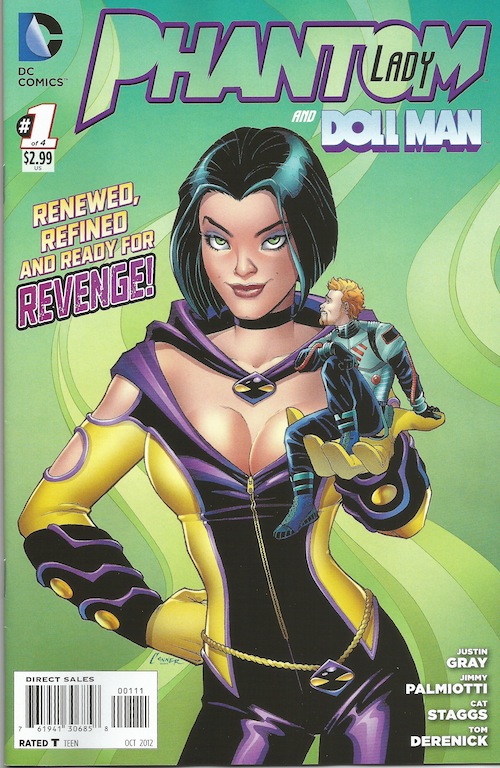
What we can say is that DC published new stories with different versions of the Phantom Lady at the greatest if not most consistent frequency.  The latest version of Phantom Lady, paired with a new incarnation of Doll Man, another hero having a questionable copyright history, is written by Jimmy Palmiotti and Justin Gray.  That can't be bad.  So, let's get on with it.  

I think the most interesting thing about the writing is that Gray and Palmiotti already make PL and DM a thoroughly modern friends-with-favors type couple.  So this won't be a will-they-or-won't they book.  Like Burn Notice's Michael Westen and Fiona Glenanne they do and already have.  

The newest avatar of Sandra Knight is obsessed with bringing down the Bender family.  One of the proud members murdered her parents.  Like Batman, she also witnessed the homicides and could do nothing to prevent them.  As an adult, Sandra makes her trade reporting for The Daily Planet and sleeps with one of the upper level Benders to find the evidence to take an axe to the family tree.  That tree probably finds its roots in a real life Scottish family of murderers also inspiring Wes Craven's The Hills Have Eyes.  

A flag raised immediately when Gray and Palmiotti set the story in Metropolis.  Way back in the day, I objected to Marc Andreyko having Copperhead kill a slew of people in Superman's City.  Manhunter eventually blasted a hole in him, but I had a definite image in my head of what Superman did and how he operated.  It didn't matter that writers weren't following suit.  In fact, this is when I began to realize that the core of DC was rotten and I started to embrace Manhunter as the only hero actually doing something to deter crime.  

The new 52 Superman is a different sort of animal.  He's purposely being written against the old characterization.  Now, I can say without a shadow of a doubt that the old Superman, the Big Red S, the Man of Steel would not have allowed the Benders to build so much as a criminal lemonade stand let alone a criminal empire in Metropolis, but the new 52 Superman? Maybe he's not quite so vigilant.

With the premise vindicated, the characterization good, the twists and turns to the source material, very little could go wrong with the book except the artwork.  


Cat Staggs is no Amanda Conner, but who is?  Staggs produces a reliable visual narration and strong anatomy.  Tom Derenick's inks and Carlos Mangual's colors are a little dark, but as a whole, the illustration is quite presentable.  

As to the Phantom Lady herself, the classic cheesecake that became so integral to the character vanishes in favor of more practical garments.  Conner's low-cut ensemble displays as much skin as you're going to get, but the artists and writers do emulate the past in the basic design of the costume.

In addition to the adherence of the yellow scheme of the original costume, they bring back the Phantom Lady's hood, something she wore in the very early adventures.  The change from purple instead of green makes her blend into the shadows a little better, and also, it compliments the yellow nicely.

Is Phantom Lady and Doll Man a must purchase.  No, I'd not say that, but if you're looking for a supplemental title with a strong female character and/or a potent partnership, then I'd slip it in your brown bag next to Batgirl.  At the very least you should consider Phantom Lady and Doll Man amongst your regular browsing on the rack.  Who knows? You might just like what you see.

4


This issue of Bionic Woman is a tonic for the doldrums.  The action never stops.  Leno Carvalho's art hits all the right notes.  It doesn't matter whether the scale depends upon examples of bionic strength or expertly beat out comedy.  Carvahlho nails it.


Writer Paul Tobin's jokes range from the running gag of Jaime Sommers taking down the group harvesting bionic parts one-by-one and gathering intel from each of her targets to a question of closeness from her friend Nora.  Tobin employs a new tactic for Jaime when one of the group under her glare smartens up, realizing that Jaime is a hero, and a "soft" one at that.  

The villain concludes Jaime's completely harmless, despite her bionic abilities, because she'll never back up her bluff.  Big mistake.  Without contradicting previous characterization, Tobin finds an ingenious means to corroborate her no-kill policy but still make her threats count.  Thus, he continues to make Jaime likeable and at once brings a new edgier attitude to her cases.

5


Red Sonja fans won't want to miss Prophecy, as the She-Devil with a Sword wages battle against Kulan Gath and his intent to destroy the world.  This time around though he has help in the form of an enchanted obsidian blade and kaiju styled death gods. 


The blade is the mcguffin threading the whole of this superbly written series by Ron Marz.  It's gorgeously illustrated by Walter Geovani greatly missed on Sonja's eponymous book, and as a result the free for all pitting Sonja, Vampirella, Eva, Dracula and Athena--The A Team--as well as Herbert West the Reanimator against the death gods under Gath's control is a feast of color and dynamism.

Prophecy however isn't just an art book, like this week's Aquaman, for example.  The premiere opened with Sherlock Holmes investigating a murder, involving the obsidian dagger.  In this issue, Marz follows through with Holmes racing to nab the culprit, a huge surprise guest star.  Athena, not one of Marz's own characters, never the less makes a very characteristic speech, followed by some good snark from West.  In other words, Prophecy doesn't just offer a kaleidoscope of good times, it perfectly blends the characters for a time-hopping escapade that intrinsically makes sense.

5


Clashing artwork proves detrimental to Doctor Who and Star Trek the Next Generation.  J.K. Woodward paints over Gordon Purcell's artwork, and as a result, he undermines such potential events as the Doctor meeting Guinan.  The story seems to discard the shocking amalgamation from last issue, but Who fans will be pleased to see the Cybermen making the Borg their bitches.  


On the whole though, compared to the opener and last issue's awesome fourth Doctor meets Kirk vignette, this chapter in the unexpected team up between Picard and the Doctor lacks oomph.  A pity because Tony Lee and Purcell set up a beautiful scene for Amy Pond as she explains why the Doctor's so special to her.

3


Man, I'm hating this.  I was never a big fan of Watchmen, but I am a huge aficionado of Darwyn Cooke.  The more I read these things, the more I think Cooke is experimenting at reader expense.

I peg Cooke as a creator that pinballs from extremes.  For that reason, his superhero stuff is so amazing and charming, no matter the subject.  Case in point, he did a King Faraday story for Solo in which the CIA agent falls for a bamboozle by two beautiful lesbian spies.  Hilarious.  Likewise, his artistic reinterpretation of a classic Batman story was laugh out loud funny.  You're laughing with Batman as he plays with a group of murderous thugs that seem to have misplaced their keys.  Cooke understands that nobody actually likes King Faraday, and any member of the Justice League is like an atomic bomb, when dropped on low-level criminals.  

At the other end of the spectrum, Cooke can go hardboiled with Parker.  He can express chilling violence and vicious men doing horrible things.  He can demonstrate the worst of womankind turning people into unwitting dupes.  He can the utilize the ultimate equalizer death, without hope or fairness.  Then, there's Before Watchmen.

This issue deals with Cooke's creation Silhouette, a lesbian hero that makes one wish Cooke were detailing the new exploits of Modesty Blaise.  Silhouette seemed like a neat character.  The only character in this miniseries worth following.  The trouble is that Silhouette also known as Ursula happens to be in a Watchmen book, and as a result, she becomes tainted by Watchmen nods to "reality."  She's stuck in a photo-shoot with Sally, and this drifts off into the photographer's Irving Klaw bondage fantasy pairing the two in a bizarre spanking session.

When we get to Silhouette's serious crusade against child predators, she becomes overwhelmed by the odds.  Of course, perhaps it's all in her head, and she's just another damaged hero that Watchmen likes to deconstruct.  The dead little girl could have been her doing, during her hallucination.  That's bad enough, but for no reason at all Silhouette's naked breast appears in a panel that almost mocks the juxtaposition technique in the original Watchmen.

Now, I'm no prude, and the shower scene might be the best scene in a low budget film, but what the hell is that breast doing there! It's like we're sailing on calm waters, and then lo! The U.S.S. Mammary arises on the horizon.  Crap! Crap! Crap! Crap! Crap! Crap!  The breast undermines the whole gravity of the scene! Darwyn Cooke, or no, I've had it with Before Watchmen.


In the last book on the docket, John Byrne really surprises in Trio.  Critics have been calling Trio the parallel universe version of Byrne's own Fantastic Four.  Now, I have also identified the similarities, but I didn't actually see this as a drawback.  At least it's fun, and there's a payoff in each issue, unlike Jonathan Hickman's convoluted FF.  I wanted to like that book so badly.

In fact, using the FF as his starting point, Byrne has been differentiating the Trio with each issue.  For instance, the Trio all have different ethnic histories.  Rock is a little black kid.  Paper is Asian.  Scissors is Arabic.  The Trio also are not an independent group.  Rather the military sponsors them, and there's a definite early Metal Men feel to story now.


When Nautilus shows up, you think Namor, but after this adventure, you'll think otherwise.  Jackasses plague humanity in Trio.  People aren't as happy to see the team as they would be if they were the FF, and that results in surprising twists.  

The big bad on the cover is a very interesting Nazi villain from another universe, and Byrne has a lot of fun characterizing the super-powered goose-stepper.  Not his first, he did a very baleful version of the Red Skull for Captain America/ Batman.  So there is an example where you can contrast.  As you may expect, the art is just remarkable, especially with the paper stock, bringing out the depth in Byrne's illustration.

4

Whew! That was a biggie.  Next week, more comic book reviews, and maybe an interview with Hastur if another Republican opens his filthy mouth.