Monday, October 1, 2012


Pick of the Brown Bag
September 26, 2012

by 

Ray Tate

Today in the Pick of the Brown Bag it's another zero week with All-Star Western, Aquaman, The Flash, Hawkman, the highly anticipated debut of Talon, Teen Titans and Superman.  I'll also discuss the Big Dog Ink flagship title Critter, and we'll visit the Alpha Quadrant with the TARDIS in Doctor Who/Star Trek as well as Phantom Lady and Doll Man.

"The Game is Afoot"


The fourth issue of Critter was okay, and that's a vast improvement.  The winning independent has been of late piss-poor due to the introduction of cat-themed, celebrity-status hungry super-team Purrfection.  Yuck. 

In this issue, writer Tom Hutchison and artist Fico Ossio at least focus on Critter's want to be an actual hero out to save the day and rescue the innocent.  Critter's roommate Gina also creates a new costume for her that's millions of lumens more brilliant than the nightmare she wore while enduring Purrfection.

On the other hand, Hutchison and Ossio introduce another publicity thirsty group of heroes called the In Crowd: Lasso Lass, Slipstream and Wing Boy.  We've met Slipstream before, and she's the only hero out of the handful that comes off as interesting and genuine.  Hutchison gives her a fascinating power that deserves more exploration; certainly more than the whole American Idol superhero phenomena he's got going as a major plot.  Hopefully, this obsession will end sooner than later.

Phantom Lady and Doll Man picks up where we left off.  Cyrus Bender is a Little Bad in the Big Bad Metropolis-based Bender family.  The family's patriarch killed Jennifer Knight's parents.  So, she's determined to bring them down.  Somebody will have to bring her down first.  

Two things immediately came to mind when witnessing this scene.  Compare the difference between the titillating Irving Klaw like bondage of the old Phantom Lady versus the actual life-threatening bondage experienced by the current Phantom Lady.
Justin Gray and Jimmy Palmiotti employ the bindings for dramatic intent, but I'd be shocked if they weren't aware of the headlights meet rope history of the Phantom Lady.  

The humor underscores the imprisonment and provides relief.  Palmiotti and Gray give the scene an edge, but they don't want it to teeter into hardboiled territory.  They secure it to the realm of the superhero.  It's all in the execution.

Naturally, Phantom Lady doesn't so much as suffer a bean to the head.  Cyrus likes to play with his food, and his friend Warlock thinks he's nuts.  Warlock actually respects the Phantom Lady more when he refers to her as a cobra.  She's not to be trifled with.

Darrell Dane debuted as Doll Man at the end of last issue, but this issue, he enters in costume and rocket pack.  It's no real spoiler to say that Doll Man rescues Phantom Lady and takes her away to give her the tools to bring down Bender.  

What follows in the book is an overview of Jen's powers, training and her limits.  However, Palmiotti and Gray preclude the potential blandness of these scenes with dialogue tailored to the characters and an overall light touch.  It doesn't hurt that the scenes are so vividly illustrated by Cat Staggs, Tom Derenick and Jason Wright.

Gray's and Palmiotti's All-Star Western pretty much sticks to the old history of Jonah Hex but with deft Moritat artwork rather Ernie Chua mastery.  Palmiotti and Gray preserve Hex's Native American connections, the means by which Hex was scarred as well as his alcoholic father, but the duo also add the idea that Hex's father was once a decent man before he hit the bottle.  Woodson Hex's protection of his newborn son and wife from a Sheriff's corrupt posse exhibits remarkable heroism and ferocity, both traits prevalent in his son.  

Hex's father fills with hate as he quenches his addiction, but Hex's mother isn't exactly pristine either.  Her flaw lies in her weakness.  She could have taken Hex with her when she left his father.  She could have convinced the man she had taken up with to allow her son passage at least out of the hell he will endure.  She did not.

The writers offset the tragic past of Jonah Hex with an almost cheerful denouement.  Hex persevered and won.  He's a successful bounty hunter.  He bonded with allies like Nighthawk and Cinnamon.  He even crosses with women, old paramour Tullulah Black being his most recent bedmate. The actions of Hex's most recent past--risking his life in an inferno to save innocent strangers--indicate that he still can represent the best of humanity.  Frankly, given how life continuously kicked him in the ribs, Hex comes off as even more admirable.

In an amalgamated future, The Doctor wants Jean-Luc Picard and the crew of the starship Enterprise to parlay with the Borg to defeat the Cybermen.  Jean-Luc refuses, instead taking the tactical option of bugging out and letting the cyborg races fight to the death like pantomime horses.


That sounded like a good plan, but in Doctor Who the plan that seems the most rational is flawed.  You don't attack Sontarans with bullets.  Even-though the potato-heads can be shot, they developed a contingency for defeating ordinary ammunition.  You can't let the Cybermen and the Borg fight because in the end, it's not an even match.

Amy Pond's courage and honesty, her faith in the Doctor sway Jean-Luc to entertain the Doctor's words and deeds, and in these scenes the creative team of Tiptons, Purcell and Woodward capture the charisma and lilt of Karen Gillan.  

With Amy's encouragement, The Doctor decides to lay his cards out on the table and take Jean-Luc on a tour of the future being rewritten.  He did something similar with Sarah Jane Smith in the episode "Pyramid of Mars," but not on such a grand scale.

All of these factors make Doctor Who/Star Trek a solid chapter in "Assimilation," but it's the flow of the Doctor's words which mirror the delivery of Matt Smith and his final Doctorish proclamation that make Doctor Who/Star Trek a jaw dropper.

Rob Liefield and Mark Poulton advance Thanagarian technology and culture.  Good.  They follow the pattern set by Justice League to introduce the Thanagarians as an actual winged race.  Even better.  They bring back Shayera.  Excellent.  They dump the reincarnation angle.  Fantastic!

THEN THEY CAST ALL THESE GOOD INTENTIONS TO THE FOUR WINDS!

This bloated, convoluted Savage Hawkman benefits from an astonishing interlocking tapestry of artwork characterizing plausible alien lifetimes, an extraterrestrial royal court and strange things that wheel in the sky, to paraphrase the Doctor.  

Illustrators Joe Bennett, Art Thibert and Guy Major should justifiably feel proud.  The art's so good that it would almost vindicate an oversize, hardback reprinting of the zero issue.  Almost.  Because Poulton and Liefield should be hanging their heads in shame.

The story's horribly xenophobic.  Emperor Provis, the ruler of Thanagar, listens to Katar Hol, presented as a pacifist on his home planet, and invites aliens from all over the galaxy to celebrate the recent peace.  Former enemies dine with new allies.  Alas, the Daemonites carry out the extermination plan for Native Americans discussed by some upper crust 18th century Europeans.  They introduce a molting virus that causes all the Thanagarians to lose their wings.

The optimistic hand of friendship gets hacked off by distrusting foreigners.  Oh, and by the way, why no follow through? If the Daemonites introduced plague, why did they not next invade Thanagar and conquer their old enemies?  

I'd like to think that this might be the writers suggesting that the molt and the alien presence on Thanagar was mere coincidence but the plotting just continues to wreak horrors on the reader's suspension of disbelief.  

Shayera's unbalanced bellicose brother Corsar succeeds Porvis and promptly invests Thanagar's economy in the magic beans of the Nth Metal.  Why?  Corsar says that it will help Thanagarians "fly again", but how? Oh, and they have spaceships.  I know it's not the same as soaring upon wing and prayer, but technically, these aliens haven't stopped flying, which begs the question of why did the Daemonites release the molt on this race in the first place? To punish them? Well, that seems stupid.  I mean Thanagar still has a space fleet, and it wasn't the boots on the ground or wings in the air that won their wars.  By the writing team's admission, superior starships and tactics won their wars.  The Thanagarians just liked to in addition bloody their beaks.

The mystical Old Ones, which the previous Emperor banished from the Court, guide Corsar.   Katar just acts as this ineffectual conscience that pipes up every second of the day.  He's like a tiny flickering Christmas light amidst a brilliant array of luminescence.  

Here's the kicker.  Katar is always wrong.  Give peace a chance? Daemonite Molt Party.  Don't listen to the Old Ones? Turns out there is Nth Metal in them Thanagar hills.  He's like the anti-Batman.

Corsar mines the Nth Metal at the expense of the land and the innocent miners.  No Quecreek Miracle here.  Katar of course cheeps protests.  From a practical standpoint, he's wrong again.  Oh, sure you can argue that ethically Katar's spot on, but the way this story is set up, pragmatism is what wins the day.  Ethics are for democrats.  Thanagar is the planet of neocon Republicans.

The Nth Metal is exactly what Corsar and the Old Ones think it is.  It's a means to give Thanagarians back their wings, well one Thanagarian.  So, there's the point.  Take away everybody's wings, just so Mr. Jiminy Cricket can get his back.  

Poulton and Liefield should have just retained everybody's wings.  There were other ways to make Katar a rebel, less annoying ones.  For example, just off the top of my head, what if Thanagar were conquerors, but Katar had the mind of a police man.  He believed in the law and justice and that's what caused the rift between he and the other Thanagarians.  That's a starting point.  Wiping out the wings of an entire race while preaching xenophobia, environment wrecking and war being the answer to everything except an unexpected Dune worm, just to get Hawkman aloft? That's just utter bollocks.

Hawkman's former and future Justice League colleagues fare better this week.  Superman is surprisingly good.  I know.  It's a change for me as well.  The origin of Superman in the beginning was related in a few scant pages, with only mention of his parents.  Mainly writers referred to the doomed planet Krypton.  Over the years that changed.

In the Golden Age, talent based Jor-El and Lara squarely on the pulps.  They looked they might have come off the covers of Astounding Science Fiction.  Jor-El of course was brilliant.  Lara was originally just his helpmate until the sixties when one of the Silver Agers gave Lara an astronaut background.  

The Donner plan for Jor-El and Lara was much the same, albeit with more crystals and white clothing to reflect the New Age movement of the seventies.  This design would later inform Smallville.

John Byrne was the first to radically reconfigure Krypton.  He introduced clones, a savage history and emotional repression for the present day Kryptonians.  

Byrne's Jor-El was a rebel in more ways than one.  He admits his love to Lara as the planet dies.  The love they freely express isn't merely isolated to each other.  Like every incarnation before them, both parents loved their son Kal-El.  They loved him so much that they were willing to send him away, let others raise him, just so he might live.

For the zero issue, Scott Lobdell and Kenneth Rocafort relate a story about the new 52 couple Jor-El and Lara.  Nothing has really changed, except the levels of sophistication.  

It's not enough for Lara to be merely a futuristic housewife.  Oh, and please, no angry e-mails about my implying that housewifery is somehow beneath women.  Whatever floats your boat.  It's wrong for a housewife to be a housewife is she's not happy.  It's wrong for housewife to be a housewife if she was forced into the role by her husband.  That's what I meant.  All right?  Can we go on? Fine.  

In terms of story, Lobdell finds a much better use for Lara.  Turns out, she's ex-military, and that leads to some humorous as well as some exciting situations that Rocafort is only too happy to render.  

Rocafort's style looks like it came from Europe via science fiction great Vincent DiFate.  The artist's unique design scheme echoes to the pulps yet still possesses the illustrative acumen of modern art.  Drink in the attractive group of antagonists.  Their appearance reflects their advancement.  These aren't mere thugs.  This cadre is a group of sophisticated scientifically knowledgable terrorists with a rationale. They worship entropy.  They turn a scientific fact into faith, and that's why they're so dangerous.  

Of course, the point is academic.  Krypton will die, or will it? Sharp eyes will note a theme in the zero issues of the Superman Family titles.

Writer Geoff Johns lets the lush artwork of Ivan Reis, Joe Prado and Rod Reis do most of the talking in Aquaman.  One of the many cool things about this zero issue is how Reis integrates the previous flashbacks into his visual narrative.  We see Dr. Shin trying to apologize to Aquaman as Arthur escapes paparazzi, but in the background rather than the fore.  

Johns also deserves credit for seamlessly knitting the history of Aquaman hinted in the series with this unknown tale.  So, we watch Aquaman at his father's bedside but we also hear what Arthur learns from his father and learn why Arthur ran.  It wasn't pressure from the media, nor did he merely feel terrible about the death of his father.

As well as the integration, this issue of Aquaman stands on its own by detailing Aquaman's search for his mother and intertwining his search with other discoveries.  On the hunt, in a thrilling moment of wonder, Aquaman learns that he possesses the power to command the creatures of the sea.


Johns mingles these elements with an explanation on why Aquaman opted to be a hero to all people--sea dwelling and land lovers in the first place.  Previously Arthur had no real motivation.  This rationale however gives a core strength to Aquaman, making the character even less disposable.

Francis Manapul and Brian Buccellato generate more excitement than I thought possible in the recounting of the Flash's origin.  I've seen the Flash's birth by lightning hundreds of times, including the most impressive recreation, on television with John Wesley Shipp.  

For the new 52, Manapul and Bucellato add some practicalities to the accident that granted Barry his powers.  Buccellato and Manapul wrap Barry in bandages and place him in a coma.  The writers give Barry a police family that visits his bedside, and they also create an intriguing mystery involving the Flash's mother and father.  

Did Barry's father kill his mother?  We can tell he had a kind of motive, involving a possible divorce.  In the past he begged Barry to believe in his innocence.  In the immediate future he'll ask Barry to accept his guilt.  Did he do it? It's an answer I suspect we'll be saving for future issues.

In addition to the deeper history and Manapul's and Buccellato's spectacular neo nouveau art, the creative team chronicle the Flash's uniformed evolution.  A past encounter with a friend explains why Barry chose to wear a costume.  Manapul's choice of words, his command of dialogue resonates behind the rationale.  The boost of humor in Barry's deeds as the Flash, makes the Speedster's defeat of ordinary gunmen just as fun as handing a super powered rogue his comeuppance.

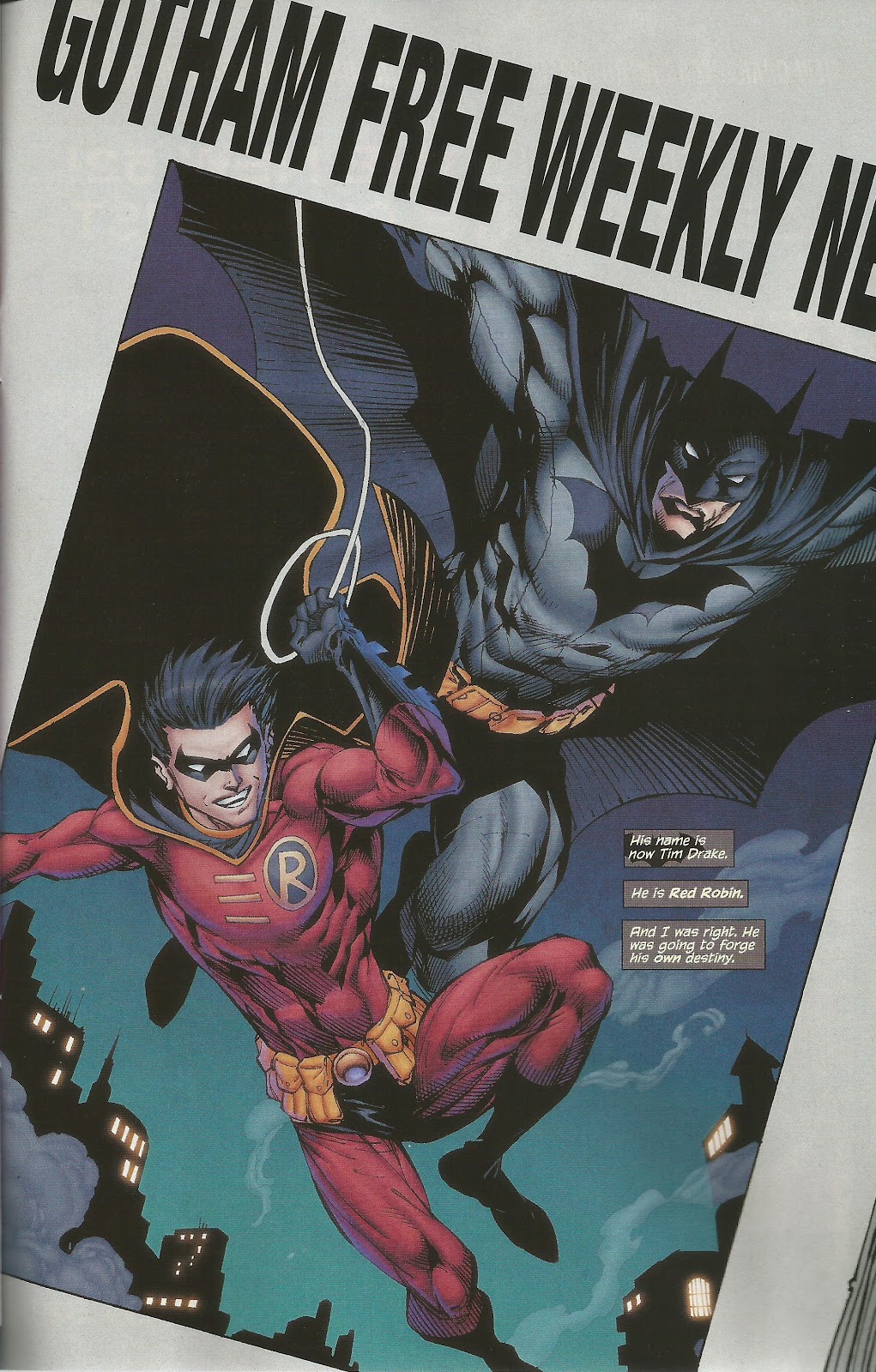
More of DC's past continuity falls by the wayside in Teen Titans zero.  Scott Lobdell and Brett Booth pare A Lonely Place For Dying the miniseries that introduced Tim Drake to the Batman mythos.  In that series, Drake observed that Batman experienced a trauma, the death of Robin Jason Todd.  Dick and Alfred help convince him that he should take on Tim as a partner.  

Of course, this is insane.  The concept of the kid sidekick, having a mature adult enable a son, daughter or surrogate to risk his life the way he or she risks his life amounts to child endangerment.  It's one of those conceits that you just have to shrug your shoulders over and accept as a comic book convention that won't be going away...ever.  It doesn't make sense unless you agree that all you're doing is reading a story, and the kid is just another character.

Lobdell keeps the idea of Batman's hurting over losing his partner, but the theme is all he keeps.  Originally, Tim's parents were well to do.  Tim's father was in Bruce Wayne's stratosphere if not exosphere.  A crazy voodoo dude murders Tim's mother and paralyzes his father.  I think they kill him later, since conflicting father figures really do not work well with the concept of kid sidekicks.  

Originally, Tim was smart, but he's not brilliant.  The status of Tim being a wunderkind was worked in way, way after Chuck Dixon's and Tom Grummett's Robin ongoing.  Lobdell reintroduces Tim Drake as gifted in both body and mind.  Tim was never a gymnast like Dick.  In Teen Titans he's a budding Olympic star of blue collar parents, but he's obsessed with only one thing, Batman.  He knows Batman isn't himself.  So, he sets out to find the Dark Knight and confront him.  Batman hopes to deter Tim Drake with a clever ruse that's also a beautifully constructed Frank Lloyd Wright inspired headquarters.  In addition, Lobdell factors in modern technological wonders.  Tim and Batman stay in contact through Twitter.  It's a bizarre but realistic twist.


Soon after his meeting with Batman, Drake attracts trouble thereby endangering his parents and cleverly taking them out of the picture.  They don't die.  Rather, Lobdell uses a real world organization to remove them.  The excision simultaneously forces Batman to adopt Tim Drake as his Red Robin.  Tim never actually becomes Robin.  

James Tynion Jr. and Scott Snyder follow up Snyder's Night of the Owls with sequel series Talon.  Calvin Rose had a poor childhood until he met an escape artist from Haley's Circus.  Well, nowadays in DC, if you say Haley's Circus, you know the Owls cannot be far behind.  They look upon the neophyte escapist as their latest Talon, assassin of the Court.


Everything goes swimmingly until Calvin feels regret over the Talon that he murders in the Owls' maze beneath the streets of Gotham City.  Haunted by the Talon's face, he continues working for the Owls but in a mostly non-lethal capacity.  

Calvin is more than a Talon.  Because of his skills, he's a ghost.  He can defeat any security and enter any edifice without a trace.  Most importantly, he can find a way out.

When the Owls give Calvin an assignment to end the bloodline of one of their investors' enemies, Calvin finds he cannot comply with the Owls' orders to slay an innocent woman and her two-year old daughter.  So, begins Calvin's escape from the Owls and what looks to be an awesome series.

The zero issue of Talon likely starts one year before The Night of the Owls.  The Court sends a Talon to retrieve Calvin Rose, now working as a civil technician on a bridge.  The Court wants him back, and we know why.  They have bats on their radar, and they need their best man, the one that got away to kill the Batman Family.  It's a great twist integrated with the DCU and fused to the old Fugitive premise.  

Talon is a real boon for Guillem March.  Heretofore only known as a babe artist, and responsible for a controversial Catwoman cover, that honestly wasn't as horrible as some people think, just a proportionately flawed tight draft, March shows that he is fully capable of not just illustrating knockouts and sexualized narratives.  He accentuates the drama, he draws emotion despite complete concealment.


In addition March demonstrates that he can render what he sees as well as what he imagines.  His illustration of ordinary objects, drapery, the way he drafts the design of a bridge, the way he constructs a car exhibit consummate skill.  Some may be surprised to see Kubert influences in his art.  Talon should settle any dispute over the limits of March's talent.

So ends another issue of the POBB.  Hope you've enjoyed the perusal.  Until next week.

Tuesday, September 25, 2012


Pick of the Brown Bag
September 19, 2012

by 

Ray Tate

Today in the Pick of the Brown Bag, I'll cover The Judas Coin an original graphic novel by Walt Simonson,.  It's another big week for DC zero issues.  Birds of Prey, Catwoman, Nightwing, Supergirl and Wonder Woman are all ripe subjects for the POBB, as well as the brand new Sword and Sorcery with the pre-Crisis character Amethyst and the even older hero Beowulf.  I'll also look at Young Justice, the all-ages title spinning-off from the television series.

Let's Get This Party Started


I'm an atheist and because of my skepticism I have low tolerance for anything based on Christian mythology.  Crosses and holy water against vampires? That's something I can accept at least for an hour or two.  Young Samson and Goliath sure.  

Angels or a benevolent god?  Forget it.  Thankfully, I don't have to believe for a second in order to accept the premise in Walt Simonson's time-spanning graphic novel The Judas Coin.  

Simonson leaves plenty of wiggle room for people like me.  In the tradition of the storytellers of old, Simonson establishes that the story may have happened, or it may not have happened.  It's a story, related to generations and perhaps amended down the line.  So maybe we're talking about the legend of Jesus and Judas, or maybe not.  Maybe it's Brian.

The key is that a curse falls on the coin in question, or perhaps the coins in question.  Well, the Hope Diamond is supposed to be cursed, and that's a real world object.  So I can accept that lots of bad things happened to people in possession of the coin but these events weren't necessarily caused by the supernatural, merely greed and happenstance.

After the preamble, the story kicks off with one of the most obscure DC comics characters from The Brave and the Bold.  The Golden Gladiator defines honor to his friend Caesar. No, not the monkey, or Julius.  The Golden Gladiator's colleague is Titus Flavius Caesar Vespasian Augustus, a real world Emperor of Rome.  Simonson did his research.  He sets the story in Germania, where Vespasian made his first impression as legate.  Marcus and Vespasian attempt to parlay with allies.  They find traitors and outlaws that might be persuaded to join their cause, only if the accursed coin doesn't foul their intentions.

Next Jon the Viking Prince and his men discover an island tribe that use the coin as a talisman.  The encounter leads to an episode that's almost Pythonesque in nature, albeit with a more dramatic sensibility.  It's here that you notice Simonson starting to tweak his artwork to suit either the period or the fame.  It's still very vividly his style, but the illustration in this short bears some nuances from his early work which included nods to Joe Kubert, the co-creator of the Viking Prince, also representing The Brave and the Bold.  

I was a little surprised not to see the Silent Knight among the heroes contesting against the curse of the coin, but Simonson jumps ship to Adventure Comics with Captain Fear next.  In the past, Alex Nino related the pirate's escapades.  Nino's artwork and Walt Simonson's renderings look somewhat similar to begin with.  Nino however was more of an evoker.  He put in just enough nuts and bolts to recreate the atmosphere of the period.  Simonson provides sharp, focused detail for mutiny possibly caused by a rather familiar looking coin.

Galloping into the west, Simonson brilliantly characterizes the trickster Bat Lash.  Watch as DC's Maverick out-talks and out-thinks his way out of a comeuppance from a sore loser.  Of course all of these dominos could have been initially toppled by a coin lying in the kitty.

Modern times finds a coin master matching wits against rival thieves, and when the bottom falls out of Two-Face's plans, he finds himself in the odd role of spectator watching and even admiring the Batman bringing his nemeses to painful justice.  Unfortunately for the Dark Knight, chances favor the criminal, or was it chance? Might not a curse and a coin jinxed the Batman's wants?  Simonson goes black and white for this case.  Combined with the widescreen horizontal format, the story feels like a comic strip, a particularly dramatic one.

In the final short, Simonson takes the coin to the future of Manhunter, his presence no doubt a gag on Simonson's most famous character.  This Manhunter is not Paul Kirk but the near one-shot Manhunter 2070.  Simonson shifts his art to anime and breaks out looser sexual mores to make the finale even weirder.

The Judas Coin is a steal, and every page earns each penny.  The paperstock beautifully reproduces Simonson's artwork and draws out the deep rich colors of Lovern Kindzierski.  Here's hoping this isn't the last prestige hardback from Simonson.


Frank Miller's Dark Knight Returns characterized the elder Selina Kyle as a madame who ran a call girl service.  That imaginary future for Batman and his mythology became canon to the post-Crisis DCU.  Miller based his Year One on the past he hinted at in Dark Knight Returns.  A poorly conceived Catwoman miniseries also corroborated Miller's hooker master-plan.

When Jo Duffy began the first ongoing Catwoman series, the first thing she did was fudge the newly minted history.  She re-established Catwoman as a lifelong thief that only pretended to be a prostitute in her early days of larceny.  Good for Duffy.


Rolling unsuspecting johns was simply an easy way to steal cash fast.  Duffy also erased Selina's friend Holly, who was killed previously in Showcase after managing to rise from the gutter to the upper crust.

Ed Brubaker cherry picked from Miller and Duffy.  He audaciously and inexplicably resurrected Holly, but he wisely glossed over Selina's past.  Jeph Loeb chucked all of Catwoman's post-Crisis continuity out the window in favor of a parallel to the animated series version.  This Catwoman also fit in with some of her appearances in Grant Morrison's JLA and Devin Grayson's Gotham Knights.

Despite all these different origins, Catwoman actually holds some immunity.  The fact is that most people have a fixed idea about who and what Catwoman is.  None of the muck tends to sticks.  The perception is quite simple.  Catwoman is a master thief who fell in love with Batman, the world's greatest detective.

The post-Crisis is no more, and the new 52 reigns supreme.  With the zero issue, Ann Nocenti debuts as the new Catwoman writer, and she orchestrates a new beginning for Selina that's closer to the ideal.  

The reason why Selina's so good at stealing is that she survived a childhood of thieving mistakes.  As a youngster, Selina and her brother were artful dodgers working for a corrupt Fagin who headed the orphanage where the siblings plied their trades.  It's funny but Gotham City had quite a few orphanages.  The addition of Selina's brother incidentally is not a new invention.  He debuted in a 1952 issue of Batman as The King of Cats.  


An example of why most 1950s comics should be avoided. 

As Selina grows older, she goes solo and starts attempting the art of disguise; a classic trick she employed in her 1940 debut as the Cat.  Although, rather than opt for a Hollywood styled makeover with latex, Selina tries to assume other roles and finds this task daunting.


Selina becomes better and better at dishonesty.  As a result she grows more cunning, and her research into different lives hones her intellect.  This is where we find her.  Only she's not searching for jewels.  She's seeking her identity.  Nocenti calls back to the distant past once more.  She plays with the idea of Catwoman's true identity.  At one point in the 1950s Batman lore, Selina Kyle suffered from amnesia.  She adopted the  Catwoman persona because she didn't actually know who she was.

The Cat seemed like a whole being.  Catwoman and Selina Kyle could have been two individuals, something Tim Burton and Michelle Pfeiffer played up in Batman Returns.  The clothes maketh the woman.  Catwoman's costume arose mainly out of comic book convention.  Costumed criminals were simply popular.  She could have theoretically stayed free from the distinction, but that's not how history played out, and the idea of she becoming a costumed felon gave greater credence to the amnesia angle.  

In the end the whole amnesia explanation satisfied nobody, and it was relegated to the designation of ruse.  There's only one good origin for the cat motif Selina Kyle chose, and Nocenti sagely employs it.


Nocenti has somebody else throw Selina off the rooftop, but there's no doubt that the kitties that revive Selina padded from Tim Burton's cat flap.  The scene also exemplifies how well Adriana Melo choreographs action, drama and lays out dynamic panels.  

Birds of Prey writer Duane Swierczynski produces the most original of the zero issues.  

He integrates three of the Birds into the new 52's past, and this book pretty much kills the Oracle identity for Barbara Gordon.  There's simply no evidence to suggest she was anybody but Batgirl.  For me, that's pennies from heaven.  For Oracle fans, well, they can suck it, like I had to do for twenty-three years.

Every cell in my body loathed the crippling of Barbara Gordon.  That's about 100 trillion units of hate, but I also had issue with the Oracle persona.  To whit, Barbara Gordon would never have joined the Suicide Squad unless she meant to destroy it from within, but there was no indication of duplicity.  

The Bronze Tiger murdered the original Batwoman.  The original Batwoman was Babs' friend and colleague.  Depending on what day it was, the original Batwoman existed in the post-Crisis and her murder was canon, sometimes.  Batman for example mentions the original Batwoman during Knightquest, when he employs the Bronze Tiger, something that also wouldn't happen but did.  The Bronze Tiger claimed brainwashing as a defense, apparently accepted by all.  It's a crap copout, and Batman would have recognized the Tiger's state when beating the snot out of him in the pre-Crisis.


Babs working alongside Batwoman's murderer? No way in hell.  Babs ending him? That I could have accepted and admired.

When Babs creates the Birds of Prey, the conception made more sense than Babs joining the Suicide Squad.  However let me emphasize.  As soon as DC started reintroducing magic and alien technology back into the post-Crisis DCU Barbara being confined to a wheelchair stopped being even remotely possible.  As soon as Batman was healed from his crippling by a mutant named Shondra Kinsolving, Barbara's paralysis became ever more insulting.

That's of course the old.  We know that in the new timeline Barbara Gordon was crippled by the Joker.  However, she was healed, in all probability through the direct involvement of Batman, approximately two years before her re-emergence as Batgirl, with regard to the formation of the Justice League.  This adventure occurs likely a few months the Joker felled her.

Fresh from Team 7, Diana Lance learns of a deal going down at the Penguin's nightclub, the Iceberg.  She infiltrates the club under the pretense of obtaining a job with security.  Since this demands smacking around Penguin's security, artist Romano Molenaar enjoys a wide berth of artistic freedom, the freedom to have Black Canary kick ass.

Romano Molenaar's artwork is a definite boon to Birds of Prey.  His ladies are proportionate, exhibit fluid motion and engage in deadly displays of martial arts.  I wouldn't mind seeing him as the regular artist on Birds of Prey, assuming that the spectacular skills of Cliff Richards are unavailable.


Once ensconced in Penguin's nest, the Black Canary meets Evelyn alias Starling, the Penguin's henchwench.  The ladies take an immediate liking to each other despite being ostensibly on the other side. 

Starling is bisexual.  In fact, she's the best bisexual/lesbian hero in the new 52 and one of the best ever.  Thanks to writer Duane Swiercynski, Starling possesses a far more entertaining personality than depth deprived Batgirl substitute number five Batwoman.  That personality pops from the dialogue when she interacts with the Canary and when she encounters Batgirl for the first time.


Starling is sexually drawn to the Black Canary, but that's only part of the story.  Swierczynski isn't simply relating a dry origin.  He's got three surprises revealed at the conclusion for regular Birds of Prey readers.

Batgirl cameos in an issue of Young Justice this week, and her brief appearance is really the only reason why I purchased the title.  Nevertheless, it was a better read than I thought it would be.

Miss Martian is my favorite character in Young Justice.  This ridiculous post-Crisis femme Martian Manhunter, with an origin blatantly contradictory to DC's entire history works extremely well without the backdrop of the mess that was. 

In Young Justice Weisman gives her an adoptive family, a love interest, a sparkling personality and an intrinsic role on the team.  Artists Christopher Jones and Zac Atkinson furthermore make Miss Martian as cute as a button.

Another alien makes guest appearance.  Young Justice writer Greg Weisman bases this version of Superman on the animated series Superman voiced by Tim Daley and George Newbern.  Never ever a bad thing.  

Justice League colleague Zatanna appears for a warm, amusing running gag.  Zatanna it turns out was a member of Young Justice, and in the present, she just joined the Justice League.  I have to admit that it's a good and novel fit.  Batman The Animated Series introduced Zatanna as the young daughter of Zatarra who crushes on a young Bruce Wayne. 

Although for all-ages, Young Justice still exemplifies a book that doesn't talk down to its audience.  The creative team for example depict a mature relationship between nineteen year-old Dick Grayson and the grown up Bette Kane, indicating that the creators feel that kids are sophisticated enough to know that adults have sex.

Ultimately, I can't really recommend Young Justice as fully as I would have liked.  The art's elegant and welcoming like most of the all-ages tie-ins that were, Batman Adventures, for example, but the story jumps around time all too frequently, and this is not a time travel story.  Rather, for no reason at all, the story starts at a point where Nightwing is Robin, then jumps to his future.  The same kind of jump occurs when Superboy meets Clark Kent for the first time and then reacquaints with Kent when he covers the present day rally for an outspoken critic of the Qurac regime.  Weisman and company in between these flashbacks/flashforwards also cut to Nightwing and Wonder Girl recruiting the Blue Beetle.

Young Justice ties in more with the post-Crisis DCU than any other animated series.  It's still in its own continuity.  Batgirl's walking after all, but people weeping for the post-Crisis chaos may find what they want in this series.  It's not exactly the post-Crisis, but Ted Kord was murdered.  No indication if comic relief shot Beetle in the head.  Jamie Reyes is the second Blue Beetle.  The presence of Qurac is a big DCU callback as is the Queen Bee, Lagoon Boy and Rocket from the Milestone Universe.

Nightwing zero deals with familiar territory, but writer Kyle Higgins adds dimension to the death of the Graysons through an adorable birthday gift that highlights what Dick lost.  

This is a uniform trait in the new 52.  The writers don't just make the parents of the heroes footnotes in their histories.  They've been imbuing them with depth and power.  The Waynes in Scott Snyder's absolutely brilliant Night of the Owls resonate, and you feel a sense of Bruce's loss.  The Waynes were nice people who loved their son.  The Graysons are no different.

Higgins shorthands the characterization of the Graysons by qualifying them in a typical parent-child scene, and though they punish Dick Grayson for doing something stupid, they clearly punish out of love.  Dick must learn from the rules he broke.

When Tony Zucco murders the Graysons, Higgins looks to the animated series for inspiration.  When Bruce speaks you can hear Kevin Conroy's empathy toward "the boy."  This is no mere copy.  Higgins once again brings nuances to a scene enhanced by artists Eddy Barrows, Eber Ferreira and Rod Reis.  Co-plotter Tom DeFalco with Higgins furthermore gently tease the bare bones of Robin's origin story into the twenty-first century of the new 52.  Dick does not become Bruce Wayne's ward.  Rather, Bruce Wayne offers the police a safe haven where Dick Grayson can recuperate.  Bruce takes Dick out of the Wayne Care Center when Batman encounters Dick searching for Zucco by himself on the streets, another echo to the animated series.

Fans of the character won't want to miss the special zero issue since it presents Nightwing in full uniform as Robin for the first time.  An attractive affair without the traditional short pants.  The story gives a strong reason why Robin dons the costume, and the illustrations of the Batman of the past in the new 52 visually allude to the original Dark Knight from Neal Adams.  If that's not enough I don't know what will fulfill your desires gentle readers.

Although Nightwing is a sad book.  It's not the saddest.  Supergirl feels like a gut punch.

The combination of Supergirl's youthful innocence, her absolute trust in her father Zor-El, and his willingness to sacrifice anything for her is just about the most heart-wrenching fiction I've experienced this year.  Thank not just Michaels Green and Johnson but also Mahmud Asrar's incredibly moving artwork.  His endearing body language for Kara, and the horrible eaten alive by guilt expressions of Zor-El combine to strike with potent impact that once again makes the reader feel what this hero has lost.

Supergirl divulges heretofore unknown details about the history of Krypton and the House of El.  The zero issue also reinforces what's already known. 

Green and Johnson emphasize that cloning is forbidden.  Kara is not a clone.  We do see however that Zor-El was conducting experiments on his daughter to make her more receptive to the gifts of the yellow sun, and he is somehow responsible for the World-Killers that Supergirl faced in her regular issues.  These experiments caused the rift between he and his brother Jor-El.  He always intended for Kara to stay in stasis in order to saturate her with yellow sunlight, which nicely sidesteps the age issue.  Kara was indeed young Kal-El's baby sitter, and while the emphasis is on Zor-El, Alura also appears to express love for her daughter.

I don't have much to say about Wonder Woman except that Brian Azarello and DC take the smartest step they've ever made in the Wonder Woman/Donna Troy/Cassie Sandsmark triangle.  They eliminate one side and "proudly present" the newest version of Wonder Girl.

Wonder Woman was Wonder Girl.  Thank the cosmos! No crazy John Byrne villain magic cloning! No firemen rescuing crying baby! No Wonder Girl predating Wonder Woman!  No Terry Long! Wonder Woman was Wonder Girl, just like she was back in the Bronze Age.  Presumably she was Wonder Baby as well.  Fan-tas-tic! Cliff Chiang's artwork even echoes that sweet Ross Andru illustration that made Wonder Girl's adventures so enjoyable.

I know didley-squat about Amethyst.  I saw ads for her series around the time of The Crisis on Infinite Earths, but the comic book was never available, and since I'm a tough sell on sword and sorcery books, I never looked into getting the back issues.  No worries.  The new 52 Amethyst is pretty self-explanatory.  On earth, she's a cross between Veronica Mars and Lisbeth Salander.  Off earth, blend in Buffy the Vampire Slayer and the modern interpretation of Red Sonja, the original chick in chain mail.

Writers Cristy Marx and Tony Bedard make Sword and Sorcery very user friendly but not all ages.  The writers take a tip from C.S. Lewis.  The children who entered the Wardrobe leading to the land of Narnia aged and gained the wisdom and experience of adults.  When they returned to earth, they became children again.  This should come as no shock to any Captain Marvel readers.  A similar magic affects Amethyst.

On earth, she appears to be Goth with dark features and a preference for dark clothes.  Once on Gemworld here referred to as Nilla, she gains the more familiar blonde hair and purple garb.  In an ingenious twist, she's just as surprised as the reader.

Amethyst's mother, Grace, has been training her since she was able to pick up a sword.  That gives Amethyst, or Amy, skills rare to other young women her age.  Those skills come in handy when she stops an attempted gang rape.

Such a crime might seem out of place in a book that's ostensibly a fairy tale, but rape and murder was the catalyst of Veronica Mars, and the books of Narnia and the Oz books of L. Frank Baum while written for kids didn't scrub their stories.  Gruesome things happened in these novels.  

The crime is furthemore not in the book for titillation.  The writers instead typify rape as a power trip and an act of humiliation, and it is attempted rape.  Amethyst intervenes thereby establishing her creds as no mean feminist hero.

When Amethyst and her mother set foot on Gemworld, their problems arise from Amethyst's aunt.  A witch of the highest order, or lowest depending on your viewpoint, Lady Mordiel absorbs the lifeforce of her bloodline, identified by the blonde hair.  All and all, it's a promising start to a new series that's not quite all sorcery or sword.


Monday, September 17, 2012


Pick of the Brown Bag
September 12, 2012

by 

Ray Tate

Hello, and welcome to the Pick of the Brown Bag.  Today, we clean up with reviews of Smallville, Lookouts and Creator-Owned Heroes.  We turn to this week's batch of comics including the zero issues of Batgirl, Batman, Frankenstein and Team 7.  We'll also look at some licensed properties such as Vampirella and Dark Shadows as well as Doctor Who and The Saint.

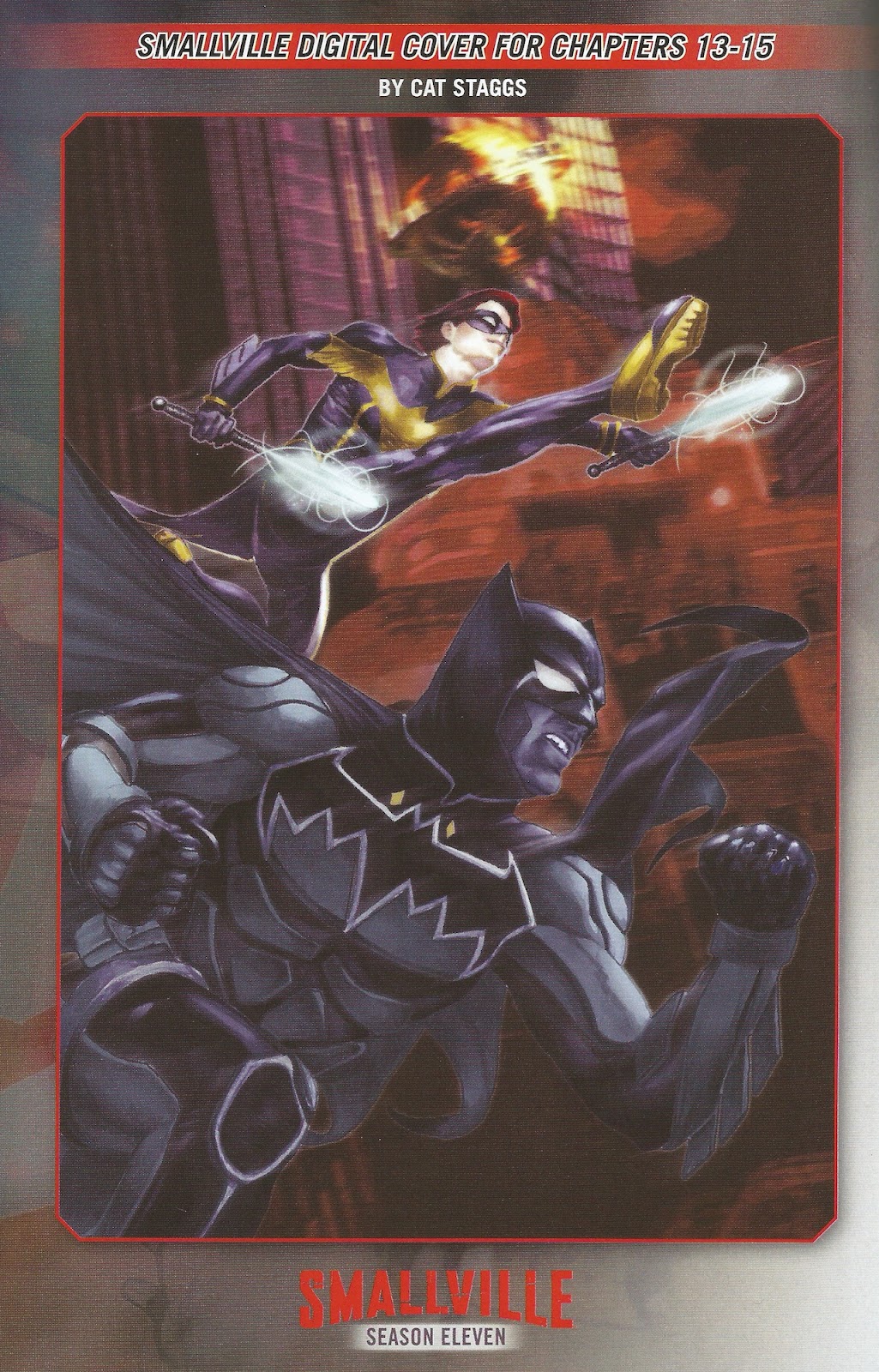
Batman finally arrives in Smallville, the comic book that is.  Creators of the show tried introduce Batman on the series, and failed consistently over rights issues that frankly still confuse the hell out of me.  Warner Brothers owns Batman and Superman.  Smallville was broadcast on the CW.  What was the problem!

Anyway....As with Hank Henshaw in the first Smallville comics, an "actor," you may have seen him before in a smaller part, assumes the role of Batman.  The creative team also fashion his new costume with the limitations of television in mind.

Looks Better Than Bale if You Ask Me

In other words, rather than embrace the unlimited parameters of a comic book like Buffy the Vampire Slayer did, the creative team mimic the format of a television show and, though increasing their budget, they still act as if constrained by reality.  This is actually a good way to go.  Because of these self-imposed margins Smallville looks like no other on the rack.

Rather than adhere to tradition with Robin or Batgirl, the creators introduce Nightwing as an amalgam of both.  Of course there was some controversy over the statements made by writer Bryan Q Miller regarding Batman's Smallville partner.  If you believe Miller, Nightwing was meant to be Stephanie Brown.  This is not how she appears in Smallville.  So, the artists at least had a heads up on DC's plans, and I suspect Miller made his statements before he actually secured permission from DC.

Again this is the smart way to go.  Batgirl is known to be Barbara Gordon or Yvonne Craig by the general public.  Barbara Gordon appeared in costume in no less than six television series.  The people buying and more importantly downloading Smallville aren't necessarily habitual comic book buyers.  Stephanie Brown? Who's she?  We expect Barbara Gordon to be Batgirl.  There can be no other.

Because Smallville is a "television show" the creators do take liberties.  Despite her appearance alluding to her role as a librarian, Babs appears to be Bruce Wayne's personal assistant.  When the heroes are out of uniform, they exhibit a most appealing Avengers dynamic.  As Nightwing and Batman, they are a very tough and downright mean dynamic duo, with Barbara humiliating her targets while Batman scares the hell out of his prey.

When Batman meets Superman, it's an explosive confrontation.  I'm guessing that Batman reacted violently to Superman's interference because Batman believes if he gets in one good punch, he can escape.  Batman is sadly mistaken.

Superman in Smallville is effective.  Superman saves a bus-load of kids taken hostage, by a criminal exploiting stolen teleport technology.  Our hero follows that lead to Lex Luthor, but after questioning the villain, Superman deduces Intergang's involvement.  This conclusion leads Superman to Belle Reve where Bruno Manheim resides.  That's where Batman enters the picture.

Oh, and just in case you were thinking the historic team-up/rivalry overwhelms the personal subplots, you can think again.  Last issue, Lex found a way to identify Superman wherever he flies.  This issue, thanks to a little help from his friends, Superman and Lois have some well-deserved quality time in the Fortress of Solitude.  When Lois returns to The Daily Planet a lovestruck intern--he's into Clark--suffers her particular brand of Loisness.  It's an uproarious moment in which artist Chris Gross stretches his muscles toward the Kevin Maguire spectrum and doesn't do bad at all in the attempt.

A year to a year and a half ago new 52 time, Barbara Gordon was crippled by the Joker, but before that Barbara became Batgirl for the first time.  Batman's and Batgirl's zero issues reinforce the idea that DC's post-Crisis history is no more, and I say good riddance to bad rubbish.

The Killing Joke in particular no longer exists; given that it had all the trappings of an earth-two story, featuring Batman tooling around in a 1940s Batmobile and a photo of the original Batwoman, Bat-Girl and Ace the Bathound, it never should have been incorporated into the DCU in the first place.  The Killing Joke was the eye of the black hole that decimated all that was good in DC comics.

Just a shred of old DC remains, and The Joker's crime is no longer as powerful.  Batgirl is back.  Permanently.  Finally.  In fact, DC went out of its way to make her feel welcome.  The retroplanted, garbage Batgirl substitute and token lesbian Batwoman still pollutes the racks, but no other Batgirl ever was in DC comics.  In the new timeline, Barbara Gordon was, is and will always be Batgirl.  That's how it should be.  That's how it should have always been.

Batman, Batgirl and last week's Detective Comics link to reveal decidedly different incarnations of Batman and Batgirl.  Better versions.  Detective Comics isn't very good until you read Batman and Batgirl and realize that Batman Dark Knight writer Gregg Hurwitz wasn't actually following the old pursuit of presenting a cold, robotic Batman.  

In Hurwitz's Detective Comics, the mentally tortured wife of Bruce's sensei hires a ninja to kill her husband.  Her husband believed that sublimating the emotions is the only way to be a true warrior.  The murder of Bruce's sensei turns out to be key in the forging of a much more empathic Batman of the new 52.  The neophyte Batman learned from the killer of his sensei.  Don't lock up your heart and humanity because this way leads to betrayal and death.

The lesson informs Batman, and when Bruce returns home, he hugs Alfred.  At the time, I simply thought the backup story in Detective Comics was the result of problems in communication between writers.  Now, I see it as the beginning of a pattern.  Yes, Batman will become dark.  Yes, Batman will terrify criminals, but as we see in the future, he will head the Batman Family.  He will make friends with members of the Justice League.  He won't just be a part of the team; we've seen his welcoming attitude toward the Flash in Flashpoint.  He will romance Catwoman.  He will hold Barbara's hand in the ICU.  All of this arises from a single point in the maelstrom of Detective Comics.

Batman details Bruce's first encounter with the Joker in his guise of the Red Hood.  In The Killing Joke, the Joker is presented as a victim.  He's a stand up comic with a wife, and he's duped into wearing the Red Hood.  The gang suckered a schlep to wear the Hood to act as a target.

Writer Scott Snyder and Greg Capullo follow Gail Simone's example.  They throw out Alan Moore's deconstructive origin story for the Joker.  Snyder and Capullo go back to the beginning, in which the diabolical Red Hood was one of the Batman's first adversaries.  He never uncovered the Hood's identity until Robin discovers through criminological analysis that the returning Red Hood's hair is actually green.  When trying to escape Batman, the Red Hood swam through chemicals, and that is how the Joker arose.

Later in the myths, it's suggested that the chemicals twisted his already abnormal brain even farther, and that's where Snyder begins.  He presents the Hood as a joke-telling psychopath prone to violence and mass murder by poison, but nowhere yet near the insanity exhibited by his future persona.  Capullo in turn draws the Hood's head as elongated, sporting a half-grin.  He's only half-way to full ahead nuts.

Batman is a reflective comic.  Capullo expresses the wry humor of Lieutenant Gordon.  Gordon's twitchy mustache through the panels demonstrates youth and Groucho subtlety.  He and Bruce appear to be sharing a private joke that mirrors the body language and veiled meaning in Batman's and Gordon's conversation about The Dark Knight's and "The Joker's" pairing up against the Arkham inmates early in the new 52 series.  The Joker in this case was the disguised Dick Grayson.

Dick Grayson, Barbara Gordon, Jason Todd and Tim Drake all appear in the backup story by James Tynion and Andy Clarke.  The tale better insinuates the Batman Family siblings into Batman's timeline and cements their ages.  Dick is the elder.  Barbara is the second-eldest, as established in a previous issue of Batgirl.  Jason comes next and finally Tim.  Now we can see how a youthful Batman can have four Robins and one Batgirl at his side.

As this week's Batgirl reinforces, Batgirl fought beside Batman and Robin (Dick Grayson).  As Red Hood and the Outlaws indicates, she never met Jason Todd or Tim Drake as Robin.  We can then guess that Dick Grayson wasn't Robin long and took on the Nightwing guise when college age.  Jason only a few years younger assumes the role of Robin, but because of his upbringing on the streets, this harder figure conflicted with Batman who promptly fired him after a few months, half a year at most.  Death in the Family likely no longer exists and thankfully neither does Superboy punching time to reanimate the dead but not the crippled.  Tim Drake then became Robin, and finally Damian Wayne.  It's a tight fit, but it's a fit.

So, what about Batgirl?  Originally, Barbara Gordon was considered "mousy."  In reality, she hid her devastating intellect beneath a guise of propriety as she worked in the Gotham City Library and disguised her brown belt with restrained demeanor.  Fed up with the way people judged her, Barbara intended to wow her friends, father and colleagues with the "The Million Dollar Debut of Batgirl."  She made her own sexy, dynamic Batgirl uniform and simply hoped to reveal herself at a costume party.  Her plans changed when she saw Bruce Wayne endangered by the Killer Moth.

Unlike the post-Crisis writers, Simone keeps the core of Barbara's origin.  Rather than become a martial artist in secret Barbara Gordon learns self-defense because she's the Commissioner's daughter.  The Commissioner's well aware of what Barbara can do.  In the old cosmology, Barbara began her career as Batgirl when older.  She already had a PhD.

Simone sagely takes Barbara's age in consideration as well as her introverted personality and dumps the party idea; perfect for a young woman, not a good idea for a teenager.  The change retains Babs' public shyness, which hides the fact that she's nuts about the concept of Batman.  Her eyes light up when she thinks of Batman, but it's not romance she's after.

Simone outfits Barbara through a very clever means.  The uniform's in fact waiting for her, and she puts it on to protect her psychopathic brother James Jr.  We can assume Year One if long gone from the DC canon.  This is not the child Batman saved during a motorcycle chase.  The Commissioner does not have an affair with Sara Essen.  Indeed, James Jr. coerces his mother to leave the family, detailed chillingly in a previous issue of Batgirl.

A cult/militia leader not the Killer Moth catalyzes Barbara's birth as Batgirl, and in a very strange way, Simone parallels the debut of Batgirl on television.  In that episode of the kitschy Batman,  the Penguin kidnaps Barbara with the intent to forcibly marry her and thereby bulletproof himself against the Commissioner.  In a very clever move, the Penguin hides in the apartment next to Barbara Gordon's flat.  He's right to think nobody would look for them there, but it also gives Barbara the opportunity to work her way along the ledge to sneak home and change into Batgirl.

Simone works the same idea but with a more realistic situation.  Barbara's taken hostage in the police department by a thug who uses her as a bargaining chip.  The thug intends to kill James Jr. mainly because he sees the psychotic personality lurking behind his eyes.  Junior's dangerous.  Barbara uses the tear gas attack to her advantage in order to change into Batgirl and defeat the thug.  Oh, and there's no henchmen around wearing uniforms that say "Henchman."

When the smoke has almost cleared, Batman appears, with the intent to rescue her, but she doesn't need the help.  Her actions instead impress him.  He even compliments her.  At that moment, Barbara joins the Batman family.

I can't say that this origin is better than the original.  Rather, like last week's World's Finest spotlighting a new death of the earth-two Catwoman, the origin suits the character within the new 52 environment, and Simone should be justly proud of reversing Barbara's twenty-three years of misfortune and recouping most of what makes Barbara Gordon special to her fans.

A different type of bat girl casts her shadow in Dark Shadows and Vampirella.  Of course the similarities are few.  Ed Benes illustrates Batgirl elegantly and has nothing to fear from bad breast artist Patrick Berkenkotter.

There's just really no call for drawing a woman like this, even Vampirella, who isn't shy about displaying her sexuality.  Indeed, being a vampire, she must issue seduction as part of the hunting process, but this is ridiculous and not at all sensual.  They look like rotting cantaloupes.

What's worse, is that the depiction distracts you from a decent story in which the proper Jonathan Frid Barnabas Collins mixes and matches with Vampirella on a stalk for a serial killer that has dared to snatch one of Barnabas' victims' descendants; under his protection don't you know.

Writer Marc Andreyko makes the duel between the vamps not just about strength but also attitude, and the often amusing dialogue paves the way for a weird team-up.  Andreyko also partners an incarnation of Pantha, who doesn't sport the ridiculous boobs of Vampirella, and the werewolf Quentin.

From vampires, we turn to a Modern Prometheus.  Mary Shelley never actually went into great detail about how the monster, whom she named Adam, arrived in the world.  She hinted that Victor Frankenstein used dead tissue to construct his eight foot tall beast and electricity to bring him to life, overtly disclosed in the Universal film with Boris Karloff.  DC's Frankenstein is even more twisted.

In Shelley's Frankenstein, Victor was a tragic hero.  The monster murdered his intended Elizabeth and his younger brother William.  Victor pursued his creation to the ends of the earth in order to destroy him.

Writer Matt Kidnt turns the creature's creator into a murdering madman.  He doesn't just use dead tissue to stitch up the glimmer in his eye.  He kills living men and women to harvest the raw material and power the furnace that will give the Monster life.

Upon gaining the spark of life, Frankenstein is appalled at Victor's lack of morality and promptly deals with him, though not fatally.  He sets Victor's victims free, and when he encounters Elizabeth, the meeting is a far cry from that of the Shelley novel.

Kindt compresses a massive number of ideas into one book, and I really wish he took the time to expand them because they're so intriguing.  This is the same feeling I had when Frankenstein starred in Men at War.  I so wanted to see a series where Frankenstein killed Nazis in inventive ways issue after issue and with G.I. Robot J.A.K.E. flanking him.

In this zero issue, we discover very quickly how Frankenstein's bride arose and S.H.A.D.E's continued involvement.  Frankenstein fights a baby-eating monster and as a result becomes a tribe member.  Victor pursues his creation with a band of period cyborg pirates to South America, not the Antarctic.  I suppose you could call them Steampunk, but that movement tends to focus on elegant clockwork and the beauty of steam-powered invention.  These gents are ugly, and artists Alberto Ponticelli and Wayne Faucher intended that homeliness.  In fact even the most unblemished of characters still has the reality of imperfection.

One of "Shelley's children" roams in "Trigger Girl."  Trigger Girl 6's body was based on the President's mother, and there's a reason for that.  "Trigger Girl 6" easily represents Jimmy Palmiotti and Justin Gray at their most outrageous and original.  It's very clear to me why they had to make their own label Creator-Owned Heroes in order to publish this story.  I can just imagine the pitch.

"It's Kill Bill meets classic Disney cartoons!"

Even the most adventurous publisher would probably take a pass on it.  A pity, because the story makes sense, relates a message without preaching and follows a narrative principle you might have learned in English class.  The events and lessons a character learns within a story change that character by the end.

Steve Niles and Kevin Mellon also earn points by crafting the first comedic post-apocalypse story that I've ever read.  The only thing that comes close to approaching the humor is Cherry 2000, and although light, I don't consider that movie an outright comedy.

The Road Runner/Coyote conclusive chase, the self-deprecation of the ostensible hero and the hillbilly behavior of the mutants all classify "American Muscle" as an absurd jest.  The usual articles, an interview and a short sketchbook by Mellon complete the entertaining package.

Another independent, this time from Cryptozoic, Lookouts certainly demands your attention.  The art on the cover reflects what's in the book, but the story isn't quite so innocent or cartoony.

The writers pit their gruff Ranger and his plethora of diverse students against a rare beast, so beautifully rendered I almost wish I could spoil it.  The thing however is not a Disney animal but a murderous monster that wipes out a family of four thankfully off screen.

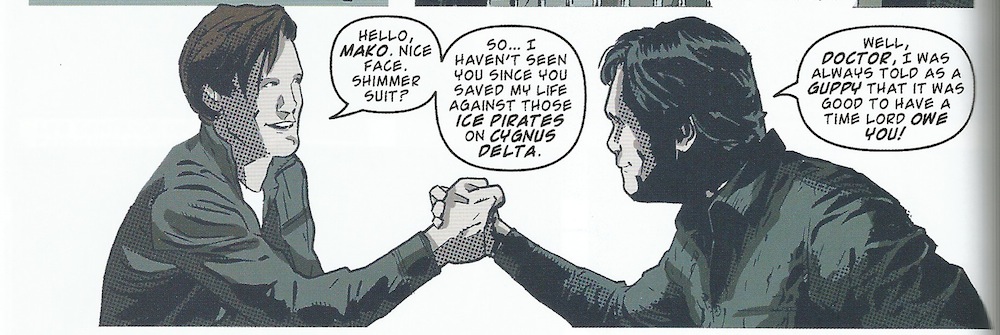
The packaging for the new IDW Doctor Who Special is nothing short of gorgeous.  The Special sports lovely paper stock and a square-bound spine.  It's a definite step-up from the Marvel Annuals which even with Alan Davis' artwork felt disposable.  Of course, the question is does the interior match the quality of the exterior.  I'm happy to say that all four stories are illustrated and written with flair.


In the first story, the always welcome Matthew Dow Smith with textural colors by Adrian Salmons illustrates the sandy environs of Morocco for the Doctor's encounter with an old enemy.  It's great to see these things again.  Their plan follows the m.o. of using humanity's own unification and numbers against it, and the Doctor's brilliant yet simple means to defeat them is classic to his characterization.  Who knew Len Wein was a Doctor Who fan?

In the second tale the Doctor encounters a lost alien and finds himself on the run from Time Lords.  What? But, the Time Lords are locked in eternal battle with the Daleks, courtesy of the Doctor.  How did this lot escape? Writer Richard Dinnick pulls same trick on the reader that Tony Lee performed when the Shadow Proclamation put the Doctor on trial.  We've really got to stop falling for this.  Josh Adams provides good, solid artwork with rainbow wielder Charlie Kirchoff.

In the third tale, the Doctor saves one of his friends from alien hit-men that invade Alcatraz.  That plot could suit any character, but The Doctor's method of rescue depends on his intrinsic sense of whimsy and of course time travel.  It's all whacky fun by Tony Lee and Mitch Gerads who makes the panels seem like consolidated Radio Times covers.


Mark Buckingham, yes, that one, contributes realistic artwork for the Doctor's encounter with a Nazi spy.  Andy Diggle characterizes the Doctor as a finder of trouble and demonstrates the penalty for any that do not heed his warnings.

The harvesters of the bionic parts decide to sink the ship that Jamie merely threatened to keelhaul.  Mind you she did back up her threat with a bionic punch that sent the ocean rushing in.

The launchers of the s.a.m. (surface-to-air-missile) intend to net Jamie from the drink.  They're unaware and do not care about Jamie's friend Nora, which is a mistake as they will soon see, nor their former man with the scalpel.

Artist Juan Antonio Ramirez keeps the visual narrative clear and dynamic, as Jamie refuses to let these reapers get the upper hand or jeopardize her friends' lives.  Tobin's story smartly exemplifies Jamie's wits and her toughness.  He also inveigles a guest appearance by one of Jamie's old friends and uses him as a double-edge to coax out humorous jealousy from Nora, who sobers up rather quickly when she realizes her chances with Jamie are slim to none.  Nora's such a great character, damn dangerous as well.

Leslie Charteris created the Saint in 1928, but you probably encountered him as the suave, sophisticated Roger Moore in the ITV television series from the sixties.  While certainly valid, Roger Moore's Saint was scrubbed quite a bit for the audience and probably to better suit Moore's easygoing personality.

In the novels, the Saint is ruthless and has no qualms when killing a villain.  In The Saint in New York for example, Simon Templar entertains a kidnaped child by slaying her abductors.  He is a prototype pulp hero:  his enemies monstrous like those of the Spider but without the Grand Guignol flourishes and his cold dispatch of justice equal to the Shadow.

Science fiction author Mel Odom and freaking great artist Eduardo Barreto adapt a Leslie Charteris short story, the "Sizzlin' Saboteur," for this low-priced preview of the full comic book.  Charteris believe it or not wrote the Saint's stories until the 1960s, including some of the teleplays in the Roger Moore series.  This story set in 1942 was published in the 1943 collection The Saint on Guard.

Right from the opening, Barreto reels you in with a horrific depiction of being burned alive.  The most terrifying thing about the scene is that he doesn't actually show the murder.  Instead, he foreshadows it with fiery colors and depicts the steps to the homicide.

Later our Saint encounters the aftermath.  Without a photorealistic appearance, Baretto's Saint still evokes Roger Moore's "the infamous Simon Templar" if he had portrayed him in the forties.

The Saint is easily one of the breeziest characters Barretto ever illustrated.  He's usually known for figures that might have burst from Men's Action magazines.  Odom's first person narration and dialogue neatly characterizes Simon Templar.  He captures the dry wit in his voice and choice of phrasing as well as the hero's intelligence.

The most anticipated of the DC Zero books is Team 7.  The reason why is simple.  This is essentially DC's ground floor book.  It's where we hope to learn the history of DC.  Already, we know that Superman and the Flash are two of the first superhumans known to the public.

We also know this team will implode, and learning the reasons why these characters will split is kind of interesting.  Will these rationales be based upon further sightings of capes and cowls?  Will differences in philosophies clash to breaking points?

Dinah Drake, Kurt Lance, Slade Wilson, Cole Cash, Amanda Waller, Lynch, Alex Fairchild and then came James Bronson and Captain Summer Ramos comprise the team.  Oddly enough, there's nine members to this Team 7, but I'm sure that will be explained by the deaths of two.  Possibly the ones we never heard of before.

In any case, the seven formed to combat superhumans counts amongst its roster some familiar names.  Dinah marries Kurt, and she becomes the Black Canary, whom Batman knows and feels unimpressed by.  Slade Wilson gains his Deathstroke gear during the outfitting of the group, and Cole Cash dons his Grifter mask for the first time--no explanation on why only he is masked.

Justin Jordan scribes a competent gang-getting-together story.  He characterizes Dinah as the mvp, a wise decision, and pours in enough action to make Jesus Merino and his fans very happy.  Merino's artwork hasn't changed all that much from his Star Trek Voyager days.  It's just gotten sharper and more fluid.  Nathan Eyring's colors are particularly notable when depicting Dinah's cold-blue stare and the familiar hair color of Alex Fairchild, a second hint in case you've missed the connection.

Well, there you have it, all the books I missed last week combined with this week's yield gives you a particularly meaty POBB.  Next week, the usual suspects and a review of Walt Simonson's The Judas Coin.