Monday, January 14, 2013


Pick of the Brown Bag
January 10, 2013

by 

Ray Tate

The Pick of the Brown Bag this week looks at Animal Man, Detective Comics, Doctor Who, Honey West/Kolchak, Smallville, Swamp Thing and World's Finest.

For this issue of Doctor Who, Brandon Siefert gives all the good bits to the Doctor's companion Amy Pond.  He characterizes her as a brave, experienced time traveler whose ability to use firearms is in serious doubt.

The art team mostly render a sleek caricature of Karen Gillan that bottles her firecracker performance as Ms. Pond.  Some might however question the bright green of her eyes.  It's a fair criticism.  However, Gillan describes her eyes as greenish hazel.  So, the artistic license is acceptable.

Amy deals with two items of interest.  The 1814 Beer Flood, believe it or not, a real historical event and an Agent of the Silence, the multi-species organization pledged to kill the Doctor.  Siefert adds to the Silence's mission statement.  He suggests when not trying to assassinate the Doctor that they seek to preserve history as they see it.  Perhaps as a counter to the Doctor's frequent interference.  That goal carries sudsy consequences.

Amy distinguishes herself as one of the Doctor's disciples.  Inaction would be inimical for a heroine of the now, but Amy's quite willing to do nothing if time demands it.  She wouldn't like it, but she would accept it as a fact.  Amy however immediately sees the flaw in the Agent's "logic."  She deduces the exact nature of the Beer Flood.  She knows what she can do and acts like an altruistic time traveler. 
  

Siefert through Amy plays with the idea of plot devices, historical writing and fiction versus fact.  It's a very meta issue of Doctor Who beneath the guise of a romp.  Siefert furthermore exemplifies how to best use the chapter serial.  Whereas the Doctor and Rory took the center stage in Siefert's first issue, Amy enjoys the spotlight for the second chapter.  Both parts are recommended, therefore the whole of the story.

Amy Pond changes history.  In Animal Man and Swamp Thing the writers offer two different reset buttons to undo the damage of the Rot.  Ironically, for all its horror, gore and destruction Rotworld goes against the grain of conventional DC storytelling.  Rotworld is optimistic.  

First and foremost, we find out that the thing Barbara Gordon destroyed last issue was indeed Batman.  Mourn him not, for as a creature of the Rot, Batman can regenerate.  This means all the heroes affected by the Rot can can be recovered.  None of the champions have yet to truly die.

Batman started playing chess against Arcane as soon as he unleashed the Rot on the world.  Alec Holland is one of Batman's knights.  The power of Swamp Thing is a means to position Alec Holland where Batman needs him.

Batman's plan for defeating the Rot hinges upon Holland's genius and his biorestorative formula.  The reasoning behind Batman's plan indicates a change in the DC paradigm.  

For the past twenty-eight years, writers portrayed Swamp Thing as an elemental, a creature not a scientist.  The new 52 version recreated by Scott Snyder goes back to the Len Wein/Bernie Wrightson beginning.  Alec Holland is Swamp Thing, and Alec Holland is needed. 


Barbara Gordon is also vital to the survival of the earth.  Batman injected her with Kirk Langstrom's formula turning her into a Girl-Bat.  You may ask why Batman used the formula on Barbara and not himself.  There are many reasons.  Barbara's intelligence is second only to his own.  She's the one person he can always rely upon.  She's the sole individual other than himself capable of overcoming her emotions to do the right thing, and she's too often overlooked by the opposition.  Batman I suspect had another reason.  One that has less to do with tactical acumen.

I believe Batman simply couldn't allow Barbara to stomach another crippling, this time from epidemic sickness.  Barbara paid her dues, and for Batman that was enough.  If true, Batman's humanity once again becomes the focus of his characterization, and the new 52 scheme of fostering more humanistic writing ultimately results in a better story.


Animal Man pin-points the exact moment when the Rot won, and that's where writer Jeff Lemire might send Buddy Baker back to his proper time in order to derail the Rot before it begins.  Right now, Buddy fights with the survivors of the DCU in rare displays of superhero gusto.


Lemire also demonstrates the power of the Green Lantern, and our floral Guardian just may also be the catalyst for Batman's and Alec's restorative.  Think about it.  A substance that grows plants in the blink of the eye "grafted" onto Batman's "brilliant" base--perhaps something to aid in healing fauna--combined with the power of the Green Lantern's willpower.  

We might not need time travel after-all.  Oh, and when a certain item from Batman's arsenal makes its appearance, 'elfin awesome.

The Joker produces a different kind of rot in Jon Layman's Detective Comics.  This is another tie-in with "Death of the Family" but Layman's story could have also been stand-alone with little difficulty, and it in a way foreshadows the proliferation of the Jokerz in Batman Beyond.  

Layman posits that the Joker would attract more than copycats but act as a trigger for like-minded budding psychopaths.  The psychoses manifests in various degrees of potency, but the sheer number of the lunatics makes Batman's night a little more hectic.  As such, the Dark Knight drifts through episodes of Joker outbreak and deals with the symptoms by various means.


The difference though lies in the leader and lieutenant of the group being more original than expected.  Rather than assume a Joker homage for a disguise.  The Grand Poobah chooses a new, creative identity, elegantly and eerily designed by artist Jason Fabok.  

At the same time, the Penguin's lieutenant Ogilvy decides to do a little scorched earth housecleaning by framing the Joker for the crimes.  So, Layman and Fabok take something that should have been forgettable and make it memorable.  Something that should have been complementary, singular.


Iconic imagery signifies this week's issue of World's Finest.  The power in Perez's illustration is unmistakable.  Every move Huntress makes designates her as the daughter of the Bat and the Cat and exemplifies how the writer and the artist have upped their game to suit the character.

Keep in mind that the Huntress manages these martial feats while suffering from the shock and trauma of a gunshot wound.  Not to mention it was likely a hollow point.  Though she eliminates her foes, Helena finds herself in custody.


Writer Paul Levitz reminds readers that Huntress doesn't enjoy the special deputy status of her "Uncle Bruce" and the rest of the Justice League.  She's wanted by Interpol, the real life international police force.  Fortunately, for Helena, she has a friend, and the outstanding rescue kicks off Power Girl's portion of the book.

Power Girl explains why you shouldn't attack her cohorts.  Cliff Richards, a Buffy the Vampire Slayer alum, is intimately familiar with potent blondes, and he invigorates the lesson with extraordinary panels in which Kara lives up to her sobriquet.  


Rosemary Cheetham's subtle colors facilitate Richards' achievement, and they make a better team overall than Perez and Hi-Fi.


On Smallville, Veronica Mars' Kyle Gallner portrayed the fastest man alive.  For the comic book, the writers go a little more Barry Allen and cast a newer "actor" for the role. This is generally speaking the only deviation.  Artist Jorge Jimenez does an excellent job reflecting the cast of Smallville in his illustration.

Jimenez keeps the Speedster active as he and the Big Red S race around the world.  From Metropolis to India to France. Jimenez's artwork is stylish and bereft of busy line work. The elegance, the lack of the distraction enhances the outrageous comedy in a spectacular art heist at the Louvre. 

Writer Bryan Q. Miller hammers out characteristic yet hilarious dialogue from Superman as he battles classic villains, changed forever by one issue of comic book merriment.  Supes' repartee with Bart sounds natural and easy, and their fight against the monkeys of Paris neatly capture the zaniness of the Julie Schwartz era while still maintaining the high verisimilitude of the television series. 


Miller introduces another villain for Smallville.  Psimon first plied his cheesy knock off Brainiac shtick in one of the last pre-Crisis issues of The Teen Titans.  

With a few tweaks Psimon works well in the Smallville universe, and his beef against Lex Luthor allows for some smart interaction and some comedic interplay between the bald billionaire bad guy and the Man of Steel.

Lex is pretty much everybody's punching bag in this issue of Smallville.  His dead sister Mercy, who inhabits his body, resists his attempts to wrest the secrets of Superman and usurps control when Luthor lets down the guard of his willpower.  


Lois Lane makes mince meat out him in an interview and Psimon turns out to be less of an ally and more of an uncooperative expensive nuisance.  Put it all together, and you have got the best Superman book on the racks.

This issue of Honey West could have easily been part of the series rather than a special that partners the blonde bombshell with Kolchak the Night Stalker.  I can however see writer Janet Hetherton's reasoning behind the snappy dialogue.  

She's got a story where Honey searches for a missing girl and ends up facing a goofy yet dangerous cult.  G.G. Fickling's Honey West publishing history spanned the late fifties to mid-sixties.  The Honey West television series broadcast in the mid sixties.  Kolchak the Night Stalker arose in the seventies.  Carl Kolchak would be a young reporter during Honey West's time, and crazy cult has Kolchak's name written all over it.  Moonstone currently rents the Kolchak license.  The story element demanded inclusion.

Hetherton casts Carl in a prime spot and recognizes the glimmer of his characterization pre-Janos Skorzeny.  Before his fateful encounter, Carl was a skeptical crime reporter.  His girlfriend, portrayed by the lovely Carol Lynley, had to convince him that the murderer wasn't a serial killing fan of the undead, but the genuine article.  The more Carl read about vampires, the more Carl became convinced.

Hetherton's cult isn't actually supernatural.  So, it's a good fit for the neophyte Night Stalker, and certainly falls in Honey West's purview.  The underlying theme of male animosity toward women also makes the tale a perfect case for the early feminist private eye.  One of the very first in fact written by a woman.  G.G. Fickling was the pen name for a husband and wife writing team.

Like Fickling and the television series, Hetherton reverses the conventions of a woman's role in fiction and fact.  The burlesque club that serves as the setting allows women to express their sexuality and earn an honest living.  The men however behave badly, and Honey will not have any of it.  Honey states that she's not a virgin, but she survives the horror trappings.  She's the effective force that tears through the decidedly male killers.  Artist Ronn Sutton revels in these moments.

In These Shoes, Are You Kidding?

It's actually Carl that assumes the traditional female role.  He's a reporter working undercover, which was one of the few options that a woman in film and television could traditionally hold. Normally, though she would give up the so-called rat-race in a heartbeat to marry the male lead.  There were however exceptions.  Torchy Blane wants to marry her Lieutenant McClane like a good little Hays Code girl, but a good story always gets in the way.  

Speaking of good girls.  Carl is the virgin of the story, and that makes him the target when Honey rescues the substitute.  Whereas most of the cult members just get their kicks watching nubiles die, the cult leader is a different flavored fruitcake.  Carl furthermore becomes an impediment for Honey's easy victory.  

To be sure, all of these quirks actually fit the down-on-his luck Carl Kolchak, and while he will become braver as well as more formidable, this persona will still be the mortal clay that in fact makes Carl unique.

So how did the rest do this week?  New Crusaders from Archie Comics offers good, solid storytelling and cartoony artwork in the style of Bruce Timm as the Brain Emperor breaks out the people he needs from jail.  Trouble is that some guests of the Big House were the more lethal heroes of the day.  The kids do all right in the first meeting against crime, and the reprint of the Gray Morrow Black Hood story, which sadly rips off the Green Hornet/Lone Ranger legacy, is still worth reading because it's Gray Morrow.  I remember enjoying this tale in an Archie Digest special long ago.  I smelled the odor of the derivative even then, but I also had an eye for art.  Gray Morrow, people!

Batwing benefits from Fabian Nicieza's absolute professionalism and experience.  The story however could have taken place anywhere, but we'll see where Nicieza finishes the tale.  New artist Fabrizio Fiorentino presents a style that's more open to light than shadow.  It's not bad just different and will take time getting used to.

The Human Bomb offers a good follow up to the premiere, but that premiere was really, really great.  We get a better glimpse of the characters that will comprise the support team of the new Freedom Fighters.  Uncle Sam, may not be the superhuman icon in a different form, and Joan although sharing the name of Miss America, is unlikely a new version of that character, who possessed the power of shape-shifting.

Earth 2 was honestly a disappointment.  While this reintroduces a new version of an old favorite, the fact is that she's not on the side of angels yet.  So what we have here is a villain attacking another villain, followed by more villains attacking other villains.  Why should I care?

Monday, January 7, 2013


Pick of the Brown Bag
January 2, 2013

by 

Ray Tate

Welcome to the birth of a new year for the Pick of the Brown Bag.   This week it's All-Star Western, Batman Beyond Unlimited, Batman: Dark Knight, The Flash, Hellboy, Justice League Dark, Superman, The Teen Titans and Vampirella Strikes.


"I'm really going to miss these little chats we had together. You're the only one that could keep up with me."--Lex Luthor to Superman in Superman IV

The Superman/Lex Luthor dynamic was a different animal in the Bronze Age.  The writers in that era emphasized that Superman was an alien with a highly advanced alien intellect.  Lex Luthor was a larcenous scientist not a business magnate.  When Superman entered movie history, the more or less original attributes left an indelible mark on pop culture.

Writer Scott Lobdell characterizes Lex as more Gene Hackman than Michael Rosenbaum or Clancy Brown.  Humor laces the genius, arrogance and threat.  It's a fitting counterbalance.
Superman is back to being an alien intelligence, rather than a defacto human small-town boy.  Both incarnations of the Man of the Steel I should emphasize had their plusses and minuses, but I'll always choose brain over brawn.

Superman visits Luthor to confirm the horrors that he deduced H'el will unleash upon the world and indeed the entire solar system.  The kind of mad science Superman concludes refers to the idea of two-way time travel being nigh impossible in the new 52.  The germ grew in the final issue of Flashpoint.  Writer Geoff Johns suggested that the time/space continuum of the previous universe was weak, and that weakness resulted in permeability followed by instability.  

The new 52 has a spine, and Lobdell employs the strength to good effect.  The plausible science fiction explains Superman's reacquaintance with Luthor and it allows for engaging repartee between the stars of the book.  Lobdell in fact scripts one of the best conversations the antagonists ever had.


In the past, Luthor and Superman talked at, not with, each other. In this universe, Luthor and Superman share a mutual respect that allows them to parlay.  Kenneth Rocafort and Sunny Gho enhance the dialogue.  The artists relish the opportunity to better focus on the faces of individuals rather than the action, which is confined to jail defense set-pieces that operate and fail as quickly as sands flow in an hourglass.

Superboy guest stars in Superman.  He's partly the subject of Superman's and Luthor's conversation, and Superboy fans I suspect will be very interested.  These are not empty words.  In addition, the Justice League arrive at the finale, unannounced and unadvertised.  They amount to only a cameo, but it's a cameo illustrated by Rocafort and Gho.  So, that's certainly honey for the trap.

It always pays to flip through a book you don't normally read, especially nowadays.  Batgirl guest-stars in Teen Titans. Writers Lobdell and Fabian Nicieza establish Tim Drake's personal relationship with the Dynamic Daredoll.  Tim, alias Red Robin, knows Batgirl's secret identity.  He also observed her enough to predict her behavior.  More importantly, he arrived at the conclusion that he can trust her if entangled in dire situations, such as capture by the Joker.

Batgirl immediately answers the call and finds the Titans directionless.  She quickly assumes command and orchestrates a rescue mission; splitting the group into away teams to check the sites of the Joker's former crimes.  

Batgirl fans will definitely want to add this issue of The Teen Titans to their collections.  Lobdell makes Batgirl a requisite to the story.  Dialogue maestro Nicieza finds a suitable voice for her.  Combined their efforts characterize Batgirl well.  Take notes Brian Cunningham.  Writers other than Gail Simone can at the very least do justice to Batgirl.  You needn't choose somebody that does not care about or isn't professional enough to do their level best for this character.


Artists Brett Booth, Norm Rapmund and colorist Andrew Dalhouse furthermore cut a fine, imposing figure for Batgirl that grants her the visual resonance of an experienced crimefighter, perfect for her role in the Titans, who literally and figuratively look up to her.

"Death of the Family" readers will be pleased to know that this book deserves the mask it wears.  With the cameo of Batgirl and the lion's share devoted to the Joker taunting Tim Drake, Teen Titans feels like a component, rather than an extra leftover piece, of the major storyarc running through the Batman Family titles.  

If anybody gets short sheeted it's Teen Titan fans.  I still haven't too much of a clue as to who the Titans are, what their history may be and how they impact on Red Robin's life.  Blockade exhibits the most personality, and he's the one that doesn't have any previous involvement with the Titans books of yore.  Wonder Girl comes off as the strong one, wanting to face the music about whether or not Red Robin is dead.  I can say she's vastly different from the Byrne creation, but that's about it.  Kid Flash appears to be a toned down version of Impulse, but not too toned down.


There's not much depth to these Titans in this issue.  They come off as likable though, and that's certainly an improvement over the Teen Titans that were cobbled together from the superior Young Justice and generica during the post-Crisis.  Even the new characters express more spark than the former roster, and overall the attitude benefits from a sense of optimism.

Batman Dark Knight puts the finishing touches on Gregg Hurwitz's new 52 redo of the Scarecrow.  This chapter should have been an epilogue because Batman seemed to pretty much do everything needed in the penultimate issue: escaped the clutches of the Scarecrow, facilitated the rescue of his captive, blew up his headquarters and wounded the crap out of Jonathan Crane.  What more needed to be done?

As it turns out the Scarecrow had one more trick up his straw-filled sleeve.  He started gassing Gotham with his deadlier, more potent fear gas.  This should seem like either an afterthought or a kickoff to a new story, but Hurwitz surprises the reader by ending the tale through a clever, unexpected and rousing means that demonstrates just how much Batman is willing to give in order to save Gotham City.

Along the way, Hurwitz imbues Damien Wayne with far more depth than I thought possible.  Whenever I accidentally read about this character, he came off like a little sphincter.  For the first time, he really does seem like Bruce's son.  Part of that feeling is owed to David Finch's remarkable artwork.


Finch doesn't just make Batman look mean, powerful and resonant.  He dramatizes the entirety and bestows to the cast renditions of subtle and not so subtle emotion.  It's difficult not to be affected by Damien's haunted expressions and Batman's somber funeral march.

The new, satisfying vision touches all the characters including the new ones.  Batman must have taken something away with his latest brush with death, for he enjoys some down time by attending the concert of one of the most multifaceted of his love interests.


Natalya Trusevich could very well be the next Silver St. Cloud, and kudos to Finch for elegantly meeting the challenge of depicting song and music in art.

While Batman Beyond Unlimited's Norm Breyfogle makes the battle between Terry and the Joker King action-packed, the whole exercise feels tiresome, as if this battle should have ended last issue.  That may be because the Joker King just really doesn't cut it as a villain, and he certainly doesn't warrant an homage to Get Carter's finale.

To quote Crow T. Robot from Mystery Science Theater 3000: "No matter how much the movie insists that there's tension, I must respectfully disagree with it."

Bruce Wayne has his umpteenth heart attack while fighting the Joker King, and that's dangerously encroaching into Aunt May territory.  It would have been much more invigorating to see Bruce clean this punk's clock.  I know he was suffering from liver failure.  I know it's not realistic, but it would have been entertaining, and that's all I ask.  The very idea that a lesser Joker can get the better of Batman is preposterous.

The once and future Superman offers a better quality story.  Aliens believing the Man of Steel to be the annihilator of worlds attack our confused hero, in vain.  I suspect much was lost in the translation of the alien bedtime stories that made Superman into a bogeyman, but for whatever reason, the alien's plan B is a corker.

This issue of All-Star Western is rather ordinary, but it's ordinary for All-Star Western not really anything else.  Jonah Hex faces off against Mr. Hyde in the main course, and Arkham embarrasses himself when under the influence of Dr. Jeckyll's formula, but Hex lacks a foil since Tullulah Black left Gotham City with the Barbarby Ghost, and he has been in much more outrageous and violent scrapes.

The backup story is actually the star attraction.  Tomahawk and General Lancaster go at it in a knock-down, drag-out fight that wouldn't be out of place in a grindhouse.


The Flash, though saved by the time-hopping ape Solivar, still suffered a critical wound and keeps him out of the action.  So, this issue consists of the Rogues saving much of Central City while Patty, Barry's paramour, learns of his secret identity.  The art by Batwing's Marcus To is decent, if rushed, but everything changes as the Flash wakes up and Francis Manapul takes over.


That is an exciting, symbolic use of two different artists.

Hellboy gets well weird when Mike Mignola reveals how the demons of Hades make Hellboy's army.  

This is the kind of imagery that loses everything in description.  It's all tied up into one great big ball of eeriness that depends upon Mignola's unique outlook on horror.  I don't even think this kind of torture has any precedent, yet it's such a ghastly idea and one that doesn't rely on the expected.

Tom Sniegowski returns to Vampirella in Dynamite's second title Vampirella Strikes.  It's really no surprise how good this reads.  Sniegowski turns Vee into a quasi private investigator that walks the mean, gory streets while quoting Nietsche.


Artist Johnny Desjardins casts Vampirella's world in sharp shadow while detailing the lovely monster slayer's traditional appearance though not in the European styled swimsuit that while striking unfortunately too often resulted in Vampirella being misclassified as a mere T & A.

Tom Sniegowski's tale becomes less interesting when he shifts the focus away from Vee, including her sterling narration, to a new character of his own creation, but Sniegowski and Desjardins make Vampirella Strikes a worthy addition to your collection.  I say that even with a predilection for the original alien origin, which Sniegowski eschews for a more Biblical myth.


Finally, Jeff Lemire with Ray Fawkes keeps Frankenstein in excellent voice and makes Justice League Dark a cast effort.  Tim Hunter and Zatanna unknowingly teleported to a realm where magic gets a Vitamin B-12 shot.  Meanwhile, Constantine and Dr. John Peril find a clever means to bring the team to this world.  The uptick in supernatural energy affects some of the roster in unusual ways, making this a must buy for Black Orchid and Deadman fans.


Ultimately, a setup issue that could have been relegated to the phrase "Wait for the trade."  Justice League Dark benefits from Michael Janin's and Jeromy Cox's superb illustration of Zatanna's absolute joy at discovering that her magic is finally up to snuff.

Overall, a good week for comic books.  That's it for now.  Join us again next time for another foray into the comic book racks, and if you haven't downloaded the Doctor Who Christmas Special, you really need to.  It frames the rest of the season, produces several new, running surprises and reintroduces an old foe for a new audience while not just preserving the past but setting it up in one of those time twists Doctor Who is famous for.


Tuesday, January 1, 2013


Pick of the Brown Bag
December 27, 2012

by 

Ray Tate


This week Pick of the Brown Bag investigates The Shadow Special and the latest new 52 crossover from Geoff Johns' Throne of Atlantis.  After the comic book madness I also review Django Unchained.

An unknown Big Bad takes over a naval vessel and launches missiles into the ocean.  This unprovoked attack on Atlantis forces Orm, Aquaman's full-bred Atlantean brother, to launch a counterattack on the surface world.  

Geoff Johns' latest fires on all cylinders.  From every angle, "Throne of Atlantis" makes sense.  The characterization is strong, and the Justice League itself seems less like a neophyte organization filled with squabblers and more like what the League always should have been.  The top tier protectors of the earth.


Orm's attacks on the surface world give Johns the opportunity to flesh out the new 52 universe, its champions and the way the supporting cast interact with the heroes.  

Johns appeared to have remembered Cyborg from The Super-Friends and included him on the team as merely a token character.  In this story, we get the sense of the man behind the machine.


Batman calling a hero by a nickname is a big deal, and Johns knows this.  He instantly grants Cyborg better cred through Batman's comments.  Batman possessing the humanity to check on another's father exhibits a remarkable change in the Dark Knight's former characterization and excellent comprehension on Johns' part.  If there's one thing Batman can empathize with its the relationship between father and son.  Johns will replicate this more richly characterized Batman when Mera rescues Commissioner Gordon in Aquaman.


Another clever use of identity occurs during the date between Superman and Wonder Woman.  The date itself is rather boring with the whole romance directionless.  However a truly noticeable moment occurs when Superman refers to Batman as "Bruce" in Diana's presence.  That's again a big deal.  I could write a book on the way Batman's secret identity fluctuated in the post-Crisis DCU.  For the new 52, Johns makes no bones about it.  Batman, Superman and Wonder Woman know each other. 

During the interim between Darkseid's invasion and Graves' assault on the League, Batman and Superman admitted to working together.  I imagine this hypothetical World's Finest case load occurred soon after Dark Knight in which Superman had to control a Venomized Batman.  We can also suppose Superman and Batman had off-panel encounters with Wonder Woman.

Johns gained fame in the comic book community for plots that take advantage of, often obscure, comic book history.  He was a sort of Grant Morrison without the application of the Mind Probe.

No! Not the Mind Probe!
Some may argue that "Throne of Atlantis" exemplifies Johns' strength.  However, as far as history goes, the animosity between Ocean Master and Aquaman is widely known to casual comic book readers and perhaps the layperson that watched Justice League from Bruce Timm and Company.  Indeed, the supporting cast that Johns employs in the adventure also reflects pop culture digested by generations: Lois Lane, Jimmy Olsen, Commissioner Gordon.  No, "Buckeye" Heywood here.

The plot lacks impenetrability and convolution.  This isn't a Blackest Night type of story requiring you to suspend oodles of disbelief.  Rather, it's a tale that combines a classic strategy--pitting one's enemies against each other--with Atlantean floods.  

Some may argue that the artist formerly known as Ocean Master is actually a Machiavellian mastermind out to foment war between the two environments, but I doubt it.

The original Ocean Master, a human, envied his brother Aquaman, and let's face it.  Aquaman did have everything: cool powers, hot wife, a kingdom and believe it or not respect.  The new 52 allowed Johns to clean that slate, and these changes negate Orm's rationale for attacking Aquaman and the surface world.  

Orm is the rightful and exalted king of Atlantis.  Orm as far as we know hasn't instituted any totalitarian edicts on Atlantis, and he genuinely appears to want to protect Atlantis.  Aquaman tried to be King, but the prejudicial Atlanteans wouldn't rally behind him.  He stepped down.  So, what does Orm gain by attacking the surface world?  Nothing at all.

Johns is joined on "Throne of Atlantis" by his usual Aquaman team of Ivan Reis, Joe Prado and colorist Rod Reis.  The illustrators take great joy in presenting an energetic Justice League.  Batman is in excellent form, in terms of physique and mystique.  In one instance, the Scarecrow's men threaten their hostages, and Batman, looking literally like a bat out of hell, shields them.  Superman and Wonder Woman perform some awesome feats of strength and stamina, but even these moments are outstripped by the beauteous Mera, especially gorgeous with Rod Reis' shade and awe, and displays of her astonishing powers.


Johns benefits also from artist Paul Pelletier on Aquaman.  I've been a Paul Pelletier fan ever since The Flash.  Ironically, Johns and Pelletier known for their Speedsters do not actually include one in "Throne of Atlantis." How good is Pelletier?  Let me put it to you this way.  Superboy and the Ravers was completely unnecessary and would have died quicker without Pelletier's precise pencils.  

Recently, Pelletier wowed me on The Fearless with his depictions of the Valkyrie.

A superb draftsman, Pelletier keenly captures the Justice League.  He brings his superb sense of narrative to the tale, increasing the human drama not just the action.  Furthermore, though Pelletier opts for a plainer style, his artwork gels with the more ornate technique of Ivan Reis.  These first two chapters of "Throne of Atlantis" earn my highest recommendation.

I wish I could say the same about The Shadow Special.  Scott Beatty comes up with a story suitable for the Shadow pulps, maybe even for those of the Spider.   Ronan Cliquet, who impressed me on several Marvel Adventures titles is at his most expressive with the man in black.

Technically, the Shadow is good and solid, that is if you know nothing about the Shadow.  I'm afraid that I know "what lurks in the heart" of Walter B. Gibson's character, and it's not this.


Gibson did not create the Shadow.  The Shadow began on radio as a narrator, graduating to bona fide protagonist with the "ability to cloud men's minds."  A wide chasm separates the radio Shadow and the written Shadow.  On the radio, the Shadow was invisible.  In prose, the Shadow was an arch-magician just like Gibson.

Gibson, like most magicians, found the idea of the occult ridiculous.  He instead made the Shadow a master of hypnotism; a spymaster with a network of agents; a maestro of smoke and light that only appeared to vanish in thin air and reappear with two signature .45 caliber automatics.  Gibson's Shadow is one of the most fascinating characters in literature, but unlike the Dynamite version, he never was supernatural.  

The Shadow's powers irk me something fierce, and in some cases, they're really unnecessary.  The Shadow could have had one of his agents--Clyde Burke for example--pull all the information on this poor girl rather than peer into her soul and judge her so harshly, or is he really presuming all of this based upon his "recognizing the darkness" in his former friend?  

The Shadow depicted above strikes me as exceptionally chauvinistic, unlike the stars of a similar scenario from Men in Black.  Tommy Lee Jones and Will Smith as Agents K and J use the Neurolyzer on Edgar's very clearly mentally abused wife Beatrice:


J: "That weak-ass story's the best you can come up with?"

K: "On a more personal note Beatrice, Edgar ran off with an old girlfriend. You're going to go stay with your mom a couple nights. You're gonna get over it and decide you're better off."

J: "In fact, you know what? You kicked him out! Now that he's gone you're going to go into town.  You go to Bloomingdales and find some nice dresses.  Get yourself some shoes, you know…maybe you can get a facial. And, uh...Oh, hire a decorator to come in here quick cause...damn!"

I can't cry foul over Margo Lane as much as I can the Shadow because Margo Lane was only used in Gibson's Shadow stories under duress.  She was no Myra Reldon, the Shadow's only female agent until Margo Lane.

Margo was more damsel in distress than competent operative.  Most readers that remember Margo Lane recall the Denny O'Neil character from DC comics The Shadow.  O'Neil took liberties to make Lane more like Myra Reldon.  

He used Margo in the comic books simply because her name was more recognizable than Myra's.  Radio was the television of its day.  Margo Lane replicated as memes do.  She is now a staple in the Shadow myths, despite Gibson wanting really nothing to do with her.

What I can say without question is that the idea of the Shadow's operatives being afraid of their spook in chief is completely wrong. 


The Shadow's agents are in on the joke.  Sure, the Shadow amazes them, and few know who the Shadow really is, the full extent of his trickery or even why he decided to destroy crime, but they are not afraid of him.  They know that The Shadow is flesh and blood and in spirit a good man.

The Shadow's laugh chills criminals to the bone.  It beckons their demise.  For a Shadow operative, the Shadow's icy laughter heralds liberation.  The Shadow explained to his agents that he would risk their lives to pursue his goals, but not callously.  If an operative finds himself pinned down by gunfire and he hears the Shadow's laugh, then he knows the scales are about to be tipped.

Margo's reaction in The Shadow Special is absurd, as is the whole sequence.  The Shadow might be a strange bird, but I don't think he sleeps in his clothing.  Who the hell does that?  The entire chain of events is a gratuitous stupidity.

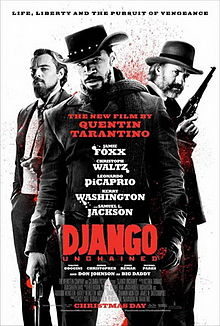
Last but not least, Django Unchained is worthy of the name Django.  Quentin Tarantino's film is an awesome, violent three hours that feels like a half-hour.  The performances all around are exquisite.  The actors just bury themselves in their characters.  I don't believe I've ever seen Jamie Foxx so expressively taciturn, and Christoph Walz who produced a hideous Nazi for Inglorious Basterds here portrays a good German protagonist with grand ease.  Leonardo DiCaprio is exceptionally evil, and it's a nice little full circle turn for him.  In one of his earliest roles in the needlessly maligned Quick and the Dead, DiCaprio co-starred as a good cowboy.

As the slave Django becomes the hero Django, Tarantino captures the period.  Perhaps some of Tarantino's ideas are apocryphal or exaggerated in movie homages, but his crystallization of the antebellum South is an alien world presented on screen for all to study.  This is a weird circle where not all blacks meet the stereotype image of the slave.  Some through education or beauty become for all intent and purpose part of the slave-owning cycle.  These slaves earn the hatred of their fellows.

The only blacks that are free are those possessing the papers stating such.  On the opposite end of the scale, if you're a slave, you can be beaten for cracking eggs.  Yeah.  This is a far cry from the gentle, positive depiction of slavery in Gone With the Wind.  Django pulls no punches when mirroring the evil in slavery. Rape, murder, casual contempt.  It's all here and belongs here.

While slavery is always the underlying motif in Django, the film entertains in other ways.  It is frequently hilarious, turning dead serious, as if a switch were flicked.  These changes in mood always feel evolved rather than jarring.  The story centers around bounty killing, and our men encounter some classic figures from the western genre, embodied by choice guest stars that nobody saw coming.  Django also rises above solely being the shattering of chains or even revenge.  The narrative relates the title character's search for his lost love, just like the original song's lyrics imply, and that's I think even more powerful a hook.