Monday, December 9, 2013

POBB: December 4, 2013

Pick of the Brown Bag
December 4, 2013
by
Ray Tate

Hello from The Pick of the Brown Bag.  In this blog, I review the week's best and the worst comic books.  For this installment I look at Action Comics, Batwing, Earth 2, The Fox, Hellboy, Painkiller Jane and Swamp Thing, but first....


Screw the mainstream critics.  I liked this holiday special.  The tunes were catchy.  Lady Gaga and Joseph Gordon-Levitt performed a cool gender reversed jazzy version of "Baby, It's Cold Outside," and the special was equal parts Gaga and equal parts Muppet Show, in that format, with Kristen Bell as extra comedy.  By the way, a Muppet ate another Muppet on the show!  How much more Muppety can you get? I mean what do you want? I've never been a big Lady Gaga fan.  I respect her politics, but I have a greater respect for her now because it was her idea to include the Muppets.  I'm thinking this is going to become traditional alternative holiday viewing, like A Nightmare Before Christmas.  Okay.  Back to comic book reviewing.


Writer Greg Pak reintroduced Lana Lang in the Action Comics Zero Year issue, but nothing in the characterization singled her out as Lana Lang.  She just seemed like a cipher called Lana Lang.


When Superman arrives this issue he immediately reconnects with Lana, and because of that connection, Lana reads authentic.  Pak splits the narration between the two old friends.  Their insights and mutual history add more resonance and substance to Superman as well as this newest version of Lana Lang.

The reacquaintance happens in South America.  Lana's an engineer in the new 52, and she oversees a geothermal energy project.  Instead of tapping a new source of environmental friendly fuel, the crew inadvertently awaken a giant monster.  Cue Superman.

Even when putting aside the more satisfying Lana/Superman dynamic, this is a fantastic issue of Action Comics.  The monster arises in classic kaiju fashion, and artist Aaron Kuder has Godzilla and Gamera on his mind when designing the beast.

Beautiful.  As the story continues, we discover the creature isn't quite the expected menace, but that doesn't stop a South American government agency or perhaps American security contractors sending a secret weapon to stop the monster and Superman.  


In the new 52, the United States as well as other governments of the world do not trust Superman.  Since they cannot control him, they seek to terminate his contract with the masses.  It's an insane bias.  Why would you jeopardize the planet just on a petty whim? Sadly, in this political climate.  It's all too believable.  Pak imagines a clever means to threaten the Man of Steel, and artist Kuder orchestrates an exciting mid-air battle.  

When the beast must be stopped thanks to the exacerbation of the situation, Superman takes a humane approach leaving behind a grin-worthy penultimate scene that changes to a smart cliffhanger.  One of the best issues of Action Comics ever.

There's a new Swamp Thing in town, and he sucks.  Jason Woodrue, the artist formerly known as the Floronic Man, beat Alec Holland in a contest of conifers, and now Woodrue tries to impress the Green with acts of pure viciousness.

He first stops at Alec's old haunt where he tries to terrorize writer Charles Soule's wonderful creation Capucine.  Capucine is an immortal warrior under Alec's protection.  She's a sort of love interest in Swamp Thing and actually quite an infectious figure.  It doesn't hurt that Jesus Saiz makes her so striking a champion.


Woodrue next blunders with the notion that the various biota are at odds with each other.  It's an ecosystem friends.  Whereas Alec Holland worked with the champion of the Red to fight the Rot, Woodrue decides to pick a fight with Buddy Baker the Animal Man.  

Soule displays why Animal Man is a force to be reckoned with, even without a connection to the Red.  Dude can absorb the powers of animals.  Any animal in the vicinity, which means Animal Man can rip your arms off if there's a chimpanzee nearby and he sting you repeatedly if a wasp buzzes along.  Do not mess with Animal Man.

It's no contest, and Woodrue looks bad.  The beauty of this whole thing is that replacement characters are usually that.  Soule doesn't even pretend the change is permanent.  He doesn't even replace Swamp Thing's narration.  

Woodrue's challenge was just a precipitate of an interesting story.  I've got a feeling that Swamp Thing will be back in two issues tops.

Mike Mignola imagines one of his ghoulish fables. Hellboy merely adds color to what's essentially a war of wills between demons over the soul of one human.  The demons however happen to be grandmother and son which wrings the tale just one more twist.

Three soldiers decide they have had enough of the war.  They desert and make a deal with the younger demon in question.  

Mignola's Hell frequently varies little from some of the environments that Hellboy found himself in as he wandered the globe looking for a purpose outside of the Bureau for Paranormal Research and Defense.  He first finds himself in a courtyard similar to the one where Jules Dulot left behind his mortal coil.

Their journey takes them to a cemetery where they meet the grandmother, and though a relation to the bargain hunter, she's actually quite amiable.  

Then Mignola unfolds one of his trademark macabre scenes in which monsters have a civilized conversation over wine.  It could be blood, but I tend to lean toward wine because that seems more inappropriate given the nature of the conversationalists.

There are two kinds of Hellboy stories.  One revolves around Hellboy hitting things with his big, metal club fist.  This story exemplifies the best of the other type in which Hellboy acts as master of ceremonies to a bizarre undersurface.


Painkiller Jane protects a Saudi princess from a hit squad while her detective partner Maureen tries to wheedle out the identity of the money man.  There's not much to this new Painkiller Jane series.  It's just Painkiller Jane kicking ass on Fire Island where the princess gets exposed to Western culture, but not in a heavy hand-handed way.


Artists Juan Santacruz and Paul Mounts beautifully illustrate the near feral attempts on Jane's life.  Palmiotti encourages the reader with plot twists like bringing in Jane's doctor friend Seth and generates second thoughts in one of the hit men to keep the princess alive for an even more lucrative purpose.  All in all, an excellent mini-series so far.


Batwing under the guise of a Bloodsport athlete infiltrates the stronghold of Charlie Caligula, the pissed off rich big bad who wanted to buy back a diamond mine from Bruce Wayne.  

Writer Jimmy Palmiotti and Justin Gray amusingly reveal that the avarice of Caligula is more about diamonds.  The explanation is a giddy little thing that has just enough verisimilitude to be science fiction and whacky enough to be fun.

Along the way, you get a cover of Enter the Dragon and one of Gray and Palmiotti's strong female characters, draped in the action-packed wardrobe fashioned by Eduardo Pansica and Julio Ferreira.


Though Caligula's actions occurred in previous issues, they're not required reading.  This Batwing adventure acts as a standalone.  So even though this isn't technically a good jump-on point, because of the impending doom of Gothtopia, it's a good issue to sample Batwing and decide whether or not to continue after the Batman Family Forever Evil time waster ebbs. 


Earth 2 should be dull about now with a Darkseid influenced Superman wreaking havoc on the parallel planet, but Tom Taylor and Nicola Scott continue to stir interest with the actions and the identity of Batman.


Batman penetrates World Army's super-powered prison to free heroes vital to his strategy for rebellion, but Taylor spreads around enough doubt and evidence to fuel the mystery.  On the one hand, Major Sato suckers him with a rookie ploy.  On the other, Lois Lane recognizes him.


General Sam Lane last issue imbued his daughter's mind to the Red Tornado robotic body.  In case you were confused by Lois' shiny, new carapace.

Batman implies that he's not Bruce, but he knew our Dark Knight.  The obvious answer is Dick Grayson, but I don't know that Dick exists on the new 52 Earth 2, and Huntress was the only Robin introduced.  Of course, the earth one Batman had three Robins.  So it's just possible that Batman of earth two had two, with Dick Grayson being the first before Bruce married Catwoman and fathered Helena Wayne.  Oh, well.  At least, we can say that he's not Terry Sloan, the former champion who betrayed his world.  In fact, Taylor has a very interesting take on Terry Sloan.

According to Sloan, he did what he did to save the world.  Well, you expect that to be true.  It's the in thing to do.  Make your villain a tragic hero, but that's not exactly new.  Taylor instead portrays Sloan as a self-serving weasel who doesn't stack up to his stranded earth one counterpart Mr. Terrific.  

I find that stark contrast refreshing.  Sometimes its better for a villain to be a villain and a hero, a hero.


Dean Haspiel and Mark Waid opened their new take on MLJ's The Fox at street level.  The second issue takes a hallucinogenic turn.

The Queen of Diamonds transports the Fox to a planet where dreams are the order of the day.  So, while there's not much genuine conflict, the art by Haspiel and colorist Allen Passalaqua, who deserves the lion's share of the plaudits, produce arresting imagery that's also a kind of throwback to a simpler idea of how people dream and fantasize.  


You don't get illustrations meant to instill terror or realistic mirrors to what one might see in a nightmare.  Instead, you experience weird off-kilter drawings that work quite well with the themes.

Good-bye Fearless Defenders.  You were too good to be amongst the Marvel products.

Tuesday, December 3, 2013

POBB: November 27, 2013

The Pick of the Brown Bag
November 27, 2013
by
Ray Tate

This week I'll be discussing the merits of All-Star Western, Aquaman, Catwoman, Doctor Who and The Flash.  I'll also say a few words about Captain Midnight and Justice League Dark.  

Most of the time I review without significant spoilers, but I'm taking an in depth look at "Krypton Returns" playing out in the Superman Family titles.  I botched the whole flow of the reviews by forgetting to pick up the most recent issue of Superboy, a crucial component to understanding what the hell just went on.

In short, some of "Krypton Returns" makes sense, and some of it doesn't.  Surprisingly, the artwork is uniformly good to great with Kenneth Rocafort, Ed Benes and Paulo Siqueira. That's not the norm on crossovers.  The art's usually the first casualty.  Before we get to the Superman Family Special, we look the rest of this week's yield.  First, Bart Simpson Comics...


Ian Boothby starts with "Prankenstein's Monster."  The whole premise seemed very lame to me at first.  Implant Bart's brain pattern to Professor Frink's robot, but this short picks up steam fast.  Boothby exploits the animosity between Bart and his mental doppelgänger to pull a nineteen eighties cartoon reference out of nowhere and introduces a last act plot twist that's beyond brilliant.  


Art by James Lloyd, Andrew Pepoy and Nathan Hamill expertly spreads across a wide cast of Springfield's inhabitants, and the sight gags are almost as funny as Boothby's more sophisticated central joke.

I thought the second story by John Zakour would also be a dead affair, but "Inherit the Windfall" offers the reader numerous gags catalyzed by Milhouse's turn in fortune.  A cornucopia of superbly modeled young Springfielders play a part in the comedy, and Art Villanueva offers an appealing candy coating for Rex Lindsey's and Dan Davis' illustration.

Wonder Woman creator William Moulton Marston with artistic cohort H.G. Peters detailed not just Wonder Woman's origins but also related fables regarding her accoutrements and Invisible Plane.  This issue of Catwoman by moonlighting Detective Comics writer Jon Layman mirrors those stories.

The tale takes place when Selina is a young adult, in the Zero Year, when Batman first raises his cowl.  Batman does not appear in the book.  So those looking for the little purple gloves need to go to Batwing.  Layman presents Catwoman as a kind of secretive, urban Robin Hood.  That interpretation works quite well.  

During the Zero Year blackout and at the cusp of the hurricane, the ever-changeable second richest man in Gotham City, this time Arnett Crocker conducts legal shenanigans to buy a general store.

What a dick.   
The purchase turns out to be even costlier than Crocker imagines. 

Selina's earlier fateful snatch proves to be fortuitous.  This is where the Wonder Woman allusion comes in.  With her ill-gotten gain, she becomes a neophyte Catwoman to scale Crocker's high rise and steal from the rich to give to the poor.

By no means one of the greatest Catwoman stories ever told, Layman's story nevertheless is good and solid.  Layman characterizes Selina as far more stable than most, and he comes up with a much better milieu for her to ply her illicit trade.  Layman furthermore uses the "Year Zero" disasters to his advantage to strengthen the premise to his tale of justice striking up from the streets.  It surpasses last week's Birds of Prey for best unnecessary Zero Year tie-in.  

Like many of the Zero Year stories, Catwoman further benefits from terrific artwork.  Aaron Lopresti returns to DC after making Justice League International at least a gorgeous failure.  Known primarily for his babe-work, Lopresti displays a fluency in drafting backgrounds and crafting somatic variety, regardless of gender.  


Not counting the window dressing in Crocker's excess rooms, Catwoman is the only babe on display in this book. Lopresti however downplays the debutante Selina Kyle of the past as well as the punky sex goddess of the post-Crisis, and some would argue the new 52.  Lopresti's Catwoman is cute and down to earth.  She's an athlete more than an Aphrodite.  A terrific sense of humor imbued to Selina's body language and expressions enhances an overall stylish normalcy.  Lopresti's Selina is just a little more glamorous than Darwyn Cooke's pragmatic pulpy Catwoman and a little less downtrodden than the original jewel thief.  The balance is inviting.

Apparently the CSIs in Gotham City are at a convention or something.  A new drug materializes on the streets, and without forensic technicians, Gotham PD must call upon fellow police scientist Barry Allen from Central City to track down the source and identify the substance.  Any excuse to pull The Flash into "Year Zero's" orbit.

The story reads like a tame direct-to-Blockbuster video from the eighties.  The macguffin makes the rounds.  Barry's doing his Squint thing.  We have the arbitrary tie-in to the past, Harvey Bullock, looking about as unlike Harvey Bullock as possible.  This makes me suspect he was actually some other cop until somebody suggested, "Hey, couldn't he be Harvey Bullock," only after Chris Sprouse had already finished the artwork.  Might we have a love interest to complete the mediocre picture? 

Iris West coincidentally happens to be interning at The Gotham Gazette.  The general history of Barry Allen and Iris West is well known to even the most casual DC Comics reader, but that all changed with the new 52.  Francis Manapul and Brian Buccelato turned away from traditional continuity on a fateful Barry-Iris date.  

Barry is currently involved and living with the loyal Patty Spivot.  So, the developing relationship between Iris and Barry is inconsequential and gratuitous.  It can and will go nowhere.  Iris is the gratuitous shower scene in the film without the sudsy nipples.

Chris Sprouse's forays into mainstream comics have been damn rare of late.  He's a spectacular artist who really should get more work.  So, his role in this mediocrity is to be the blackballed but talented cinematographer that's stuck photographing a low budget video rather than a Hollywood summer thrill ride.

Aquaman finishes his fight against the Ice King and decides his future.  Aquaman's battle against the Ice King is suitably epic, but writer Geoff Johns and artist Patrick Zircher generates more drama from the character interaction.

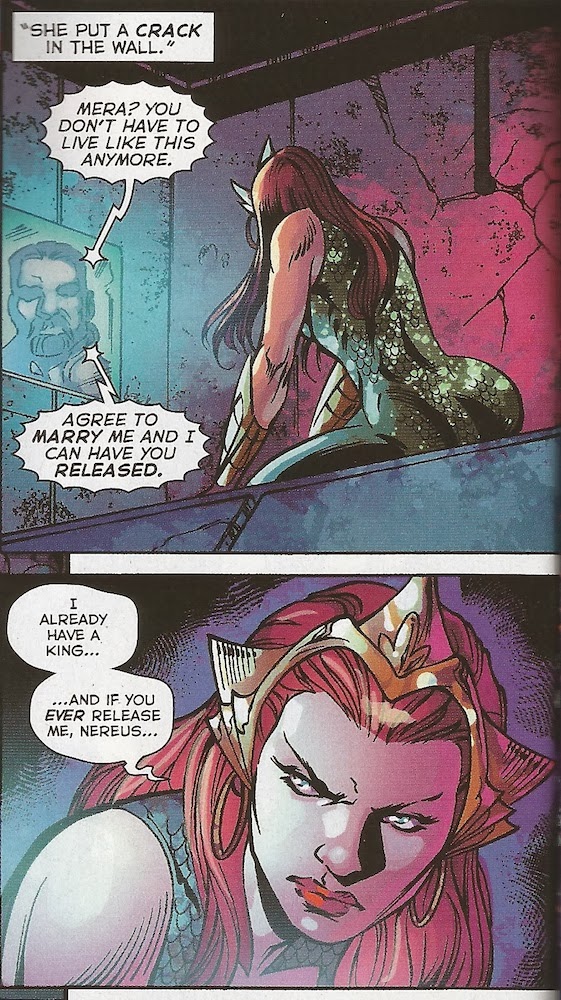
An arranged marriage promised Mera to Nereus, and he thinks that he's in love with her.  That's why he's helping the Ice King.  His deeper rational gives the the interloper sympathy.  The Ice King is aware of this motive, and that's why he keeps Mera alive and imprisoned.


No mere prison can hold Mera, and Johns amplifies the abilities of this former mere Aquaman girlfriend.  Mera is extraordinarily powerful because of her absolute control of water, and Johns implies multiple breakout attempts in the six month interim between Aquaman's repelling of the Scavenger's forces and his reawakening after a telepathic shutdown.

In this six month interim much happened.  Atlantean forces captured Tula, Murk and Spark.  All three rebels experience a change of heart about the Sea-King.  They're not the only ones who grew.  Orm, Aquaman's brother, found that not all surface dwellers should be destroyed.


These plot elements and character evolution intrigue, but this is mere sauce for the goose.  The reunion between Aquaman and Mera entices more than the fisticuffs, and that's a testament to Johns' skill.  He's better known for loosely plotting massive company-wide undertakings, not concentrating on smaller human interest stories.


The question of whether or not Aquaman and Mera will stay together surprisingly offers the greatest suspense.  Through this query Patrick Zircher produces his best dramatic work to date.  Zircher produces incredible illustration, whether used to express the lightness or sadness of being.  Through imagery alone Zircher conveys the emotions worn on the scaled sleeve, and the deep potentials for either choice made.  This issue of Aquaman shouldn't be missed.

Justice League Dark spins its wheels in Jungian muck.  The Night Nurse resembles Brandon Seifert's Witch Doctor too much, and Swamp Thing shouldn't be conducting occult hokum.  He's a scientist.

J.M. DeMatteis' story pays off in the end, which sets up the cliffhanger, but why did we need to wallow through supernatural claptrap to get there? Another waste of good artwork.


All-Star Western continues to be utterly hilarious and fantastic.  Gina and our star displaced nineteenth-century bounty hunter Jonah Hex traveled to Burning Man for fun, but instead, they found a demon with a hankering for hedonism and debauchery.  The Burning Man Festival is known for both, so the demon finds himself right at home, and quickly begins a takeover.


The demon thinks he's found a smorgasbord of death and destruction in Hex, but there's a cool catch that writers Palmiotti and Gray introduce.


Jonah Hex has never been a big blip on my radar before he came to Gotham.  The contrast first lured me in, but Hex actually proved himself to be something I really didn't see before, a hero.  I'm a big fan of spaghetti westerns, but I found it difficult to see the bounty hunter as a champion.  That's because the west operates on different, wilder rules, where the homesteaders are often just as seedy as the gunslingers.  Hex seemed to be one of many killers.


Hex went to Gotham City, old timey and the future, and he proves himself to me as a heroic character all the way.  The demon's pronouncement just cinches it.  Hex is something different.  Along the way to finding out more about Hex, readers will enjoy the guest appearance of Constantine and the outrageously fun kickoff guest appearance by yet another DC Comics staple.  It's a team-up nobody expected.

Tony Lee's Dead Man's Hand, folds with a clutter of cards.  The story started out well with a puzzle for the Doctor to solve and historical personages to meet, but this chapter is a dull one that tries too hard to take part in the anniversary frolic.

The Doctor and Oscar WIlde go to rescue Thomas Edison from a hitherto unknown alien who just might be housing an old enemy of the Doctor's inside his head.  That sounds good, but the execution generates all the padding of a repetitious stroll down the same corridor, and when the Doctor demands to press his case in a virtual reality setting, Lee cannot help but bring in all the Doctor's many personae with him.  While the Doctor appears to be stalling for time in the story, the stall feels like an artificial stretch in the fabric of the writing.  It all just seems forced.  

Meanwhile, Clara has little to do in the town of Deadwood other than chastise the Doctor for his "heartlessness" concerning a zombified Wild Bill Hickok.  The Doctor's observation of the facts is much kinder than the ramifications of Clara's belief.  If Clara is correct, we would be in fact burying the living.  Technology we have yet to discover just may rescue sparks of life.  That would be a horrible.

Skyman first appeared in the forties for Columbia Comics, according to the fascinating Secret History of Marvel Comics (ISBN: 9781606995525) a shell corporation for Martin Goodman and his partner Louis Silberkleit.  Originally, Skyman was a non-powered crimefighter/aviator with a Flying Wing.  The hero had very little to do with Captain Midnight, until he gained something called an Icarus Cape in issue fifty of Big Shot Comics.  No prizes to anybody who figures out the nature of the fashion statement.  

Skyman eventually fell into public domain, which means writer Josh Williamson's positioning of Skyman as a right wing Captain Midnight knockoff is fair game.  Skyman most recently appeared in Dynamite's Project Superpowers any way.  So a totally heroic version of the figure is still out there, and hey, if you don't like either, create a new version yourself.  That's what public domain means.

Skyman last issue revealed that he planted bombs around the building of Fury Shark, the daughter of a Nazi scientist.  Captain Midnight is horrified.


The scene leads into a good tussle between the old guard versus new Coke.  It's not groundbreaking, but Williamson puts a lot of sincerity in the argument as well as energy in a fight that's ably conducted by Eduardo Francisco. 


Williamson also makes good use of Captain Midnight's entourage and conceives an intriguing subplot for Special Agent Jones, who first captured Captain Midnight.  Since we see Jones doing his job, but not at the expense of our main character, he seems less antagonistic than he appeared in the premiere.


Superman Family Special 
Krypton Returns

"Krypton Returns" properly began much earlier in the Superman books.  We caught a glimpse of Superman in the past trying to save Krypton's future.


Explicitly, the whole thing sprang into being when Supergirl killed alleged Kryptonian H'el.  Rather than die like a good murderous lunatic, H'el got sucked into a time fissure, which opened when H'el attempted to bring Krypton back, thereby destroying the earth in the process--the "murderous, lunatic" portion of the equation.  H'el landed on Krypton before it exploded.  Supergirl ended up with Kryptonite poisoning as a result.  She got better.  H'el got worse.

H'el discovers that he is not truly a living, breathing Kryptonian.  The pale-skinned antagonist grew from cells that Jor-El sent out into space.  This is why H'el refers to Jor-El as his father and Superman as his brother.  The truth pushes the pest and loser over the brink of normal madness and into the arms of sheer indescribably dangerous time traveling mania.  You would need another DSM to categorize H'el's madness now.


The Oracle, who pissed off a lot of crippled Barbara Gordon fans by not being a red-head, gathers Superman, Supergirl and Superboy to stop a time/space tsunami.  Will this be another Crisis? Nope.  Not a red sky to see.  The writers deserve credit for isolating the story in the Superman Family titles, rather than compounding timeline confusion with another crossover.  Although "Krypton Returns" is confusing intrinsically.

H'el makes cause and effect his bitches.  A fracture of the proper new 52 timeline splinters into alternate cracks in time and space.  The damage parallels the whole of Marvel's ephemeral multiverse, which always lacked the definition of DC's classic parallel earths.

So, all right.  H'el took a sledge hammer to time and space, and now the Superman Family are starting to see if not feel the impact.  Now, one really good question: why do the Superman Family not immediately disappear.  My guess is that Oracle prevented the logical consequence in order to ultimately preserve the timeline.  

Oracle tracks down key disturbances and sends Superman, Supergirl and Superboy back through alternate time to stop H'el from succeeding in the alternate past.  It's a little convenient that there are only three crux points, but that's small potatoes.

Supergirl's bias against Superboy began a while back in Superboy and her own title.  Clones proved to be a devastation to Krypton, and Superboy is a clone.  The finale to "Krypton Returns" proves Supergirl wrong, and evolving the characters is one of the things writers Scott Lobdell, Michael Alan Nelson and Justin Jordan do extremely well.  That's why I don't mind recommending the entire story if all you're looking for is good representation of the Superman Family.  Superman and Supergirl grow closer.  Superboy makes a heroic sacrifice that seals his place in the roster.  Although there's a good chance, that Superboy may in fact this fellow.


Oracle isn't exactly like Marvel's Watcher.  He's a good imitation, but he's more like Galactus without the appetite.  He's more of an ultimate cosmic explorer, and he doesn't really play the whole non-interference game.  So, Oracle could have rescued Superboy from his death and turned him into the Herald.  We're getting ahead of the story though.


Superboy's assignment is to preserve Supergirl's future, and this is another exemplar of good writing.  Superboy and Supergirl do not get along.  Except in the past, she doesn't know that he's a clone, or Kon.  They become fast friends, and the writers don't make the mistake of turning them even closer.  That would have gone nowhere, given Superboy's sacrifice, and Supergirl wouldn't remember anyhow since Superboy very sagely wipes the events from her memory.  

Last week I recommended Supergirl even though I hadn't read part two of "Krypton Returns."  I'd do the same thing over again.  If "Krypton Returns" emphasizes anything, it's that H'el is really a sad case.  I don't mean you can feel sympathy toward him.  He's more like one of those blow-up clown punching bags.  


You just can't help but to enjoy when Kara beats the crap out of him.  Remember, this emo Kryptonian manipulated Supergirl's feelings.  She fell hard for him.  That didn't stop her from stabbing him in the chest with a chunk of kryptonite.  Did I mention that the lethal rock poisoned Kara in the process? Kara is H'el's bane.  So, I retract none of what I said about "Krypton Returns" part three.  It's awesome alone just for the damage Supergirl wreaks on H'el and the visceral depiction.

Part two in Superboy explains a lot of how Supergirl got to be where she is in part three.  All three Superman Family titles split the parts fairly equally.  So you can get a lot of Supergirl in Superboy and visa-versa.  


That is hot in more ways than one.  The heat vision is an opening salvo in a montage of Kara kicking clone ass, juxtaposed with exactly where she learned how to fight,  Aunt Lara, Superman's mom.  Again, "Krypton Returns" is strong on Superman history, characterization and binding the Superman Family.  The fault lies in the plotting of Superman's part in the whole affair.  


Don't squeeze too hard, Superman.  You'll only be hurting yourself.  Jokes aside, Superman meeting his mom isn't really as cheesy as it sounds.  The writers already foreshadowed Lara being a warrior, and they pay off those expectations.

The writers in addition demonstrate that Lara isn't just a one-dimensional figure.  She possesses a knowledge of science.  She is an advanced warrior.  So she knows to look for a reason behind the fight, and in the end, she's Superman's mom.


All well and good, but in Superman an alternate Jor-El shows up to help Superman stop H'el.  Superman just espied his mother telling his dad that she's pregnant.  Two Jor-Els in the same period isn't disconcerting.  This is.


Wait.  What? Superman killed a whole multitude of Parademons in Justice League.  H'el is a deranged amoeba with delusions of grandeur, and he's already  screwed up history with his callousness.  Kill him already, and let's end this story on a plausible note.


A Chronal What Now?

Congratulations, DC.  You finally did it.  You hurt my head.  I understood Monarch.  That was just a cheat.  I understood the Superboy punching time.  That was just stupid.  This explanation really strives for science fiction gold, but it just leaves too much on the cutting room floor and not enough in the feature.  How does repeatedly punching H'el create a chronal strip that saves Krypton?  Sure punching H'el is a lot of fun.  I get that, and he comes back just like the clown bag, but what does that do? Shouldn't Superman's punch kill H'el eventually even if the Man of Steel holds back just a bit?  The repeated strike should cause too much shock to the target's body.  It shouldn't throw off some kind of time travel whammy that prevents Krypton's destruction.  I just don't understand, and the pseudoscience isn't clearly explained.

In the end, it doesn't matter.  The good outweighs the confusing, but sister, is it ever confusing.  That's why I recommend you just skip over the Superman section of Superman.  Just assume that whatever mission Oracle tasked Superman to do, he did and soak in the glory of scenes like this.


Yeah, that's the stuff.