Pick of the Brown Bag
March 5, 2014
by
Ray Tate
Live from Pittsburgh! It's the Pick of the Brown Bag. This week I look at the Batman/Superman Annual--which is not part of the Huntress/Power Girl and Batman/Superman team-up. I also examine the fate of Nightwing in Forever Evil, Warren Ellis' take on Moon Knight, the conclusion to Action Comics, Futurama, Loki, Scooby-Doo Team-Up, the second issue of She-Hulk and Swamp Thing.

The cover to Forever Evil says it all. Doesn't it? Actually it doesn't. Nightwing's fate doesn't have anything to do with the cover. It turns out writer Geoff Johns had something more devious in mind than merely mussing Nightwing's good looks.
The Grid decided to obey Owlman and Ultraman. Owlman told Grid to protect Nightwing. Ultraman ordered Grid to secure him so he doesn't escape. No problem for an idiot A.I. There is a problem however when Batman, Lex Luthor, Catwoman and the Injustice Gang penetrate the Crime Syndicate's headquarters.

Upon seeing his son in the Grid's trap, Batman drops pretenses and exposes his humanity. Not only does the Dark Knight apologize to his former sidekick. This lowering of shields leaves Batman vulnerable.

Lex Luthor acts like a villain even if he doesn't believe he's one. Villains rarely think of the consequences of their actions, and the ramifications of Lex Luthor's assault and his inadvertently threatening Nightwing unleashes a whole world of bat-shit crazy.

The key here is Batman would have done exactly what Luthor intends, albeit in a kinder manner, but Batman, and Catwoman, on team Batman throughout this exercise, overreact. They let their emotions cloud their judgement.
Catwoman has always been more instinctive than logical. So, her reaction is in her nature. As to Batman, it's more than just his feelings over Nightwing directing his response. Batman's running on steam. He's the only Justice Leaguer left on the planet; he doesn't know about Cyborg's resurrection. Batman justifiably distrusts Luthor. Luthor of course doesn't tell Batman his full plan and the bald baddie's lifelong hate for Superman doesn't warm him to anybody but Bizarro. It also doesn't help matters that Batman's working with a group of killers that he'd rather put behind bars. Saying Batman's under a lot of stress is an understatement.
Batman's actions ironically jeopardize Nightwing's life because part two of Luthor's plan is elementary. All this conflict and threat though arise naturally and not through a stupid contrivance. This is still a surprise to me because of Geoff Johns' incumbency of sloppy writing in the post-Crisis. Credit where credit is due. Forever Evil is tight and well-thought out.

The rest of the Injustice Gang--Black Adam, Black Manta, Captain Cold, Deathstroke and Sinestro, concentrate on the task in hand. They kill two of the Syndicate outright, and Manta has a shock in store for the deadly lunatic Atomica.
Not only am I now convinced that Nightwing will make it out of Forever Evil alive, but I suspect he will emerge physically unscathed. I though he would end up disfigured to predicate his taking over the Red Hood role. The Red Hood switch is still a possibility, due to his secret identity being blown, but Nightwing's assumption of the role will not be due to resulting battle scars, which honestly would have been too convenient and likely wouldn't stick for long.

Red Hood (Jason Todd) is one of the two Batman Family members Batman takes with him into space to fight on War World. Batgirl is the second, and as you can see, Batman's haunted by both of their pasts. This offers a change.
With few exceptions, The Powers That Be only saw Jason Todd as Batman's momento mori. Barbara couldn't even be an occasional reminder of Batman's pain. Seeing Babs in a wheelchair every day should have eaten Batman alive. Nah. That was just hunky-dory. Cause that's where she belonged. Fortunately, rational minds prevailed and Batgirl finally returned. Jason returned sooner, from the dead, but hey, water over a thirty-five year old bridge.

The Batman/Superman Annual acts as a superior done in one sequel to a subpar opener. In that former confusing tale Mongul, the Darkseid wannabe of the galaxy, attempted to take over the earth and kill the Man of Steel and Dark Knight in the workings of a virtual reality game. Now, Mongul's son comes to earth to offer a more direct challenge and a save for the planet.

Though the annual isn't as interactive as I would have liked. There's no historic meeting of Batgirl and Supergirl. It is filled with exciting action and smart character bits that fuel continuity.

Pak adds cement to the relationship between Batman and Superman. Though neither would admit it. At this stage, they're friends not just colleagues. Pak focuses on their dual nature, but not just their disparities also their similarities. Superman comes out of the story looking more lawless than Batman, who believes in redemption.

Pak also grants the families some good moments. Supergirl is tough and selfless; identifying her metamorphosis into a Red Lantern all the more ridiculous. Steel is determined and studious. Batgirl smart and hilarious. Krypto brings some baleful visual humor to the book, and some bite. Jason and Batman pull off a quirky double-act that characterizes Jason as a former Robin that actually spent quality time with Batman and not just soon ended up dead. Formerly, Jason's best moments occurred in the pre-Crisis.
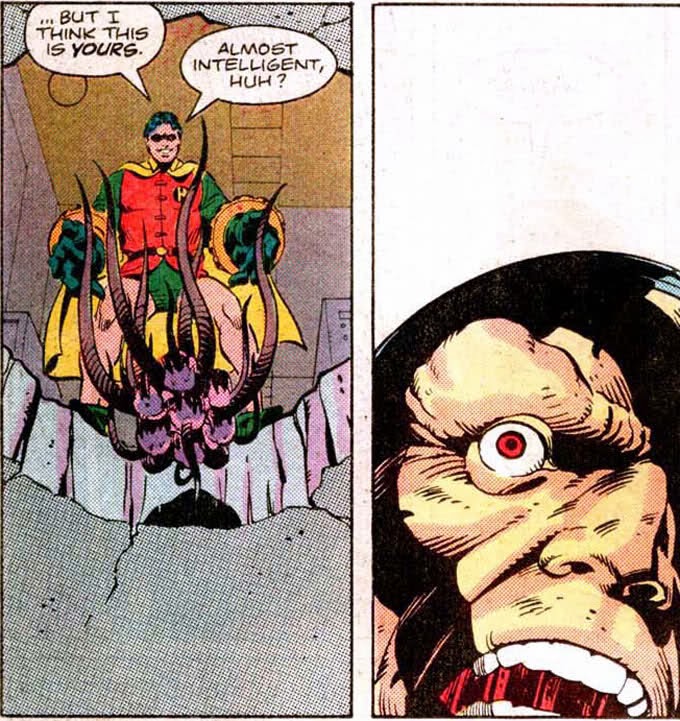
This is the second time Jason thwarted a Mongul.
You don't think for a moment either group will fail or make a sacrifice, nor would we want them to, but it's still fun to watch them succeed.

Pak's run on Action Comics began inauspiciously with a Zero Year tie-in introducing a flatly characterized Lana Lang, and Superman dealing with natural elements. As a consequence, I had serious doubts about Pak's ability to write either Superman or Lana. His second story changed my mind.

Pak introduced Lana as an engineer, which was fine. We can always use another smart woman in the DC Universe. The emergence of a dragon from a geothermal drilling experiment gone wrong chimes the call for Superman, but Pak instead of opting for an obvious Superman vs. Subterranean battle chose to use the dragon as a metaphor for the Man of Steel.

Superman, seeing a little of himself in the creature, instead of destroying the beast takes him back to the Fortress of Solitude. There the beast undergoes transformation into a more peaceful form. As the story progress, Lana and Clark discover an ancient civilization and a new hitherto unseen enemy organization which provides the technology for antagonists like the Ghost Soldier.

Lana Lang and Superman this chapter witness and experience a horrible tragedy that shakes Superman's resolve and greatly pisses him off. Lana's pissed as well, but she doesn't have heat vision. That makes all the difference in the world.

Artist Aaron Kuder brings a superb sense of anger to Superman's expression and actions. This guy is scary when enraged. Not at all the Boy Scout for which so many people take him.
Superman's angry not just because bad guys murdered innocent lifeforms or threatened his friends. Superman's anger is almost existential. Ignorance is why his friend Baka had to go back to the underworld. Certain individuals destroy what they do not understand, and he's angry because these humans are still fearful and ignorant.
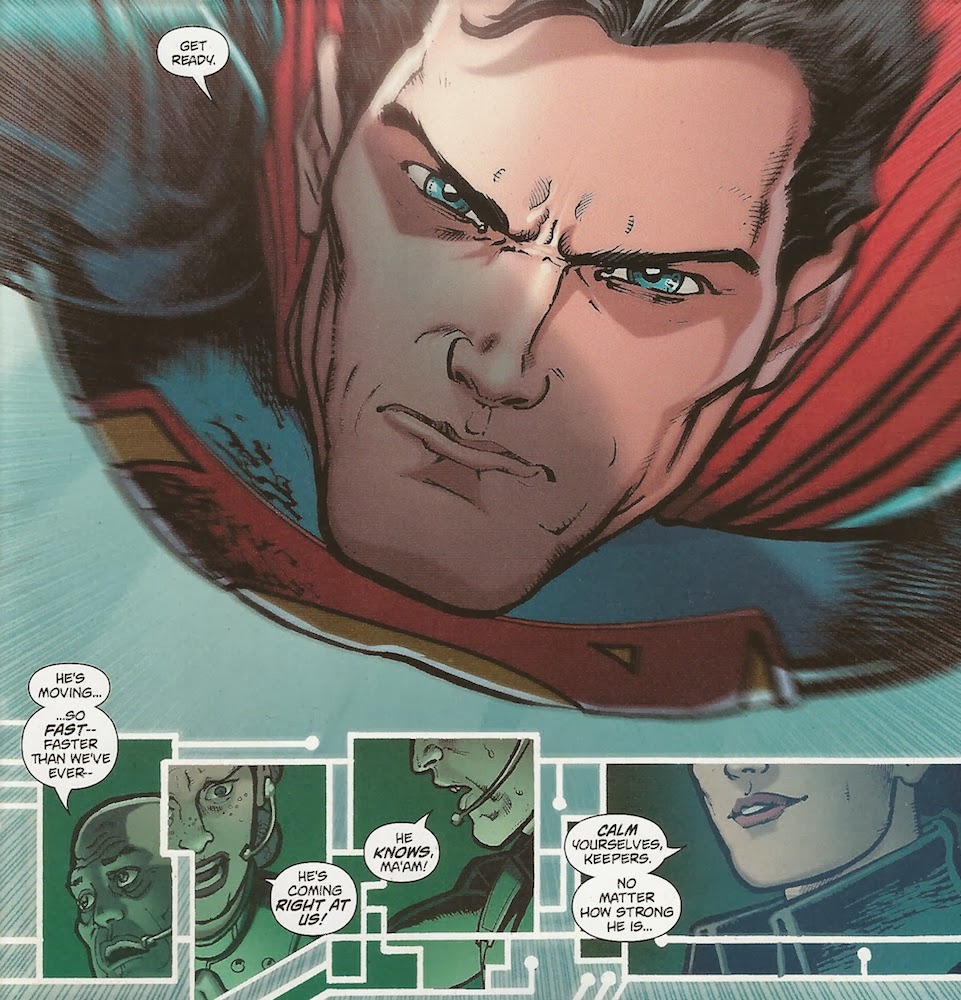
As Action Comics enters Pak's third story, dovetailing off of this one, it becomes apparent that this is the Superman book.

Moon Knight debuted in Werewolf By Night, but you more than likely encountered him in the seventies in The Hulk, the last of the Marvel Magazines, before he graduated to his own tamer comic book. Co-creator Doug Moench based Moon Knight on the Shadow; although most saw him as Marvel's Batman.

The Shadow's true identity was not Lamont Cranston as so many thought. He was in fact Kent Allard, a World War I aviator. Allard assumed Lamont Cranston's identity when the playboy traveled to Europe. Cranston wasn't the Shadow's only sobriquet either, but no matter the guise, Allard was always the Shadow. His personae were just one of many sleights of hand the Shadow's prolific arch-developer, if not creator, magician William B. Gibson innovated.

Moon Knight began as Marc Spector a soldier of fortune who lives after being mortally wounded in the shadow of Khonshu, a minor Egyptian deity. Spector upon returning to the U.S., establishes the new identity of wealthy dilettante Steven Grant, followed by Jake Lockley cab driver and of course Moon Knight, who flew over the city in a crescent moon long before Tim Burton and company came up with the Batwing.
Over the years other writers took cracks at Moon Knight and failed miserably. Some emphasized the Egyptian connection that was only meant to be a tweak of magical realism. At one point, Moon Knight instead of remaining a man became the avatar of Khonshu. A lot of writers predictably took the joke too far and suggested that Spector actually suffered from multiple personality disorder. At the extreme, Brian Michael Bendis defecated all over the concept by giving Moon Knight the personalities of Wolverine, Captain America and Spider-Man.
Warren Ellis' Moon Knight is a fascinating composite that mostly reduces the figure back to a reset point but never the less incorporates all that went before and answers Bendis' lousy "contribution." Thus operating within Marvel's ludicrous mantra that every comic book still counts within a sliding scale of time. So, let me get this straight. KGB agent Natasha Romanov seduced Hawkeye to attack Iron Man six years ago? Really? Fine. Keep believing that.

Ellis introduces Moon Knight as Mr. Knight, a facetious device to explain why he's not arrested by the cops. The threat of jail would mean something if the law actually did anything to superheroes, but they usually don't.
The Mr. Knight guise is an entertaining conceit, turning Moon Knight into Nick, without Nora, Charles. Ellis draws upon Spector's knowledge as a strategist from his days as a mercenary, six years ago. Ellis furthermore explains Moon Knight's predilection for wearing white and glowing in the dark quite admirably.

Moon Knight investigates the death of a pair of innocent night travelers. This leads him into a labyrinth where waits a modern Minotaur, not to be confused with another Marvel villain.

Upon dispatching the beast, Moon Knight flashes back to the immediate past, I guess a year ago? Ellis here explains exactly what Moon Knight is, and he really sells the answer. No bones to artists Declan Shalvey and Jordie Bellaire whose work is truly breathtaking but without Ellis, we might have been stuck with a concept just a shade worse than Bendis' cretinous Crescent Crusader.

Charles Soule's foray into Marvel continues with a second issue of the She-Hulk. Last issue Jen opened up her own law office, and here we discover what insane person would have rented her office space. We next watch Jen weed through the many applicants who answered her want-ad for a paralegal.

My money is on the monkey actually being the entity Jen hired, and Ms. Huang is his host. Kind of like the Brain Slugs from Futurama but in a more symbiotic relationship. The monkey could be one of the many simians from the Red Ghost's menagerie.

Whatever Soule chooses it's equally funny. Either Huang is an efficient if abrasive weird individual or the monkey is an efficient if abrasive weird individual.

After the stress of the office, Jen relaxes with best gal pal Hellcat. I would have preferred Tigra, a licensed private investigator, to join the title's cast, but I can see Soule's reasoning. Any time you put Hellcat in anything, that anything's fun increases exponentially. Tigra is however on her way. Greer's one of the defendants in the infamous blue file litigation that Jen's former firm allowed her to keep.

Charles Soule has a flair for green. Swamp Thing last issue discovered his home had been invaded by a cult that worships Avatars such as himself. Meanwhile, the former Avatars that he freed from the Green vacated his home for mischief.

The story at first resembles Bewitched, with Lady Weeds and the chubby Avatar taking the role of Sam's wilder cousin Serina and Uncle Arthur. The Sureen appear to come straight from Monty Python's Flying Circus, but just when you think Soule is orchestrating a farce, the book becomes decidedly dramatic.

No drama can be found in Scooby-Doo Team-Up. Bat-Mite doesn't do drama, and frankly, he doesn't do comedy very well either.
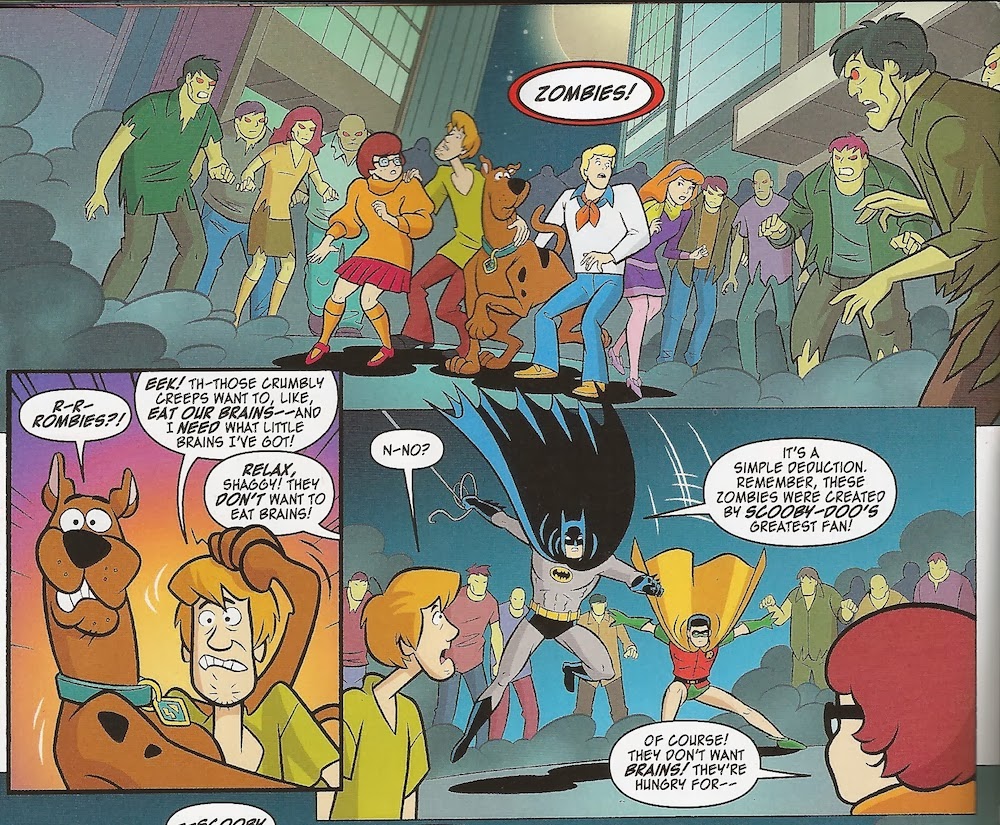
Surprisingly though, Sholly Fisch's latest is pretty amusing. That's because Fisch takes the logical next step in a shared world whose inhabitants include Batman, Robin, Scoob and the Gang and cosmos help us all Bat-Mite. It also doesn't hurt one bit that Dario Brizuela provides elegant artwork that's perfect for the cartoony and the slightly more serious. I'd love to see him on a Batman all-ages title.

Loki's second mission for the All-Mother coincidentally ties in with Marvel's Agents of SHIELD on ABC. The trio of goddesses send Loki to fetch former paramour and all around trouble maker Lorelei, who appeared in the cliffhanger last episode of SHIELD.
Loki finds his quarry in a Speed Dating bar, but humorist Al Ewing cons the reader into accepting things at face value. Loki begins palming the pea by relating a story within a story. Loki caught up in with Lorelei in Las Vegas.

How I wish this was the basis of Catwoman. Ewing even calls Lorelei's crimes a heist. A combination of Charlie's Angels and the excellent Now You See Me, the story takes another little twist when Loki pulls off some classic switches and terrific little scams.
At the same time, Ewing introduces engaging new characters and once more emphasizes Loki's want to change from cackling evil to bona fide trickster. Lee Garbett and Nolan Woodard accompany Ewing on this journey of redemption, and they do so with a light touch and sublime lines that impress with a perfect handling of subtle comedy in a realistic backdrop of artwork.

Last but not least, Jesse Leon McCann returns to cartoon spin-offs with Futurama Comics. The crew of Planet Express all catch a cold, leaving Bender in charge of the ship and delivering the packages. What could possibly go wrong? So much that the Professor decides to make a deal with the devil in order to return to youth, giving his brain a jog in order to discover the cure for the common cold.

In Futurama, the devil is a robot, but all the good rules still apply, the Monkey's Paw gotcha and the ever important signing the contract in blood.
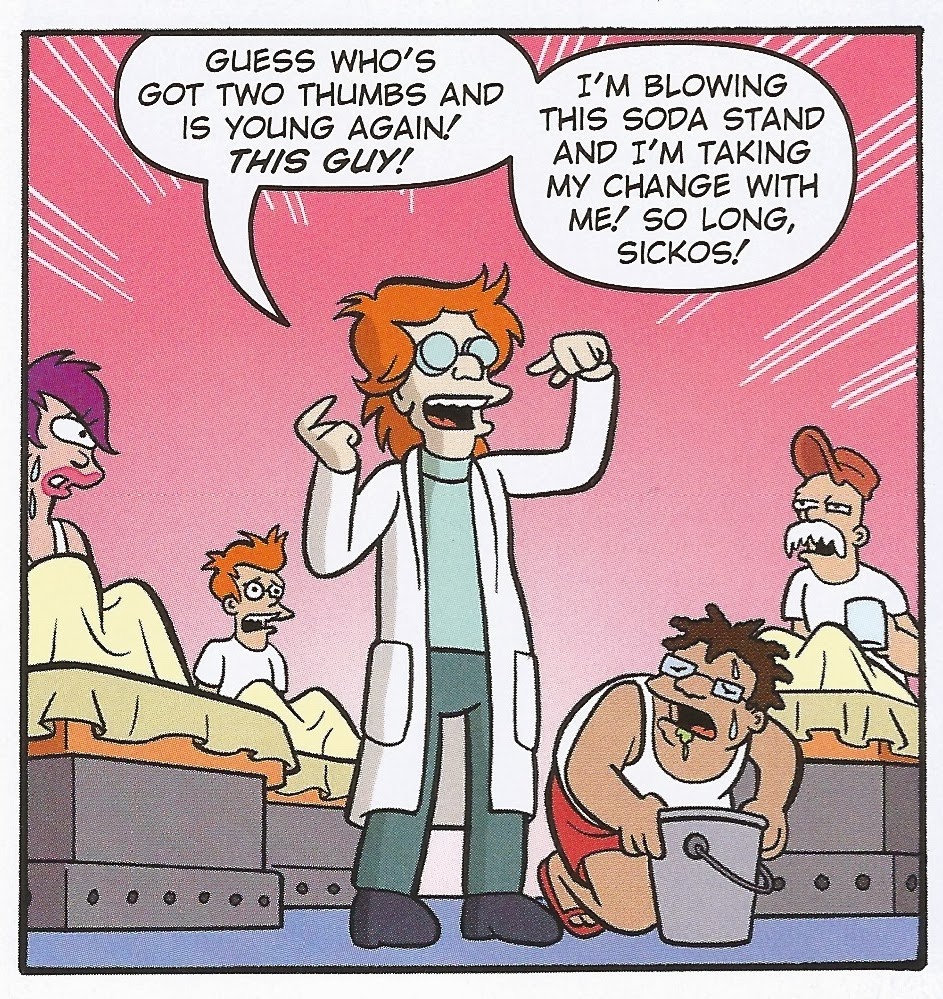
Now, young again the Professor and Bender take on Las Vegas, but the devil follows, skulking like a vulture to snatch the Professor's soul.
McCann's story is a riotous romp in which the Professor beats the devil, returns to the wrinkles and saves the world. One of the more unusual twists McCann plies pays Bender back in kind, and the clever but insane means in which the Professor beats the Robot Devil jibes right along with the zaniness of the television series.
James Lloyd, Andrew Pepoy and Nathan Hamill bring the whole cast to life in the panels, and when I say whole, i mean the entire populace of New, New, New York.


