Tuesday, March 25, 2014

POBB: March 21, 2014

Pick of the Brown Bag
March 21, 2014
by
Ray Tate

The Pick of the Brown Bag is on the air! This week I review Bart Simpson Comics, Batman & Aquaman, Buffy the Vampire Slayer, Legendary, Ms. Marvel, Rocket Girl, Simpsons Comics and Wonder Woman.


"...From now on, every girl in the world who might be a Slayer, will be a Slayer.  Every girl who could have the power, will have the power.  Can stand up.  Will stand up. Slayers.  Every one of us.  Make your choice.  Are you ready to be strong?"

By having Buffy speak these words at the conclusion of the revolutionary television series, Joss Whedon did something phenomenal.  He severed his ties to his character.  She was no longer being written by anybody.  She belonged to us.  He gave her to us.  

Every girl watching "Chosen" could feel empowered.  Every male fan could admire the implications.  Buffy the Vampire Slayer ended in a world full of Slayers.  Buffy would still fight the monsters, but she would no longer rescue victims.  There would be no more victims.  Women everywhere would now overcome the many terrors that preyed upon them.  Real and myth.  They would need no prince to ride up on his horse and slay the dragon.  They can ride.  They can hold the lances, and they have the strength and confidence to use them.  In Buffy's world, women became true equals to if not better than men.

When Buffy the Vampire Slayer concluded, Dark Horse announced the end of their successful Buffy the Vampire Slayer comic book.  Not to worry though.  Joss Whedon would turn up a few years later to introduce a new volume of Buffy the Vampire Slayer that he would write and run.  It would act as Season 8.

Here I would like to introduce The Ouroboros Principle:

a tie-in's claim to being canon to a project produced in another medium diminishes as the tie-in builds its own continuity and relies more upon that continuity for storytelling.

Although Season 8 was not canon, I enjoyed most of it.  It was a joyful reminisce as well as a logical advancement in the lives of Buffy and the Scoobies.  "Twilight" followed by "The Last Gleaming" on the other hand burned Buffy the Vampire Slayer off my subscription list.  The story reached a level of inane that would have seized up the brains of the crew of the Satellite of Love, and they specialize in stupidity.
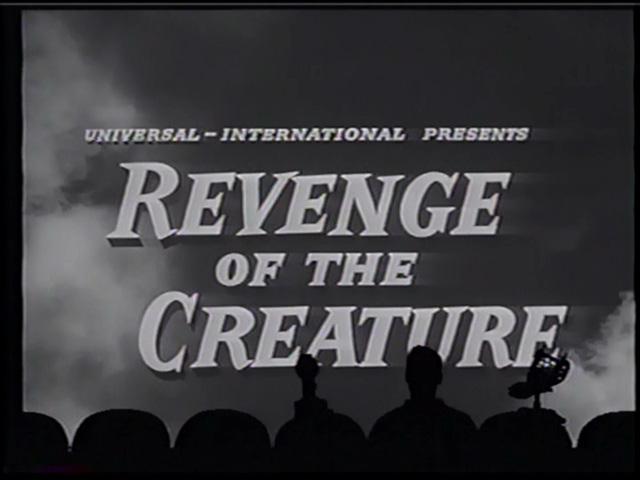
  

Whedon used these two arcs to target the very thing that made the finale so awe-inspiring, and I hated it.  I loathed these two stories so much that I haven't bought a Buffyverse book since.  Given that I've purchased every Buffy the Vampire Slayer project since Dark Horse got the license, that's saying a lot.


It's now Season 10 in Buffy the Vampire Slayer and Christos Gage takes over the writing duties.  In general, I like Christos Gage's work, and a friend raves about his skill in Angel & Faith; as much as I rave about Tigra.  So, I decided to give Buffy another chance.  Heck, I gave Gail Simone another chance and another chance and another chance.  I can give something I actually like a fair shake, now that allegedly the rubbish has gone.

"New Rules" is the title of this arc, and it couldn't be more aptly descriptive.  We first join Buffy in the midst of some old-school slaying with the Scythe.
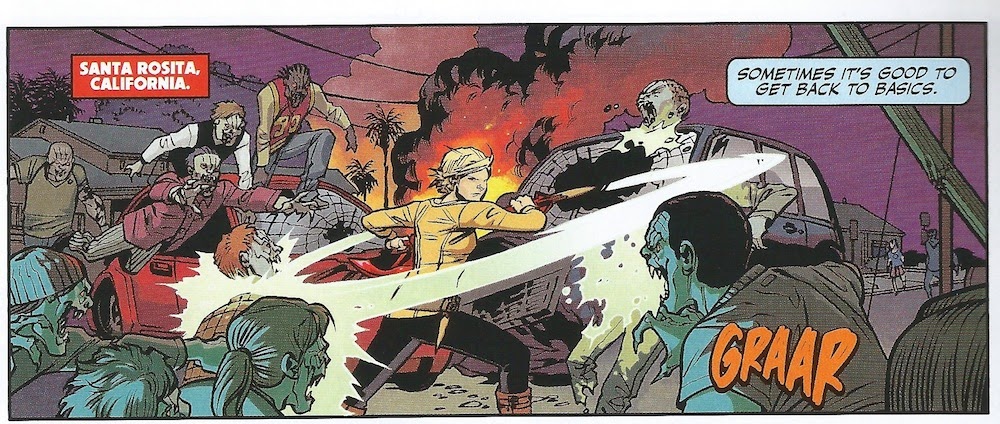


That's a good opening, but readers quickly learn that the vampires Buffy dusts are actually revanants, Lurks from Fray, or as they refer to them in the comic book "Zompires."  Cheesy, but I can believe Buffy and the Gang would refer to them as such.  

These creatures aren't exactly new.  The average vampire in Buffy the Vampire Slayer wasn't cunning but merely predatory with a semblance of an intelligence jig-sawed from an echo of the personality that was.  Arch vampires such as Spike, Angelus, Darla and Drusilla were the exceptions not the rule.  So technically, this is just Buffy the Vampire Slayer in comic book form, which is a good.  Although, things change.
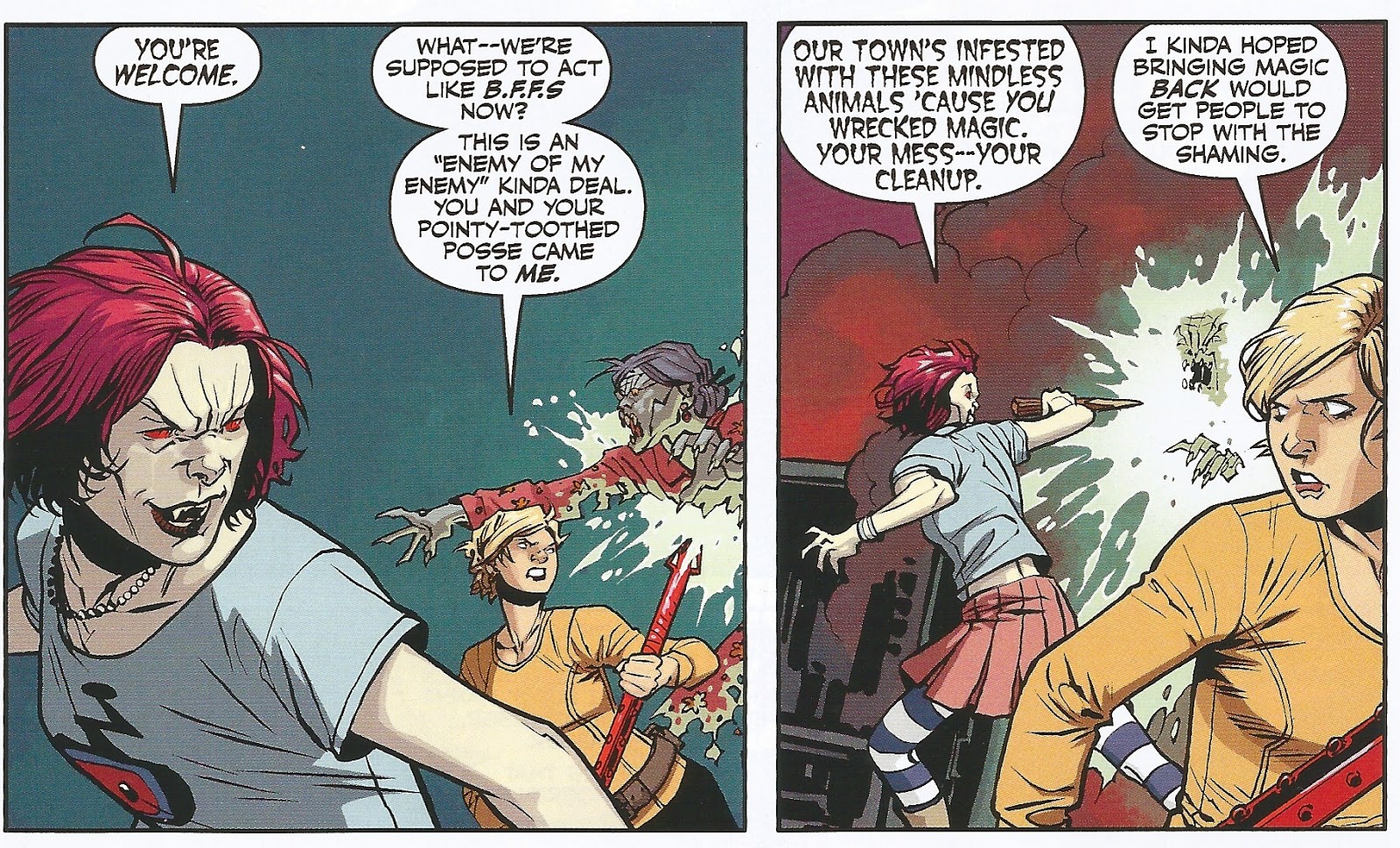


Even the idea of a vampire helping Buffy isn't entirely out of sorts with the concept.  Discounting the vampires with souls, Buffy made temporary deals with ordinary and arch vampires infrequently in the series.  However, vampires wanting to kill other vampires is an oddity.  I'm willing to go with it though, and as the story unfolds I'm finding a lot of assets: the return of Spike and Faith being major ones but also a near miss return to the status quo.


Magic is back into play.  So is Willow.  Buffy destroyed magic at the conclusion to "Last Gleaming," and I didn't want to read this book any more.  So they brought magic back, with the expected consequences.  Fine.  Had they not dispensed with it in the first place...Never mind.  One thing that hasn't changed apparently is the removal of the "every girl" rule.  That irritates me, and it's going to keep this book off my subscription list.  However...


If you think that Buffy's hugging Harry Potter, you can be forgiven, but it's Giles, silly.  Resurrected and rejuvenated.  One may say regenerated.  The key though is that however young Giles now may be, he possesses all of his marbles.  So, Giles is back, which would have been unnecessary had he not been needlessly killed in the first place, but...I'm letting my bitterness out again.  Can't be helped really.  

So, here's the deal.  I'm not adding Buffy to my subscription list.  This is going to be an issue by issue decision.  Christos Gage and phenomenal artist Rebecca Isaacs bring a lot of Buffy style to the pages, but it's not enough to make me forgive the Powers That Be for "Twilight" and "Last Gleaming."  Gage and Isaacs appear to be undoing these things.  Emphasis on things, but I don't feel the same way about the Buffy the Vampire Slayer comic book as I once did.  I don't even feel the same way that I did when the Buffy the Vampire Slayer comic series made no claim of canon.  So, yeah.  It's off the ignore list.  It's not even close to being a permanent fixture in the brown bag.


Rocket Girl is basically one major chase in the subway tunnels of New York.  It's all dependent on Amy Reeder's frenetic artwork, and because of that, it's fantastic.


Batman and Aquaman--What? You want more thoughts about Rocket Girl? Can't give you any.  It's really about Rocket Girl outmaneuvering her opponents, flying better than them, employing awesome aerial tactics, in the subway tunnels.  Honest.  How you respond to this issue of Rocket Girl will result from how much you love Amy Reeder's illustration, and you should.  Okay.  There is a spot more of appeal.  Rocket Girl herself is an infectious personality.  She's boisterous and self-sacrificing.  There you go.  Buy Rocket Girl.

To tell the truth, I began to think a theme had started to develop midst this week's comic books.  After reading Rocket Girl, I tackled Batman and Aquaman.  To my shock, I found similarities.  

Batman and Aquaman is also more of an artist's book.  Patrick Gleason escorts Batman and Aquaman into various levels of Ra's Al Ghul hell as Batman seeks to confront the madman.  He's pissed off because Ra's stole Talia's and Damien's bodies.  So, baby, this is personal.

Why's Aquaman involved? Heh.  Apparently, Ra's used whale wombs to birth his inhuman armies.  Exploiting whales.  Aquaman.  You get the picture.  It's a wonder Greenpeace wasn't available for backup.  Of course, it's doubtful The Rainbow Warrior would be able to keep up with the King of the Sea and Batman's seacraft.

Anyway, maybe writer Peter Tomasi occasionally called up Gleason and ordered, "Crabs! I want Aquaman to use crabs, God damn it!"

By and large though, Batman and Aquaman is comprised of page after page of Batman and Aquaman beating down Leagues of Assassins.  Batman and Aquaman takes all of the strangeness that Grant Morrison brought to Batman and Robin and just repeatedly hits it.  I like it.  Mick Gray provides the moody inks, and John Kalisz flashes some evocative colors, especially red for rage and green for eerie.  


Birds of Prey is just the opposite of Batman and Aquaman.  While Ra's Al Ghul also manifests as the Big Bad, these books couldn't be more different in technique.  Robson Rocha substitutes for Romano Molenaar this issue, but Rocha doesn't get to do what he's best at in World's Finest.  There's just not that much action to orchestrate in Birds of Prey.  This issue is a writer's book.

Christy Marx ratchets up the suspense and intrigue. The chapter sets up the expanding war between Ra's Al Ghul and heretofore unknown immortal Mother Eve.  Instead of employing the fisticuffs seen in Batman and Aquaman, Marx builds believable machinations that make Batgirl nervous. 

Ra's offers Black Canary the means to resuscitate her brain-dead, comatose husband Kurt, in exchange for stepping aside while he kills Mother Eve.  His deal with Condor is similar, save it uses Black Canary as a bargaining chip.  Batgirl appears to be instinctively aware that something, she doesn't know what, is up with her team.  So Birds of Prey is all psychological shenanigans rather than sinew.  With all the duplicity in the plot, Marx can be forgiven for this slight tremor of uncharacteristic dialogue from Batgirl.


She sounds a lot like Wonder Woman in this scene.  All that's mission is the "Hola!"  Not that Batgirl sounding like Wonder Woman is necessarily a bad thing.


In the last Wonder Woman, Apollo seemed to fall at the hands of the First Born, but the Sun God had an ace up his sleeve all along.


As something launches an energy attack on Hera,the former goddess, Cassandra and her henchmen attempt to join the First Born on Olympus, using minor god Dio as their door.  However, the battle between Apollo and the First Born  damages her ship.  Fortunately for Cassandra, Cliff Chiang returns, and Wonder Woman has never looked better.


Reunification of all kinds occur in this issue of Wonder Woman, and like Birds of Prey, it as well is setup for the larger war to come.  The fuel of the fire is mutual hatred of the First Born.  Former enemies at the start of the new volume of Wonder Woman ally, and the implications of Wonder Woman's new role as the God of War offer the promise of an end to the First Born's temporary victory.  A meaty precursor.

Another Legendary figure serves as the unwitting catalyst of carnage in Bill Willingham's latest from Dynamite.  Red Sonja's sister Magna Spadrossa flies on the airship Victory along with Oscar Goldman and former pilot Steve Austin, along with of course Captain Victory.


Captain Victory was a Jack Kirby creation. Oscar Goldman and Steve Austin need no introduction.  This astounding and unexpected mash up is an elegant tickle to the imagination. The group battles none other than, I cannot believe I'm saying this, Dr. Moreau and his beast men.  


The draw of Legendary is the continued paring and pitting of antagonists and protagonists that you would never expect to find in the same book.  The premiere and the second issue sported a team-up with Vampirella and the Green Hornet.  That almost makes sense, but Steve Austin, Oscar and Captain Victory versus Dr. Moreau on behalf of the sister of Red Sonja, if not the actual Red Sonja? That's like being struck in the head with a brick that causes delight instead of damage.

With Willingham's steampunk re-imagining comes the artist Sergio Fernandez Davila.  He draws in a realistic manner.  So, Captain Victory doesn't look like the Kirby exaggeration, but a long-haired young galoot comporting himself with the dignity of a captain.

Davila offers readers a likeness of Richard Anderson for Oscar Goldman, perhaps to better identify the mustachioed Steve Austin, who differs from Lee Majors.  Could be a joke on Iron Man as well.  Every hero in armor now must have a mustache.  Anyway, as for the lovely Ms. Spadrossa, please observe her boobs.  I don't mean that in a prurient way. 


Throughout the night-time adventure, Magna is clad in a nightie, and her boobs move like they would in a nightie.  It's a lovely expression of body animation from an artist whose realism extends to the motion of anatomy and not just its static depiction.  Mind you, that nightie must be made of some wickedly strong material to keep intact all through the adventure.

Ms. Marvel's second issue improves on the first, which wasn't bad at all.  Exposed to a mutagenic mist Kamala Khan discovers she possesses the ability to change her shape.  This issue, she begins to hammer out the intricacies of these metamorphoses and uses her power to do good.  At the same time, she encounters the first problems of maintaining a secret identity.  It's very Buffy.


Last but not least, a double dose of Simpsons insanity hits the racks.  In the family comic book, Homer discovers that his capacity to hold his breath in a dunk tank filled with Krusty Kola in a typical convoluted fashion nets him the posh job of Chief of Police.  Of course, Wiggum takes over Homer's job at the power plant.

The corruption inherent in the Springfield Police Department preys on Homer's conscience, and he decides to actually make the police work, or at least try to work.  Homer introduces some practical innovations.


The frequently laugh out loud issue takes advantage of Homer's intrinsic want to do good.  Only the crayon must have moved, because his usual ineptitude appears to be dormant in a mostly straightforward attempt for a clean sweep.  No worries though.  Through an equally convoluted means, the roles of Wiggum and Homer switch back.


In Bart Simpson Comics Bart's status as a trickster serves as the hub for two shorts that are equally funny.  In the first vignette, Bart steals Professor Frink's hair tonic experiment for superb mayhem that allows artists Jacob Chabot and Art Villanueva to cut loose with all sorts of hirsute antic.  

The tight little tale by Shane Houghton ends with a brilliant punchline comeuppance for Bart and a rare victory for Principal Skinner.

In the next half, Bart's visit to the the scare-mongering dentist seen way back in "Last Exit to Springfield" coincides with Skinner's appointment.  This coincidence inspires Bart to change places with his dentist and institute a little cosmetic surgery, via glue, to turn Seymour into a vampire.  
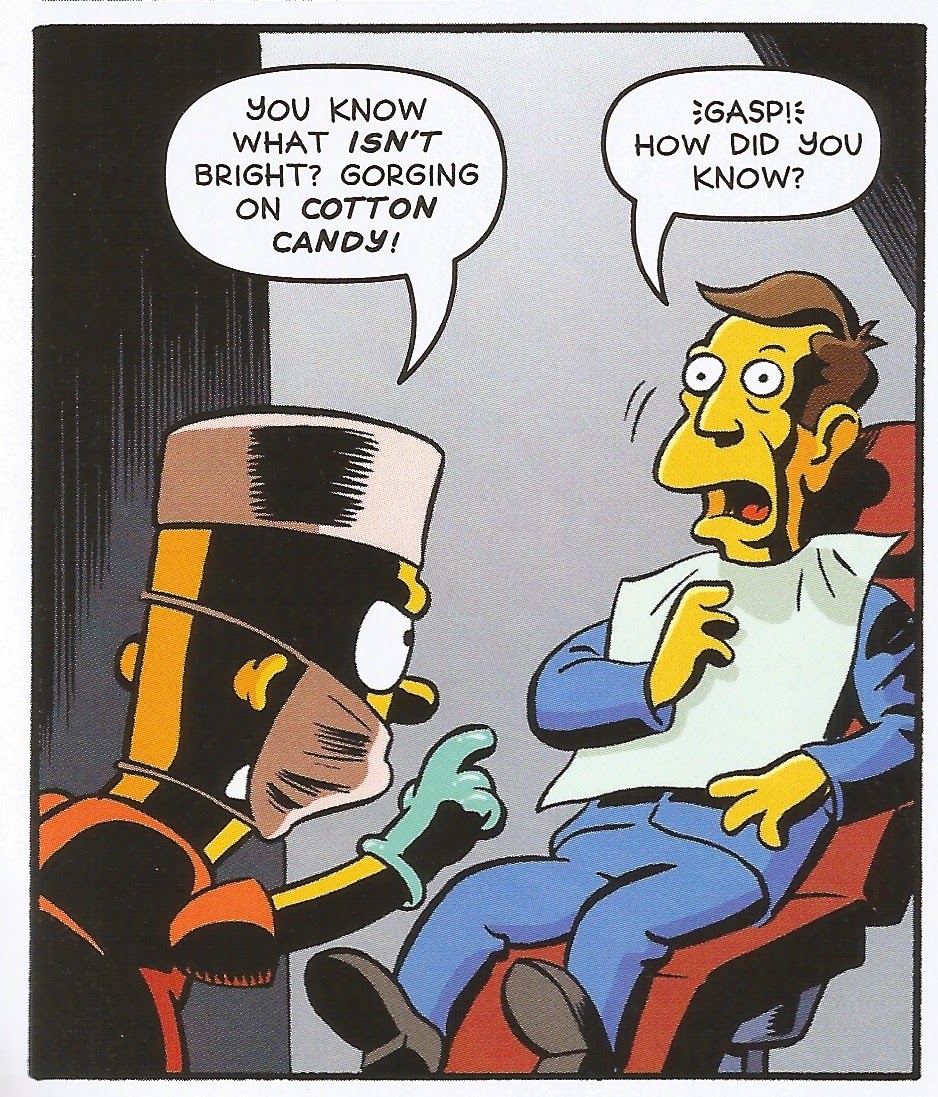

The scenario benefits from Hillary Barta's over the top shadows turning the moment into a cross between Nostferatu and Marathon Man.


The beauty of the tale is that Skinner knows exactly what happened to him.  Of course, he wouldn't think that he's a vampire, but that doesn't stop writer Ian Boothby from exploiting the general stupidity of Springfield society and the elementary roster's darkest fears.

When Bart realizes his prank has run its course, he saves Skinner by way of shifting vampire paradigms.  Best of all, Bart uses the items on hand, which just goes to emphasize the juvenile appeal of the new so-called creatures of the night.

Monday, March 17, 2014

POBB: March 12, 2014

Pick of the Brown Bag
March 12, 2014
by
Ray Tate

Welcome to the Pick of the Brown Bag.  Here I review the most entertaining and the least entertaining comic books.  It's a remarkably short stack this week with Batman, Captain Marvel, The Fox, Secret Avengers, Smallville and Kickstarter phenomenon Veronica Mars.


This issue of The Fox was pretty amazing.  To catch you up...


Lately Fox's magnetism manifested into a trip into a dream realm where he met other Crusaders and the Diamond Queen.  He also uncovered the Big Bad of the whole affair, the Druid.  The Fox believed he saw the last of the Druid, but it turns out that dispelling the beast from the Diamond Queen's lands, so to speak, just made him more powerful.

The Druid infiltrated World War II to find a pivot point where he could turn history to his advantage.  Enter the Fox, who teams up with the Shield and his Axis counterparts in a very uplifting way to ultimately defeat the Druid.  I guess I should have prefaced that with a spoiler, but the means by which the Fox and his friends win is unique.  Kudos to writer/artist Dean Haspiel.


Batman confronts Doctor Death on the Riddler's platform high above Gotham City, which is being bombarded by Hurricane Rene; possibly an homage to Renee Montoya, introduced in Batman: The Animated Series and quickly absorbed into DC mythology proper.


As Batman contends against the lunatic, Jim Gordon faces the Riddler himself.

When I read comic books, usually I absorb the artwork subliminally.  It's a trick of the brain similar to how you can hear the words to unfamiliar songs when you see the lyrics written out, or when you read the subtitles of a foreign language movie without losing the visual narrative.  The faculties tend to blend together, and you forget what you're doing.  You just start doing it.  The human brain is the best computer on the planet.  

Because of the disturbing design of Dr. Death, I found it difficult to merge Scott Snyder's prose and Gregg Capullo's artwork.  

I read the story without looking at the art involving Dr. Death, or I studied the drawings while not reading the words.  This is the first time such a thing happened.  So, congratulations are in order.  Dr. Death's body horror is so repulsive that it has a physical consequence.  In addition to this surprising effect, there's a lot of other good material to read and view in this chapter of Batman.


Snyder opens the story with a flashback to Bruce's past.  Snyder and Capullo have done more to turn Thomas and Martha Wayne into actual characters rather than mere stepping stones in Batman's origin than any other creative team.  Just look at Thomas' gesture as he contemplates a means to ingrain the importance of Zorro to his son.  That gesture is greater detail than anybody ever lent to Thomas.  Before this instance Martha had this to say in the conversation. 

That little laugh of Martha's speaks volumes.  She's had this talk before with her husband, and she takes pleasure in her child mirroring her own thoughts on the subject.  This is the secret of Snyder's and Capullo's success.  They built on the Batman mythology rather than tore it down.  First it was the Court of the Owls, easily the most innovative notion in Batman comics for years.  Next, they killed the Joker after making him worse than ever before, descending into an abyss like most disorganized serial killers do before they self-destruct.  In the Zero Year Snyder and Capullo reconstruct Batman's origin with a greater attention to the characters that always took part.  

By turning Thomas and Martha into living, breathing figures, Snyder makes the blow struck against this family all the more tragic.  This is especially true when Martha dies.  Martha doesn't die because she wouldn't give up her pearls.  She doesn't die from a heart attack.  She dies as she exhibits concern for her family, and she faces Bruce in a terrible moment that would have haunted anybody, turned anyone into a Batman dedicated to destroying crime.


Bruce didn't become Batman because his parents were killed.  Bruce became Batman because he saw his parents murdered.  

Snyder really should have ended Batman at the point where  Bruce witnesses Martha's death because it's the most powerful moment in the book and hands down one of the most powerful depicted moments in Batman history of all time.  The few panels that flash forward to the past present and the final splash page where young Bruce cries for help really undermine the impetus of this gut-punching imagery.

Although Batman is indeed very much about the murder of the Waynes, the plot set in Zero Year establishes Batman as a force of symbolism.  He unveils a new item in his arsenal that stuns Gotham City and lets them know he's out there.
  

This is a Batman that does not want to be an urban legend.  He is in your face.  As you can see, Snyder and Capullo are very specific when lining up those focusing on Batman's presence.  Some will probably complain about seeing Harper and her brother, but Snyder balances out the old with the new--a theme in Zero Year.  

Babs Gordon once again falls under the shadow of the bat.  While it's clear that Snyder likes Babs, I also think he chose the right member of the Batman Family to represent tradition.  She's the Commissioner's daughter, and she provides the link between Jim Gordon and Batman.  Harper is the the path to the future present of Batman.  So she belongs in the story as well.  Yes, I would have still preferred her to be just the DC version of the Girl With the Dragon Tattoo, but that's done now, and I accept the facts as they work in the story.

The battle between Batman and Dr. Death as well as the orchestrations offer a lot of excitement and daring-do.  It's at once Zorro and The Shadow all wrapped up into the package of one boy's hatred of crime and his vow to avenge the murder of his parents.  I wished it had ended with a win.


Batman's defeat or pyrrhic victory may play better in the trade but here it just seems to exacerbate the story and rob the reader of a satisfying conclusion.  I also object to the Riddler being this smart so early.  I can buy his contingency plan against Gordon, but a second disaster planned for Gotham City seems a little too much, too soon.  Never the less Batman's still a riveting read.


The Crisis of Infinite Earths nests in this week's Smallville, and Batman finds himself face to face with his disturbing doppelganger.  Writer Bryan Q. Miller takes steps to ensure that this Crisis is as memorable as the last, and not just an inconsequential Zero Hour or Infinite version.


Believe it or not, that's Bruce Wayne, and it's not a Jokerized Bruce Wayne.  He was nuts to begin with.  Evil Bruce murdered his parents, just like Owlman did in Forever Evil.  Only, he's a dark single, and not reflective of an entire twisted earth.  


Batman's double confirms his suspicions.  The Joker-Bat killed Clark Kent and left him lying in a Gotham City alley for Batman to find.  This version of Clark Kent was human but still wore the cape and shield of Superman.  Batman's mirror image knew that he would deduce the truth and track the killer down.  An exciting battle ensues, and artist Edgar Salazar orchestrates exquisite fight choreography worthy of two Batmen.  The duel bleeds out to the Batman Family of Smallville.


Nightwing (Babs Gordon) strikes with extreme efficiency, and you can tell from the ferocity of the attack that she's not playing around.  Neither unfortunately for her is the visitor from the parallel earth.  However, the moment the Joker-Bat states that he killed the other Barbara who was confined in a wheelchair.  You know things will play out differently here.  Miller already introduced Batman's super-science in a previous issue.  Never the less, the climax of the battle is still a terrible moment.  However, if Smallville were as dark as the universe from whence the counterparts came, what would be the point?  No sacrifice is needed.  No sacrifice is made.  As dark as things get in Smallville, Clark's optimistic effect on others always slants the outcomes to the positive.

Miller doesn't open Smallville with Batman.  Instead, he teases with the recapitulation of the premiere.  Instead of Clark leaping into the water to save Lex Luthor, it's Lex who attempts to save Clark Kent.  The moment is full of interest. This is not the action of a villain.  Lex instinctively attempts to save his former friend, and it demonstrates that Lex hasn't been completely corroded.  


Miller finds a clever means to secure Clark's identity, and through this twist, he also creates an instance of epiphany.  Lex is intelligent enough to know that his hatred of Superman isn't rational.  He knows that Superman is exactly what he says he is.  His loathing of the Man of Steel is inexplicable.


Superman repays Lex for the save, and Miller and Salazar do not disappoint.  The Monitor who designated this version of Superman inferior, among all the others of the infinite worlds, gets his ass handed to him, and it's a satisfying comeuppance demonstrating the gamut of Superman's power.  

As you can see Superman plies his strength against the Monitor in a toe to toe duel.  For an encore, he displays his invulnerability and force of will in an attack against the Monitor's ship and bathes in the monstrous energies that do not play by the rules of our physics.  Actually can hurt him. This won't stop Superman.


When Superman defeats the Monitor, Miller concludes the story with two enjoyable epilogues.  In the first, Clark visits Lex at the hospital, and they're discussion parallels some of the dialogue from past episodes of Smallville where Clark tries to pull Lex away from the dark side of his nature.  Lex may be learning from a past unknown to him.  One thing's for certain, he won't be repeating his mistakes, and he might even end up being more beneficent in the end.


In the second epilogue Batman takes off his blinders and joins the Justice League.  Salazar and Miller give us the moment we so wanted to see in Smallville, the fruition of the World's Finest team.  Finally, just when you think Miller and Salazar are done wowing you, they include a Prince in the finale of the mix.  If you haven't been reading Smallville, you've been missing out on the most consistently entertaining stories pertaining to DC's multiverse.


Secret Avengers restarts with a comedic story that has one foot in the Marvel movie/television world and one foot in the comics.  The easier it is to understand; the chances are that it's aimed at the audience that doesn't read comic books.  


For example, the earthbound action in which Black Widow and Jessica Drew enjoy a massage, ice cream and target practice is pure stripped down movie narrative bliss.  Few laypeople know Spider-Woman.  Those that do likely watched her cartoon.


Spider-Woman doesn't define herself in the story until she lets loose a venom blast.  Jessica unleashes her trademark bio-weapon at classic villainous organization A.I.M., also unlikely known to the average person just sampling comic books.  Their fashion choice of course speaks for itself.


The chaps seek to kill Hawkeye, known to everybody who saw The Avengers.  In other words everybody.  So far so good.  We have Natasha, from The Avengers, hanging out with a friend who knows ordinance.  Hawkeye, also from the movie, shows up.  He's running from homicidal beekeepers. At this point, you can really just go with this comic book.  You don't need to know the intricacies of Marvel continuity.  Kot however just can't help himself.


The narration sets up stumbling blocks.  I appreciate Kot's attempts to make the exposition bouncy, but he would have been better off not including it all.  The mention that Black Widow and Spider-Woman are Hawkeye's ex-girlfriends isn't necessary.  I've only just recently dipped back into Marvel.  I didn't know Hawkeye dated Spider-Woman, and I didn't need to know.  I am aware that originally Black Widow was a KGB agent that seduced Hawkeye into battling Iron Man, but that's silly.  That couldn't have happened in a contemporary Marvel timeline, despite Marvel's claims otherwise.  I was content to simply adhere to the movie, which makes more sense anyway.

I would have enjoyed Secret Avengers more had I not read Kot's narration.  Kot explains the two versions of Nick Fury, "Get over it."  A person however who only watched films and television would become confused by this inclusion.  Nick Fury has always been black, hasn't he?  None of this would be an issue if Marvel cleaned out the cobwebs once and awhile like DC.  Can't we just accept that Nick Fury classic was white and Nick Fury modern is black?  No duplicate needed?

Despite the narration, there's a lot of hilarity and action that atones for the sins of continuity.  Secret Avengers exhibits a mature tone.  It's crazy violent and sexy.  


Artists Matthew Walsh and colorist Matt Wilson anticipating censorship employ some genuine artistic license and embrace the absurdity of nudiphobes.  They even use the old look Spider-Woman to block the offending booby.  If you're concerned that this is sexist.  Rest assured. Hawkeye's man-parts get a Hawkeye.  Yet for some reason, it's absolutely okay to blow a hole in somebody's hand and snap another person's neck.


It's very easy to recommend Secret Avengers on the Avengers part alone, but when you throw in the secret element, presumably represented by SHIELD, things go screwy.  Nick Fury, Phil Coulson and Maria Hill sound little like Samuel L. Jackson, Clark Gregg or Cobie Smulders, and since when did MODOK join the party ala' Project Paperclip?   Secret Avengers is worth watching, but not yet putting on the subscription list.


I was a pretty big fan of Ms. Marvel.  I liked the character.  I liked the multiple-personality angle, which reminded me of Rose and Thorn.  I liked her when Carol Danvers and Ms. Marvel finally merged and when she changed her costume to black and became an Avenger.  I enjoyed her as well as Binary.  

Brian Reed's Ms. Marvel let me down, and she became thoroughly mishandled during the Civil War.  Kelly Sue DeConnick took over and promoted her to Captain, a righteous advancement long overdue, but her debut with Spider-Man just didn't do it for me, and I wouldn't have paid DeConnick's version any more attention had not a friend recommended the latest story arc.  The arc involving a cancerous lesion that wasn't probably would have irritated me had I read it in comic book form, but as a trade, it was good.  Everything about it was good.  The problem for me I think is not impatience, but experience.  I've ridden out things before only to be burned, robbed of time and coin.  So, I tend to go into comic books now with a short fuse.  Let me just say that Captain Marvel is the exception proving the world.  I can name a helluva lot of titles that I dropped and endured with no payoffs.

I decided to give DeConnick's Captain Marvel a try in comic book form first.  This series looks a little more conducive to chapter play.  The short of the story is that Captain Marvel sacrificed her memory to save New York and maybe the world.  So she doesn't know who she is or her past except as an interested party, which is kind of good.  Ms. Marvel during the Civil War did a lot of lousy things to good people. So the less of that stain the better.  A grateful New York gave her the lease to the Statue of Liberty.  I love this idea of Carol having a home in the crown of Lady Liberty.  It reminds me of Mighty Mouse's home in the clouds.


Captain Marvel is an Avenger, and trusted by all.  She's a real superhero, a champion of the people, not a vigilante or a  jingoistic soldier--as she was during the Civil War.  On a mission, Carol encounters a third kind.


Iron Man stops by for a visit, and this is again another moment of a comic book trying to tap into the better's zeitgeist.  DeConnick mimics Robert Downey Jr.'s Iron Man, and that is a good thing.  A very good thing.


The conversation above doesn't go exactly how Captain Marvel anticipates.  DeConnick captures Downey's snarky portrayal of Iron man to enhance the comedy.  The timing is just perfect, and it also opens up another door into Ms. Marvel's life.  DeConnick involves Captain Marvel with another Avenger, and it makes perfect sense.   Same backgrounds.  Mutual friends.  Brilliant.


Carol's new beau will have to wait a little longer for her return since the framing sequence takes us to the present where Carol finds herself in Marvel space for all sorts of rogue action, pun not intended.


Artist David Lopez was another draw for me to DeConnick's latest volume of Captain Marvel.  I first encountered Lopez's artwork on the lamented Hawkeye & Mockingbird.  His anatomic artwork is just so damn juicy.  The realistic, energetic body language, the understated expression all just leads to a remarkable experience.  Am I in? Yeah.  I'm in.

Sunday Night at the Movies

"A long time ago, we used to be friends..."


Full disclosure.  I'm a backer of Veronica Mars.  I was so happy with this film.  Veronica Mars celebrates the past without wallowing in it like a cheesy reunion television movie.  Instead, the story posits a new mystery for Veronica to solve as she comes at a crossroads in her life.  Does she take the expected course, or does she take the rockier path to happiness?  

The script is as brilliant as anything from the television series.  Maybe even more so.  Kristen Bell easily assumes the skin of her alter-ego.  Jason Dohring's Logan brings a lot of surprises, and the kids are all right with Mac and Wallace, Tina Majorino and Taylor Diggs respectively.  Frank "Weevil" Capra, Ryan "Dick Casablancas" Hansen stylishly return with Enrico Colantoni, Keith Mars.  

New faces blend in perfectly with the old cast, and there are moments for every fan of the series.  For me it was Veronica's brief encounter with Principal Clemmons; there's always that one secret person that roots for you to succeed no matter how you choose that success.  A seamless narrative, terrific acting and one hilarious guest appearance waits for anybody who just wants to see what all the fuss is about.  Veronica Mars is available everywhere on download, and if you're lucky in a theater near you.  Check it out.