Pick of the Brown Bag
February 4, 2015
By
Ray Tate
This week's a comicopia of goodness. I'll review Angel and Faith, Cluster, Django and Zorro, Hellboy and BPRD, Imperium, Jungle Jim, Red Sonja: Vulture's Circle, Shaft, Squirrel Girl and Swamp Thing but first two Vampirella books, her usual title and her new Legendary mini-series.

The story begins with a lousy passenger on an inbound flight to Athens. Sure, he was an asshole, but he didn't deserve this.

As you can see the Faustus formula that three immortals hope to use to destroy humanity is back in play, and it's up to Vampirella and the Kabal to stop the latest New Coke taste-tester. Medea.

The battles between Medea and Vampirella offer blood and action courtesy of Patrick Berkenkotter. Author Nancy Collins exploits myth and madness to characterize the villainess of the piece. That same attention to mythology explains how Vampirella and Ms. Evily can hope to combat an arch witch with so many years under her girdle. In short, it's an every day, entertaining issue of Vampirella smartly written and nicely drawn with an impressive interpretation of a classic monster.

Vampirella Legendary brings Vampirella back to the Steampunk world created by Bill Willingham. Although Willingham has since cashed his check and moved along. All right. All right. He’s a busy guy on Fables. So maybe he didn’t have the time to extend to Steampunk Dynamite. Fair Enough. Anyway, writer David Avallone ably substitutes.
The Legendary mini takes place after the immediate victory of the Steampunk heroes over the forces of a dark cabal of enemies. Not to be confused with the pragmatically inadvertently heroic Kabal with a K.
Vampirella in this universe is really just a business woman with a night club. Essentially, she’s Rick Blaine…

…and we got to see the sequel to Casablanca where Rick drains the bad guys of blood and rips off various limbs.
Somebody with links to the cabal decides to shut down Vee's club. She’s not happy.

This simple plot of persecution allows for a roomy display of Vampirella’s many supernatural powers, even more so than she displays in her regular title. Sorry, Ms. Collins.
These embellishments are courtesy of artists David Cabera and Robby Bevard, who produces a very evocative shade of blue for Vampirella’s eyes.

The entire creative team demonstrate Vampirella’s dangerous strength, extraordinary speed and deadly cunning. The examples come in the form of astounding violence, matching the mayhem in the original Legendary series, and far too good to spoil here.

An extremely quiet issue of Angel and Faith pays off with the theme of reunions, and it doesn’t matter that some of these characters were only introduced in the comic book. Writer Victor Gischler dollops these figures out rather than slams you with them like Christopher Gage did in Buffy the Vampire Slayer. He also bothers to characterize the for all intent and purpose new players and ties everything together.
The happy tidings begin with Angel and Fred, portrayed by Amy Acker on the television series. Ms. Acker has been in everything, starting with Alias and so far ending with Person of Interest.

It’s nice to see Gischler pick up the thread of Fred’s unusual history on Angel, summarized neatly and dead-on accurate by artist Will Conrad.

Following, Faith returns to London where she’s met by Giles’ aunts, introduced in the comic book.

 I gave up on Buffy the Vampire Slayer and its sister titles upon the end of “Twilight,” which pissed me off something fierce. So I was only aware of the aunts via a friend filling in details during his attempts to lure me back to the fold. Gischler and Conrad give the ladies personalities. They resonate. So I didn’t mind when they interacted with Faith. The same goes for the mysterious Nadira and Inspector Brandt.
The interconnections of all the characters reads and looks seamless. The tiny cohesions foreshadow the essence of the title.

Whedon didn’t just throw Angel and Faith together for this comic book series. They have a canonical history. Angel sponsored Faith’s redemption, which she began when she switched bodies with Buffy and slept with Riley Finn. So this is big, and the moment’s given proper respect.

Normally, I can't review Hellboy because I'm either spoiling something or nothing happens. By nothing, I mean Mignola creates a sense of dread or foreshadows with these implacable panels of stillness. This week's Hellboy and BPRD is a different animal. Lots happens, and it's all pretty good.
First a traitor in the ranks attempts to dispose of Hellboy. We know this can't happen since this is the past and the future of Hellboy is dark and foretold, but then Mignola does this.

This is the most hopeful outcome I've seen in Mignola's cosmos. He's been predicting Hellboy being the harbinger of doom for the earth forever now, but it looks like the future's not shady after all. I also like that he could have been eaten by Papa Crocodile or whatever that fellow is on his first mission. It's got that quirky sense of humor I expect from Mignola.
Archie of the BPRD, and the only member who actually likes Hellboy intends to go find his charge, but the BPRD find themselves otherwise occupied with some awesome monsters and some psychic tomfoolery.

Shaft writer David Walker continues to inveigle the reader with a potent, rich portrait of John Shaft and the seedy grindhouse times he lived in; without the kitsch that reflective works usually pin to the late sixties and early seventies.

Walker produces a story sporting dialogue that could easily be spliced together to form one damn, fine trailer for a new Shaft movie. He hits all the right touchstones. The police bring Shaft in for questioning.

We get two different opinions on the man.

Note the "ticking time bomb" comment. The comment's ubiquitous in action hero trailers from the 1960s to the 1990s, but none better live up to the description than John Shaft. Artist Bilquis Evely conveys Shaft's underlying rage. This imagery and terse dialogue however do not comprise the lyrics in the song.

Walker replicates the feeling of the surreal often accompanying the otherwise realistic period settings of action films prevalent in the seventies.

He also asks other questions that figure into the main plot and draw in the suspects to vicious murder while directing the violence and callousness that often frame the world of Shaft.
Those looking for an absurdity in the vein of Black Dynamite, which I enjoyed for entirely different reasons, will be disappointed. Shaft is a serious endeavor that's an excellent detective series in graphic novel format.

Django and Don Diego De La Vega make their way to Arizona to meet the distasteful, self-appointed Archduke of the same. He's thrown a party and invited a rogue's gallery of wealth as his guests. The florid Don Diego prowls among them and ingratiates himself by being completely insufferable to a host looking for temporary parasites.

 Such is the Archduke's contempt for those he deems lower class that he forbids the use of Spanish in his household and presence. This naturally gives Diego the opportunity to orchestrate his contempt while still maintaining his foppish facade. Translation at the bottom of the post.
Meanwhile Django shares the stables with Bernardo, and he begins to develop his opinion of Don Diego farther, but even he cannot imagine the august personage that he finds himself accompanying.
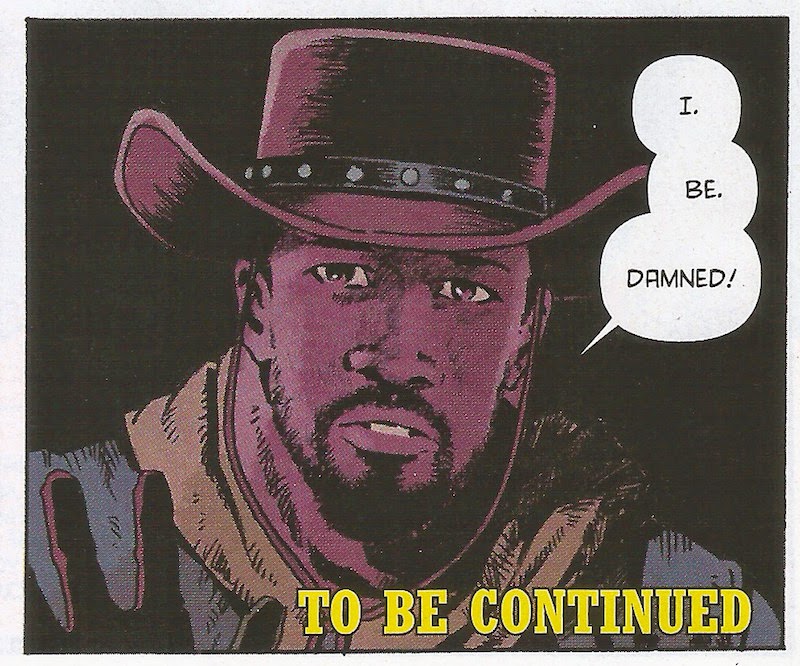
Let me put it simply. It's Zorro. The original Zorro. With Django, written by Quentin Tarantino and Matt Wagner with good artwork by Esteve Polls. I can't even begin to imagine a reason why you wouldn't be buying this.

After capturing a pervert wizard whose clumsy attempts to get laid only earn him pain, Red Sonja and her pupils prepare for a war against Sutekh, and along the way, we learn about the man Sonja finally let into her bed.

Dialogue and sisterhood are at an all time high in Nancy Collins' Vulture's Circle, and she constantly reminds the reader why Sonja retired through subtle creaks and throbs of old wounds. These narrative devices interweave through an exciting story that foments a Big Bad worthy of Sonja's steel.

Jungle Jim was a comic strip co-created by Don Moore. The title character was basically the epitome of the great white hunter. There was very little special about him and probably would have disappeared from pop culture's collective consciousness if not for progenitor Alex Raymond's remarkable artwork. Jungle Jim managed to trek into a series of lousy movies with Tarzan star Johnny Weissmuller in the title role. These films also managed to artificially extend the life of an ultimately generic figure.
Unlike Tarzan who has been reiterated and recapitulated many times, this is the first anybody tried to revamp Jungle Jim. Fan-favorite writer Paul Tobin manages to do this stylishly and elegantly by authoring a new character with co-creator Sandy Jarrell and just calling him Jungle Jim.
Okay. There are tiny shreds of similarity between the different versions of Jungle Jim. Both appear to be earthlings. Both live in jungles. Both ostensibly combat evil forces. Other than that...

Artistic License but In Definition Pretty Accurate
Tobin sets Jungle Jim on Arboria, Prince Barin's planet in the Ming Empire. The tale takes place in the future with respect to Jeff Parker's Flash Gordon series. Some time has passed since Flash visited, disrupted the Beast Men program and thumbed his nose at Ming the Merciless.
An underground formed, Flash's Beast Men comrades have taken on several missions and there's more collusion between the planets. One of Vulko's hawkmen for instance gets a good mention later in the story. Enough time has also passed that the legendary actions of Jungle Jim has largely supplanted the actual moment when Flash rebelled against Ming.
Tobin kicks off the story with another homage to the original source material. Jungle Jim's dragon lady Lille DeVrille becomes an Arborian in need.

The Beast Men take up the cause and behind the very friendly artwork by Jarrell lies some adult, dramatic material. Lille considers knocking boots with Rhino Man Kungor, who has his sights on somebody else.

Lille's always in a state of perpetual drunkenness to keep her numb to the memories of torture she endured as Ming's prisoner. Furthermore, Jungle Jim is killing Ming's forces, not taking prisoners.
I'll admit to a having low expectations for this one, but Tobin surprised me. The artwork delighted me, and the connections to Flash Gordon make Jungle Jim a good companion work.

Cluster also takes place in the future. Humans have gone to the stars and possess the technology terraform planets. They are not alone, but this isn’t Star Trek or Close Encounters of the Third Kind. Cluster mashes Starship Troopers with the atmosphere of Escape from Alcatraz. Just for good measure Ed Brisson throws a ticking clock from 24.

Although it may seem like I’m saying Cluster is derivative. That’s far from my meaning. The aliens the prisoners have been tasked to fight are nothing like the insects from Starship Troopers, and Cluster bears none of the camp. The updated prison setting imbues grittiness without going to far, and the clock provides the motivation necessary for the prisoners to act for the benefit of the common good, which may not be that good any way.

While Slarreg may deserve incarceration, the other crimes, if we take these prisoners at their word, seem to be trumped up to provide the necessary cannon fodder to take on alien competitors.
Even if you’re not a fan of the prison genre, Damien Couceiro and Michael Garland create gorgeous alien landscapes and inventive looking monsters to draw your attention into the story. Cluster is ultimately because of them a lot of fun because this could have been an unbearable and unreadable Dystopia.
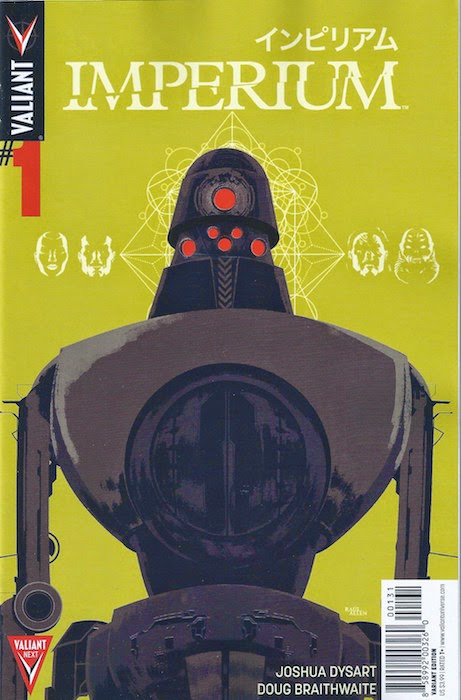
Imperium by Joshua Dysart is incredibly dark. It’s so dark that you subconsciously ignore Doug Braithwaite’s artwork, which on the surface gorgeous, whips out a sting of a scorpion tale.
As you read the words and follow the story, you realize that this Utopian world is a sham, and there’s something far more sinister going on. That dread affects the Valiant Universe of modern times.
Imperium is compelling reading even if you’re not familiar with the characters or the setting. This is super villainy at its most malevolent.

Charles Soule’s Swamp Thing combines many forces from Swamp Thing’s past to stop Lady Weeds from destroying the Kingdoms. Really, all you need to know is this.

John Constantine and Abigail Arcane do not know each other and have never met, which once again distinguishes the new 52 from previous continuities, and there’s a different kind of weird anatomy lesson in Swamp Thing that once again, you won’t be able to unsee.

Last but not least, Squirrel Girl prepares to meet Galactus. The whole book is a hilarious, not to mention thrilling attempt to steal a suit of Iron Man armor that will propel Doreen into space. Believe it or not, the history between Squirrel Girl and Iron Man is absolutely true.

That’s the lovely thing about the Marvel Universe. As dark and as stupid as it got because of Civil War and whatever the hell the X-Men were up to, there were still these ultimately silly comic book stories hidden in anthologies and back ups that count just as much as say Ultron’s umpteenth invasion of the earth.

DC never had that because they kept rebooting their cosmology. That’s not to say that DC was wrong to do that. The new 52 is a brilliant gem, but there’s something to say about Marvel’s six-year-sliding scale model, if it keeps the moment when Iron Man and Squirrel Girl teamed up to take on Doctor Doom.
Nobody Expects the Spanish Inquisition!
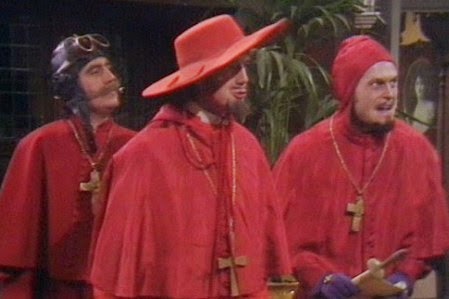
Translation: Spanish is life! It is love! It is as beautiful as an orange blossom and as sweet as the flush of a cheek. It can roar like the ocean or whisper like a butterfly's wings. It is like a song. No! It's like a concert! A symphony! This language must be free as a stallion roaming on the plains.


