Pick of the Brown Bag
March 4, 2015
by
Ray Tate
Welcome to the Pick of the Brown Bag. In this column, I review the best and the worst from the comic book racks. This week I'll review Altered States: Vampirella, Angel and Faith, Hellboy and the BPRD, Holy F*ck, Scooby-Doo Team-Up, Star Trek and the Planet of the Apes and Swamp Thing. I'll also have a few words to say about Hawkeye and Harley Quinn. However, we open this week with the return of Jessica Drew as Spider-Woman.

Spider-Woman began life in Marvel Two-In-One as a HYDRA agent. Ben Grimm was the first to see something heroic in her. He judged her to be a mixed up kid. She was more mixed up than he could imagine.
The child of two scientists, Jessica had the misfortune of living atop a cache of radioactive elements. The exposure sickened Jessica to the point of death. Jessica’s father attempted to cheat the Reaper and save his daughter through experimental means.

The antidote wasn’t all that it was cracked up to be. So the man that would become the High Evolutionary placed young Jessica in suspended animation. Because of Captain America, suspended animation is one of Marvel’s staple plot devices. It’s rarely used at DC.
The High Evolutionary eventually perfected the cure and removed Jessica from her capsule years later.

Jessica felt ostracized from humans and denizens of Wundagore alike. Her alienation primed Jessica for a role in her mother's organization HYDRA. Jess' mother we learn in the waning issues of Spider-Woman became Madame Viper. At least in this scene, you can almost see the credibility in the strange turn of events.

She even kind of looks like Madame Viper.
Slowly, Jessica emerged from her shell. She discovered her isolation was in part a side-effect of her abilities. Her pheromones either made people love her or hate her. In group therapy, she met her first true friend Lindsay McCabe. Jess later joined forces with a disabled criminal researcher. They became formidable bounty hunters. A few years later, after Jess and Scotty split up, she became a genuine super-hero and saved Carol Danvers' life after Carol had been drained of energy by Rogue. Through law enforcement contacts including Nick Fury, Jessica gained her private investigator's license.
More than any other Marvel character, Spider-Woman's history was one of becoming her potential. That ended when old enemy Morgana Le Fey slapped her in a magical coma and catalyzed the loss of her powers.

Spider-Woman was once a favorite Marvel character. Next to Tigra, I liked nobody in the Marvel Universe better. After the reduction in stature, subsequent Marvel writers curtailed Jessica Drew's prevalence. A few bucked the trend and gave me a nice little bonus.

Spider-Woman first encountered Tigra in Spider-Woman #49. This moment in the debut of West Coast Avengers however was better since it established a series of missing Tigra stories in which Tigra acts as an operative for Jessica Drew Investigations.
Lots of idiocy happened in the interim tween now and then. Jessica's newest writer Dennis Hopeless touches upon these events in quick snatches of dialogue and dismisses them just as rapidly. Hopeless essentially goes back to basics, though with snappy and practical new duds designed by artist Javier Rodriguez.
The new outfit and the motorcycle riding draw similarities to Batgirl, but Jessica Drew comes by it honestly. The truth of the matter is that Batgirl is a remarkably influential touchstone in pop culture, especially when concerning Marvel's street-level female super-heroes. The analogizing in Jessica's case is mostly the consequence of the character's evolution. The motorcycle riding for instance was established long, long ago. Jessica Drew's history however different spy-bounty hunter-private investigator results in Batgirl's always a detective, and the characters foster the same kind of independence from their namesakes. However, Jessica, unlike say Silk, is not and never has been a carbon copy of Batgirl, and this issue distinguishes them further.

Though Jessica closed shop, she's still plying her trade. Persistent stalwart Daily Bugle reporter Ben Urich uncovered a story and a crime that nobody seems to believe, including Jessica Drew.

That changes after she encounters the Porcupine, a classic baddie from Pym past.

Spider-Woman has a very Rockford Files feel. Jessica claims no longer to be a licensed private investigator, but like Jim Rockford, she's helping the truly helpless.

Although never planned, Rockford seldom got paid by his clients. He ended up truly embodying the idea of a paladin. Spider-Woman isn't even seeking a fee.
Although never planned, Rockford seldom got paid by his clients. He ended up truly embodying the idea of a paladin. Spider-Woman isn't even seeking a fee.

Needless to say, I'm liking this treatment of Jessica Drew a lot. The personality Hopeless develops for Jessica rings true of the old Jess, a sort of hard-boiled character that nevertheless hasn't truly mastered cynicism or opportunism, and she's much more attractive in the new costume than the old. I mean that in an aesthetic sense of course.

A starship from earth crash lands on the planet Drakulon and deposits Lt. Ella Nomandy into the wastelands. There she encounters two species, the humanoids and their bat like predators.
The kick off to the Altered States what-if series isn’t necessary, but it’s not without interest. Series writer Nancy Collins comes up with a helluva twist that keeps the story invigorated, provides a lot of material for old and new comparisons…

…and in general gives impetus to the action in the plot. At the heart of the story is Collins’ take on Vampirella. Collins has never attempted to present Vampirella other than as tradition demands. Vampirella has the distinction of being the first truly altruistic vampire in literature. This is even more evident in her actions on the behalf of the Drakulon people that intended to kill her.
Putting aside Collins’ typically extraordinary writing, artist Francesco Manna illustrates Vee with rare dignity.

This scene could have been the wet dream of a sexploitation fiend, but instead Manna just acknowledges physics and refuses to draw anything but precision anatomy.

Angel and Faith try to help Fred and a comic book creation an alien demon at Nadira's haven. However, their well wishes just may be impossible to grant.

The demon is named Koh, and this is his story, which logically should clue the reader to run the other way or skip the story until Angel and Faith once more focuses on the stars. However, writer Victor Gischler compels you to read the tale of a third tier tangentially involved figure. Let me correct myself. It’s not all on Gischler. Some of the blame for the enticement lies with Will Conrad and Michelle Madsen.

Holy crap.

Sent to Argentina on his first mission, Hellboy and the BPRD find at first that the monster of the piece is more of a scarecrow than a demon. However, behind the monkey's mask lies an insidious foe that Hellboy fans will be delighted to encounter. Hint. It's not Rasputin.

This issue of Hellboy skyrockets into areas you didn’t expect, and Hellboy learns his lessons quickly. So this isn’t exactly a primer.

 Infused with a sense of quirkiness, Mignola seems to relish the opportunity to write Hellboy again. The contagious thrill turns the simple monster hunt into an insane man’s attempt to justify his mad science over the crazy supernatural.
You cannot help but laugh out loud when this treatise on whose madness is the most cogent rolls to the cliffhanger where just as nutty fruitcakes deem the narrator “a lunatic.” A brilliant issue. Simply brilliant.

The second issue of Holy F*ck isn’t quite as funny as the premiere, but it’s still pretty damn funny. I’ve been laughing every time I see the cover. The thought of Jesus Christ being in love with Satan just tickles me in ways I can’t describe. Yes, I’m an atheist. Why do you ask?
Anyway. Holy F*ck has more than just yucks going for it. The story actually features some clever inventions and twists. For instance, writers Nick Marino and Daniel Arruda Massa have done their research.

Anansi is an African god of knowledge that habitually takes the form of a spider. Who better to spy on Satan? The gist of the plot makes more sense than the entirety of Prometheus.

There’s actually a reason why the magic mirror works.

All these factors contribute to Holy F*ck’s entertainment value which is considerably high, literally and figuratively. Even when not laughing, you'll be saying to yourself, "Hmmn, that's pretty interesting."

In a perfect Scooby-Doo Team-Up Perry White appears to conjure Great Caesar's Ghost, when he speaks his traditional oath.

Superman admits that he's not a ghost breaker, but he knows the perfect team to handle the exorcism. It turns out that an old Superman foe is behind the spectral visitation, and although the story is for laughs, his motive makes sense. Humiliation and money. It’s criminal genius at work, which fits with the motif of Superman’s traditional rogue’s gallery. You can’t out power Superman. You can however outwit him. It’s hard to do, but possible.
The haunting is only one part of the plan. The Superman nemesis anticipates his every action, depends on Superman’s ever true morality in order for the second part of his scheme to succeed. Best of all, he’s weighed the odds.
The surprise twist forces Lois Lane, Jimmy Olsen, Scooby and the Gang to adapt. Having already met Supergirl, they naturally figure she’s their best bet, but Supergirl must be on another life-saving mission. Instead, they get a welcome replacement.

Writer Sholly Fisch incorporates numerous bits of Superman mythology into artist Daniel Brizuela’s merger of the Ruby Spears Superman design and the Bruce Timm Animated Series world. This isn’t the only union.

This won't be quite so cut and dried as you expect, Kids.
Fisch and Brizuela blend Scooby-Doo and Superman lore into an extremely satisfying alchemy that produces solid gold. To reveal any more than that would divulge the sometimes comical, always adventurous mystery solving. Just go out and buy this. Essential for Scooby-Doo and Superman fans.

Writers Amanda Conner and Jimmy Palmiotti appear to be setting up their favorite clown Harley Quinn for 22 Brides. Harley for some reason has got a crime fighting jones going on. So, she decides to recruit back up via Poison Ivy’s computer mojo.
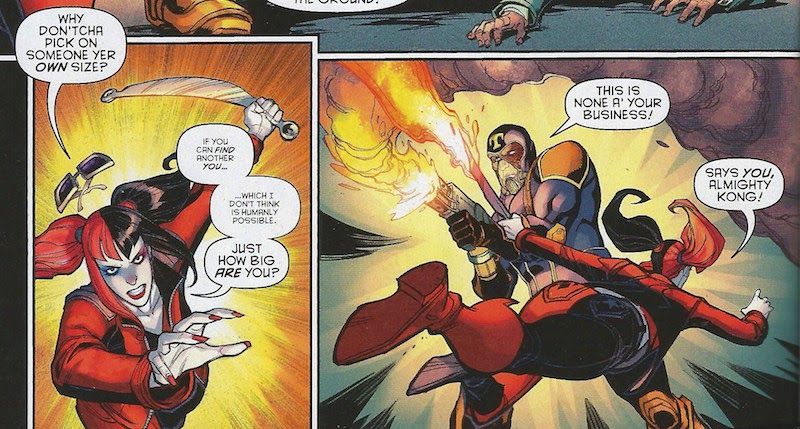
There’s a pretty funny and ever so sick battle pitting Harley against an arsonist. The thing is this is probably the most original treatment of arson and the firebugs that start blazes I’ve ever seen. Maybe it’s because I suffered through an astonishingly boring arson-based story on Hawaii-Five-O, but the conclusion of the arson antic in Harley Quinn really just makes you suddenly sober up in a big way.

The crime fighting, Harley’s benign law-abiding ways regarding animals, her bisexuality, which totally amazed some ace reporters that haven’t seen Batman: The Animated Series…

Ace Reporters. So cute.
…all kick Harley Quinn way, way out of continuity. In fact, you should regard this book as set in The Animated Series sometime after “Harley’s Holiday.” Or not. Because really, Harley Quinn maintains its own “flexible reality” like The Simpsons. The arson caper for example breaks a lot of physical laws as does Harley’s goofy method of insulating herself from the flames. So, just sit back, relax and enjoy.


Captain Kirk quickly observes Taylor’s absence from the Planet of the Apes. The away-team soon find an unconscious Chekov and add up the numbers.
Taylor intends to escape from the Planet of the Apes using Starfleet technology. It’s nice that he left Nova behind. Sorry, sweetie. We had a memorable moment. Call me.
Taylor’s actions lead to a nice bit of roughhousing, some comedy from Spock, and all done to the tune of Rachael Stott’s amazing artwork. She's got a twelfth Doctor tee shirt at Red Bubble that's to die for by the way.

Swamp Thing brings back the former Avatars from their slumber in order to fight the Machines and Arcane.
What follows is a mural in June Chung green of Jesus Saiz and Javier Pina imagery depicting an all out war among the elementals and the Machines.

Normally, when a story like this happens, art frequently overtakes the story, but Charles Soule comes up with some intriguing unexpectedness.

You may think. Oh, “The Day the Earth Stood Stupid” from Futurama or “Silence in the Library” from Doctor Who, but Soule ups his game for something truly remarkable and surprisingly thoughtful. I say surprising because the story is after all about a war, violence and monsters. A fantastic finish to the series.

SHIELD tasks Hawkeye and archer protege Kate Bishop to a Hydra base in order to sabotage new weaponry. I liked the banter between Hawkeye and Kate Bishop. I loved the artwork by Ramon Perez.

The story throwing the Hawkeyes at oodles and oodles of HYDRA agents is a lot of fun, but I didn’t care for the juxtaposition of the present and the past, where Hawkeye and his brother Barney as children catch frogs and avoid their abusive father. I don’t see how that pertains to the current story, nor do I see the point of its inclusion. This is especially true since writer Jeff Lemire juggles the points of view between Kate and Clint.
Had your substitute artist drawn Tigra thusly...
...instead of in the form of a crack-whore, maybe She-Hulk wouldn't have been canceled. Tiara is love. Don't screw up love.


